Category Archives: Education

Jadavpur University ties up with Intach over Writers’ restoration

Kolkata :

Jadavpur University has approached the Indian National Trust for Art and Cultural Heritage for expert guidance in the mammoth restoration project that it has undertaken over Writers’ Buildings – the 236 year old seat of the state secretariat. At the moment JU architects are conducting a detailed survey on the condition of the building, preparing a layout of how the restoration process would progress and interiors would be re-organized once the work is over.

Objections were reportedly raised by the West Bengal Heritage Commission over the state PWD department’s decision to hand over the responsibility of restoration to JU and IIEST (formerly Besu) jointly. The Commission felt that a building of the rare stature of Writers’ Buildings should be handled by an agency whose expertise lies in restoring heritage institutions. The Commission felt that the architecture departments of neither JU nor IIEST had the required experience. However, belying such doubts the state PWD has gone ahead with its decision and has not interrupted the ongoing survey work that is being conducted by JU at the premises.

Intach has not only been formally invited by JU, talks have also happened between the national level heritage conservation agency and the PWD authorities over ways in which Intach would bring in its expertise in overseeing the project right from the drawing and testing stage now and also later during the execution. Most departments of the state government shifted out of Writers’ Buildings last October with the state secretariat shifted to Nabanna, so that the heritage building at Dalhousie can be restored. However, execution is yet to happen and the delay has raised several eyebrows.

“We must remember that Writer’s is no ordinary building and execution of the plan cannot happen immediately. We are conducting a series of tests on the structural status of the different portions of the building and the strength of its foundation. Once execution starts cracks should not develop in the portions that are relatively weak. Again, the building as we see it today, was not built all together; portions were added with time. Naturally the health of the building will also be somewhat heterogeneous,” said Madhumita Roy, head of JU’s architecture department, who is leading the project. She feels that the project report on how execution should be ready for submission to the state government by November. Once the state government approves it, execution should start immediately.

Confirming that she has tagged Intach in the project, Roy said, “I have closely followed the work that Intach has done in restoring institutional heritage e.g. Gwalior Monument, Princep Ghat, St John’s Church and Lalgola correctional home. I think it will be able to guide us well both on the methodology and progress.”

Intach state convenor, GM Kapur said that the main problem with Writers’ restoration is lack of original drawings which could guide the restoration team. “I am sure that the original drawings would exist in what was then known as the India Office library, a part of the British Library. We will write to them to see if they exist and then organize for copies so that they can be consulted.”

PWD officials said that JU experts are conducting the survey and the condition of the building. “Suggestions are invited from any consultancy or architectural firms as to how the restoration work could take place. All the suggestions will be discussed with the heritage commission following which work order of the actual work will be issued,” said a PWD official. Earlier, the demolition work of the extended portions was supposed top start off from this month.

source: http://www.timesofindia.indiatimes.com / The Times of India / Home> City> Kolkata / by Jhimli Mukherjee Pandey, TNN / July 10th, 2014

University of Calcutta to confer a posthumous doctorate on Lithuanian traveller anthropologist Antanas Poska

Vilnius (Lithuania):

In a rare honour, the University of Calcutta has decided to confer a posthumous doctorate on one of the world’s greatest explorers – Lithuanian traveller anthropologist AntanasPoska.

In an exclusive interview to TOI, Lithuanian foreign minister Linas Linkevicius said that Poska – the man who undertook an incredible journey to India on a motor bike all the way from Vilnius in 1929 will be conferred the doctorate during the University’s next convocation ceremony around September.

Confirming this to TOI from Kolkata, the University vice chancellor Suranjan Das said Poska “symbolised an eastern European’s inquisitiveness about India” and was being conferred the doctorate “for his contribution in making India known to the outside world through his extensive writings”.

Das told TOI “Poska’s feat is unparalleled when it comes to popularising India in Europe. Poska also studied in the University of Calcutta. Developing a close relationship with Lithuania is a priority for the new Indian government and conferring the doctorate will help seal the friendship”.

Das said “We have formally confirmed the University’s plans to confer the doctorate on Poska. However, it has to be given by the governor of West Bengal who presides over our convocation. Since the earlier governor resigned recently and we are waiting for the chair to be filled, the date of the convocation is yet to be finalised. It could take place around September-October”.

Lithuania’s ambassador to India Laimonas Talat Kelpsa has plans to bring Poska’s daughter Laimute Kiseliene to Kolkata to receive the doctorate.

It was TOI who had unveiled the extraordinary tale of Poska and a never before known facet of his work – the first ever translations of Rabindranath Tagore’s works into the Lithuanian language.

TOI had dug out Laimute who is now professor of choreography and dance methodology at Lithuanian University of Education. She for the first time ever unveiled to TOI a set of three binded books with “Tagore” written on them and a small palm sized journal made from birch tree barks.

She had received it from a frail old woman who had showed up at her door one day with these manuscripts.

The handwriting on them was familiar – it was that of her father who had written them during his exile.

Post 1929, when Poska returned to Lithuania from an eight year long journey across the world, the Soviet government packed him off on an 18-year-long exile to Siberia “without any formal reason”.

The frail lady then told Laimute that her father had returned from India as one of the biggest admirers of Rabindranath Tagore.

He then translated some of the poet’s works into Lithuanian – the first ever for any Indian literature to be done in that country.

Lack of paper during the exile forced him to use birch tree barks to write on. He also wrote poetry during his exiled years, copying Tagore’s style.

He had then given the documents to the lady in confidence who then worked in a Soviet controlled publishing house.

He wanted them published but the government destroyed most of his works.

Poska also gave her a note that read “These translations are a small bit of light for all those in despair”.

The lady instantly realised that they were “great cultural heritage” and hence hid them from the Soviets.

After knowing Poska is now survived by a daughter, the old lady had landed up at Laimute’s door many years later to hand over the manuscripts.

In an exclusive interview to TOI, Laimute had said “I was amazed when I received these manuscripts. He was a great fan of India and I grew up listening to stories of Tagore and Gandhi. My father never told anyone about these translations. Tagore’s works made a great impact on my father and hence took great pains to translate them thinking it would help those under Soviet oppression to see hope. These are real treasures of cultural heritage”.

“I would gladly give them to any publisher who would publish the translations now. There is nobody in Lithuania to validate the translation,” Laimute who has never shown these manuscripts to anyone before, said.

She added “The dream of his life was to translate the Vedas to Lithuanian”.

One of the translated works “dated 1932 at Shantiniketan” that TOI saw read in the introduction “While being a guest of a great Indian poet. With his personal help, I have prepared a small present for Lithuanians. This is a pearl of Tagore’s work called Fruit Gathering”.

Laimute revealed that Poska and Tagore met twice during his stay in Kolkata.

Laimute said “While in Shantiniketan, he waited for three days to meet Tagore. My father later revealed that the first meeting between him and Tagore wasn’t warm. Only when Tagore learnt of his interest in India, his travels, he became interested in Poska. Poska had expressed interest to Tagore of translating his works – an offer Tagore didn’t like. Tagore supposedly told him he looked down upon foreign translators who he felt ‘made it a business to make money from his works'”.

Poska in his journals also had nice things to say about the people of Bengal.

“During his next visit to Bengal. Poska found the people to be as warm, kind and creative as Tagore’s stories,” Laimute said.

Poska met Laimute’s mother Maria while on exile.

Laimute was born in Petro Pavlovsk in Kazakystan in 1950. She was nine years old when the family finally returned to Lithuania from their exile.

“Poska was never told why he was being exiled by the Soviets. So when he was ever asked the question, he would jokingly say it is because he stole Stalin’s pipe. One of Poska’s close friends and linguists from Bengal professor Suniti Kumar Chatterji gifted him a photo of Tagore which he always carried with him,” Laimute who took to being a professor of dance after hearing her father’s stories on Indian dances, said.

Poska and his co-traveller Matas Šalcius set out for an incredible journey to India on a motorbike in 1929. Their ways parted in Iran and each of them reached India separately in

1930. While Šalcius traversed India and continued his journey east up to the Philippines, Poska stayed on in India for five years, studying at Bombay University, later at Calcutta University and working at the Anthropology Laboratory of the Indian Museum in Kolkata.

He devoted these years to the study of commonalities between Lithuanian language and Sanskrit, Indian Vedas and Lithuanian folklore, making friends among Indian intelligentsia and expressing his passionate support for Indian independence.

He was a passionate advocate of the Esperanto language – international language of peace that was created by Ludwik Zamenhoff of Lithuanian Jewish origin in the end of the 19th Colonial India.

During the Soviet occupation, Poska was arrested for being well travelled and knowledgeable about the world beyond the Iron Wall.

He was first sentenced to hard labour in Siberian gulags, later transferred to Central Asia.

In Osh (Kyrgyzstan), he discovered and described an unknown Palaeolithic settlement and rare fossils.

Laimute finally revealed “Matas Salcius didn’t know how to ride a book. So it was father who drove all the way through so many years of travel”.

source: http://www.timesofindia.indiatimes.com / The Times of India / Home> City> Kolkata / by Kounteya Sinha, TNN / July 18th, 2014

Solar power to light up 100 schools

The State pollution control board has taken an initiative to supply electricity to 100 schools across the State by setting up solar plants.

West Bengal Renewable Energy Development Agency (WBREDA) is taking up the work on installation of 10 kilo watt plants on the rooftops of school buildings.

“The Rs. 3-crore project will start with a few schools in every district. The maintenance of these plants will be carried out by the pollution control board,” an official of the WBPCB said.

Nodal agency
WBREDA has been the nodal agency to set up alternative and renewable energy units in the State.

“Now, other departments like pollution control board, public health engineering, and even the agriculture department have started work on installation of solar pumps,” the Trinamool Congress website that highlighted the initiative said.

“The step will not only ensure a pollution-free environment but also create awareness for the future generations,” the website said.

source: http://www.thehindu.com / The Hindu / Home> News> Cities> Kolkata / by Special Correspondent / Kolkata – July 08th, 2014

Ode to women who dared

They charmed audiences with their histrionics on stage and screen. Men sought their company and women envied their acting and singing skills. They didn’t care for the purdah and dared to defy social norms that prohibited women from stepping out in public. A tribute was paid to 10 actresses of Bengal who have left a lasting impression on the minds of audiences. Titled ‘Songstress’, the programme paid homage to Nati Binodini, Narisundari, Angoorbala, Kanan Debi and Keya Chakraborty among others. The programme weaved in storytelling by popular elocutionist Sujoy Prosad Chatterjee. Songs and dialogues from the plays and films in which they acted were performed.

Commenting on the actresses, an official of 40A Creative Studio that organized the homage said only those who also sang were chosen. Chatterjee also felicitated some prominent actresses of Bengali stage including legendary actress Chitra Sen and veterans like Dolly Basu, Anashua Majumder and Sohag Sen. Actresses Mumtaz Sorcar and Arunima, along with filmmakers Anindya Ghosh and Sekhar Das, were present at the programme.

Students’ tryst with Germany

Students of Birla High Schools Boys and Girls have completed a year-long exchange programme on a project with German partner school Amandus Abendroth Gymnasium in Cuxhaven, Germany. Ten students each from the boys and girls school and 20 from Amandus Adendroth Gymnasium started working on endangered species – mussels in Germany and tigers in India. Each student was hosted by the family of a German student and teachers were hosted by their German counterparts.

All the students worked on the project during school hours apart from attending some classes with their German partners in school. Various educational excursions were organized by the partner school during the stay – Klima Haus, University of Applied Sciences in Bremerhaven, Polar Haus (Alfred Wagner Institute) and Wadden Sea were visited. The entire group visited the mayor’s office where the students had a privilege to meet the mayor of Cuxhaven, Erika Fischer, and interact with her.

Nature in the city captured on lens

Young photographers aged between 16 and 18 years captured glimpses of nature and animals in Kolkata on their lens for a photography exhibition at Harrington Art Gallery. Rashbehari Centre for Ecological Movement (CEMO), an organization that has been spreading awareness on environmental issues for the past few years, held the exhibition on Friday and Saturday.

Students from leading city schools put on display around 40 photographs revolving around the theme ‘Nature-watch in Your Backyard’. The photograph taken by Tiyasa Mal, a student of Shri Shikshayatan School, featuring the flight of three birds in the sky, won the first prize. The second prize went to Kunal De of DPS Newtown for a tiger dragonfly’s photograph. Sweta Karmakar of National High School for Girls bagged the third prize for her excellent snap that featured a squirrel on the hunt for food. Dr Debal Sen, a cardiologist and amateur photographer, inspired the budding shutterbugs to play with light and shadow, striking a balance with their studies. Five members of the host organization exhibited some photographs on wildlife worth between Rs 2,000 and 5,000. “The money raised from the sale of these images will be donated to our organization,” said Purnima Dutt, a member of CEMO.

Show of Bengal tourism

The state tourism department organized a show at Eco Park in Rajarhat New Town to showcase Bengal’s tourism prospects. The venue was the glass house in the Eco island. More than 100 delegates from different parts of the country and also from abroad participated in the show. A presentation was given to the participants on how the tourism department was working towards developing tourism in the state. Hidco authorities handed over a special leaflet and a small souvenir to each of the delegates.

(Contributed by Prithvijit Mitra, Sarthak Ganguly, Jhimli Mukherjee Pandey & Suman Chakraborti. Compiled by Urmi Mukherjee. Photograph by Debobrata Shome)

source: http://www.timesofindia.indiatimes.com / The Times of India / Home> City> Kolkata / TNN / July 07th, 2014

Super girls show what it takes to beat the odds

SanaAfrinBENGAL09jul2014

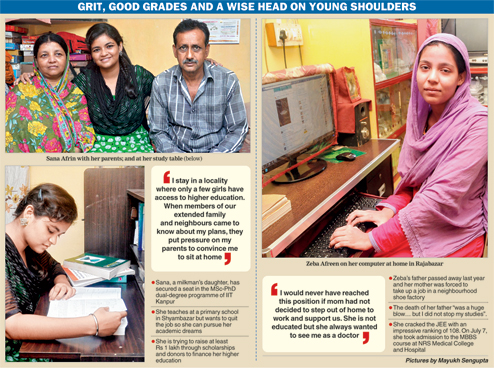
A milkman’s daughter made it to the IIT to pursue her dream of becoming a physicist. Sana Afrin funded her education and that of her brother’s by giving tuition and working as a primary school teacher.

Zeba Afreen, a fatherless girl whose mother works in a sweatshop to pay for her education, is set to become a doctor.

Metro meets the two inspiring girls.

SANA AFRIN

The test was tough but she secured an admirable countrywide rank of 23 to win a seat in the MSc-PhD dual-degree programme at IIT Kanpur.

The daughter of milkman Sheikh Rahi of Paikpara in north Calcutta had cracked tougher tests and hopefully overcome the one she is currently fighting: finance her education at an IIT.

Born in a financially weak and conservative family, 21-year-old Sana’s tryst with hurdles began at a young age when her father had to make a choice between daughter and son since he could afford to educate only one of the two children.

“My parents decided to support my education despite some unpleasant advice from relatives and friends. My younger brother had to wait a year to start his schooling,” said Sana at her home in Saudagar Patti, Paikpara.

Sana did not disappoint her parents, especially her hardworking father who delivers milk door to door to earn his living. She scored well in her Class X board exam and chose science for her Higher Secondary.

Just when she thought everything was on course, Sana faced her biggest hurdle. Her father didn’t have the money to pay her admission fee, leaving the daughter on the threshold of giving it all up.

To rub it in, some relatives advised her father that it was not wise to educate a girl so much. “They said I wouldn’t be able to cope with science. When I heard this, I was determined to prove that my parents’ decision to educate their daughter was right,” she said.

Loans from friends and scholarships from some NGOs helped her tide over the crisis and shut disapproving mouths.

Sana is now awaiting her BSc Part III results from Calcutta University.

She not only managed her education but also that of her younger brother, a Class XI student at an English-medium school in Dum Dum.

Sana remembers the hostile reaction when she announced her wish to go to college after Class XII. “I stay in a locality where only a few girls have access to higher education. When members of our extended family and neighbours came to know about my plans, they put pressure on my parents to convince me to sit at home.”

The gritty girl stuck to her plan: BSc with honours in physics. She filled in forms of various colleges and took admission in the first college where her name appeared on the merit list.

She knew all too well about her father’s financial situation and the people who wouldn’t let go any opportunity to scuttle her academic pursuit. Sana circumvented the situation by giving tuition, the earning taking care of her and her brother’s education to some extent.

Sana now teaches at a primary school in Shyambazar after clearing the Teacher Eligibility Test last year. Only one per cent of the several lakh candidates who appeared for the TET could get through.

In February this year, she appeared for the IIT Joint Admission Test for the MSc course. “I wasn’t well-prepared for the exam… I had just joined the school. I was also studying for my third-year final and doing private tuition,” she said.

Still she managed a ranking of 23.

She is aware that her current job will bring some financial stability to the family but her heart is with higher studies at IIT Kanpur. “I want to study and fulfil my dreams. I do not want to remain a primary school teacher.”

The new challenge is to arrange for her admission and semester fees. “I have been able to book my seat by paying a token amount of Rs 10,000. I need close to Rs 1 lakh,” she said.

When she visited a government department that apparently helps children from poor families with stipends and scholarships, she was told that she was not eligible. “They said they would have helped me had I been pursuing medical, engineering or civil services. They will not fund anybody’s education for research,” Sana said.

She never forgets to thank people who doubt her abilities. “They deserve credit. If they don’t question my ability, I will not be able to give my best,” she said.

Sana is eligible to apply for an IIT scholarship considering Sheikh Rahi’s financial situation, but she does not want to leave anything to chance.

If she manages to arrange the money, she would leave for Kanpur on July 16. The prospect of not spending Id with her parents does make her sad but she is determined to fulfil her dreams because her brother’s future is also at stake. “It will be tough but I need to do this and provide a better life to my parents and fund my brother’s higher education.”

ZEBA AFREEN

When Zeba Afreen’s father passed away last year and her mother was forced to take up a job in a neighbourhood sweatshop that manufactures footwear, she had several excuses to abandon her dreams.

But the 20-year-old did not lose sight of her goals, the immediate one being the Joint Entrance Exam. She studied 14 hours a day despite taking care of household chores and three younger siblings.

The Rajabazar girl cracked the JEE with an impressive ranking of 108. On July 7, she took admission in NRS Medical College and Hospital to its MBBS course.

Zeba did not let her father’s death influence her preparations, though “it was a huge blow… a bolt from the blue”. “But I did not stop my studies. I kept studying for the joint exam,” she said in her Rajabazar home opposite Tasvir Mahal cinema hall.

“I initially thought of quitting studies and taking up some odd job. Mother was dead against it. She wanted me to continue my studies,” she said.

Her father was a small-time envelope-seller and didn’t have any savings, forcing his wife Afsari Khatoon to work at the small shoe factory to support her children.

Zeba did not disappoint her mother.

She took help of senior teachers in her locality to prepare for the physics, chemistry and mathematics papers since she couldn’t afford classes at coaching institutions for competitive examinations.

“There was no way I could afford the expensive coaching centres. My only option was to study hard on my own,” said Zeba, who passed Higher Secondary from Shri Shikshayatan after Madhyamik in a neighbourhood school.

There was no dearth of distractions that cropped up every day to offset Zeba’s dream, the most annoying being the din on the road outside her house while she was preparing for her exams.

“I couldn’t concentrate even at night. Autorickshaws ply till late in the night… honking of vehicles. Ooph!”

This was Zeba’s second shot at the entrance exams. She came somewhere in the 2000s on the rankings last year and so decided to give appear again instead of taking up engineering in a lesser-known institution.

“I used the failure to identify areas I needed to work upon. From time management to improving my answers, I practised hard in the past one year,” she said.

“I would never have reached this position if mom had not decided to step out of home to work and support us. She is not educated but she always wanted to see me as a doctor,” Zeba said.

She now intends to focus on her two younger sisters and a brother. “I hope to guide my siblings the way my mother guided me.”

After completing her MBBS, Zeba wants to specialise in neurology and help the poor. “I owe my success to many people who came forward to help me when I was in need,” she said.

What message do you have for Sana and Zeba? Tell ttmetro@abpmail.com

source: http://www.telegraphindia.com / The Telegraph – Calcutta / Front Page> Calcutta> Story / by Zeeshan Jawed / Wednesday – July 09th, 2014
Students’ date with robots

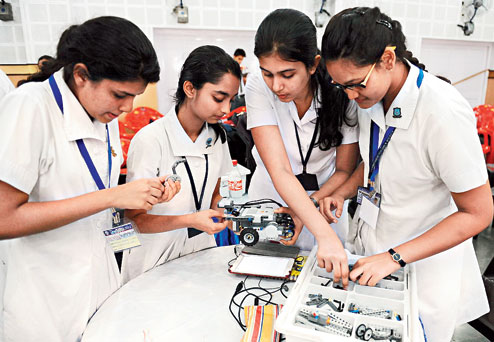
Students at the robotics workshop at La Martiniere for Girls. Picture by Sanjoy Chattopadhyaya

The first day of a robotics workshop at La Martiniere for Girls in May saw the girls struggling with motors, beams and light censors. But at the end of three days, they were adept at not just assembling a robot but also programming and navigating it through obstacles.

Five of the nine teams that participated in the workshop, including La Martiniere for Girls, qualified for the global round of International RoboCup Junior Competition presented by Indian RoboCup Junior Foundation. Tiro Nomura from Saitama University, Tokyo, judged the teams.

Lorraine Mirza, the principal of La Martiniere for Girls, met David Prakash, the chairman of the Indian RoboCup, in Bangalore. “Why not the east? I would like to host it in our school,” Mirza thought and soon enough she made arrangements to host the workshop and competition in Calcutta, in association with St. Augustine’s Day School, Barrackpore.

The students had to build autonomous robots and not remote-controlled ones, programme the robots and manoeuvre them through obstacles. “The robots have got sensors to sense the obstacles and avoid them,” Prakash said.

And then, as Mirza said, “it was time to test how much you (the students) have learnt and to pick out the teams that are going for the national competition”.

“On the first day, it was torturous for us and it took us three hours just to assemble. But over the next three days we learnt the programming as well,” said Nilakshi Padhi, a Class IX student of La Martiniere for Girls who was part of one of the teams that qualified for the national competition.

Four-member teams from South City International School, Mahadevi Birla World Academy, St. Augustine’s Day School, St. John’s Diocesan Higher Secondary School, La Martiniere for Girls and Boys and others took part in the workshop.

G.S. Rautela, the director general of National Council of Science Museums and the chief guest, urged the students to follow their passion. “Don’t be guided by peers or what your parents are pushing you to. If you like to build robots, build robots. If you want to write a poem, write poems. But follow your passion.”

source: http://www.telegraphindia.com / The Telegraph, Calcuta / Front Page> Calcutta> Story / by Jhinuk Mazumdar / Monday – July 07th, 2014

Partha: Not dropping Kabir name from book, adding more stalwarts

SUMMARY
After withdrawing the book last week, Partha Chatterjee had ordered the chairman to revise the book.
___________________________________________________________

Less than a week after it ordered to withdraw a Bengali textbook for Class 12, which contained a long paragraph on contribution of former Trinamool Congress MP and singer Kabir Suman to contemporary Bengali music, the state government Thursday said the book will be relaunched after revision and addition of some more names.

Among others, the revised boom will now detail the contributions of artistes such as legendary singers such as Hemanta Mukherjee, Manna Dey, Shyamal Mitra, Sandhya Mukherjee and Gautam Chatterjee in the book ‘Bangalir Bhasha o Sanskriti’ (The language and culture of Bengali people).

Education Minister, who had ordered the book to be withdrawn, Thursday told the Assembly that it was “unfortunate that the book did not refer to such stalwarts like Hemnata or Manna Dey or Sandhya Mukherhee.”

“But, of course, we are not in favour of dropping anyone from the list. If ‘Pachakanta’ (a derogatory term for Kabir Suman) can be there, other artistes can also be there,” Partha Chatterjee told the House after a meeting with Aveek Majumdar, chairman of the syllabus committee (for classes upto 12).

After withdrawing the book last week, Partha Chatterjee had ordered the chairman to revise the book. “The draft of the revised version will be shown to me on Monday,” the minister said, adding that the government would recruit poet Ganesh Basu and nuclear scientist Bikash Sinha as advisers to the syllabus committee.

Though the government mentioned factual errors in the book as the reason for its withdrawal, sources said, the riling party was not very happy at reference to rebel TMC leader Kabir Suman.

Suman, a Kolkata-based modern Bengali singer-songwriter and musician contested the Lok Sabha election on a Trinamool Congress ticket from Jadavpur constituency in 2009. He was subsequently suspended from the party after he fell out with the party leadership.

source: http://www.indianexpress.com / The Indian Express / Home> Cities> Kolkata / by Express News Service / Kolkata – July 04th, 2014