Category Archives: Education

Bengal girl joins Malala in Dutch book

RekhaKOLKATA02sept2014

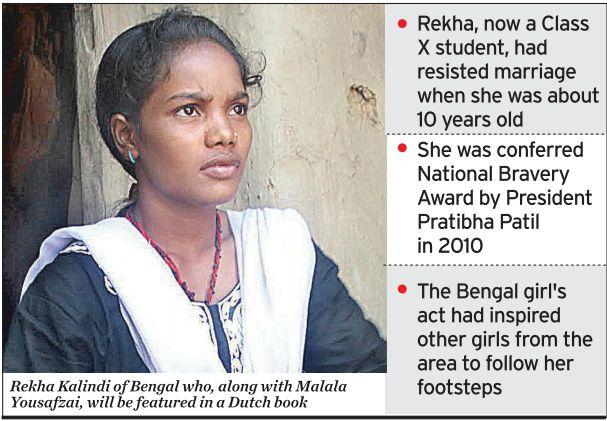
What is common among Malala Yousafzai, Anne Frank, Hellen Keller and 16-year-old Rekha Kalindi from Purulia in West Bengal?

The braveheart from the State will feature along with Malala and Anne Frank in the book Children who changed the world to be released in November in Amsterdam marking the 25th anniversary of the UN Declaration of the Rights of the Child.

Rekha, now a student of Class X, resisted marriage when she was about 10 years old. Her resistance led to other girls in the area following in her footsteps. She, along with two other girls from the district, was conferred the National Bravery Award by then President Pratibha Devisingh Patil in 2010.

The book is written by Dutch Newspaper NRC Handelsblad’scorrespondents who live and work in the countries of the children featured in the book.

It profiles 20 children and the chapter on Rekha is written by journalist Aletta Andre.

Girls inspired
“Rekha’s story fits very well in this theme (the book’s theme), as she resisted a very common but not so great practice in her area, when she was about 10 years old and has with her act inspired other girls to do the same. It shows that very young children, even very young girls in a patriarchal society, have the power to make a difference,” she said in an email response.

Speaking to The Hindu, Rekha said she was very happy that the story about her is being published in other countries. Since the time she and other girls from Purulia had resisted child marriage, many girls came forward to oppose the practice, she said, adding that poverty and lack of education are still resulting in such marriages.

She also pointed out that a Class V textbook of the State Board has a chapter on child marriage where her and another girl’s names feature.

“Such stories (like Rekha’s) encourage adolescents to protest and raise their voice against child marriage,” Asadur Rahaman, chief of field office UNICEF in West Bengal, said. Pointing out that child marriage and trafficking of girls continue to be a concern in States like West Bengal, Mr. Rahaman said that a scheme like Kanyasree providing scholarship to school-going girls is a significant
initiative.

source: http://www.thehindu.com / The Hindu / Home> News> Cities> Kolkata / by Shiv Sahay Singh / Kolkata – August 28th, 2014

Jadavpur University begins work on graphic anthology of Tagore stories

Kolkata :

Jadavpur University Press on Friday started the process of compiling a graphic anthology of 10 short stories by Rabindranath Tagore with Harper Collins as the co-publisher. It also launched a book of essays by Upendrakishore Raychowdhury on half-tone photography, published in a single volume for the first time. And professor Abhijit Gupta and Deeptanil Ray of JU unveiled a website that showcases the evergreen comic books generations have grown up devouring.

“Raychowdhury had written the essays in Penrose’s Pictorial Annual, a London-based magazine that reviewed graphic art. British Library had the only copies of the magazine and gave us permission to reproduce them in a facsimile edition. We have not edited a word and have printed images of those articles,” said Dr Devalina Mookerjee, development editor at JUP. When asked about the Tagore project, she added: “We want the artists to look at the stories in the context of contemporary world. The artists will be working independently.”

Illustrators Vishwajyoti Ghosh, Trinankur Banerjee, Sarbajit Sen and Nitesh Mohanty discussed their work and plans with Rimi B Chatterjee as the moderator.

Later, Mohanty told TOI: “It’s a one-of-its-kind project where all artists will bring in their essence to the eternal spirit of Tagore. We will stick to the original and there will be no deviation from the original story.” Banerjee agreed and added: “And to retain the spirit of the doodles, the book will mostly be in black and white. But there will be a colour section as well,”

Professor Emeritus Sukanta Chaudhuri regaled the audience with an address on Tagore’s doodles while Sekhar Mukherjee, former head of the animation department at National Institute of Design, spoke on the animated ‘Birpurush’ that has been in the works for a while now.

The day was rounded off with a discussion on ‘Upendrakishore’s versatile genius’ with Prasad Ranjan Roy, Subhendu Dasmunshi and Amlan Dasgupta. Samantak Das was the moderator.

Former home secretary Roy, who is also related to Upendrakishore, said: “Satyajit Ray had written about how he showed the same passion of violin and pakhowaj. At night he would study stars with a telescope while in day he would take to the canvas with oil and watercolour. Possibly, he took up half-tone photography after his drawings for ‘Chheleder Ramayan’ became unusable. But his daughter Purnalata has written that he took it up while in the UK.”

source: http://www.timesofindia.indiatimes.com / The Times of India / Home> City> Kolkata / TNN / August 30th, 2014

Spunk and sacrifice – Awarded for excellence, courage and more

SnehaKOLKATA29aug2014

Sneha Mukherjee has a plastic sphere where her right would have been and minus power in her left eye but the only “favour” the 12-year-old takes in class is to sit in the front row.

Sneha underwent an eye surgery for removal of tumour when she was just 11 months old and had since had no vision in her right eye.

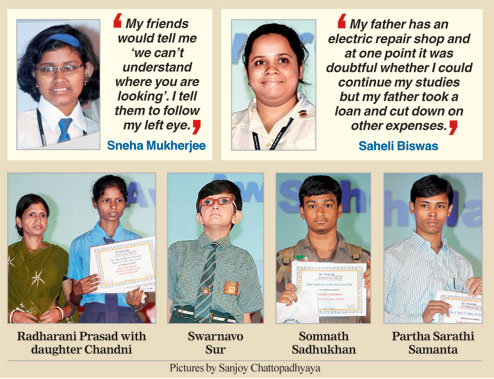
That has not impaired her spirit and Sneha, who has a ready response for any insensitive remark about her eye implant. “My friends would tell me ‘we can’t understand where you are looking’. I tell them to follow my left eye,” said the Class VII student of St. Joseph’s Convent in Chandernagore and winner of The Surrendra Paul Memorial Award for Courage at Peerless presents The Telegraph School Awards for Excellence 2014, in association with Parle-G and powered by Adamas University.

If Sneha has always been encouraged by mother Lopamudra not to take any favours, other parents have made sacrifices — big and small — for their children’s education.

Radharani Prasad has to work as a domestic help as her husband is confined to bed by paralysis but that didn’t stop her for admitting daughter Chandni to Gurukul Vidyamandir Higher Secondary School after she scored 75 per cent in ICSE. Chandni received The Telegraph Education Foundation Scholarship.

“The school did give us concession but despite that I had to pay about Rs 15,000 for her admission after taking loan. I haven’t been able to pay her monthly fee so far,” said Radharani, who shared The Abhirup Bhadra Memorial “Thank You Baba-Ma” Award with Balaka and Swarup Sur, parents of Swarnavo, a kindergarten student at Assembly of Angels Secondary School, Barrackpore.

Swarnavo had a hernia surgery when he was 10 months old and an eye surgery when he was three. “He is extremely regular in school and I do not have to give him any special attention,” said the proud mother.

It was for Subir and Swarnali Biswas (who received The Abhirup Bhadra Memorial “Thank You Baba-Ma” Award) that their daughter Saheli (who received The Telegraph Education Foundation Scholarship) could continue her studies.

“My father has an electric repair shop and at one point it was doubtful whether I could continue my studies but my father took a loan and cut down on other expenses,” said the student of Class XI.

The spunky Somnath Sadhukhan, who received The Faith in Astha Scholarship, studies geography honours at Surendranath College while his mother sells pens and stationery in and around Shyambazar.

Rudrangshu Mukherjee, the managing trustee of The Telegraph Education Foundation, had one thought on Saturday for the students. “When you become somebody eminent, somebody successful… just turn back and reflect on those who need to be educated, those who need your support… “Please grow with The Telegraph Education Foundation, the best is yet to be because the best is in your hands.”

Barry O’ Brien, the convener of The Telegraph School Awards for Excellence, shared how students and teachers have often told him how moved they are by the stories of courage and resilience.

“Don’t just be moved. Don’t just take a handkerchief out of your pocket and wipe your tears. Do something small, very small, it could be anything. Try to reach out to somebody,” was O’Brien’s advice,

Delhi Public School Megacity and Sunita Sen, the principal of Ballygunge Shiksha Sadan, did just that, responding on the spot to a request to fund a laptop for Partha Sarathi Samanta, the son of a guard who is studying MTech at the Indian Institute of Engineering Science and Technology. They chipped in with Rs 40,000 for the recipient of The Club Friday Scholarship.

source: http://www.telegraphindia.com / The Telegraph, Calcutta / Front Page> Calcutta> Story / by Jhinuk Mazumdar / Tuesday – August 26th, 2014

History made at Purulia Sainik School on I-Day

Kolkata :

Since early morning on Friday, there was an air of urgency in the proceedings at Sainik School, Purulia. It was Independence Day and the occasion is celebrated with much pomp and gaiety at the institution which turned 50 recently. This year was going to be different though. History was about to be created with the honour guard of senior cadets preparing to salute the first headmistress of the school. This was also the first time in the school’s history that the National flag would be unfurled by a lady Army officer. A second-generation Army officer, Lt Col Palli Swarna Lata is now the headmistress and officiating principal of the school. The Lt Col joined the Army as a short service commission officer but was granted permanent commission later on.

“Both Republic Day and Independence Day are celebrated with much patriotic fervour at this school,” said Lt Col Lata, after taking the salute and unfurling the flag. The school has a checkered history. Among its alumnus is Air Chief Marshal Arup Raha, the present Indian Air Force chief. Several others who have passed out from the Sainik School in Purulia have served the Army, Navy and Air Force as officers. Many of them have served in other fields including the central paramilitary forces and the private sector. Many alumni of the school have been decorated with gallantry awards. One of them is Col (retd) Subir Mookherjee who received the Shaurya Chakra for gallantry in 1980. On Friday, some former students of the school celebrated Independence Day with Mookherjee at his Salt Lake residence in Kolkata, with a view to draw inspiration from the brave soldier.

“Several former students from the batches between 1992 and 2012 went to Col (retd) Mookherjee’s residence on Independence Day. Alumni from all over India and abroad also called him up to thank him for his service to the nation,” said Shreyas Kumar, an alumnus based abroad who is also the vice-president, Sainik School Purulia Student Welfare and Inspiration Foundation Trust (SSP SWIFT). The organization has launched nine scholarships, one of which was recently won by a girl student Sagnika Chakraborty. One of the scholarships is dedicated to late Flying Officer Rafi Ahmad of the IAF. On Friday, these scholarships were distributed among deserving students by Lt Col Lata.

“This year, two cadets from Sainik School, Purulia, have joined the NDA and INA. Preparations are on to train more cadets for the next semester,” Lt Col Lata said.

source: http://www.timesofindia.indiatimes.com / The Times of India / Home> City> Kolkata / by Jayanta Gupta / August 17th, 2014

Strict teacher and a Small Wonder fan

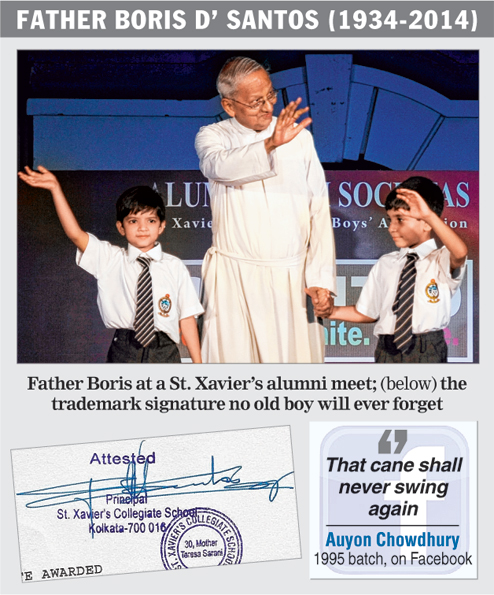
FatherBorisKOLKATA15aug2014

Few students of Father Boris D’ Santos would have got away without a caning or two and yet the loudest applause was for him at the last reunion of St. Xavier’s old boys in December 2013.

Father Boris, the long-serving former vice-principal of St. Xavier’s Collegiate School, Calcutta, passed away on Wednesday. He was 80.

He had been suffering from bone cancer for some time, the school said. “Fr. D’ Santos had been ailing for some time. He received the best treatment that medical science could offer…. The doctors who attended included some of his former students,” said a statement issued by the school. Along with other Jesuits, his sister and her husband were present in his last moments.

Born on April 19, 1934, Father Boris was himself a student of St. Xavier’s school. A few years ago, when he was asked about his association with the school that was celebrating 150 years, Father Boris’s eyes had glistened as he related a story: “My brother and I were almost turned away from St. Xavier’s school on the day of admission in 1943 for turning up late. But fortunately, a lady teacher of the school happened to enter the prefect’s room and recognised my mother. They were friends. She said she could find a seat each for us and so I joined Standard I Section B on February 1, 1943.”

His classmate of the 1951 Senior Cambridge batch, General Shankar Roy Chowdhury, remembered young Boris as being good in both studies and games and “second-to-none in sprints”.

It was while he was working at CESC (then Calcutta Electric Supply Corporation) that Father Boris found his vocation to be a Jesuit. He joined the Society of Jesus (The Jesuits) on September 14, 1965, and was ordained as a priest in 1974. The much-loved Jesuit was appointed prefect of St. Xavier’s school in 1984, a post he held till he gave it up a few months ago because of failing health.

The social media was flooded with messages saluting the master who juggled various roles, as English teacher, prefect, disciplinarian, counsellor, pastor and mentor. “Rest in Peace, Father. Thank you for everything that you inculcated in us. Will never forget you,” wrote Arpanarghya Saha.

“He shaped our young minds with his animated lectures. He cared more about us learning the language correctly than merely completing the syllabus,” said Ranjoy Chowdhury, 25, of the Class of 2005.

What endeared Father Boris to students was largeness of heart and a sense of humour. Dhruv Mookerji, theatre actor and a former student, remembered the last time he was pulled up by Father Boris. “It was in 1995. I was to give a speech at a school event. When he heard it the day before, he took me aside and angrily asked me to make it shorter. I pleaded it was less than one-and-a-half pages long. But he waved his finger and warned me that the event must be wrapped up before 4.30pm so that he could watch Small Wonder (the science fiction sitcom featuring Vicki the robot girl)!”

Former students recalled the complex signature that no one dared imitate.

The school described his death as the end of an era and iterated its belief that staff and students, their parents, and the old boys’ association would uphold the values and principles he held dear.

The funeral mass for Father Boris will be held at the St. Xavier’s chapel at 10am on Thursday, followed by internment at Dhyan Ashram, Joka.

source: http://www.telegraphindia.com / The Telegraph, Calcutta / Front Page> Calcutta> Story / Thursday – August 14th, 2014

45 years on, an inspiration returns to her inspiration – The fairy godmother, The La Martiniere girl

Shabnam Ramaswamy, who started life afresh from the streets to become the force behind Jagriti Public School and Stree Shakti women’s co-operative in Katna village of Murshidabad, returned to her alma mater, La Martiniere for Girls, on Friday morning for the first time in 45 years.

The 60-year-old fairy godmother to hundreds of women and children took a walk down her La Martiniere memory lane…

ShabnamKOLKATA11aug2014

Whenever I’d go over the AJC Bose flyover I’d point at my school and show my driver or some staff member travelling with me in the car: “See, that’s my school!” After I went out of school in 1969 and all these years of struggle, I had never set foot in my school.

As I was addressing students of the school, I was thinking I would have loved my father to be alive today. In those days, picking me from a village, bringing me to the city and admitting me to this school, what a chance it was for me.

I went through all the stereotypes of marriage and conventions but it was the school that really made me what I am in terms of my lateral thinking, turning of views, never to give up against all odds. These are things in the books you read but the teachers put it across in a manner that really changed the way I think.

Shabnam2KOLKATA11aug2014

One book that I loved reading during my school days was Tom Sawyer. He was such a big influence on me. Him painting the wall, the mundane routine of doing that job when everyone else was having fun. At 22 (Shabnam was married off at 16) when I’d see other girls around me having fun and I would think, like Tom I’m going to make everybody come and paint my wall too while I sit on the stool with all my treasures. And today it seems like it’s really happened!

Look at the background I came from. My mother was illiterate, so was my grandmother. My father was in the army. So it was really the school that taught me how to handle life and the education gave me the ability to juxtapose both worlds, not to hate that or look down on it but do something about it. In fact, today I’ll be visiting one such teacher’s house who has baked a cake and waiting for me. I’m just looking forward to meeting her after all these years.

College I did because I desperately needed the graduate degree but it’s the school that made me. Looking at the school after all these years, no matter how much the buildings have changed and new ones have come up, these pillars will remain. The pillars are like pillars of strength for me. Today, with pride I can say that I come from here.

Shabnam3KOLKATA11aug2014

My favourite corner was always the field because I loved sports. I used to throw javelin, discus and do high jumps, long jumps. I used to participate in inter-school sporting events. I wasn’t a hugely academic person.

When I was starting Jagriti (Shabnam’s CBSE-affiliated English-medium co-educational public school for the poor) my reference point was this school. The discipline, the curriculum and the philosophy is modelled on all that I learnt from my own school — La Martiniere.

As told to Mohua Das

source: http://www.telegraphindia.com / The Telegraph, Calcutta / Front Page> Calcutta> Story / by Mohua Das / Saturday – August 098th, 2014

IIT-Kharagpur working on national digital library

Seeking to create a national online educational asset for students interested in research and innovation, the IIT Kharagpur, recently put forth a proposal to form a NDL to the Ministry of Human Resource Development.

Seeking to create a national online educational asset for students interested in research and innovation, the Indian Institute of Technology (IIT) Kharagpur, recently put forth a proposal to form a National Digital Library (NDL) to the Ministry of Human Resource Development.

The MHRD not only approved of the project, but also granted Rs. 100 crore for the project to be kick-started by the IIT Kharagpur, one of the premier tech institutes in the country. This was announced by institute’s director Partha Pratim Chakrabari at the 60th convocation ceremony in July-end.

Talking to The Hindu over phone, one of the core team members who ideated the NDL Partha Pratim Das said the project’s main aim was to create a knowledge base for students of all ages, especially for those interested in research.

“Every university has its own digital archive of its intellectual output and syllabus, known as the Institutional Digital Repository (IDR), whose access is limited to the university’s own staff and students. The NDL is modelled on the IDR, but will consist of IDRs of several universities and any student will be free to access it. For instance, a student of IIT Madras will be able to access study material of a specialisation taught exclusively at IIT Kharagpur. The NDL aims to streamline IDRs and other study material into one common online,” Prof. Das, also a professor of the computer and engineering department, said.

Except for copyrighted content, the data will mostly be available for free.

While the NDL is a relatively new concept in India, it has already made its appearance in most universities in the west. The content for the NDL will be derived from institutes of all types of specialisations and will include school-level study material as well.

The multi-faceted project would start by incorporating digital content of about 50 institutions at the primary level, keeping the next target at about 100 institutions.

Another focus of the project is to create e-content, comprising video lectures, interactive questions and answers and books, in multiple languages.

Stating that ‘a lot of activity is planned in vernaculars’, Prof. Das said: “Initially, the knowledge base will be created in English. We will gradually include vernaculars and create a multi-lingual interface so that students from across India can freely access it without facing a language barrier,” Prof. Das said.

The brainchild of a four-member team will be launched in 18-21 months and a prototype will soon be launched to test the project’s feasibility. About 100 courses will be launched at a preliminary level.

Headed by Prof. Chakrabarti, the proposal was worked on by professor in charge of the institute’s central library Subrata Chattopadhyay, professor of the computer and engineering department Sudeshna Sarkar and librarian of the central library B. Sutradhar along with Prof. Das.

Keeping in mind the evolving technology, plans are on to make the interface available across all platforms — cell phones, tablets and laptops. Content will also be developed keeping in mind the needs of differently-abled students.

source: http://www.thehindu.com / The Hindu / Home> News> Cities> Kolkata / Kathakal Nandi / Kolkata – August 04th, 2014

Meet Bengal’s miracle man

Kolkata :

Ratan Lal Hangloo has shown that things can be done in Bengal. That real change is possible. Kalyani University is undergoing a remarkable transformation under him – a revolution of sorts that can be a role model for not just academic institutions in Bengal but every sector to pull the state out of this morass.

Hangloo, a respected historian with roots in Kashmir, has been at the helm of Kalyani University for just nine months but it has been like a rebirth for the varsity that had sunk into a cesspool of indiscipline, employees’ agitations, corruption, nepotism and neglect. He has survived Bengal’s political minefield so far with a blend of toughness and pragmatism (plus skills with a camera) and shown great skill in handling explosive controversies like the Bhaktabala BEd seat scam.

At first sight, Hangloo hardly comes across as a disciplinarian. With a quick smile and ready wit, he looks every bit the charming professor he is. But beneath the exterior lurks an administrator with a mission.

He recalls that he joined on a Friday (November 8, 2013) and instead of spending a relaxing weekend, he picked up his camera and went scouting, clicking every part of the campus – from laboratories to lavatories and classrooms to hostels. He has all the images stored in his office computer as evidence of what the campus and its buildings looked like nine months ago.

He ordered an immediate clean-up drive, along with a bold bid to “secure the campus”. He first got the breaches in the university’s boundary wall sealed to stop trespassing, which was common. Locals living on the periphery of the 300-acre campus fiercely opposed it but he wouldn’t budge. There is now a sense of order and security on campus, which looks clean and green.

But more important than these cosmetic changes are the systemic transformations he has brought about. He has introduced rules where none existed. When he took over, the university did not have a leave register for employees and faculty and not even something basic as an academic calendar. There were no records of equipment worth crores of rupees. “I got leave registers made, had a teacher audit all equipment. This university has received a lot of funds since its inception in 1960, but most of it was not spent properly. All the construction has been very shoddy and I have asked engineers to carry out structural evaluations and undertake repairs. In six months, the campus will look much different and all buildings will sport a new look,” Hangloo told TOI.

Hangloo has displayed rare courage in taking on troublemakers. For instance, his predecessors used to live in fear of a casual employee, who used to bully and dictate terms to senior officers. “This man was the leader of a politically-backed employees’ union and had even ransacked varsity offices, including the VC’s chamber. A few months ago, I got to know he was inciting security guards. I sacked him summarily,” said Hangloo, who also evicted the unions from their rooms in the administrative building.

He has asked every officer to prepare a ‘PSO (problems, solutions, outcome) Report’ every month and introduced a docketing system to keep track of files. For the first time in its history, KU now has a prospectus and an academic calendar. Regulations governing PhD admissions were framed and a half-yearly newsletter (another first) is being published.

The new VC has constituted 22 committees comprising teachers and non-teaching staff to deal with various activities. There are, for instance, committees on purchases, security, and upkeep of vacant land. This has brought in a lot of transparency and efficiency and no one can now bully officers into doing anything wrong, say officials.

The go-getter sets a personal example through hard work and diligence. He’s at his wood-paneled office at 9am sharp and continues working till 9.30pm. The varsity is on the cusp of other physical changes also: construction of a new administrative building, auditorium, staff and faculty quarters will commence soon. Three new centres for women’s studies, cultural studies and for studies on the Bengali Diaspora have started functioning at KU. Hangloo’s immediate plans include upgrading of courses, two new smart classrooms for every department, upgrading technology in the campus and enabling cutting-edge research in every field.

Hangloo, who relaxes with a burst of badminton and a dose of music (he has Pannalal Bhattacharjee’s ‘Shyamasangeet’ loaded on his phone) every evening, deals with problems and opposition with equanimity. He recalls a quote from Vivekananda: “You’ll be ridiculed, opposed and then accepted at any new place”. Hangloo is keenly aware of the legacy of Kashmiri Pandits’ contribution to Bengal: “Pandit Sambhu Nath Bhatt, JN Sapru and Jolly Mohan Kaul had rich associations with Bengal. I, too, would like to be remembered for doing my bit for the cause of higher education in Bengal”. Going by the work he has done in Kalyani over the last nine months, Hangloo seems all set to live up to that legacy.

source: http://www.timesofindia.indiatimes.com / The Times of India / Home> City> Kolkata / TNN / August 07th, 2014
British Baptist Missionary William Carey to be remembered on his 253rd birthday

Kolkata :

British Baptist Missionary William Carey, who was the driving spirit behind the spread of modern English education in Kolkata, will once again be remembered on his 253rd birthday on August 17. The Bible Society has organised for a Carey Lecture to be delivered by Jawhar Sircar, the CEO of Prasar Bharati.

Sircar has been researching on old Kolkata for a long time and will focus his lecture on the Bengal Renaissance and the role of Carey behind it.
This will be followed by a dance drama, Dhrubojyoti Tumi directed by danseuse Alaknanda Roy. The performers are inmates of correctional homes.

source: http://www.timesofindia.indiatimes.com / The Times of India / Home> City> Kolkata / by Jhimli Mukherjee Pandey, TNN / August 07th, 2014

Feast of Jesuit founder today

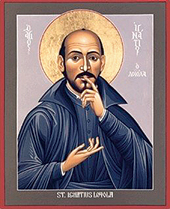
The 20,000 Jesuits and their institutions all over the world celebrate the feast of their founder, St. Ignatius of Loyola, on July 31.

FatherIgnatiusKOLKATA31jul2014

Ignatius was an unusual character of the 16th century, a brave knight and soldier under King Ferdinand of Spain. In 1521, he was wounded in the battle between France and Spain. His life was transformed during his long convalescence and he founded the Jesuit Order, the Society of Jesus, along with Francis Xavier at the University of Paris in 1537, which was approved by the Pope in 1540.

Perhaps Jesuits impart the best-known education in India and elsewhere. They have come to be known in the public mind for their educational work and have acquired the reputation of being among the world’s best educators and educationists.The Jesuit educational network is the largest in the world today.

The Jesuits conduct no less than 50 university colleges, 17 institutes of business administration and 210 high schools across the country; almost all of them are among the most reputable ones. More than 500,000 students belonging to every religious, linguistic and socio-economic group, receive their education at these institutions.

The situation is the same wherever the Society of Jesus has established itself for the greater glory of God. There are 28 Jesuit universities in the US.

As Malachi Martin has said in his book, The Jesuits, “Jesuits always aimed to be the best. And they were. They had a part to play in every major political alliance in Europe and America, in Asia and Africa. They became shapers not only of religious history, but also of world history. Even Nazi generals (incl. Hitler) dreamed of such a cadre of men; and even Lenin envied them.”

Historian Romila Thapar has stated that if India has a written history; the credit goes to the Jesuits.

St. Xavier’s college and school will remain closed on July 31 in honour of their founder. Here’s wishing all Xaverians, present and past, a very happy feast of St. Ignatius of Loyola.

The writer is the principal of St. Xavier’s College, Calcuta
source: http://www.telegraphindia.com / The Telegraph, Calcutta / Front Page> Calcutta> Story / by Fr. Felix Raj / Thursday, July 31st, 2014