The ‘toy train’, puffing along the Hill Cart Road, has been such an intrinsic part of the Darjeeling experience of yore that no back-to-school programme here is complete without a glimpse of this legacy of the British Raj.
Former students of St Paul’s School, here to celebrate 150 years of their school’s coming to Jalapahar, did one better – they took a ride on a train pulled by one of the oldest engines here. For some, it was truly a ride down memory lane because the ‘toy train’ and its ridiculously small compartments were what used to bring them up from the plains for their nine months as boarders at ‘SPS’.
Saturday’s journey, undertaken by many with their families, was only as far as the Batasia ‘loop’ and back; any trip longer is powered these days by the quieter and more efficient diesel engines. With time allowed at the ‘loop’ for photo-shoots and another clear day offering the Kanchenjunga as a breathtaking backdrop, it made for a memorable morning.
At Batasia, the driver revealed that the engine was 130 years old. “Oh, it’s still far less than our school,” someone quipped.
“We had just one holiday, and it began before Christmas. The toy train journey would start at 1.20pm and it was six hours before the train pulled up alongside the waiting metre-gauge train at Siliguri,” said Joe Hammond, who used to live in the school compound because his father was a teacher. “In between, there would be this stop for tea at Kurseong,” added Hammond, who now lives in England.
Julius Mirza, who came from Iran to be part of the celebrations, recalled when he first came up in 1947, he was surprised by the size of the compartment.
Lunch at Keventer’s, Glenary’s and the many restaurants they would swarm as students on the rare outings to town heightened the nostalgia before the ‘Old Paulites’ went up Jalapahar for that final hurray.
‘M-n-M’, a professional band from Mizoram, enthralled the audience with retro numbers that began with the 1960’s giving way to recent songs. School students and some ‘Old Paulites’ with an inclination for music took the stage too.
source: http://www.timesofindia.indiatimes.com / The Times of India / Home> City> Kolkata / by Arup Chatterjee, TNN / November 01st, 2014
Calcutta-born education scientist Sugata Mitra grew up in a strict Jesuit-school environment in Delhi where life was all about discipline and order.
Little did he know that one day his life would be all about “theories of chaos”, the key to a series of self-organised learning environments that are transforming the way education is imparted.
Mitra, a physicist by training and a polymath by choice, is the winner of the 2013 TED prize that fetched one million dollars for his radical educational project School in the Cloud. Seven such experimental facilities have since been launched in the UK and India, three of them in Bengal.
Apart from giving shape to his vision, the 62-year-old scientist is making the most of his stay in Calcutta with “a daily visit to the bazaar to shop for fish and duck eggs”.
For Mitra, professor of educational technology at Newcastle University in the UK since 2006, each day is about implementing what he calls SOLE, or unsupervised self-organised learning environment. This theory forms the basis of his School in the Cloud concept, a term that he first used in a riveting speech after winning the TED award last year.
Mitra was the first recipient of the one-million-dollar purse since it was raised from $100,000. Past winners of the prize, awarded by the non-profit Sapling Foundation to foster the spread of “great ideas”, include Bill Clinton and Bono.
The journey to worldwide recognition of Mitra’s great ideas started with a winning experiment in 1999 called Hole in the Wall. The then Delhi-based scientist and educator embedded a computer within a wall in a Kalkaji slum and children were allowed to use it freely. The experiment proved that kids could quickly learn computers on their own without any formal training.
Mitra called it Minimally Invasive Education and the experiment caught on, even inspiring the novel Q&A by Vikas Swarup that Danny Boyle adapted into the Oscar-winning Slumdog Millionaire.
The unintended connection with Slumdog Millionaire is not something he is excited about. “I was quite startled at first because I couldn’t see the connection,” Mitra said of the film. “The fact that you can learn by yourself was put into a very different, rather sad context. I wish that one wouldn’t have to learn under the circumstances as we see in the movie.”
So would he have approved if the story didn’t feed on the rags-to-riches formula?
“I found Vikas Swarup on the Web after the film released in England and wrote to him. We were in correspondence and I still feel it would have been better if it were about a slumdog professor who did not win a million-dollar game show but went on to become a professor!” Mitra said.
School in the Cloud, which has brought Mitra back to Calcutta, started in the UK three months ago. “It’s a three-year research project and according to the budget, a maximum of seven locations is what I could afford (with the prize money). The challenge was to find those seven places,” Mitra said.
In England, he picked George Stephenson High School, “where the steam engine man George Stephenson lived”, and another in the rural hamlet of Durham. In India, he found a school each in Delhi and a town called Phaltan, near Pune, besides the three in Bengal. The first three are already operational.
“I am here because the most remote of all the sites is a village called Korakati in the Sunderbans, where the facility will hopefully be operational from March 9, followed by one in the village of Chandrakona in West Midnapore on March 13. Third in line is a semi-urban school at Gocharan in Barasat,” said Mitra, working out of a well-appointed study in his Salt Lake home.
Since the project was launched here this February, help has come from “unexpected quarters”.
“People had read about my TED wish in the papers and I was getting calls. Then, one morning in February 2013 somebody landed up at my house early morning. He was a schoolteacher from Korakati who wanted to do something for his village and from the description, it was the kind of place I was looking for — no electricity, no health care, no primary education,” the education scientist recounted.
Midnapore appeared on his radar through an NGO and Gocharan was suggested by a doctor friend who works there.
Mitra’s confidence in his experiment with unsupervised self-organised learning challenges the basics, including the concept of a school.
If his Hole in the Wall experiments with slum children in India from 1999 to 2004 showed there is no limit to learning capacity “as long as children are left unsupervised and allowed to work in groups”, carrying the project to the UK entailed turning it “upside down”.
In the third phase, he chose south India for an experiment that made him realise how children stop being adventurous if there’s a teacher breathing down their necks. “Therefore, the process of unsupervised learning had to be done purposefully or replaced with a different kind of adult, maybe a grandparent.”
He found out that a grandmother’s presence helped step up a child’s academic performance. “That’s how I got the third piece of my puzzle. I realised I had to have children in unsupervised groups, along with the Internet and an admiring adult.”
In his pursuit of the “admiring adult”, Mitra put out a request for “British grannies”.
“We were looking for retired teachers who may not be grandmothers but were willing to come on Skype and talk to children for one hour every week for free. I got hundreds of calls,” Mitra recalled.
And when the TED prize happened, he thought: “Now is the opportunity to put these pieces together and see what we get.”
“It was TED that coined the term School in the Cloud, where cloud is the other word for the Internet and that is where grannies and children connect,” he explained.
Mitra today has 300 grannies on board, mostly from the UK and also the US, Canada, Australia and India. “At any point in time, we get 30 active grannies,” he said.
And what does a School in the Cloud look like? “Essentially like cyber cafes for children with a few important differences. The computers are big, publicly-visible screens within a glass-walled room, which is an effective control on what they are doing on the computers,” Mitra said.
The group size is determined by the number of computers he can afford. “So we have clusters of four or five children per computer. It has low-level seating and there’s a 52-inch screen on the wall where the granny comes on live over Skype, almost lifesize. It’s like being present there,” smiled Mitra, who keeps an eye on the proceedings through a surveillance camera along with his research team.
English is the most important part of the agenda, Mitra said, for the Indian leg of the School in the Cloud project. “While they want their children to learn many things, what the parents are most interested in is English because they feel that will change their lives more than anything else, which I feel is true. I hope native English-speaking grannies will be more easily able to transfer language skills to these children.”
A typical SOLE session, 40 to 60 minutes long, is open to topics that children might ask for or those initiated by the grannies.
A research team will soon be travelling to Korakati and Chandrakona for a baseline measurement of where the kids stand. “I am focusing on ages six to 14. They follow a very old-fashioned disciplined structure but I have managed to remove the adults,” said Mitra, who has arranged for a waiting room next to the schools for mothers to watch on a large screen what their children are up to.
Schools in the Cloud in Bengal will be kept shut during regular school hours so that children continue with their regular education and their teachers don’t feel threatened. “I am not replacing schools. I am supplementing them,” Mitra said.
Just as fish and duck eggs supplement the Bengali in him
What message do you have for Sugata Mitra? Tell ttmetro@abpmail.com
source: http://www.telegraphindia.com / The Telegraph, Calcutta / Full Page> Calcutta> Story / by Mohua Das / March 04th, 2014
The Calcutta School of Music and Max Mueller Bhavan have joined hands to continue the school’s centenary celebrations as well as commemorating iconic composer Richard Strauss, whose 150th birth anniversary fell this year.
CSM will host ‘Bach-A Benediction and Theatre as Music’ — a fundraiser to boost their orchestra facilities on Friday evening at The Oberoi Grand, with Max Mueller Bhavan flying in eminent pianist-scholar Siegfried Mauser and vocalist Amelle Sandmann-Mauser, who will perform with the CSM Chamber Orchestra. “Since this is a fundraiser, there are no tickets but donor cards priced at Rs 750 each. The cards can be picked up from the school till Friday afternoon and also at the venue in the evening,” said Dickoo Nowroji, CSM president.
On Monday, the venue will shift to the Victoria Memorial, where the German pair will perform Beethoven, Wolfgang Rihm and of course, Strauss, among others. “The event is titled ‘Towards Modernity’ as what will be reflected in the concert is that classical music has not only survived for centuries but it’s still dynamic and progressive,” said organizers from the Max Mueller Bhavan. This programme is open to public, they added.
Sanjib Mondal, the resident conductor of the CSM Chamber Orchestra, was busy on Thursday rehearsing for the first time with Mauser. “Despite the time crunch, we are very happy after practicing together. Normally, before major concerts like these, we have many rehearsals but somehow, this time, after only one rehearsal we have become comfortable to each other’s style and pattern. Two more rehearsals will follow on Friday before we hit the stage in the evening,” he said.
“A fun trivia about Strauss is that the opening bars of his composition ‘Thus Spake Zarathustra’, a tone poem inspired by Friedrich Nietzsche’s novel of the same name, was used in the famous movie ‘2001: A Space Odessey’,” said Nowroji. The Oscar-winning film was produced and directed by Stanley Kubrick in 1968.
Apart from being a pianist, Mauser is a professor of musicology, the president of the College of Music and Theatre in Munich and the designated rector of the University Mozarteum in Salzburg. He was also honoured with the German Federal Cross of Merit and the Bavarian Order of Maximilian. His wife Amelie was trained in Barcelona, Rome, London and Munich and she is also and actress in theatre and opera.
source: http://www.timesofindia.indiatimes.com / The Times of India / Home> City> Kolkata / TNN / October 31st, 2014
St Paul’s School will turn 200 in another nine years. But it is time now for the institution to mark another milestone.
The school may have been raised in Calcutta, but most feel it is only when it moved to the mountains, and Jwalapahar on particular, that the school acquired its halo and high ground. Rather literally.
Some 300 Old Paulites have converged at this favourite tourist destination to celebrate 150 years of their school’s coming to the “Burning Mountain”, a name believed to have been acquired from the explosion of flaming rhododendrons that used to bloom there.
Over the next three days, Paulite Forever, as the celebrations have been christened, will see former students from round the world and as far back as the early fifties reliving their school days and sharing space with the current crop and teachers.
“The Quad”, “Dawkins”, “Lower Field”, “Dorms”, “Prep Hall”… Words that meant the many nooks and corners of boarding life in one of the premier institutes of the country will come alive once more for them.
Men who have moved on to their many distinguished paths will shed all that for school blazers, flannels, grey suits and the many little things that made life at what used to be a boarders-only school. “Several Darjeeling schools have this legacy of the British education system. But, St Paul’s was a little more into the British way than the others,” gushed film distributor and entrepreneur Arijit Dutta shortly after checking into a hotel at Darjeeling on Wednesday evening.
“You see, we looked down upon others from our perch high above Darjeeling town,” joked the 1983 pass-out.
As the first whiff of winter grips this hill town and the heavy woolens come out, the month-long cultural festival on the Mall nears its end and the hotels prepare for off-season discount offers, the Paulite party is set to begin. The nippy air is thick with a sense of anticipation.
“It will be a terrific reunion,” added an Old Paulite.
source: http://www.timesofindia.indiatimes.com / The Times of India / Home> City> Kolkata / by Arup Chatterjee, TNN / October 30th, 2014
Since when did you want to become a doctor? Since I was a child in Chittagong. My father wanted my elder brother, whose schooling was being taken care of by a well-to-do family, to be a doctor but I too dreamed of becoming one.
But you weren’t even going to school… Yes, while my friends attended school, I used to sell fruit in the market but I made sure I progressed too. When they were back, I’d take their class notes and copy them. This went on till I was 13 or 14, when I became a tutor to some four- and five-year-olds and could pay the fees. So, I managed to go to school in classes IX and X and did well in matriculation. It got me a scholarship and took care of my Class XI and XII fees. I continued to be a tutor, and that was the time I began to believe that I could become a doctor. Though I had good results in the intermediate exams too and was eligible, I was told it wasn’t possible to get into medical studies in Chittagong, in what used to be East Pakistan.
And you decided to come to Kolkata… That the standard of education was much higher in India was motivation too. I arrived in 1955, all but penniless and armed with a letter from Mrs Nellie Sengupta and permission to stay at the zamindar’s Kolkata home for a few days. I discovered that Mrs Sengupta’s contact had fallen on bad times and was saddled with graver problems than mine. That’s when my struggles began. I went from one medical college to another but without any success. One day, overwhelmed by a sense of hopelessness, I was at College Square, when a man sitting on the same bench pulled me into a conversation. He literally dragged me to the famous Sarbadhikari house on Amherst Street and told me to seek an audience with Dr Kanak Chandra Sarbadhikari the next morning. I managed to meet the influential orthopaedic surgeon but he told me that I couldn’t get into a government college because I had no papers. He arranged for me to face the board at National Medical, which was then a private college. The interview went off well and I was in.
But you still had no money… I couldn’t afford hostel fees but managed somehow. Among things I did was carry the stretcher up and down buildings for St John’s Ambulance Brigade. It was hard work but it allowed me to stay at Netaji Bhavan. Later, when I started receiving refugee stipend, I moved to the hostel.
How did you end up in Newcastle? My life has been like a ship with a captain, dragging me from one place to another with the sole aim of making me a good surgeon. I had no resource to get into postgraduate education in Calcutta and the refugee stipend was also stopped. While I was contemplating all this, I fell in love and got married in secret. That was the best thing I did in my life. Leaving her behind at her parents’ place, I went to England in 1961 with very little money and without doing internship. After a month of going from one place to another, I finally landed a job at the Berry General Hospital in Manchester. The one year there got me the registration number, and after drifting from one speciality to another, circumstances had me landing up in the neurosurgery department. Gradually, I grew fascinated by what the neurosurgeons were doing — their fight between life and death, working on the pulsating brain to cure patients. I told myself I should be a surgeon for the most precious part of the body.
So, the struggle continued in England? Yes, it was hard. I had no holidays, working even on weekends to make ends meet for the growing family (son was born in 1963 and daughter in 1965).
How did you stay focused and pursue a high ambition despite poverty and other problems? Struggle has always spurred me to strive harder. I am sure it is largely because of my childhood moorings. In Chittagong, even as my mother somehow kept us alive, my father filled us with teachings of the great souls. They sounded hollow initially but became a source of great strength later. Swami Vivekananda’s words in particular provided the answer whenever I was confronted by doubt and dilemma. Soon, I knew nothing could stop me from achieving my goal.
When did you consider settling in India? The moment I passed FRCS from Edinburgh and England, my wife was keen to come back to India. I too wanted to serve here. It was 1971 by the time I could save enough for plane tickets. However, I couldn’t find a job here and we went back. A second attempt, in 1973, got me a job in Safdarjung Hospital in Delhi but they were only into head injuries. I was doing a much higher level of work. I failed to get a suitable placement and realized a job in India was not for me. I went back and worked harder to try to get a career in England. It was difficult for an Indian doctor to get a consultant’s job there at that time. During this period of despair, I got a call from Dr William Sweet, the famous neurosurgeon of Harvard University. I worked with him at the Mess General Hospital but I did not quite enjoy it and went back to the National Health Service in Newcastle.
You became a world famous surgeon… At that time, the success of aneurysm surgeries was very poor and I decided to take it as a challenge by making it my area of work. I travelled the world at my own expense to get better at it, meeting doctors, writing in publications.
You treated several VIPs. Can you tell us about it? On one occasion, in the mid-80s, I received a call from the PMO and later came to know it was Gopalkrishna Gandhi (who would later serve as governor of Bengal) at the other end. I had to rush to Delhi to attend to President Venkataraman’s wife, who had a brain haemorrhage. She insisted she be treated in Newcastle. After she had recovered sufficiently, she didn’t want stay in the hospital or move to a hotel. So, she came to stay at our house, and it became a fortress. They were charming people and strict vegetarians, so my wife and I became vegetarian chefs for a while! Soon, VIPs from different parts of the world wanted their loved ones to be treated by me. When I reached retiring age (65) in 2002, the Newcastle hospital named the OT ‘Robin Sengupta Theatre’ in a rare gesture. They wanted me to continue and I finally stopped in December 2012. I am now an emeritus consultant there.
You’ve had other honours as well… In 2003, the BBC did a programme ‘A Day in the Life of Dr Robin Sengupta’, which was a part of their ‘What is best in NHS’ series. Then, because I have trained so many Indian neurosurgeons in England, the Neurosurgery Society of India named me ‘Neurosurgeon of the Millennium’ in 2000. The National Academy of Science made me an honorary fellow. I was really moved when former President APJ Abdul Kalam gave me the Vivekananda Samman at the ‘World Confluence of Humanity, Power & Spirituality’ organized by SREI.
Why did you choose Kolkata for the Institute of Neurosciences Kolkata (I-NK)? Apart from an emotional connect with the city that made me a doctor, I also saw the urgent need for neurological services in eastern India. I had attained a great deal but I asked myself, ‘Should I now slip into a comfortable life in England, enjoying the fruits of my struggle and hard work, while people continued to suffer?’ Friends and relatives tried to dissuade me from such a task but Vivekananda’s words reminded me that it was better to wear out than rust away. My wife and I donated all our resources and so many others helped raise the funds, but I built I-NK with the support of the Kolkata Municipal Corporation and the government of West Bengal. I am looking for a bigger campus to set up facilities for top-level education and research and extend world-class services to more people. I-NK already has an association with the Newcastle hospital and more doctors from around the world will want to work here. There is no dearth of cases here. I am hoping the state government will join in this effort and we’ll do wonders.
What have you learnt and unlearnt in these 15 years of I-NK? I learnt that handling patients and their relatives here is a different art. In the West, they want to know the truth. Patients too want it, even if means asking ‘Doc, how long do I have?’ Here, not only will relatives insist that you not tell the patient, they often don’t want the truth themselves. All they want are false assurances.
What do you see when you look back? I see my struggle but also the sacrifices of people around me, particularly those of my family. The struggle may have been tasteless and painful at that time, but it’s like vintage wine now. That’s what time does. When I lost my only son, who too was studying medicine, in an accident in 1983, I was overcome by a sense of guilt at not having spent enough time with my family as I chased my goal. I still do surgery; it seems I’ll never be able to rest. There’s still so much left to do.
source: http://www.timesofindia.indiatimes.com / The Times of India / Home> City> Kolkata / by Arup Chatterjee & Debasish Konar, TNN / October 17th, 2014
This year’s Beyond Boundaries — the annual global convention of St Xavier’s College — will reach out to its global alumni to collect funds to aid the college’s ambitious expansion plans.
The convention is slated to be held at Melbourne between October 10 and 12.
“In the last three years, we have partially reached our vision,” said Fr Felix Raj, the college principal. “The Raghavpur campus, which is the rural face of St Xavier’s College, has benefited around 126 students who have already enrolled in various courses started on the campus. In Raghavpur, we have been able to begin three courses at the moment — BCom honours, Bengali Honours and BA (general) courses. We will soon open history honours and political science honours on the same campus. We are also planning to start a community college and offer certificate and diploma courses along with degree courses on vocational subjects. Primarily, we are aiming to start vocational subjects like mechanics, agriculture, fisheries and nursing, among others. We will also take care of placements,” he added.
Fr Raj spoke about the college’s further plans of expansion. “By 2017, a communication campus is set to be unveiled at the EM Bypass plot which St Xavier’s College has acquired behind the Satyajit Ray Film and Television Institute (SRFTI). The campus will offer graduation and postgraduation courses in journalism, mass communications, videography, multimedia and animation. The Educational Multimedia Research Centre (EMMRC), which is now at Park Circus and run by the college, will be shifted to the same campus,” he said.
The St Xavier’s College (Calcutta) Alumni Association (SXCCAA) plays a vital role in the college’s expansion process, said Firdausul Hasan, secretary of the association. “Every year, we have a mission and this year it is raising funds to aid expansion. The Rajarhat campus of the college, inaugurated by CM Mamata Banerjee last year, will also host an engineering college and the convention will help us realise Father Felix Raj’s vision 2020, which is our mission for this global convention,” Hasan added.
“This vision will only be possible with the alumni’s help. They have always stood by us. As president of SXCCAA, I am confident that the vision will be realised because of the association’s support,” said Fr Raj.
source: http://www.timesofindia.indiatimes.com / The Times of India / Home> City> Kolkata> TNN / October 01st, 2014
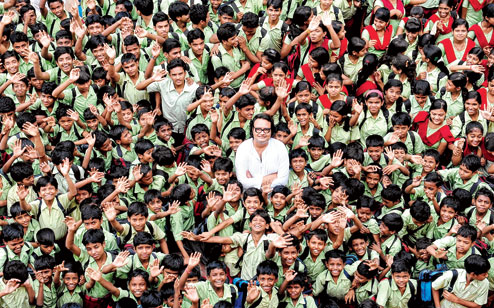
Vinayak Lohani basks in the love of his 900-strong Parivaar comprising destitute children whom he feeds, clothes and educates in Thakurpukur. Picture by Sanjoy Chattopadhyaya
His sartorial style is a crisp, white kurta-pyjama teamed with thick, black-rimmed glasses. He idolises Sri Ramakrishna and Swami Vivekananda and quotes Sunil Gangopadhyay. He worships Satyajit Ray and Ritwik Ghatak and unwinds with Anjan Dutt’s songs. He loves eating fish and roaming the old lanes and bylanes of Calcutta at night.
If 37-year-old Vinayak Lohani is catholic in his tastes, he is single-minded when it comes to his cause: providing home, hearth and education to the poorest and most vulnerable of children through the largest free residential school in eastern India.
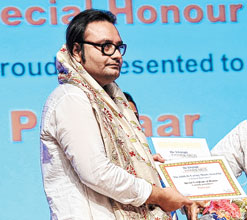
Vinayak receives a special certificate of honour on behalf of Parivaar in the ‘A School that Cares’ category of The Addlife Caring Minds Awards, along with a special honour from The Telegraph Education Foundation at The Telegraph School Awards for Excellence 2014, presented by Peerless in association with Parle-G and powered by Adamas University. The awards were given away at the Science City auditorium on Saturday
Vinayak, winner of The Telegraph Education Foundation’s certificate of honour at The Telegraph School Awards for Excellence 2014 on Saturday, was born in Bhopal but has made Bengal his home.
Vinayak had come to Bengal as a student, first to earn a degree in mining engineering from IIT Kharagpur and later an MBA from IIM Calcutta. It was while studying for his MBA that the then 20-something engineer sprang the first surprise of his career. He opted out of campus placements.
“I was the only one in IIM Calcutta’s history to do so!” he says with a laugh. “I wanted to do something in the social space. I wasn’t interested in a corporate career.”
By then, Vinayak had started skipping classes, writing journalistic pieces on social initiatives and volunteering with NGOs. He had worked with Infosys for a year in between his stints at IIT and IIM and realised that his calling lay elsewhere. Calcutta, with its “rich history of leaders and reformers”, fuelled his desire to be different.
“Being a good student from a middle-class family, engineering and MBA happened by default. But soon I found myself losing interest in a mainstream job and the corporate environment,” recalls Vinayak.
Vision & Vivekananda
For inspiration, Vinayak had Vivekananda. “I have always been inspired by the agents of change in society and the sense of sacrifice, service and devotion, especially Swami Vivekananda’s. I took diksha from the Ramakrishna Mission…spent time with monks. Mother Teresa’s influence was strong, as was the legacy of our freedom movement. I found no momentum to return to my hometown. All my thoughts became very Calcutta-centric.”
At 25, Vinayak became quite the non-conformist, determined to establish a reformatory institution of his own rather than be in the so-called rat race. “Doing what everybody else was doing didn’t excite me. My notion of success was different. I had been to the best of educational institutions, so I didn’t need to prove my abilities to anyone. I knew that if I put in my best I might be able to make it happen.”
Vinayak’s plans did irk his civil servant father, though. “My folks were worried whether I had the kind of maturity needed to carry out the responsibility of running an organisation, dealing with different domains and steering it safely and successfully.”
After moving out of IIM, he rented a small house in Sakherbazar in Behala. His plan was to start a free residential school for deprived children — the kind he had seen loitering on railway platforms and in red light areas. A few friends, researchers and professors from IIM were Vinayak’s “sounding board”.
Parivaar was born in 2003 but bringing up the child proved far from easy. “I prepared proposals, met people here and there, but all in vain because no one wanted to support something that was the wishful thinking of one individual,” says Vinayak.
With his efforts to raise funds leading nowhere, he rented a building near Thakurpukur with his earnings from lectures and tuitions to MBA aspirants. Vinayak started his mission with three kids, often not knowing where the next meal would come from. “It was a hand-to-mouth existence. I was spending whatever I was earning. My mother was my first donor,” he recounts.
In another six months, Vinayak had 55 children under his small roof, thanks to the support of “well-placed” IIM alumni who responded to his emailed appeal.
By the end of 2004, he had purchased a two-acre plot in Thakurpukur to build his dream brick by brick. Parivaar is currently spread across 20 acres. “Surely this is eastern India’s largest free residential institution for children today but not too many people know about it,” says Vinayak.
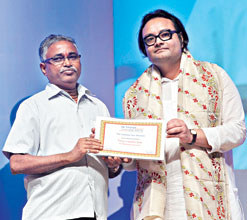
Vinayak presents The Shining Star Honour to Purna Chandra Rout, a non-teaching employee of La Martiniere for Girls for 37 years, at the Science City auditorium on Saturday. Pictures by Rashbehari Das
Parivaar path
Parivaar is today an institution that houses 672 boys and 298 girls whose lives have changed because of education and Vinayak’s encouragement. Some have gone on to get university degrees. “We have had a significant number of very inspired volunteers. They were mostly our donors who became our campaigners and spread the word actively,” says Vinayak.
Parivaar has two campuses that take in children between the ages of four and 10. The one for boys is called Parivaar Ashram. Located a few blocks away is the girls’ campus, called Parivaar Sarada Teertha. Each campus has dorm-like housing, a library, computer room, dining area, a soccer field and a volleyball court.
Parivaar also has its own co-educational school till Class X called Amar Bharat Vidyapeeth, located on the boys’ campus. “It’s not as if the kids’ stay is over once they are through with their education here. Would a parent ask a child to leave home? The older ones tutor the younger kids, earn pocket money and can move out of their own free will once they feel they are ready,” says Vinayak.
There are a few rules that set Vinayak’s initiative apart from others of its kind. “We don’t accept institutional support from any foreign agency. Ninety per cent of our donors are individuals of Indian origin, whether they are living in India or abroad. No government support. That’s how I could build it my own way because foreign or government agencies have their own parameters. I wanted to design my school my way, just like an artist would create his own piece of art,” he reveals.
Target 5,000
While his field teams are scouting for destitute children to bring home, Vinayak’s mind is preoccupied with the future challenges of the mission. “I hope to touch 1,200 by December. Since we have limited capacity at the moment, we admit children based on their neediness. Primarily orphans and the homeless are picked up from railway platforms and pavements, or those with one parent and incapable of taking care of the child.”
Apart from the city, Parivaar reaches out to rural areas, including the tribal belts of Midnapore, Bankura, Purulia and Jharkhand. The emphasis is on giving girls vulnerable to exploitation an opportunity to build their lives.
Vinayak’s IIT and IIM education hasn’t gone waste either. Parivaar is an example for institutions on how to “scale up” operations using entrepreneurial skills.
Unlike many social welfare organisations that are cagey talking about finances, Vinayak is upfront about money. “We raise around Rs 14 crore every year. I can raise Rs 100 crore over the next 10 years but I am not satisfied with that. For me, sky is the limit. I am taking Parivaar to 5,000 children in the next seven years. My aim is to convert Parivaar into the largest free residential school in the country.”
Model mission
The Parivaar model is already a case study at business schools. “A lot of people want to do things but don’t know how to get started. There’s a huge possibility of social enterprise and since I understand how it works, I want to help those who want to be agents of change — be it in education, health or livelihood,” says Vinayak.
His personal turning point was the decision to take the road less travelled, away from home and family. “When I took up the responsibility of these children I decided that I was not going to marry and raise a family. Otherwise, it wouldn’t have been possible for me to give myself completely, emotionally. I would have become nervous, I would have collapsed. So a strong focus was the emotional focus. I closed the door on any thoughts or feelings that might be distracting. And see what I have today, a family of 900!” he smiles.
Vinayak is now comfortable letting the institution run on “auto-pilot”. The faculty and his 179-strong office team take care of everything, his role being limited to “reviewing, mentoring and monitoring”. That is when he isn’t busy giving lectures at youth forums or in his new role as member of a special taskforce under the Union ministries of finance and women and child welfare. He also makes time for helping, mentoring and handholding young social entrepreneurs.
If there is one thing Vinayak is touchy about, it is about not being identified as “a Bengali”. His Bengali look, he says, has been “acquired through effort”. The dhuti was his choice of everyday attire until two years ago, when he switched to his trademark white kurta-pyjama.
“I would get offended when people wouldn’t take me as a Bengali. I have always identified with the Calcutta of the 1960s and ‘70s — the shilpis, buddhijibis and their simple-living-high-thinking philosophy that defined the city’s cultural aristocracy. Emotionally, I see myself as that and I have really tried to become one for all these years,” smiles Vinayak.
What message do you have for Vinayak Lohani? Tell ttmetro@abpmail.com
source: http://www.telegraphindia.com / The Telegraph, Calcutta / Front Page> Calcutta> Story / by Mohua Das / Monday – September 01st, 2014
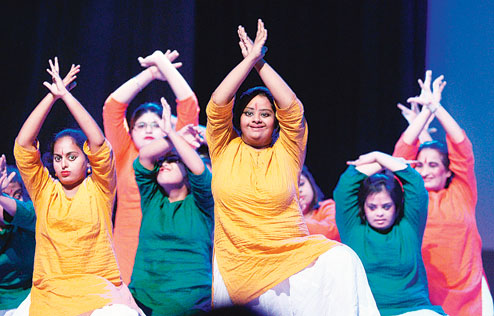
Students of Manovikas Kendra perform at a programme to mark 40 years of the organisation, at Science City auditorium on Thursday.
From tiny tots to students of vocational units, some of them on wheelchairs, everyone joined the celebration.
Sharada Fatehpuria, the founder- director of Manovikas Kendra, turned nostalgic as she remembered the first day of the institute. “It was January 28, 1974, and Saraswati Puja was being celebrated in the foyer of Gyan Manch at Abhinav Bharati High School.
The journey began with two children in one room and today Manovikas Kendra is spread over an acre and it is full of wonderful children who are studying and playing with 160 dedicated personnel,” she said.
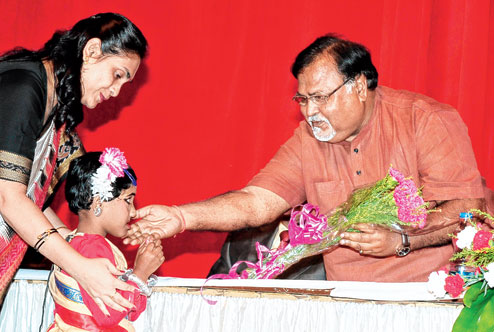
Education minister (below) Partha Chatterjee was the chief guest on the occasion.
Pictures by Arnab Mondal
source: http://www.telegraphindia.com / The Telegraph, Calcutta / Front Page> Calcutta> Story / Friday – September 05th, 2014
A place steeped in history recently hosted a spirited discussion on the teaching of history. Teachers, academicians and people of letters gathered to take a fresh look at the teaching of India’s Freedom Movement.
The discussion, titled Teaching the history of the Freedom Movement to young children, was organised at Victoria Memorial on August 19, part of a series of critical conversations to be held at the heritage venue in future.
Moderated by Devi Kar, the director of Modern High School for Girls, the participants included history teachers Anirban Mondal of Netaji Nagar Colony High School, Durgapur, Tina Servaia of Calcutta International School, and Amita Prasad of Modern High School and Megha Malhotra of The Seagull Foundation for the Arts.
“At least somebody is thinking of schoolteachers. The onus of making students understand the essence of history lies on us teachers and textbooks. India’s struggle for freedom is usually an emotionally charged topic. Can it be taught?” wondered Kar as she threw open the discussion.
Mondal felt history as a subject is very abstract and often incorrectly interpreted. “History as a discipline may not match with history of everyday life and what is interpreted on screen. We need to blend the two to teach the subject effectively,” he said.
Prasad stressed on making history lessons more approachable and not reducing it to a litany of dates and places. “Teaching history can be difficult, especially when children have little idea about the events. It is the task of a teacher to concretise the knowledge and make it a real-life experience,” she said.
The only non-teacher in the group, Malhotra, spoke about her foundation’s project on teaching conflict to students and how they have a pool of teachers to work with various schools.
The general consensus at the end of the discussion was that teachers need to excite students and teach them in a language they understand. “I like to mix activities. A Class XII student can be involved in an activity meant for junior classes, if it is meaningful. It all depends on the approach,” said Servaia.
The teachers went on to discuss classroom experiences and the advantages of using visuals and staging plays as teaching aids.
Angels on canvas
She returned to India from Israel in 2002, terribly disturbed by what she saw there and that is what inspired her to work on Angels, a collection of paintings in oil and water colour.
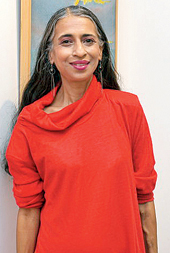
Rumi at her exhibition. (Rashbehari Das)
The Angels series by Rumi was part of an exhibition of her works at Chitrakoot Art Gallery.
At the opening of the exhibition on August 23, her birthday, the artist recalled how she read the Bible very seriously after she was left shaken by the Israel experience. “I wished for angels to be sent to earth and protect mankind.”
The exhibition was also a fund-raiser event for Rumi’s dialysis and kidney transplant.
“When I met Rumi at a friend’s place I had a feeling that I had come across a natural artist. Being a musician, I know what it is to be natural. The care and love in her paintings is evident. I wish her speedy recovery,” said Monojit Datta, Rumi’s friend and musician.
Ancient art
It was a world of kings, queens and love. Self-taught artist Devirani Dasgupta’s third solo exhibition, held recently at the Academy of Fine Arts, transported one to ancient India. Heavily influenced by Madhubani art and resplendent in earth colours, Dasgupta’s acrylic-on-canvas compositions tell stories of their own. “I am a surrealistic painter trying to connect the known to the unknown through the association of forms,” said Devirani.
Contributed by Chandreyee Ghose & Samabrita Sen
source: http://www.telegraphindia.com / The Telegraph, Calcutta / Front Page> Calcutta> Story / Sunday – September 07th, 2014
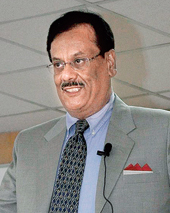
Kunal Banerji at the interactive session. (Anup Bhattacharya)
Kunal Banerji, an associate professor of management at Eastern Michigan University and a St. Xavier’s alumni, addressed students of JD Birla Institute’s management department on quality management.
The management guru dwelled upon the three cornerstones of business excellence — quality, profitability and productivity — at an interactive session organised by the Calcutta Management Association, in association with The Telegraph, on August 29.
He peppered his lecture with topics ranging from compensation and appraisal to use of suggestion systems and continuous improvement efforts to illustrate why it’s important to improve product quality, or how to do it more effectively, in the service sector.
Banerji drew from his Total Quality Management and Business Excellence, a research paper he co-authored with David E. Gundersen and Ravi S. Behara, to answer most of the questions.
He explained how quality is more perceptual than real. “Till a point of time all foreign goods were considered to be of the best quality… that is how our psyche was built. After 1992 (post-liberalisation of the economy), this perception of quality changed.”
On behalf of the CMA, its executive committee member Asok K. Banerjee thanked Banerji for discussing his research extensively with the students. “We had a great audience and a wonderful ambience.”
Banerji said: “It was a mixed crowd and that is always very interesting. Honestly, I didn’t expect such a big crowd. I don’t get such a big crowd in the US, probably because of the population rate.”
J.N. Mukhopadhyaya, the director of the JD Birla Institute’s management department, said he was happy that the seminar turned out well.
source: http://www.telegraphindia.com / The Telegraph, Calcutta / Front Page> Calcutta> Story / by A Staff Reporter / Friday – September 05th, 2014