Category Archives: Education

One stop, three starts

ApolloKOLKATA04dec2014

The Apollo Hospitals group will set up a medical college in the city with 150 MBBS and 50 postgraduate seats and a 1,000-bed hospital.

The state government has given a 14-acre plot at Calcutta Riverside in Maheshtala, on the southern fringe, to the group for setting up the medical college. The institution will be the fourth private medical college in Bengal.

The township is coming up on 262 acres on the banks of the Hooghly, about 20km from the city. Apart from residential apartments, Calcutta Riverside includes a medical college, a film city and a sports academy.

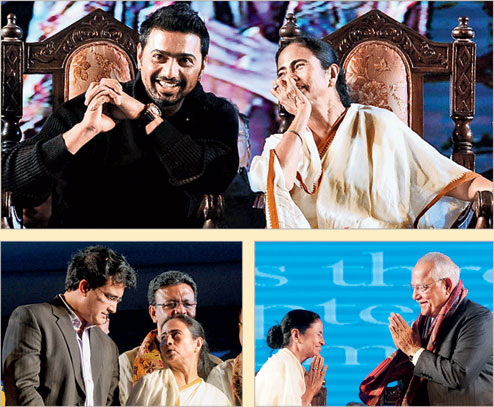
“With the Apollo Institute of Medical Sciences and Research, Calcutta will become one of the health hubs. We’ll bring faculties and new technology,” Prathap C. Reddy, the chairman of the Apollo Hospitals group, said at a programme where chief minister Mamata Banerjee laid the foundation stone for three facilities at Calcutta Riverside.

He said the medical college would be part of a bigger project by the Apollo group, which will have 17 other colleges, including ones related to paramedics, nursing and allied health services.

Mamata said she had formed a group of ministers to get the project cleared. “In the coming days a lot of doctors will be produced from here,” the chief minister said in her speech at the programme.

Apollo officials said the Rs 300-crore project would be completed in five years and in two phases. In the first phase, there will be 100 MBBS seats and a 500-bed hospital.

“We are planning to bring faculty from abroad,” said Rupali Basu, the chief executive officer of Apollo Gleneagles Hospitals, Calcutta. Once the building that will house the medical college is ready, the group will apply for a no-objection certificate from the health department. After getting the certificate, the group can apply for an inspection by the Medical Council of India.

Bengal has 2,450 MBBS seats, nearly half of which were scrapped by the medical council earlier this year because of lack of adequate infrastructure at the colleges.

The council later restored the seats after the colleges promised to set up the required facilities.

Along with the medical project, the chief minister laid the foundation stone for Kolkata Studios and Sourav Ganguly’s school and sports academy. The former Team India skipper was present on the occasion.

source: http://www.telegraphindia.com / The Telegraph, Calcutta / Front Page> Calcutta> Story / by The Telegraph Special Correspondent / Tuesday – December 02nd, 2014
Tapan Raychaudhari, the renaissance man

Calcutta University V-C remembers the historian

Historians and students in Kolkata remembered Tapan Raychaudhari as a man who had all the qualities of a ‘Renaissance man’. The eminent economic and social historian Tapan Raychaudhari breathed his last on Wednesday in Oxford. He was 90 and had not fully recovered from a stroke he suffered last year.

Professor Raychaudhuri was a Reader in Modern South Asian History at St. Antony’s College, Oxford, from 1973 to 1992. An alumni of Presidency University, he completed his second D. Phil. in Oxford University in the late 1950s, and was the Emeritus Fellow of St. Antony’s College until his death. The winner of a Padma Bhushan in 2007 for his contribution to the study of history, Professor Raychaudhari authored several books on colonial India.

Among his many publications are Bengal Under Akbar and Jahangir, Jan Company in Coromandel, Europe Reconsidered: Perceptions of the West in Nineteenth Century Bengal, and The Cambridge Economic History of India (co-edited with Irfan Habib). He had also penned two autobiographies — Bangal Nama in Bengali and The World in Our Time in English.

Remembering his teacher at Oxford University, Vice-Chancellor of the Calcutta University Suranjan Das said Professor Raychaudhuri took equal interest in both academic as well as personal concerns of the student, a quality which is rarely found in a teacher.

Recalling an incident when his foodie professor personally accompanied him and another student to the dining hall to help shed their inhibitions in a new environment, Professor Das told The Hindu: “Professor Raychaudhuri never imposed his ideologies on us. Even if he differed with our arguments, he would think from our point of view and accordingly assist us to arrive at a logical decision. He treated criticism for his own work in an intellectual way.”

Although Professor Raychaudhuri migrated to the U.K. in 1970’s, he was passionate about research on Indian studies and helped establish the Centre for Indian Studies at Oxford University to encourage research on Indian studies to help dispel commonly-held stereotypes about India and Indian pluralism. Instead of focusing purely on research and analysis, the Centre would take a cultural approach on Indian studies to help understand Indian culture.

Professor Raychaudhuri was a strong critic of post-modernism and believed in empirical studies, the Vice-Chancellor said adding that his wife Pratima Raychaudhuri had played a critical role in supporting him in the domestic front.

source: http://www.thehindu.com / The Hindu / Home> News> Cities> Kolkata / by Staff Reporter / Kolkata – December 01st, 2014

Calcutta University confers Honoris Causa on President

Kolkata :

President Pranab Mukherjee was awarded Honoris Causa by Calcutta University on Friday.

After assuming office as the President of India, Mukherjee has received several offers of honorary doctorate from universities, all of which he has refused. He felt that as the President of India, he should not accept such offers. But, when it came from his own alma mater, his sentiments overwhelmed him, Mukherjee said.

“I thank the university for bestowing upon me the Asutosh Mookerjee Memorial Medal that was introduced a year ago to commemorate the 150th birth anniversary of the towering personality of Indian education,” he said at the CU convocation.

Recalling his ties with the varsity, Mukherjee said he studied at Suri Vidyasagar College. “I pursued law and two postgraduate degrees — modern history and political science — from CU. It is my good luck to have been associated with this esteemed institution,” he said. It might be mentioned that the President had also taught for sometime at Vidyanagar College in South 24-Parganas.

On the sidelines of the convocation, CU VC Suranjan Das shared an anecdote. “Much after he left the university as a student, a few years ago he requested us for duplicate copies of his registration card. I was amazed as he remembered his registration and roll numbers. We could immediately provide the copies,” Das said.

Governor Keshari Nath Tripathi, too, was present at the convocation where DSc was awarded to scientist Bikash Sinha and ENT surgeon L S Ojha. DLitt was awarded to former foreign secretary Muchkund Dubey. Among the eminent teachers awarded was historian Jayanta Kumar Roy for his substantial contribution to the university.

Later in the day, the President inaugurated the 150-bed facility of Institute of Neurosciences Kolkata at Mullickbazar — a PPP project in which the health department and KMC chipped in for the venture of three NRI doctors.

Mukherjee urged young doctors to embrace value-based principles while aspiring to be top professionals. “They have to remember that the nation invested in their education and they should never snap the sacred bond with the motherland while pursuing higher studies abroad.”

The President wanted a suitable rehab policy for patients with neurological problems, which is growing among the elderly populace with increased life span. “Elderly people are suffering from diseases like dementia, for which the need for medical aid and treatment cost are increasing. The dignity of patients is to be protected so that they are not isolated,” he said. He wanted campaigns highlighting treatment of neuro-psychiatric diseases.

source: http://www.timesofindia.indiatimes.com / The Times of India / Home> City> Kolkata / TNN / November 29th, 2014

French scientist wows students with ‘do-it-yourself’ science

Kolkata :

It’s a rare lecture that makes teachers feel like the taught and forces guardians to pull out chits of paper from their wallets to take down notes in a hurry. When renowned French scientist and author Nicole Ostrowsky speaks, the laws of magnetism take on a whole new meaning.

The acclaimed physicist was in Kolkata last week as the star attraction of the third edition of Apprentice Scientist competition at The Future Foundation School (TFFS). The contest, held in collaboration with its partner school Lycee Francais de Pondicherry, encourages some of the best young brains in the city to get out of their textbooks and test their scientific aptitude in creative ways.

The participating school teams get the same equipment — and questions that force them to think out of the box. This time, for instance, each team got two plastic glasses, a football, three bottles and other items that look like odds and ends. One of the questions was: can you transfer air using two cups and a container full of water?

The teams of Class VII students had to complete four experiments, at the end of which they came to realize, hands-on, that all sciences — physics, chemistry, biology — are linked.

The correlation between sciences was a key feature of Ostrowsky’s lecture. She added psychology to the group and pointed out how it would dominate research in the days to come.

Ostrowsky, author of ‘The Agenda of the Apprentice Scientist’, is on a worldwide mission to make science fun for children. A professor emeritus at University of Nice in France, she has taught at Harvard and founded the ‘Exploratoire’ in Paris, a hugely popular collection of interactive scientific experiments. This is her first visit to Kolkata. “I am fascinated by the colours here,” she said.

The packed hall at TFFS was completely under her spell as Ostrowsky put up one scientific riddle after another: If you put a pea and a banana in a bowl of water, which will sink? If all the icebergs in the world melted, would the sea level rise? She showed how the answer to these questions can be found in simple experiments at home. “Be curious. Ask questions. That is what a scientist does,” she advised students. Handing over her pointer stick to students, she asked if anyone could find its centre of gravity. One boy did, drawing applause.

The same spirit was seen in the contest where Cedric Le-Bescont, head of science teachers at Lycee Francais, was urging the competitors to “forget your books and write your own science”. “Forget what you learnt. Analyze what you see,” he kept telling students.

He wanted them to stop etting confined to any one branch of science and to allow them to look for down-the-lane answers. The winners were Heritage School, followed by South City International and Modern High for Girls.

source: http://www.timesofindia.indiatimes.com / The Times of India / Home> City> Kolkata / TNN / November 25th, 2014

Bengal honour for Baltic biker boy

LithuanianKOLKATA23nov2014

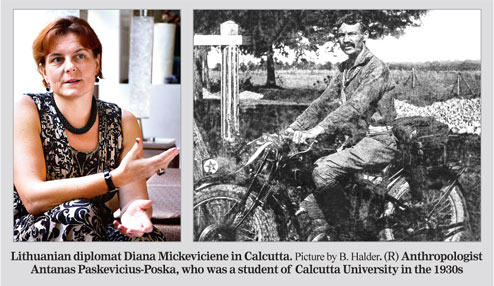
In the autumn of 1929, 26-year-old Antanas Paskevicius-Poska set off on a rather long motorbike ride. The Lithuanian would travel down south to Egypt, through Central Asia, with India as his final destination. From Iran, he took a ship to Bombay. In early 1931 he joined the University of Bombay, where he received his Bachelor degree in 1933. Then he shifted to Calcutta to collect material for his Masters. The five years he spent in India, including three in Calcutta, resulted in an eight-volume travelogue titled From the Baltic Sea to Bengal, other than accounts in the Lithuanian press about India and sundry friendships he struck with the intellectual elite.

The story will come full circle on November 28, when President Pranab Mukherjee takes the stage at the convocation of Calcutta University, Poska’s alma mater, and a posthumous DLitt is handed over to Laimute Kisieliene, Poska’s daughter.

“The Lithuanian scholar was brought to our notice by Diana Mickeviciene, a diplomat who came to us on behalf of the country’s embassy in Delhi a year-and-a-half ago to look for material on Poska. We found that he had studied in our anthropology department and had even worked on his PhD. This made us think of recognising his contribution to Indological studies,” said the vice-chancellor of Calcutta University, Suranjan Das. Rimantas Vaitkus, Lithuania’s vice-minister of science and education, and ambassador Laimonas Talat-Kelpsa are flying down too.

Mickeviciene, who has just returned to Lithuania, had spoken to Metro when she was here. “Poska was Calcutta’s ambassador in Lithuania. It is because of him that Lithuanians know about the city. He also worked at the anthropology laboratory of the Indian Museum on racial anthropology and started translating the Gita. Lithuanian is the closest living sister language to Sanskrit,” she said.

Poska, she pointed out, had also spent some time in Santiniketan as a friend of Laxmiswar Sinha, who, like Poska, was a practitioner of Esperanto, a constructed international language. Here he came in touch with Tagore and translated some of his poems into Lithuanian.

Among his friends was the linguist Suniti Kumar Chatterji, who became interested in the Lithuanian and Baltic culture. The monograph of his comparative research of Indian Vedic and Baltic pagan rites, Balts and Aryans, was dedicated to Poska. Chatterji even travelled to Lithuania twice, Mickeviciene added.

Poska met Mahatma Gandhi twice, in Bombay and in Allahabad, and conveyed to him the support of the Lithuanian people for India’s Independence. “Gandhi had gifted him a tablecloth which he took with him even to Siberia, where he was sentenced in 1945 for refusing to comply with an order to destroy books published before the Soviet occupation,” she said. He was the head of the library department of the Lithuanian SSR commissariat then. Most of his archives were destroyed.

Poska’s doctoral research remains unfinished business, though. He did his PhD thesis in physical anthropology under professor Biraja Sankar Guha. It was sent to London for the measurements of skulls to be checked. Poska’s diary mentions that the paper was sent to the British Museum in 1936, and he was planning to go to London to defend his thesis but the delay in his return journey from India, financial difficulties and finally the outbreak of World War II came in the way.

When Chatterji visited Poska in Lithuania in 1966, he had volunteered to retrieve his dissertation from London and to accord the scientist a PhD from the university. However, though Poska’s diary mentions Chatterji’s letter informing him of granting him the degree, and Chatterji himself addressing him as “Dr. Antanas Poska” in the preface to Balts and Aryans, the university archive has no such record.

“Without the defence, his PhD could not have been completed. All we have is the title (‘Physical Affinities of Shina-speaking people of the Western Himalayas’). But we all agree that he deserves recognition,” said vice-chancellor Das.

source: http://www.telegraphindia.com / The Telegraph, Calcutta / Front Page> Calcutta> Story / by Sudeshna Banerjee / Sunday – November 23rd, 2014

NBU to host science meet

Siliguri :

The North Bengal University has been chosen by the state department of science and technology to host the Bengali Science Congress for two days in February-end next year.

According to varsity sources, the authorities were informed by officials of the state science and technology department about hosting the two-day event from February 28.

“The trend of hosting the Bengali Science Congress was started by the erstwhile Left Front government. The main aim of holding such a meet is to encourage young students to take up science in their higher studies, pursue research or start careers in the field. Even research scholars benefit from the congress as they get to know about the recent findings in the field, new technologies and new areas which can be subject of future research,” a varsity source said.

The two-day event will be conducted mostly in Bengali and thus, it has been titled Bengali Science Congress.

“Most of the lectures, exhibitions and posters will be in Bengali. Students may not understand certain scientific terms in English and that is why Bengali has been kept as the medium of instruction. Such events will help clear their doubts and also give them direction as to which field of science they want to take up in future,” a source said.

The last time NBU had hosted the congress was in 1998. Topics in different fields of science like botany, zoology, chemistry, physics and environmental science will be dealt with at the event. Around 25 resource people like faculties of different varsities and scientists will be invited to the event.

“We are hosting the event after around 16 years. The host varsity as well as the state department will choose the resource persons for the event,” said the source.

source: http://www.telegraphindia.com / The Telegraph, Calcutta / Front Page> North Bengal & Sikkim> Story / by The Telegraph, Correspondent / November 20th, 2014

Innovation showcased at science meet

Kolkata :

Innovation and creativity were the hallmarks of the third Times NIE Science Project Competition held on Saturday at NSHM Knowledge Campus, Kolkata. Presented by NSHM Knowledge Campus, the event saw students from over 50 schools impressing the distinguished panel of judges with their projects on Physical Science, Life Science or Social Science. The projects were evaluated on three primary parameters: innovation, application and presentation.

The projects made by the students ranged from nanotechnology, hydraulics, cardiology, hovercraft, Everest climber, USB fan to smart stick for the blind, virtual reality, solar car, windmill, gastro-entro system, bottle tornado, robotics, gyro boat, Kepler space telescope and solar sound radio receiver.

The judges were Dr. Abhijit Chakraborty, professor and head, Crystallography and Molecular Biology Division, Saha Institute of Nuclear Physics; Dr. Rajendra Nath Basu, chief scientist and head, Fuel Cell and Battery Division, CSIR-Central Glass & Ceramic Research Institute, Kolkata and Dr Manish C Bagchi, CSIR Emeritus Scientist, School of Bioscience & Engineering, Jadavpur University.

The first prize was won by La Martiniere School for Boys for their project ‘Auto control street light’ which showed how street lights can glow for one or two km only on detecting vehicular movement. In second place was Calcutta Girls High School for their project, ‘Flix’, a hydraulic robotic arm which was based on Pascal’s Law. The Heritage School came third for their project on the advantages of automatic irrigation system. Special Appreciation Awards were given to 10 schools.

“At NSHM, we believe in learning by doing. In fact, we give emphasis on experiential learning. The kind of curriculum we offer are not typical academic courses. We call them professional degree courses which are different from the run-of-the-mill or traditional academic courses,” said Cecil Antony, managing trustee, NSHM Knowledge Campus.

source: http://www.timesofindia.indiatimes.com / The Times of India / Home> City> Kolkata / by Althea Phillips & Monalisa Chakraborty, TNN / November 17th, 2014

Raman memorial lies forgotten

Kolkata :

Few in Kolkata seem to remember Sir C V Raman on his 226th birth anniversary or the fact that he discovered the Nobel-winning Raman Effect at a small laboratory in this city.

The memorial on the campus of Goenka College of Commerce at BB Ganguly Street stood forlorn and deserted on Friday. A bust of the scientist had been garlanded and a bunch of agarbattis lay nearby. Nobody had bothered to relight them after they went out soon after being lit the first time.

“We haven’t seen any programme organized here. The college administration takes care of garlanding the bust and keeping the place clean. We sometimes use it as a shelter when it rain,” a student said.

When the ‘Hall of Scientific Fame’ was inaugurated in January 2013, it was announced that scientific discourse would be held there routinely. Replicas of Raman’s instruments were to be displayed. An enclosure exists but it is empty.

The original building of IACS, the first science research unit of India, was established during Bengal Renaissance where Goenka College now stands. It was here that Raman carried out his research between 1907 and 1933 that won him the Nobel Prize in 1930.

When Bidhan Chandra Roy was chief minister, he offered land to IACS at Jadavpur as the BB Ganguly Street plot had to be returned to the government so that Goenka College, which was in Presidency College, could become an independent institution. Raman was extremely unhappy on coming to know that the original campus of IACS hadn’t been preserved and resigned his membership.

In 2012, scientists from Kolkata appealed to then Prime Minister Manmohan Singh to build a memorial on the original site. This was inaugurated in 2013. “It’s just a memorial where no other activities are held. Little effort is made to preserve heritage in our country. We can’t carry out any activity at BB Ganguly Street as we are located quite far now. We can’t keep replicas there as the space is open,” said Prof Deb Shankar Ray, acting director, IACS.

source: http://www.timesofindia.indiatimes.com / The Times of India / Home> City> Kolkata / by Jayanta Gupta, TNN / November 08th, 2014

Rs 16cr bounty for IIT-Kharagpur innovators

Kolkata :

Freedom to experiment has always been a strong point for IIT-Kharagpur. And now, this freedom will take budding innovators across the globe to realize their dreams. On Wednesday, two alumni of the institute, Arjun Malhotra and Srigopal Rajgarhia, came up with a generous ‘gift’ of Rs 16 crore for their alma mater.

While Malhotra, with his Rs 6 crore plus grant, is setting up the innovation centre inside the campus, Rajgarhia has donated Rs 10 crore to connect the Kharagpur campus with best-known institutes abroad. This is not just an “exchange” link in the form that we know it otherwise. Under this international programme, 30 best students of IIT-Kharagpur will be sent abroad to complete portions of their projects/credits there. This will be added to their degrees and the entire cost for their travel, stay and tuition will be borne by the institute from the endowment.

A part of Rajagarhia’s grant will be used to bring top-notch faculty from abroad for specific teaching hours.

For Malhotra, donating to IIT has become routine now. “I am aware of the talent in the boys here, which sometimes don’t come to the fore for lack of funds. The innovation-centre is a no-holds barred place where any one within the campus can soil his hands to bring alive any bright idea,” promised Malhotra.

“We need to build the confidence among students so that they inculcate the ability to start experimentations from the very beginning. The institute wants them to get exposure from the very first year. Innovation should not be limited only for a handful of students,” said alumni affairs and external relations dean Siddhartha Mukhopadhyay.

PP Chakraborty, director of the institute, was happy that finally IIT-Kharagpur has shed its conservatism in teaching-learning process and moving towards globalisation. “It is not enough to be just a premier tech school of the country. Our students do need foreign exposure. Each selected student’s curriculum will be framed in such a way that they are able to do a lot of reference work in the libraries and laboratories, attend lecture hours and also visit industrial houses abroad.”

source: http://www.timesofindia.indiatimes.com / The Times of India / Home> City> Kolkata / TNN / November 06th, 2014

French return to Park Mansion

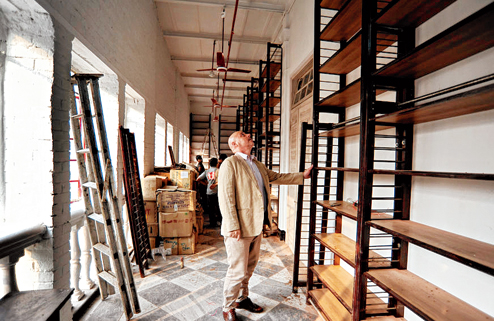
Director Stephane Amalir inspects the book racks at Park Mansion. (Amit Datta)

Alliance Francaise, the city’s cultural bridge with France, is returning to the address where it stood for 59 years till a fire ousted it in 1999. The shift to Park Mansion is slated to take place in mid-December.

“Khaleel Munzil (the current rented address on AJC Bose Road) is a nice building but it is up for sale. We want to move out before we are asked to,” says director of Alliance Francaise du Bengale (AFB) Stephane Amalir.

AFB operates out of Khaleel Munzil and Bimal Villa on West Range, a few buildings away. “We will retain Bimal Villa but the library and the administrative offices will shift to Park Mansion, where we have acquired a 3,500sq ft apartment on the second floor on a 10-year lease,” Amalir says.

The French culture hub, then called Alliance Francaise du Calcutta, was housed at Park Mansion ever since it opened in 1940. It is the second in India after the Pondicherry centre, which turned 125 this year. “Back then, Alliance Francaise had 8,000 sq ft over two apartments in the first and the third floor. The consulate too was there as was the Trade Commission in separate apartments. I would pick up a book from the Alliance library upstairs before going home,” recalls Fabrice Etienne, the consul-general, who was posted at the Trade Commission here for two years in 1995-96.

The fire broke out in the wee hours of April 18, 1999. “We were rendered homeless and moved around to Max Mueller Bhavan, Nehru Children’s Museum and Sukhsagar Building in Elgin Road till we settled at West Range,” says Kaushik Chakraborty, a teacher at Alliance since 1981. Veteran staff members, like him, Mirza Salim Baig and Amitabha Ghosh, are nostalgic about the return to the old address.

Of course, much has changed. The wooden staircase is gone, gutted completely by the fire. It has been replaced by marble steps. Amalir is busy supervising the renovations. “We were handed an empty shell. The idea is to accommodate modern needs while keeping the charm of the old building.” Fire-proofing gadgets are being installed. In the library, there will be tablets to access Culturetheque, the upcoming e-library platform. “Members will be given passwords to log in from home as well to magazines, books, films and reading material online.” An 800sq ft room will host film screenings and conferences while bigger cultural events will use outside venues. The 18ft high ceiling will be retained as also the wooden doors and windows.

source: http://www.telegraphindia.com / The Telegraph, Calcutta / Front Page> Calcutta> Story / by Sudeshna Banerjee / Tuesday – November 04th, 2014