Category Archives: Education

IIT-Kgp bags top award for patents

Kolkata:

The IIT-Kharagpur has won an award from the Indian government for being the top academic institute for patents in 2016.

IIT-Kharagpur director Partha Pratim Chakraborty said they have received a letter from the Union Ministry of Commerce and Industry, which said that the institute has been awarded the prize for ‘Top Academic Institute for Patents 2016’. PTI

The award will be given on April 26 in Delhi by Union minister Nirmala Sitharaman at a function jointly organised for the celebration of World IP Day by the Indian Intellectual Property office.

The Indian Intellectual property office confers national intellectual property awards on outstanding innovators, organisations and companies in the fields of patents, designs, trademarks, and geographical indications on the occasion of World IP Day every year.

The National IP Award carries an amount of Rs 1,00,000, a citation and a memento.

To simplify the process of patent filing by students as well as professors who have done some substantial research within the institute, the IIT has been running an IP Portal.

Prof Goutam Saha of the institute said patents help them in getting consultancy work and other projects / PTI

source: http://www.timesofindia.indiatimes.com / The Times of India / News Home> City> Kolkata / TNN / April 10th, 2016

Belle Vue to set up 2 new hospitals and nursing college

Kolkata :

With an investment of Rs 500 crore, the super-speciality Belle Vue Clinic is building another 400-bedded hospital, an eye hospital and a nursing college in Rajarhat.

“We have got two plots of two acres each in Rajarhat area where we will be expanding. Funds to the tune of Rs 500 crore have already been allocated for the new facilities,” hospital CEO P Tondon told reporters here today.

He said the 400-bedded super speciality hospital will have different departments but it will specialise in trauma care.

“Trauma care is a very difficult subject and everybody doesn’t want to venture into it,” he said adding that the construction work will begin from January next year.

The new hospital as well as the eye hospital will be ready by 2020, the official said.

On another two acre plot they will set up a nursing school, accredited by the Nursing Council of India, where 400 students will be trained in nursing skills.

“There is a lot of shortage for nurses. We are also seeking permission from the state government to allow us train male nurses as well. Lot of patients want male nurses and so there is a big shortage in the market,” Tondon said.

The nursing school will offer courses in General Nursing & Midwifery (GNM) and a BSc in nursing. Both courses are of three year duration.

Belle Vue has now got recognition from the National Accreditation Board of Hospitals & Healthcare Providers (NABH).

Their existing setup in south Kolkata has 287 beds at present which will be expanded to 357 in a year’s time.

“We are always short of beds. Lot of patients under the West Bengal health scheme also come to us and so we are adding two new floors in the building to have 70 extra beds,” the hospital head said. NIK NN

source: http://www.timesofindia.indiatimes.com / The Times of India / News Home> City> Kolkata / PTI / April 08th, 2016

Pages from city’s past – Young Metro

The 88-page book with a black-and-white cover may not grab eyeballs, but flipping through it will make one realise what a treasure trove it is.

The first edition of Uttaradhikar, brought out by the Oriental Seminary archive, is not a mere school journal but a compilation of memoirs and tales about the city from a host of writers.

The bilingual publication edited by C.P. Ghoshal, a teacher at the school and in-charge of the archive, took around eight months to put together. “I wanted the contributors to write about Chitpore or their school memories or about the history of Calcutta in the 18th and 19th centuries. A publication by a school that goes back to 1829, should bring out the flavour of the various periods that it has been part of,” he said.

The book, being sold for Rs 50, has write-ups from current and ex-students as well as from historians and researchers. The English essays are by Subha Das Mollick, the founder-member of Bichitra Pathshala, and Mary Ann Dasgupta, an educationist.

Mollick writes about the Our Living Memory project that involved several schools in the city. The project attempted to link family history and collectibles to history textbooks and underline the latter’s relevance in today’s world. Dasgupta takes readers on a tour of St. Paul’s Cathedral and its relics.

Other contributors include historian Soumitra Srimani, researchers Simanti Sen and Rajat Kanti Sur and current student Ayan Ghosh.

There are six write-ups in Bengali – a heady mix of Calcutta in the 19th century, Chitpore’s culture, old boys’ memories and a current student’s journey. The book cover, designed by a former student, is a throwback to Chitpore’s popular woodcut printing.

The book was launched by former student and academician, Ashok Chowdhury, the current principal of the school, Diptiman Kundu, and Srimani at a cultural programme on the school premises.

source: http://www.telegraphindia.com / The Telegraph,Calcutta,India / Front Page> Calcutta> Story / by Chandreyee Ghose / Friday – April 01st, 2016

Faculty of Heritage Institute of Technology receives Gandhian Young Technological Award 2016

It was a proud moment for Heritage Institute of Technology Kolkata when one of its faculty members, Debjyoti Chowdhury, received the Gandhian Young Technological Innovations Award 2016 from the President of India on March 12, 2016.

Chowdhury was previously a student of the Department of Applied Electronics and Instrumentation, of the institute and was guided by Madhurima Chattopadhyay, head of the department of Applied Electronics and Instrumentation of the institute under whom he completed the project for which he received the award.

Chowdhury had created a “Cost effective self-stabilizing smart hand held platform (spoon/pen) for the elderly or Parkinson’s disease patients” under the guidance of Chattopadhyay. The project introduces an easy to adopt hand mount device that can be used to support the tremors in hands of old people with the disease for day to day normal activities like writing with a pen,having food with a spoon and also holding crockery/knifes.

More than 500 Institutions competed for the award and a total of 1,80,000 projects were submitted for the award.

source: http://www.timesofindia.indiatimes.com / The Times of India / News Home> City> Kolkata / by Jhimli Mukherjee Pandey / TNN / March 15th, 2016

Old boys get together to give back to their alma mater

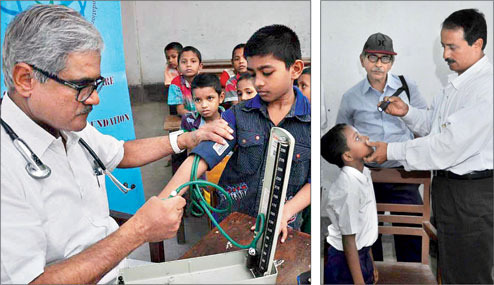
Rabin Chakraborty examines a student and a free eye check-up camp on at Uttarpara Government High School on Sunday. Pictures by Anup Bhattacharya

The 1972 batch of Uttarpara Government High School, which calls itself UGHS72 Soulmates, has got together to give back its due to its alma mater. On a Sunday morning, the classrooms are abuzz with children and their parents. Aritra Ghosh of Class IV cannot read small letterings and so Bablu Ghosh his father, a BSNL employee, has brought him to the free eye camp organised by Soulmates with the help of a medical trust, the Salt Lake City Global Health Welfare and Social Research Foundation.

“The doctor said he is myopic and will have to be given glasses,” said Bablu, who also got his eye power checked for free. Aritra’s classmate Arka Pramanick, probably wanted to spend the Sunday morning with his friend. “He came and complained that he cannot read properly and told me that the school was going to have an eye camp. So I brought him here to get his eyes checked,” said Narendra Pramanick, a tailor at Bally, Howrah. But Arka’s eyes are just fine, assured the ophthalmologist at the camp.

Not just eye camp, a general health camp was also held at the school by the Soulmates earlier. Leading cardiologist Rabin Chakraborty, psychiatrist Moloy Ghoshal, both of who belong to the ’72 batch, and oncologist Arundhati Chakraborty participated in the camp to assess the physical and mental wellbeing of the children and their parents in the school. “I was shocked to find young children and their young mothers suffering from hypertension and stress,” said Chakraborty.

“I found a Class III child had blood pressure that measured 124/86. It is dangerous. On top of that he was obese. I found out that he hardly does any physical activity. He watches cartoon shows on television most of the time,” said Chakraborty. And his mother, a 41-year-old, suffers from hypertension with her blood pressure reading 164/96. “I found out from her that there was a lot of tension at her home. Though they live in a joint family, the kitchens are separate. The husband works at the race course. She knows that she has hypertension and is undergoing homeopathy treatment but she is not regular with her medicines. I prescribed medicines for her and counselled her on how to cope with stress,” said the cardiologist.

The camps are aimed to increase health awareness. “I always tell them to avoid the four Fs, Fast Fried Fatty Food,” said Chakraborty. Oncologist Arundhati Chakraborty does family history screenings and symptom screenings at the health camps. “I try to make them aware about breast and cervical cancer,” she said. Psychiatrist Moloy Ghoshal has also held a stess management programme, all under the aegis of Soulmates.

It was in 2013, prior to the WhatsApp boom, that the batch of 1972 of Uttarpara Government High School got together. “It was Jhantu Banerjee, based in Delhi, who got us together. Out of a class of 78, a total of 65 got together. Unfortunately, eight of us are no more. So without wasting time, we met with the motto of giving back to the school what it gave to us. We want to help the teachers, help the present students and also improve the infrastructure of the school,” said Dipankar Roy, member of Soulmates.

A cycle stand for the school children funded by the alumnus is just the beginning of this journey.

source: http://www.telegraphindia.com / The Telegraph,Calcutta,India / Front Page> Calcutta> Story / by Special Correspondent / Monday – March 14th, 2016

Experts to Document Ashoka Circuit in State

Kalaburagi :

A joint initiative of HKRDB and Calcutta University to document an Ashoka Circuit for Karnataka from Sannati to Siddhapura has been launched.

Head of Ancient History Department of Calcutta University Prof Susmita Basu Majumdar is the Principal Investigator. As part of this expedition, a documentary will be filmed and a pictorial Pali-English-Kannada dictionary will be compiled.

Karnataka has perhaps the largest number of Ashoka sites and those dating back to the 3rd century BC are the earliest legible records found from Afghanistan in the northwest, Andhra Pradesh in the south, Odisha in the east to Girnar in the west. The project will first document all the Ashokan sites in Karnataka and then establish the full circuit from Afghanistan.

AshokaBF02mar2016

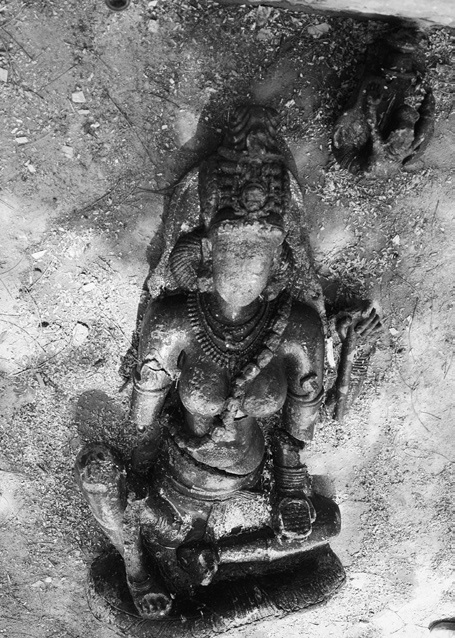
A team of three, Prof Susmita Basu Majumdar, artist Rajib Chakraborty and film maker Ranjay Ray Choudhury visited the Chandralaparameshvari temple at Sannati on Sunday, to document the spot where the Ashoka edict was found. They found the original idol of deity Mahakali broken into four pieces lying on the western side of the temple on the banks of river Bhima.

Prof Basu Majundar took the initiative to re-join the idol and narrated the interesting story behind the discovery of the Ashoka inscriptions. In 1986, a portion of the roof of the temple collapsed and caused damage to the 12th century seated four handed figure of goddess Mahakali wearing mundamala and holding damaru, trishula, kapala and sword.

Presently, this beautiful piece of sculpture only shows the trishula and kapala and the other two hands are broken but the temple authorities informed that the present image of Chandraparameshwari which is worshiped in the temple is a replica of the previous Goddess.

The khandita pratima of the deity lying on the banks of Bhima was almost awaiting the visit of this team and when the sculpture was joined it looked as if the beautiful Goddess had reappeared.

The idol base had a protruding pillar like hinge which was fitted into a stone socket. The stone on which the Ashoka inscription was engraved was used to form the base of this deity. When the idol was damaged, the inscription was discovered.

This inscription carried the separate edicts one and two and rock edits 12 and 14 of Ashoka (274-232 BC). Karnakata was the southernmost boundary of the Ashoka’s Mauryan Empire.

This inscription was discovered in 1989. Now the original idol which is about 600 years old is also restored to the temple. The matter is being reported to the ASI for further action.

source: http://www.newindianexpress.com / The New Indian Express / Home> States> Karnataka / by Express News Service / March 02nd, 2016

Bengal village teen bags top Nasa scholarship

Eighteen-year-old Sataparna is among only five scholars from the world chosen for the programme
Eighteen-year-old Sataparna is among only five scholars from the world chosen for
the programme

Kolkata :

Eighteen-year-old Sataparna Mukherjee, a Class 12 student from a village around 30km from Kolkata, has been selected by the National Aeronautics and Space Administration (Nasa) for its prestigious Goddard Internship Programme under the Goddard Institute for Space Studies (GISS). She is among five scholars chosen from across the world for this programme.

Nasa’s GIP selects five exceptional individuals from across the world every year and funds their entire education after school.

Sataparna, who will appear for her school-leaving exams this year from St Judes School, Madhyamgram, in Kamduni – it gained notoriety for a brutal gangrape in 2013 – will be at Oxford University, where she she will pursue graduation, post-graduation and PhD (as Nasa faculty) in aerospace engineering at its London Astrobiology Centre.

Sataparna told TOI, “It all started in May last year when I was a member of a group on a social networking site where there were many members, including some scientists. One day I shared some of my thoughts on ‘Black Hole Theory’, and one of the members of this group gave me Nasa’s official website and told me to post my findings, which I did.” Sataparna’s paper on Black Hole Theory, and how this could be used to create a ‘Time Machine’, was hugely appreciated. “I am very happy to get this opportunity where I will also work as a researcher at the Nasa centre in London,” she said.

Under the Goddard Internship Programme, Sataparna will work as an “employee and researcher”, where she will be part of its earth science and technology development programme. Nasa is paying her a generous sum as honorarium, apart from bearing all her expenses.

Her father Pradip Mukheree, a headmaster of a primary school who led a people’s movement against goons and political pressure to drop the infamous June 2013 Kamduni gang-rape case, said, “She has made us, and the entire country, proud.”

Pulak Chakraborty, a professor of English at the Nabagram Hiralapal College, who’s acting as Sataparna’s referee at Oxford, said, “She is a very good student and her ability should not be judged through her marks alone. She is original, and that has made her attain so much.”

“She is going on August 17,” said Pradip. “Though every cost is borne by the university and Nasa, we will arrange for the passage money, which is quite high. I am thinking of taking a loan because I don’t want to let this opportunity go,” he said.

source: http://www.timesofindia.indiatimes.com / The Times of India / News Home> City> Kolkata / by Saibal Gupta / TNN / February 29th, 2016

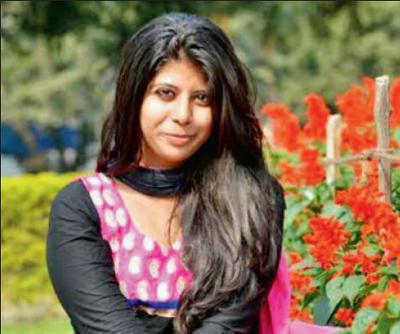
Kolkata girl creates underwater drone

Sampriti Bhattacharya

Kolkata :

At 28, she has created an underwater drone that can map ocean floors and explore the deep sea, where even GPS doesn’t work. Kolkata girl Sampriti Bhattacharya’s invention — the Hydroswarm — has been patented and is quite a rage with the defence sector and oil giants.

What’s more, Forbes has featured her among the top 30 most powerful young change agents of the world. Sampriti, who left the city about seven years back for her masters, is now a PhD scholar at Massachusetts Institute of Technology (MIT).

Hydroswarm was created as part of her research thesis. “Underwater navigation has been a reality for many years but for advanced searches you need maps that are as refined as, say, the Google map. This is where my drone comes in. It can map the ocean, sitting on its bed, and you can zero in on the minutest objects, living or non-living.

You can even map underwater pollution with the help of this drone,” said Sampriti, who was in Kolkata for a short while and returned to the US on Thursday. A South Point alumnus, she studied engineering at St Thomas College and did her masters in aerospace engineering at Ohio State University before switching to robotics at MIT.

She told TOI that she always wanted to create an underwater robot because there was no easy way to study the ocean floor. The only option was the very expensive remotely operated underwater vehicles generally used to track warships.

source: http://www.timesofindia.indiatimes.com / The Times of India / News Home> City> Kolkata / TNN / January 29th, 2016

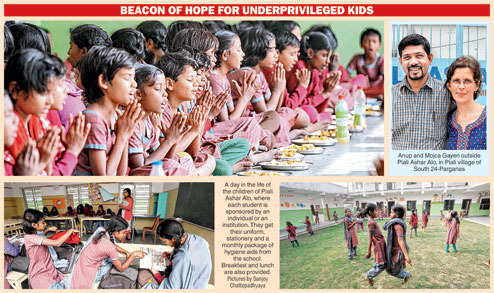
Bengal school with Slovenia heart – Couple united by a calling

SloveniaKOLKATA01FEB2016

• Name of school: Piali Ashar Alo
• Where: In Piali village, around 27km from Calcutta
• Students: Underprivileged children
• Founders: Anup and Mojca Gayen
• Sponsors: Slovenian schoolchildren and various other individuals and families; two German NGOs

A bright village boy who might have been grazing cattle had a German lady not funded his education is giving many others a shot at education through a school he and his Slovenian wife have set up with donations from Europe.

Anup and Mojca Gayen’s Piali Ashar Alo, in Piali village of South 24-Parganas, isn’t just an extraordinary act of charity. It is a mission spanning continents and small contributions – from Mojca digging into her personal savings to provide Rs 12,000 as seed money to students of 30 schools in Slovenia collecting newspapers over two years to sell them in bulk and raise Rs 4.5 lakh for a plot of land.

The school, which had started out from a rented space in February 2008, has since gone from a class of 12 students to a roll call of 140, mostly children of daily-wage earners, van rickshaw-pullers, fisherfolk and brick kiln workers. Most of the students are girls.

The genesis

Anup, 45, had always wanted to do something for the underprivileged, a feeling that found an echo in wife Mojca, 38. She was on a six-month internship in India in 2006 when she decided to leave her job as a psychologist in Slovenia and stay back.

“If there is no education, children of the poor will continue to remain poor. I believe that if not all, at least 50 per cent of our students will grow up and stand by another poor child,” says Anup.

In the early days, Anup and Mojca would go from door to door to convince parents to send their children to Ashar Alo. The school still sends teachers to homes in the village, but only to ensure that the seats are filled by children who wish to study.

Each student, from kindergarten to Class VII, is sponsored by an individual or an institution, most of them based abroad. They get their uniform, stationery and a monthly package of hygiene aids from the school. Breakfast and lunch are provided too.

The school has two floors with open-plan classrooms and a playground spread across a bigha and two cottahs of land. The building was designed by a Slovenian who was then studying architecture and had spent a year in Piali observing the place, its people and climate.

“He took note of how most villagers spend a lot of time on the verandas of their home and felt that his design should reflect that. So we have open classrooms,” explains Mojca.

The playground bustles with energy during a break between classes, badminton and skipping being the students’ favourite activities. This they are allowed to do only after they have finished their meal and cleaned up, for etiquette and discipline are as important at Ashar Alo as learning to read and write.

The school also teaches its students to dream. Twelve-year-old Sanchita Mondal’s father earns a living as a hawker on local trains, but she aspires to be a doctor. She is one of three students from Ashar Alo who now go to a CBSE-affiliated English-medium school in Sonarpur, about 5km away.

“We are not from rich backgrounds but the importance of education was obvious to our families when we were young. But the importance of education is not obvious to many in Piali,” says Mojca.

Ashar Alo’s focus is on educating girls, although the school remains a co-ed institute. “Women must learn to read and write. Even at home, they should not have to listen quietly to everyone who has an opinion. They should be able to speak and go to the bank or the post office,” says Mojca.

According to Anup, “80 per cent of the girls in the area” wouldn’t go to school until the start of the previous decade.

Momina Bibi, who works in the school’s kitchen, is one of them. Her daughter Jasmina Khatoon is a Class VI student, though. “I couldn’t study but I want my daughter to earn a decent living,” says the 29-year-old.

Many girls leave their education midway to get married. A six-year-old who studies in the school also accompanies her grandmother to beg.

A couple of years ago, the school started charging between Rs 30 and Rs 50 a month from the parents of some children who can afford to pay the fees. “Otherwise, they tend to take everything for granted,” explains Anup.

Flashback

Anup remembers carrying hay on his head and helping his grandfather graze cattle. It was a life he would have probably continued to lead in Champahati, the village next to Piali, had his mother not sent him off “with a pair of clothes, a plate and a glass in an aluminium box” to catch a train to Sealdah and from there to Behrampur.

He was eight then and headed for the Children’s Home run by the Christian Mission Service. He next moved to Azimganj, then Bhadrakali and again to Konnagar College to complete his education. In 1993, Anup enrolled for a mechanical and motor vehicles training course at the Industrial Training Institute near Kanyakumari. He topped his batch.

His first job was with a courier service in Calcutta that earned him Rs 700 a month. A succession of jobs later, he found his calling in educating needy children. “I owe my education to a German lady. We would write to each other but I never got a chance to meet her then, because it was meant to be confidential,” says Anup.

But he finally did manage to meet her in the middle of 2008 when his wife helped track Haide Marie Schneider in Germany through a friend who had searched the “telephone dictionary and managed to locate her despite Schneider being a common name”.

“I travelled to Germany to meet her,” he recalls.

Wife Mojca first came to India in 2006. “I had always wanted to serve poor children…and I went to Africa and then came to India…not to travel but to serve. But my work was for a limited period and I didn’t intend to stay,” she recalls.

That was, of course, until she met Anup. “I had a wish and he had more experience in the field and we decided to do it together,” says Mojca.

Funding

After Ashar Alo started, Mojca wrote to people she knew in Slovenia for help. One of them, Romana Jordan, mobilised schoolchildren to collect newspapers and sell them to raise the money that helped buy a plot.

Christlicher Entwicklungsdienst, a German NGO, came into the picture after one of its members visited the “empty plot with a gate” and offered to help. “Given our resources, we would have maybe built 10 rooms in 10 years!” says Mojca.

Another German organisation called FAMI helped the couple build the boundary wall. “Before them, there were only individuals and families sponsoring us,” says Mojca.

Today, she and Anup can look back at a job well done, altgough far from complete. “Not many might know about us in Bengal, but not less than a million people know us in Slovenia,” smiles Anup.

What message do you have for Anup and Mojca? Tell ttmetro@abpmail.com

source: http://www.telegraphindia.com / The Telegraph,Calcutta,India / Front Page> Calcutta> Story / by Jhinuk Mazumdar / Monday – February 01st, 2016
IIT Kharagpur students win prestigious award

Team ‘Aces’ comprising of four 4th year undergraduate students, Anubhav Goyal, Anush Gupta, Lakshya Kalra and Shreshtha Mundra of IIT Kharagpur secured 1st place in the finals of the PAN India HULT Prize competition held at IIM Ahmedabad on January 9.

Top 30 teams from all over India had pitched their ideas to a panel of 13 eminent judges.

They will be competing against 50 other teams from across the globe at the Regional Finals of HULT Prize Competition 2016 being held at Boston, for a prize money of $1 million. The other finalists include teams from other prestigious colleges and universities like Harvard, MIT, and Yale.

The teams were asked to suggest ideas to double the income of people living in crowded urban areas within 5 years. The winning team ‘Aces’ had come up with a mobile application along the lines of Mechanical Turk to provide these people with a means of stable income by utilizing their non-productive broken time.

The app basically has simple questions based on image categorization and text verification. The team will provide this data to research groups and companies that require this preliminary data processing and transfer the monetary benefits to the people in crowded slums. Yes we are planning to initiate these ideas. Firstly the team will conduct a pilot in the month of Feb and this pilot will be the integral part of our pitch at Boston. The development of the mobile app is in the beta stage and is being handled by one of our team members.

The entrepreneurial spirit of Kharagpur can be estimated from the fact that 5 of the 30 teams at IIM Ahmedabad and 2 of the top 3 teams were from IIT Kharagpur.

Team Sanyojan comprising of Ayush Garg, Kartik Pal, Pradeep Kumar Mittapally and Pradyumna Mishra bagged the 3rd prize and will be competing at the Shanghai Regional Finals.

The idea of Team ‘Sanyojan’ was to provide B2B Services and promote local entrepreneurship along a Co-operative Society Model Supported by an Extensive Tech Platform and Micro-financing Schemes. Sanyojan’ works on a cooperative society model to provide a holistic solution. Our enterprise focuses on providing B2B services by connecting people, both skilled and unskilled, with businesses like Contractors, Security Agencies etc. Workers, employed through our enterprise, give back to the community by training other people for similar jobs.

The HULT Prize is organized by HULT International Business School in partnership with the Clinton Global Initiative and is largest student competition globally to solve the world’s toughest social challenges.

The Hult Prize Foundation is a start-up accelerator for budding young social entrepreneurs emerging from the world’s universities. Named as one of the top five ideas changing the world by Former US President Bill Clinton and TIME Magazine, the annual competition for the Hult Prize aims to create and launch the most compelling social business ideas—start-up enterprises that tackle grave issues faced by billions of people.

Winners receive USD1 Million in seed capital, as well as mentorship and advice from the international business.

source: http://www.timesofindia.indiatimes.com / The Times of India / News Home> City> Kolkata / by Jhimli Mukherjee Pandey / TNN / January 20th, 2016