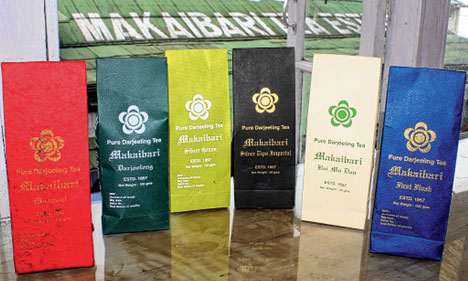
Makaibari tea packets kept in a room at the garden
Makaibari (Kurseong):
The “Rajah” of Makaibari tea has decided to “gift” his crown to workers.
Swaraj Kumar Banerjee, more famous as Rajah Banerjee, said on Thursday he would “gift” his 12 per cent shares in the marquee estate to the workers.
Barely a fortnight ago on March 16, Rajah had declared that he would exit Makaibari by selling his 12 per cent share to the management of the garden led by the Calcutta-based Luxmi Group.
That announcement had come exactly a year after Rajah’s bungalow at Makaibari was gutted in a fire, hastening the 70-year-old’s plans to hang up his planter’s boots.
If the decision is approved under corporate laws, this will possibly be the first time in the history of Darjeeling tea that the owner of a garden will give up his shares for the workers.
“I will gift my 12 per cent share to the workers,” Rajah told a meeting in the garden on Thursday, stressing his aim was to empower the 600-odd workers.
Sources in the Luxmi Group in Calcutta welcomed the move “as long as it is permissible under the Companies Act”. “We have no problem if he wants to give away his shares. It is a welcome gesture. We have to see if this is permissible under the Companies Act,” a source said.
Industry observers said, however, that the share transfer could turn risky, especially in years of poor earnings. “If the garden does not make enough profits and distributes dividends, workers may feel let down and this could be a tricky situation,” one observer said.
Rajah had forged a “strategic tie-up” with the Luxmi Group in 2013 and retained the 12 per cent stake in the estate that his family had been running since taking it over in 1859.
Members of the Makaibari Joint Committee, which represents the workers, on Thursday expressed “gratitude” for the “gift”. Rajah made it clear, though, that “the management representative on the panel will not be entitled to the shares”.
Additional reporting by Sambit Saha in Calcutta
source: http://www.telegraphindia.com / The Telegraph,Calcutta,India / Home> West Bengal / by Vivek Chhetri / March 30th, 2018
A Bata wore a Bata at a Bata store in the city on Tuesday.
Christine Bata Schmidt, the granddaughter of Bata founder Tomas Bata, visited the store in South City in the afternoon to launch a CSR campaign.
It was no surprise that Christine chose Calcutta to launch the project. “Calcutta will remain our heart in India,” Christine, a director of Bata Shoe Organisation, the holding company of Bata India, said.
In the early 1920s, Czech shoemaker Tomas came to India to source rubber and leather. Most Indians walked barefoot then and he sensed an opportunity. In 1931, he set up a factory in Konnagar. The unit started producing rubber and canvas shoes for the first time in India. Later the factory was moved to what came to be known as Batanagar.
“His idea was to be the shoemaker to the world. Great shoes that were affordable,” Christine said about her grandfather. She will visit the country’s oldest shoe manufacturing unit in South 24-Parganas on Wednesday.
Thomas J. Bata, Christine’s father, was crucial in expanding the brand throughout the country and making it a household name.
She entered the store around 3.30pm. After looking at the models on display, she picked some shoes while interacting with the children who were there for the launch of the CSR campaign.
The project is being partnered by Nanhi Kali – an NGO managed by KC Mahindra Education Trust and Naandi Foundation that provides primary education to underprivileged girl children.
For this campaign, Bata India has introduced Ballerinas with illustrations by children from schools adopted by the Bata Children’s Programme, a global programme for disadvantaged kids. The shortlisted drawings have been displayed on the inner sole of the Ballerinas. The shoes will be available across more than 200 stores in India. With each pair of Ballerinas sold, Bata will provide Rs 65 to the project.
“Bata hopes to secure a brighter future for these girls by reducing school dropouts and improving learning levels,” Christine, a member on the board of Earthwatch, a global NGO that works for sustainable environment, said.
“Calcutta is historic. At the same time, it is very alive. I do enjoy that,” Christine, the chairman of Bata Shoe Museum, a footwear museum in Toronto that refects the evolution of footwear, said.
source: http://www.telegraphindia.com / The Telegraph, Calcutta,India / Home> Calcutta / by Debraj Mitra / March 21st, 2018
From ship builders, dentists, shoe-makers — to chefs. How did the Chinese in India get stuck with the identity of the Chinese chef? A report from Kolkata, the only Indian city with two Chinatowns where the Chinese came 220 years ago
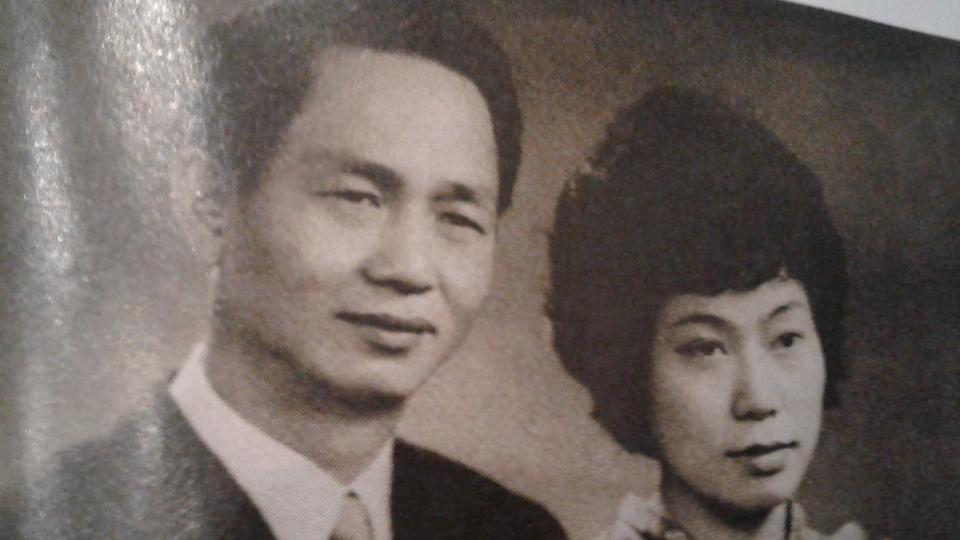
(R) Monica Liu with her husband. Liu, an Indian Chinese, is one of the most successful restauranteurs of Kolkata. (Photo courtesy: Monica Liu)
You could almost say Tong Atchew was a good mushroom growing on foreign soil. A mushroom does wonders for the soup, the stir fry and as stuffing. No flash, no permanent dash, but it still stands on its own even as it adds to the flavours of the mix into which it is thrown.
Atchew, a middleman, believed to be the first Chinese immigrant in India, arrived in 1798. He managed to strike a deal with Warren Hastings, the governor-general of British India, and became the owner of a sugar mill near Kolkata.
In the late 18th century, Kolkata was the terminus, the port and the transit point to pretty much everywhere else. The Chinese in India, especially the Chinese of Kolkata, the only Indian city with two Chinatowns –– the first in Tiretta Bazaar has existed since the 1800s, the second, in Tangra since 1910 –– consider Atchew The Ancestor. Here was someone who made ‘leaving home’ a success story, in contrast to staying put, the established wisdom for that age. He consolidated the image of the Chinese as a hardy migrant who slogs for his success, is a credit to his community, and keeps his own counsel.
At Tangra, the second Chinatown, of Kolkata. (Samir Jana/HT PHOTO)
The Chinese who came to Kolkata were mainly from coastal China, then ravaged by civil wars; many landed in between the two world wars too. All had different skills and traditions, which they innovated, in order to survive. The Hubeis, who were “teeth-setters”, became dentists. The Cantonese were ship-fitters; by the ’50s they had moved into carpentry. The Hakkas were talented shoe-smiths and leather manufacturers. All of them came to India to work. None of them came here to cook.
But as the example of Monica Liu, a Hakka housewife who has become Chinatown’s most well-known businesswoman over the past 10 years, shows, the restaurant business can become an area where race or ethnicity may find accommodation, and success –– if it does not challenge established tastes too much.
In the ’90s, Liu cooked for the late chief minister Jyoti Basu at his home after his return from China. In 2012, writer Amitav Ghosh did a lunch with the Financial Times at Liu’s flagship restaurant, Beijing. Here, he discussed the opium trade, linguistic adjustments made by men who met at sea featured in his Ibis trilogy over beer and steamed bhetki. In 2018, Liu is preparing to face cricketing legend Sourav Ganguly in the popular Bengali television game-show, Dadagiri.
Two Bengali boys watching Liu, as she does the rounds of the tables at the Beijing restaurant, delay stuffing the last tiger prawns into their mouths and greet her saying they have seen her appear in some TV programme. In block heels, cropped hair and thinly pencilled eyebrows, Liu’s is as public a public face as is possible in a community that shuns the media.
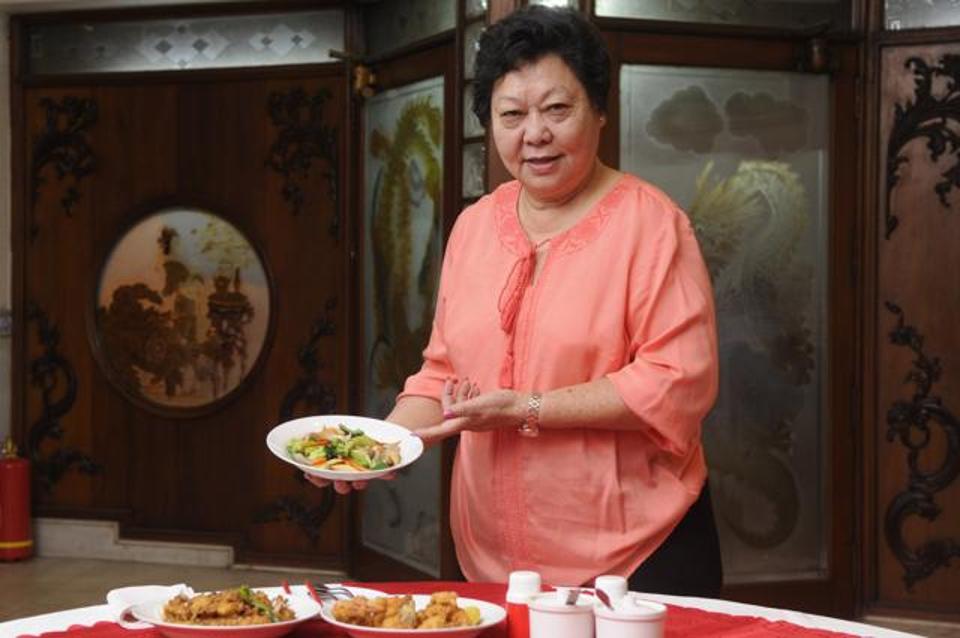
Proprietor and head chef Monica Liu at her Beijing restaurant in Tangra, Kolkata. (Samir Jana/HT PHOTO)
Image issues
“Our food is suited to Indian tastes,” says the owner of five restaurants in and outside Chinatown, returning to our table. Liu opened Kimling, her first, in 1991. “In my restaurants, I always keep a chilli-garlic gravy, popular with customers, ready. Sometimes they want their chicken dry or with gravy. But this is not to say my food is Indian-Chinese. It is Chinese,” says Liu playing the elder stateswoman of Chinese cuisine to the hilt.
Restauranteurs in Tangra, riding the restaurant boom in the ’90s, had no problem saying they sell Indian-Chinese to create a space, as it were, for selling their food. “It was part of their entrepreneurial logic to boost saleability,” says anthropology researcher Piya Chakraborty. But the renown of many Chinese restaurants now owned by non-Chinese (such as hotelier Anjan Chatterjee’s Mainland China, which he started in Mumbai in 1994 and which he brought to Kolkata, and musician Debaditya Chaudhury’s Chowman chain in 2010) has produced a new kind of anxiety. So the assertion of ‘authentic Chinese’ to be got at Tangra, and not just at central Kolkata, the original Chinatown, is important now.
Food networks
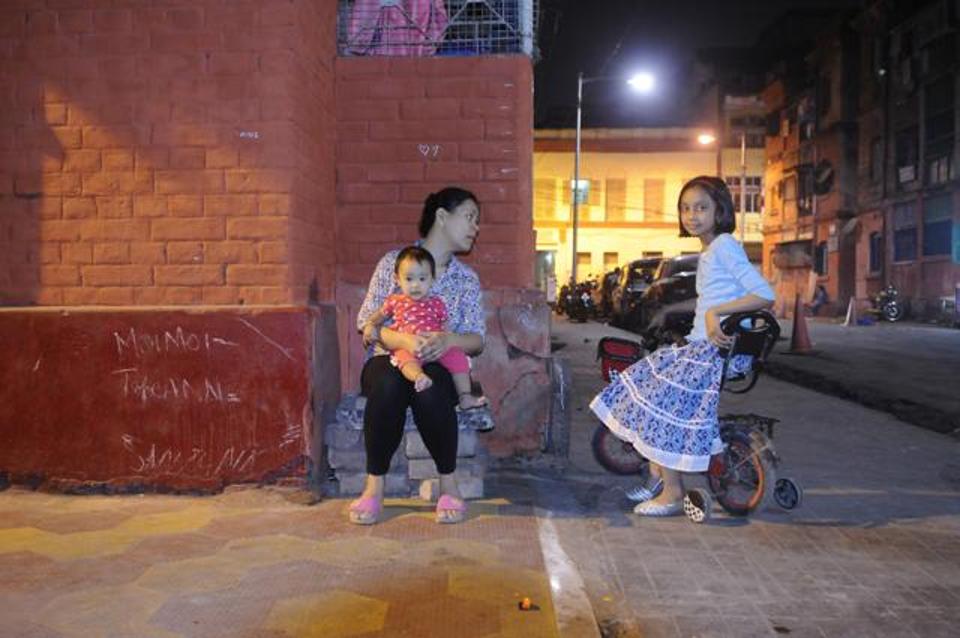
The small eating houses in Tiretta Bazaar, central Kolkata, was originally meant to feed the local Chinese working men, numbering around 25,000 till the early ’60s, before the outbreak of the Indo-China war of ’62. Central Kolkata was a Cantonese stronghold. When a new throughfare split the area, the Hakkas, the other sizeable Chinese immigrant group, re-located to Tangra. The collective sense of security in mixed neighbourhoods, where each minority recognises the other as such (central Kolkata had substantial Anglo Indian, Jewish, Sindhi, Bihari populations), however, stopped many Hakkas from moving out.
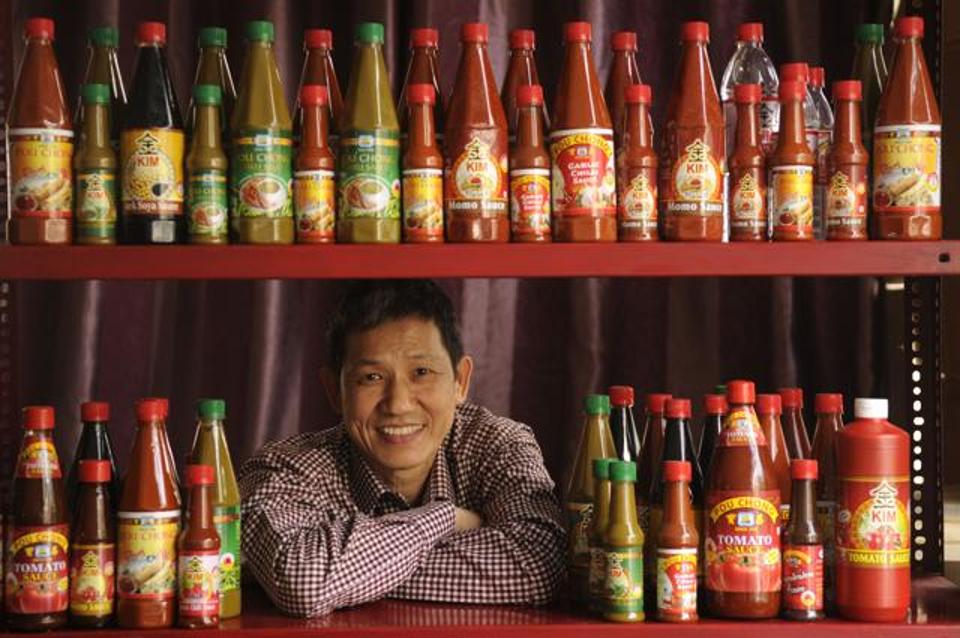
Dominic Lee, a Hakka, who owns Pou Chong, one of the most well-known brands of sauce and noodles made by the community near Tiretta Bazaar, is perceived as Mr Lee, the sauce-maker, not the Indian-Chinese sauce-maker by the neighbourhood. His professional identity, he says, has never felt eclipsed by his racial identity. (That is why he is able to field questions of “authenticity” without feeling defensive about it.)
This is not to say that the Chinese do not maintain strong community networks. Lee’s products are used by Tangra outlets like Liu’s Beijing, as much as all over central Kolkata eateries. When casting directors of the Salman Khan-starrer Tubelight were scouting for a youth to portray “a Chinese”, Lee recommended Thomas Chen, a Cantonese mechanical engineer and singer in Kolkata, for the cameo.
David Rocco, the popular Canadian-Italian TV host, has interviewed Lee for his programme Dolce India. When quizzed about the ‘authenticity’ of his sauces, Lee’s answer is pat: “It’s authentic for this area. The Hakkas are gypsies. Each group of Hakkas has its own Hakka cuisine.” No two Bengalis, he says to further explain his point, make pulao or paturi the same way.
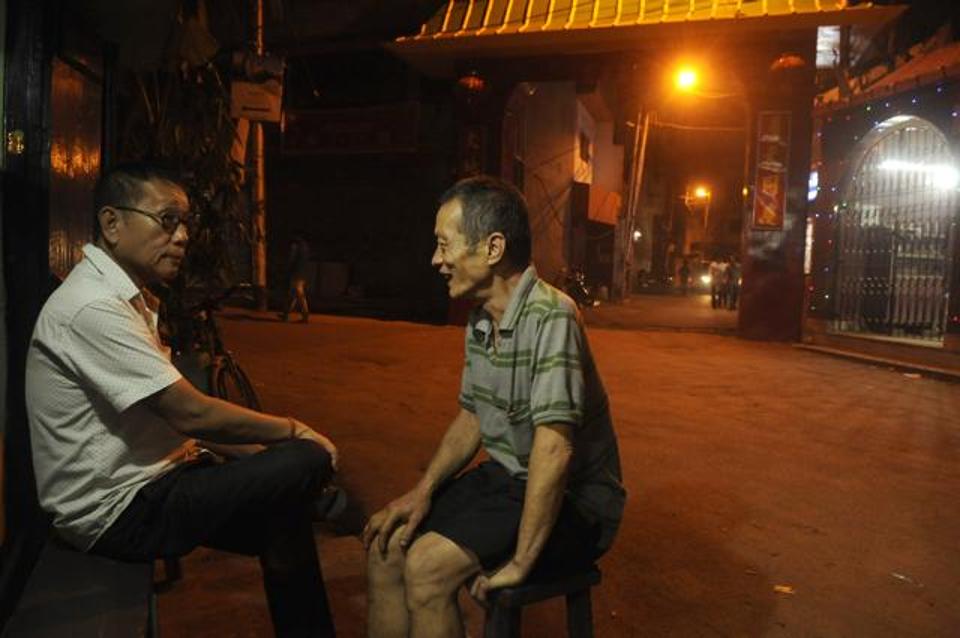
Owner of the Pou Chong brand, Dominic Lee at his shop at Tiretta Bazaar, the first Chinatown. The combination of the Pou Chong tomato and Pou Chong green chilli sauce is usually used with the Kolkata kathi roll. (Samir Jana/HT PHOTO)
The Pou Chong brand, started by Lee’s father to cater to the large Chinese population, was badly hit, a second time, when families were uprooted at the outbreak of the Indo-China war in 1962. “It was a collective trauma for the community, which may explain the wall of silence it maintains now,” says Chakraborty.
The war with China nearly emptied central Kolkata; hundreds of Chinese were deported to and jailed in camps in Rajasthan on mere suspicion of being ‘Chinese agents’. Monica Liu and her family were picked up and sent to a prison camp as was Thomas Chen’s mother in her teens; they were released without compensation or apology after several years. In a cruel twist of fate, the role he had to enact to crack the Tubelight audition was to play a Chinese soldier interrogating an Indian spy.
“I can never touch a potato or a gourd since then. Even the smell of their cooking scares me,” says Liu. They were a staple in her prison camp. For many Indian Chinese with similar experiences, family traditions around food have just not come together because of interrupted family life. Chen says he learnt to make a Chinese-style whole steamed fish, but not from his mother. The lack of schooling, because of formative years in jail, may also have pushed many of those from the earlier generation towards informal sectors like food, other than ‘office jobs.’
By the ’70s, the situation stabilised. Local Chinese boys entered the city’s five-star kitchens as hotels opened their first Chinese restaurants. “They popularised our products. Chinese, by then, had become part of the city’s street food. Every street corner had someone selling chow on carts. The combination of the Pou Chong tomato and Pou Chong green chilli became the Kolkata kathi roll sauce,” says Lee.
The eating culture of the central Kolkata Chinese developed in close contact with other migrant communities at the margins of Bengali society. Their restaurant clientele – fellow Chinese – was assured due to their still sizeable population in this area so they were under no pressure to suit their food to a ‘Bengali’ palate. Jayani Bonnerjee of OP Jindal Global University, a specialist on the Indian-Chinese community, talks of a dish called ngapi, a shrimp paste of Burmese origin, that was eaten at both Chinese and Anglo-Indian homes on Bentinck Street, though it’s not clear who influenced whom.
“The Chinese and Anglo-Indians had an affinity for one another; for ease of schooling and professional networks, many Chinese had become Christians. They shared schools, met each other in church, visited each other’s homes,” says Bonnerjee. When Waldorf, the famous Kolkata Chinese restaurant on Park Street, changed hands, the ownership went to an Anglo-Indian family, the Mantoshes, most probably in the ’90s, she points out.
At Bow Barracks, central Kolkata. The Central Kolkata Chinese stay in mixed neighbourhoods. (Samir Jana/HT PHOTO)
Indianisation
The Supreme Court ultimatum in 2002 to shift out 592 tanneries in Tangra, where the Hakkas on leaving central Kolkata went, was another big jolt for the community. It nearly emptied out Tangra. Most left for Canada. Those who could not; converted the godowns into restaurants. This is where the Indianisation of Chinese restaurants began.
The story of Tangra’s Indianisation is classic migrant-nama: left with lemons, they made lemonade. But when they did, that was inadvertently the first step taken by the community to build, with the Bengalis, a shared culinary mythology.
Chinese eating houses probably took their initial reluctant steps towards serving ‘Indian Chinese’ when Kolkata’s office-goers passed through the tannery areas in Tangra on their way home and showed up at the factory-cum-kitchens of the Chinese to request for fried chicken to go with booze.
Bengalis who frequented these Chinese joints wanted Chinese food, but on their own terms — fried, spicy and saucy. Enter the Chilli Chicken (chicken nuggets dipped in corn slurry, deep fried and finished up with soya sauce) and Schezwan Chicken (made by tossing deep fried chicken with a reddish sauce out of a bottle and Sichuan pepper, a key ingredient). Sichuan pepper, when it met Bengalis inside Chinese restaurants, began to be called ‘Schezwan’, so goes the joke.
Authenticity-seekers eat in Central Kolkata places like Eau Chew and Tung Nam now; Tangra is the spice-lovers’ haunt. Such customers might, says Monica Liu, on the rare occasion, ask her the passive-aggressive question, “what is your cooking medium?”, which she knows how to answer. “We use the same oil, or as much oil – the way you like your biryani,” she says fixing the customer with gimlet eyes.
The last Chinese waiter to take orders at the tables of Chinese restaurants like Liu’s Beijing, is not known. Till the ’70s, the Chinese restaurant was not the first place where Bengali boys looked for jobs. Now they do. This is now Beliaghata boy Babu’s stage. In Liu’s kitchen, Biharis are firing up the woks, and two Hakkas are chopping the vegetables and supervising them. The word is in many ‘Chinese restaurants’ Nepalis and south Indians are doing the cooking. Peter Chen, who runs the famous carpentry firm in Poddar Court, central Kolkata, says as much but won’t identify the restaurants. “They are doing a fine job, let them be,” he says.
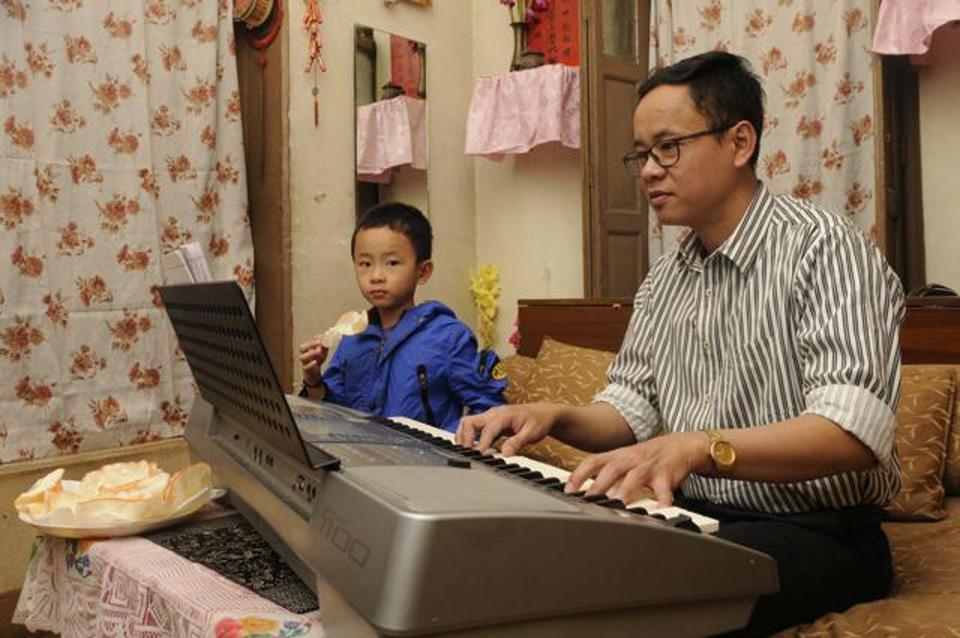
Mechanical engineer Thomas Chen with his son, Travis, at his home in Bow Bazaar, central Kolkata. ‘I am almost Bangali,’ he says. Chen has done a cameo in a Salman Khan film and also sings in Bengali, Hindi and Mandarin. (Samir Jana/HT PHOTO)
The Chinese have taken up Indian food as well. When dal poori entered Chinese homes has not yet been documented, but Peter Chen, the businessman likes it. Chang Chen Fa, a Hubei chef loves it. Thomas Chen, the singer, eats it. Chen, who welcomes us into his home with tea and Chinese prawn wafers, says his pork is spiced with Everest turmeric masala. “I am almost Bangali,” says Thomas Chen, who speaks the flat, unaccented Bengali spoken in urban Kolkata.
Many young Indian-Chinese like Chen, especially those who were born in India, say experts, are increasingly trying to define their Chinese-ness in the context of their immediate surroundings. Chen and his family participate in community art projects around Tiretta Bazaar, the area he grew up in. He is not looking to be Chinese in China.
As we leave Kolkata, two images remain with me. Monica Liu barking at her employees to slice the carrots well, which pretty much sounds the same in every language. And Chen singing khayal at his home, which he says, helps him hit the high notes when singing in Mandarin.
People often say the Chinatowns of Kolkata are going or gone. Both, I think, daily renew themselves.
source: http://www.hindustantimes.com / Hindustan Times / Home> Lifestyle> Art & Culture / by Paramita Ghosh, Hindustan Times / March 10th, 2018
The Hill Business Summit provided many industrialists with a rare platform to trace their roots to the region and promise projects.
Rudra Chatterjee, the managing director of Luxmi Group which owns the Makaibari tea garden in Kurseong, urged hill residents to keep welcoming investors and tourists.
“The people here are brave, loyal and hardworking. A time comes when a region changes and this is the time. We need to keep coming back, peace must be maintained and we must keep inviting investors to the region,” said Chatterjee.
He promised to open more Makaibari kiosks in the hills to employ the children of garden workers and rolled out plans for a sports and hospitality project.
The boss of Keventer Agro, one of the biggest food processing chains in Bengal that started from Darjeeling, promised to “correct” a gap. “After four decades, we have come back to the birth of Keventer. I don’t know why we never thought of coming to Darjeeling to look into our roots. Keventer has a food-processing unit in every district of Bengal but not in Darjeeling. I am here to correct this,” a nostalgic Mayank Jalan, Keventer’s MD, said
Jalan promised to “figure out” what the firm needs to do in Darjeeling within the next 24 months. Keventer’s in Darjeeling is famous for its breakfast, although the restaurant is no longer associated with Jalan’s company but owned by a local entrepreneur, Robin Jha.
Chandrajit Banerjee, director-general of trade body CII, recounted his family ties with Darjeeling. “It is such a great place to come back after nearly 37 years. It feels special because my grandfather started a business here and my father cultivated it before leaving for Calcutta,” said Banerjee before announcing a series of initiatives that the CII intends to take up in the hills.
For Harsh Neotia, it has been a wait of over a decade. “For the past 13-14 years, I have been visiting north Bengal and I always aspired to do something in Darjeeling. It is one of the most astounding places but for one reason or another, we could not do (invest in projects),” said Neotia.
Neotia’s group is developing two properties, at Ghoom and Makaibari.
“Two hospitality units are coming up at an investment of Rs 150 crore each. The Makaibari project is likely to be completed by 2019 and the first phase of Ghoom by 2020,” said Neotia, who also expressed a desire to explore opportunities in the hills’ education sector.
source: http://www.telegraphindia.com / The Telegraph,Calcutta,India / Home> West Bengal / by Vivek Chhetri / March 14th, 2018
The Jaguar Land Rover showroom in New Town’s Action Area II
New Town:
Rajarhat is becoming the new motown of the city with major dealers opening state-of-the-art facilities.
The motown is adjacent to Ecopark in Action Area II of New Town, with sprawling outlets of Eastern Honda, Lexus Motors, Renault, Hyundai and Maruti. The latest in line is the Jaguar Land Rover showroom in the auto mall.
The state government allotted seven acres to auto dealers in 2006.
“Each of the dealers received an acre each,” Vinod Agarwal of Lexus Motors, who has shifted his premium dealership Jaguar Land Rover from AJC Bose Road to the auto mall in New Town, said.
Agarwal, who runs a Renault and the Tata Motors passenger cars and commercial vehicles dealerships in the city, has set aside space for all the three in the mall.
Bengal Hyundai has taken up another portion of the auto mall, while the Maruti Regional Office, which is currently on Camac Street, is due to shift to the new address at Rajarhat some time soon.
It will have a Volvo dealership, along with Austin, the oldest dealership in the city, as neighbours.
Toyota, BMW, Kia Motors are apparently looking at motown addresses.
Much like its Vasant Kunj headquarters in Delhi, Maruti will have its regional office in New Town with the display area in the building.
“It’s a four-storey building with a lot of space. Some floors will be reserved display our cars. We will shift there some time soon,” a Maruti source said.
One of the city dealers said the average space for a showroom is not more than 15,000sq ft. Here, there would be much more space with more cars on display.
Sanjay Patodia of Austin is now busy completing Austin Towers, a building with 1,26,000sq ft carpet area. “I have not yet decided which dealerships will be housed there,” Patodia who has automobile sales outlets in Chowringhee, Patuli, Baruipur and Howrah said.
Asked about the footfall in Rajarhat, Patodia, a seasoned player in the auto sector, said: “Once Rajarhat develops fully, people will come in. It will get customers from VIP Road, Jessore Road, too.”
Agarwal has already experienced a rise in footfall in his showrooms.
“There is so much space here with test drive facilities and everything. It is difficult to run dealerships in the heart of the city,” Agarwal said.
The state-of-the-art JLR showroom is spread over more than 20,000sq m with 11 cars on display.
“The entire range of Jaguar and Land Rover models are on display here,” he said.
source: http://www.telegraphindia.com / The Telegraph,Calcutta,India / Home> Calcutta / by Anasuya Basu / March 11th, 2018
The chief minister will present Banga Ratna to nine persons from north Bengal for their contribution in different fields at the inauguration of the Uttar Banga Utsav here on Monday.
Mamata Banerjee is scheduled to launch the eight-day cultural fest at Kanchenjungha Stadium here.
Official sources have said among the recipients of the Banga Ratna are Manas Dasgupta (economist from Darjeeling), Dinesh Chandra Roy (researcher on folk culture of the region from Jalpaiguri), Prem Kumar Bhutia (social worker of Kalimpong) and Debkumar Mukherjee (educationist from Cooch Behar).
The others are Malin Das (folk music instrumentalist of Cooch Behar), Dilip Kumar Roy (writer from Alipurduar), Prem Bihari Thakur (retired teacher from North Dinajpur), Tapas Kundu (researcher on Molecular Biology from South Dinajpur) and Radhagobinda Roy (social worker of Malda).
“Each award will carry a prize of Rs 1 lakh, a shawl and a certificate.
Apart from the awards, a total of 54 meritorious students from eight districts of north Bengal will get Rs 10,000 each from the chief minister.
Thirteen of them will get the assistance at the inaugural and the rest will be provided with the amounts by the administrations of their respective districts,” an official of the organising committee of the festival said.
source: http://www.telegraphindia.com / The Telegraph, Calcutta,India / Home> West Bengal / by Bireswar Banerjee / January 08th, 2018
Two youths in Jalpaiguri have achieved success in combined fish and vegetable farming through an old technology and earned accolades from officials of the district administration who are now planning to showcase their success as an example before farmers.
Arkaprabha Das and Subhadip Mitra have introduced aquaponics, a technology where water is used both for fish and vegetable farming, on a one-bigha plot near Canal More under Kharia panchayat of Jalpaiguri Sadar block, 8km from the town.
With assistance provided by the Fish Farmers’ Development Agency and the district administration, they have come up with the project.
They have dug four ponds, measuring around 30ft by 15ft with a depth of 5-6ft, where they are farming different species of hatchlings like pabda (Indian catfish), punti (swamp barb), telapia (Indian tilapia), shingi (stinging catfish), magur (walking catfish) and chitol (clown knifefish).
“In these ponds, the growth of fishes would be high as compared to other ponds measuring around four-five bighas of land. In those ponds, it takes around six to seven months for fishes to grow but here, the fishes would be of similar sizes within 75 days,” said Das.
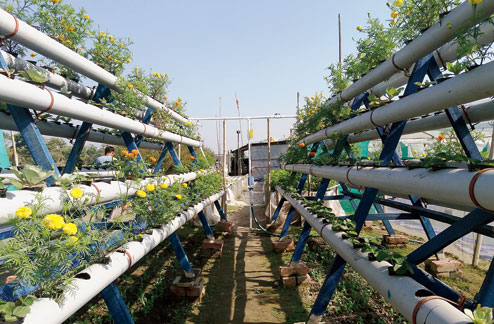
Unlike other ponds where the water is stagnant, the water here, which is mixed with the waste released by fishes, is channelized through pipes, which have holes above. On these pipes, the duo have planted marigold shrubs and flowers are also growing on those pipes.
“Due to presence of nutrients in the water, the flowers are also growing steadily. We are then diverting the water to bed (a flat structure) where the water is flown through pebbles. The water here is getting purified while we have planted vegetables on the bed, which are getting the nutrients,” he said.
From this bed, the water is being shifted another bed, known as flowing bed. There, though the water has been kept covered, flowers, strawberry and chillies have been planted above the cover.
In course of the process, ammonia from water is being removed and nitrogen compounds present in it help in growth of plants. Also, the water, while being diverted back to the ponds carries fresh oxygen, which helps in growth of fishes.
“It is old technology but is hardly used by cultivators,” said an official of the district fisheries department.
“We feel aquaponics should be largely used in our state. It can expedite production of fishes, vegetables and flowers. In total, around Rs 5 lakhs or so has been spent for the project. We will keep on helping them in the initiative,” Somnath Chakraborty, the chief executive officer of Fish Farmers’ Development Agency, said.
Rachna Bhagat, DM, Jalpaiguri, said they will showcase the success story among cultivators of the district.
“It is a unique project. We will apprise other cultivators and those who are into fish farming, about the technology,” she said.
source: http://www.telegraphindia.com / The Telegraph, Calcutta,India / Home> West Bengal / by The Telegraph Correspondent / January 06th, 2018
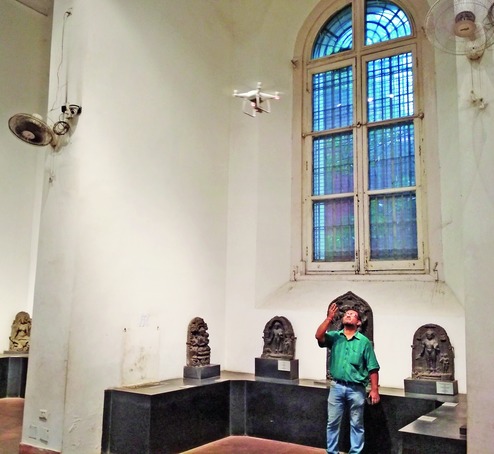
A drone from RC Hobbytech Solutions Pvt Ltd being tested at the Indian Museum
Calcutta:
A start-up born out of a career setback has started soaring on the rotor blades of drones.
RC Hobbytech Solutions Pvt Ltd, started by two friends, specialises in building unmanned aerial vehicles, commonly known as drones, and has already bagged orders from the Indian Army, the railways and Calcutta police, among others.
Flooded with contracts, the fledgling start-up is servicing these orders with a soft loan from IIM Calcutta, project-based finance from banks and the Rs 1.5 crore it won in a competition launched by Balmer Lawrie under the Startup India scheme in November.
For co-founder Biswajit Dey, a graduate in aeronautical engineering from St Peter’s University in Chennai, RC Hobbytech was a seed sown by the disappointment of missing out on a chance to join the Army Aviation Corps because of an accident that put him in hospital for three-and-a-half months.
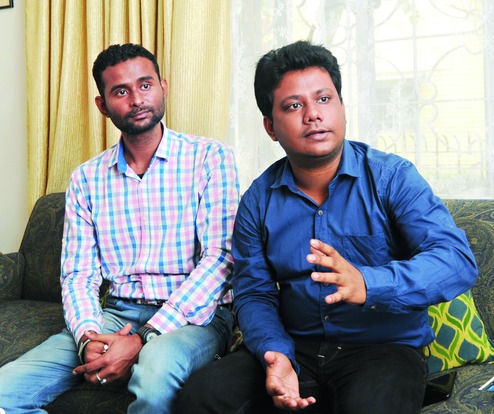
A dejected Biswajit came to Calcutta to meet his school friend Ritesh Kanu, who had just graduated in business management from Techno India Salt Lake and was to appear for an interview at the RBI.
Ritesh didn’t go for the interview. Instead, he and Biswajit decided to launch their start-up.
“I liked making drones and fiddling with them while Ritesh was trained to market them. That made us a good team,” said Biswajit, who learnt the basics of drone technology in college. “There is a huge market for unmanned aerial vehicles in agriculture, surveillance and mining,” said Ritesh.
Co-founders of RC Hobbytech Solutions Pvt Ltd Biswajit Dey and (right) Ritesh Kanu. Picture by Sanat Kr Sinha
RC Hobbytech is working on drone technology to replace the army’s system of detecting intruders along the country’s vast borders. “The army sets up poles with two free-hanging bottles to detect intruders. Whenever an infiltrator tries to cross a border fence, the bottles make a noise and alert the sentries at the forward post. They have electric fences but the wiring can be cut and the alarm system switched off,” Ritesh said.
The start-up’s Drones Tech Lab division has devised an Intruder Detection System based on GPS for the army. The system sends alerts to the forward post and control room in three seconds whenever an intruder is detected. The information includes the exact position of the suspected infiltrator.
“Our system is based on sensors and also sends messages over mobile phone, giving the correct location,” said Biswajit.
A pilot run of the system at Udhampur in Kashmir from March to April earned a letter of appreciation from the army, Biswajit said.
He is currently modifying the system to give it an industrial finish along with camouflage.
From a drone start-up, Biswajit and Ritesh are now a “solutions provider in surveillance industry, leveraging unmanned technology and integrating hardware, software and data analysis”.
They had started with a capital of Rs 4 lakh in 2014 and ended up burning the cash in a year. When their families started asking what they were up to, the duo stopped going home. They then floated a company called EduRade to teach drone technology in institutes and raise money. “It was in 2016 that we pitched for incubation at IIM Calcutta. We met Subhranghshu Sanyal, CEO of the IIMC Innovation Park, at an event and he liked our product. We were incubated in October 2016,” Biswajit recalled.
Sanyal is impressed with what the duo have done so far. “They are providing real-time solutions to problems that are quite risky for human beings to solve. Their work for the army takes risk away and improves accuracy, which is fantastic,” he said.
source: http://www.telegraphindia.com / The Telegraph, Calcutta,India / Home> Calcutta / by Anasuiya Basu / December 28th, 2017
Precision landing in dense winter fog with a visibility limit of 50 metres will become possible at Calcutta airport from January 4, when the Category III-B instrument landing system makes it debut on the primary runway.
An official of the Airports Authority of India said on Monday that pilots trained to land aircraft in low visibility were practising assisted touchdown during non-peak hours. “Visibility is fine as of now but pilots are having drills in preparation for the launch.”
He said air traffic control personnel were also acquainting themselves with the new system.
CAT III-B, the answer to fog-induced flight delays almost every January, was sanctioned for the city airport in early 2014 and cost Rs 130 crore to install. Metro had reported on November 30 about the instrument landing system awaiting a final clearance by the directorate-general of civil aviation.
“All inspections have been completed and we are ready for operations. We will be providing the facility by the cut-off date and it is up to the airlines to use it,” the official said.
To be able to use the CAT III-B system, airlines need compatible aircraft and pilots trained to operate in low-visibility conditions.
Captain Sarvesh Gupta, the chairman of the airline operators’ committee in Calcutta, said most pilots flying in India were trained in CAT III-B operations. It pays for airlines to have pilots compliant with CAT III-B procedures because fog delays translate into loss of revenue.
Between late December and mid-February, flights are often disrupted because of dense fog in the morning and night. According to officials, such disruptions usually happen between 3am and 9am, when the maximum number of flights operate.
The CAT II instrument landing system currently in operation enables aircraft to land till visibility of 350m. This is inadequate for a city where visibility often dips much lower in winter.
Whenever flights have to be diverted, not only do passengers suffer but affected airlines also take a financial hit. Apart from burning additional fuel, an airline has to pay landing and parking charges at the alternative airport. If the delay is long, arranging accommodation for passengers entails more expenditure.
“When hundreds of passengers are stranded at an airport, infrastructure is tested as well. The washrooms are used by more people than they can handle and there is sometimes no place for passengers to even sit,” Gupta said.
Airport officials expect CAT III-B to almost eliminate fog-induced disruptions because visibility hardly, if ever, drops below 50m in Calcutta.
The number of lights along the centreline of the primary runway have been doubled as part of the upgrade from CAT-II to III-B.
The new instrument landing system has been installed on the southern side of the primary runway because the wind blows from north to south during winter in these parts. A tailwind would increase the possibility of an aircraft overshooting the runway while landing.
The new system also includes an advanced signalling mechanism.
source: http://www.telegraphindia.com / The Telegraph, Calcutta,India / Home> Calutta / by Sanjay Mandal / December 19th, 2017
The Newton Bhabha Fund on Thursday started a workshop for scientists on the Indian Institute of Science Education and Research’s Calcutta campus at Mohanpur in Nadia.
The three-day workshop aims to involve scientists from across the globe and the IISER in social and economic development, Sourav Pal, the IISER Calcutta director, said after inaugurating the workshop.
Scientific research should be industry-oriented instead of remaining confined within laboratories, Pal said.
“A huge amount of money is spent on research across the world. Many brains are being used at laboratories.
“But, it is high time that research findings are translated for the benefit of people through industries. It should be used for capacity-building of the researchers as well,” he said.
“A researcher should not be satisfied only by publishing his findings in a journal.”
The workshop, “Functional Nanomaterials: From Spectroscopy to Bioimaging”, is supported by a Researcher Link grant under the Newton Bhabha Fund.
Prasun Mandal of IISER Calcutta, who is the joint coordinator of the workshop, said the prime objective was to bring together chemists and researchers from various faculties to explore new ideas for social and economic development.
The Newton Bhabha Fund has organised the workshop in association with the University of Manchester, the British Council, the UK’s Royal Society of Chemistry, and IISER Calcutta, Mandal said.
source: http://www.telegraphindia.com / The Telegraph, Calcutta,India / Home> Calcutta / by Subhasish Chaudhari / December 15th, 2017