Category Archives: Business & Economy

Federer inspires fangirl’s charity

Visits to Wimbledon every year and foundation to sponsor local talent
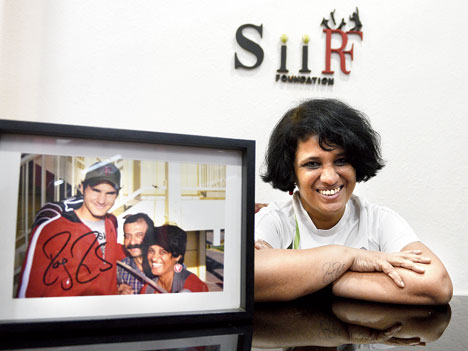
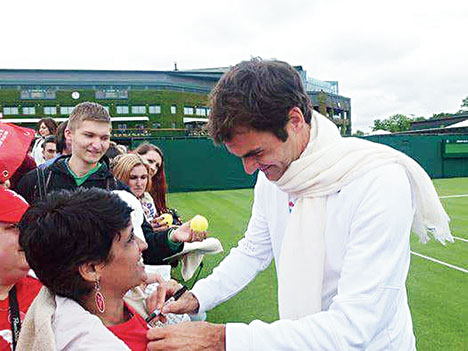
Sunita Sigtia (in top picture by Gautam Bose) started her not-for-profit organisation SiiRF last August, inspired by her idol Roger Federer. The foundation sponsors talents to help them continue in their chosen sport. Sigtia, who travels to Wimbledon every year to watch Federer play, gets an autograph from the tennis legend (above) at Wimbledon in 2013

Chowringhee:

Roger Federer’s philanthropy spurs Calcuttan Sunita Sigtia as much as the magic of his tennis that takes her to Wimbledon every year to watch him play. Her not-for-profit organisation SiiRF, established 10 months ago, stands for “Some Immensely Inspired Roger (Federer) Fans”.

SiiRF was born on August 8, the champion’s birthday, and has since sponsored two young talents who had been struggling to continue in their chosen sport because of financial reasons.

For Sunita, who has met Federer on many occasions, SiiRF is now a mission only matched by her admiration for the legend. “My charity is inspired by Roger….The lesson I have learnt from him is that you have to give something back to society in whatever way possible. My dream is to associate him, even if in a small way, with my foundation,” she told Metro.

Sunita, who is in her 40s, runs a fabrics business. Tennis, Federer and charity – not necessarily in that order – help maintain the work-life balance that she seeks.

One of the two sportspersons Sunita has set out to help is Amit Rawat, the son of a cobbler and a domestic help. Amit, who grew up in a slum in Beniapukur, learnt to play tennis while working as a ball boy at Calcutta International Club and got so good at it that he caught the eye of a coach.

Sunita’s foundation has arranged a brand new kit for him. She also recently sent him to a tennis academy in Pune for six weeks of training. “Amit has done well on the Calcutta circuit, but the next two years are crucial,” she said.

Bristy Mukherjee, the 14-year-old girl who won a silver medal at the Asian Youth Chess Championship in Thailand last month, has also benefited from Sunita’s sponsorship. The teenager’s mother had mortgaged her jewellery to send her to the event. SiiRF has now pledged financial and other support to Bristy for future tournaments.

Sunita, who has “RF” tattooed on her neck and his signature on her forearm, is the Indian face of Fans4Roger, the official fan club of the legend. She had first seen her idol up close in June 2008, when she was visiting London for a house-warming at New Malden, around 5km from Wimbledon. “The house-warming was the official reason for the trip, but I knew I had to visit the All England Club,” she said.

Wimbledon queues are long. For one of the show-court tickets, thousands of fans camp overnight. People in these queues bring tents, folding chairs and rainwear, among other things. Sunita only had an umbrella and it started raining heavily that night. “I was freezing. Another man offered me shelter in his camp,” she recalled.

Visiting Wimbledon has since been an annual ritual. Before each Grand Slam, Federer is presented with the Red Envelope, a collection of good-luck messages from fans across the world. Delivering the envelope to the legend is considered the highest possible honour for a Federer fan. Sunita did so at Wimbledon 2011, wrapping the envelope in silk fabric with RF inscribed in zardosi. “He simply loved it,” she said, beaming at the thought.

Federer’s charity, the Roger Federer Foundation, is involved in more than a dozen educational projects benefiting lakhs of African children in countries like Namibia, Zambia and Zimbabwe.

As one of the privileged fans who get to travel each year to London, Paris, Melbourne and New York to get a glimpse of their idol, Sunita believes the best tribute to “the best tennis player ever” would be to emulate his spirit of giving.

Federer might say: “Roger that.”

source: http://www.telegraphindia.com / The Telegraph,Calcutta,India / Home> Calcutta / by Debraj Mitra / May 30th, 2018
Apeejay Surrendra Park Hotels To Manage Oldest Hotel In India

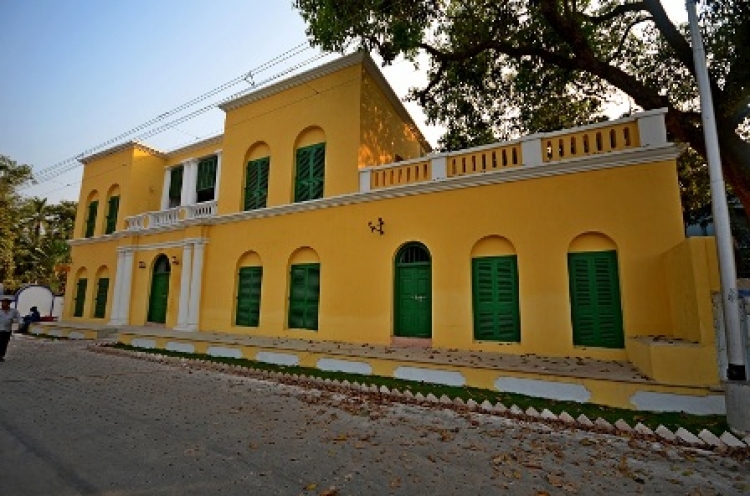
Apeejay Surrendra Park Hotels has entered into an agreement with the Government of West Bengal to manage the historic The Denmark Tavern, the 232-year-oldest hotel in India, in Serampore, Kolkata.

“We are delighted to manage The Denmark Tavern on behalf of the West Bengal Government. THE Park Hotels will build on the rich legacy of the Tavern and bring it and the area back to life. The hotel will soon be buzzing with guests enjoying a quiet break on the banks of Hooghly and the sights and sounds of old-world Serampore and beyond,” Priya Paul, Chairperson, Apeejay Surrendra Park Hotels.

The Tavern was established in 1786 in what was then Fredricksnagore. The two-storeyed structure by the Hooghly is the place where the Danes had kept their flagstaff and cannons. The Tavern was a place to meet and stay for traders, clergy and travellers exploring Bengal.

In 2010 – 11, more than 200 years after the tavern’s heyday, a group of restoration experts studied the building that stood in complete ruins surrounded by debris. It took around two years to restore the Tavern to its former glory as part of the Serampore Initiative, a restoration programme for several Danish heritage structures led by the National Museum of Denmark and funded by Realdania, a private trust in Denmark, in collaboration with West Bengal State Heritage Commission, and Indian National Trust for Art and Cultural Heritage (INTACH).The refurnished building has a cafe, inspired by the double height central atrium of the Indian Coffee House in Kolkata and six high-ceilinged spacious rooms.

The restored Denmark Tavern will fall under THE Park Collection brand of THE Park Hotels. The Park Collection is intimate, personalized, and tailored to transmit inimitable guest experiences. The Denmark Tavern will have THE Park Hotel’s design aesthetics, its impeccable services and will reverberate with Anything But Ordinary experiences. The hotel will open by September 2018.

source: http://www.traveltrendstoday.in / Travel Trends Today / Home> Hot News / by T3 News Network / May 24th, 2018

Kolkata to get first batch of women traffic cops

Kolkata:

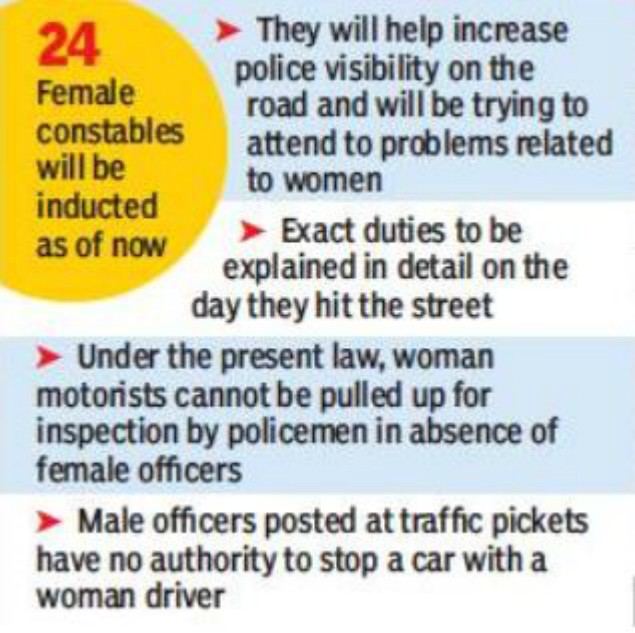
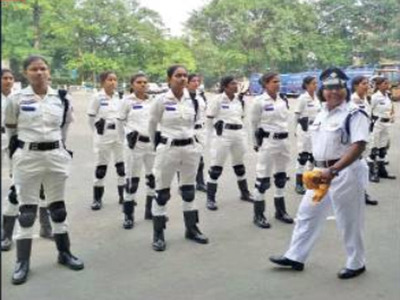
They have been growing steadily in numbers. They handle important assignments, including latenight duty at important crossings. And now, in a first, lady constables of Kolkata Police will be on vigil on Kolkata streets in their scooterettes — either in blue-white or in pink-black shades.

The primary job of the new brigade will be to assist cops to help out women on streets seeking help and also help cops pull up female riders who break rules. “You cannot strictly call them traffic cops. Their duty will not be the same as a traffic cop. But yes, the scooterettes — just like the Bullets — will increase our presence on the streets. We will provide all details about them once final deployment and role gets thrashed out,” said a top IPS officer at Lalbazar.

Sources said that though this new woman battalion is likely to induct scores of lady constables, around 24 of them were present during their first official appearance at Lalbazar.

On Monday, commissioner Rajeev Kumar went to the Police Training School to inspect the new battalion. “As per our initial plan, some lady constables from here will be deputed to the traffic department for on-road duty. These lady constables will help traffic police in womenrelated matters,” said an IPS officer.

“So far, we had women in senior positions but never on the road. Even men cannot easily misbehave with women,” said an officer. The practical problems though remain. Till the other day, most traffic guards did not have a dedicated ladies toilet. Neither was there any dedicated changing room or a drop-at-home at night. “We are trying to look into the practical problems and address them,” said an official at Lalbazar.

Under the present law, woman motorists cannot be pulled up for inspection by policemen in absence of female officers. Male officers posted at traffic pickets have no authority to stop a car with a woman driver.

“We need to account for the safety of women officials in our departments as well. Women officials in Kolkata Police are not many, but the numbers are fewer in the traffic department,” a senior traffic officer explained.

source: http://www.timesofindia.indiatimes.com / The Times of India / Home> News> City News> Kolkata News / by Dwaipayan Ghosh / TNN / May 23rd, 2018

The communist who was not a bhadralok

Kolkata:

Veteran Marxist thinker and former state finance minister in the Jyoti Basu government (1977-86) Ashok Mitra died at a private nursing home on Tuesday morning. He was 90.

A man of letters, Mitra represented the rare breed of Marxists who left his cushy job as the chief economic adviser (CEA) to the government of India in 1972 and cut his teeth on Left politics as the finance minister of the first Left Front government in 1977. He was the pioneer of the alternative development model in Bengal. The senior economist leaves behind a rich legacy of debates and discourse over Centre-state relations that have come in handy for states now to expand federalism in terms of economic and political powers. Mitra, unlike his successor Asim Dasgupta, was not very keen on adopting uniform tax rates across the country. He believed it was an infringement of the state’s domain.

Uncompromising as he was with the dirt and filth of running the administration, quite evident from his famous “I-am-not-a-bhadralok-I-am-a-communist” remark over removing senior bureaucrat and Basu-loyalist S M Murshed from the post of power commissioner, the economist was slowly getting bitter with his own government till he put in his papers as the minister in January 1986, following differences with Basu. He also resigned from the CPM at the same time — just a month after he was inducted into the party state committee.

However, the separation couldn’t make a dent on Mitra’s unflinching commitment to Left ideology. All his life, the scholar kept writing against the “anti-poor policies” of the successive Congress governments at the Centre and was one of the fierce critics of globalization. A few years later, in 1993, CPM nominated Mitra to the Rajya Sabha where he made significant contribution, particularly on economic issues. He was the first to take note of the rightward shift in India’s economy following the appointment of Manmohan Singh in the Narasimha Rao government in 2007.

A brilliant author and regular contributor to magazines and newspapers, Mitra had a great command over both in Bengali and English. Apart from books like “Calcutta Diary” or “From the Ramparts”, Mitra wrote quite a few books in Bengali, including “Kabita Theke Michhile”, “Nastikatar Baire”, “Akatha Kukatha” and the much-acclaimed memoir “Apila Chapila” that deals with issue ranging from politics to literature. His collection of essays, “Taal Betaal”, won the Sahitya Akademi award in 1996.

The veteran Marxist was getting upset with the Left Front government over its tryst with private capital in Singur and couldn’t come to terms with the ways of CPM, particularly in Bengal, even after the government was voted out of power in 2011.

Former Lok Sabha Speaker Somnath Chatterjee offered glowing tributes to Mitra. “He was not only a brilliant economist, but a person who upheld the cause of the downtrodden till his last. I admired his erudition, his writing skills and his superb literary sense. I recall the days when I was a member of the State Administrative Reforms Committee formed by the Jyoti Basu government of which Ashok Mitra was the chairman. The committee had several meetings where members gave their opinions. Mitra didn’t depend on anyone in compiling the views and wrote the entire report on his own within a short time,” Chatterjee said.

Chief minister Mamata Banerjee condoled the passing away of the veteran Marxist.

source: http://www.timesofindia.indiatimes.com / The Times of India / Home> News> City News> Kolkata News / TNN / May 03rd, 2018

Landmark nuggets in 75th year

Desi steel for Howrah Bridge

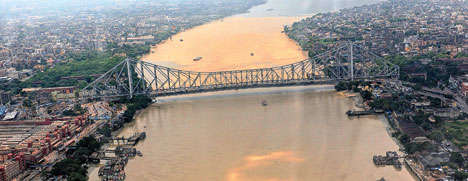
• When Howrah bridge was built in the late 1930s, nearly 90 per cent of its steel was made in India.

• When Vidyasagar Setu was built in the 1980s, all the steel was imported.

• The 705m-long Howrah bridge was built in 41 months. The 823m-long Vidyasagar Setu took 14 years to be built.

Calcutta:

These and more such nuggets of information about the two bridges across the Hooghly were shared at the Bengal Chamber of Commerce and Industry on Wednesday during a lecture on the completion of the Howrah bridge’s 75 years.

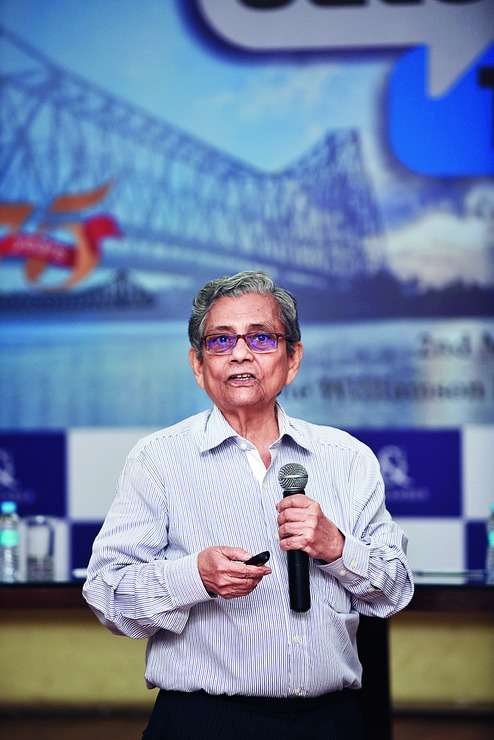
Amitabha Ghosal, an engineer who was part of the team that built Vidyasagar Setu, spoke about the history of the Howrah bridge and its engineering.

Ghosal began by saying why the Howrah bridge was built. Traffic to and from Howrah station had been slowly but gradually on the rise. A pontoon bridge that stood over the Hooghly and connected Calcutta and Howrah had to be lifted whenever a large ship came under it.

“River traffic was then more important than road traffic, which was however increasing. So a need was felt to build a bridge,” said Ghosal, who studied the design, construction and tendering of the Howrah bridge while working on Vidyasagar Setu.

There had been talk about building a bridge since 1900 but the actual planning didn’t begin till 1921. World War I was one of the reasons for the delay.

Amitabha Ghosal at the Bengal Chamber of Commerce and Industry.
(Sanjoy Chattopadhyaya)

The pontoon bridge was commissioned in 1874 for 25 years, but remained in use till 1943, when the Howrah bridge was commissioned. Construction began in November 1938 and carried on till March 1942.

Four companies from England, Scotland, Germany and India had placed bids in a global tender floated for the construction of the Howrah bridge. The German company was rejected because World War II was brewing.

Cleveland Bridge of England won the bid but British-owned Indian company opposed it. “It was a tiff between the British in India and the British in England. The British in India managed to convince the authorities that the entire work cannot be given to an England-based company,” said Ghosal.

A compromise was worked out. The Indian company – BBJ Construction Company Limited, a consortium of Braithwaite, Burn and Jessop – was asked to make the steel. Most of the steel – 23,500 tonnes out of 26,500 tonnes – was manufactured and supplied by Tata Iron and Steel Company (Tisco), now Tata Steel.

The foundation of the bridge was built by the Indian-owned Hindustan Construction Company, which is now building the Parama flyover in Calcutta.

source: http://www.telegraphindia.com / The Telegraph,Calcutta,India / Home> Calcutta / by Subhajoy Roy / May 03rd, 2018

Gate-way to a new Calcutta

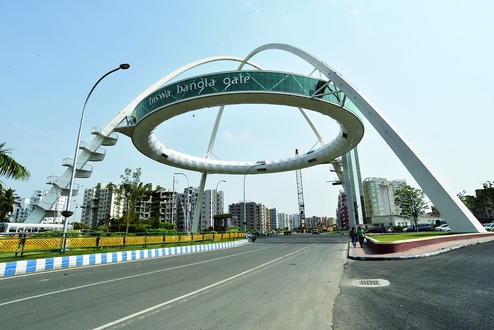
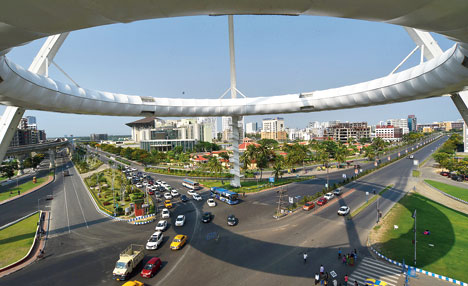
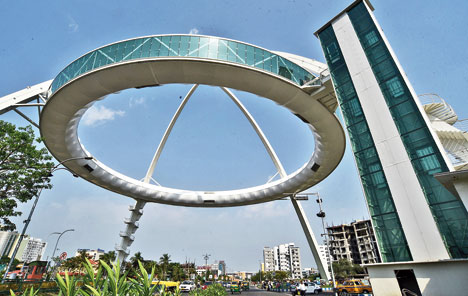
Kolkata Gate, a steel-and-glass structure with giant arches at the Rabindra Tirtha crossing of New Town, is almost ready. The two steel arches that criss-cross each other 55m above the ground can be spotted from several kilometres away.

A circular viewing gallery made of steel and toughened glass has been set up at 25m above the ground level. The 10ft-wide and 60m-long gallery has been constructed by interlinking four prefabricated structures that resemble aerobridges. These structures in turn are welded and attached to the steel arches at designated points. The facade is made of toughened glass with laminated silicone sheets that can withstand gale-force winds, hailstorms and extreme heat.

A bird’s-eye view of New Town clicked from a landing a few feet below the viewing gallery of the Kolkata Gate. The view from the gallery will be unhindered as nothing taller than the gate will come up in the area, New Town being a planned city and with pre-determined floor levels for every plot.

Programmable LED lights and flashers have been placed along the length of the steel arches to give it a snazzy look at night. The viewing gallery will have a snacks counter during the day and a fine-dining restaurant after 7pm. At night, only diners will be allowed inside the gallery that will offer a panoramic view of the township. The walls of the gallery have been painted with murals with an entire wall dedicated to the schemes and achievements of the state government.

“The restaurant will offer a one-of-a-kind experience. It will be unlike any other in the city and will offer cuisines from across the world,” said Debashis Sen, the chairman of Hidco. It is likely to open doors in June, officials said.

Two lifts with a glass facade made of toughened glass similar to that used in the viewing gallery will take visitors up to the gallery. The lifts are equipped with telephones at every level so that the operators can get in touch with visitors in case of an emergency. Hidco is mulling a Rs 30 fee per person for a visit to the gallery. Diners at the restaurant won’t need to pay the fee.

source: http://www.telegraphindia.com / The Telegraph,Calcutta,India / Home> Calcutta / by Snehal Sengupta / Photos by Sanjoy Chattopadhyaya / April 30th, 2018

GPS tracking for Nepal cargo from city

Calcutta:

Cargo shipped from other countries to Calcutta and then sent by road to Nepal is now being tracked by the customs authorities with GPS to ensure the containers do not go missing on the way.

As part of a pilot project which started on Wednesday, the customs authorities are using the GPS-enabled electronic cargo tracking system to lock Nepal-bound containers at the Calcutta ports.

“Cargo containers from India cross over to Nepal from Raxaul, Jogbani and Sanauli. While Raxaul and Jogbani are in Bihar, Sanauli is in Uttar Pradesh. Now, we can track a container’s journey to any of the three border points from a port. The tracker will help us know whether a container has deviated from the route or stopped midway and for how long,” a customs official said on Friday.

At the border points, Indian customs officials remove the device. A report is immediately generated containing all details of the trip.

“Importers and exporters can track the movement, too, with this system. This will increase transparency as well as make documentation less complicated,” the official said.

Three containers bound for Nepal were sealed with the new tracking system at Kidderpore and Garden Reach ports on Wednesday.

India and Nepal had signed a memorandum of intent in 2017 to introduce the tracking system.

Surrounded by land on all sides, Nepal’s import cargo from across the world are shipped to Calcutta, Haldia or Visakhapatnam.

However, because of its proximity to Nepal, bulk of Nepal’s cargo is shipped to the ports in Bengal.

Nepal imports items from pulses to helicopters, most of which are shipped to Kidderpore, Garden Reach and Haldia. Other items it imports include electronic goods, plastic granules, machineries, coal, urea and food products such as black pepper and noodles.

Customs officials said around 1,500 containers carried cargo from Kidderpore and Garden Reach on an average every week.

Officials said there had been a few occasions when the containers went missing on the way to the border.

source: http://www.telegraphindia.com / The Telegraph,Calcutta,India / Home> Calcutta / by Special Correspondent / April 21st, 2018

Fashion frat step up for fest

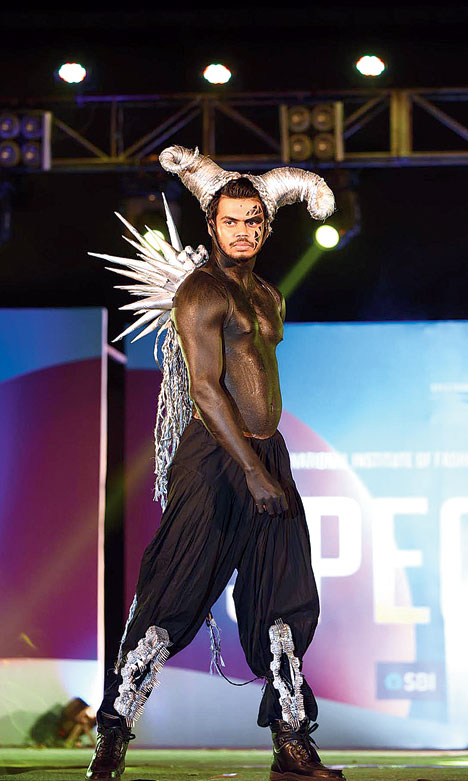
Students walk the ramp Picture by Shubham Paul

It was the annual fest of the best-dressed campus in town. National Institute of Fashion Technology (NIFT), in Sector III, held Spectrum 2018, with the theme of alternate reality, and colleges came from near and far to join what was one big party.

Off-stage events like “Task it up” had teams rushing to complete a series of fun activities before others. One round had all of them take off their shoes at a spot, run a distance and come back to put them on. Laughter and chaos ensued.

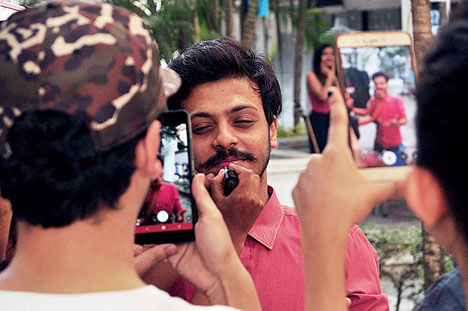
A round of “task it up” asked teams had to apply lipstick on a man

Another round saw all the males on the campus disappear. The task was for teams to apply lipstick and eyeliner on men. “Please, please, please!” a group of girls begged a male student who had set up a chaat counter. “We’ll eat all your phuchkas!” But the boy would have none of it.

Aritra Sarkar, another youth who was helping an NIFT friend put up a stall, was a rare man who allowed himself to be decked up. “I thought I’d help the teams out,” he smiled through scarlet lips as the teams fumbled to click a selfie with him to show the judges.

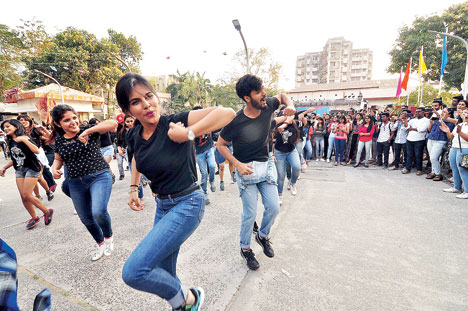
Students break into a flash mob. Picture by Prithwish Karforma

Students broke into flash mobs and came together to watch dance contests. Bhawanipur Education Society College won accolades for their dance to a medley of Bollywood songs with a message. Pratik Khatri played Mogambo, a skirt-chaser who finally gets nabbed by a gay man, played by Rounak Verma. “We wanted to portray gender equality, and show that men, women and LGBT all have equal rights and that no one has the right to harass another,” said Rounak.

Students had put up stalls selling cupcakes, stationery and accessories.

Madhurima Mukherjee, a first year student, had put up a tattoo corner. Some visitors longed for tattoos but were afraid their parents might not like it. Jhanvi Priya, another student, had found a way out. “I really love my dad and wanted my first tattoo to be dedicated to him,” she said, shutting her eyes tight as Madhurima prepared to ink a heart beat sign on her wrist with the word “Dad” on it. “It’s a surprise for my dad but I’m sure he won’t scold me now,” winked Jhanvi.

Style quotient

Piyush Kedia and Venkatesh Jaiswal of IIT Kharagpur nailed the quiz. “Our weakest link was the fashion-related questions but over all, I guess we pulled through,” said Piyush.

They fielded posers such as: Who introduced blue jeans? (Levi Strauss) Which actress, when asked what she wore to bed, had said “Channel No. 5 of course”? (Marilyn Monroe) and What kind of jewellery became popular in the hippy movement of the 1960s? (Bead jewellery).

The most awaited act had to be the fashion shows. The Bhawanipur college, for instance, interpreted the “alternate reality” theme by fixing the necktie and breast pocket behind one’s shirt and the Ionic Fashion Academy girls wore long flowy gowns that reminded one of leafy vegetables.

Other students in avant garde costumes

The host college had three entrants. The fashion and lifestyle department showed men with ram horns and girls with snake-like wraparounds with lights blinking on their clothes. The audience gasped collectively as one model took a fall but she recovered and the student emcee, Nandita Banerjee, couldn’t have handled it better. “A round of applause for the team and another one for the model who reminded us that the show must go on!” she smiled.

A student in a fashion show on the theme of “abaya and hijab” .

Another act that was warmly received was the fashion show by women in burkhas and hijabs with layers, sequins, and designs.

“We wanted to show that a woman in hijab can be fashionable too,” said Taqdis Fatma, a student of the clothing production technology department who walked the ramp. “Many of us wear abayas every day but it’s not that we’re forced to do so. It’s a choice and we’re comfortable in it.”

The segment featured seven girls, one boy and even a child. They paraded holding up placards with words like “Peace, love and harmony”.

“There is such camaraderie and brotherhood in the air,” smiled Nift director Col (retd) Subroto Biswas, who had joined the college during Spectrum last year. Harsha Singh, the cultural president of Nift, said the event had been a learning experience for the entire team.

source: http://www.telegraphindia.com / The Telegraph,Calcutta,India / Home> Calcutta / by Brinda Sarkar / April 20th, 2018

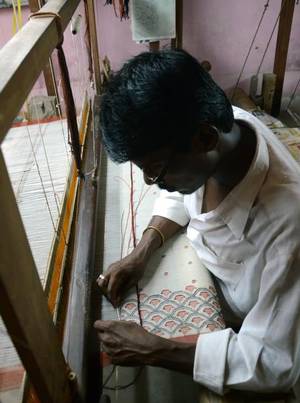
Textiles ministry pitches for GI tag for more Bengali sarees

The Bengali Jamdani does not have a GI tag yet. Here, a weaver at the pit loom works on a Jamdani print at a factory in Kana, West Bengal. File photo. | Photo Credit: Sushanta Patronobish

So far, only three types of sarees from West Bengal — Baluchari, Santipur and Dhaniakhali have obtained the GI tags.

The textiles committee of the Union Ministry of Textiles has asked the various weaving communities of West Bengal to apply for the Geographical Indication (GI) tag for Intellectual Property Rights (IPR) protection.

So far, only three types of sarees from West Bengal — Baluchari, Santipur and Dhaniakhali have obtained the GI tags.

“We are asking the different weaving communities of West Bengal to go for GI registration. Some of them are the weavers of Bengali Jamdani, Begumpuri and Bengali Tangail sarees which have huge export markets,” deputy director of the Textiles Committee of the textiles ministry T.K. Rout told PTI.

The weavers of scarves and stoles of Fulia should also apply for GI registration, he said.

Mr. Rout said that once these weaving communities get the GI tag, their IPR would be protected and legal action could be initiated against those who were not bonafide claimaints of these textile products. “Even the export markets of these products would be protected,” he said.

“GI is IPR which provides protection to the products which have origins in a particular geographical location and different from patents and trademarks,” Mr. Rout added

It also gives protection to those weaving communities from counterfeit claims by others, he said adding that the ministry was working to facilitate this process.

As of date, 270 products of the country had been registered under the GI Act, out of which 151 of those belong to the textiles and handicrafts segment.

source: http://www.thehindu.com / The Hindu / Home> News> Cities> Kolkata / by PTI / Kolkata – March 16th, 2018

Calcutta boy’s haveli hotel in Bikaner

Forefather’s legacy reinvented with honesty of heritage

Golpark:

A Calcuttan whose forefathers had migrated to the city from Rajasthan more than 150 years ago has returned to his roots to turn an ancestral haveli into a boutique hotel.

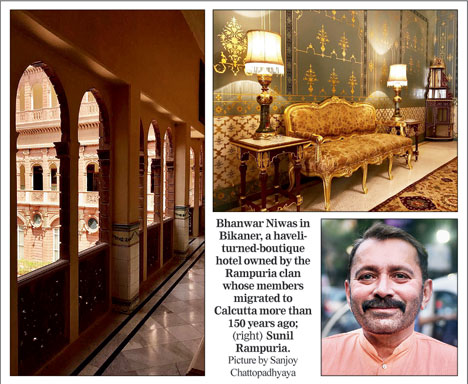
Bhanwar Niwas, one of the famous mansions owned by the Rampuria clan, stands in the old walled city of Bikaner. The haveli had been built in the late 1920s by Seth Bhanwarlal Rampuria, heir to a textile and real estate fortune in Calcutta. It became a boutique hotel in 1993 at the initiative of Bhanwarlal’s grandson, 61-year-old Sunil Rampuria.

Sunil, an alumnus of La Martiniere for Boys and St Xavier’s College, is now based in Bikaner but keeps visiting Calcutta, which he calls “home” and where his parents and in-laws remain.

“The Calcutta I grew up in has made me the person I am. The city is steeped in tradition but that has not stopped it from being liberal. Calcutta moulds you,” Sunil said.

He remembers going to a kindergarten school on Royd Street that used to be run by a Spanish woman and an Iraqi man. “I always wondered why their surnames were different. Back then, living in was not a common thing,” he quipped.

Sunil had sold a house in Vizag, where he had worked in a construction company for several years, to fund the facelift of Bhanwar Niwas.

Although the property is more than 90 years old, it did not need much renovation. The architecture of the three-storey mansion is a mix of Indian and European styles with a majestic facade and a sprawling courtyard in the middle. Multiple staircases and large rooms complete the heritage look.

“People from my native place came to work in Calcutta and eventually settled down. But there were relatives back home. They built large houses because they were a status symbol,” Sunil told Metro before returning to Bikaner last weekend.

Several bhujia makers in the city trace their roots to Bikaner. The Rampurias are one of the oldest among these clans with several havelis spread among Sunil’s distant relatives.

His great grandmother lived there until 1988. Sunil left Calcutta in 1992 when he was 27 and started the project the same year. He was married with three children and his parents were apprehensive about the decision because of the risks.
In Bikaner, people were surprised that Sunil was reversing a trend. While his forefathers had migrated from a provincial town to a booming business centre, he was returning from Calcutta.

Before the hotel opened, Sunil made changes like carving attached bathrooms out of the large rooms. He did the stencil-painted wallpapers himself.

The hotel has done well over the years. “I don’t have go to Delhi to solicit business,” Sunil said.

Bhanwar Niwas offers a wholesome period experience in its own way. It is located in the middle of a locality and guests can see people celebrate local festivals. There are no TVs in the rooms because Sunil wanted to be “faithful to the period when the mansion was built”.

It is hard to miss the connection with the Best Exotic Marigold Hotel, the 2012 film about a young Sonny Kapoor (played by Dev Patel) who wants to realise his father’s dream of restoring a grand hotel in Jaipur.

Sunil downplays the comparison, but is proud that his eldest son Prashant now looks after Bhanwar Niwas.

Calcutta is dotted with centuries-old buildings that are caught in the conservation conundrum.

A little over a month ago, the Calcutta Municipal Corporation allowed the building that housed the old Kenilworth Hotel to be demolished by its present owners after downgrading its heritage status. Heritage conservationists alleged a builder-official nexus.

Metro reported last week that Tripura House, the stately Ballygunge Circular Road mansion, will have a residential highrise share a portion of its 100-cottah compound after the West Bengal Heritage Commission gave its nod to a project rejected by the civic body.

Heritage has to be relevant to make conservation viable, Aishwarya Tipnis, an architect working on French heritage structures in Chandernagore, said in a lecture at the Indian Museum last Wednesday. “Conservation is no rocket science. It is far from a NASA code that can’t be cracked,” she said.

Sunil seems to have cracked the code.

source: http://www.telegraphindia.com / The Telegraph,Calcutta,India / Home> Calcutta / by Debraj Mitra / April 12th, 2018