Category Archives: Business & Economy

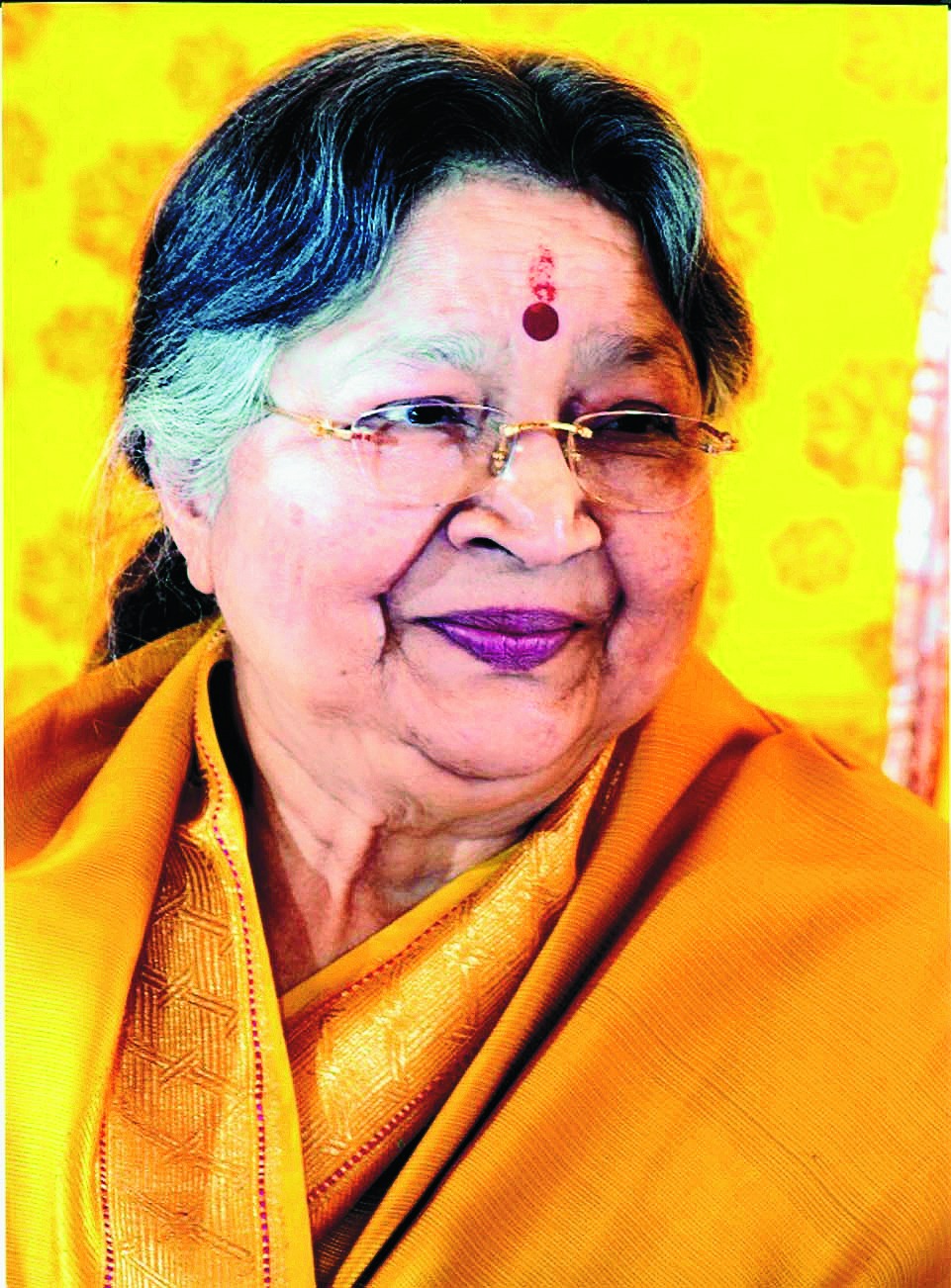
Sushila Goenka dead

Sushila Goenka

Calcutta:

Sushila Goenka, the wife of industrialist Rama Prasad Goenka, passed away on Sunday evening. She was 82.

Her eldest son Harsh Vardhan Goenka, who is the chairman of the RPG Group, and younger son Sanjiv Goenka, the chairman of the RP-Sanjiv Goenka Group, were present along with their children and other family members during Sushila’s final moments.

R.P. Goenka’s brothers, Jagdish Prasad and Gouri Prasad, were also present.

Born in Calcutta on August 15, 1936, Sushila, a daughter of Ram Sundar Kanoria, got married in 1948. A devotee of Indian tradition and culture, she was known for her interest in Indian music and her intimate connection with musical legends like Lata Mangeshkar.

Sushila was a director of Saregama India Ltd. Along with her husband, she was instrumental in setting up the Mahalaxmi Temple on Diamond Harbour Road.

She was cremated at Keoratala on Monday morning in the presence of friends, family members, ministers, senior government officials and city-based industrialists.

source: http://www.telegraphindia.com / Telegraph,Calcutta,India / Home> Calcutta / by Special Correspondent / July 17th, 2018

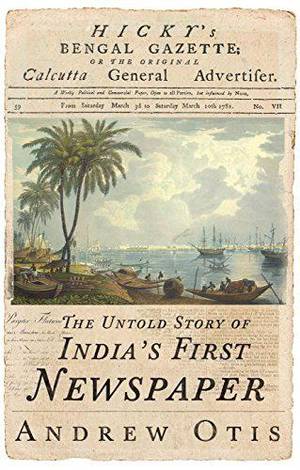
Hicky’s Bengal Gazette: The Untold Story of India’s First Newspaper review: Winds of freedom

In 1780, an Irishman took on the British in Calcutta with a tell-all weekly that covered everything from corruption to politics

It was 1780. Great events were shaping and shaking the world. Four years earlier, in 1776, Britain had lost its first colony; a new nation was born, namely, the United States of America. And nine years, later, in 1789, the French revolution ushered in a new era of freedom and hope in Europe.

At a time when the western world was changing rapidly a new spirit was also taking shape in one of Britain’s eastern colonies. Calcutta, then capital of British India, though the East India Company ruled only a small part of India at that time, was witnessing developments that were new not only in India, but in all of Asia. As free thought and freedom of expression swept across the world, an Irishman called James Augustus Hicky gave Calcutta and India its first printed newspaper in 1780.

Taking on power

Hicky’s Bengal Gazette, according to the young American scholar Andrew Otis, was a four-page weekly newspaper priced at ₹1. And it took on the rich and mighty of British Calcutta. What did Hicky publish in the pages of his newspaper? “He tried to cover everything that might be important to Calcutta, devoting many sections to politics, world news and events in India.” Topics that featured regularly were poor quality of sanitation and lack of road maintenance. Houses of poor Indians had thatched roofs, prone to catching fire. The outbreak of fires was frequently reported in Hicky’s paper. Through the letters he solicited and published, the editor gave voice to Calcutta’s poor.

He attacked corruption in the East India Company and in high echelons of society. The Bengal Gazette reported that the Governor of Madras, Sir Thomas Rumbold, had been recalled to England to answer charges of corruption in front of Parliament. “Hicky sarcastically wrote,” Otis tells us, “Rumbold was a great man for only amassing a fortune of about 600,000 pounds while in India, much of it from bribes and extortion.”

Hicky did not spare any institution. He exposed the problems of low pay for soldiers in the subaltern ranks of the Company’s army. Failed wars of the Company also came under its gaze. The Company’s army suffered a crushing defeat in the Battle of Pollilur at the hands of Hyder Ali, then ruler of Mysore. As the news of the disaster trickled in, Hicky questioned why the British were fighting in India. He accused the Company of squandering the lives of its soldiers. He even praised the noble actions of Hyder Ali in his treatment of the captured soldiers of the Company.

But as Hicky continued his fearless mission against corruption, the powers of the day did not sit idle. A rival newspaper was born in Calcutta. The India Gazette of Messink and Reed differed from Hicky in every possible way. The two papers represented two sides of the political spectrum.

Tough rival

Hicky emphasised independence while the India Gazette made no secret that they had the support of Governor Warren Hastings. So much so that Hastings had given the facility of free postage to India Gazette. There were hardly any opinion columns in it, a clear sign of their obeisance to Hastings’s authority. And they did so for a good cause, that was monetary rewards. India Gazette became the Company’s de facto mouthpiece; the Company’s departments placed advertisements and notices in that paper.

Press freedom

But Hicky took on the might of the establishment. He alleged through his pieces in the paper how one Simeon Droz had sought a bribe from him and wanted to get favours for him from Marian Hastings, wife of Warren Hastings, in lieu of the bribe. Hastings fumed that someone could show such imprudence. He passed an order that the Post Office would no longer extend its facility to the Bengal Gazette.

Hicky fought back. He hired 20 hircirrahs (courier men) to deliver his newspaper, and his newspaper’s popularity soared. He continued his fight against the most powerful man of the day and his entourage.

Hastings hit back and the Chief Justice Elijah Impey decreed that Hicky be imprisoned on charges of libel. A grand jury sat to decide the fate of Hicky.

After a fierce courtroom battle, the jury acquitted him. Hicky won, Hastings lost. As Otis tells us, “He had proven that it was possible to protect the Press against the most powerful people in British India.”

There were still three more trials to come that tried to muffle the voice of Hicky. What happened; did freedom of the press triumph? For that you must turn to Otis’s book, as he sketches a riveting tale of the struggle of India’s first newspaper editor.

Hicky’s Bengal Gazette: The Untold Story of India’s First Newspaper; Andrew Otis, Westland/ Tranquebar, ₹899.

source: http://www.thehindu.com / The Hindu / Home> Books> Reviews / by Sunandan Roy Chowdhury / July 14th, 2018

Paris pat for Siliguri tea firm

Athena Minami receives the award on behalf of Lochan Tea Limited in Paris

Siliguri:

A Siliguri tea firm has bagged an award in a Paris contest with its Darjeeling Tea picked the winner from an assortment of worldwide contenders.

Lochan Tea’s Giddapahar Spring Wonder drew rich pickings at the first edition of the “Teas of the World” International Contest, becoming the only Indian company among winners in various tea categories.

The contest was organised by Agence pour la Valoriasation des Produits Agricoles (Agency for the Valorisation of Agriculural Products orAVPA), and the awards were handed out in Paris on July 10.

“We were the sole Indian company that won an award in the contest. Some other varieties of Darjeeling teas were also put up at the event but those were by foreign importers,” said Rajeev Lochan of Lochan Tea.

Lochan had sent the samples from Giddapahar, a garden near Kurseong.

“It is called the Giddapahar Spring Wonder, one of the finest first flush muscatels. We have informed Sudhangshu Shaw, the garden owner, about the achievement,” Lochan said. The AVPA is a France NGO working in the field of agriculture.

source: http://www.telegraphindia.com / The Telegraph,Calcutta,India / Home> West Bengal / by Avijit Sinha / July 14th, 2018

Bengal jobs for former KLO rebels

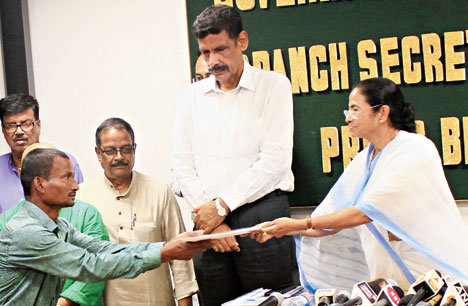
Mamata hands over a job letter to one of the former KLO rebels. (Passang Yolmo)

Siliguri:

Thirty-six former militants of the Kamtapur Liberation Organisation (KLO) were on Thursday hired as home guard volunteers in the Mamata Banerjee government’s first initiative to rehabilitate the ex-rebels who wanted a separate state.

Mamata handed over job letters to the group, including Mihir Das and Madhusudan Das, once prominent faces of the KLO. The 36 – 21 from Alipurduar and 15 from Jalpaiguri – will be engaged in their districts.

The former rebels – most were arrested during Operation Flushout in 2003-04 by the Royal Bhutan Army – have been disgruntled and long demanded rehabilitation. “They have been provided jobs and will work for the interest of the society. The initiative was taken by the chief minister,” said Amitabha Maiti, the Jalpaiguri police chief.

The decision to address the grievances of those who had resorted to armed struggle demanding a separate Kamtapur state – most were from the Rajbangshi community – follows another important decision the chief minister took during her ongoing trip of north Bengal.

On Tuesday, she had announced the elevation of Bangshibadan Burman as the chairman of the West Bengal Rajbangshi Development and Cultural Board. Burman, board vice-chairman till then, is a top leader of the Greater Cooch Behar Peoples’ Association, also formed to demand a separate state.

A section of the former militants had shunned Trinamul and supported the BJP in the May rural polls in some pockets of Alipurduar. “This had helped the BJP score well in some areas, particularly in the Kumargram block that borders (BJP-ruled) Assam,” an observer said.

The former rebels expressed satisfaction. “We have been raising the demand for 15 years. Some others like us who have been left out should also be provided similar jobs or some other assistance,” said Mihir Das, who hails from Kumargram.

Additional reporting by Anirban Choudhury in Alipurduar

source: http://www.telegraphindia.com / The Telegraph,Calcutta,India / Home> West Bengal / by Avijit Sinha / July 13th, 2018

Calcutta through Chinese eyes

Victoria Memorial:

If there was no Chinese community in Calcutta, there would have been no rickshaw, no Darjeeling tea and no noodles for us.

But the Chinese – missionaries, migrants, journalists and government emissaries – also left their written impressions of the city.

“The Chinese formed the largest migrant group from outside South Asia in the city. There were those who came to look for jobs and those who got smuggled in,” Tansen Sen said.

“It was the site of opium export and of financial transactions in the late 19th and early 20th century. The Mahabodhi Society here was a transit point between Sri Lanka and Thailand, China and Tibet. Many walked from Kalimpong to Lhasa, carrying necessary commodities. All this shows how important Calcutta was to the Chinese.” The professor of history and director, Center for Global Asia of New York University, Shanghai, was speaking on Chinese encounters with colonial and post-colonial Calcutta at Victoria Memorial on Thursday.

Governor General Warren Hastings initiated exchanges with China in the Qing dynasty. He sent a diplomatic mission to Tibet in 1774-75 and granted land near Budge Budge to Tong Atchew, the first Chinese trader to Calcutta, to set up a sugar mill in exchange of tea. British records show how Chinese labourers, especially carpenters, began to grow in popularity.

If Atchew did not document his impressions, Huang Maocai, sent by the governor of Sichuan in 1879, did. “His job was to check if the British planned to attack China and he created maps of the entire region from Sichuan to Bengal. He was fascinated with the railways and the telegraph as well as streetlights and tap water.”

But Kang Youwei, who visited Calcutta twice in the first decade of the 20th centure and stayed at the Grand Hotel, found the streets “filthy like those in Beijing”.

By the time Kang comes, there were three Chinese settlements in Calcutta – Bowbazar, Tangra and Budge Budge. Sen stressed that it would be wrong to lump the community together. “Bowbazar, housing the Cantonese, was a relatively open community. Tangra, housing the Hakkas, was gated. They did not like each other.”

The next major visitor, Tan Yunshan, the founder-director of Cheena Bhavana, Visva-Bharati, described China Town as an unhygienic place of criminal activities, opium dens and “where Chinese women showcase their small feet”, an euphemism for prostitution.

“But those who lived here regarded the place differently, like Kwai-Yun Li. Daughter of Hakka parents who migrated here in the 1920s and owned three shoe stores, she grew up in Chhatawala Gali and then Tangra, and was friendly with Bengali and other communities.”

But the political changes in 1949, when the Kuomintang lost the civil war in China and India recognised the People’s Republic of China (PRC) government, impacted the local Chinese populace.

The rise of communism or the “godless regime” impacted David and Mary Lamb, Chinese Christian missionaries who not only had to quit Shanghai but were also precariously placed in Calcutta as the Bengal government was supportive of PRC. The Lambs founded the Ling Liang Chinese Church and Grace Ling Liang English School in Tangra.

But worse was to come in 1962 with the war. As Kwai-Yun Li, who migrated to Canada and wrote of her Chinatown experience, told this correspondent during her Calcutta visit in 2008: “Fear was in the air…fear of being deported or put into Deoli.”

Deoli, in Rajasthan, is where a British detention camp for World War II Japanese prisoners had been reopened “to lodge Chinese-Indians”. Sen says those who had opted for PRC passports in 1949 were the first to be targeted. Many who were deported to China were settled in villages in Guanxi, Guangdong and Yunnan. “They still maintain Indian traditions like wearing sari and celebrating Diwali.”

The Chinese writings, Sen pointed out, present a perspective different from British writings and deserve to be read to understand the cosmopolitan nature of Calcutta.

source: http://www.telegraphindia.com / The Telegraph,Calcutta,India / Home> Calcutta / by Sudeshna Banerjee / July 01st, 2018
Software developed by N Bengal techie helps check Oz shark attacks

Shark Spotter has been deployed in 11 beaches in north New South Wales such as Byron Bay, Ballina (picture for representation only)

Jalpaiguri :

Remember Jaws, the 1975 Hollywood thriller on a giant man-eating great white shark that struck terror on fictional resort town Amity Island? In beaches across Australia, the Steven Spielberg reel horror is real with the country recording the largest number of unprovoked shark encounters with humans after the United States.

Now several Australian beaches have deployed a technology co-developed by a technologist from north Bengal that uses artificial intelligence to seek out sharks based on aerial footage from drones and warn swimmers to get out of the water quickly.

Dubbed as Shark Spotter, the software uses an algorithm capable of using video footage streamed from drones to detect sharks and alert swimmers. “The Shark Spotter is the world’s first, non-destructive technology able to detect sharks and other potential threats using real-time aerial video imagery. The new algorithm is 90% accurate in distinguishing sharks from other marine life. Human spotters from fixedwing aircraft or helicopter have accuracy of 12%-18%,” said Nabin Sharma, a lecturer at the University of Technology Sydney, who along with Michael Blumenstein developed the software that is making waves Down Under.

Shark Spotter has been deployed in 11 beaches in north New South Wales such as Byron Bay, Ballina, where shark attack was a major problem. And they have already saved lives. Shark attack reports from these beaches have declined significantly, prompting authorities in beach towns in the US and Europe to also consider the technology.

The Shark Spotter technology has won in three major categories (Research & Development Project of the year, Artificial Intelligence or Machine Learning Innovation of the year and Community Service Markets) in the Australia Information Industry Association, iAward 2018, New South Wales.

Sharma did his schooling in Holy Child School, Jalpaiguri, before graduating from Ananda Chandra College in the town. He then did Master of Computer Application (MCA) and Bachelor of Science from Siliguri Institute of Technology, before doing his PhD from the School of ICT, Griffith University. He is currently a lecturer with the School of Software, University of Technology Sydney (UTS).

Of more than 500 known shark species, 26 have been involved in unprovoked attacks on humans. Of these, Australia has 22 shark species. Australia records an average 1.5 deaths per year from shark .

source: http://www.timesofindia.indiatimes.com / The Times of India / Home> City News> Kolkata News / by Pinak Priya Bhattacharya / TNN / June 24th, 2018

TCS is largest employer in Bengal

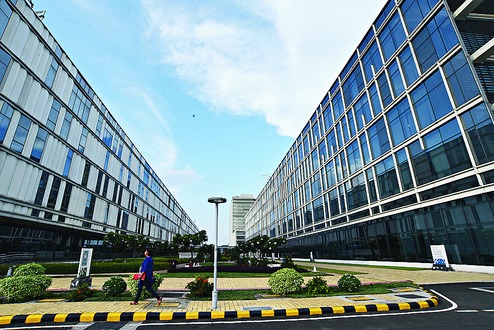
The TCS campus in Rajarhat. Picture by Sanjoy Chattopadhyay

Calcutta:

TCS has emerged as the largest employer in the private sector in Bengal, having close to 40,000 people on the rolls spread across 15 locations in Calcutta.

The company, India’s largest by market capitalisation, has added 10,000 people in the last 33 months alone. It is expected to add another 2,000 this year .

Even as automation, digital disruption and just-in-time recruitment may potentially tamper the pace of addition of workforce across the company, TCS executives said Calcutta will continue to maintain its share of the overall pie.

The company has close to 3,95,000 people on the rolls as on March 31, 2018 across 50 countries, but mostly in India.

Ajoyendra Mukherjee, executive vice-president and global head of human resources of TCS, said the company has given 20,000 offer letters to students in campuses across the India.

In Bengal, the company has gone to 40 engineering colleges last year, offering employment to nearly 2,000 students. Apart from TCS, Bandhan Bank, RP-SG Group and ITC are some of the large private sector employers in the state.

The special economic zone in Rajarhat now houses the largest facility for TCS in the city. It employs around 17,000 people, operating at 90 per cent of the capacity.

The IT behemoth has 2.5 million square feet space in this 40 acre sprawling campus, out of the 4 million square feet it has across Calcutta, including leased and owned space. The city is one among the top four locations for TCS in India.

The campus still has the space to add at least one million square feet and create at least 10,000 more jobs.

According to Suresh G Menon, vice president and general manager – eastern region of TCS, banking financial, utilities, retail are some of the core areas Calcutta focuses on. “We are 10 per cent of TCS now,” he said.

Tapering curve

Mukherjee said the company’s headcount would not grow at the same pace as revenue like in the past, due to multiple factors, such as automation in the IT world and cost push. The company recorded 7,700 net addition last year.

“Analytics, IoT (Internet of Things) and automation are changing the entire delivery process. We are going for hiring in an agile way which is on-demand,” Mukherjee explained.

source: http://www.telegraphindia.com / The Telegraph,Calcutta,India / Home> Business / by Sambit Saha / June 07th, 2018

Id gift for buddy trio’s business idea

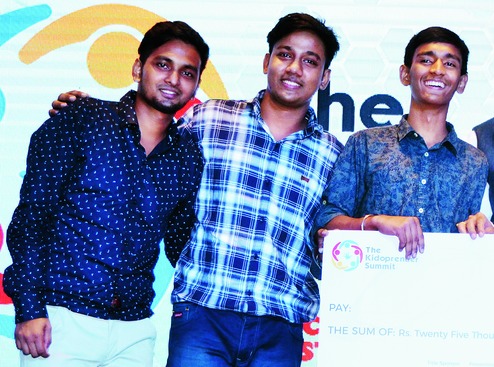
(From left) Md Wasim Ali Ansari, Azhar Rabbani and Ayush Singh at The Kidopreneur Summit at Novotel on Saturday. Picture by Biswajit Kundu

Calcutta:

They gave Id celebrations at home a miss to pitch their business module before a roomful of entrepreneurs. Azhar Rabbani and Mohammad Wasim Ali Ansari, along with Ayush Singh, have devised a plan to provide easy accommodation to outstation students through an app.

The three friends beat six other teams to bag the first prize at The Kidoprenuer Summit, in association with The Telegraph, at Novotel on Saturday. Co-hosted by Sonali’s Cubo, Merchants’ Chamber of Commerce and Srei Infrastructure Finance, the one-of-its-kind conclave gave young entrepreneurs a chance to showcase their innovative business ideas.

The OFY (Only For You) Homes project hopes to address the accommodation problems that students of other cities face when they come to Calcutta to study. “More than 60 colleges in and around the city don’t offer hostel facilities and at any time around 30,000 students are looking for a place to stay,” said Ayush, 17, a student of Shree Jain Vidyalaya.

The boys plan to offer standardised paying guest accommodation and flats on rent through an app. “Students can rent a home for any period of time and also share it with a maximum of four roommates. We will offer packages. They can get food, Internet, electricity and other amenities at Rs 6,000 to Rs 12,000 a month,” said Azhar, 18, of Seth Anandram Jaipuria College.

College mate Wasim, 18, said the trio have been working out the logistics for the past three months. “We hope to launch the app by the year end. We are tying up with people who rent out rooms,” he said.

Yubasana Kapas, 14, of Gokhale Memorial Girls’ School won the third prize for her plan to showcase Bengal’s art and culture before foreign patrons.

Three students – Kaushik Sardar, Shane Romel Kujur and Gaurav Bordoloi – from National Institute of Technology, Durgapur, bagged the second prize for Pedals Go, an app-based rental plan for bicycles.

“The event has brought three generations of entrepreneurs on one platform,” said Vayjayanti Pugalia, who curated the event.

The summit saw young entrepreneurs from across the country exchange notes with business stalwarts from the city and share their stories and challenges.

source: http://www.telegraphindia.com / The Telegraph,Calcutta,India / Home> Calcutta / by Chandreyee Ghose (additional reporting by Samabrita Sen) / June 17th, 2018

West Bengal bags allocation of world’s 2nd largest coal mine

The announcement regarding the coal mine allocation was made by CM Mamata Banerjee on Facebook.

Kolkata :

West Bengal has finally received allocation of the Deocha Pachami Harinsingha Dewanganj coal mines in Birbhum district. Deocha Pachami Harinsingha Dewanganj is the world’s second largest coal mine. The project is likely to bring investment worth Rs 12,000 for the state.

Making the announcement on Facebook, chief minister Mamata Banerjee wrote, “I am very happy to share with all of you that after a long wait of 3 years, West Bengal has got the allocation of the Deocha Pachami Harinsingha Dewanganj Coal Mines in Birbhum district.”

The chief minister added, “With an estimated reserve of 2102 million tonnes, it is the 2nd largest coal mine in the world. The mining project has huge potential of generating nearly a lakh of direct and indirect employment opportunities in Birbhum and neighbouring districts.”

Referring to the coal mine, Mamata added, “It will also involve investments worth Rs 12000 crores in the intermediate run. There will be huge socio economic development of Birbhum, the neighbouring districts and the entire state.”

Necessary administrative infrastructure has already been set up to start the project immediately.

source: http://www.timesofindia.indiatimes.com / The Times of India / Home> News> City News> Kolkata News / by Ajanta Chakraborty / TNN / June 09th, 2018

Kolkata’s first Durga Puja-themed restaurant encapsulates city’s most celebrated event

Dashabhuja, the new restaurant, connects Bengal’s most delightful celebration with its inhabitants’ most delightful indulgence—Durga Puja and the festive Bengali cuisine.

With food stalls lining the streets, devotees queuing up outside eateries and plates full of food passed among families and friends, the whole of Kolkata turns into a giant food court during Durga Puja.

While the five-day festivities get over in the wink of an eye, the city now has its maiden Durga Puja-themed restaurant ready to serve gastronomes round the year.

Dashabhuja, near the city police headquarters at Lalbazar, connects Bengal’s most delightful celebration with its inhabitants’ most delightful indulgence—Durga Puja and the festive Bengali cuisine.

The elegantly-lit eatery, decorated with colourful overhead canopies and various forms of the goddess Durga, simulates the feeling of sitting in a marquee while pampering the taste buds. The sound track of rhythmic dhak beats, an inseparable part of the Puja rituals, and several Puja-themed hangings and artefacts add to the festive ambience.

The menu, comprising authentic Bengali platters, gives prominence to Puja dishes starting from bhog (community feast of food items offered to the Goddess first) of khichdi, bhuni khichdi and labda (mixed vegetables) to the lavish spread of mutton curry, luchis (a type of puri), chanar paturi, rice, and payesh or the Bengali version of kheer.Along with the Puja-specific main course, the mouth watering variety of “Pujor Misti” or the sweets offered to the goddess Durga, such as chandrapuli, narkel naru, balushai, etc., are also served in the eatery round the year.

According to the restaurant owner, an artist associated with designing prominent community puja pandals or marquees for the last three years, the eatery is a perfect amalgamation of his dream and the family business.

“My dream is to design the themes for Durga Pujas while we have been running restaurants as part of our family business.

So in my new project, I thought of connecting the two. This is the first of its kind project that would let you soak in the carnival spirit of the puja in Bengal—throughout the year,” said Sayak Raj, the owner, who also designed three prominent community pujas last year.

Raj also revealed he was in conversation with a number of city artisans and sculptors, who would be making the Durga idols for some of the most popular pujas this year, and plans to install artefacts designed by them in his eatery.

“I wish this restaurant to be an archive of the Durga Puja celebrations in Bengal so that visitors from other states and countries can get a glimpse of our heritage and culture surrounding this festival. We are planning to decorate the interior with the miniatures of Durga idols to be installed in some of the prominent pujas in the city this year,” he said.

The restaurant, inaugurated by veteran Bengali actor Barun Chanda and legendary Indian classical dancer Uday Shankar’s daughter and actress Mamata Shankar barely a month ago, has created a buzz among food enthusiasts in the city and received significant celebrity presence.

“We have also requested some popular committees to provide us with their Puja theme songs so that we can play them in our restaurant all year long — along with our signature theme music,” the owner added.

source:http://www.nationalheraldindia.com / National Herald / Home> Food / IANS / June 12th, 2018