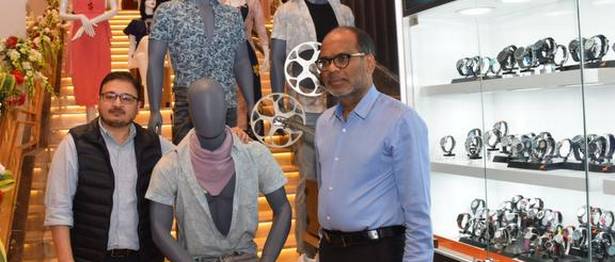
Future Lifestyle Fashions CEO Vishnu Prasad (right) and Future Retail CEO-East Zone Manish Agarwal – Debasish Bhaduri
It was in 1934 that American film production company Metro-Goldwyn-Mayer decided to set up a cinema hall in Calcutta to promote its films. The hall was inaugurated in 1935. Famous as an elite British city, the then Calcutta was a large market for Hollywood films.
Eighty-five years later, the iconic cinema hall on Chowringhee Road has made way for Future Group’s first ever movie themed ‘Central’ store.
The fashion and lifestyle retail store will play old Hollywood, Hindi and Bengali hits. These classics were big draws at the ‘Metro cinema’. The screenings are likely to start in April.
According to Vishnu Prasad, CEO, Future Lifestyle Fashions (which owns Central), the company is preparing a list of classics that have been screened. Plans are afoot to bring in the yesteryear stars who featured in these films. Over each week, a film will be played.
First thematic store
“This will be our first thematic store. In fact, Metro Central will be a filmi store. Going forward we may look to host theme-based movie screenings at the store. The idea is to bring alive a lost heritage of the city,” Prasad told BusinessLine.
Metro Central, as it is called, is expected to rake in ₹100 crore by FY20 with apparel sales accounting for nearly 70 per cent of it.
Down memory lane
Metro Cinema’s distinctive art deco structure has, over the years, defined the culture of the city. Initially, it screened only films produced by MGM. Gradually, Hollywood films made way for Hindi cinema and an occasional Bengali film.
The two-storied structure was designed by Thomas Lamb, a Scottish architect settled in the US who built several movie theatres around the world. MGM commissioned him to build two theatres in India. Metro Calcutta’s famous cousin in Mumbai was built in 1938.
Prasad points out that “special care” was taken at the time of renovation so that the art-deco façade, waterfall-style columns and grand staircase within were retained. The company has spent ₹22-25 crore on renovating the heritage structure that will have 55,000 sq ft of space.
Sources say the group had held talks for the renovation and reuse of Grace cinema, too, but issues such as structural stability of the building put things on the backburner.
source: http://www.thehindubusinessline.com / Business Line / Home> Variety / by Abhishek Law / Kolkata / February 15th, 2019
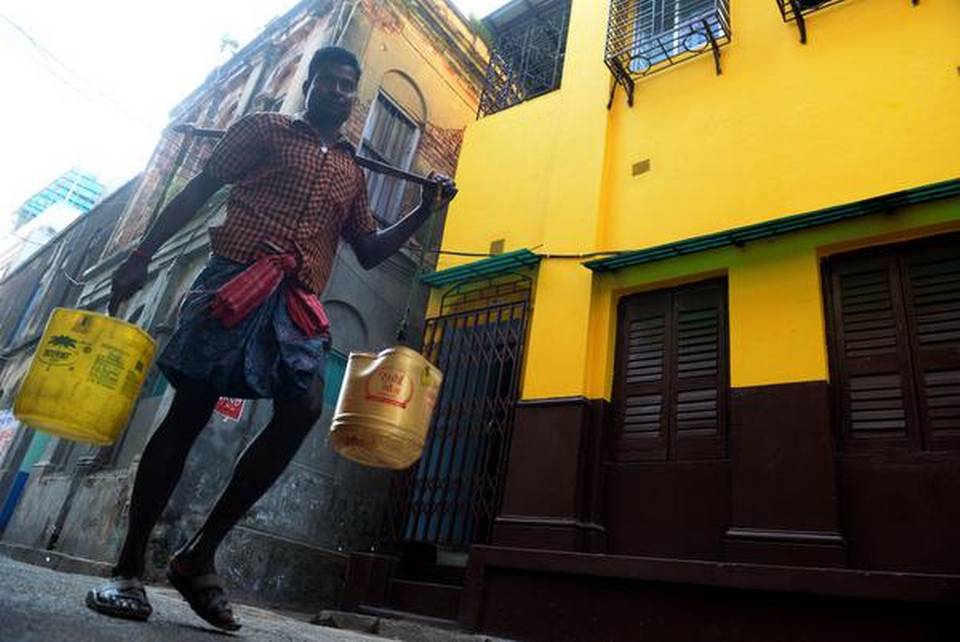
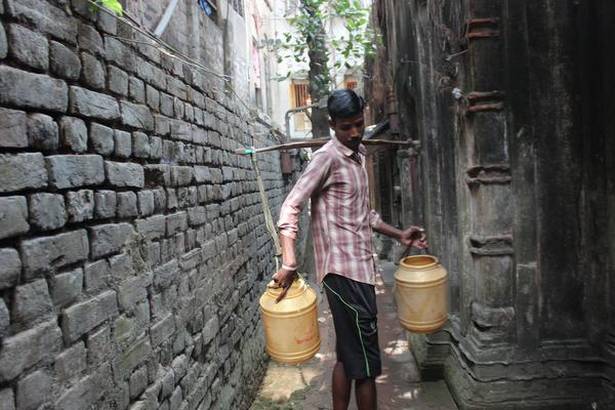
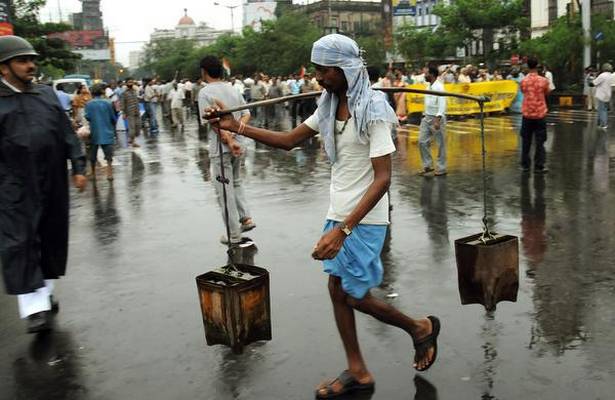
Bhadis make their way through Kolkata’s streets, carrying two plastic cans of water on an eight-foot-long bamboo pole balanced on their shoulders. | Photo Credit: Debajyoti Sarkar
The circadian rhythms of a bhadi’s life are dictated not by sunrise and sunset, but by the Kolkata Municipal Corporation
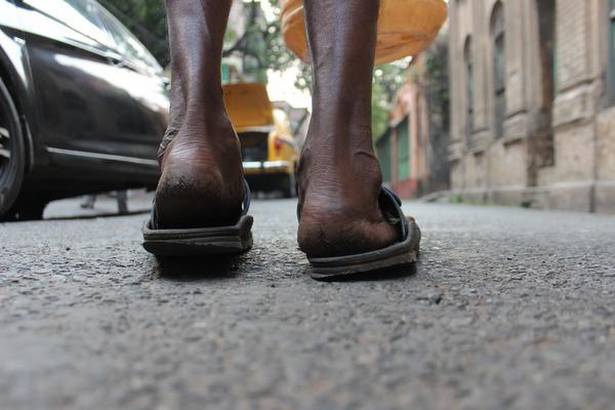
The frayed soles of his black rubber sandals scraping against the gravel, his body canted forward for balance, his steps quickened by the burden he carries, Chintamani Palai makes his way through Kolkata’s Shyampukur Street where houses look like boxes jostling for space. At either end of the eight-foot bamboo pole he carries on his shoulders hang two large, fluorescent yellow, plastic jerrycans filled with water that sloshes with every step.
It is Palai’s 21st trip of the day, between the municipal tap at the end of the street and back to the various homes, where he sells the water at ₹2 per can of 15 litres.
“I don’t need water today,” says Arup Ghose, a resident.
“You don’t? Ah! But I have brought it for you. I don’t like to throw away the water. Don’t give me money.”
“Okay. Fill the tank then.”
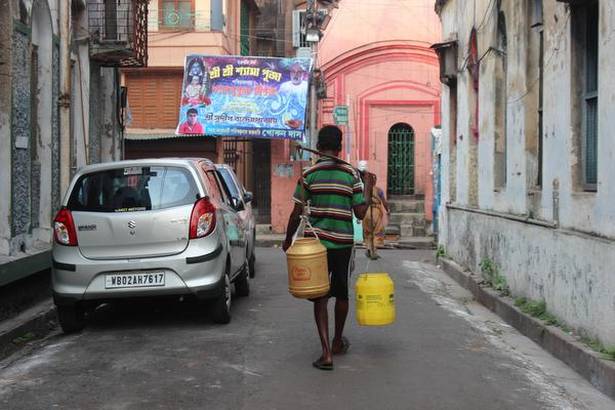
The numbers of bhadis in Kolkata are declining: from thousands even a decade ago they are down to a few hundreds now. | Photo Credit: Arpita Chakrabarty
Palai removes his sandals, climbs up two floors to the terrace, and upends his two cans into a plastic tank. He is now back on the street, his stooped shoulders a visible imprint of his profession, on his way to fill the cans again.
Palai moved to Kolkata from his hometown in Odisha 33 years ago. He is a bhadi – literally, one who carries the load.
Where are the jobs?
Odia bhadis have quenched thirsty Bengali homes for as long as one can recall. Palai’s father was a bhadi; so were his grandfather and great-grandfather. The work they do doesn’t count as registered employment — this is ‘make-work,’ necessitated by migration, unemployment and water scarcity. Back home in Odisha’s Bhadrak district, Palai could not find a stable job that would provide for the 22 members of his family. His family owns half an acre of land; his three brothers work intermittently as farm labourers, construction workers and dairy farmers. “Most of the work is seasonal, so we can’t depend on it throughout the year,” says Palai.
And so, able-bodied men like Palai have been migrating to eastern India’s biggest metropolis to look for work for decades now. Those without specific skills like cooking or plumbing end up as bhadis. But paradoxically, even though unemployment and migration is on the rise, the numbers of bhadis in Kolkata are declining: from thousands even a decade ago they are down to a few hundreds now.
“It’s a strenuous job,” says Palai. “Those of us who were trained by our fathers and grandfathers continue to work, but the young people don’t want to be bhadis anymore. They want easy, light jobs.”
***
Palai left Odisha when he was just 12. “It was the year Indira Gandhi was killed. The political atmosphere in Kolkata was volatile. So I ran back home, and returned to Kolkata a year later. I finally began working as a bhadi in 1985.” His smile is broad, his teeth are stained from the paan he chews incessantly, mostly to dull the ache of hunger and fatigue.
The circadian rhythms of a bhadi’s life are dictated not by sunrise and sunset, but by the Kolkata Municipal Corporation. The corporation releases water to the taps between 5 a.m. and 9.30 a.m., then again between 3 p.m. and 6 p.m.. In hours in between, he fills water from tubewells in the area and delivers it to those who need extra water, or who prefer tubewell water to tap water for washing. By noon, he has already ferried 990 litres of water, criss-crossing the lanes of north Kolkata. “I never counted this, all my life,” laughs Palai. “Today, when I keep a count with you, it seems quite a job.”
In the few hours that I shadow him, plotting his back and forth trips on Google Maps, I find that he has walked 5.11 km. In this time he has refilled his jerrycans 43 times, stopped at 26 homes, climbed three or more flights of stairs several times over.
The work they do doesn’t count as registered employment — this is ‘make-work,’ necessitated by migration | Photo Credit: Arpita Chakrabarty
He squeezes in a couple of hours for lunch. It’s usually rice and fish curry. Outside the small, square single room that he shares with another bhadi and two jhalmuriwalas (men who sell the spicy, puffed rice street food), all from Odisha, pieces of rui fish are being fried on a kerosene stove. Inside, the men are busy chopping potatoes for the fish curry. Another bhadi, back from work, is crushing poppy seeds on a sil batta, working it into a creamy paste that will go into the curry.
Jhalmuri brothers
“We cook and eat together,” says Palai. “This is our bonding time. We talk, make fun of each other. There is no time for any of this in the evening — by the time the jhalmuriwalas return home, it’s close to midnight, and we are asleep.” After a short siesta, Palai is back at the taps. Now there aren’t as many people as there were in the morning, but Palai is still impatient; he has dozens of homes to deliver to before the water is shut off at 6 p.m.
“I have a client whose landlord doesn’t provide any water,” says Palai, chewing paan as he waits in line at the tap. “So I supply them 90 litres of water two times a day.” Most of his regulars are inherited — his father once delivered water to them — and so this equation is much more than transactional: both bhadi and customer have built up a relationship neither wants to forego.
“We have piped water in our house,” says Archana Dasgupa, a septuagenarian who lives on Shyampakur Street. “But Palai is more than a bhadi to us; his grandfather delivered water to my father-in-law in the 1940s. He’s now a part of our family.”
In a city whose young have been migrating out in increasing numbers, Palai and his peers are valuable resources for the ageing population left behind: Kolkata has the biggest 60-plus population of any city in the country, and it also has the least number of 20 to 30 year-olds among all the metros. “Without our children, we depend on men like Palai for other regular jobs too, like buying groceries, cleaning the house, fetching water from the Ganges for the puja, and so on,” says Dasgupta.
The price of delivery has increased from 20 paise per can in the 1980s to ₹2 in 2018. But, says Palai, he doesn’t charge everyone the same price. The West Bengal State Cooperative Bank, where he delivers, pays him a modest salary of ₹3,200 per month. “I started with ₹20 when I joined the bank in the 1980s.” Palai’s family has been delivering water ever since the branch was established 50 years ago.
Odia bhadis have quenched thirsty Bengali homes for as long as one can recall | Photo Credit: Arpita Chakrabarty
After filling, carrying, emptying, refilling, and carrying water on his shoulders every day of the week, Palai earns ₹9,000 a month. “There are days when somebody’s water pump breaks down, and I fetch water for them till they repair it. I supply water for weddings. My earnings rise at such times.” He sends half his earnings home to the village. He is not unhappy, but his legs have begun to hurt more often, so he has begun to take painkillers.
He may well be the last bhadi in his family. “I want my son to study hard and get a proper job. I tell him, become something else. If you live as a bhadi, you die a bhadi.”
***
The Hooghly River flows west of Kolkata; there’s a huge groundwater reserve. The city’s eastern fringes are covered with wetlands that naturally treat waste water into raw water for fisheries and agriculture. Two decades ago, only a handful of houses in the city had piped water supply. Bhadis formed the water army who supplied water for drinking and washing across households. “There was an acute water crisis in those days, and it was the bhadis who brought water to our homes, like they do now.”
Manual support
Today, the demand for bhadis is lower. Five water treatment plants have boosted water supply to Kolkata’s homes. But the city now grapples with depleting groundwater. As independent houses turn into multistoreyed apartments pumping their own water from large tubewells, they deplete the city’s natural groundwater reservoirs.
In some places, the corporation does not supply water at the right pressure for it to be piped to above-ground storage tanks. Says Arunabha Majumdar, Chairman, Indian Water Works Association, “The residents then depend on the manual support system, the bhadis, to fetch water.”
Like 77-year-old Shyamal Mitra. “Every summer we face an intense water crisis. The piped corporation water is not regular. The supply pipeline has no pressure and water cannot be pumped up to the first and second floors,” says Mitra.
A floating population of six million per day — greater than the city’s resident population of 4.4 million — also depends on public water taps. The city, within the municipal corporation limits, draws 300 gallons of drinking water a day from 18,000 water taps, 12,000 hand tubewells and 400 tubewells.
High levels of arsenic have been found in the groundwater in various parts of Kolkata. The prolonged water depletion raises the risk of contamination, especially in the areas that are heavily dependent on groundwater, forcing them to turn to bottled water and the service of the bhadis.
Corporation tap water has been found to be safer than the packaged water sold in the city, and to contain more minerals and to be less acidic.
Since bhadis fetch water from Corporation taps, they are still getting takers.
***
Pitabas Parida has been supplying water for just two years in the Bagbazar area. Parida, who belongs to Odisha’s Jujpur district, has travelled to all major metros looking for work. He worked in a fibre factory in Bengaluru, made milk packets in Chennai, shaped iron rods in Hyderabad, and worked as a farm labourer back home, before coming to Kolkata.
He has no house in the city. Parida and another bhadi live in a dilapidated Shiv temple in Bagbazar. It is surrounded by high-rises and wild shrubs have taken over its crumbling walls. The duo’s belongings — some clothes, two mobile phones, two chargers, and two thin mattresses — take up a corner of the temple. Parida eats at a local dhaba and uses public toilets.
Around the temple are water cans of all sizes. It is wise to keep them there because no one will steal from the house of god. Parida, 38, a frail man whose bony face is his most striking feature, delivers water to 30 houses every day.
“Why do you this job?” I asked him.
“Back home there’s nothing I can do for a livelihood. Besides, Kolkata is close to home. This is my life,” he said.
Men like Palai and Parida make up Kolkata’s invisible water distribution system. It is hard labour for little money, but it is all they know.
This essay is from a National Geographic Society and Out of Eden Walk journalism workshop.)
The Uttarakhand-based writer explores the lives of those who walk mountains.
source: http://www.thehindu.com / The Hindu / Home> Society> Cover Story / by Arpita Chakrabarty / February 09th, 2019
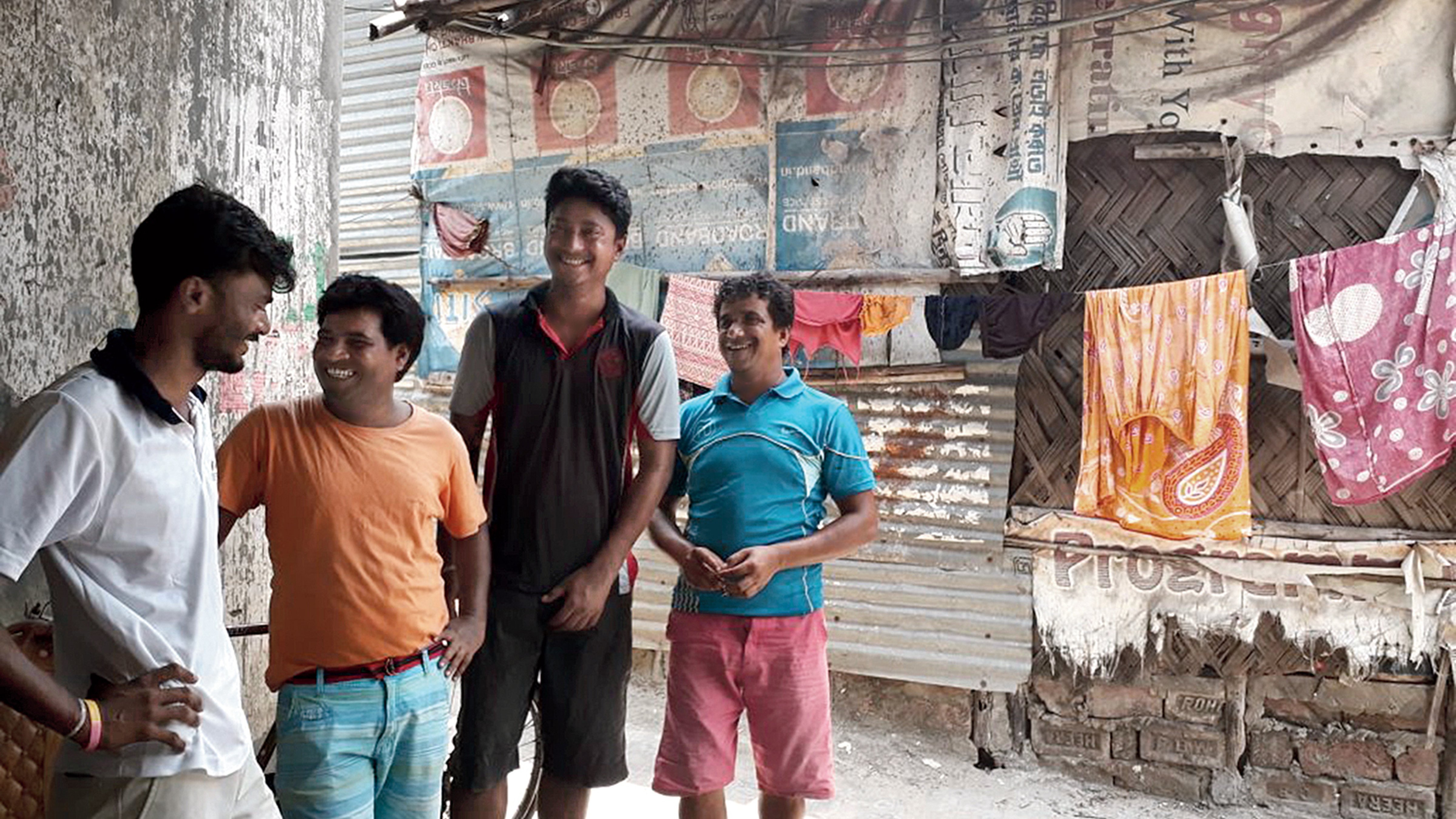
Madar Tala Colony in south Calcutta’s Tollygunge area is locally known as “Caddiebasti”
Caddies Sheikh Halim, Raju Sardar, Sundar Kanti and Sharif Ali have fixed clients at the two golf clubs in Calcutta / Manasi Shah
adar Tala Colony in south Calcutta’s Tollygunge area is not very far from the two biggest golf clubs of the city — Royal Calcutta Golf Club (RCGC) and Tollygunge Club. Within it is a basti or slum like any other. Vegetable vendor on one side, meat shop on the other, a pedlar on a cycle van selling rat poison, a tyre repair shop, row upon row of cellular houses, sagging clothes lines heavy with laundry.
Locally, this settlement is known as “Caddiebasti”. Caddie, as in the person who lugs a player’s bag and clubs during a game of golf, for a fee. “Two hundred caddies live here with their families,” says Mohammed Rajesh. He is 40-plus, started out in his pre-teens as a ball boy. His father was a caddie too and his grandfather as well.
It is 9am and he has just returned after caddying for his regular clients since 5 in the morning. Now he is sitting at the doorstep of his one-room residence. His smartphone is playing a Hindi film song from the 90s.
Rajesh says a caddie has “fixed” clients who pay him on a monthly basis. Temporary clients pay them according to club rules. The rates depend on expertise, though all training is largely informal, picked up from watching a father or an elder brother.
Rajesh talks about how RCGC organised classes for him and his colleagues last year. “It was about the rules of the game and etiquette. Then we had to take an exam, for which we were marked and, thereafter, assigned categories. Some of us were in category A and others in category B,” says Rajesh. “I am in A,” he adds after a moment’s hesitation and just then a pressure cooker at a neighbour’s goes off loudly, as if whistling in appreciation.
Sundar Kanti, 34, has recently been promoted to category A, but he has lost some clients — not everyone wants to pay extra bucks. But the caddies appear to be a united bunch. “If you pay less, no one will caddie for you,” Sundar threatens some invisible bad client, his tone near rebellious.
Pappu, reed thin, in his twenties — he refuses to share his last name — looks younger than Rajesh and Sundar. And though it is difficult to imagine him shouldering a burden of almost 12 kilos on his frail shoulders every day for many hours at a stretch, fact is he has been caddying for the last eight years. He has seven fixed clients, he boasts.
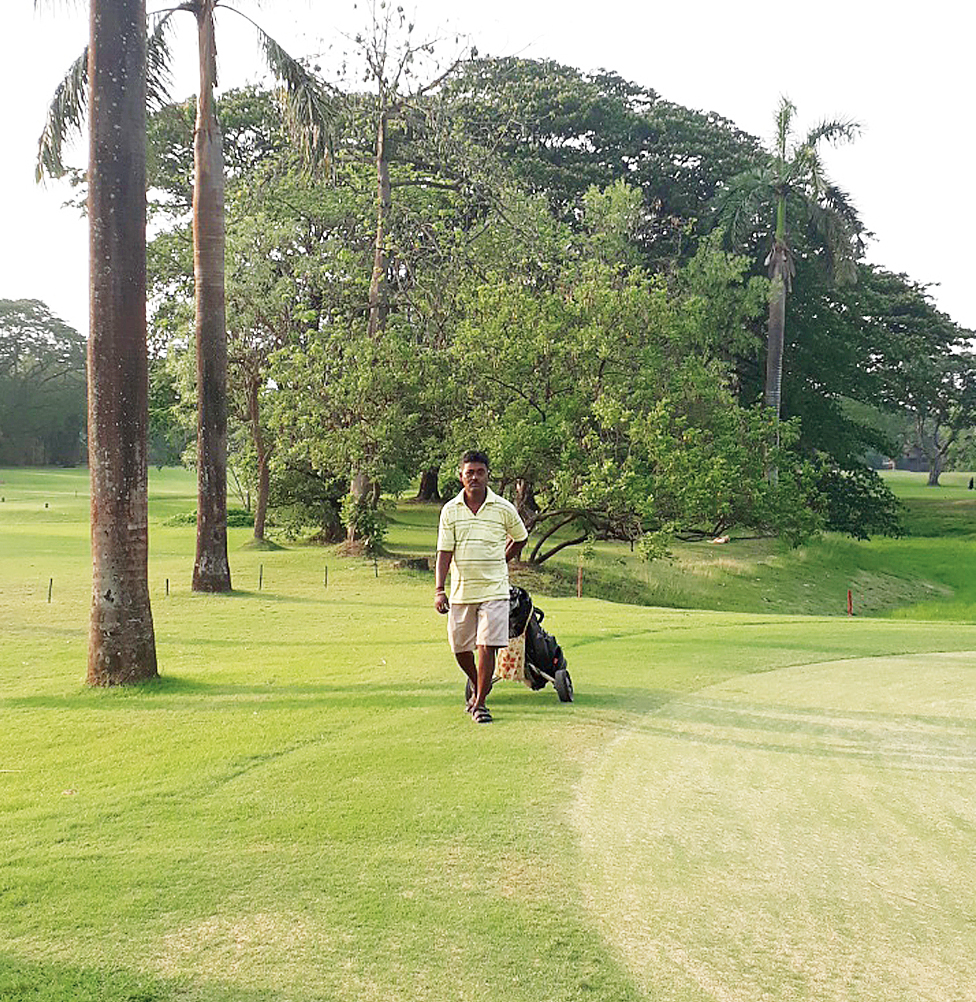
Sandip Dey, a caddie at RCGC loves to play a shot or two of golf / Manasi Shah
Fifty-year-old Sandip Dey seems to be sulking — whether that is his general demeanor or he is just tired, we cannot say. “A caddie has to fetch water for the saheb, clean the ball, hand him the club, hunt for the ball and fetch it,” he rattles off dispassionately.
The luxuriant golf course of RCGC is filled with cotton shrubs. There are cotton stubs, which can easily be mistaken for tiny golf balls. Sandip says, he is in this profession because he loves to play a shot or two. “Some clients let me,” he says, clenching and unclenching his fists. “Part of our job is also to humour clients,” interjects Goutam Hazra, 32. “It is a time-consuming sport and morales tend to wane,” he adds.
What about women caddies? Sheikh Halim, Raju Sardar and Sharif Ali, caddies all, break into a smirk as if it is a great joke. “There are no female caddies in India. But if you go to Thailand, America, you will find them,” 28-year-old Raju manages, in between giggles.
It is afternoon by now. The men of Caddiebasti are returning from “duty” in droves. They are dressed in tees, bermudas, some of them still have their caps on — all markers of the elite workspace they are part of and yet not quite part of. Some like Pappu will stray time and again — he says he tried his hand at various odd jobs — only to succumb to the lure of walking the green stretch.
Rajesh’s T-shirt reads “the Takeoff”. But his chatter and possibly dreams too don’t soar beyond golf. So what if his 12-year-old son is immune to golf’s magic? “You would have heard of Shiv Shankar Prasad Chawrasia,” he asks reverentially. Chawrasia is an Indian professional golfer; since 2008 he has won six Asian Tour events. Rajesh points eastwards and says, “He used to live there [in Bikramgarh] before he became so famous. His father was the greenskeeper at our club. And before he started to play, he was one of us, he used to work as a caddie.”
source: http://www.telegraphindia.com / The Telegraph Online Edition / Home> People / Manasi Shah – November 25th, 2018
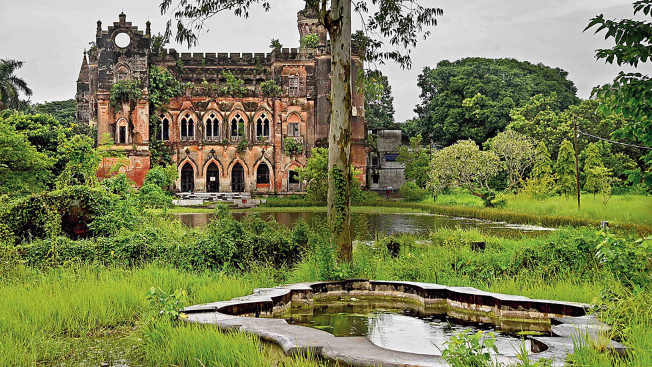
Wandering in the Bengal countryside could bring you to these accidental Indo-English castles
Gaine Garden on the Barasat-Taki highway looks every bit the English castle Image: Ankit Datta
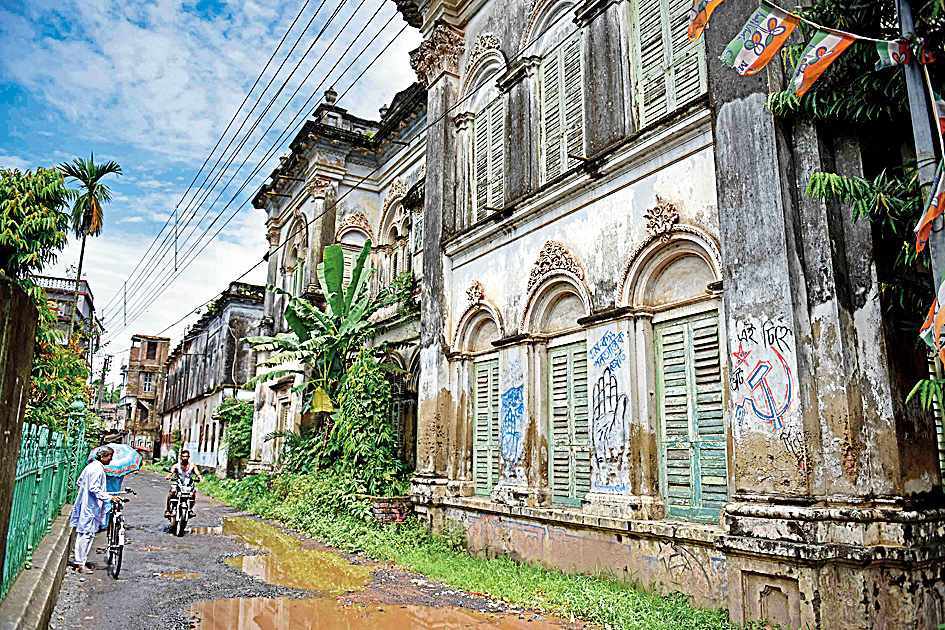
Anyone who has travelled along the Barasat-Taki road — northwards from Calcutta, towards Basirhat — would have noticed the picture-postcard castle. Visitors are not allowed inside the gated compound, but you can stop and admire the turrets, spires, the uneven roofline broken by stepped gables.
But that afternoon, when we reach the place, the gates are wide open. A truck is downloading bricks — we learn they are for the construction of a government office building. It is a 30-acre campus and we are eager to explore it. We sneak in and manage some quick clicks, when some security guards spring into action. We are chased out with a stern — “You need permission from the [social welfare] department.”
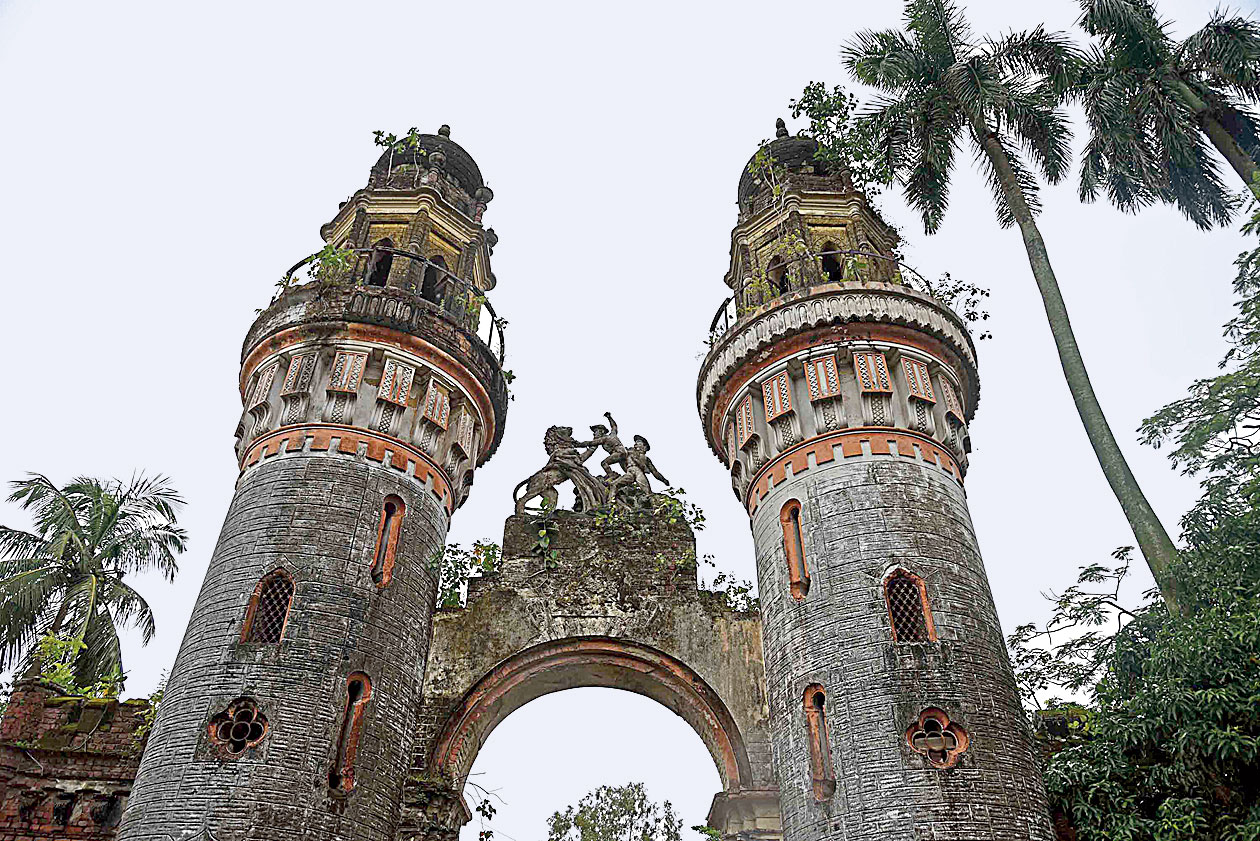
Atop the Gaine Garden gateway is some colonial baggage in stone — figures of two Englishmen overpowering a lion with bare hands Image: Ankit Datta
Out on the road, we ask a passerby what this grand structure is called and what it’s meant to be. “This used to be called Gaine Garden, property of the Gaines,” he informs us, and for details redirects us to the Gaine progeny living in Dhanyakuria village in North 24-Parganas.
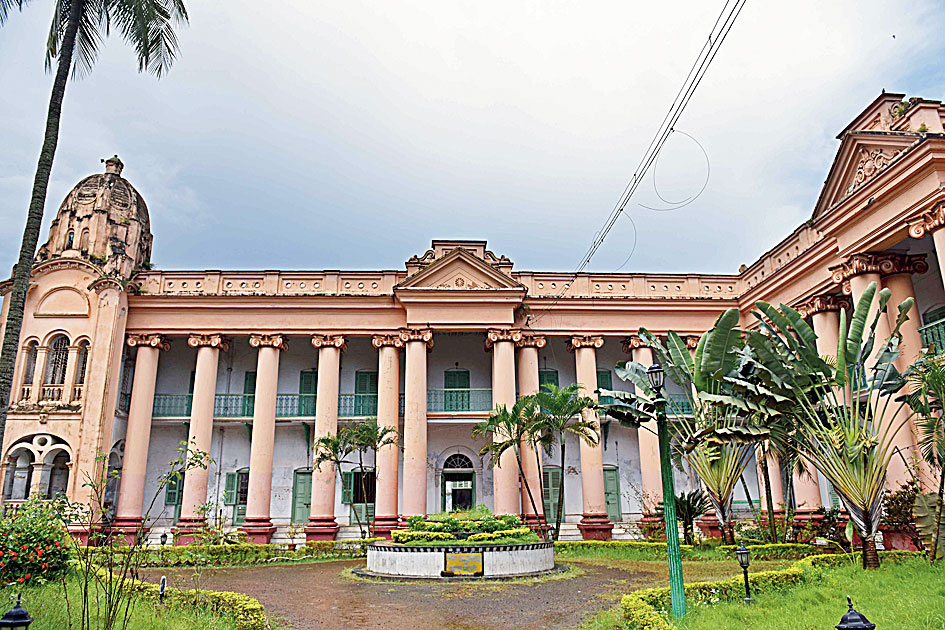
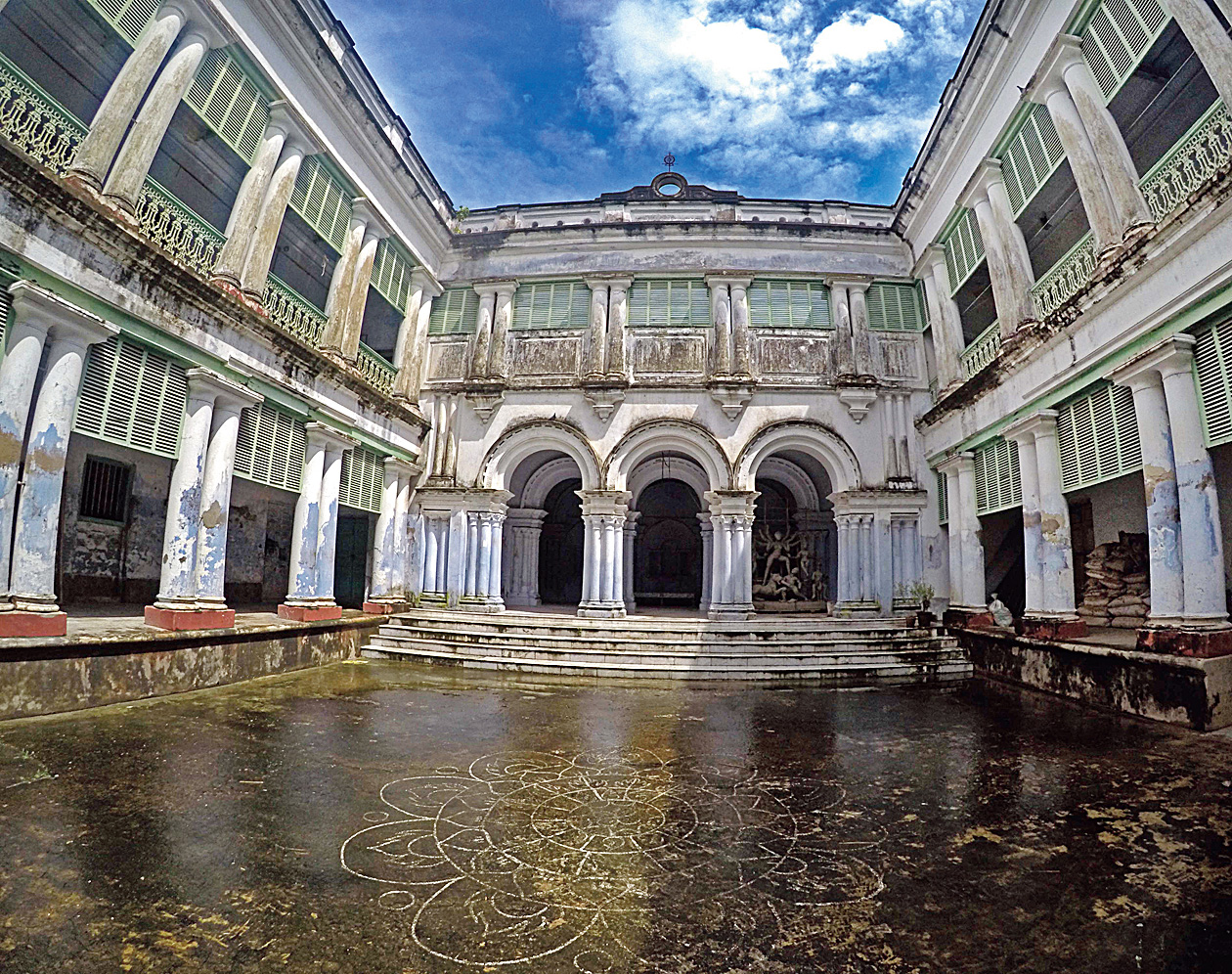
Teacher and writer Monjit Gaine lives with his elderly father, Kanchan Gaine, and his family in a portion of yet another grand structure of long, open corridors and many wings called the Gaine Rajbari. Monjit ushers us into the majestic thakurdalan or collonaded altar for Durga worship. He says, “Every other month some tele-serial or movie is shot here. Villagers call this ‘shooting bari’.” According to him, it is the rent from film production companies that aids the upkeep and maintenance of the huge mansion.
Unlike Gaine Garden, Gaine Rajbari was meant to serve as residential quarters and is located inside Dhanyakuria village Image: Ankit Datta
The Gaines made a fortune trading in jute, jaggery and other agricultural products. They worked in partnership with two other families of Dhanyakuria — the Sawoos and the Ballavs. All of them enjoyed the patronage of the British. “Huge tracts of agricultural fields and land ownership turned them into zamindars,” says Monjit. “Family lore goes that our ancestral properties extended to Satkhira in present-day Bangladesh, and in north, central and south Calcutta,” he adds.
Gaine Mansion was built in parts, primarily by Gobinda Chandra Gaine and his son, Mahendranath Gaine, mid-19th century onwards. Mahendranath was a prominent member of the Bengal Chamber of Commerce and owned quite a few jute mills too. He was the one who built Gaine Garden by the main road. Post Independence, the state government acquired the property. Says Monjit, “A few years ago we heard it had acquired the heritage tag. [Once a property gets this tag, it cannot be defaced, its basic structure cannot be changed either.]” He has no clue about the ongoing construction.
Its thakurdalan has featured in films such as Guru Dutt’s Sahib Bibi Ghulam, the Indo-French production La Nuit Bengali and the Uttam Kumar-starrer Suryatapa. You can spy a Durga idol in one corner of the thakurdalan of the Gaine Rajbari. The Gaines have been commissioning the idols to the same family of artisans for nearly 200 years Image: Ankit Datta
According to Monjit, the three leading families worked for the development of the area. They built hospitals, roads and schools. We cross the Sanskrit primary school-turned-private English medium prep-school founded by the Gaines. Beyond it, a little ahead of the trisection is the mansion of the Sawoos. The gate is locked, a neighbour says the caretaker has gone to the market and the owners don’t live here.
We peep through the collapsible gate and spy a thakurdalan almost as majestic as the Gaines’. Here too, there is a solitary and stark frame of an under-construction Durga idol. Later, we call Ashok Sawoo, who lives in north Calcutta. The house was built by his forefather, Patit Chandra Sawoo, 200 years ago.
The Sawoo Mansion usually remains closed; most of the family lives in Calcutta now. The house was founded by Patit Chandra Sawoo 200 years ago and extended by his son Rai Bahadur Upendra Nath Sawoo Image: Ankit Datta
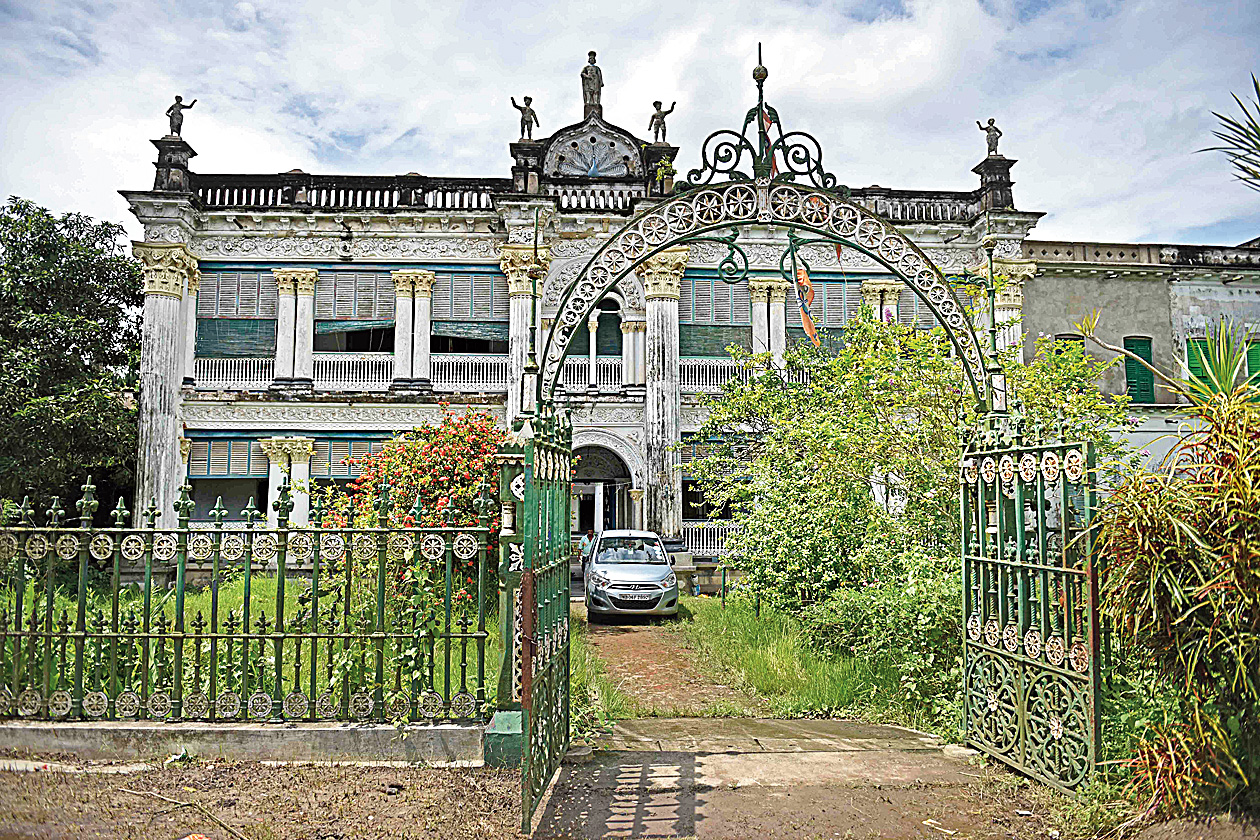
We walk down to Ballav Mansion next. Painted in green and white, the mansion has ornate cast iron gates and fencing. The Corinthian pillars, stucco work in the verandah and the grand thakurdalan reflect the wealth of the family. There is a well-kept garden too. Says family member Uma Ballav Biswas, “The house was built by my great-grandfather, Shyamacharan Ballav, 150 years ago. He made his fortune mainly in jute trade.”
At the time of filing this piece, Uma is looking forward to the annual family reunion on the occasion of Durga Puja. It seems the same artisans make the Durga idols for the Gaines, the Sawoos and the Ballavs. The same family of priests presides over the festivities. Says Monjit, “If anyone wishes to see our houses in full grandeur, this is the time. There’s no restriction on entries at this time. Just like our ancestors, we welcome villagers and visitors.”
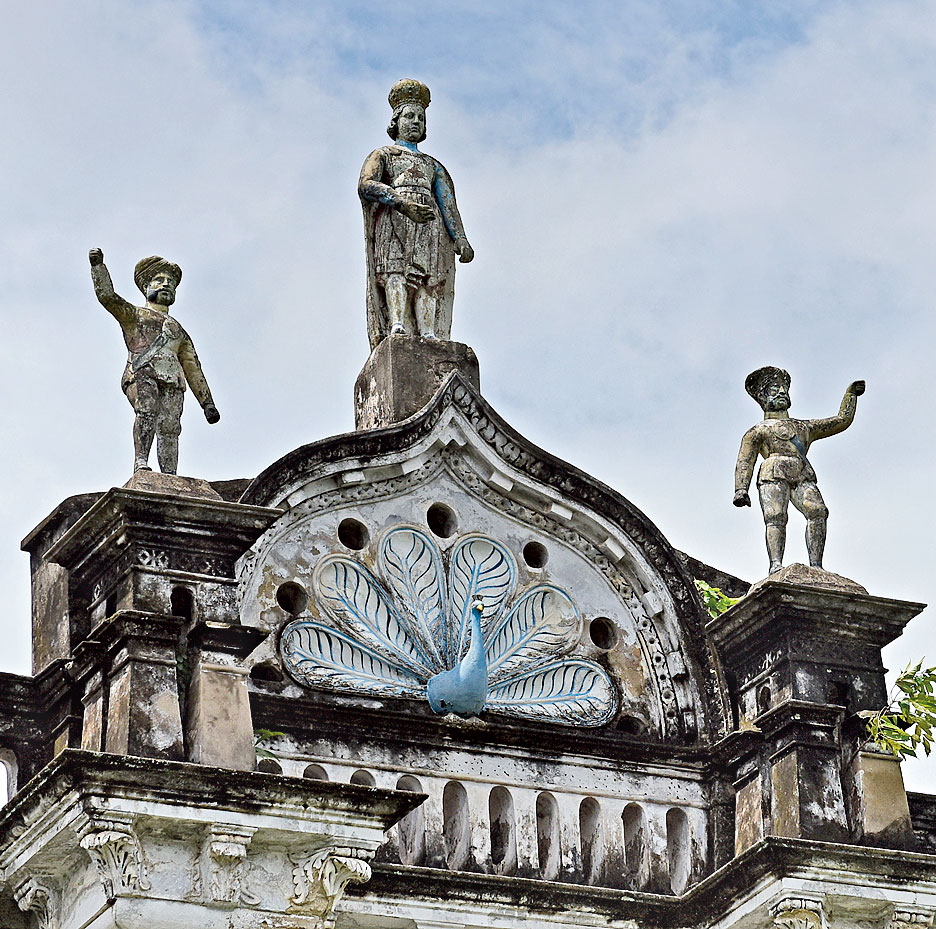
Ballav Mansion is referred to as ‘putul bari’ or dolls’ house by locals — after the figurines on the central arch and those on either end of the roof Image: Ankit Datta
The centrepiece is a princely figure wearing a cape and fancy headgear; the rest of the figurines include moustachioed Indian sentries and a lone peacock Ankit Datta
source: http://www.telegraphindia.com / The Telegraph,Calcutta,India – Online edition / Home> Heritage / by Prasun Chaudhuri / October 21st, 2018
The $100 million loan is the third and final tranche under the $400 million Kolkata Environmental Improvement
Investment Program and is aimed at expanding sewerage and drainage coverage and providing sewage treatment in Kolkata.
New Delhi :
India and Asian Development Bank (ADB) on Wednesday signed $100 million loan agreement to strengthen capacity of Kolkata Municipal Corporation (KMC) for resilient urban services, an official statement said.
The $100 million loan is the third and final tranche under the $400 million Kolkata Environmental Improvement Investment Program and is aimed at expanding sewerage and drainage coverage and providing sewage treatment in Kolkata.
It will target expansion of sewerage and drainage services in selected peripheral areas of KMC to at least 3,000 additional households and provide sewage treatment for at least 1,00,000 households, the Ministry of Finance said in the statement.
The agreement was signed by Ministry of Finance Additional Secretary Sameer Kumar Khare for the Indian government and ADB’s India Resident Mission Country Director Kenichi Yokoyama for the multilateral lending agency.
Mr Khare said it will supplement the efforts made in previous phases that aim to provide affordable access to water supply, sewerage and drainage services in Kolkata.
Kenichi Yokoyama said that the current financing will be used to construct 43 km of additional sewer drain pipes, four pumping stations, 13 km of pumping mains and three sewage treatment plants to improve sanitation service and climate resilience.
The overall goal of the programme, approved in 2014, is to restore water production capacity to 1,478 million liters per day and ensure leaks on 700 kilometers of water pipes are repaired by 2023, the statement said.
It aims to install 40,000 water meters in pilot areas, 170 kilometers of sewer-drain pipes and provide new sewerage connections to 27,000 homes, it said.
source: http://www.ndtv.com / NDTV.com / Home> Sections> Kolkata / by Indo-Asian News Service / October 04th, 2018
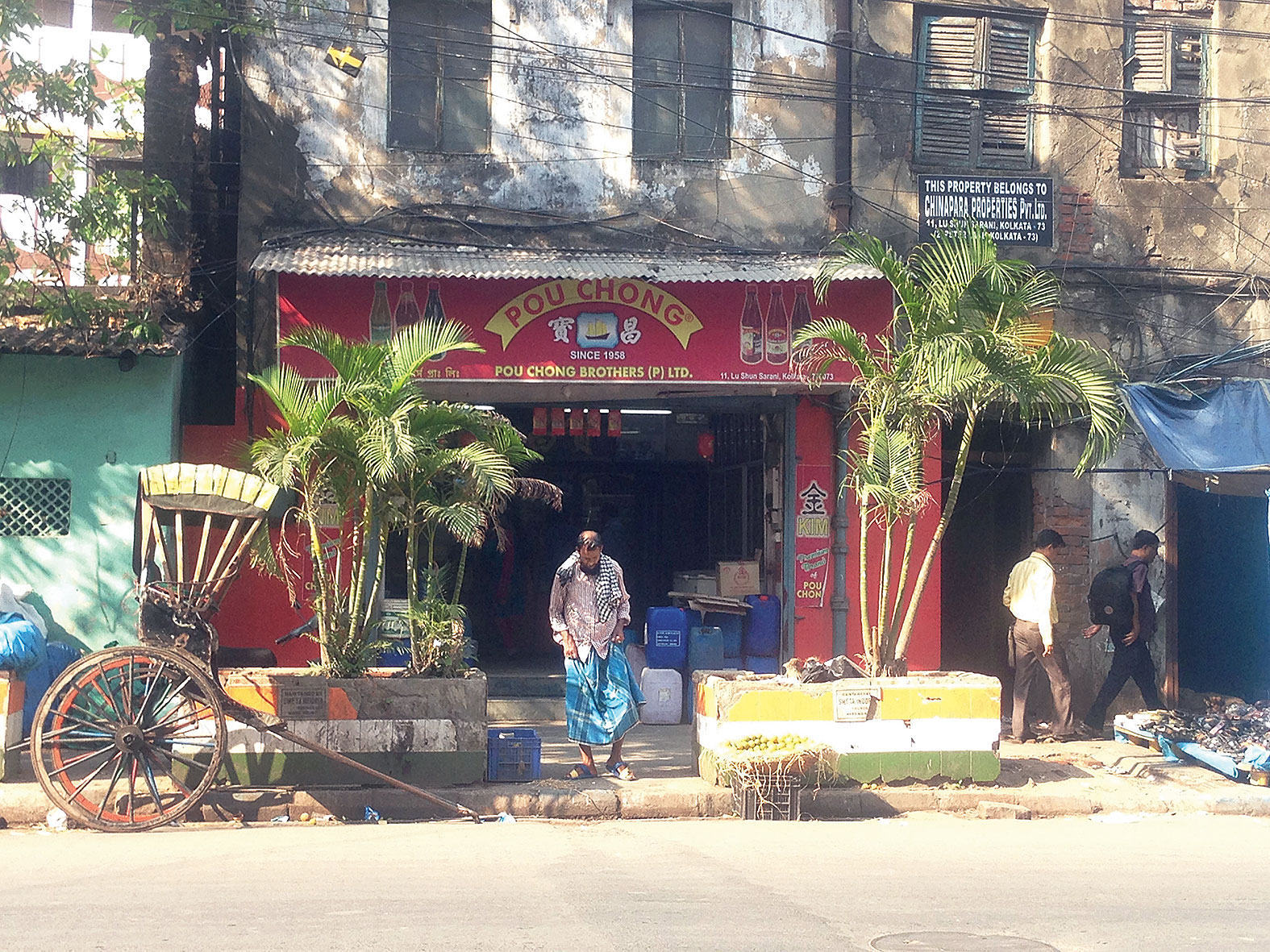
Two Chinese condiment shops on either side of a lane in Calcutta vie for patronage
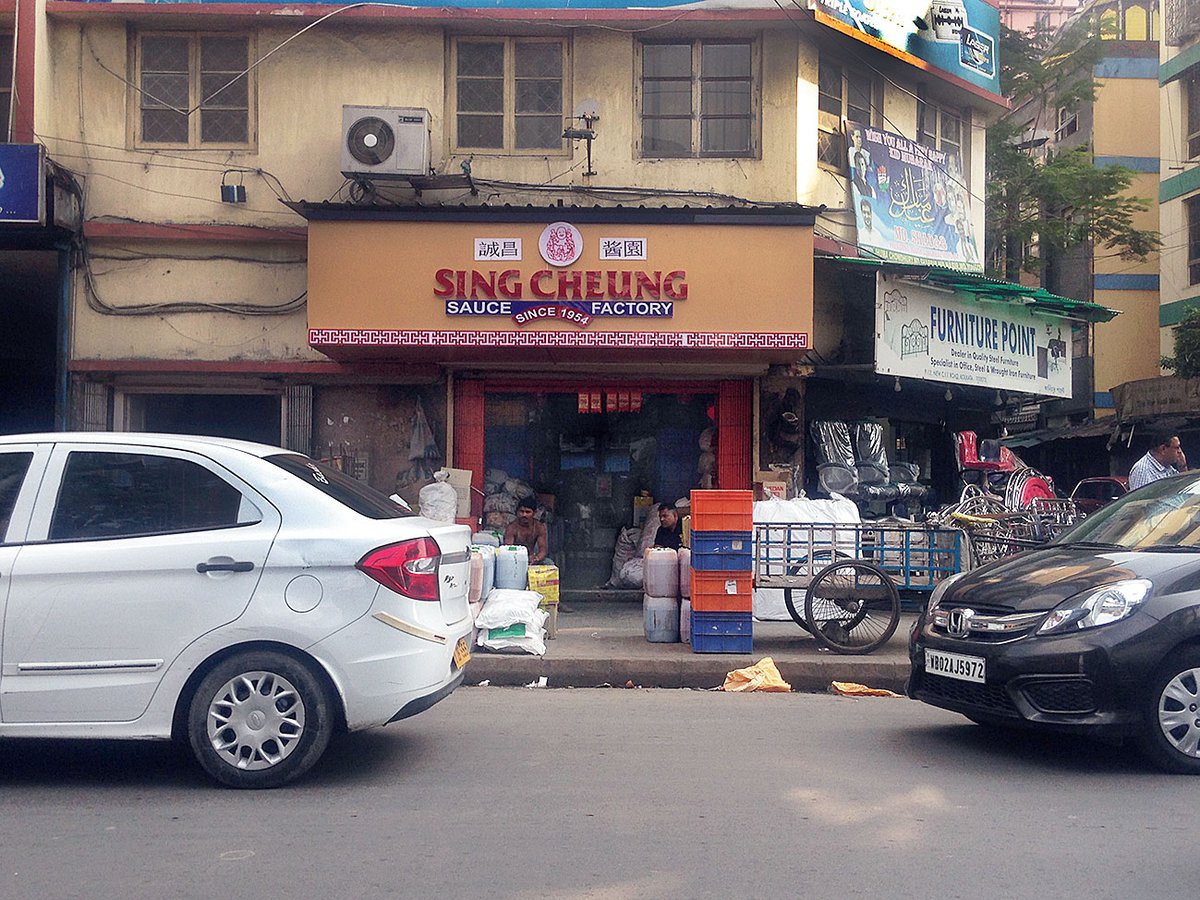
Sing Cheung, on the side of Lu Shun Sarani in central Calcutta competing for the most-authentic tag Manasi Shah
Lu Shun Sarani in central Calcutta is one saucy lane. On either side of it are two Chinese sauce shops — Pou Chong and Sing Cheung — and between them, an ongoing tussle for the tag of the most-authentic.
Sing Cheung is the older of the two, by four years.
It has been many months since the Chinese New Year, but time seems to have stopped here. There are Chinese lanterns and scarlet wall hangings all over the place. A tangy smell clings to the air and the place is bustling with customers, staff and barrels.
Yes, barrels. Plastic ones, almost 50 in all, inside the shop and outside it. White ones with orange or green caps — some empty, some full. It takes us a while to understand that these contain sauces — tomato chilli, garlic chilli, momo, capchico (red and green), coriander chilli, chilli vinegar, black bean, oyster, varieties of soyabean — No. 1 Dark, C Light, A Light and even an all-in-one sauce.
Another shop on the other side of Lu Shun Sarani in central Calcutta tussle for the most-authentic tag / Manasi Shah
One of the staff says, “Here we sell sauces by the kilo.” Locals, apparently, come with their containers and buy the sauces off the barrels, instead of buying whole bottles. It works out cheaper.
At the centre of the room is a wooden counter and on it, a couple of brochures that mention the range of sauces and items sold. A bespectacled bald man is sitting behind the counter and barking orders — Ye karlo. Yahaan dhyaan do. Inka kitna bill hua? He doesn’t have a moment to spare. Time is sauce, sauce is money.
“We cater to restaurants and the locals. All the Chinese restaurants in and around the city use our sauces. We sell authentic Chinese condiments,” he says after much prodding. And what does he mean by authentic? Silence, and then: “That information you will get only at our factory in Topsia.” He turns away to make it clear that he is not going to entertain any more questions
Sauce bottles / Manasi Shah
We turn to the customers. A middle-aged man keeps referring to a handwritten list. He is Surinder Jha, who works at a hotel in Hazaribagh. An elderly woman, Christine Lee, walks out of the shop with a bag full of condiments. It is for a cousin from Australia, she informs excitedly. “She is visiting Calcutta for the first time and wants to take these back with her.” She has bought the manchurian chilli, oyster, and red and green capsico sauce.
And how are the sauces here different from those on sale at the other famous sauce shop in the locality? The shop assistant parrots, “We are the best. Whoever comes to us will not venture into any other sauce shop.”
Pou Chong came up four years after Sing Cheung. In recent times, its owner Dominic Lee has been featured in Canadian chef David Rocco’s television show, Dolce India.
Rocco is a big guy. We are expecting razzmatazz and snootiness. This place, however, turns out to be more human, less busy — at that moment at least. The Chinese woman at the counter greets, “Namaste, Madam.”
There are no customers except for a man who is here to buy fruit crush; yes, they stock those too.
He finally settles for aam panna. Seeing our amused expressions, the woman from the counter asks us to taste their specialities. A few drops of pudina chutney, Thai chilli sauce and momo sauce on wooden ice cream spoons. She is not taking no for an answer. And, she is studying our expression intently. The pudina chutney is, well, like pudina chutney — just thicker. The momo sauce, just like momo sauce. But the Thai chilli is a deceptive thing, opens on a sweet note with the chilli kick coming in right at the end.
Unlike Sing Cheung, conversations have replaced brochures at this shop. A man in a red tee senses our confusion and starts to rattle off more options — garlic chilli, tomato chilli, no-onion no-garlic — yes, there is such a thing — and kasundi. We wait for him to catch his breath and then ask, “Isn’t there another shop around here that also sells sauces and is, in fact, more famous?” Without batting so much as an eyelid he says, “Famous toh humlog bhi hain.”
source: http://www.telegraphindia.com / The Telegraph,Calcutta,India / Home> Culture / by Manasi Shah / October 07th, 2018
The National Association of Software and Services Companies (Nasscom) on Thursday said it will host its first international SME conclave here on January 10-11, 2019, to provide entities an opportunity to establish a business connect.
The two-day conclave will be attended by over 2,500 delegates, 100 chief information officers, while over 200 companies will showcase their products and solutions, the association’s SME Council Chairman Kamal Agarwala said.
Small and medium enterprises constitute about 80 per cent of the association’s membership and they contribute about 20 per cent of the total software exports of the country, according to industry sources.
source: http://www.outlookindia.com / Outlook / Home> The News Scroll / September 27th, 2018
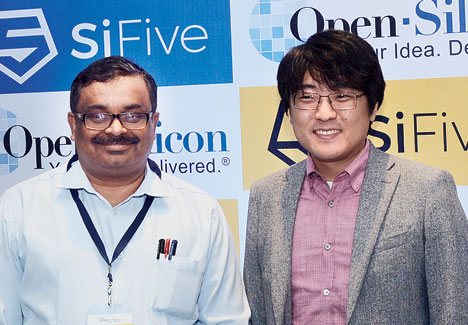
IIT Kharagpur director Partha Pratim Chakrabarti with Yunsup Lee, co-founder and chief technology officer, SiFive. Picture by Bishwarup Dutta
Calcutta:
IIT Kharagpur is exploring the possibility of using a platform developed by a group of researchers at the University of California, Berkeley, that can be freely used for designing semiconductor chips.
In the foreseeable future, Digital India will need application-specific chips in every conceivable domain but today only a handful of companies have the ability to design integrated circuits (IC).
Inspired by the success of open source software, SiFive, a US-based company, aims to change the ecosystem of chip design by promoting OpenSilicon – a platform where pre-designed open source components can be stitched together to design customised ICs.
The OpenSilicon platform already provides the open source RISC-V processor developed by the researchers at UC Berkeley.
Recently, SiFive hosted an academic symposium at a city hotel, where cost-effective ways to design and fabricate semiconductor chips were discussed threadbare. The symposium was attended by professors from IIT Kharagpur.
Later, the academics explained the significance of the conclave.
Designing semiconductor chips require sophisticated and expensive software tools or CAD tools and years of experience. Chip fabrication costs are astronomical. For any start-up that wants to get into custom chip designing, the costs and skill requirements are difficult to overcome.
“It is a promising initiative. Offering open source pre-designed components through a cloud-based design framework has the potential to bring down the design cost. Also, bundling multiple custom ICs in a single fabrication cycle can help in sharing the fabrication costs among the partners,” said Pallab Dasgupta, dean, Sponsored Research and Industrial Consultancy, IIT Khargpur.
Dasgupta is also a professor in the department of computer science and engineering with years of experience in electronic design automation.
The IIT has an advanced chip design laboratory since 2000, which has successfully designed and tested more than 100 chips with its fabrication partners. It carries out research for top global semiconductor and EDA companies.
SiFive is aiming to let more start-ups use its platform to minimise the cost of developing semiconductor chips and rid the chip design industry of the proprietary regime of a handful of wealthy companies, said Yunsup Lee, co-founder and chief technology officer (CTO) of SiFive.
“India is home to some of best research and educational institutions in the world. We are honoured to host presentations from the academic luminaries who are on the frontlines of innovation and research in the areas of machine learning, hardware verification, circuit design and more,” said Yunsup, who delivered a lecture at the symposium.
When Metro asked him to explain what prompted the company to hit upon the concept of looking beyond the proprietary regime, Yunsup, who has done his PhD from UC Berkeley, where he co-designed the RISC-V ISA and the first RISC-V microprocessors with Andrew Waterman, said: “At the University of California, Berkeley, we believe in taking the technology to a larger pool of users so the technology can do greater good. This was developed during our student days. With this motto in mind, we are touring 20 cities across the globe to popularise the concept.”
IIT Kharagpur director Partha Pratim Chakrabarti, who attended the session, said: “The concept they have floated is innovative. We are holding talks about a tie-up that the company has proposed.”
source: http://www.telegraphindia.com / The Telegraph,Calcutta,India / Home> Calcutta / by Subhankar Chowdhury / September 14th, 2018
The Textile Show by CCI presents contemporary versions of traditional craft
“Our craft has to grow and adapt. It has to be a living tradition and not just be preserved as our heritage. Which is why innovation and thinking out of the box help,” says Sarita Ganeriwala, founder of Karomi, an organisation that works with the women weavers of West Bengal, focussing on the myriad possibilities of Jamdani technique.
“Karomi works with urban and rural artisans and ours is weaver-centric organisation. The focus is keeping the craft alive. For me, the product comes ahead of the story of the weaver. We develop high quality products with high functionality,” she says.
Karomi products are not just ethnic, but have a contemporary feel,” Sarita points out, adding that her art background has enhanced her design interpretations. A textile design graduate from NIFT Delhi, Sarita was joined by Sarika Ginodia, a chartered accountant, to provide a sustainable business leadership to the firm.
Disha, founded by Amrita Chaudhary, works with 400 women artisans of the Shekhawati region in Rajasthan and engages them in tie-and-dye. It has made the women self-reliant by forming a self-help group. The stories of Karomi and Disha are woven by the skilled weavers from economically marginalised regions of Shekhawat and West Bengal. All the three women who have spearheaded this revolution will participate with their creations at the Textile Show organised by Crafts Council of India (CCI), in the city.
Disha provides a dignified livelihood for vulnerable women. Its activities include assistance in creating SHGs, skills training, promoting children’s education and very importantly, conducting awareness workshops on women’s social and legal rights. The 400-member SHG founded by Disha is trained in tie-and-dye and the Japanese craft of shibori to create saris, dupattas, stoles and running fabric in chanderi, tussar, and mulberry silk.
“Our design mission is to bring together the classic and the contemporary. We handover out complete designs to our weavers and they are also involved in the design development process from the beginning. At times, design intervention takes place at the loom level,” says Sarita.
Karomi has developed a special range of khadi and khadi blends for the Chennai exhibition. “We have brought products in plain khadi, khadi-linen, among others, all with the jamdani style of weaving. This collection is most suitable for Chennai’s weather,” says Sarita. Karomi received the UNESCO Award of Excellence for Handicrafts — Jamdani stoles in 2012 and again in 2014.
At the exhibition, Disha will showcase shibori saris, stoles, and dupattas. These artisans also use fine bandhini work on chanderi and silk saris. The Karomi design story is all about natural fabrics and linen woven in the jamdani style, inspired by colour blocking and geometrics, all woven by women weavers in remote villages of West Bengal.
The Crafts Council of India (CCI) is a volunteer-run, not-for-profit NGO working for the sustainable growth and development of India’s crafts and it’s craft artisans.
The Textile Show is at CCI’s Kamala Crafts Shop, Egmore, September 6 to 8, 10.30 am to 7 pm. For details, call 28191457.
source: http://www.thehindu.com / The Hindu / Home> News> Cities> Chennai / by Chitra Deepa Anantharam / September 05, 2018
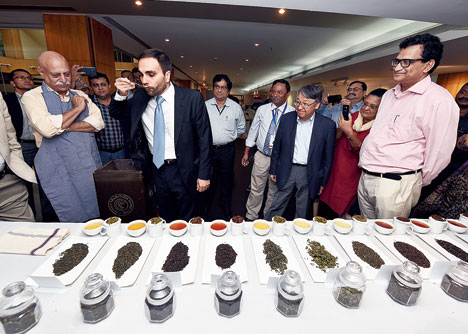
French consul general Damien Syed has a go at the tea tasting session. Pictures by Sanjoy Chattopadhyaya
A beverage made from the first harvest of a garden is light and delicate. A few months later, the second harvest from the same garden lends a rich musky character to the drink. The two are like youth and wisdom.
Calcutta:
Tea tales brewed at a tasting session for the champagne of Darjeeling on Friday.
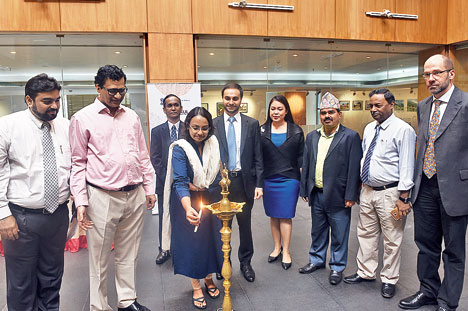
Kajari Biswas, director of the Indian external affairs ministry’s branch secretariat in the city, lights the inaugural lamp at ICCR on Friday
Foreign envoys were shown how to make the “right slurp” – and forget manners for a moment – to realise all the flavours, each independent of the other, at the same time.
India’s favourite drink has a centuries-old heritage. The tea industry creates maximum sustainable livelihood in Darjeeling and is steeped in the local history of the hills.
“Since the time the British first planted tea saplings in the Darjeeling area way back in the early 1800s, tea has become synonymous with the art, culture, lifestyle and economic ecosystem of the people around the tea gardens,” said Samrat Chowdhury, the chief mentor of BAUL (Bespoken Architectural and Unique Legacies of Bengal), which hosted the Chiabari Festival at ICCR, with the external affairs ministry and Chamong Chiabari Tea Resorts.
There are more than 80 tea gardens in the hills of north Bengal. The Darjeeling tea industry employs 55,000-odd workers and some five lakh people are dependent on the industry.
Arijit Raha, the secretary general of the Indian Tea Association, gave an overview of the Indian tea industry. The stagnation in auction price over the past few years and climate change were some of the challenges before the industry, he said. “There is an urgent need to check unfettered expansion as well.”
Krishan Katyal, chairman and MD of auctioneer J Thomas, at the event
Krishan Katyal, the chairman and managing director of auctioneer J Thomas, said the beauty of Darjeeling tea was in the distinct difference in flavours of the drink made from the leaves of the same garden in two different seasons.
“During the first flush in spring, the leaves are fresh and green like new shoots. The liquor is a beautiful, clear, light and delicate. The leaves of the same garden during the second flush in summer are of a completely different texture – thicker, heavier and more succulent. The tea is richer, with a ruby red colour and a depth and mellowness,” said Katyal. “It is hard to choose one. The two flavours are like youth and wisdom.”
The consuls general of France and Japan were among those at the event along with Kajari Biswas, the head of the Indian external affairs ministry’s branch secretariat in the city.
During a tea tasting session, Ajay Kichlu, the director of the Chamong Group, invited Damien Syed, the French consul general, to the table.
When Syed kept sipping the tea, Kichlu and Katyal asked him to slurp in a spoonful and let it roll in his tongue. The reason – a sip allows just one composite taste, while a slurp allows a jet of the liquor to enter the mouth, activating all the taste buds simultaneously. “The composite taste is dissected into specific compartments and each one of them is felt independently,” Kichlu said. Syed got it right the next time.
The programme included discussions on the prospect of tea tourism and the way forward for attracting foreign visitors. “We are trying to make India a 365-days-a-year destination. Niche offerings like tea tourism would play a key role in that,” said J.P. Shaw, the regional director of India Tourism in Calcutta.
P.K. Bhattacharya, the secretary general of the Tea Association of India, said 11 new tea estate proposals are pending with the government. “A couple would be approved soon.”
source: http://www.telegraphindia.com / The Telegraph,Calcutta,India / Home> Calcutta / by Debraj Mitra / August 04th, 2018