Category Archives: Business & Economy

Halmari CTC tea pips own feat, breaks Rs 500 barrier

Kolkata:

Halmari, the first among Assam varieties to find a place at the Harrods Top Tier Tea Gift Box, may soon be called the Sergey Bubka of CTC tea. The former Ukrainian pole-vault icon broke his own world record 16 times. The CTC (crush, tear and curl) tea produced on the plush plains of this Upper Assam estate has already surpassed its own feat four times in just two years. Late on Tuesday, it created history by vaulting past the Rs 500/kg barrier.

Nine sacks of Broken Pekoe (BP) CTC tea belonging to Halmari Tea Estate fetched a price of Rs 501/kg at an auction brokered by J Thomas & Co. The buyer was Prasad Tea , a tea-buying house in Siliguri. Last July, another Broken Pekoe variety of Halmari estate had fetched a record price of Rs 441/kg. The buyer then was Kolkata’s Sealdah Tea House . Only eight days before that, Halmari, owned by Kolkata-based Amarawati Tea Company , had grabbed eyeballs when another batch of its Broken Pekoe went for Rs 426 a kg.

“Of the nine or 10 CTC varieties that have gone for over Rs 400 a kg so far, seven are from Halmari,” owner Amit Daga told TOI.

Dissecting the character of the record-breaking tea, Krishan Katiyal, CMD of city-based J Thomas & Co, the world’s largest tea auctioneer, said: “This tea is of surprisingly excellent quality for an early second flush variety. The liquor is smooth, full, sweet, malty and mellow.”

Katiyal added that he expects more such good quality tea from Halmari as “the garden’s quality is on an upward curve”.

Daga feels he is lucky to be the owner of one of the “best-placed gardens on earth”. Located 28km from Dibrugarh town, the 374-hectare estate boasts a rich loamy soil suited to produce high quality tea from pedigree clones.

“I also congratulate my whole team for the feat. The courage of the buyer is also commendable to say the least. Preparing such a clientele is not an easy job. It seems the Indian consumers are graduating to the next level for quality tea,” he said.

Stressing on the need to maintain quality, the Halmari owner said: “We are 100% EU-compliant as we export to European clients. But I have no idea why the brand is getting so much value for the past 20-25 years.”
Over 1,000 people work at the Halmari estate to produce around 9.5 lakh kg tea a year.

Bharat Arya , director & CEO of J V Gokal & Co, one of the largest exporters of tea in India, lauded the efforts put in by Halmari, saying the owner must be treating his tea leaves like his baby. “They handle it very well. Thus the tea forms a nice thick cup. It is brisk, strong with a gutty liquor. Basically the garden’s raw material is good.”

Speaking from Siliguri, Raju Prasad, owner of Prasad Tea, said the CTC tea that he bought was better than most Darjeeling varieties although one should not compare between the two. “I paid a good price for an excellent batch of tea. This particular tea is mild and bright bodied. It strikes the taste buds as and when one sips it,” he said.

Prasad has already found buyers for his latest batch. “It will be divided into two parts. One will travel to a Maharashtra seller. The other lot will be sold in the Siliguri market. It is all set to fetch Rs 650-700 a kg in the market,” he said

If you think this is not a big price to pay, think again. Unlike Darjeeling, which goes for thousands per kg and has a select clientele, the CTC caters to the mass market and India is the world’s largest consumer in the category, running through 1,080 million kg of CTC tea in 2015-16. Of the country’s total tea production of around 1,200 million kg last year, CTC accounts for almost 90%.

Asked whether Indian consumers are prepared to pay good price for quality tea, Prasad said, “Today’s tea aficionados are confident about quality. So, they don’t mind paying for it.”

source: http://www.timesofindia.indiatimes.com / The Times of India / News Home> City> Kolkota / by Sovon Manna / June 09th, 2016
Hill royal relic now rubble – GTA pulls down Bangla king’s centuries-old palace to set up hotel management school

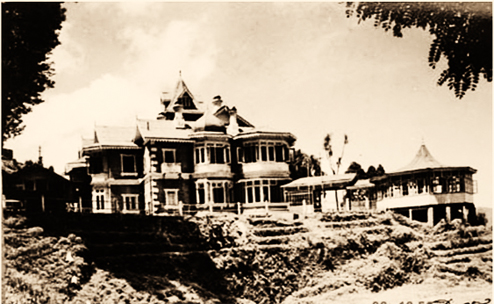
An undated photo of Sailabash: Courtesy Das Studio in Darjeeling

Darjeeling :

Darjeeling’s rare connection with present-day Bangladesh and a part of the hill town’s rich history has been reduced to rubble.

The GTA has pulled down Sailabash, the over-a-century-old summer retreat of the raja of Digapatia, to set up a modern hotel management institute and guesthouse in one of the last few available green spaces in Darjeeling.

Digapatia is now in Rajshahi, Bangladesh.

The palace under the tourism department of the GTA near Jalapahar and was brought down about two weeks ago. “The building was in a dilapidated state and recent earthquakes too had caused some damage,” said Kishore Ghimire, an executive engineer of the GTA.

In his book, A Concise History of The Darjeeling District Since 1835, which was published in 1922, E.C. Dozey, a writer and historian, said the building had been set up on land that was once owned by Capt J. Masson, the superintendent of Tukvar tea estate, by the “Digapatia Rajah”. The retreat was earlier called Girivilash and the name was changed to Sailabash after Independence.

The Late Nayan Subba’s soon-to-be-published book, Heritage buildings of Darjeeling, Kalimpong and Kurseong, says Raja Pramatha Nath Rai Bahadur had founded Girivilash whose garden was laid out by a German floriculturist and horticulturist, Morgenstern, and was looked after by 12 gardeners.

Nobody could say exactly in which year the building had been constructed. But its believed it was built in the last decade of the 19th century.

“Girivilash was a favourite place for the British governors of Bengal….The British army took over the palace in 1942. Later on, it was acquired by the government. It also served as a Tibetan school for a while. The palace has lost the historical grandeur of Girivilash,” writes Subba.

According to Subba, the colonial building had an attic with miniature gables and a small dome, and an all-weather glazed rotunda with small square windows in classical style. There was a tennis court as well.

“Raja Pramadanath Roy occupied the front suite on the ground floor, which included the library, with its precious screens of velvet and ornate wooden pelmets,” writes Subba.

The front suite of the upper storey with the snow view rooms was “for the rani”,

Subba writes. It was “beautifully furnished with a curtained brass cot and a chandelier. There was a huge grandfather clock, which indicated the days of the month and the full moon day (Ekadashi). On the ground floor were the drawing room, dinning room, tash khana (card room) and the billiards room,” Subba adds.

Despite being in a dilapidated state, Sailabash was still a landmark in Darjeeling and used to house a guesthouse after Independence. Once the building was taken over by the Darjeeling Gorkha Hill Council, the office of the hill body’s vice-chairman was housed there. For the past 20 years, the building had been lying vacant.

Bharat Prakash Rai, convener of the Indian National Trust for Art and Cultural Heritage (Darjeeling chapter), said: “How foolish can we be to dismantle such structures in the name of development. Could it not have been repaired? We have lost a piece of history and that is very sad.”

Dawa Lepcha, the GTA Sabha member in charge of tourism, said: “A big-scale hotel management institution will be coming up and the requirements were such that the building had to come down.”

GTA executive engineer Ghimire said the project cost had been pegged at Rs 55 crore. “Apart from the institution, there will also be a guesthouse with 24 rooms for in-house training. The infrastructure is being set up as per the parameters laid down by AICTE (All India Council for Technical Education)”

The five-acre plot in which the Sailabash was located has Annapurna and Kafal guesthouses, along with a pond built by the DGHC. “The Annapurna guesthouse will be used as an administrative building for the institution, while a part of Kafal will have to be dismantled. The pond will be smaller in size and we will have facilities for rainwater harvesting,” said Ghimire.

The engineer said restoration of the building would have cost much more.

source: http://www.telegraphindia.com / The Telegraph, Calcutta,India / Front Page> North Bengal> Story / by Vivek Chhetri / Wednesday – June 01st, 2016

Restaurant school with French help

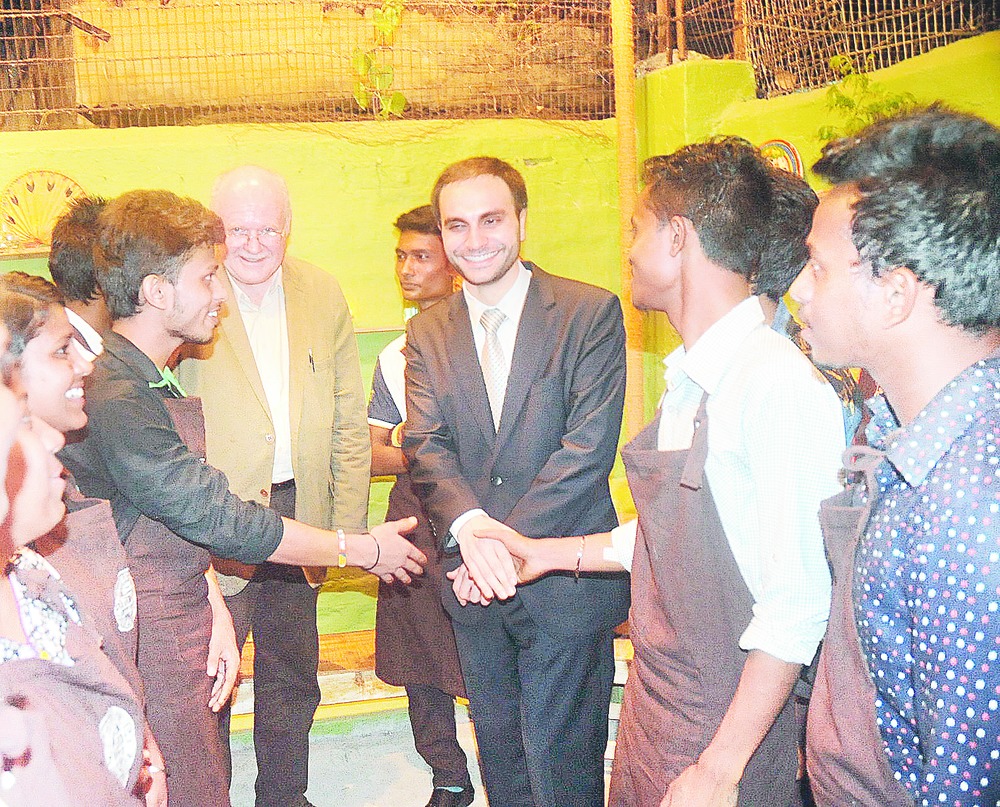
French consul general Damien Syed and German consul general Olaf Iversen meet the underprivileged youths being trained at Toto in Chetla. Picture by Bishwarup Dutta

Falafel served with pita bread. Chocolate cake. Apple pie.

These dishes were part of the food served by underprivileged youths from colonies in Kalighat and Tollygunge. The occasion was the inauguration of French restaurant school Toto in Chetla.

The school, which will also run a café, is a joint initiative of the local NGO Tomorrow’s Foundation and the French NGO Life Project 4 Youth (LP4Y), and is being supported by the French consulate in Calcutta.

“Our objective is education to employability. This is an entrepreneurship development project and we are looking at it as a business school,” said Arup Ghosh, founder of Tomorrow’s Foundation. Four volunteers of LP4Y have come from France to start the Calcutta project. “They are providing the knowhow, we are providing local help.”

In a two-storeyed house in Chetla which is housing both the school and the eatery, 15 youths are being trained to run a business when they are not busy picking up European recipes in the kitchen. “We had started off in October by recruiting five girls. When we started to think of the kind of business activities we should focus on, they suggested baking. It was important to take the idea from them based on their interest,” said Constance Delawstre, one of the volunteers.

That is how the seed of Café Toto germinated. The management is intent on serving only vegetarian fare. “We want to serve fresh and healthy food. We do not want to take a chance with meat in this heat,” says Delawstre.

The French volunteers are taking recipes of chosen Western dishes off the internet, preparing the dishes themselves for the students to taste and teaching them how to cook them. And if the reactions at the opening of guests like Marc Salesse, head of the consulate’s visa section, are anything to go by, their apple pie and chocolate cake are already tasting “just like back home”.

Not just cooking, the youths are also being trained in soft skills, like greeting a guest and taking orders, and management. “The youths have too much fire in the belly to not succeed. Once they complete the 12-month course, they should get entry-level jobs or set up their own place,” said Ranadeb Banerjee, a food and beverage industry veteran who is one of the coaches. The school offers them the option to continue beyond the course duration till they become self-sufficient.

Rama Rao and Gobindo Das, both orphans brought up in a Tollygunge NGO, are the biggest instances of the will to succeed. Rama had dropped out of school after Class VI but has taught himself spoken English. After a six-year gap, he has enrolled in an open school to appear in Madhyamik. Gobindo, too, picked up English on his own and took the Higher Secondary exams last year.

Other students stay with their families in slums. “I have to support my mother and two sisters. I am learning how to run a business,” said Sonu Kamti, who aims to deal in garments. Others like Laltu Singh and Gobindo Das are in it to learn computers. Such is their involvement that they have even sawed the café’s furniture themselves.

The guests left with a promise to return. “There was a need for such a café in our neighbourhood. The food is authentic and simple and the atmosphere convivial,” said Damien Syed, the French consul general. “It is a wonderful idea to create jobs through vocational training. Perhaps they can cook some German dishes too,” said Olaf Iversen, Syed’s German counterpart.

For now, the café will deliver food home on order and stay open only on advance booking. “Once the youths get trained, we will open thrice a week,” said Daniella, another volunteer.

source: http://www.telegraphindia.com / The Telegraph,Calcutta,India / Front Page> Calcutta> Story / byu Sudeshna Banerjee / Wednesday – June 01st, 2016

A Kolkata Laundry Helps People With Special Needs Find Employment

Kolkata :

A laundry service launched at Kolkata’s Pavlov Hospital, ‘Dhobi Ghar’ is being called a laundry with a difference.

The service will be run by people who have suffered stigma and often been abandoned by their families due to mental illness and aims to provide them an opportunity to a live a life of dignity.

Health and Family Welfare Minister of West Bengal Shashi Panja told NDTV, “This is the first of its kind project taking off in West Bengal. This laundry project empowers these individuals who are going to work here who have been through mental illness and recovered. It is about empowerment, self-respect and hygiene.”

The West Bengal government says it wants to improve conditions at hospitals for persons with mental illness. The government says they will work with NGOs and private players to create more such opportunities to integrate them into the work force.

The laundry project was set up by Anjali in collaboration with state government’s health and family welfare department. It has Sparsh Foundation as a technical partner and is enabled by The Hans Foundation.

Executive Director of The Hans Foundation Dr G V Rao told NDTV, “We are going to continue to see how we can replicate this and take it to the next level in order to increase the numbers.”

Those who have found work at the laundry say they want to be independent. Gita Kundu, who is undergoing treatment at Pavlov Hospital, told NDTV, “We feel nice doing this work. I am ironing these days. I feel better.”

“If we can do what we have been told to do here, then I can call myself successful as being able to earn and live independently is a man’s first responsibility,” added Ratan Nandi.

source: http://www.ndtv.com / NDTV / Home> Kolkata / by Saurabh Gupta / May29th, 2016

Start-ups… straight from the (he)art

It is often said that a successful start-up is like a love affair: demanding, but has its own prize. The story of Kultprit is like that, but with a twist. It all started when Salt Lake boy Saumya Jain, with a background in mining, went to London for a cousin’s wedding. He had no clue how his life was going to change.

Saumya always had a passion for fashion. Though he never had any formal training, he followed fashion trends and dreamt of starting a fashion start-up in Kolkata. But the fear of moving out of the mainstream always bothered him. In London, during a ride in the underground, he met Olena, a young Ukrainian girl. They had an instant connection, and love blossomed. Olena was mad about fashion and was working in the fashion industry in London, and Saumya always dreamt of the perfect partner with whom he could share his life and passion. Kultprit was born out of their love.

The merchandising brand has a website that deals in clothes and accessories. It has slowly carved a niche in the international circuit. “Kultprit was born in July 2014. We just got married, came back to Kolkata and wanted to do something different. So we decided to unite our passion for fashion and form a brand that represents the spirit of youth,” says Saumya.

The brand employs eight permanent designers and several freelancers from all around the world. “Designers and doodlers from India, Brazil, the UK, Singapore, Spain, Ukraine, the Czech Republic regularly contribute for us. Though Kultprit is our brainchild, it is also a stage for the amazingly talented young designers around the world to showcase their talent,” Olena says.

Speaking on the brands sustainability and future Olena said, “Kultprit is not only a fashion label. We support lot of fashion influencers around the world. Musicians, bloggers, actors and artists all over the world who give out strong messages to the youth are our fashion influencers. They are not our brand promoters but we are inspired by their work and in turn promote them though our designs,”

Colours used to intrigue Ranodeep Das since childhood. When teachers demonstrated algebra problems, he was busy scribbling and sketching a bird’s nest he could see outside the window. Since childhood, almost like every 90s kid, he was in love with Batman and Superman. And as he grew up, the idea of designing these characters and their merchandise came to him. And he gradually realized that the young generation was increasingly getting addicted towards customizable products.

When all his friends were busy hunting for mainstream careers, this young entrepreneur chose to have his own start-up: Rare Planet. On being asked how he dreamt up such an idea, Ronodeep says: “Everybody loves celebrity merchandise, customizable and designer products. And that is how I thought of the idea of Rare Planet.” Rare Planet designs superhero-themed earthen pots, kettles and wall art. Among the various products that Rare Planet has, the best are the colourful busts of Hellboy, Bane and the Joker. It also makes customized masks and movie memorabilia.

For Ekta Bhattacharya , it all started when she saw a poster of Satyajit Ray’s ‘Gupi Gayen Bagha Bayen’ at Nandan. She fell in love with the illustration. Since then, the girl from Barrackpore looked up to the other side of Ray — the illustrator — for inspiration. “I always loved painting, but Ray’s illustrations gave me direction,” she recalls. “Though I was never interested in a mainstream career, I was not sure of becoming a poster artist either. It happened by chance. A friend of mine, a short-film maker, asked me to design a poster for his film. He suggested I paint it, as it is rarely done nowadays. I always wanted to do a poster like that and readily agreed. It got lots of praise. I then realized this is what I am actually good at. I realized that that was who I am — a designer,” Ekta says. She launched her company — Ekta’s — in 2015, and leads a team of seven designers.
Her painted posters were hugely appreciated by artists like Soumitra Chattopadhay, Anupam Kher and Mahesh Bhatt. Ekta even painted a poster for Mahesh Bhatt’s last production ‘Hamari Adhuri Kahani’. “Money has never been the driving factor. It is the creative satisfaction that I derive working for my clients. Each one of them is a challenge,” she says.

From a very young age, Sharmila Dutta never liked looking at things devoid of colour. When kids of her age were busy playing, she choose to scribble and paint the walls of her room. Sharmila took this love forward and formed Colorblot , her start-up for those seeking customized walls an ​ interior designing.
Her company aims to design and customize rooms according to customers’ needs. “I have painted a lot of walls in people’s homes. Getting your wall painted is like getting a tattoo done. The art becomes a part of your existence,” she feels.

Sukanya Majumder never thought she would someday form a brand that would style some of the biggest Tollywood actors. The Behala girl was always into dancing and play-acting in her school days. But when she went to college, she saw herself in a new light. Her fondness for mingling metal and art became her calling.

“It was in college that I first met Neha Panda, who was a well-known stylist then. I was intrigued by her work. I thought about creating jewellery differently for people to wear it at work and play. Why not create something that is a statement and becomes part of one’s identity? It is then that I formed Sukanya’s, in end-2014,” she recalls.

Sukanya’s makes all kinds of daily wearable jewellery, from anklets to arty jhumkas and Rastafarian headgear. Everything she does is customizable. “I try to make my creations in a way that reflects the identity of my customers. Whatever one wants to wear, I try to make,” Sukanya says.

source: http://www.timesofindia.indiatimes.com / The Times of India / News Home> City> Kolkata / by Sayan Mazumder & Abhro Banerjee / May 28th, 2016

Nezone-Ok Play in pact to make indigenous e-rickshaws

Kolkata :

City based Nezone Group and leading moulded plastic maker Ok Play has forged a partnership to manufacture indigenous e-rickshaws.

“We have collaborated with Ok Play to manufacture eastern region’s first ICAT (International Centre for Automotive Technology) and Automotive Research Association of India (ARAI) approved e-rickshaw,” Nezone group managing director M L Beswal told .

As steel pipe producer it is forward integration for us as we will be providing the chasis of the e-vehicle, he added.

Calcutta High Court’s direction to the West Bengal government to form a high-power committee to take steps against unauthorized e-rickshaws comes as a boon for us, he said.

According to estimates, over a lakh e-rickshaws are plying across the state, most of which are either built with Chinese components and are unable to meet regulatory requirements.

PSU banks have also approved this product which will help buyers to get subsidised Mudra scheme loan to purchase the vehicle.

This is a complete green vehicle as even components used for body are all UV stable plastic body which is non-polluting, long lasting and edge free, Nezone officials said.

Feasibility is being carried out to make solar powered e-rickshaw as well, Benswal said.

He said if some direct fiscal benefit scheme is offered by the West Bengal government it would help in quick switchover to authorised e-rickshaw in the state.

The Delhi government has announced a subsidy of Rs 15,000 per e-rickshaw. The Maharashtra government has waived registration charges on such vehicles.

Several state governments have waived VAT on e-rickshaws. The union government has reduced central excise to 6 per cent on these battery operated vehicles.
BSM MD SOM

source: http://www.timesofindia.indiatimes.com / The Times of India / News Home> City> Kolkata / PTI / May 26th, 2016

Barcelos comes to Kolkata

Kolkata :

Costa Mazzis-owned Barcelos has brought Afro-Portugese cuisine to the city. Rohit Malhotra, India Business Head of Barcelos, told Business Line that the franchised 100-seater casual dining restaurant was result of a tie-up with MP Jewellers family outfit Trivia Food & Beverages Pvt Ltd.

Indranil Roychowdhury, Director of Trivia, said that collaboration was likely to be replicated in the near future for a few more in West Bengal.

For Barcelos, it is the fourth outlet after setting up two in New Delhi and one in Gurgaon. “By July we would be present in Jaipur and Mumbai through the franchisee route”, Malhotra said. Apart from one company owned outlet in the Capital, Barcelos is following the franchise model for expansion in the country.

Portuguese restaurateur Mazzis, who first set up his shop in South Africa, linked his brand to a village in Portugal – Barcelos – with legends attached to cockerel or rooster.

Though its low-oil flame grilled chicken along with “peri-peri” or a number of table sauces made of African chili are the menu drivers, for India, Barcelos has created a range of vegetarian dishes.

Barcelos official said that the chain now popularising a typical flavour and taste of the fiery African peri-peri in the country where Portuguese traders centuries ago introduced chili. Variants peri-peri sauce is also used by Barcelos chefs as a secret marinade for meat or seafood before they are roasted or grilled, Malhotra said.

source: http://www.thehindubusinessline.com / Business Line / The Hindu, Bureau / Kolkata – May 16th, 2016

Brand Bengal to steal the show in London, Edinburgh and Glasgow

Kolkata :

Two-fifty-nine years after East India Company brought business to Bengal, the roles have reversed. Brand Bengal, aka Biswa Bangla, has travelled the British Isles, and it means business.

Starting Tuesday, shows are being organized in London, Edinburgh and Glasgow to hard-sell the exotic arts and crafts of Bengal. The exhibitions will be a prologue to the grand Biswa Bangla showroom coming up in London three months later, as announced by chief minister Mamata Banerjee during her London visit in July, last year.

Titled “Gods and Demons”, the event will include live demonstrations and workshops on the making and rich history of the masks of Bengal. There will be visual storytelling from Patachitra, which was used originally as ways of spreading ancient mythology. The integration of modern social themes and issues in the artwork makes patachitra and mask-making inspiring tools for today’s artists.

Talking to TOI about UK’s exposure to “Bengal summer” at the Nehru Centre (till Friday), the Scots in the Museum of Edinburgh on May 12 and 13, Rajiva Sinha, secretary, micro and small and medium scale enterprises (MSME) and textiles, said, “The Biswa Bangla tagline ‘where the world meets Bengal’ says it all. The most exciting part of the event are the live shows by artisans Suman Chitrakar and Sankar Das. They have blended the traditional art-forms into the modern-day usage.”

In Glasgow, the location for the grand event is the Art Village Scotland which will be held on May 14 and 15, as part of the Southside Fringe festival.

“Biswa Bangla believes there is a keen appreciation for Bengal arts and crafts in the modern global community and we want the British to be a part of it, keep these art forms alive by bringing the magic of Bengal’s temples into the UK living rooms,” said London-based designer Neishaa Gharat, who represents Biswa Bangla in the UK.

Das, who hails from Sabdalpur village in South Dinajpur, will tell the British audience how “there was no rain in Kushmundi 200 years ago and people started praying to the gods for rain and to restrict the evil powers. Many characters became part of the dance, Kali, Rakshasa, Hanuman and Dakini – these are the faces we still carve today.”

Chitrakar, a villager from Naya who has applied patachitra to modern-day products like painted bags, apparels and crockery said, “Patachitra painting started many years ago. Patuas were mostly Muslims but painted Hindu gods. They moved house-to-house, singing for grains and money. Gradually, this took the shape of the art form we see today. In 2004, there were only 18 patuas in Naya, now there are 300.”

Gharat, who has been working with traditional Indian arts, crafts and textiles promoting artisans and creating designs for a global audience, sounded exited “because this is a government initiative to revive the art and craft of Bengal, which is one the most culturally diverse states in India. The art forms are fascinating because they give away such a stark dichotomy between tradition and modernity. There’s a tremendous legacy of skilled work out there and the willingness to take it forward.”

John Bell, former chairmen of the British Guild of Travel Writers and a consultant for the United Nations World Tourism Organisation, delivered the key note speech. Bell, who started his career with the BBC in London, producing and reporting for its travel and transport programmes on radio and television, said, “The work is not just a question of design, its jobs and poverty … this beautiful art is not just beautiful art, its beautiful art for good … the more we trade, the more we work, the more work we give to our friends Shankar Das and Suman Chitraker here, the more we are doing for the people of West Bengal and doing good for ourselves.”

– Aimed at rejuvenating the state’s handloom and handicraft products, Biswa Bangla was conceptualized in 2013
– The first store to sell products under the brand opened in 2014
– With 7 stores, the venture clocked a Rs 15 crore in 2014
– In the next two years, revenue is expected to increase six-fold to about Rs 100 crore.
– Among the arts being revived at Biswa Bangla are:
– Indo-Portuguese shawls (takes six months to embroider)
– Muslin
– Darjeeling tea
– Masks
– Attar perfumes
– Kalimpong cheese
– Mustard sauce
– Sundarbans honey
– Bonolokkhi ghee
– States like Rajasthan and UP are adopting the Biswa Bangla model
– Biswa Bangla markets 5,000 products, including 24 kinds of dolls from various parts of the state

source: http://www.timesofindia.indiatimes.com / The Times of India / News Home> City> Kolkata / by Ajanta Chakraborty / May 04th, 2016

City food start-ups make it big

Calcutta :

City-based food start-ups are spreading across the country, displaying an entrepreneurial flair that is otherwise in limited supply in Bengal.

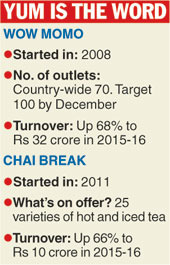
One such start-up is Wow Momo Foods Pvt Ltd. It started selling dumplings or momos in 2008 from a single outlet in Bansdroni. Today, it has over 70 outlets in India, with at least 36 in Calcutta alone. It aims to open 100 outlets, which include both kiosks and quick-service restaurants,by December.

YumKOLKATA26apr2016

“People have varied tastes in each part of the country, yet every region has accepted us pretty well, including south India, where a sort of taste revolution is happening now,” said Sagar Daryani, co-founder of Wow Momo.

Besides Calcutta, the momo chain is present in Delhi, Bangalore, Chennai, Kochi and Pune, selling over two lakh momos per day. About 80,000 momos a day are sold in Calcutta alone.

“The best part is that over 90 per cent of our outlets are profitable,” said Binod Homagai, co-founder and chief operating officer of Wow Momo.

In 2015-16, the start-up’s turnover stood at about Rs 32 crore compared with Rs 19 crore a year ago, a rise of 68. 4 per cent.

“We are aiming for at least Rs 55 crore in March 2017,” said Daryani, who is also the CEO of Wow Momo.

The momo maker offers around 12 flavours across different varieties of steamed, fried, pan-fried, sizzler and baked momos, besides their signature chocolate momo.

The company is also planning to raise funds by December. “We intend to go for another round of funding to raise Rs 30-60 crore at a valuation of over Rs 350 crore,” Daryani told The Telegraph.

In August last year, Wow Momo had raised Rs 10 crore from Indian Angels Network at a Rs 100-crore valuation.

Another food chain reaching out to customers beyond Bengal is Chai Break. Starting in 2011, founders Anirudh Poddar and Aditya Ladsaria offer a variety of options in tea.

“The idea to begin a tea chain struck us over a cup of coffee at a coffee shop. We found a coffee shop at every nook and corner of the city but unlike coffee, there was no such ‘tea lounge’ offering a wide variety of tea,” they said.

Today, the chain offers 25 varieties of hot and iced tea, including their speciality “royal tea”, a hot beverage blended with kesar.

Moreover, customers can choose between Indian, Italian and Chinese cuisines in most of their outlets.

“No region in the country offers so many kinds of tea as Calcutta and that is what we will offer to the states outside Bengal,” Ladsaria said.

The company sources about 1,000 kg of organic CTC tea from Assam and 200 kg of Darjeeling tea per month. Sixty per cent of its total beverage revenue come from tea.

The start-up claims to be making profit and is eyeing a Rs 10-crore turnover in 2015-16.<>

In the preceding fiscal, Chai Break’s turnover was Rs 6 crore. The start-up expects a turnover of Rs 20 crore by March 2017.

Chai Break has seven outlets in Bengal. They plan to take the number up to 10 by the end of this fiscal.

“People from all over the country have been requesting us to open a store in their city and we have now decided to begin expansions,” Ladsaria said.

The first such outlet is coming up in Chennai, which will be operational in the next few months. The start-up is also looking at properties in Guwahati and Bhubaneswar.

According to industry body Nasscom, there are over 15 food start-ups in the state.

source: http://www.telegraphindia.com / The Telegraph,Calcutta,India / Front Page> Business> Story / by Abhranila Das / Monday – April 25th, 2016

Power for 500 garden families

Siliguri :

Around 500 families of a Terai tea garden who had been living without electricity for the past 13 years got power supply in February following the State Legal Services Authority’s instruction to the West Bengal State Electricity Distribution Company Limited .

Amir Sarkar, the general secretary of the Darjeeling District Legal Aid Forum (DDLAF), a voluntary organisation, said the residents of Girja Line in Gayaganga Tea Estate, 20km from here, had been facing hardships for a long time.

“The information came to us from Dhumkuriya Legal Aid Clinic, Dagapur, which is a unit of the DDLAF, in 2011. We took up the matter with the Sub-Divisional Legal Services Committee here in Siliguri,” Sarkar said.

It was followed by a visit of a team from the committee and some representatives of the DDLAF.

“It was found that even though the WBSEDCL had installed meters in the houses, there was no electric supply,” the DDLAF secretary said.

After the visit, the residents submitted a mass petition demanding power supply to the DDLAF, which took it up with the State Legal Services Authority (SLSA) and the West Bengal Human Rights Commission in Calcutta.

Representatives of the DDLAF and local people appeared before the commission and the SLSA where the case was heard.

“We also pursued the case in a circuit bench of the state human rights commission in Siliguri. Around 100 residents of Girja Line were present at the hearing,” Sarkar said.

Both the bodies ordered the chairman of the WBSEDCL to extend electricity supply to the affected families.

“Although the direction was given back in 2011, the WBSEDCL took time in executing it. We had to take up the matter again. Finally, the residents of Girja Line got electricity in February this year,” Sarkar said.

On April 10, the residents organised a programme.

“They celebrated the occasion. They had invited members of the subdivisional judiciary and also the DDLAF. All those present were felicitated by the residents of the garden,” Sarkar said.

Ajay Kumar Das, the additional district and sessions judge (first court) of Siliguri and chairperson of the subdivisional legal services committee and Sridhan Su, civil judge (senior division), Siliguri, attended the programme with others.

The judges spoke on the free legal assistance process and justice accessibility programme and apprised the tea garden workers and their families as to how to get justice through the alternative dispute redressal mechanism, Sarkar said.

source: http://www.telegraphindia.com / The Telegraph,Calcutta,India / Front Page> North Bengal> Story / by The Telegraph Correspondent / Saturday – April 23rd, 2016