The Gaudiya Mission, a spiritual and philanthropic organisation established in 1935, propagates the teachings of Sri Chaitanya and the Vaishnava faith.
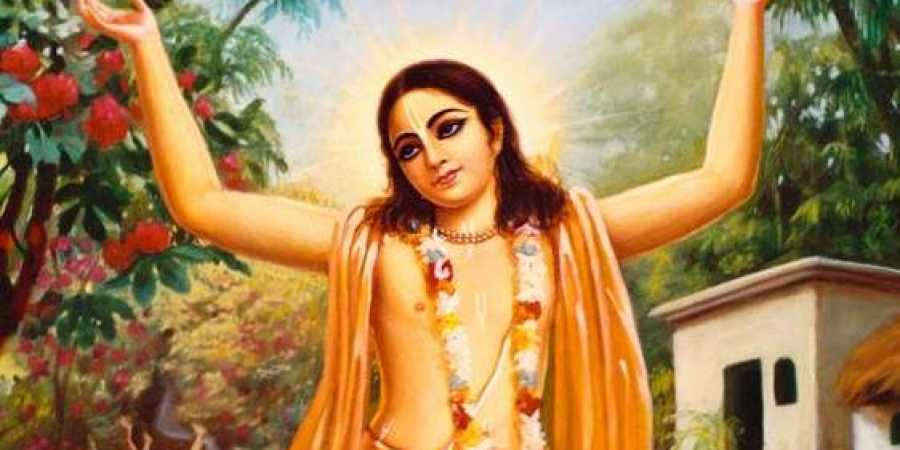
Sri Chaitanya Mahaprabhu
Kolkata :
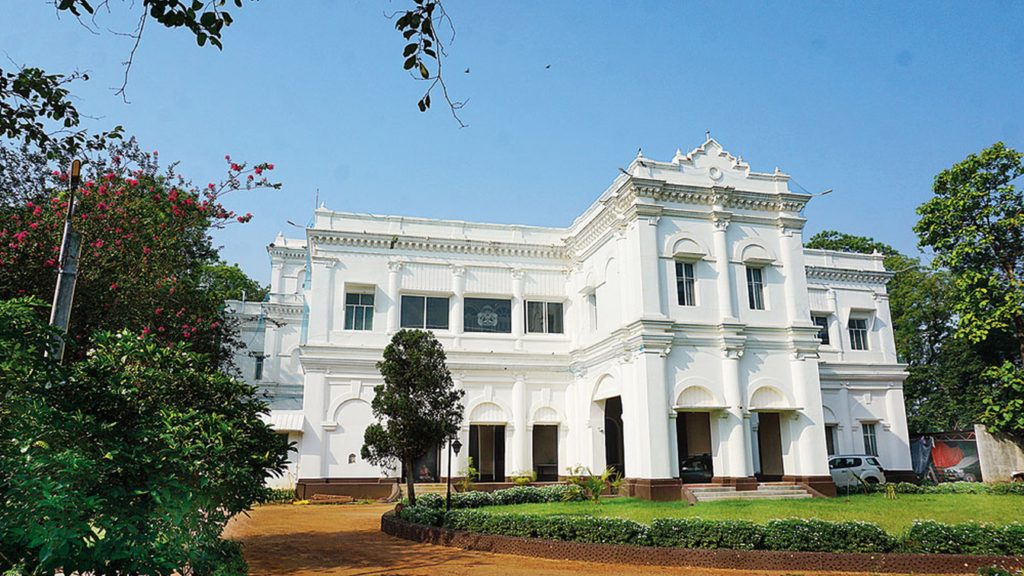
The world’s first museum dedicated to the life and teachings of 16th-century saint and social reformer, Chaitanya Mahaprabhu is ready to be inaugurated at the city’s Baghbazar Gaudiya Math on August 13, an official said.
Chief Minister Mamata Banerjee will inaugurate the technically-enabled ‘Sri Chaitanya Mahaprabhu Museum’ built to preserve information related to the great saint. “The museum is the dream project of Gaudiya Mission which will be a reality after it’s inauguration on August 13. Amidst the prevalent cruelty, clashes or say intolerant situations in our society, we wish to showcase Mahaprabhu’s teachings and vision and serve the society,” Bhakti Nishtha Madhusudan Maharaj, the mission’s assistant secretary and museum in-charge told IANS.
The Gaudiya Mission, a spiritual and philanthropic organisation established in 1935, propagates the teachings of Sri Chaitanya and the Vaishnava faith. It has many centres in India and temples in London and New York.
He said that they aimed at spreading the message across society and not just keep it restricted to the devotees. They want researchers, intellectual and scholars to avail of the library facilities and experience a detailed life of Mahaprabhu by visiting the museum.
The museum is a three-storey structure built on an area of approximately 1,350 square metres and includes galleries, public utility areas and a library. Each floor is dedicated to different phases of the saint’s life starting from his birth, his marriage with Vishupria, journey throughout the country up to the period after he attained ‘Sanyasa’ (sainthood).
Life-size models, 3D films, audio tracks and animatronics will ensure maximum engagement of the visitors. The museum has been designed by the National Council of Science Museums (NCSM). “While the museum seeks to play a key role in creating awareness among the present generations, its primary objective is to preserve all the evidence of Vaishnava heritage, living traditions as well as the intangible heritage which are disappearing very fast,” the official page of the museum said.
A rich collection of resources such as the saint’s memorabilia, artefacts, manuscripts, rare books, pictures and other valuable exhibits are on display. People can even get a glimpse of hsi original hand-writing. Also, there is an auditorium, archive, meditation room, Library, space theatre and a canteen.
Multimedia display, light and sound illustrations have been used for an immersive experience. There is Virtual Reality to depict the ‘Nagar Samkirtan’ (religious chant) where visitors will feel that they are participating in ‘Kirtan’ along with Mahaprabhu. The budget of the state-of-the-art museum is somewhere around Rs 12-14 crore, a mission official said.
While laying the foundation stone in 2013, the then president of the Mission Bhakti Surhid Prabrajika Goswami Maharaj had said that it was the world’s first museum on the saint with modern communication methods which will collect, preserve and disseminate archival literature of the Sri Chaitanya cult.
source: http://www.newindianexpress.com / The New Indian Express / Home> Cities> Kolkata / by IANS / August 08th, 2019
17-year-old creates group to give kids choice of education
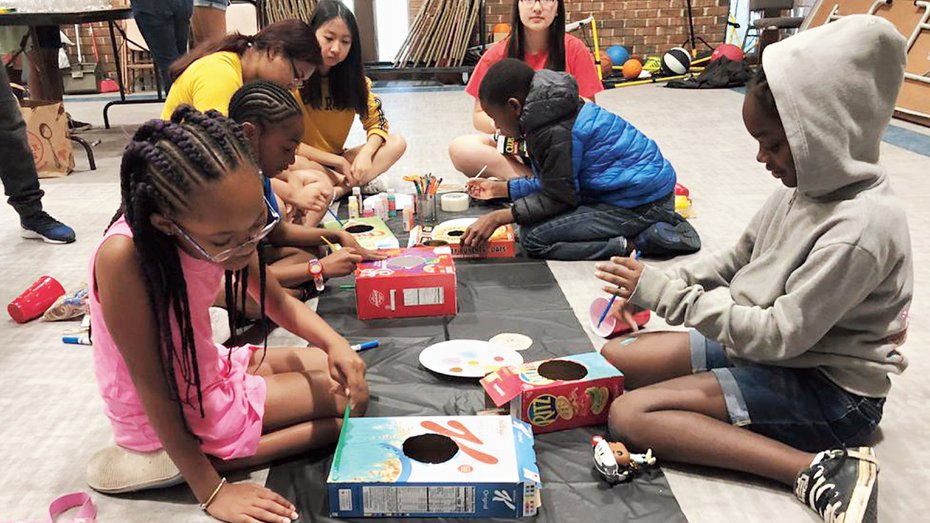
Children take part in a guitar-building session during a music workshop conducted by Humanities of Tomorrow, a Dallas-based group floated by Kaushiki Roy to spark interest in the humanities through creative activities. The students also made and decorated maracas, flutes and drums at the workshop.(Pictures sourced by correspondent)
A teenager with roots in the city is changing mindsets among students in Dallas, Texas, where she lives now.
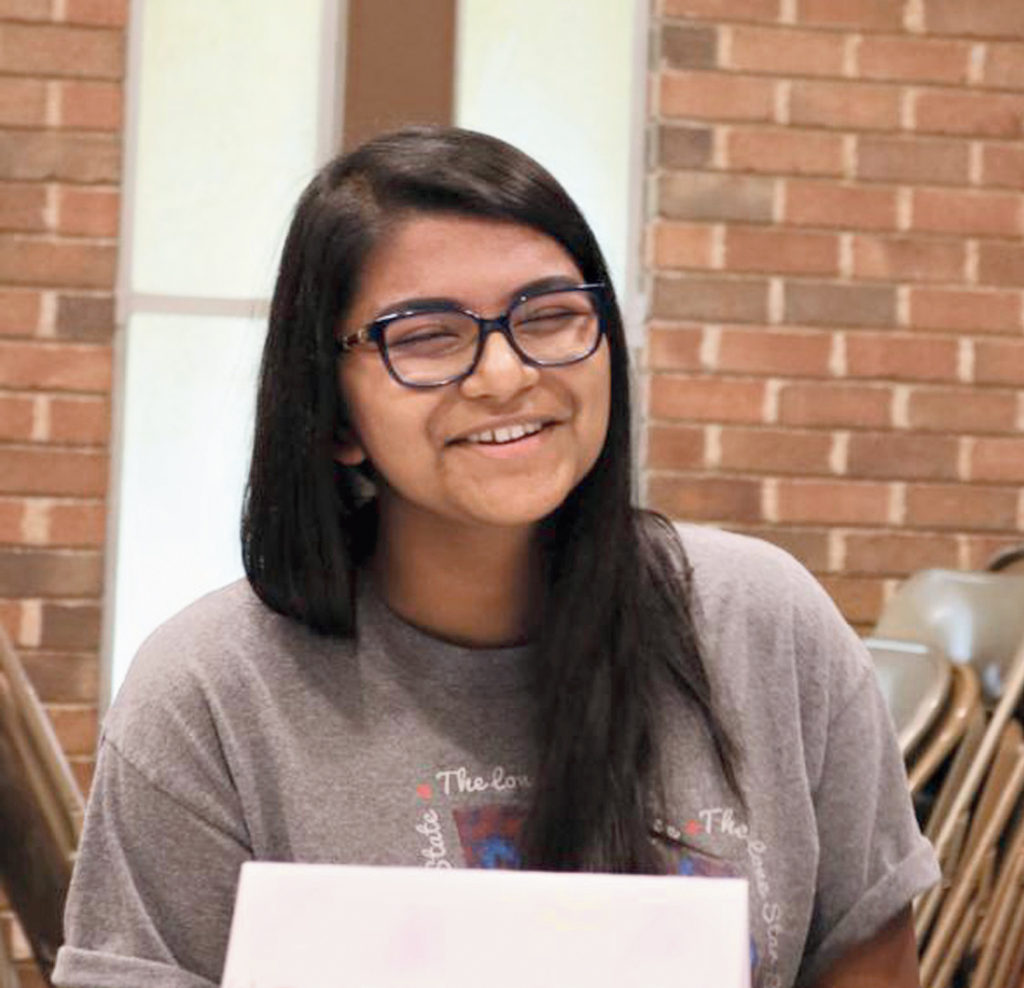
Kaushiki Roy, 17, believes in giving children a choice in education. A former student of Calcutta International School, she created a group last month to help under-privileged children develop a taste for art, dance, theatre and music and pursue the arts stream in college.
Her goal: To rid students of the pressure created by the school curriculum and parents to opt for STEM (Science, Technology, Engineering and Math) subjects.
Kaushiki floated Humanities of Tomorrow with the help of some like-minded friends. Together, they involve children in diverse activities from art and craft to music and theatre.
“There are many non-profit organisations that coach underprivileged children in STEM subjects so that they can pursue college education in science and technology. However, none of them creates any interest in the humanities. I decided to do just that,” the Grade 12 student said.
The daughter of an IT professional, Kaushiki had felt the pressure to excel in science and maths during her schooldays in Calcutta.
“I studied there for two years — classes VI and VII. Right from that stage, I could sense this urgency among my classmates and their parents to work harder on science and maths. Most of the parents were doctors and engineers, like mine, and the kids wanted to follow the tried and tested path too,” said the fan of Ariel Lawhon of I was Anastasia fame.
“I remember attending an algebra class on my first day in school and feeling at a loss while my classmates aced the problems,” she said.
Kaushiki, who discovered her love for the languages early, felt kids in the US were also under pressure to excel in STEM subjects.
“The emphasis intensifies from Grade 8. My school caters to a diverse range of students. There are many Asians, too. Most kids are striving hard to excel in physics, chemistry and maths. Humanities subjects are often neglected,” said the girl who enjoys playing the piano.
Kaushiki Roy
Kaushiki, along with six friends, have designed a two-week arts curriculum for children. Surprise awaited her at home when her father supported her initiative despite his science background.
Workshops conducted by their group engage the children in mandala-making, playing the drums and encourage them to dabble in different theatre genres. Zumba and impromptu acting sessions are also held. The idea is to appreciate the creative qualities of the kids.
“There are different teachers for each subject. The teachers are all students like me. We also have volunteers. Together we try to train the children in forms of dance (contemporary and popular) and music. They learn to express through art. The training is meant to give them a good time and encourage them to speak up,” Kaushiki said.
“They should at least be given a choice. Liking humanities does not make you a loser. The mindset must change. Let them learn everything and then decide what they want to take up in college,” she said.
Kaushiki’s greatest gift — when students express an interest in pursuing humanities in future.
Humanities of Tomorrow has already conducted sessions for two different clubs of underprivileged children. The last day of each session ends with a carnival where the trainers and students have a good time together.
“Till now we have touched the lives of nearly 80 kids (between 9 and 18 years) in our locality. All of them are now looking at humanities from a different perspective. These children don’t get the kind of exposure we enjoy in school. So I am giving it to them in my way. We are thinking of inducting some of these children into our group as volunteers,” Kaushiki said.
She is already planning cultural awareness and environmental awareness weeks in her fall and spring breaks, respectively.
Kaushiki hopes to leave Texas for higher studies next year but wants her organisation to continue working. “My school has been very supportive. We are in the process of training juniors. I will help them when I come home during breaks. I will try to set up a branch of Humanities of Tomorrow in the state where I study,” said the girl, who dreams of being a journalist.
source: http://www.telegraphindia.com / The Telegraph, online edition / Home> West Bengal / by Chandrayee Ghose in Calcutta / August 28th, 2019
Inaugurated on March 11, 2019, the Museum remains open from 10 am to 5 pm for visitors.
RBI
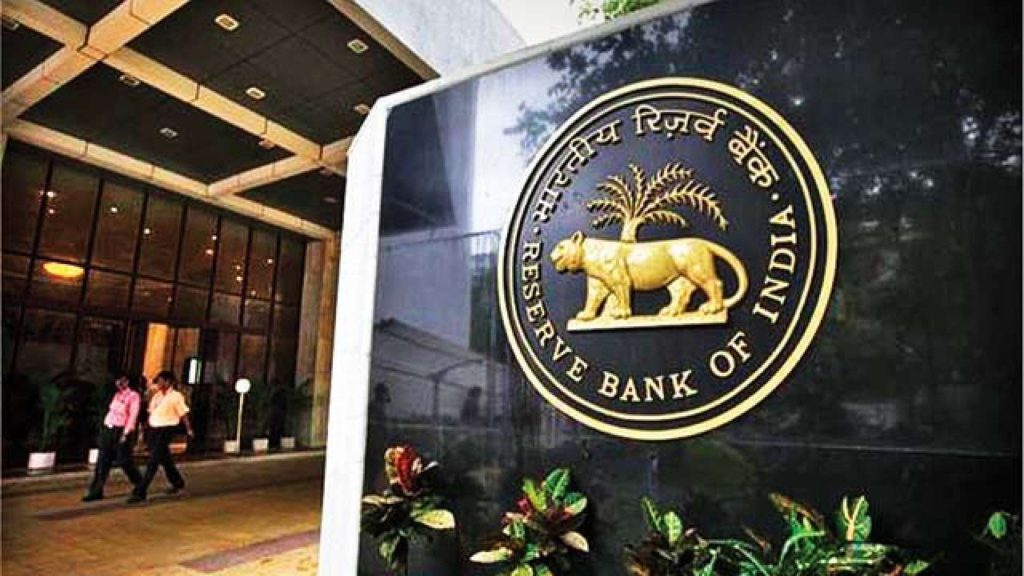
The Reserve Bank of India (RBI) Money Museum at Council House Street in Central Kolkata, which opened earlier this year, has been drawing a lot of attention for its unique initiative. The museum has been built with an aim to improve people’s knowledge of the banking system with the help of interactive displays.
Inaugurated on March 11, 2019, the Museum remains open from 10 am to 5 pm for visitors.
The main attention of the museum is a huge tree made using defunct coins and demonetised notes attached with a computer model depicting how money gets transferred to the account digitally.
Money Museum is divided into three sections, the first section depicts the evolution of the barrier system and the use of grains as currency in medieval ages. In continuity, the museum shows the evolution of money in modern times.
Its printing and bond making machines catch the attention of visitors. The bond machine is said to be the only machine which was used to print bonds for different states.
The museum is built to make people aware of the various aspects of banking and the history of RBI, said a senior RBI official.
Interestingly, the museum has everything to entertain children. There is an interactive games centre for kids with an aim to promote financial literacy.
source: http://www.dnaindia.com / DNA / Home> India / by ANI / July 31st, 2019
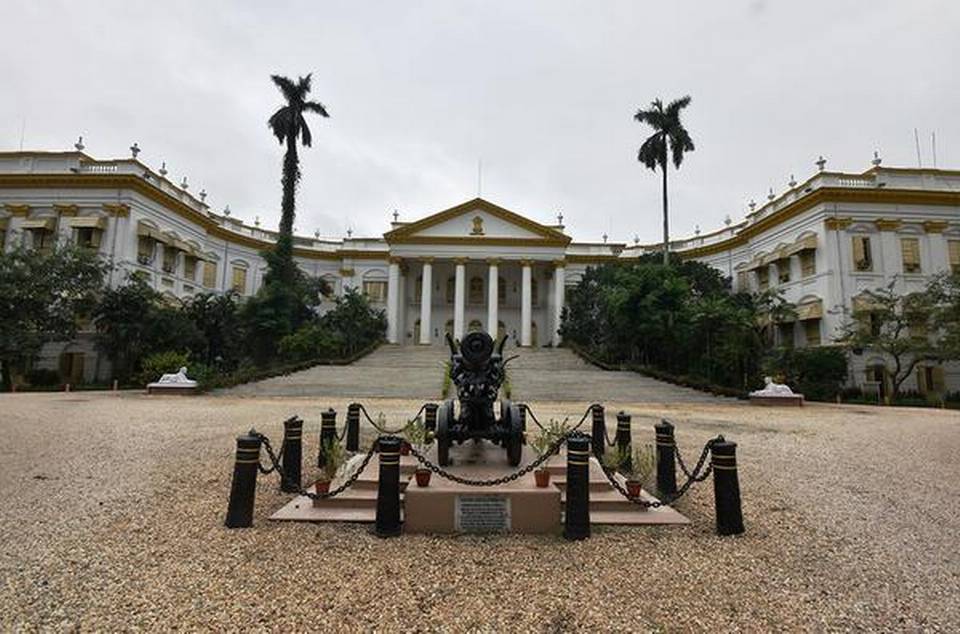
A view of the stately Raj Bhavan in Kolkata. File | Photo Credit: Victoria Memorial Hall
Some of the policies that shaped colonial India, including the introduction of English education in India through Thomas Macaulay’s Minute of 1835, the Doctrine of Lapse, and the Partition of Bengal, were plotted in the Raj Bhavan.
A large room in the south of Raj Bhavan, Kolkata overlooking its gardens has a beautiful oil painting of Mahatma Gandhi by Jamini Ray, hung on the wall just above the desk of the Governor in a room that is called the Governor’s study. Not any people know that some of the most fundamentally transformative policies that shaped colonial India, including the introduction of English education in India through Thomas Macaulay’s Minute of 1835, the Doctrine of Lapse, the Ilbert Bill, the Partition of Bengal, and many others, were plotted in this very room. In words of Lord Curzon himself, the room ‘has witnessed discussions as agitated and decisions as heavily charged with fate as any private apartment in the wide circumference of the British Empire.’
Other rooms in the Raj Bhavan, Kolkata like the Council Chamber in the North-east wing of the first floor, which hosted the swearing-in ceremony for each new Governor-General or Viceroy, the Ball Room which from the very beginning was fitted with the original chandeliers and mirrors that once belonged to the French General Claude Martin and the Throne Room where the so-called throne of Tipu Sultan, captured from Seringapatam in 1799, is kept have all been witness to major historical events of the subcontinent in the 19th century.
Several anecdotes about the Raj Bhavan, Kolkata, the building that remained the principle seat of power for entire subcontinent from 1803 to 1912 have been the documented in the book titled “Those Noble Edifices- The Raj Bhavans of Bengal” which was unveiled by Governor Keshari Nath Tripathi here on Thursday. In the foreword of the publication, The Governor said that, this volume was planned because “we wanted to share these ‘secrets’ and inside stories of Kolkata’s most hallowed precincts with the public” and “ the purpose is to bring the Raj Bhavan – including its exteriors and interiors – closer to the public”.
Jaynata Sengupta, secretary and curator of Victoria Memorial Hall, who has written the book ,said that this publication is an attempt to “ lift this shroud of mystery and show what lies beneath, what the Raj Bhavan really means as a residence, to its exalted overlords as well as to its humbler inmates and workers”. Mr. Sengupta, in the publication about throws light of three Raj Bhavans of Bengal, the Raj Bhavan build by Lord Wellesley in Esplanade in early 19 th century which is similar to architecture of the Kedleston Hall in Derbyshire and the Raj Bhavans at Barrackpore and Darjeeling.
Full of maps, hundreds of archival photographs, letters and manuscripts the 200 page publication also refers buildings older that the existing Raj Bhavans where Governor General and officials of the East India company lived, from the Old Fort located between the river Ganges and today’s BBD Bagh (erstwhile Dalhousie Square), a house on what is on the street that subsequently came to be named after him (Clive Street) and the Old Government House which was also known as the ‘Buckingham House,’ . It was at this very spot at the Old Government House that Lord Wellesley constructed the Raj Bhavan. The cost of building Raj Bhavan then to between £1,70,000 and £1,80,000, that is, between Rs. 22 and 24 lakh which angered the East India Company’s Board of Directors.
In fact Lord Wellesley had similar plans of making another Raj Bhavan at Barrackpore, which derives its name British barrack or cantonment, but the plans were rejected by the Board of Governors of East India Company. The first bungalows at Barrackpore, was bought by the Bengal Government in 1785 for the occupation of the British Commander-in-Chief. After assuming the title of British Commander-in-Chief, which was conferred to him after the Battle of Seringapatam in 1799, Lord Wellesely took over the house British Commander-in-Chief was Sir Alured Clarke. “Wellesley later described Barrackpore as ‘a charming spot which, in my usual spirit of tyranny, I have plucked from the Commander in Chief.” Mr Sengupta writes in the book. Documents like a minute dated 1 April 1857, in Governor-General’s Lord Canning’s own handwriting, “regarding the outbreak of the ‘disturbance’ (the Revolt of 1857) at Barrackpore on the occasion of the disbandment of the 19th Native Infantry” have been highlighted in the book. It is believed that Lord Canning’s note was written at Barrackpore not far from where the “disturbances” have broken out. Mr Sengupta said that the Government House at Barrackpore was a mere shadow of what Wellesley’s grand and ambitious plan could have produced, it was still spacious enough to serve as a country residence for Governor-Generals and Viceroys. After independence, the Raj Bhavan at Barrackpore came under the care of West Bengal Police, housing the police training academy. Now the academy has been shifted out and the building has been restored. The restored building now houses a museum.
The third important structure the book discusses in detail is the Raj Bhavan in Darjeeling which came up on what was not of the conquered territory of the British. After the introduction of Tea to Darjeeling in the early 1840s and the British negotiating treaties with both Sikkim and Bhutan in the 1860s, Darjeeling became formally a part of British India in 1866. By the 1870’s Darjeeling became the summer seat of the Bengal Government and a suitable accommodation for the Lieutenant-Governor was built in the late 19 th century. Unlike the Raj Bhavan at Kolkata, which was built without a Garden the Raj Bhavan at Darjeeling always had a Garden.
“The main house was so extensively damaged by the Nepal-Bihar earthquake of January 1934 that it had to be entirely demolished, and replaced by a new Government House built in ferroconcrete during the tenure of Sir John Anderson (1932–37),” Mr Sengupta writes.
source: http://www.thehindu.com / The Hindu / Home> News> National / by Shiv Sahay Singh / Kolkata – July 18th, 2019
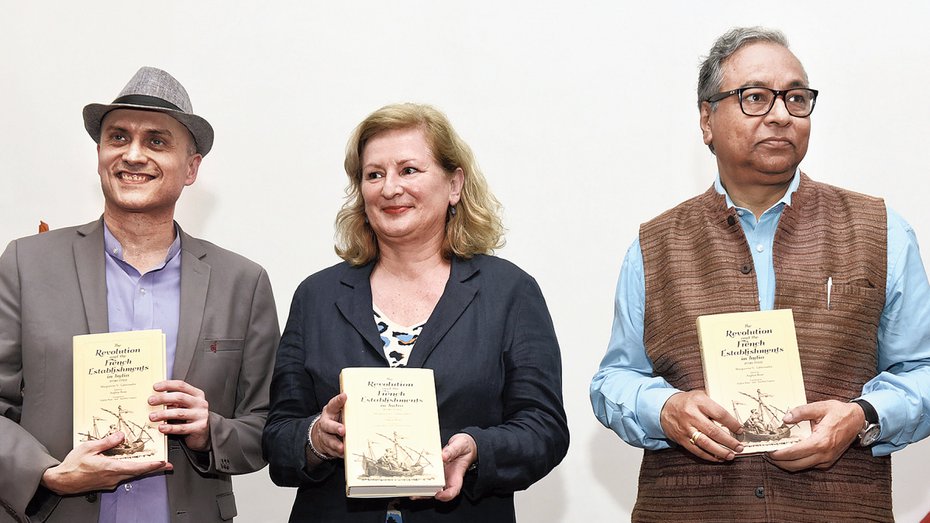
(From left) Alliance Francaise du Bengale director Fabrice Plançon, consul general of France Virginie Corteval and social historian Jawhar Sircar launch The Revolution and the French Establishments in India (1790-1793)./ The Telegraph picture
The fort of Bastille may have fallen in July 1789 but it was not until the British frigate La Vestale docked at Pondicherry in January 1790 that news of “the Paris Revolution” reached India.
The report was confirmed by the French barge Bienvenue which arrived soon after on February 22 from Port Louis, the capital of the Isle de France (now Mauritius).
A translation of a book, The Revolution and the French Establishments in India 1790 -1793, that sheds light on the happenings in the French colonies in the post-Revolution phase was launched on Thursday.
“The book in French published in 1930 was written by Marguerite V. Labernadie, a doctoral student who discovered the administrative archives of the French colonies in India lying almost in ruins in Pondicherry. The book offers fascinating insights into the relation between French colonial establishments in India and the effect of the French Revolution on them,” said Arghya Bose, the editor of the book.
Bose, a Chandernagore boy, chanced upon a dusty copy of the book at Bibliotheque Nationale de France (BNF) when he was a student at Sciences Po in 2015.
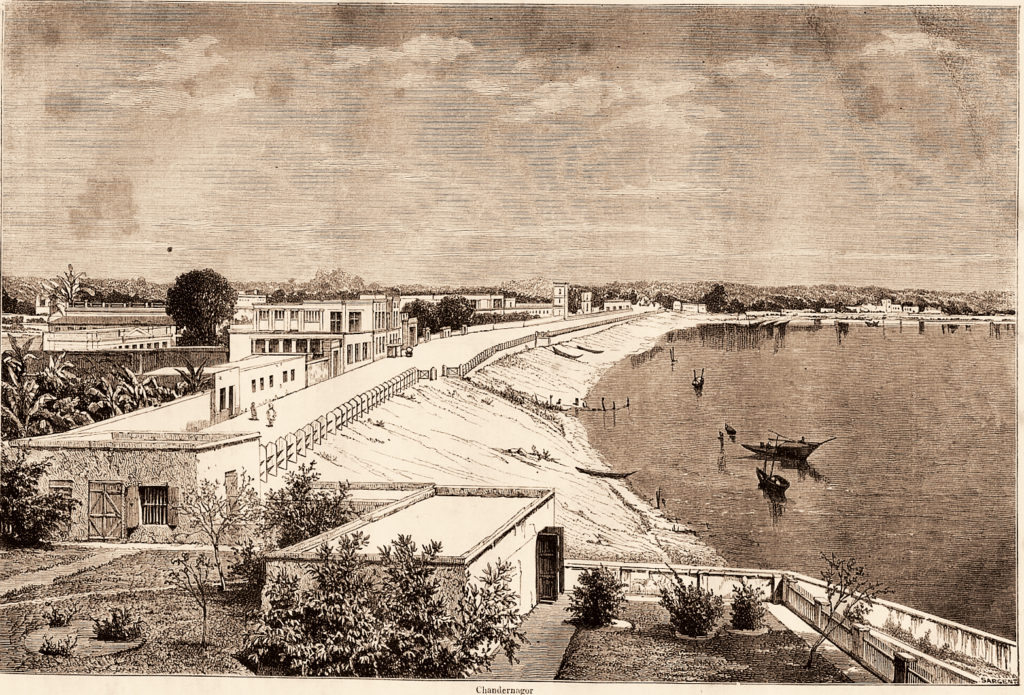
Chandernagore in Wood Engraving by Brickers & Sons, London (1878). / The Telegraph picture
On his return, he joined the Alliance Francaise du Bengale and met Sandhia Vasseur who had just joined as the librarian. “My grandparents on my mother’s side were French citizens of Indian lineage from Pondicherry. In 1947, when they were offered Indian citizenship, they refused and left for Cambodia, which was still a French colony. A war there in 1964 made them shift to France. I was interested in the Franco-Indian encounter as I have seen in my own family how important the French identity can be to people born in India. So when Arghya came up with the idea of translating the book I readily agreed. It was on Gallica, the BNF’s digital portal.”
The news of the revolution triggered political unrest against the French East India Company. “France was not sending money or armaments. The Bienvenue had embarkment orders for the paltry European artillery and troops, leaving Pondicherry defenceless. Chandernagore too faced frequent sieges and humiliation by the British. So people met Chevalier de Fresne, the governor general of Mauritius and Pondicherry, with a host of demands. Constituent assemblies were formed and decrees passed as they tried to replicate what they heard had happened in Paris. Such was the eagerness to conform to the changing political structure in France that they sent expensive gifts to relatives back home, seeking volumes of the minutes of the National Assembly,” said Bose.
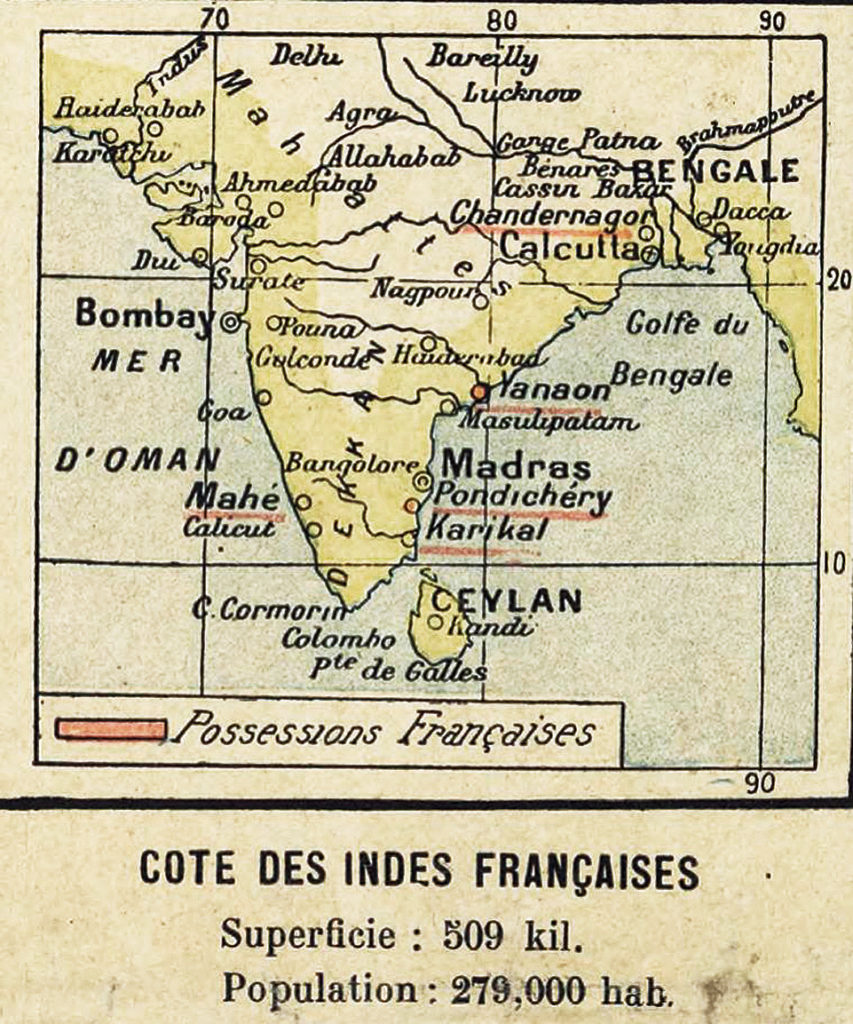
Another interesting aspect is the tussle between Chandernagore and Pondicherry. “While Pondicherry claimed administrative supremacy, Chandernagore, dealing especially in salt and salt petre, was the centre of trade. It paid enough revenue to the French government to offset deficits from the other Indian colonies Mahe, Karikal and Yanaon. They demanded control over the use of their revenue which Pondicherry refused.” The book ends with the British invasion and capture of the French colonies in India in 1793 as a fall-out of France going to war against England.
“The French colonies are not studied at length. Material available to Indian researchers on this subject is scarce. The book is a valuable addition to French colonial history in India,” said Jawhar Sircar, who was present at the launch.
source: http://www.telegraphindia.com / The Telegraph, online edition / Home> West Bengal / by Sudeshna Banerjee in Calcutta / July 08th, 2019
The paintings by Zayn al-Din were commissioned by Mary Impey, an English natural historian and patron of the arts in Bengal
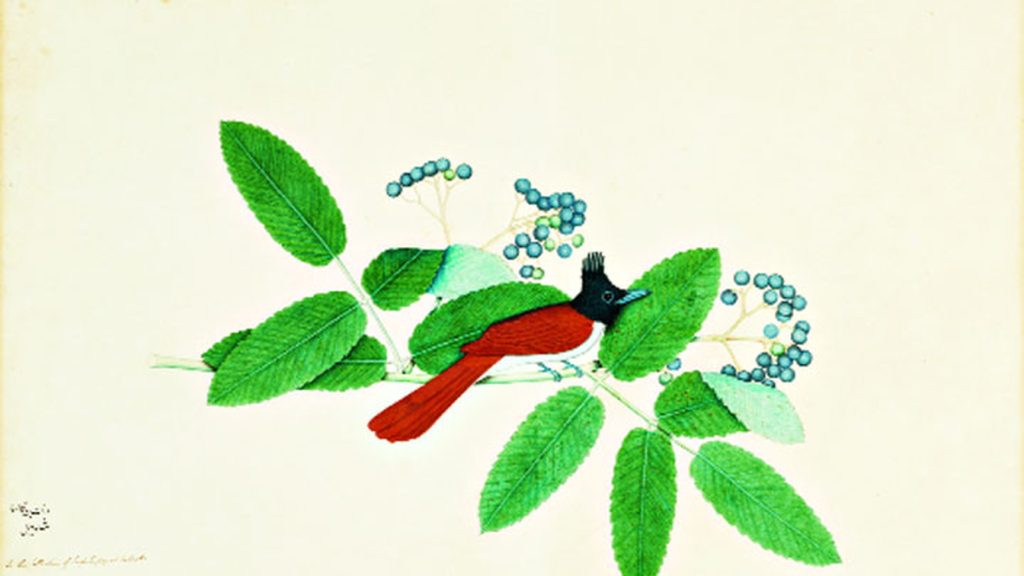
Falsa Tree with King’s Nightingale was painted on a 53.5cm x 75cm canvas by Zayn al-Din in 1782 . / Picture courtesy: Stockholm Auction House
Two watercolour and pencil-on-paper artworks painted in Calcutta in the late 18th century by one of the most famous exponents of the Company School of Art will go under the hammer at the world’s oldest auction house in Sweden on June 12.
The paintings by Zayn al-Din were commissioned by Mary Impey (March 2, 1749 -February 20, 1818), an English natural historian and patron of the arts in Bengal. She was the wife of Elijah Impey, the first chief justice of the Supreme Court at Calcutta (1774-82), who had infamously sent Maharaja Nandakumar — a highly-placed officer in the nawabi administration — to the gallows on charges of perjury.
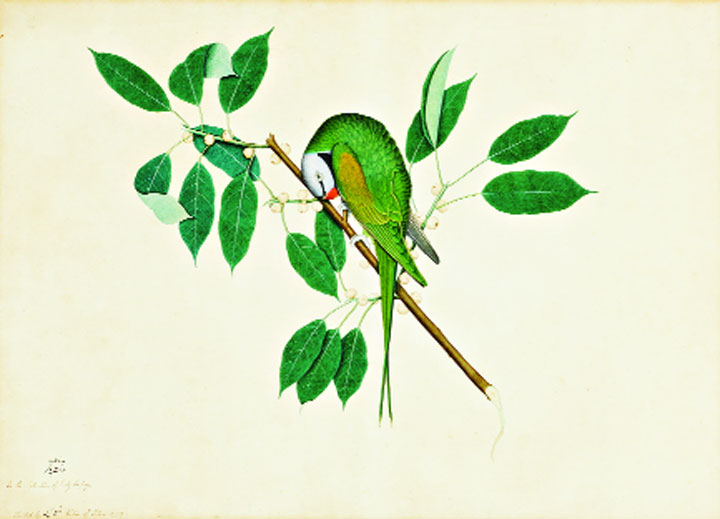
Falsa Tree with King’s Nightingale, dated 1782, and Parrot in a Parkar Tree, dated 1779, have been in the possession of a Swedish family for long.
“We are immensely proud to present these rare artworks. We are not sure how they reached Sweden. They have been in the same Swedish family for a long time and this is the first time that they reach the market,” Victoria Svederberg Bojsen, a specialist in classic and modern art at the Stockholms Auktionsverk (Stockholm Auction House), founded in 1674, told Metro over phone from Stockholm.
“The estimate price is Euro 51,000 (Rs 40 lakh) to 61,500 (Rs 48 lakh). However, we believe they will reach an even higher price. Our hope is naturally that they will now be returned to India where they originated,” she said.
Birds are the subjects of both the paintings. Falsa Tree with King’s Nightingale is a 53.5cm x 75cm canvas.
The inscriptions on both pictures read: In the Collection of Lady Impey of Calcutta. Painted by Zayn al-Din Native of Patna 1782.
“Both paintings include a description of the subject in Persian — Darakht ban falsa, Shah Bulbul in the first and Madna Tota, Darkaht Pakar in the other. The artist’s name is also written in Persian,” said Nandini Chatterjee, associate professor of history at the University of Exeter in the UK.
The painting (right), titled Parrot in a Parkar Tree, is signed and dated 1779. The inscriptions on both artworks read: “In the Collection of Lady Impey of Calcutta. Painted by Zayn al-Din Native of Patna 1782”. / Picture courtesy: Stockholm Auction House
Metro had sent the images to Chatterjee, who is part of a research on two sets of natural history drawings produced between the late 18th and early 19th centuries in Calcutta. The drawings are held at the Victoria Memorial Hall and the Royal Albert Memorial Museum & Art Gallery in Exeter.
The Impeys moved to India in 1773 after Elijah Impey was made the chief justice of Bengal. They set up a menagerie at their house in Calcutta’s Middleton Row. When they shifted to Fort William two years later, they started a collection of native birds and animals on the extensive gardens of the estate.
Mary Impey commissioned several local artists to paint the fauna and flora they had collected. Her three principal artists were Sheikh Zayn al-Din, and brothers Bhawani Das and Ram Das. All three had come from Patna.
Together, Zayn al-Din and the Das brothers painted more than 300 artworks, half of them of birds. The collection, often known as the Impey Album, is an important example of Company style painting.
“With the decline of the Mughal courts, the artists sought the patronage of Europeans. These artists had to change their traditional techniques to suit their new masters. These revisions included a more accurate representation of the subject and a change in perspectives,” said Jayanta Sengupta, the curator of the Victoria Memorial.
Little is known of Zayn al-Din, the artist whose works will be auctioned in Sweden next month. He is known for his extraordinarily detailed paintings for the Impey Album. His drawings of mountain rats, hanging bats, parrots and storks serve as interesting zoological studies and are now preserved at the Ashmolean Museum in Oxford.
“The artworks from the Impey Album rarely reach the international market and the few that have been sold previously at Christies, Sothebys and Bonhams have fetched between $80,000 (Rs 55.5 lakh) and $140 000 (Rs 97.7 lakh),” Bojsen said.
The real study of the Indian subcontinent’s natural history is said to have started with the Mughals. Baburnama — the memoirs of the first Mughal ruler — has beautiful illustrations of birds and animals. Shah Jahan also took a keen interest in the flora and fauna.
With the fall of the Mughals, the artists sought the patronage of Europeans. Calcutta became a thriving centre of the (East India) Company school of painting.
“India was an unknown land for Europeans and along with its indigenous archaeology and history, they also wanted to explore its abundant flora and fauna. Imperial documentation differs from its Mughal predecessor in scale and systematic approach,” Sengupta said.
“Mary Impey was part of a circuit of Europeans who commissioned paintings of Indian natural history. Apart from the pictorial documentation of flora and fauna, the extensive notes kept by her about their habitat and behaviour were of great use to later biologists,” he said.
The collection went to England with the Impeys in 1783 and were sold at a London auction in 1810. Several pieces are in various museums, including the Metropolitan Museum of Art in New York and the Victoria and Albert Museum in London.
“The style of inscription, and the handwriting is identical to other paintings all around the world. I do not believe Zayn al-Din’s name is in his own handwriting. It was probably written by a British collector, maybe Lady Impey herself. Many such British Orientalists (and perhaps some of their spouses) knew Persian,” Chatterjee said.
Some of Zayn al-Din’s works are at the Royal Albert Memorial Museum too. “But those have his name written in English and Bengali, perhaps by a collector who was interested more in the vernacular language, than Persian, which was the Mughal language of administration and courtly culture,” Chatterjee said.
source: http://www.telegraphindia.com / The Telegraph, online edition / Home> West Bengal / by Debraj Mitra in Calcutta / May 28th, 2019
A 200-year-old palace in Odisha has a Bengal connection — a little-known love story
The Belgadia Palace was built in the early 19th century but repurposed by Sriram Chandra Bhanj Deo for his second wife, Sucharu Devi. The king, however, could never live in this palace with his wife / Picture: Prasun Chaudhuri
For most tourists, Baripada is nothing more than a gateway to the Simlipal National Park, famous for its tigers and elephants, in Odisha. That there could be tucked deep within the small town an iridescent palace with an untold love story at its core, is not common knowledge.
Belgadia Palace is now home to the descendants of the erstwhile kings of Mayurbhanj, the Bhanj Deos. Praveen Chandra Bhanj Deo belongs to the 47th generation. He lives in a part of the palace with his wife, two daughters and his 91-year-old mother. On the initiative of his daughters, Mrinalika and Akshita, most of this 215-year-old palace is now open for pubic viewing. Says Akshita, “We want to make people aware of the legacy of our ancestors in the district as well as in the state of Odisha.”
Before throwing open the palace doors, the sisters undertook a thorough recce of the place that revealed a gem too many. One such was the tumultuous love story of their ancestor Sriram Chandra Bhanj Deo and Sucharu Devi, the third daughter of Keshub Chandra Sen, philosopher and social reformer of 19th century Bengal.
Akshita Manjari, the daughter of the current owner of the Belgadia Palace, Praveen Chandra Bhanj Deo, in the palace library / Picture: Prasun Chaudhuri
Sriram Chandra met Sucharu Devi in Darjeeling. She was educated, enlightened and a 15-year-old girl who was not in purdah. He was 18 and looking for a wife who would be his companion. After a brief courtship they got engaged.
That was in 1889. But the crown prince’s family vehemently opposed the match. “The daughter of Keshub Chunder Sen as Maharani of Mayurbhanj! The daughter of that rebel, that revolutionary! To the conservative, orthodox powers in the Hindu state this was preposterous,” reads Sucharu Devi’s biography written by her daughter, Joyoti.
The young prince was no rebel; he toed the family line and married a girl from a local royal family. But the romance between him and Sucharu Devi did not die. “We tried to persuade her to marry but nothing would induce her to forget her lover,” writes Suniti Devi, her elder sister — the erstwhile queen of Coochbehar — in her autobiography.
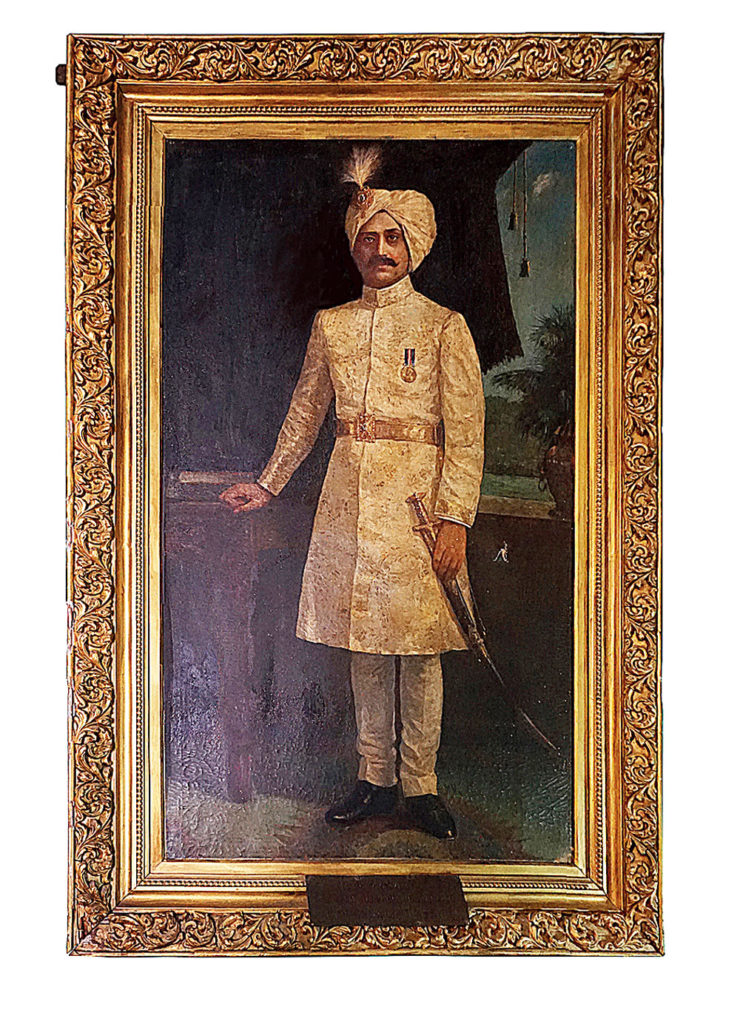
An oil painting of Sriram Chandra Bhanj Deo that adorns the palace walls along with spoils from the countless royal hunting expeditions / Picture: Prasun Chaudhuri
Sriram Chandra’s first wife, Lakshmi Devi, gave birth to two sons and a daughter and thereafter, she died of smallpox. Writes Suniti Devi, “The Maharaja’s wife died, and he came back to ask my sister to marry him. The marriage (sic) took place in Calcutta, and for some time they led the happiest lives.” This was 1904.
Since the Maharaja never dared to take Sucharu Devi to his native state, he built for her the Rajabagh Palace in Calcutta’s Mayurbhanj Road — now the building houses the J.C. Ghosh Polytechnic. They had two children — Dhrubo Narayan and Joyoti. Sriram Chandra met with an untimely and mysterious end in 1912. The accepted version is that he was accidentally shot while he was out on shikar.
Even though the construction of the palace began in 1804, it was developed in several phases. The present interiors were especially designed for Sucharu Devi since she was not welcome in the main Mayurbhanj Palace. But she visited Mayurbhanj and her palace for the first time only after her husband’s death, on invitation of her stepson, Purnachandra Bhanj Deo.
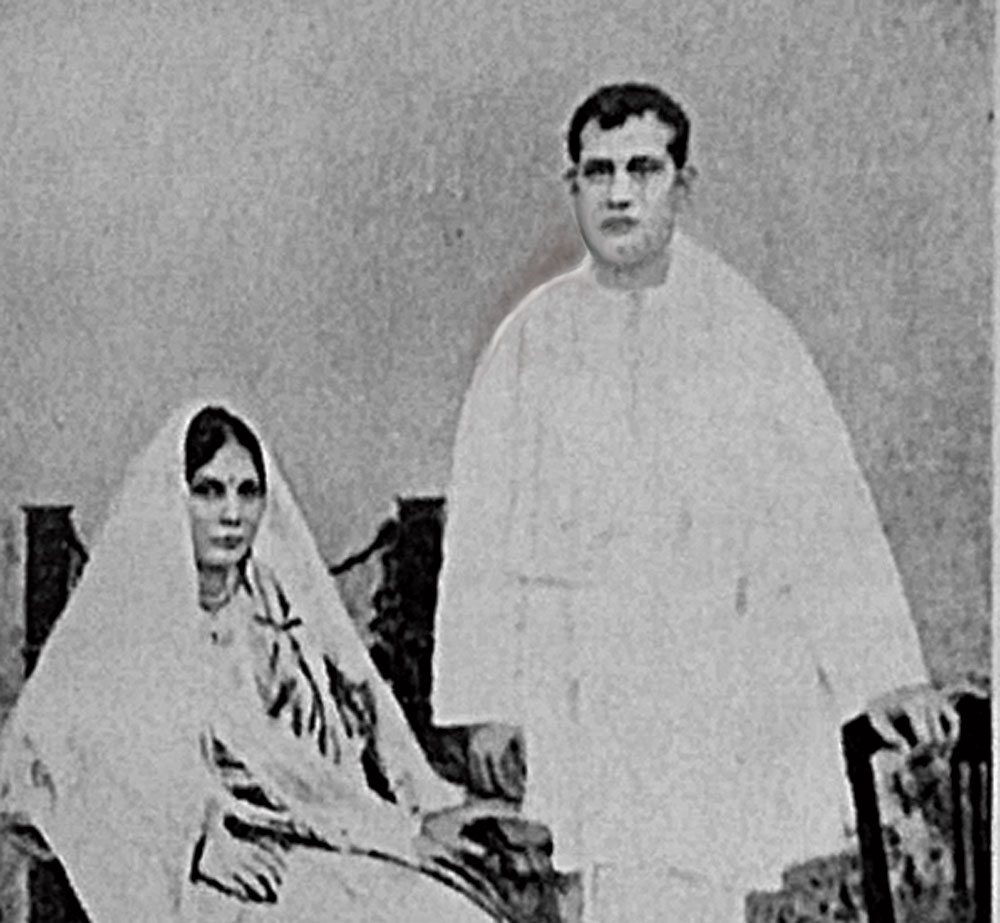
Sucharu Devi and Sriram Chandra on their wedding day. The photograph is from An Illustrated Biography: Sucharu Devi Maharani of Mayurbhanj by Joyoti Devi Kaye, their daughter
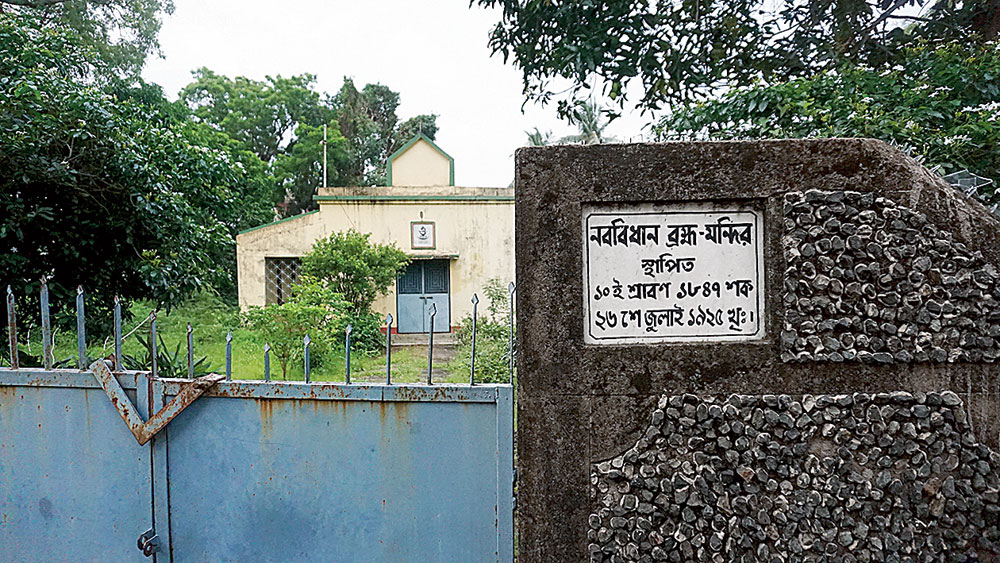
She continued to visit Mayurbhanj occasionally and was associated with social work and spiritual work in Baripada. Her involvement with the Nababidhan Brahma-Mandir in the centre of the town is known. A torch-bearer of feminism in India, she was elected president of Bengal Women’s Education League in 1931.
Sucharu Devi died in 1961 in Calcutta. To date, the rooms and verandahs of Belgadia Palace, we are told, are imbued with her refined sensibilities. As she was an accomplished painter it is believed that artists like Jamini Roy and Hemendra Nath Majumder had visited the palace.The furniture, furnishings, paintings and photographs in the palace continue to reflect her touches. Says Akshita, “She had a deep influence on most of the activities of the Maharaja, who was known as the philosopher king and also revered for his public welfare efforts.” And that is what makes intriguing the fact that to date, there is no portrait of the woman herself on display at Belgadia Palace. “This happened probably because she was never accepted wholeheartedly by the larger family and state subjects because of the difference in caste, creed and religion,” reasons Akshita. She and Mrinalika have plans to find and display the love letters and photographs of Sriram Chandra and Sucharu Devi, for all to see and appreciate.
In a letter dated January 31, 1904, the 32- year-old Sriram Chandra writes to Sucharu Devi proposing marriage once again. It goes: “Dear S… Will you then share my sacrifices if I ask you to sacrifice all worldly pleasures and to be my spiritual companion? That seems to me at present to be the voice of the Almighty. Yours S.R.C. Bhanj Deo.”
The Nababidhan Brahma-Mandir in Baripada / Picture: Prasun Chaudhuri
source: http://www.telegraphindia.com / The Telegraph, online edition / Home> Heritage / by Prasun Chaudhuri / June 02nd, 2019
When engineers chanced upon a vault in Calcutta’s St Paul’s Cathedral, they also unearthed a singular story of a singular man
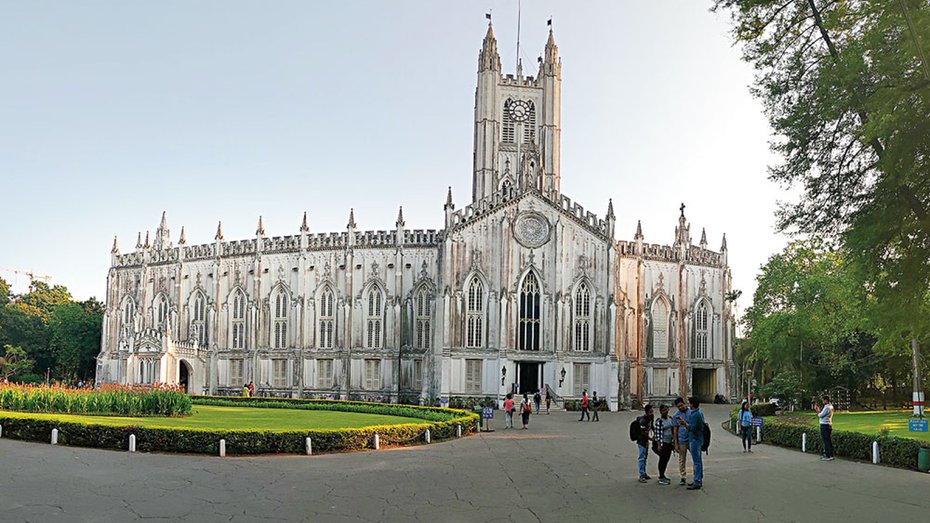
St Paul’s Cathedral in Calcutta / Picture by Pradip Sanyal
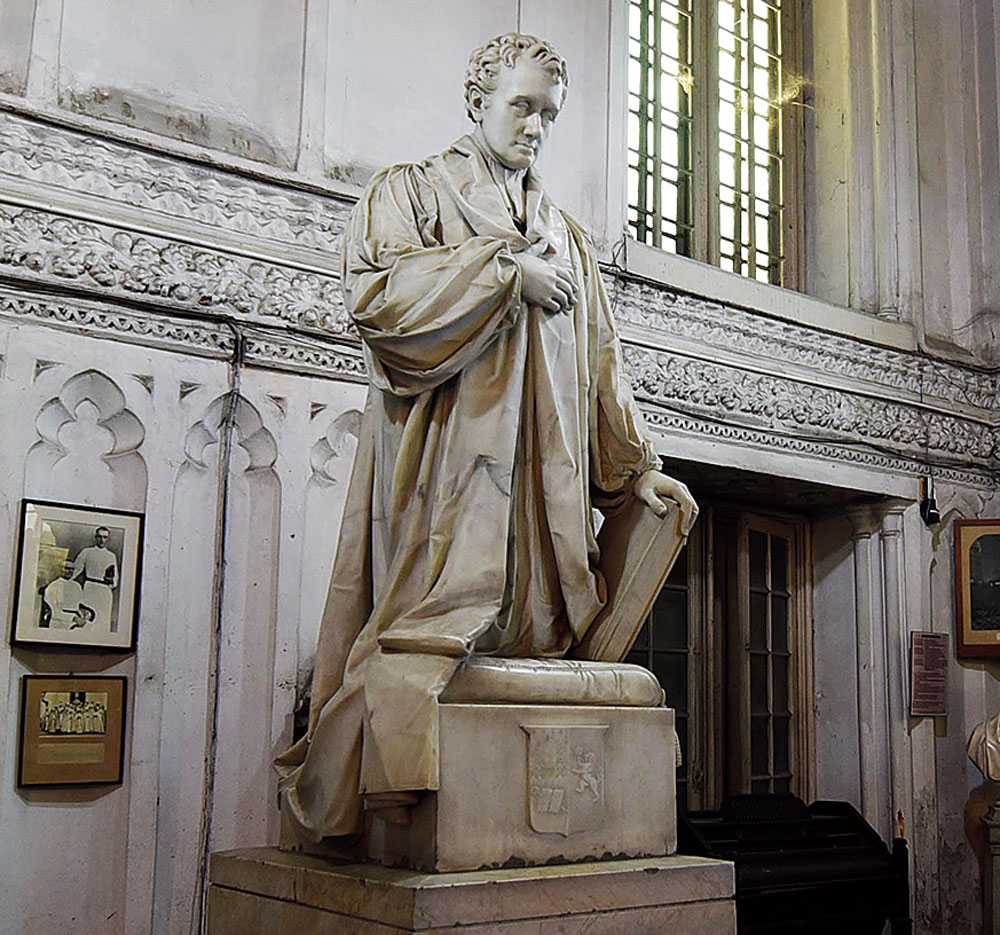
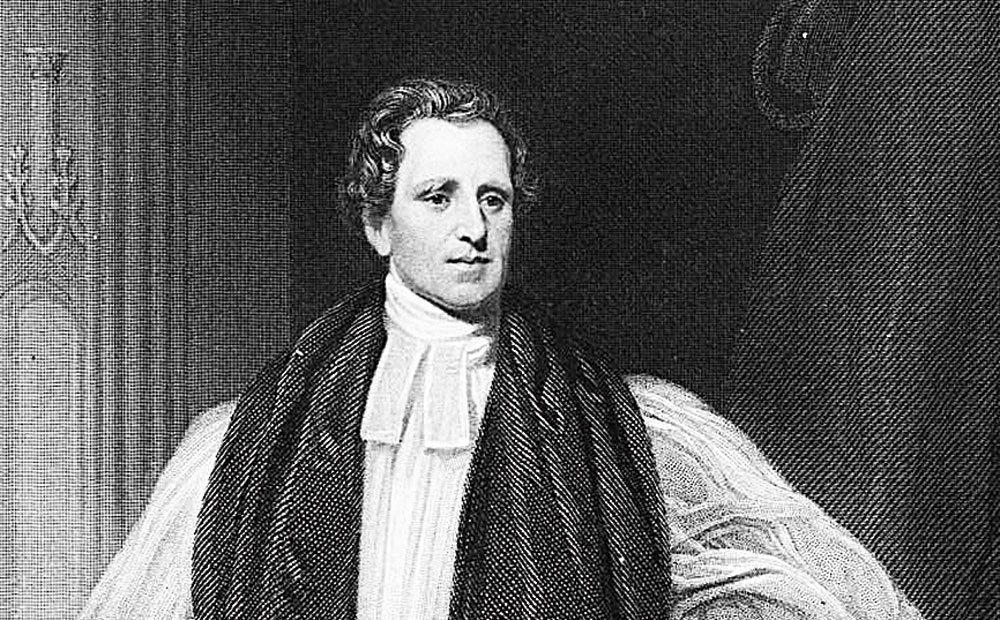
Sometime ago it was reported that the coffin of Daniel Wilson was found in a vault under the main altar of Calcutta’s St. Paul’s Cathedral. Wilson was the fifth Bishop of Calcutta and founder of St. Paul’s, which came up in 1847.
“This is not some out-of-the-box discovery. We were all aware that the coffin was kept there,” says an official from St. Paul’s Cathedral who does not want to be identified. He continues, “In fact, there is a small opening on the outer wall of the cathedral for ventilation. It was kept covered so that no stray dogs could go in. We could see the ornamentation on the coffin. The remains of the bishop were never missing. It was just that we had never gone down into the vault.”
It seems Wilson himself had made provision for the vault under the altar. “There is a reference to his musings in the book, The Final Report of St. Paul’s Cathedral, Calcutta, written by Archdeacon Pratt, who was a close associate,” says senior researcher Mary Ann Dasgupta.
St. Paul’s is said to be the first Anglican cathedral of the Victorian age. In his book, Splendours of the Raj: British Architecture in India, 1160-1947, Phillip Davies writes: “The building was constructed in a peculiar brick especially prepared for the purpose, which combined lightness with compressional strength; the dressings were of Chunar stone, and the whole edifice was covered inside and out with polished chunam.” Up the stairs of the cathedral and next to the main door is a marble bust. Would that be of Wilson? No, it belongs to Reginald Heber, who was Bishop of Calcutta in 1827.
The bust of Reginald Heber in the cathedral / Picture by Pradip Sanyal
The story goes that when Heber’s bust was sent from England, Wilson couldn’t find a suitable space to display it. St. Paul’s hadn’t been built and St. John’s Church in BBD Bag, often referred to as the “old cathedral” in later years, was not spacious enough.
In a proposal written in 1839, Wilson wrote, “…subject of reproach, not only to the good taste, but to the piety of the greatest Empire in the Eastern world, that our Government House, our Mint, our Town Hall, our Custom House, our Bridges and even our Ghats… to say nothing of our official residences and private dwellings… should be upon a scale in some measure correspondent with the position we hold in India, whilst our Cathedral [St. John’s Church, built in 1787] is mean, inappropriate and incommodious…”
Heber’s bust became the peg on which Wilson put forth an application to the government for a site for a new cathedral. He wrote to Lord Auckland: “I beg permission to enquire of your Honour and the Government of India whether it would be possible to grant me a small angle of ground on the Esplanade near the Chowringhee Road for the purpose of erecting a Church.” Auckland gave consent and land and signed his missive “I am Your Lordship’s most truly Auckland”. That was May 1839. Eight years later, St. Paul’s Cathedral was ready.
Dasgupta is working on the history of St. Paul’s. She says, “It is not possible to explore the history of the cathedral without delving into the history of the man who founded it.” She has visited the library at Bishop’s College, St. Xavier’s College archives and the Asiatic Society.
Daniel Wilson was born in central England’s Spitalfields in 1778. The eldest son of a wealthy silk manufacturer, he was barely in his teens when he joined his uncle — an even wealthier silk manufacturer in London — as an apprentice. The young Wilson was, however, more inclined to religious studies than business. He pursued higher studies and eventually graduated from Oxford University and was ordained a priest in 1802.
Wilson was a vicar in north London when he accepted the call to become the Bishop of Calcutta. In Wilson’s biography, his son-in-law Josiah Bateman, writes: “In October 1797, Daniel Wilson felt his spirit stirred to go as a missionary to heathen lands; and in October 1832, he stood on the banks of the Hooghly as Bishop of Calcutta.”
From her explorings, Dasgupta has pieced together a portrait of Wilson. Wilson, the disciplined man. Wilson, who did not like wasting time. Says Dasgupta, “Most of the previous bishops of Calcutta did not survive for long, most probably due to the hectic schedules they had to follow. They used to go for long tours — Burma, China, Malaysia. Bishop Wilson did not do this at the onset. He waited for some time to adjust to the climes. He took care of his health.”
Bateman writes, “His personal habits at this time were very simple and regular. He rose early, and rode on a small black horse, brought from the Cape, which for a time, was able to take care both of itself and its master…”
We learn that he was a prolific letter writer and well-read in the classics.
“He had friends back in London with whom he would correspond,” says Dasgupta. In one letter to his children dated 1840, he wrote about the construction of the cathedral. It read, “Every morning I ride round on my horse and watch the different views which the Cathedral will present (sic).”
Besides being a devout Christian, Wilson was a dynamic man, full of energy. According to his biography, the jurisdiction of the Bishop of Calcutta in 1832 was far-reaching.
Bateman writes, “It was manifestly a burden too heavy to be borne. It must not be supposed that he found abundant records, well-defined duties; and established precedents… The Palace was a blank, the correspondence of his predecessors with the Government and clergy had disappeared, and the Registry contained little but a list of licensed chaplains.”
The coffin of Daniel Wilson was found recently at St Paul’s Cathedral in a vault under the main altar / Wikipedia
Bateman elaborates, “Sixty or seventy servants, turned loose into the house, and speaking an unknown tongue, had to be recognised and mastered. Guests were to be entertained, and sick friends watched over, nursed, and cheered. It will easily be imagined that some time elapsed ere light shone upon this darkness, and order issued from this chaos.”
Wilson loved good food and people and had a reputation of being a great host. Dasgupta has read his journal entries where he writes how “the wonderful young editor of Friend of India” had breakfast with him and so also “Mr Hunt, the great railway man” and Mr Wylie, “who is one of those noble, kind-hearted, thoroughly good men, of whom there are so few in the world”. Yet another entry reads, “This morning I had all my Cathedral clergy and their wives to breakfast… there were 46 present.”
But when engrossed in work, the same man did not like being disturbed and could be very impatient. Dasgupta says, “Before the visitor would settle down in his chair, Wilson would start up in a hurried but determined way and say, ‘Well, my dear friend, you must excuse me; good morning, good morning, here is your hat and here is your umbrella,’ and before the visitor left the room, he would again be buried in his books and papers. But he was always polite in his approach.”
The day Wilson formed the St. Paul’s Cathedral Committee, he also announced that he had signed his will. Dasgupta came across a photocopy of it. In it, he states that he has given Rs 1 lakh for the building of the cathedral and another lakh will be paid out after his death. He also bequeathed his grand collection of 8,000 books to the cathedral library.
He died in 1858. Fifteen years before that he had inspected the vault which was being built for him under the communion table. He wrote in his journal:
“I could not but think as I walked up and down the abode of death how soon I might be called to lay down my pastoral staff and rest in that bed or grave as to my mortal frame, till the Resurrection morn (sic).
source: http://www.telegraphindia.com / The Telegraph – online edition / Home> Heritage / by Moumita Chaudhuri / April 28th, 2019
The designer rewinds with The Telegraph to pick 20 landmarks that made Sabyasachi the brand that it is today!
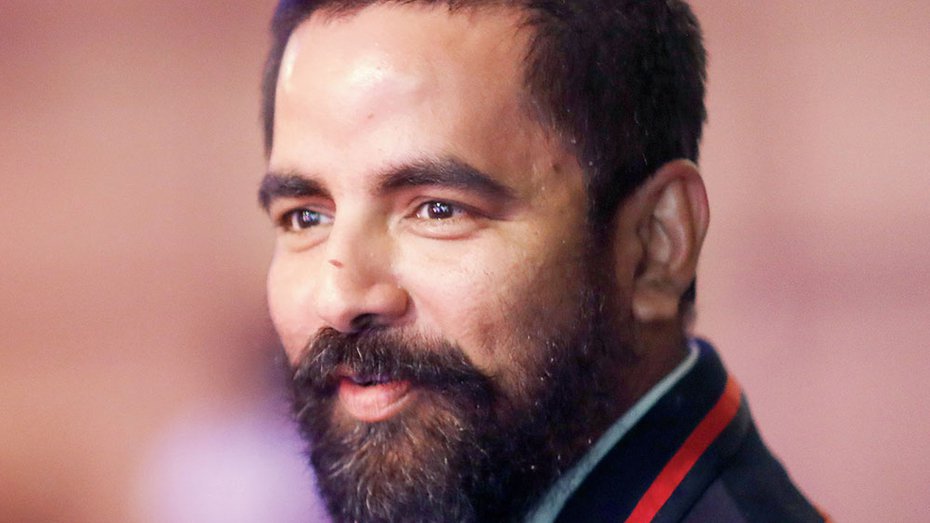
Sabyasachi Mukherji / Telegraph file picture
Sabyasachi considers his graduation show at National Institute of Fashion Technology, Calcutta, as the first landmark of his career. The show had won him three awards — the Best Design Collection from NIFT Calcutta, the Ritu Kumar Award for Excellence in Textile, and the critic’s award in Confluence, which was the best among students from all the NIFTs. “That gave me my first foray into the fact that I could start becoming a designer, it gave me the confidence and the boost that I will not take up a job but start my own label. If those awards did not come my way I would probably be working in an export house now. It made me believe in myself,” says Sabya.
The second was being adjudged best designer at a contest called Khadi Goes International, which won him a scholarship to go to London and an internship with the Victoria and Albert Museum. “It was my first trip outside India… I had never really been anywhere except for Delhi and Bombay. So it was my first international flight. I got a lot of independence, because you know, Bengali kids are very protected, in the middle class you don’t really go out that much, so I didn’t have much exposure. So it opened my eyes about possibilities that there exists a market outside India as well.”
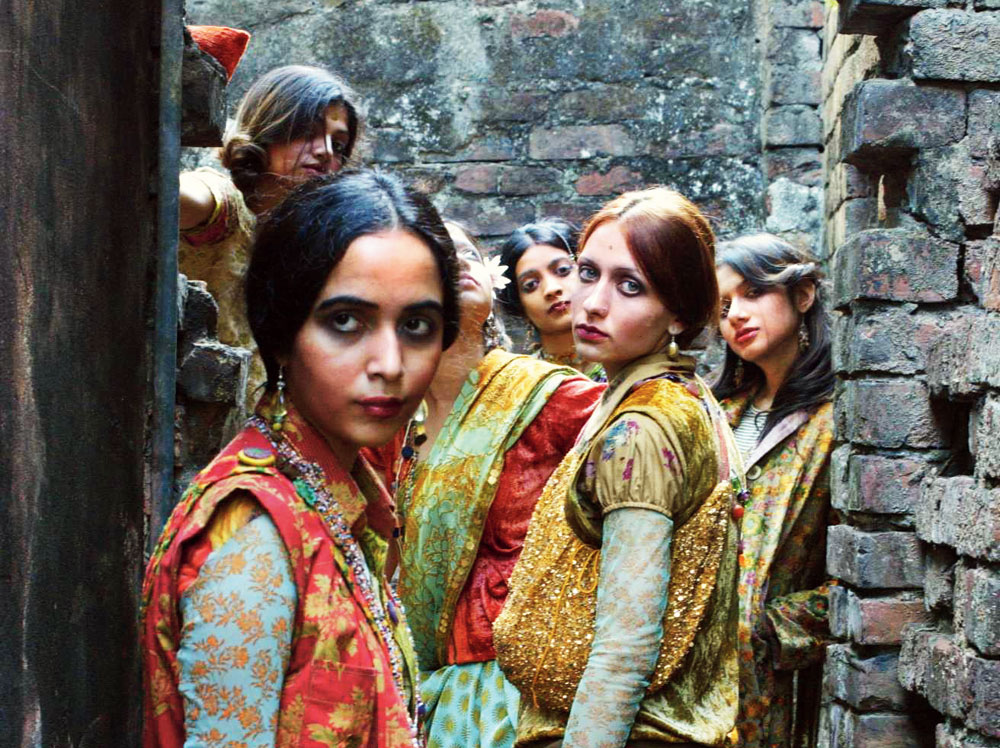
Sabya feels that his debut at Lakme India Fashion Week with his collection Kashgar Baazar in 2002 was the third and possibly the biggest landmark. “I became a star overnight. It put a lot of pressure on me. Because I did not even make it to Page 3, I made it to Page 1. I remember, The Telegraph coming up with the headline, ‘Fashion star rises from the east’. It came on the main newspaper, not in a supplement. It became a national news everywhere… I became a big star. It catapulted me into the brand that it is today.”
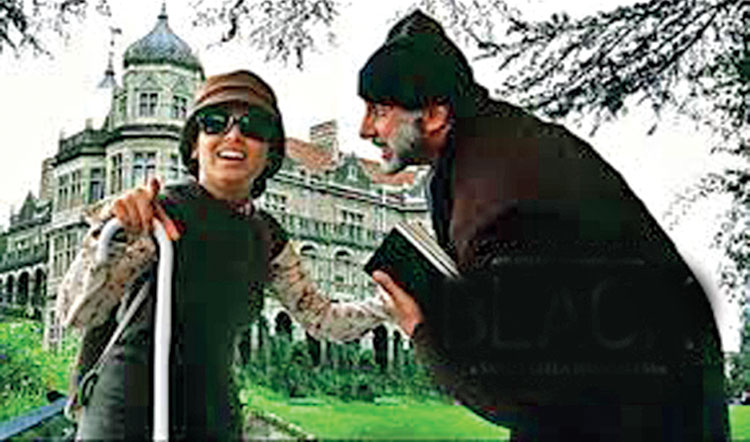
His first Bollywood film, Sanjay Leela Bhansali’s Black, which won him his first ever national award for costumes, is very special to him. “When he (Bhansali) had first called me for the movie I did not even know who he was and what kind of films he made. I was a big fan of Mr Bachchan and the fact that I got to work with Rani Mukerji and Mr Bachchan in my first film was enormous.”
A scene from the film, Black
Retailing from Espee, one of the first multi-designer fashion stores of Calcutta by Sangita Kejriwal and Purnima Chawla, holds a very special spot in Sabya’s heart. “I remember I used to cycle to Espee to see my clothes hanging; I could not believe that a store would actually put my clothes in their window.”
Winning the Mercedes-Benz Asia Fashion Award in Singapore got him a ticket to Paris and the chance to intern with global fashion stalwarts Jean Paul Gaultier and Azzedine Alaia. “I came back feeling much more confident about my body of work.”
Sabya’s Spring/Summer 2005 collection Frog Princess / A Telegraph picture
His Spring/Summer 2005 collection Frog Princess got him his first ever international store display — Browns in London. “Ms Burstein, who owns Browns, is considered to be a fashion legend. She was the first person to retail John Galliano, Alexander McQueen and all of these people, and legend has it that if Browns puts somebody in the window of the store during London Fashion Week, that person is supposed to be a huge star in the future. She put me on the same platform. I was in the window of Browns during London Fashion Week. Of course, I became a big star in India, I did not become a big star internationally, but she must have seen some potential.” Frog Princess opened many doors and he got a chance to showcase at his first ever international fashion week — Milan Fashion Week. His next collection after that was Snail in Autumn/Winter 2006, with which he had the opportunity of showing at New York Fashion Week.
It was Chand Bibi in Autumn/Winter 2007 that saw Sabya flirt with a full Indian show. “Chand Bibi and much later Bridal Sutra were my first taste of how beautiful Indian clothes could be. Full Indian shows I did and I think they paved the way for the future of the brand. And if I were to give a collection for commercial success… Chand Bibi actually paved the way for the brand that Sabyasachi is today. It consolidated my position as an emerging bridal-wear designer.”
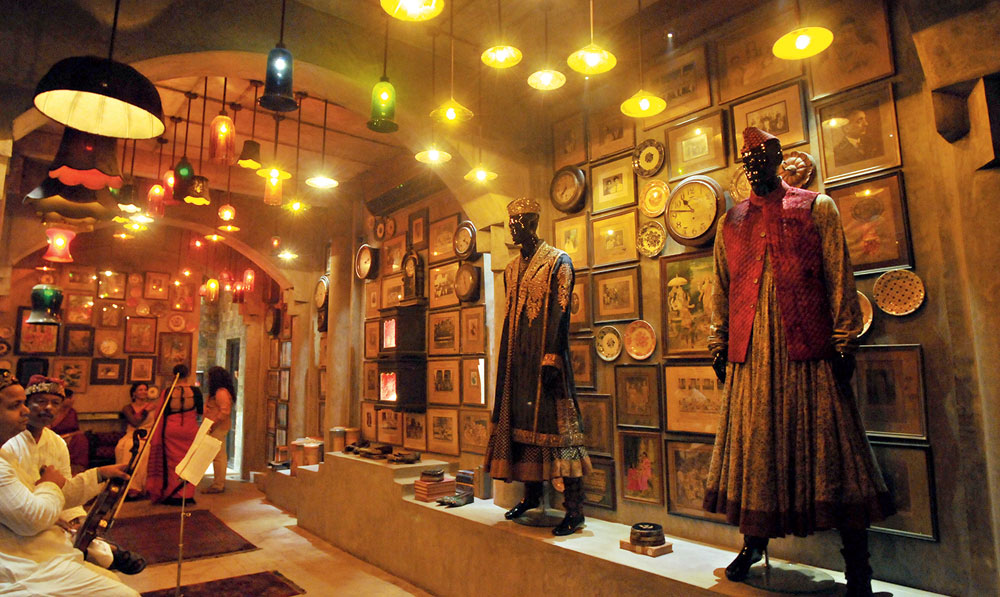
The Calcutta store was about 40 per cent retail and 60 per cent experience / A Telegraph picture
The next big landmark was Opium, which he had shown at the India Couture Week in Delhi and which got rave reviews everywhere. Till today, it is one of Sabya’s biggest commercial successes.
A big feather in the cap of the brand was his collaborations — Christian Louboutin, Pottery Barn, Asian Paints, Forevermark — each of these have been very big landmarks for the brand. His collaboration Sabyasachi X L’Oreal Paris in 2018 was his foray into beauty.
Another huge collection was Big Love in 2015 / A Telegraph picture
Another huge collection was Big Love in 2015, when the brand started flirting with modern Indian clothing. It was still lehngas and everything, but it was a modern concept, which is still continuing today. A big landmark for the brand was introducing the Royal Bengal Tiger logo and it started with Big Love. “I thought the brand was getting bigger and bigger and it was important to anchor the brand with a signage which could replace my name Sabyasachi. And the Royal Bengal Tiger was a beautiful logo and it has become a bestseller because we have started putting it into the waistbands of lehngas, on belts and bags. I think the logo would find many iterations in many things to come.”
The brand’s first Cannes red-carpet appearance was with Aishwarya Rai Bachchan wearing a Sabyasachi sari. “That was my first red-carpet moment. She wore a sari of mine at Cannes and the kind of traffic it generated it has never generated that kind of traffic again.” His first public criticism was dressing up Vidya Balan for Cannes and Sabya considers that a landmark, too. “I learnt a very important lesson that when you are a very big brand the onus lies with the public too. So the people who praise you today are the ones who are going to criticise you tomorrow. You need to understand that people are going to criticise and you have got to respect that but you still got to move on and do what you want to do and not get shaken by public criticism. It made me stronger.”
The first interior designing project that Sabya did was for Taj 51 Buckingham Gate in London. Sabya designed the hotel’s iconic Cinema Suites.
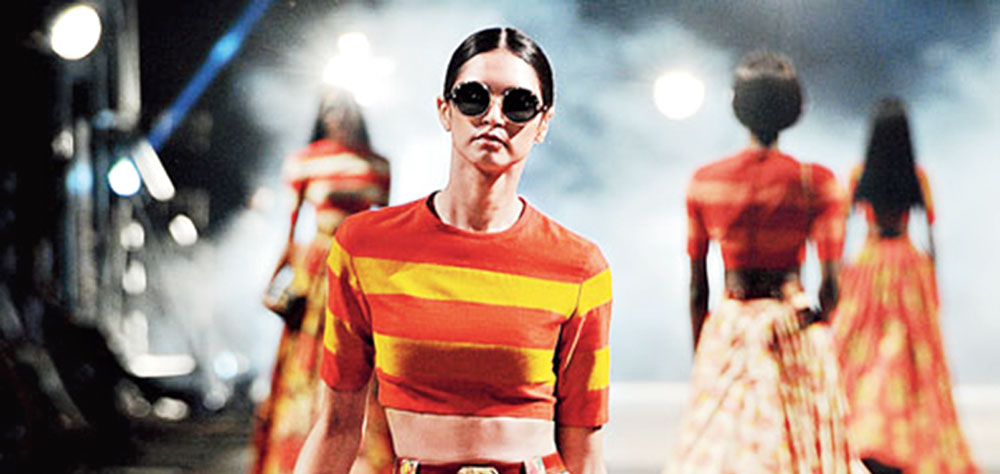
A game-changer for the brand from the communication point of view was opening Sabyasachi Instagram and the first Instagram show that was Firdaus (2016). “I think I changed the format and a lot of big designers ever since have shifted away from doing fashion shows and switched to doing shows on Instagram. So we changed the way fashion communication was done in India.”
Sabya started his jewellery line in 2017 / The Telegraph picture
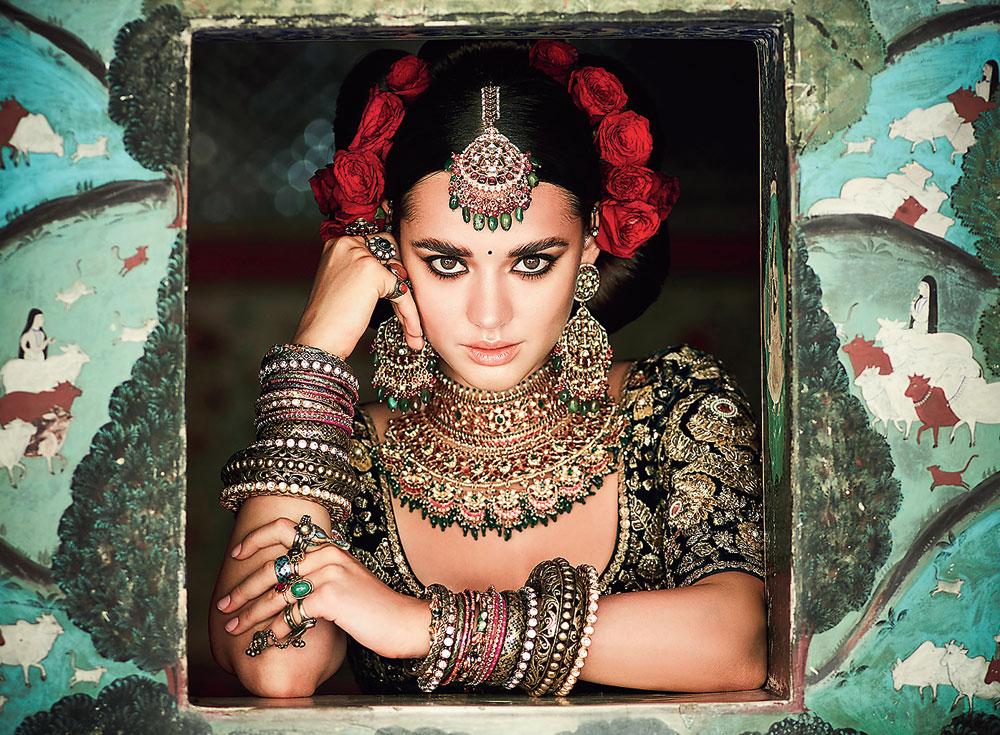
Sabya started his jewellery line in 2017. “I have ambitions to make it India’s number one jewellery brand. I started it two-and-a-half years ago and it is already over-performing. There are conversations with big stores overseas to stock Sabyasachi jewellery.”
The year of the big weddings in India saw Sabyasachi become the go-to name for weddings. In a span of a year he did the wardrobes for all the big weddings in India —Anushka Sharma, Deepika Padukone, Priyanka Chopra and then Isha Ambani and Shloka Mehta.
One important personal landmark for Sabya was speaking at House of Commons and going to Buckingham Palace for dinner. “(The experience was) surreal! I had always seen Buckingham Palace from outside, to go inside… I remember I went with Manav (from his team), and Manav pressed his nose against the glass window and said ‘Oh so this is how it feels to look at people outside’. We could see all the people outside staring at the palace and we thought we could have been one of them.”
His show Band Baajaa Bride has been one of the most popular programmes on Indian television. It ran for eight seasons and won numerous awards.
His foray into the Far East with Lane Crawford and his White Wedding line with them was very important because “I want to own the wedding space not only in India but internationally as well”.
source: http://www.telegraphindia.com / The Telegraph, online edition / Home> Culture / by Smita Roy Chowdhury / April 27th, 2019
Recently, a Santhal village in Birbhum killed the post of majhi haram or morol. We visit the headman of a nearby village
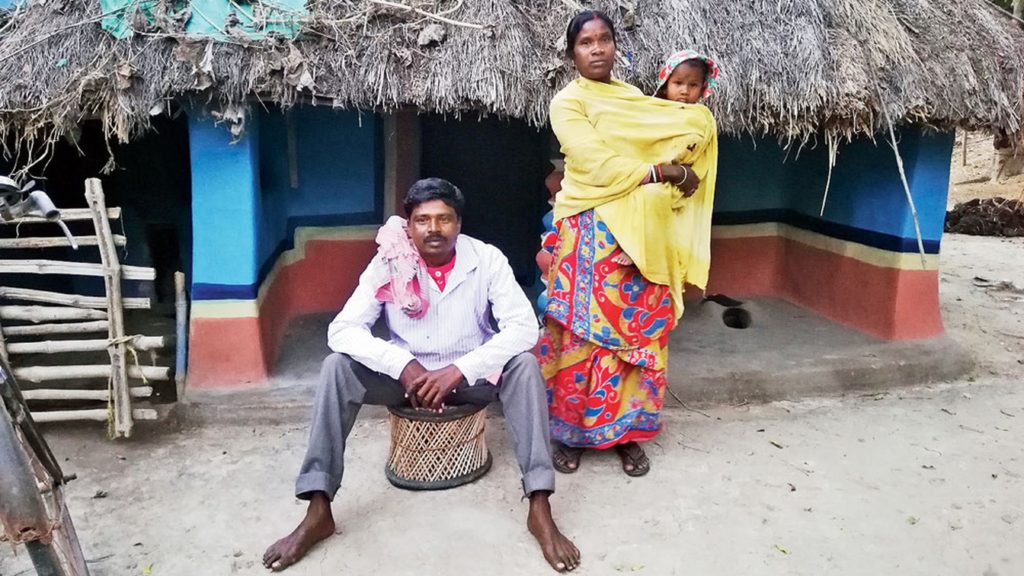
Majhi haram Nilu Mardi with a neighbour / Image: Moumita Chaudhuri
Gopal Nagar Dakshin Palli in Bengal’s Birbhum district is a tribal village. The drive from Bolpur town to the house of Nilu Mardi, the village headman, takes all of half an hour. The reason behind the trip — a recent report about another tribal village in this very district doing away with the concept of morol or village headman. Reports attributed the move by Chatormath village in Suri town to political interference. It also said that other villages were planning to follow suit. Nilu Mardi is a majhi haram, a term used to describe the headman of a Santhal village.
A majhi haram performs the role of a morol, but all morols are not majhi harams. Mardi hurries out of his mud hut, his hands folded in greeting. The 40-something moustachioed headman is of shy demeanour; he offers his visitors a charpoy and fetches a low cane stool for himself. Over steaming cups of milky tea, he starts to talk.
He says, “My father was a majhi haram and I have inherited the title from him.” According to him, the headman in every Santhal village is actually the religious head, selected quite literally by the higher powers. Mardi describes how a jaan or seer performs rites, which involves among other things blessing a magic stick.
The stick hops out on its own and stops at a house of its choice and the male head of that household is anointed majhi haram. Says Mardi, “One cannot assume or give up the title at whim. It remains in the family as long as it has to be there.” In case there are no male successors, the stick and the title are passed on to the son-in-law.
At this point in the conversation, Balu Tulu, a man of average build, not more than 60 years old, enters the courtyard. There is another mud hut facing Mardi’s home; the courtyard is common to both.
Tulu lives in the second hut; he is also a relation of Mardi. A concrete structure is coming up on another end of the courtyard — an uncommon sight in a village where there is no pucca house — which houses a common kitchen with two clay ovens. A little away from it, there is a generous stack of straw.
Tulu expresses shock and surprise at the fact that a tribal village has decided to do away the headman’s post. “Chatormath will actually lose the status of being a Santhal village in that case,” he announces to no one in particular. As it turns out, to date, in a Santhal village, money and social hierarchy is no great divider. Tulu speaks freely in front of the headman.
Mardi too does not seem to mind. “I am the majhi haram but he is an elderly person and in a Santhal village we always consult the elders and respect their knowledge,” he says humbly. The women of the family are sitting out too, witnessing the conversation unfold; from time to time there is giggling, oftentimes someone makes a point without any inhibition. “I have to preside over cases where one has stolen a morog (rooster) or a handi (utensil),” says Mardi and there is tittering all around. He also settles household feuds, big and small, and skirmishes.
The main issue these days, however, is inter-caste marriage. There is an unwritten rule among the Santhal tribes that if two adults marry without the consent of their families, then the families have to bear the consequences. Tulu says, “If two adults marry within the community, they are allowed to stay together but then both the bride and the groom’s families have to do the ritual goat sacrifice — the boy’s family has to sacrifice two goats, while the girl’s family has to sacrifice one.” But when the marriage happens outside the caste, there is a problem. “We generally call off the marriage and order them to stay apart. And if they refuse to listen to the village head, they are asked to leave the village,” says Tulu. But matters don’t end here. “Nowadays, aggrieved parties approach courts of law and even the panchayat. They also take the help of the police and are eventually allowed to stay on,” he adds.
The older man repeats what Mardi has already explained — that the majhi haram of a Santhal village is not a political post. “That is why political parties do not interfere in the works of a majhi haram,” says Tulu. So when a village in Birbhum has turned hostile towards an age-old Santhal ritual, we have to understand there are other reasons, he adds knowingly. Mardi agrees: “Let alone the police, the panchayat won’t even entertain a case from our village if anyone tries to bypass the majhi haram.”
source: http://www.telegraphindia.com / The Telegraph, online edition / Home> Heritage / by Moumita Chaudhuri / March 17th, 2019