Category Archives: Arts, Culture & Entertainment

India’s first municipal archive

The digitised municipal archive was launched in 2017 with copies of the Calcutta Municipal Gazette

A 1927 edition of the Calcutta Municipal Gazette / File photo by Subhasish Bhattacharjee

Calcutta’s East-West Metro line, the same that will connect Howrah and Dalhousie Square, was conceived nearly a hundred years ago by the British. “An expert had come down from London in 1924,” informs Deepankar Ganguly, who helms the Calcutta Municipal Corporation archives. He continues, “According to the original plan [which is to be found among the archival gems] too, a portion of the stretch was to run under the Hooghly river.”

The digitised municipal archive was launched in 2017 with copies of the Calcutta Municipal Gazette. The gazette’s founder-editor was Amal Home, who had been handpicked by Subhas Chandra Bose when he was the CEO of the civic body. “The gazette blossomed with all kinds of writings and contributions from within India and abroad,” says Ganguly. So you have Mahatma Gandhi writing on khadi and C.V. Raman on music. But primarily, the gazette carried news of municipalities across the globe.

Amal Home, Editor, Calcutta Municipal Gazette / File photo by Parimal Goswami

One such issue from 1931 is titled “Raman Number”. Among other things it contains the speech the physicist delivered at the Calcutta Town Hall. It reads: “A hot day in June is not an opportune moment to enter upon praise of the physical climate of Calcutta. But from the point of view of research, there is something more important than the physical climate, and that is the intellectual climate… For a hundred years, Calcutta has been the intellectual metropolis not only of Bengal, or of India, but of the whole of Asia.” The same issue has a clip about a Captain T.A. Joyce of the British Museum who had returned to London after an expedition in the British Honduras, where he possibly unearthed the ruins of a Maya civilisation; the third anniversary of Paikpara library; and an advertisement by the health department of the Delhi Municipality seeking tenders for rat traps.

Encouraged by the then mayor of Calcutta and a generous grant, Ganguly and his team of three digitised all gazettes between 1924 and 1975. But as he himself points out, an archive cannot constitute editions of the gazette alone.

In the days and weeks that followed, Ganguly started to digitise the 1,000-plus books, documents and maps that were in possession of the civic body and would have ended in the rubbish bin for sure. Gradually, rare civic body related documentation procured from elsewhere also found place in the archive index.

An archive is not an archive. It is like Sleeping Beauty waiting to come alive at The Heritage Enthusiast’s touch. Even a cursory scroll down the corporation archives’ online index conjures a different time, different places, a variety of issues. Somerset county’s war on T.B.: 1925. Program of Nutrition education in New York city area: 1946. Public health protection in Soviet Russia: 1946. Paris Street accidents: 1925. Municipal election in Rome: 1947. Tokyo municipality gherao by workers’ union demanding higher pay: 1946.

The bare bones of history mean different things to different people. When Gary Stringer and Ayesha Mukherjee of the UK’s Exeter University visited the archives, they were surprised at a detailed handcrafted map of Subeh Bangla from the 18th century that they were shown. Stringer offered to lend expertise to enlarge the map digitally to reveal details the naked eye could neither see nor appreciate.

Ganguly talks about an incident from the 1946 Direct Action Day that is recorded in the municipal archives. It seems when riots broke out in Calcutta, Tagore’s sister found herself in the crosshairs of the unrest. That is when corporation councillor Haji Md Yousuf came to the rescue of her and the entire family. When this archival finding was reported, someone from the councillor’s progeny got in touch with Ganguly and requested that he be allowed to see the report.

The longish room on the top floor of the CMC building in central Calcutta is teeming with nuggets. How way before Independence, the electric train was thought of by the British, but was axed by the coal syndicate. How the corporation commissioned one Bipin Behari Das to make three motor cars by hand. How one of them is to be found at the Banaras Hindu University. A photograph of Das’s workshop at 100 Bondel Road also exists. A six-line advertisement Tagore wrote for Tisco is to be found, as also news of a member of the Birla clan celebrating a marriage in the family by building a block for Calcutta University. And among the collection of advertisements is one of Dunlop selling pneumatic tyres for bullock carts.

Ganguly praises current mayor Firhad Hakim and his predecessor Sovan Chatterjee for supporting the initiative. A flip through the guest book reveals that the archive has got the attention of researchers from Dhaka to Cornell. It is a fact that as the first municipal archive in India, it has built some sort of a reputation. But as to whether the rest of the city is aware of the riches it has in its midst, there is serious doubt.

source: http://www.telegraphindia.com / The Telegraph, online edition / Home> West Bengal / by Upala Sen / March 15th, 2020
Art is about beauty

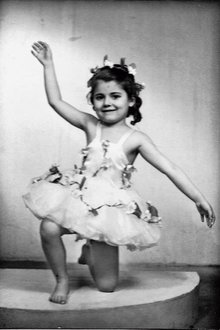
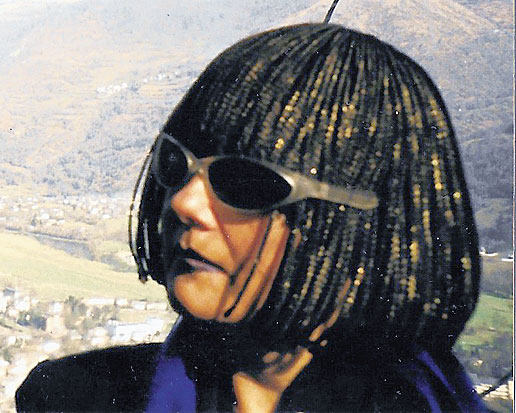
Artist Anita Gopal, who divides her time between Calcutta and London, talks about her charmed childhood in Calcutta

Gopal as a child / Sourced by the Telegraph

In part one of her story, artist Anita Gopal, who divides her time between Calcutta and London, talks about her charmed childhood in Calcutta, a chance meeting with artist David Hockney and her moment of truth

I was brought up in a very visual household. My father Prem was a British Raj dandy. He only wore Chinese silk shirts, sharkskin suits and bow ties that were hand-tied. He scoffed at the American clip-on versions. Never short-sleeved shirts: he considered it too vulgar for men to show their arms.

He dressed me and my brother Paul and my mother. He would take me to New Market in Calcutta and buy me dresses and matching knickers, shoes and bags…often six at a time!

I was told that there was a clear distinction between good and bad taste. It was not a matter of opinion.

Anita Gopal / Sourced by the Telegraph

My mother Rosalie was a beauty and glamorous. She was English and came from a family in which beauty was highly prized. My parents met and married in London and travelled to India on a P & O liner in 1947 to land in the middle of Partition. My father’s family were Punjabis from Lahore and were Hindus, so they left everything and ended up in Delhi. My grandfather Nand, who had also been a British dandy, followed Gandhi and started wearing dhotis!

Eventually my parents moved to Calcutta where they became a glamorous couple. They went to parties every night. They went to the Grand, the Great Eastern and Spencer’s and Firpo’s and the nightclub Golden Slipper.

My mother always wore beautiful saris in the evenings. I still remember the smell of Lanvin’s Arpege and the rustle of saris when she kissed me goodnight. She gave me a golden slipper charm from the nightclub which I kept for years. My birth certificate states place of residence as Grand Hotel! My parents knew M.S. Oberoi, who kindly let them stay at the Grand for six months.

Later they lived in Ballygunge and my father designed the flat with cream walls and dark red sofas; the verandah with a bar and cane furniture, which later featured in my life.

With this background it was fairly inevitable that I became mad about fashion and glamour and beauty.

My father died tragically young and my mother, brother and I moved to London.

I went to Kingston School of Art to do a B.A. Hons. in fine art. During my foundation course fashion was one of the elements. I was asked to do my BA in fashion but I refused as I thought it was trivial and frivolous! I thought fine art was a much more serious vocation!

I painted from the model for three years, using a method of measuring known as the Coldstream method by William Coldstream, an English painter. It was a very strict and precise way of painting based on the school of philosophy called Logical Positivism started by A.J. Ayer, an English philosopher. This style was not approved of at Kingston School of Art. It was considered reactionary. One was supposed to paint in the house style of abstract expressionism.

After college I lost faith in the idea and stopped painting.

I travelled back to India with my partner for the first time since childhood. We started a small business importing cane furniture from Calcutta to London. It was a successful business, but I also started painting again in a very different way. Whilst travelling all over India I fortuitously met David Hockney, who told me to do whatever I liked, as that was what he had always done.

This was a release for me from the self-imposed Coldstream method.

I started using different viewpoints like Cezanne and local colours like El Greco and rhythms like Delacroix.

I suddenly realised that art was about beauty. I painted again from the model and from fashion magazines like Vogue which are full of beauty and glamour.

So full circle back to my childhood upbringing!

Needless to say I have hundreds of clothes shoes and bags!

I also am very particular and fastidious about the decor in my flat!

This is part one of my art story…the second part is how I came to invent my eventual style, which I call Fractism. It is made entirely of paper and is cut paper relief, but of course it is all cut from glamorous magazines.

(To be concluded next week)

source: http://www.telegraphindia.com / The Telegraph, online edition / Home> Style / by The Telegraph / April 30th, 2020

Photographer Nemai Ghosh, the man who never missed a moment

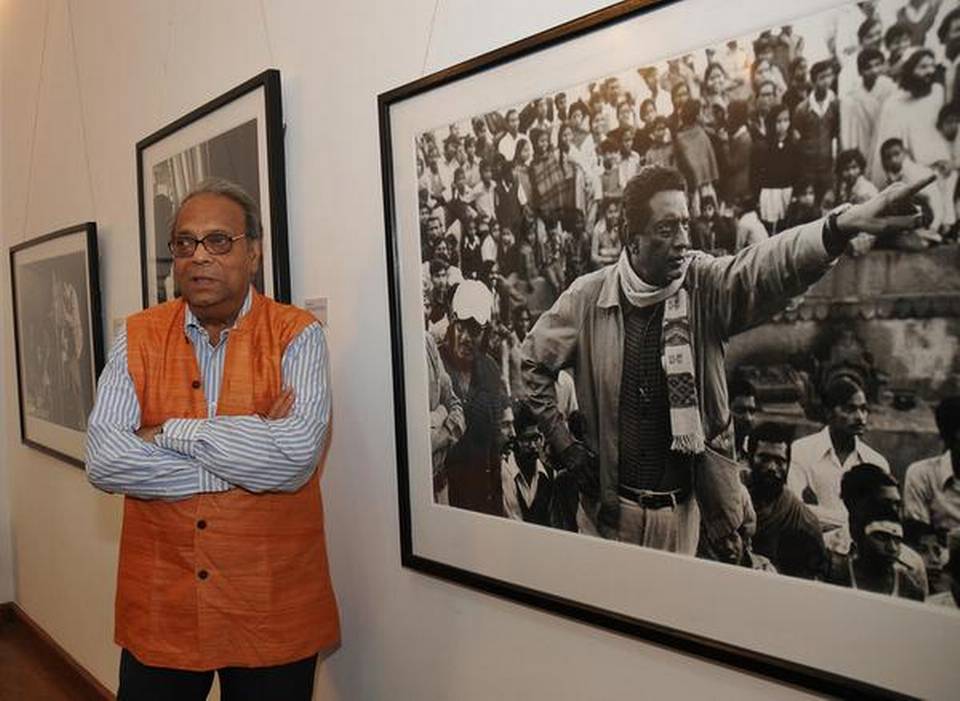
‘Goopi Gyne Bagha Byne’ (1969) onwards, he was the still photographer for all of Satyajit Ray’s works till his last film ‘Agantuk’ (1991)

For someone best remembered as the visual biographer of legendary filmmaker Satyajit Ray and a documentarian of the making of his astounding body of work, an interesting aspect about Nemai Ghosh was that he started off as an actor with actor-director Utpal Dutt’s Little Theatre Group in Kolkata.

Arts critic and publisher-editor Samik Bandopadhyay remembers one such play that he acted in: the landmark Angar (1959) about the exploitation of coal miners. It had music by Ravi Shankar and complex sets (Nirmal Guha Ray) and lighting design (Tapas Sen) with an entire sequence of a mine getting submerged under water. “He was an impressive and formidable figure on stage but was never so interested in photography then,” recalls Mr. Bandopadhyay.

Nemai Ghosh passed away in Kolkata on Wednesday. He was 85.

Ghosh’s interest in photography was kindled entirely by chance in 1966 when he found an abandoned camera and started tinkering and playing around with it. Being a great lover of cinema himself, he wanted to shoot the process of filmmaking which is when his path crossed with that of Ray. Initially just “tolerant” of his presence, as he once recalled, Ray discovered Ghosh’s talent by and by to have him become a part of his unit. Goopi Gyne Bagha Byne (1969) onwards, he was the still photographer for all of Ray’s works till his last film Agantuk (1991). “The only other parallel I can draw is Raghu Rai’s photographs of Indira Gandhi,” says photographer Chirodeep Chaudhuri of an imagemaker’s consistent collaboration and engagement with a personality.

Ray’s son and filmmaker Sandip Ray remembers meeting him on the sets of Goopi… “He was a part of the family. He was always there, not just on the shoot, but our home as well,” he says.

Black and white

The magic of his black and white images lay in the specific fleeting instants that they managed to capture, that too without flash, in natural light. “He never missed a moment, captured the right moment,” says Sandip Ray. “His work in theatre gave him a sense of the moment,” says Mr. Bandopadhyay.

Filmmaker Sujoy Ghosh compares his frames to videography. “Each of his photos tells a story to me. Like Jaya Bachchan in Kalighat, teeka on the forehead, prasad in hand, happy… I see many things in the process. It’s instructive and informative about the process of filmmaking itself,” he says.

Mr. Chaudhuri points out the candidness in his frames unlike the “manufactured PR images and ‘behind the scenes’, ‘making of’ balderdash” where the stars are perennially performing or posing.

“There was an endearing quality about his photos. You could see his love for theatre and cinema [reflected in them],” says Mr. Chaudhuri.

Apart from Ray, Ghosh also chronicled some of Mrinal Sen’s films and he was the still photographer on Mira Nair’s The Namesake. “His portraits of my father were absolutely brilliant,” says Mr. Ray. Sujoy Ghosh remembers him shooting on the sets of his own film Kahaani. “I fell at his feet. It was such an honour that he considered our film,” he says.

On theatre

Beyond Ray and films, a major part of his work was on the theatre in Bengal and about Kolkata itself. His work was a reference point for Sujoy Ghosh when he went shooting in Kolkata for Kahaani. “It was an amazing inspiration. Every photographer and painter has a [unique] way of looking at places, objects, people which is different from ours,” he says.

Mr. Chaudhuri remembers him showing rare colour photos of Ray when he visited Ghosh at his home couple of years back. “He was so excited going through the folders and files of his work on the computer,” he says. One of Ghosh’s disappointments, according to Mr. Chaudhuri, was not being given space by the State government to archive his work. Later, he gave away most of it to the Delhi Art Gallery.

In the latter half, he was passionately documenting painters at work and musicians in performance. According to Mr. Bandopadhyay, Ghosh had clicked some exclusive pictures of the ailing Italian maestro Michelangelo Antonioni, some of them in his hotel room, when the latter had come to Kolkata for the retrospective of his work at the International Film Festival of India in 1994. Impressed with his images, Mr Antonioni, who had taken to painting in his later years, had invited him for his exhibition to Italy. Ghosh took pictures of Antonioni moving around in the exhibition on a wheelchair. Having been witness to and documented the maestro’s painting phase, Ghosh wanted to preserve them in the form of a book. Sadly there were no takers for it in the commercial publishing world.

source: http://www.thehindu.com / The Hindu / Home> Entertainment / by Namrata Joshi / Mumbai – March 26th, 2020

An acclaimed Bengali pulp fiction writer turns a voyeuristic eye on the secrets of Calcutta by night

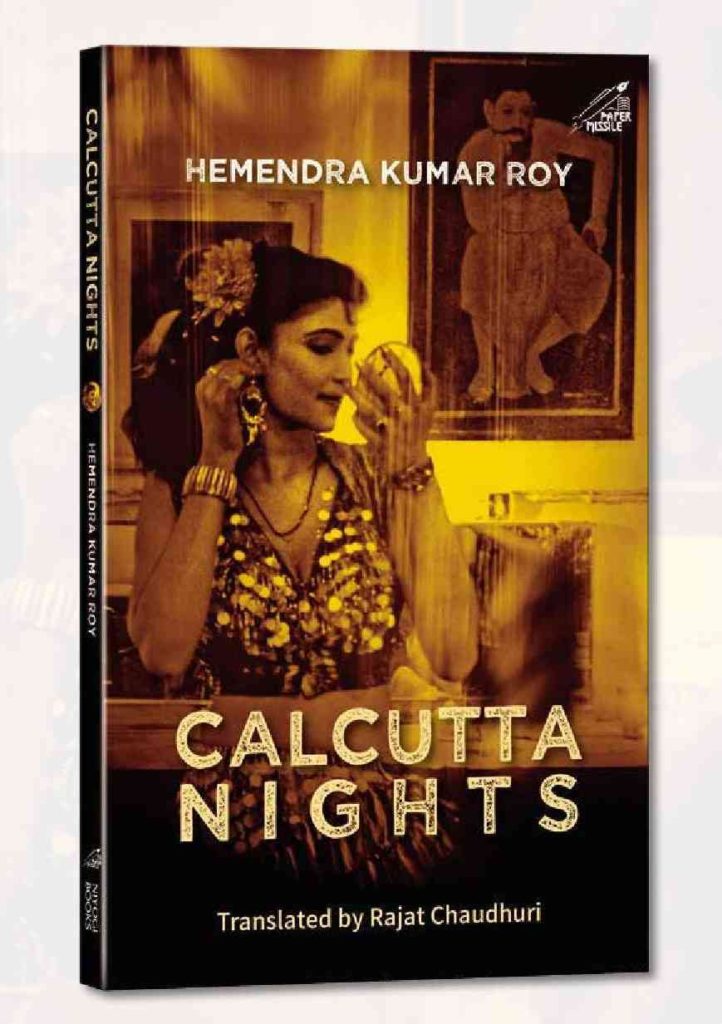
Epicentre of the renaissance and reform by day, the city was den of shocking behaviour by night, according to Hemendra Kumar Roy’s ‘Calcutta Nights’.

Clyde Waddell / Public Domain

In these times of social distancing, Calcutta Nights , a recently translated crisp vintage work from 1923, beams up from the past the whole human mess of city life as we may fail to experience for a long time now – enticing , contagious with its mirth, sorrow and decadence, yet ultimately safe. Calcutta-ness is both a cult and a code.

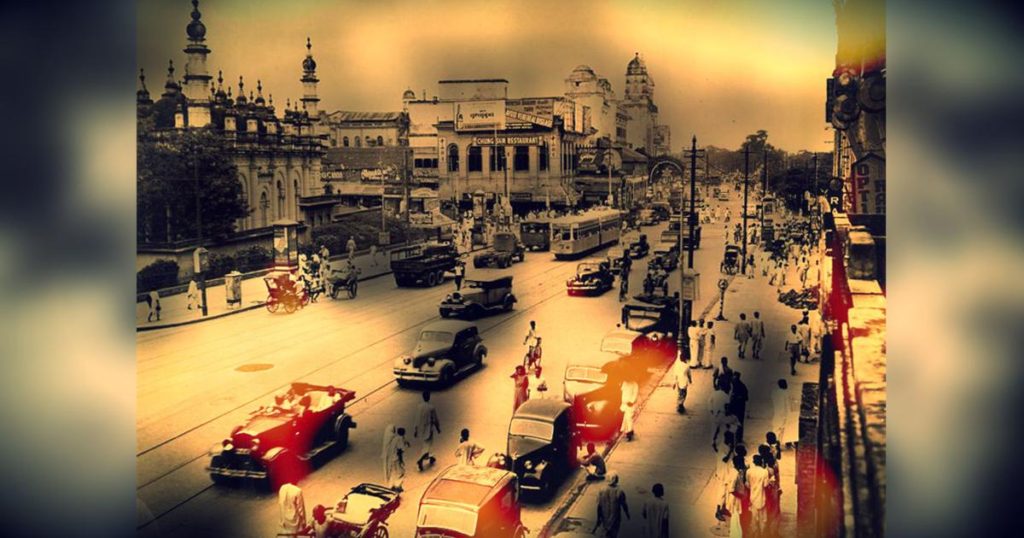
That Calcutta, totem pole of cult, is a distilled city, a Xanadu rich with local detail yet universal, contemporary yet not belonging to any particular period, a continuum of experience. No wonder then, that this wondrous city, simultaneous epicentre of renaissance, nationalism, reform movements and debauchery, should inspire city sketches, first made popular in the mid and late 19th century by the inimitable Hutum Pyachar Naksha. Decades later Hemendra Kumar Roy, prolific and popular author of detective fiction, adopted a nom de guerre to have a go at chronicling the scintillating night life of Calcutta in the 1920s.

If books were bordello windows, their sepia light beckoning, Calcutta Nights would be one such, quite literally. A salacious account of what the night unravels, the book takes you behind the scenes, reports on the microcosm of hedonism, the power plays, symbiotic relations, the intimacies of a prostitute with her regular customer, the paanwali bartering and trading with the police, the beggar, the opium-smoker. What sets this book apart is the flawed and reluctant author.

A warning, apparently

A prolific writer of detective fiction, primarily for children and young adults, Roy probably stumbled upon this diverse and rich material probably while researching for his more innocuous detective novels – armed with a stout stick, he says, and at great personal risk. Against his better judgment, he writes about city la nuit, worried and embarrassed about the task at hand, the adirasa or eroticism that he has failed to avoid while raising the curtains of hell.

In his introduction, he rushes to reassure his readers that none of them will find Calcutta Nights obscene. It is, rather, written with the noble intention of sounding a warning to “fathers of young girls and boys”. Our Meghnad Gupta, author in hiding, is no Samuel Pepys, the veritable diarist of 17th century London who wrote himself into his salacious scenes, boasting about his own ardour and peccadilloes.

The city Roy writes about is a city of men, consumed by men. In the author’s own words this book is “ written for an adult male audience,” a sweeping exclusion that predictably rankles this reviewer’s entitled, liberal, feminist bourgeoise self. Said outrage is difficult to cull at first. Then, as the book shines with its vivid portrayals, the puritan author becomes part of the setting and it is possible to turn the judging “gaze” right back at him, to see him in all his troubled light.

Here was an author writing about hedonism at a time when the wave of nationalism was peaking, his puritan acuity often criss-crossing with an awakening of socialism. His feelings about the women he writes about swing from condescension and humble misogyny (empathetic and damning at the same time – a tone often taken when writing about giants by the best of Bengali literary stars, Sarat Chandra Chatterjee included) to genuine insight.

Atmospheric ride

A pacy read, the depiction is vivid and colourful. Despite his protestations the author is clearly an insider – therein lies the strength and authenticity of this sketch. The description is atmospheric. Roy bring alive, with cinematic realism, the night in which “owls flutter away…and gradually the swarthy ugly faces begin to peep and snoop.”

And slowly Chitpur Road transforms itself – weary clerks disappear, the streets are filled with the scented babus, their faces aglow with Hazeline snow seeking verandthe a belles. Kapure babus, hothat-babus, ingo- bingos, the rich, the white, the Marwari, Chinese, European women of loose morals, courtesans of Chitpur, lustful ladies of Kalighat, the poor prostitute, the wanton widow – each scene, as the chapters are aptly called, presents to us a glossary of social categories.

One of the most striking sketches is that of the Bhikiripara or beggar’s quarters. There are fabulously sensational bits, revealing the author’s – Roy had translated Bam Stoker’s Dracula – penchant for the supernatural and the fantastic. Particularly recommended are scenes from the Nimtala Crematorium and the one featuring a prostitute who beckons men into her room where a dead man lies, his throat slit open.

Translator Rajat Chaudhuri craftily balances archaic words with new ones, never upsetting the tonal authenticity of a period piece. Ultimately he strikes the right cadence – the voice often changing as it travels from Chitpur bordellos to the jazzy evenings in the Anglo quarters or the dim Chinese taverns.

For its depiction of the crowded and dense interplay of lives in the Calcutta of those days, this book is a perfect curl-up for these epic-dammed solitary afternoons. A treasure trove for every city addict has been discovered.

Calcutta Nights, Hemendra Kumar Roy, translated from the Bengali by Rajat Chaudhuri, Niyogi Books

source: http://www.scroll.in / Scroll.in / Home> Book Review / by Lopa Ghosh / March 29th, 2020

A glorious history of visual arts from east India

VISUAL ARTS: Ghare Baire is a grand exposition of Bengal art being held in Currency Building in BBD Bag

Assassinated, a painting by Prokash Karmakar / Delhi Art Gallery

Ghare Baire is a grand exposition of Bengal art being held in Currency Building in BBD Bag. It celebrates the glorious history of visual arts in this region of eastern India. It gently unfolds before one’s eyes as one perambulates through the galleries on the three floors where over 800 works are displayed. One can even go so far as to say that this is one of the best things that has happened in years in Calcutta’s stultified cultural space if one can forget the prime minister’s self-appointment as the head honcho of Bengal’s culture in his inaugural speech on January 11, and the mangled Bengali text accompanying the exhibits, that has since been rectified.

The massive project has been handled and financed by the Delhi Art Gallery. The National Gallery of Modern Art collaborated with it. Most of the art work came from DAG’s collection. The magnificent Currency Building constructed in 1868 has been restored by the Archaeological Survey of India. Ghare Baire is closed now, but according to a DAG statement, “As per our ongoing plans and talks with the Ministry of Culture, Ghare-Baire… is planned to be extended by a year, and that will be confirmed once we emerge from the current lockdown, by mid-April.” The introduction of the catalogue by Ashish Anand, CEO and managing director, DAG, drops a clanger. Rabindranath is referred to as thakurda. Hope that will be taken care of.

The exhibition begins with Frans Balthazar Solvyns’ prints of life in 18th century Calcutta hung along the staircase that leads to the first floor galleries with views of Calcutta by the Daniells, Henry Salt, and of Chittagong by James George. This is supplemented by other relevant material like maps and contemporary books. It is obvious that this is backed by solid research. This is the kind of museum that Calcutta needs to showcase Bengal as the crucible of Indian modernism.

This is the first — European Artists in Calcutta — of the 11 sections, the other 10 being: Early Indigenous Art, Realism and Academic Art in Bengal, Bengal School, Santiniketan: Charting Untrodden Courses, and Visualising Bengal Man-made famine, The Liminal Language of Bengal’s Modernists, India’s National Art Treasure Artists, Devi: Intrinsic to the City, Printmaking: Democratising Art, and lastly,

Modern Sculpture in Bengal on the ground floor. Another ground floor room is dedicated to Nemai Ghosh’s adulatory photographs of Satyajit Ray. This gives one some idea of the treat in store.

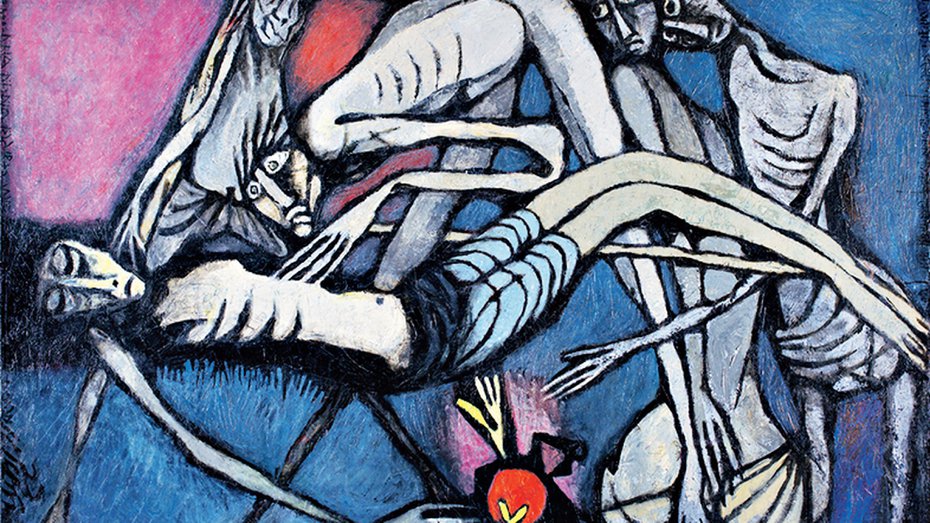
There are some splendid Early Bengal oil paintings of deities, but the Kalighat pats are of uneven quality. The Santiniketan section had a huge lacuna: no K.G. Subramanyan. Of late, 32 new works have been added, two by Subramanyan. The most moving is the section on the Bengal famine with Chittaprosad, Zainul Abedin, Paritosh Sen, Somnath Hore, Quamrul Hassan and Gobardhan Ash, and a large Ramkinkar oil.

The exhibition allows almost forgotten Calcutta Modernists like Prokash Karmakar (picture: Assassinated, 1966), Nikhil Biswas, Dharmanarayan Dasgupta, Bijan Choudhury, Rabin Mondal and Paritosh Sen to reclaim their rightful place in art history by revealing them in their full glory. Yet, women artists are given short shrift. Sunayani Debi, Meera Mukherjee and Mrinalini Mukherjee are there, but where are Arpita Singh, Anjolie Ela Menon and Jayashree Charavarty? Didn’t they deserve to be here?

source: http://www.telegraphindia.com / The Telegraph, online edition / Home> Arts / by Soumitra Das / April 04th, 2020

Jamsetjee Framjee Madon — a pioneer of Indian cinema and champion of Calcutta’s poor Parsis

In Pioneering Parsis of Calcutta, Prochy N. Mehta chronicles the little-known lives of the first Parsis who came to the city during British rule.

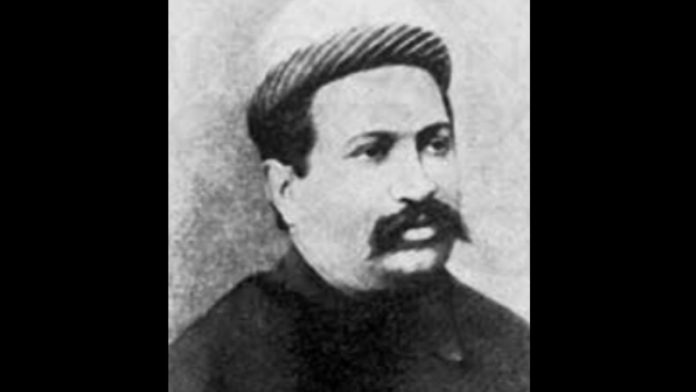
Jamsetjee Framjee Madon | Niyogi Books | Prochy N. Mehta


Jamsetjee Framjee Madon was one of the pioneers of Indian cinema. He owned over 120 cinema halls at one time. Jamsetjee was very modern in his outlook and a reformist in his religious views. He was one of the first trustees of the Late Ervad D.B. Mehta’s Zoroastrian Anjuman Atash Adaran and was a supporter of the young Bella, to whom he left Rs 5,000 in his will to help her in her legal case. 

Jamsetjee Framjee Madon was born on 27 April 1856 in a very poor family in Bombay. The family being truly indigent, he had to seek employment at the tender age of twelve as a scene-shifter in the dramatic company of Cooverji Ratanji Nazir, at a salary of Rs 4 per month. The young lad got enamoured of the stage, copying the roles of the heroes and heroines of the plays and later playing small roles on stage. Since he had a good voice, he could act the part of a courtesan and became quite popular. 

He then joined Elphinstone Natak Company which toured the country and in 1875, on an auspicious day, he came to Calcutta with this touring company. Some time later he took over this company in partnership with a few others. This company prospered, thanks to his experience, far-sightedness and hard work, and made Calcutta its permanent home. Simultaneously he started dealing in auctioned goods and in 1885 started another business as wines and provision merchant at 5, Dharamtalla Street. His honesty, perseverance and gentle nature soon attracted important Indian customers and the shop became extremely popular among government officers and Englishmen. There were seven branches of this store including those at Calcutta, Darjeeling, Lucknow and Delhi. 

In 1903, at the time of the British invasion of Tibet, Jamsetjee opened food and provision stores all the way from Siliguri to Chumbi and assisted the armed forces in supplying food and provision to soldiers even at great personal risk. The British officers greatly appreciated Madon’s fortitude and bravery as a result of which Jamsetjee was given a large contract of supplying the army during the wars in Kabul. He carried out his work at great risk and in significantly difficult circumstances, to the utmost satisfaction of the military officers. In appreciation of these services, the British Government awarded him the Order of the British Empire in 1918.

On 30 March 1919, the Calcutta Parsis felicitated Jamsetjee at a function under the chairmanship of the trustee of the Anjuman, Seth Edulji Pestonji Guzdar. Madon Seth was congratulated on obtaining the Order of the British Empire and praised for his simple life, gentle nature, honesty and kindness and for his munificence towards the poor. 

Seth Jamsetjee, like the other Parsi elders of the community, had a generous nature and was always anxious to assist the needy. Having grown up in poverty he felt for the poor and gave employment to many poor Parsi youngsters in his cinemas and shops. He was thus responsible for the livelihood of a large number of Parsi families. Many of his charities were done secretly and it can be truly said of him that his left hand was not aware of what his right hand gave away. It was estimated that such secret handouts averaged Rs 5,000 every month. This help was not restricted to Parsis exclusively; all the needy benefitted from his charity, irrespective of caste or creed. Many institutions of public welfare owed their existence and prosperity to him. 

In 1907 Seth Jamsetjee took up the mission of building a second Tower of Silence in Calcutta. Starting a subscription list with his personal donation of Rs 5,000, he went from house to house and managed to collect a lakh of rupees from the Calcutta Parsis. It was due to his influence that the municipality gave a grant of Rs 27,000 towards the purchase of land for this second Tower of Silence, and he personally bore the expenses of Rs 20,000 towards building it. Seth Madon’s efforts and far-sightedness resulted in bringing together the priests of the Kadimi and Shahanshai sections for the first time in Calcutta. The Kadimi priests performed the religious rites at the time of the foundation and the Shahanshai priests performed the consecration rites. 


In 1912, at the time of the building of the Mehta fire temple, Seth Jamsetjee provided his devoted services. The building attached to the fire temple used as a residence for the priests was built and donated by him and his family to the Atash Adaran. He presented several chandeliers, lamps and carpets for the main prayer hall and also many tables, chairs, large cooking utensils for general use. This generous-hearted Parsi also had the foresight to start funds with initial personal donations to take care of the future maintenance of the Atash Adaran.

Seth Jamsetjee was deeply sympathetic towards the poor Parsi families in Calcutta. In Dharamtalla Street he built Khorshed Madan Mansion at an expense of Rs 1,10,176 in memory of his beloved daughter, Mrs Khorshed Rustomji Maneckji Mehta, who had died on 14 January 1920 during the lifetime of her parents. Seth Jamsetjee donated this house to the Anjuman on the understanding that the flats be rented out to the poor and middle-class Parsi families of Calcutta at a low rent. Further he set aside a sizeable fund for the maintenance of this building. 

He also secured the land for the ‘aramgah’ for the Parsis in Darjeeling and donated funds towards its maintenance. On several occasions he gave donations to the Anjuman on behalf of his friends and relations. Seth Jamsetjee organised several ‘benefit nights’ in many of his cinema houses to collect funds for charities for Parsis as well as other communities. 

In 1923, the British Government honoured him with the award of Commander of the Order of the British Empire in recognition of his many cosmopolitan charities. 

About twenty years prior to the advent of cinema on a commercial basis in India, Seth Jamsetjee experimented with this new media and perfected it for public viewing. He was truly a pioneer of the cinema industry in India. 

The young lad of twelve, who started his career as a scene-shifter at a salary of Rs 4 per month, aided by some lucky turn of events and greatly due to his own inherent ability, perseverance and hard labour, became, in the evening of his life, the owner of a hundred cinema houses in India. Seth Jamsetjee’s life is a shining example of Parsi adventure and philanthropy. Upon his death which took place in Calcutta on roz 22 Govad, Mah 10 Dae, Year 1292 y.z., corresponding to 28 June 1923, Calcutta lost a true benefactor of the poor. 

This excerpt from Pioneering Parsis of Calcutta by Prochy N. Mehta has been published with permission from Niyogi Books.

source: http://www.theprint.in / The Print / Home> Page Turner> Book Excerpts / by Prochy N. Mehta / April 04th, 2020

Nabaneeta Dev Sen passes away

Dev Sen had announced she was suffering from cancer

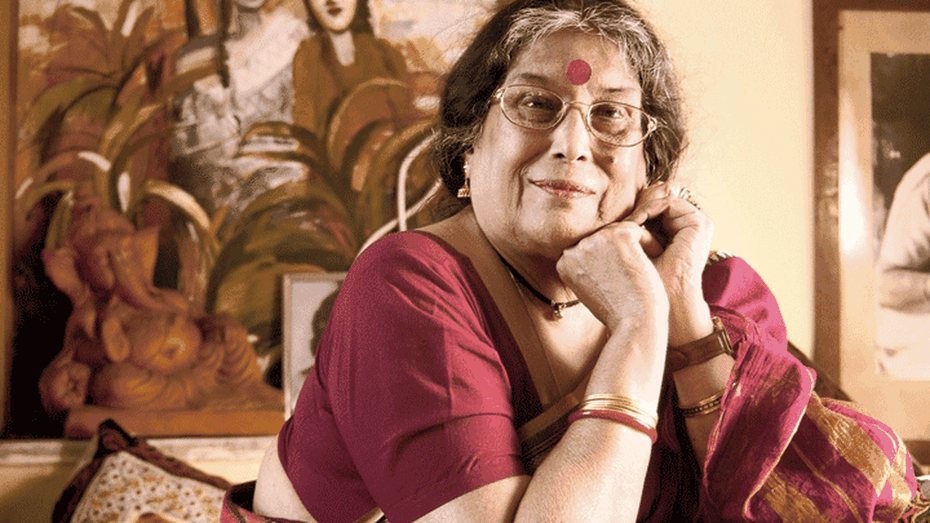
Nabaneeta Dev Sen / Telegraph picture

Nabaneeta Dev Sen, poet, novelist and academic, breathed her last at her south Calcutta home on Thursday evening. She was 81.

Dev Sen had announced she was suffering from cancer.

Her spontaneity, unique style of expression, vast and varied experience of life are evident in her poems, short stories, novels, plays, travelogues, literary criticism, essays and works of children’s literature. Some of her well-known works are Bama-bodhini, Nati Nabanita, Srestha Kabita and Sita Theke Suru.

Her Radhakrishnan Memorial Lecture series at Oxford University, a pioneering work on The Ramayana seen from women’s viewpoint, in 1997 started a new school of studies on Sita across the world.

Dev Sen is survived by her daughters Antara and Nandana, from her marriage of 17 years to economist Amartya Sen. Her last rites would be performed on Friday, before which she would be taken to Jadavpur University, a family friend said.

The daughter of the poet-couple Narendra Dev and Radharani Devi, Dev Sen grew up in a literary milieu and graduated from Presidency College. She received her masters degree from JU in 1958, where she later taught in the comparative literature department till her retirement in 2002.

She was also an alumna of Harvard University, from where she took a masters with distinction, and of Indiana University, where she did her PhD. She then completed her post-doctoral research at the University of California in Berkeley and Newnham College, Cambridge University.

The recipient of the Padma Shri and the Sahitya Akademi award was a polyglot, reading Hindi, French, German and Sanskrit among other languages.

A friend of over 50 years, author Sirshendu Mukherjee reminisced: “She had an unbelievable sense of humour and spontaneity. So infinite was her vitality that sitting next to her was like sitting by a dynamo. She had a lot of health issues, always going around with an inhaler. Yet nothing seemed to touch her. She was without fear and beyond prejudices.”

Lauding both her poetry and prose, Mukherjee said he had lost “a favourite author”. “She may not have written for children as much but what she has written is amazing. She also spoke up for a definite place for women in society through her work.”

Chief minister Mamata Banerjee expressed grief over Dev Sen’s death. “Saddened at the passing away of noted litterateur and academic Nabaneeta Dev Sen. A recipient of several awards, her absence will be felt by her myriad students and well-wishers. My condolences to her family and admirers,” Mamata tweeted.

Her last photographs made public were with Abhijit Vinayak Banerjee, when the economist came to meet her at her home Bhalo-Basha on October 23 during his brief sojourn to Calcutta after winning the Nobel Prize.

That photograph of her smiling radiantly through an oxygen tube attached to her nostrils will endure.

source: http://www.telegraphindia.com / The Telegraph, Online edition / by Special Correspondent in Calcutta / November 08th, 2019

Kolkata-born Miss England helps raise funds for city’s children in UK

The Hope Foundation was founded in 1999 by Irish humanitarian Maureen Forrest to provide protection and safety to 14 young girls in Kolkata who were forced to survive on the streets.

Miss England 2019 Bhasha Mukherjee (Photo | Instagram)

World :

Indian-origin Miss England 2019 Bhasha Mukherjee helped raise funds for a UK charity working with street-connected and slum children in Kolkata as part of her beauty with a purpose mission.

Mukherjee, a doctor by profession who spent her childhood in Kolkata, took time out from preparations for the Miss World contest next month to join the Hope Foundation’s annual fundraiser in London on Friday night.

The evening raised over 20,000 pounds for the charity through ticket and auction sales and also received several pledges to sponsor children in India.

“I think it’s destiny that brings people together. I am from Kolkata, so Hope Foundation is very special to me,” said the 23-year-old, who moved to UK as a nine-year-old and is currently employed as a junior doctor in Lincolnshire, eastern England.

“Hope isn’t just about the children of Kolkata, it’s about children all over the world as well. And, my beauty with a purpose project is health education, which I am very passionate about as a doctor.

“I want to take this platform of Miss England and empower people to take control of their own health and stay well in the community,” she said.

The Hope Foundation was founded in 1999 by Irish humanitarian Maureen Forrest to provide protection and safety to 14 young girls in Kolkata who were forced to survive on the streets.

It has since grown from just one protection home to 12 homes and also operates a range of other outreach work, which has impacted the lives of millions who reside in Kolkata’s slums and on the city’s streets.

“I suppose it was my dream, and is my dream, to live in a world where it would never hurt to be a child.

“Our legacy will not be the buildings we have left there (Kolkata), but the thousands of children that we have introduced to education, these children are in turn breaking the cycle of poverty,” said Forrest, honorary director of the foundation.

The fundraiser, which was backed by historic India-connected tea brand Britannia and UK fitness retailer DW Sports, raised nearly 9,000 pounds through an auction of lots including a holiday to India and signed sports memorabilia.

The rest of the profits raised are also intended to go towards implementing the work of the foundation, which has offices in the UK, Ireland, US as well as India.

“This evening is not just about celebrating the great part that Hope (Foundation) plays in the lives of these street-connected children.

“It’s also about the inspiration that these children provide us so that we can endeavour to make changes to their lives, said Reza Beyad, London-based entrepreneur and the foundation’s UK ambassador.

“Hope offers, through its various programmes, opportunities for these kids to step out of the social bubble created for them by injustices in society,” he said.

source : http://www.newindianexpress.com / The New Indian Express / Home> World / by Press Trust of India / October 06th, 2019

Time stops at Trincas, as it celebrates its 60th birthday this weekend

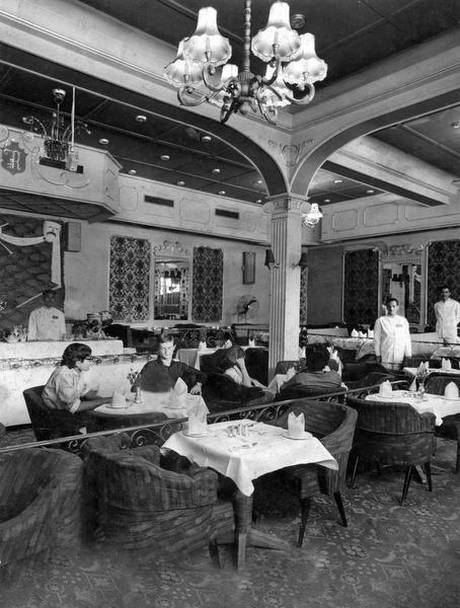
“It was a magical time: gentlemen in suits and ties and ladies in evening gowns, all decked up to eat, drink, dance and sing-along. In the 1970s and ‘80s, Trincas was dominated by the Anglo-Indians. It definitely is Calcutta’s most nostalgic location.”

Usha Uthup has more reason than most to be nostalgic about the iconic restaurant and performance venue — her maiden performance at Trincas was what made her the darling of the city, and eventually the country.

Trincas, one of Kolkata’s most iconic venues for a family evening out, is celebrating its 60th birthday this weekend. It was established by a Swiss man, remembered today only as Mr. Trinca, back in the 1930s as a bakery and tea house, but was taken over by Ellias Joshua and Om Prakash Puri in 1959, then shutdown for extensive renovations before reopening in 1961. Famous for live music performances, fresh food and a wide range of drinks at the bar, it became Park Street’s main attraction.

Celebrating music

The Puris eventually innovated again, sectioning off a third of the floorspace to make a quiet area and pioneering Szechuan cuisine in the city in the newly christened ‘Ming Room’. But what Trincas has been known for most, are its legendary live music performances. Carlton Kitto, an Anglo-Indian jazz guitarist, was followed quickly by Usha Uthup, whose maiden performance at Trincas was in 1969. Returning to headline the Diamond Jubilee celebrations over three days, October 27, 28 and 29, Uthup recalls her four decades at Trincas — “The people and their dress have changed, Trincas has not. It’s the same great music, good food and drinks and people enjoying themselves”.

Uthup found her way to Trincas after she began her career in the erstwhile Bombay at the Talk of the Town bar, now known as Not Just Jazz By The Bay. Her father was Vaidyanath Someshwar Sami Iyer, so returning to Madras’ Mount Road to perform in the basement of what used to be the Safire theatre complex in a club called Nine Gems, was homecoming for her.

Cornel Bloud, the lead guitarist and occasional singer who has been gracing Trincas’ stage just about every night for the last 25 years, also has fond memories. “The crowd has changed a lot, we don’t see many older people like we used to, now it’s mainly younger people coming to relax with their friends, but they all come to enjoy themselves. Trincas is a brand: time will pass but people know to come here for a good evening out with their families.”

Today’s customers are far more relaxed, jeans and T-shirts have replaced suits and dresses, save for the handful who have been stalwarts for decades. Office goers throng the restaurant on weekdays, while those seeking an alternative to the thumping bars and nightclubs of the city come to Trincas to listen to the Eagles and other classics that walk them through the 1960s, ’70s and ’80s. Weekends see the wooden dance floor in front of the stage cleared for those who can jive, twist and waltz — often gracefully, sometimes not so. Sing-alongs are also popular, with the band and lead singers frequently taking song requests scribbled on napkins.

Om Prakash Puri’s grandson Anand, having spent decades running similar establishments in Mumbai and Delhi, has now returned to the family business with a keen eye on keeping pace with changing customers. Tall with a managerial presence, Anand sits across the table from me narrating his plans for the coming decades. He coordinates the waiters with an easy flick of the wrist or tap of a finger. “I’ve seen Cal change. It’s not the sleepy town it used to be, so many venues for live music, ranging from rock to indie, have popped up everywhere. I see writers, poets, musicians all over the city. I need to let them know Trincas is for them too, while not altering where Trincas has come from.”

Anand’s calm exterior hides myriad plans milling about on a war footing below the surface. He is setting about replacing the flowery curtains with the old, blood-red velvet drapes, tied back with old-fashioned thick ropes. Old pictures telling the story of the restaurant are going up, as are small red table lamps. His eyes dart around his family’s pride — “See the wall here?” — he points at a creamy space between speakers behind him.

“I’ve dug up some old photos for it. And there used to be a mirror here, I am going to get that back up, too.” The back of the stage has also gone back in time. “Do you remember the mirrors?” he asks me, and I nod. “Well, they too have gone. The old photos showed a red velvet sofa-backing type of backdrop, so I copied that and this is what we now have.”

While other live music bars and restaurants try their level best to keep up with rapidly changing times, Anand strikes a fine balance between taking Trincas even further back in time, and looking forward. As Trincas celebrates 60, a new generation of Puris are looking at 100.

source: http://www.thehindu.com / The Hindu / Home> Life & Style / by Anthony Khatchaturian / September 25th, 2019

Mini Europe by the Hooghly

Kolkata’s splendid history holds impressions of waves of European cultures

Kolkata :

Across the River Hooghly – a tributary of the River Ganges – one can still see signs of various European countries that had created their own unique areas, to facilitate trade through Calcutta’s Port. For those not too familiar with Bengal’s early history, a visit to the area is a real treat as one can see signs of the settlements of various European countries, along the banks of the Hooghly River.

The countries that settled here, creating their own spaces were Denmark, France, Holland and Portugal. As one drives along the riverside road, it is fascinating to see the structures that have survived over the years. The area occupied by the European settlement is the present Hooghly District. Fortunately, these countries have begun to appreciate the historical value of these old ruins. Denmark has recently restored a Tavern at Serampore and tourists now have a splendid place for a meal.

It was almost a century after the Portuguese adventurer Vasco da Gama landed on the western coast of India in 1498, that other European countries realised that they were losing out on trade with India. Soon the European settlements began inroads into Bengal, with the Hooghly being their main source of navigation. The first to create a settlement were the Portuguese who settled down at Bandel, long before the British made Calcutta their stronghold. They were soon followed by the Dutch in Chinsurah, the Danish in Serampore and the French in Chandannagar.

Across the River Hooghly – a tributary of the River Ganges (Photo: By Shona Adhikari) Image Credit: IANS

The Portuguese also built the first Christian church in Bengal in 1599.

In 1632, Mughal Emperor Shah Jahan attacked the Portuguese settlement and demolished their small fort and their church. The head of the Church, Father Joan De Cruz, was taken prisoner to Agra, where he was thrown in front of a ferocious elephant, who instead of trampling the priest, lifted him up and seated him on his back. Shah Jahan was so impressed that he freed the priest and provided free land for a new church.

Interestingly, such miraculous episodes continued. During another siege, Taigo, a local Christian, in a desperate bid to save the statue of Mary, dived into the Hooghly with it and was never seen again. However, on the day of the inauguration of the church, it was found on the river bank. Re-established, the statue came to be known as “Our Lady of the Happy Voyage”.

There is also a splendid Imambara worth seeing in Bandel. Designed by architect Keramtulla Khan, the two-storied building is centred round a rectangular courtyard, decorated with fountains and pools and has a sundial that is a great attraction. The structure has two 85-feet high towers with 152 stairs in each – one for men and the other for women. Built in the memory of the philanthropist Hazi Muhammad Mohsin, the structure took 20 years to build. The three-storied structure connecting the towers contains a clock at the top story. The lower rooms are said to contain splendid chandeliers, but are unfortunately out of bounds to the public.

The Dutch settlement ended in 1825, the Dutch fort of Gustava was demolished by the British and very little remains of the Dutch rule in Chinsura. The Dutch church was demolished in the 1980s, but the Dutch cemetery still stands containing an assortment of graves under the shade of ancient trees, with the oldest dating back to 1743.

It was after receiving Mughal Subedar Ibrahim Khan’s permission in 1673, that the French colony Chandannagar was established as a trading post on the right bank of the Hooghly River. Bengal was then a province of the Mughal Empire. The colony became a permanent French settlement in 1688 and in 1730, when Joseph Francis Dupleix was appointed governor of the city, its development included 2,000 new houses and a considerable amount of trade and commerce. For a short while, Chandannagar also became the main centre for European trade in Bengal.

Today, Chandannagar still boasts considerable French heritage.

The Strand is considered the most beautiful stretch of the Hooghly River. The tree-shaded promenade along the river is about 1km in length and 7 meters in width, and the area houses a number of French mansions. The Durgacharan Rakshit Ghat on the Strand is also an interesting mix of Indo- French architecture.

Also on the Strand is the Dupleix Palace Museum – one of the oldest museums of the region housing French antiques and period furniture. Just off the Strand is the Sacred Heart Church, dating back to 1884. It was designed by French architect Jacques Duchatz and has beautiful stained glass windows. A French colony till 1950, French is still taught as a third language in many of Chandannagore’s schools.

To make you aware that you are in French surroundings, there is the Chandannagar Gate constructed in 1937 to mark the Fall of the Bastille. Etched on stone is the slogan ‘Liberte, egalite, fraternite’ (Liberty Equality and Fraternity).

Serampore , the Danish Settlement, remained under Danish rule till 1845, after which the Danish Governor decided to sell it to the British East India Company. The Serampore college, remains well maintained with its grand facade. Danish missionary Carey along with Ward and Marshman, began the Serampore Mission Press and published the first Bengali translation of the Bible. They also launched the “Friends of India” newspaper. Another outstanding contribution was the installation of India’s first paper mill at Battala, set up by Marshman, which was powered by a steam engine.

The Baptist Mission Cemetery in Serampore contains the family graves of Carey, Ward and Marshman – three personalities whose immense contribution to literacy, cannot be disregarded. Between 1801 and 1832, the Serampore Mission Press printed 212,000 copies of books in 40 different languages.

IANS

source: http://www.gulfnews.com / Gulf News / Home> Asia> India / by Shona Adhikari / September 13th, 2019