Category Archives: Arts, Culture & Entertainment

Home is where the care is

Knock knock: medical services are being delivered on the doorstep for senior citizens living by themselves, reports Sudeshna Banerjee
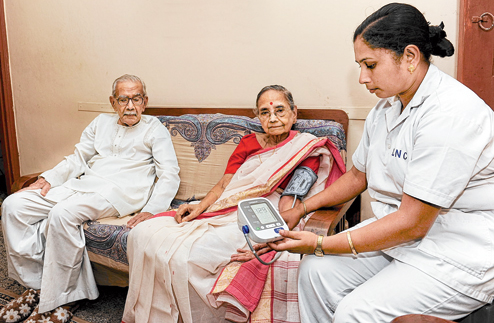
ChatterjeesKOLKATA06JUL2014

The Chatterjees of Jodhpur Park live on their own. The husband, a diabetic in his 70s, is recovering from a hip surgery. He has a nurse coming in every day to monitor his parameters and medicine intake, while a physiotherapist makes him do the mandatory exercises. A doctor drops by when the nurse flags for attention. His son, living away in the UK, does not have to depend on his weekly calls back home to find out how his father is doing. An emailed report reaches him every Saturday, with details of his medical status. It is not his mother who sends the mail but a homecare agency which he has engaged for his parents’ care. He can rest easy that they will take steps in case of a medical emergency as well.

With children flying the nest in search of career opportunities, the elderly in Calcutta are living alone at home in greater numbers. And to look after them, private agencies are coming up with far better management and accountability than the local nurse-ayah centres.

According to market analyst Frost & Sullivan, the Indian healthcare industry was valued at $79 billion in 2012 and is expected to reach $160 billion by 2017. The largest slice of the pie comprises healthcare delivery services.

“India has a 144 million geriatric population, second only to China. Fifty-one per cent of this number die of chronic diseases like cancer, diabetes and cardiac ailments. Because of advanced diagnostics, diseases are getting detected early and people are living longer. So there is a long period over which disease management is required,” said Ganesh Krishnan, co-founder and chairman of Portea Home Medical Care Services. In his estimate, the home healthcare market is worth about $2-4 billion and in the next 10 years the size of the industry would grow to over $15 billion in India.

The IIM Calcutta graduate, based in Bangalore, who calls himself a “serial entrepreneur”, detected this demand after selling off his last online venture, Tutorvista, in 2013 for $213million in what he says is the largest ever exit in the education sector in India.

Portea is already present in 18 cities, including Calcutta. “Seventy per cent hospital visits can be treated at home,” he said.

An NRI trio of Elina Dutta, Prateep Sen and Tamojit Dutta, along with a couple of friends, started Tribeca Care, a healthcare-at-home platform. They launched the facility in Calcutta last year with Prateep relocating to the city from the US. “We want to make it viable here before expanding to other cities,” said Elina, a former advertising professional who shuttles between Dubai and Calcutta.

Mission Arogya, an NGO which has set up the Kolkata Medical Emergency System website (www.kmes.in) with a Rockefeller Foundation centennial grant it won last year providing people with real-time data on ICCU bed availability in hospitals, is also venturing into this sector with Arogya Homecare Services, which will see a formal launch on August 1.

“We have started providing continuity of care for patients returning from hospitals. This way, patients need not overstay at hospitals, thereby raising their bills. Hospitals too can admit new patients if beds get vacated sooner,” said Mission Arogya co-founder Rajib Sengupta. Their second service in the pipeline is emergency retrieval. “We are tying up with institutions with advanced life support ambulances, which have ICU monitor and resuscitation kits, other than the usual oxygen and stretcher. We are training paramedical staff so that they can rush with an ambulance if a situation arises.”

Nurse with GPS-enabled device

And Calcuttans are ready to pay for such a service. “When we wanted to come here, everyone warned us that Calcutta is price-sensitive and price realisation would be lower. If you look at e-commerce figures for instance, the city lags behind even Chandigarh and Pune. But we have got the biggest response from here,” said Krishnan of Portea.

“It proves Calcuttans are ready to spend for what they perceive is important. Since it is usually the children who engage such services on behalf of parents, it shows family values and attachment are higher here than in other metros,” he added.

Perhaps the number of children having left home in search of jobs too.

What is novel about these companies is the professional approach they bring to a traditionally unorganised sector. “For every patient getting discharged from hospitals to our care, we appoint a care transition manager. He is responsible for setting up the infrastructure at the patient’s home — the bed, devices, oxygen cylinder… whatever his needs be,” said Tamojit Dutta.

Tribeca has divided the city into sectors and created a panel of 15 general physicians. “These days it is tough to make doctors come on call. Our empanelled doctors will do home visits for emergencies in their area,” Elina said.

Each of Portea’s health workers carries a GPS-enabled smartphone. “Thus we know how far he is from the patient’s home. We have developed an app by which the readings get recorded in our centralised database. If a patient’s blood sugar level, for example, is found to be high, the system issues an alert and the doctor in our headquarters has a discussion with the on-site health worker about remedial measures. The patient’s son sitting in the US gets to know that his mother’s sugar has been checked and the findings are sent via email and SMS,” said the Portea chairman.

Mission Arogya, which has a no-profit no-loss revenue model, wants to ensure that the service stays within the reach of the middle class as well. “Ours is a pay-for service model, not a subscription-based one. If a client wants us to scale up in any way, like use webcam and video conference to provide regular health updates to near and dear ones, we will do so,” says Sengupta, a Jadavpur University software engineer who is also pursuing research in bio-medical informatics at the University of Nebraska, Omaha.

Hospitals are largely welcoming of the development. “All these years we had no such service in Calcutta. People are at last thinking about it. With the number of patients with chronic illnesses on the rise, this is the answer,” said Arindam Kar, director, critical care, Medica Superspeciality Hospital, who has voluntarily trained a team of advanced nurse practitioners of the hospital to look after released patients at home for over two years now.

“This is a pay-for service and the patients are taken to the hospital if needed,” Kar added.

Each nurse is in charge of about five-six patients and is the one-point contact for all their medical needs. They instruct the ayahs engaged by the patients on duties like changing of oxygen cylinders, taking a call on whether a doctor needs to be called and facilitating appointments and blood sample collections.

Explaining why domiciliary disease management is beneficial to hospitals, he says the average realisation per occupied bed is far less for patients with chronic illness like Parkinson’s disease or bed sore than for those with acute illness requiring operation or investigations.

“After two days of stay in a hospital, if a patient with urinary tract infection is prescribed an antibiotic which has to be infused over an hour, he would find it taxing to stay back just for that. In such a case, it would suit both him and the hospital to have him treated at home,” Kar said.

Quality of caregivers

One problem area seems to be the lack of quality and accountability of the primary caregivers. At Tribeca, the senior-most nurses are direct employees of the company but the rest are sourced from nurse-ayah centres. “In the first batch of ayahs that we trained, a lot either left soon after or did not deliver,” Tamojit recalled. Tribeca Care tried out about 40-45 agencies from which the number of supply points has now been filtered down to 15. “We can’t handle a 300-strong ayah workforce. We’d rather have 30 nurses in our employ and work with agencies that we trust.”

But Portea does not believe in outsourcing. “We give the health workers a three-month training at a centralised location spending a lot of money. We can’t control quality unless they are our own people,” Krishnan said. The company has a 700-strong workforce across the country.

This lack of accountability has kept Mission Arogya from including ayahs in its portfolio of services. “Our nurse will teach the ayah engaged by patients how to take care of them, like changing the catheter,” said Sengupta.

Service bouquet

Elderly patients are asking for more. Mission Arogya will soon start delivering laboratory services and medicines to the doorstep. They will also take orders for medical equipment like medical mattress, Nimbus bed, bipap ventilation and insulin.

“We are trying to do dialysis at home but that will depend on logistics and location of the client,” said Sengupta. Portea also offers equipment on hire and pharmacy deliveries.

Tribeca Care is even devising a package that will include services of lawyers and accountants. “For the elderly, tax returns to groceries, everything is a problem. They are requesting for these services. We help with technology, too, like setting up Skype for clients to talk to relatives abroad,” Elina said.

“We even dabbled in property management as some clients needed help in disposing of property. We are also thinking of starting packaged tours for the elderly who are fit to travel,” said Prateep.
_________________________________________________________

HELP AT HAND

Portea Medical
3355 4554
E-mail: care@portea.com
Website: www.porteamedical.com

Tribeca Care
4027 7777
E-mail: enquiry@tribecacare.com
Website: www.tribecacare.com

Arogya Homecare
2436 1080, 8334880900
E-mail: contactus@missionarogya.org
Website: www.missionarogya.org

What other services do senior citizens require at home? Tell ttmetro@abpmail.com
___________________________________________________________
source: http://www.telegraphindia.com / The Telegraph, Calcutta / Home> Front Page> Calcultta> Story / by Sudeshna Banerjee / Sunday – July 06th, 2014

Bitten by travel bug, rickshawpuller on solo expedition from Kolkata to Ladakh

SUMMARY
Das way back in 2008 had gone all the way to Rohtang Pass in a rickshaw with his wife and daughter.
_____________________________________________________________

A rickshawpuller has set out on a daring 3,000-km expedition from Kolkata to the famous Khardung La pass in Ladakh, which has one of the world’s highest motorable road.

Forty-year-old Satyen Das, who ferries commuters at Naktala in south Kolkata, marshalled his personal savings and generous donations from local people, packed his luggage under the passenger’s seat of his refurbished rickshaw and started on his one-of-a-kind journey last month.

“I make a living on my rickshaw and spend my whole day with this, so I could not leave it behind when I started to dream about my trip to Ladakh,” Das said.

He has already reached Uttar Pradesh from where he will go to Srinagar and reach Ladakh after crossing Kargil next month. “I want to spread the message of world peace with this journey and also I want to promote rickshaw as a cheap and eco-friendly mode of transport,” he said.

Expecting to complete the expedition within five months, he is also eyeing an entry into the Guinness Book of World Records for his feat.

Bitten by travel bug, Das way back in 2008 had gone all the way to Rohtang Pass in Himachal Pradesh in a rickshaw with his wife and daughter. But this time the target is higher and he is travelling alone.

“He has this addiction of travelling in the Himalayas and going to far-off places,” said Partho Dey, secretary of Naktala Agrani Club, who helped him with funds.

Das modified his rickety old rickshaw with additional brakes and new body made of light steel at a total cost of Rs 15,000. In a day, he pedals to cover around 40-50 km and for makes night halts at religious places where he can stay for free.

Having only elementary education, the rickshawpuller said the unique road trip is also a great learning experience as he gets to understand the culture and diversity of India by criss-crossing different states, cities, towns and villages.

“My first task in the morning is to go to the local police station and take permission to move ahead. So far I have been getting it easily,” Das said. He is armed with maps to find his way to his next stop and a digital camera to document his special journey.

The club members are taking care of his wife and daughter, whom he left back home.

“We estimate that the trip would cost around Rs 80,000, which we have raised it amongst ourselves after we saw his passion and determination to travel,” Dey said adding that they have have given him an ATM card to withdraw cash as and when required.

source: http://www.indianexpress.com / The Indian Express / Home> Cities> Kolkata / by Press Trust of India / Kolkata – July 04th, 2014

Snow leopard, red panda get new conservation centre in Darjeeling

SUMMARY
At present, the zoo has 14 snow leopards and 17 red pandas. It is the first Asian Zoo to have started captive breeding of snow leopards.
_______________________________________________________________

To reintroduce captive-bred endangered animals like red panda and snow leopard into the wild, the Darjeeling zoo has now started a new breeding conservation centre for wildlife.

Built in an area of five hectares inside the zoo, the centre hosts three pairs of snow leopards and two pairs of red panda, the Padmaja Naidu Himalayan Zoological Park director, A K Jha, said.

“As per the guidelines of the Central Zoo Authority, our main objective would be to ensure a safe and healthy transition of captive-bred animals from the zoo to the wild. This new centre with all the required facilities will help us achieve that,” he said.

In the years 2003 and 2004, they had released four red pandas, born under captivity, into the wild. Two of them, however, died later on for not being able to take the pressure of jungle.
“Our resources were limited that time, but now we have guidelines from IUCN and CZA. We are also doing our own feasibility study before we restart the process. We are very cautious this time,” the zoo director said.

Although snow leopards have been born under captivity here since 1989, yet none have been released into the wild so far. The official said they should be able to release red pandas into the wild in the next 1-2 years, but the snow leopards would take around 4-5 years.

Two female cubs were recently born to a snow leopard brought from Czech Republic.

“Releasing them into the wild will take time. We will have to train them to be able to hunt food in a forest,” Jha said, adding that they would also have to find a proper habitat which the species can adopt as their new home.

At present, the zoo has 14 snow leopards and 17 red pandas. It is the first Asian Zoo to have started captive breeding of snow leopards.

An endangered species, snow leopards are found in higher altitudes of the Himalayas and are hunted for their valuable fur.
A joint initiative of both the state and central government, the Darjeeling zoo is also conducting conservation programmes for other endangered Himalayan species like Tibetan wolf, Himalayan salamander, etc.

source: http://www.indianexpress.com / The Indian Express / Home> Cities> Kolkata / by Press Trust of India / Kolkata – June 27th, 2014

Khaled’s role in setting stage hailed

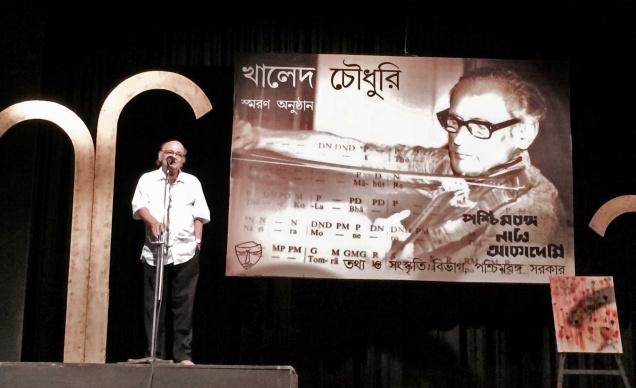
World is a stage: Theatre personality Manoj Mitra talks about his association with Khaled Chowdhury at a condolence meeting in Kolkata recently. Photo: Kathakali Nandi / The Hindu

Khaled Chowdhury was a stage designer who had worked with Shambhu Mitra, Ajitesh Bandopadhyay, Tripti Mitra, Meghnad Bhattacharya, and Manoj Mitra

Theatre personalities congregated on Saturday evening to reminisce the role of Chiroranjan Dutta Chowdhury and his prolific works at a city auditorium.

Known to the world as Khaled Chowdhury, he passed away on April 30 this year after a prolonged illness at the age of 95. The stage designer had worked with eminent Bengali theatre personalities like Shambhu Mitra, Ajitesh Bandopadhyay, Tripti Mitra, Meghnad Bhattacharya, and Manoj Mitra.

Mr. Chowdhury was first entrusted with designing the stage for Raktakarabi written by Rabindranath Tagore and directed by Manoj Mitra in 1954.

From then on, there was no looking back for him. Some of his famous works include working for the sets of Putul Khela, Pagla Ghora, Ebong Indrajit, Dakghar, Gudia Ghar, Sarhad Par Manto and Badnam Manto, Alakanandar Putrokanya, and Mudra Rakshas.

According to Mr. Chowdhury, designing a set was not just the mere arrangement of props on stage. He believed in innovating sets and props, and blending them with artistic flavours.

Born in a village in Assam in 1919, he lost his mother when he was nine years old. His relationship with his father was stormy, often forcing him to run away from home. He ran away to Sylhet, Bangladesh, in 1936.

However, he returned to India in 1943 and settled in Kolkata on the advice of novelist Tarasankar Bandopadhyay.

“Mr. Chowdhury was a man of very firm ideals. As a result, he let go of many awards as he felt they were against his policies. He had strong opinions and refused to budge from them. This led to him being misunderstood as an arrogant person. But those close to him knew his true nature,” veteran theatre personality Manoj Mitra said.

Apart from stage designing, Mr. Chowdhury had designed almost 4,500 book covers and folders for various theatre groups.

He also took interest in music and had composed several songs on the lines of folk music.

Pradip Dutta, one of his close aides, rued the lack of documentary preservation of Mr. Chowdhury’s works.

source: http://www.thehindu.com / The Hindu / Home> News> Cities> Kolkata / by Kathakali Nandi / Kolkata – July 01st, 2014

World tour for Hooghly’s bamboo pandal

Kolkata :

A Kartik Puja pandal that a city-based architect had created for a local club in Bansberia, Hooghly, has caught the attention of a prestigious museum in the US. The pandal will now be showcased in six cities across the world as part of a travelling exhibition on megacities.

The Kartik Puja pandal at Bansberia

The Museum of Modern Art (MoMA) in New York City, considered among the most influential museum of modern art in the world, has acquired the publication rights of the image of the bamboo temple pavilion that architect Abin Chaudhuri had created in Bansberia. The colourful installation will feature in MoMA’s upcoming publication and exhibition titled ‘Uneven Growth: Tactical Urbanism for Expanding Megacities’.

The exhibition explores new architectural possibilities to address rapid and uneven growth around the globe and will be on view at MoMA, New York from November 2014 to May 2015. The exhibition will also travel to Mumbai, Rio de Janeiro, Istanbul, Hong Kong and Lagos.

Chaudhuri, whose design studio has created landmark buildings like the International Management Institute in Kolkata and IMI Bhubaneswar, School of Planning and Architecture in Bhopal and Kazi Nazrul Museum or Nazrul Tirtha in New Town, is delighted at the honour. “The selection of our work by MoMA for its prestigious publication came to us as a pleasant surprise. Being showcased in its exhibition or in the publication is a dream come true for the contemporary architect and artist fraternity,” remarked the principal and design director of Abin Design Studio (ADS).

The bamboo pavilion had earlier won the Black Elephant award indicating the ‘best of show’ entry at the first edition of the 2013 Kyoorius Awards in Goa. In the UK, the pavilion was in the top-five best installation art at the Apex award.

What had impressed the award juries and officials at MoMA is the thought that went into creating a pandal with locally available materials that would not only create an attractive pavilion but also be useful thereafter.

In fact, it was the need to fence a football field that led to the selection of bamboo poles as material of choice for the pandal. Kartik Puja is celebrated with fanfare in Bansberia.

“We run a small football camp at Bansberia. Every monsoon, water would flood the field and then cows and buffaloes would trample and damage the soft ground. Fencing is an expensive affair. So we decided to use bamboo for pavilion so that they can later be used to fence the ground,” Chaudhuri explained.

source: http://www.timesofindia.indiatimes.com / The Times of India / Home> City> Kolkata / TNN / July 01st, 2014