Category Archives: Arts, Culture & Entertainment

Case Diaries – The mysterious case of the three iron chests

SUDHITI NASKAR / AGENCY GENESIS

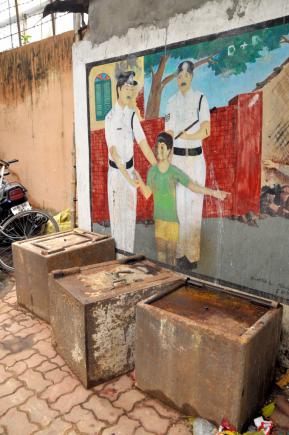
In 2007, three iron chests were dug up from 178 Rashbehari Avenue in Kolkata. They were kept at the Gariahat police station while their ownership was disputed.

On a sultry Monday afternoon in mid June this year, a group of about three hundred people—journalists, photographers and locals—crowded around the police station in Gariahat, in south Kolkata.

When Umesh, the istriwala, who presses police uniforms in his small shanty adjacent to the thana, stepped out to get a better look at the scene, he saw that the top of the thana’s high boundary wall had been fitted with bamboo poles, between which was strung a cloth screen. He told me that a few intrepid journalists and locals had climbed up on nearby trees to see what was going on inside, while others peeked through a side gate.

The focus of everyone’s interest was three iron chests that were inside the compound. The chests had been unearthed a few years earlier from a plot on Rashbehari Avenue that was being excavated for construction. Since then, speculation had grown about their contents, whetted, perhaps, by recent treasure hunts—both successful, such as at the Sree Padmanabhaswamy temple in Kerala in 2011, and comically unsuccessful, such as at Unnao, Uttar Pradesh, last year, launched on the promise of a godman’s dream. True, the Rashbehari chests were old and rusty, but who could say what they might contain? Murmurs of gold and hidden treasure filled the air, drawing more people to the scene. Officers from the Archeological Survey of India and Geological Survey of India supervised the opening of the chests, along with about fifty policemen.

The scene had been equally chaotic on 24 June 2007, the day the three chests were found. Constable Sudip Nayek recounted to me that he had been on patrol that morning, when he came upon construction workers unearthing a chest from plot 178 on Rashbehari Avenue. Nayek promptly informed his superiors at the station, and the police came out to the site. As a crowd gathered, police cordoned off the area. Over the course of the day, two more chests—each chest weighed around 100 kilograms—were dug up and lifted out with a crane.

The Indian Treasure Trove Act, 1878 defines treasure as “anything of any value hidden in the soil, or in anything affixed thereto,” and directs any such treasure worth more than Rs 10 to be handed over to the government. Thus, the chests became government property. Nevertheless, there were claimants to the chests, though their contents were unknown. Mahamaya Pal, a homemaker in her sixties, had recently sold the Rashbehari plot to a Kolkata-based shoe company called Sreeleathers, which had been excavating it. Both Sreeleathers and Mahamaya Pal staked their claim on the chests and were soon embroiled in a legal battle at the Alipore Civil Court.

After a long but inconclusive case that lasted for seven years, in December 2013, the court ordered that the chests be cut open. There was speculation that there would be riches hidden within them, and even archaeologists were hopeful. “I am excited,” said Ashok Patel, superintending archaeologist, ASI, to the Indian Express. “The chests may have anything. I am sending some experts there.”

I met Mahamaya Pal at the Kalighat temple—a place she called her “own”—on a rain-soaked afternoon in late June. The chests had been opened earlier that month, but Pal still spoke of feeling a spiritual connection to them.
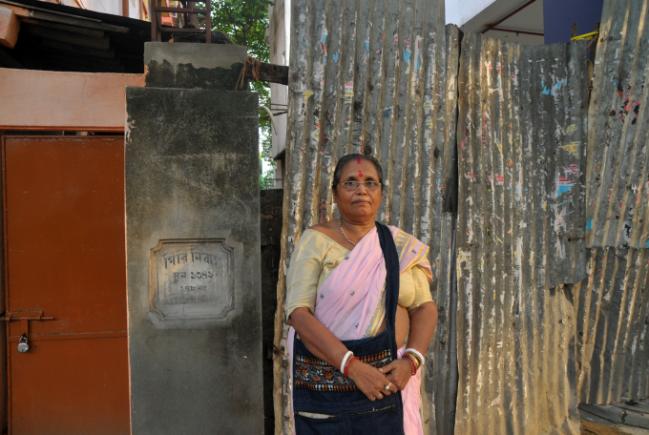
Mahamaya Pal, the former owner of 178 Rashbehari Avenue, who sold the plot to Sreeleathers, the company that discovered the chests.  / Sudhiti Naskar / Agency Genesis
Mahamaya Pal, the former owner of 178 Rashbehari Avenue, who sold the plot to Sreeleathers, the company that discovered the chests. / Sudhiti Naskar / Agency Genesis

“Nothing but the truth can be spoken in the temple,” she insisted. Her eyes glazed over as she described how, as a child, she had been told stories about Kali and other Hindu deities by her grandmother. Now she believed that the chests had been kept for her by the dark goddess herself. She said that after they were discovered, she had started getting “messages” from “another world” telling her that the treasure belonged to her. “This is all secret knowledge,” she whispered, her face twitching. “This is a mystery of the secret chests that belong to Ma Kali.” Her faith in this belief had been fanned by the astrologers and tantriks she has been frequenting for a few years. She told me that she had spent over one lakh rupees on the ownership case with Sreeleathers, a sixteenth of the sum she got from selling her plot.

Pal’s long wait had come to an end on 16 June, about seven years since the chests were found. That morning, she said a prayer at home, applied a tilak of sandalwood paste on her forehead for luck and went to the police station with her family and lawyer. She waited expectantly, watching the shower of sparks fly from the cutters as the fire brigade personnel laboured at the chests.

Both Pal and Sub-inspector Bireswar Roy, the officer in charge of the case, gave me a recap of the events of that morning. It took two hours for the first chest to be cut open. A diamond cutter was used instead of a gas cutter to protect the “precious” content from damage. But the eager crowd were in for a sore disappointment. Roy told me that the chests only contained a few handfuls of latch needles (used in knitting machines) in polythene bags; a letterhead, dated 1975, of a local business, the Sri Ramkrishna Hosiery Factory; a desktop calendar; four Rs 5 notes with Hindi writing on them; and a lone one paisa coin dated to 1953. One chest was completely empty. “What a waste of time!” a photographer said as he walked away from the scene.

Some bravely maintained that the exercise hadn’t been a waste of time—The Hindu quoted an unnamed ASI official saying, “These needles were made in the 1970s. From them we will come to know how the textile industry functioned during that time. They may have some historic value.”

Roy believes that the location of the chests justified the excitement surrounding them. The plot was close to a Kali temple said to have belonged to “Roghu Dakat”—a famous dacoit—and around which there were rumours of human sacrifice and buried treasure. “There was a possibility that these chests contained jewellery or gold hoarded by the dacoit,” said Roy.

Though the contents of the chest were of little value, Roy still believes something about the situation doesn’t add up. After the outer iron casing of the chests was cut open, he said, the firemen found a layer of fire resistant clay. Within this was another iron casing that had to be cut through before the contents could be reached. “Why would someone put nothing of value inside those chests but take such great care to seal them impeccably?” Roy said.

Pal is equally mystified. “We never had any connection with a clothes business,” she said. “And none of my family members ever dealt with Ramakrishna Hosiery.” She was born in that same house on 178 Rashbehari Avenue to a family of traders and grocers, she said, and has been living there all her life. “The house is eighty years old,” she said. “It was built in 1935. How is a bill from 1975 buried in a chest underneath it without any of us knowing about it?”

source: http://www.caravanmagazine.com / The Caravan Magazine / Vantage> Web exclusives for the Caravan / Home> Case Diaries / by Sudhiti Naskar / July 17th, 2014
______________________________________________________________________
Sudhiti Naskar is a freelance journalist based in Kolkata. She likes to document people’s lives in moments of flux. She is regularly published in international magazines. She is currently represented by Agency Genesis.

University of Calcutta to confer a posthumous doctorate on Lithuanian traveller anthropologist Antanas Poska

Vilnius (Lithuania):

In a rare honour, the University of Calcutta has decided to confer a posthumous doctorate on one of the world’s greatest explorers – Lithuanian traveller anthropologist AntanasPoska.

In an exclusive interview to TOI, Lithuanian foreign minister Linas Linkevicius said that Poska – the man who undertook an incredible journey to India on a motor bike all the way from Vilnius in 1929 will be conferred the doctorate during the University’s next convocation ceremony around September.

Confirming this to TOI from Kolkata, the University vice chancellor Suranjan Das said Poska “symbolised an eastern European’s inquisitiveness about India” and was being conferred the doctorate “for his contribution in making India known to the outside world through his extensive writings”.

Das told TOI “Poska’s feat is unparalleled when it comes to popularising India in Europe. Poska also studied in the University of Calcutta. Developing a close relationship with Lithuania is a priority for the new Indian government and conferring the doctorate will help seal the friendship”.

Das said “We have formally confirmed the University’s plans to confer the doctorate on Poska. However, it has to be given by the governor of West Bengal who presides over our convocation. Since the earlier governor resigned recently and we are waiting for the chair to be filled, the date of the convocation is yet to be finalised. It could take place around September-October”.

Lithuania’s ambassador to India Laimonas Talat Kelpsa has plans to bring Poska’s daughter Laimute Kiseliene to Kolkata to receive the doctorate.

It was TOI who had unveiled the extraordinary tale of Poska and a never before known facet of his work – the first ever translations of Rabindranath Tagore’s works into the Lithuanian language.

TOI had dug out Laimute who is now professor of choreography and dance methodology at Lithuanian University of Education. She for the first time ever unveiled to TOI a set of three binded books with “Tagore” written on them and a small palm sized journal made from birch tree barks.

She had received it from a frail old woman who had showed up at her door one day with these manuscripts.

The handwriting on them was familiar – it was that of her father who had written them during his exile.

Post 1929, when Poska returned to Lithuania from an eight year long journey across the world, the Soviet government packed him off on an 18-year-long exile to Siberia “without any formal reason”.

The frail lady then told Laimute that her father had returned from India as one of the biggest admirers of Rabindranath Tagore.

He then translated some of the poet’s works into Lithuanian – the first ever for any Indian literature to be done in that country.

Lack of paper during the exile forced him to use birch tree barks to write on. He also wrote poetry during his exiled years, copying Tagore’s style.

He had then given the documents to the lady in confidence who then worked in a Soviet controlled publishing house.

He wanted them published but the government destroyed most of his works.

Poska also gave her a note that read “These translations are a small bit of light for all those in despair”.

The lady instantly realised that they were “great cultural heritage” and hence hid them from the Soviets.

After knowing Poska is now survived by a daughter, the old lady had landed up at Laimute’s door many years later to hand over the manuscripts.

In an exclusive interview to TOI, Laimute had said “I was amazed when I received these manuscripts. He was a great fan of India and I grew up listening to stories of Tagore and Gandhi. My father never told anyone about these translations. Tagore’s works made a great impact on my father and hence took great pains to translate them thinking it would help those under Soviet oppression to see hope. These are real treasures of cultural heritage”.

“I would gladly give them to any publisher who would publish the translations now. There is nobody in Lithuania to validate the translation,” Laimute who has never shown these manuscripts to anyone before, said.

She added “The dream of his life was to translate the Vedas to Lithuanian”.

One of the translated works “dated 1932 at Shantiniketan” that TOI saw read in the introduction “While being a guest of a great Indian poet. With his personal help, I have prepared a small present for Lithuanians. This is a pearl of Tagore’s work called Fruit Gathering”.

Laimute revealed that Poska and Tagore met twice during his stay in Kolkata.

Laimute said “While in Shantiniketan, he waited for three days to meet Tagore. My father later revealed that the first meeting between him and Tagore wasn’t warm. Only when Tagore learnt of his interest in India, his travels, he became interested in Poska. Poska had expressed interest to Tagore of translating his works – an offer Tagore didn’t like. Tagore supposedly told him he looked down upon foreign translators who he felt ‘made it a business to make money from his works'”.

Poska in his journals also had nice things to say about the people of Bengal.

“During his next visit to Bengal. Poska found the people to be as warm, kind and creative as Tagore’s stories,” Laimute said.

Poska met Laimute’s mother Maria while on exile.

Laimute was born in Petro Pavlovsk in Kazakystan in 1950. She was nine years old when the family finally returned to Lithuania from their exile.

“Poska was never told why he was being exiled by the Soviets. So when he was ever asked the question, he would jokingly say it is because he stole Stalin’s pipe. One of Poska’s close friends and linguists from Bengal professor Suniti Kumar Chatterji gifted him a photo of Tagore which he always carried with him,” Laimute who took to being a professor of dance after hearing her father’s stories on Indian dances, said.

Poska and his co-traveller Matas Šalcius set out for an incredible journey to India on a motorbike in 1929. Their ways parted in Iran and each of them reached India separately in

1930. While Šalcius traversed India and continued his journey east up to the Philippines, Poska stayed on in India for five years, studying at Bombay University, later at Calcutta University and working at the Anthropology Laboratory of the Indian Museum in Kolkata.

He devoted these years to the study of commonalities between Lithuanian language and Sanskrit, Indian Vedas and Lithuanian folklore, making friends among Indian intelligentsia and expressing his passionate support for Indian independence.

He was a passionate advocate of the Esperanto language – international language of peace that was created by Ludwik Zamenhoff of Lithuanian Jewish origin in the end of the 19th Colonial India.

During the Soviet occupation, Poska was arrested for being well travelled and knowledgeable about the world beyond the Iron Wall.

He was first sentenced to hard labour in Siberian gulags, later transferred to Central Asia.

In Osh (Kyrgyzstan), he discovered and described an unknown Palaeolithic settlement and rare fossils.

Laimute finally revealed “Matas Salcius didn’t know how to ride a book. So it was father who drove all the way through so many years of travel”.

source: http://www.timesofindia.indiatimes.com / The Times of India / Home> City> Kolkata / by Kounteya Sinha, TNN / July 18th, 2014

Kolkata NCC gets 2000 people to pledge their eyes by November

Kolkata :

National Cadet Corps (NCC) volunteers of the West Bengal and Sikkim Directorate have succeeded in getting 2,127 people to pledge their eyes over the last ten days. It is now their aim to motivate 100,000 people to pledge their eyes by NCC Day in November. This will be a record of sorts.

This plan was revealed by Major General Shyam Srivastava, additional director general, NCC, West Bengal and Sikkim Directorate, at a ceremony on Friday that was attended by NCC director general Lt Gen Aniruddha Chakravarty. The DG is on a maiden visit to this directorate and also visited IIT, Kharagpur, a couple of days ago where an advanced training course was being organized for cadets who wish to appear for civil services and other competitive examinations.

Lt Gen Chakravarty lauded the efforts of the NCC is the state and said that pledging of eyes is the ultimate donation that a person can make as it helps a visually challenged person see the world. Among those who pledged their eyes were the cadets, their family members and people at large. A cultural programme was organized by visually challenged youth from the Bhartendu Andh Ashram during the day. A presentation was also made to clear the myths associated with eye donation.

source: http://www.timesofindia.indiatimes.com / The Times of India / Home> City> Kolkata / by Jayanta Gupta, TNN / July 11th, 2014

Go-getter Bumbaiyya nurtures rugby dreams

Kolkata :

It’s probably apt that he has adopted the name Azad. Bumbaiyya, as he was known on the Howrah station platforms, has certainly broken free, thanks to a few well-wishers. Azad is now a strapping 20-year-old-youth, working in a glass factory in Odisha and looking after his widowed mother and sister. But things were not always this way for him. There was always the possibility of Bumbaiyya losing his way and ending up dead in some dirty gutter close to one of the busiest railway stations in the world.

Nobody seems to know what Bumbaiyya’s real name is. In 2004, when award-winning filmmaker Gerry Troyna was shooting at Howrah station for his BBC Four project ‘Monsoon Railway’, he came across the 10-year-old child and featured him in the documentary that won international acclaim.

“Bumbaiyya had apparently run away from home and turned up at the Howrah station. There, he collected used plastic bottles from the tracks and platforms. He also travelled a lot on trains, particularly those moving towards Mumbai. That is how he seems to have got the name ‘Bumbaiyya’. Gerry did not stop at featuring him in the film alone. He insisted that the boy start life afresh and seek shelter with an NGO in Kolkata. Bumbaiyya also came in touch with Mahindra Shinde, who is a former street child and part of Gerry’s crew now. He seems to have been inspired and actually adopted to the discipline involved in staying at the hostel run by the NGO. I would monitor his progress and Gerry would also keep in touch from wherever he was,” said Pallavi Biswas, a member of Troyna’s team.

It was at the hostel that Bumbaiyya adopted the name Azad. He took up studies and rugby. He was so good at the sport that Azad got selected to the national under-19 rugby team. “I played for the national side in several parts of the country. I also travelled abroad to countries like England and Thailand. By then, I had got in touch with my family in Odisha. Before I could sit for my Class X examinations, my father passed away and there was nobody to look after my mother and sister. I love rugby and would have loved to continue but had to start looking for a job to take care of them,” Azad said.

He believes that there is similar potential in other children who grow up on railway platforms. “They simply require a platform (not the railway kind) and some helping hands. They will certainly realize their potentials and grow up to be responsible adults,” Azad added.

Troyna doesn’t feel that he did anything out of the ordinary for the youngster. “I just opened a door for him. It was for him to take the opportunity. Today, when I watch this strapping young lad, I am proud. I am full of admiration. The films I make are not just entertainment. I believe that they must leave a positive effect. The people who agree to let us enter their lives must benefit in some way. I try to maintain a positive contribution and have never betrayed the trust of people, whether a beggar or a senior official. Azad loves rugby and is actually very good at it. I just hope he gets a job where he can continue to play the sport,” the 65-year-old filmmaker said.

source: http://www.timesofindia.indiatimes.com / The Times of India / Home> City> Kolkata / by Jayanta Gupta, TNN / July 12th, 2014

Businessman with green thumb turns sabziwallah for pleasure, not profit

ALL FOR THE LOVE OF FARMING

Pawan Khaitan packs the boot of his car with fresh produce to deliver to family and friends Pictures by Sanjoy Ghosh

Some watch movies, some play cards and some go salsa dancing. For businessman Pawan Khaitan, life after work is largely devoted to playing sabziwallah.

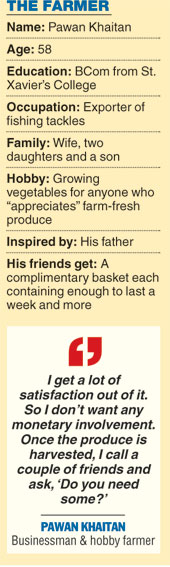
Khaitan, a 58-year-old resident of Lake Road, exports fishing tackles for a living and plays golf at leisure but nothing gives him more pleasure than getting his hands and feet dirty on his 40-cottah Rajpur farm and carrying back a carload of garden-fresh produce for family and friends.
FarmerKOLKATA11jul2014

“Different people get a kick out of different things. Some people go to a bar, spend a lot of money and get a kick out of drinking. Planting seeds and seeing them grow gives me a lot of happiness,” he says of his love of gardening, which he inherited from his father.

Khaitan has been involved in hobby farming for four decades, investing money, time and effort in it without ever expecting financial gain. “I get a lot of satisfaction out of it. So I don’t want any monetary involvement. Once the produce is harvested, I call a couple of friends and ask, ‘Do you need some?’ That’s my way of gauging whether they share my excitement,” smiles the businessman.

Pawan Khaitan works on his farm in Rajpur, South 24-Parganas /  Pictures by Sanjoy Ghosh
Pawan Khaitan works on his farm in Rajpur, South 24-Parganas / Pictures by Sanjoy Ghosh

He vividly recalls the day he told a chef at Taj Bengal about the different kinds of lettuce he grows on his farm and offered to send him a complimentary basket. “After receiving it, he and his general manager called back, offering me a year’s contract. I said no. I said I wouldn’t mind sending him a basket every Sunday but I won’t do business with this.”

Khaitan, who loves being on the RCGC green when not tending the greens in his garden, visits farms and agriculture fairs whenever he is touring. “From Delhi to Holland, there is something to learn everywhere because what grows in one place you might not find in another,” he smiles.

The businessman has reserved five hours every Sunday for his farm, “checking, watering, planting, instructing and harvesting the plants from start to finish”.

“I learnt how to cultivate vegetables from my father on his 80-cottah farm in Narendrapur,” he recalls. “Now there’s so much more information available, new technologies and reliable sources for seeds that I can bulk order online. Twenty years ago, we would depend on the para supplier or Chetla Haat and end up buying spurious seeds that would hardly sprout!”

This winter, Khaitan grew 13 varieties of lettuce alone. He is also fond of philodendrons (money plant), of which he has several species on his farm.

The most surprising thing about Khaitan’s hobby is that the bulk of the vegetable produce doesn’t go into his own kitchen. “Je ranna kore shey khaye na (the one who cooks doesn’t eat). I see these plants grow, so I don’t obsess about eating them. I give away the produce to friends, who appreciate it for what it is worth. That’s my way of being happy,” he says.

After every round of harvest, the produce is loaded in a van and taken to Khaitan’s Lake Road home, where he soaks the greens in ice-cold water. “I give them a cold bath with my own hands and put them in hibernation,” he says.

Khaitan then neatly arranges the produce in baskets layered with crushed ice, ready to be home delivered to members of his family and friends, “almost 20 of them”.

Even the Royal Calcutta Golf Club has benefited from having a green thumb like Khaitan among its members. It was while playing a round of golf at his club one day that the businessman realised the course didn’t have a flowerbed and proposed that there should be one. “I managed to trace a spot between tee numbers 9 and 11, collected flower seeds from my farm and planted them there.”

Voila! The RCGC course now has a flower patch, thanks to Khaitan. “I intend to get some summer flowers from my Delhi farm like sunflower and zinnia (for the course). I love nature. Even my business is linked to fishing. I interact with nature all the time,” smiles the businessman.

For the employees of his farm, Khaitan arranged a surprise feast of farm-fresh produce one day to show them how tasty a simple salad could be.

“I brought a big bottle of olive oil and balsamic vinegar to the farm and tossed some leaves in it and made a big salad platter for them to try,” he says.

Noorjahan Bibi, one of the workers, didn’t know what to expect but was pleasantly surprised by what was served. “At first, I thought what is this vegetable that we hadn’t grown before, let alone eat. Then, one day he organised a meal for 25 of us, including some neighbours, and we really enjoyed it. We have since learnt to prepare the soil with special manure for this type of lettuce and it seems quite easy now.”

Each winter, Khaitan grows vegetables different from the previous year’s mix. His next season is already planned — he intends growing varieties of spinach, greens and tomatoes that are not available in the market.

“I like to grow everything that you don’t get in the market. I plan to have six types of Italian spinach, six types of lettuce, six kinds of Chinese greens and different kinds of tomatoes, including Mexican and Spanish,” says Khaitan. “If I were to grow a flowering vegetable, it would take a long time to harvest. Leafy vegetables grow a lot faster. One can harvest in a month,” explains Khaitan, who also grows basil, celery, parsley and oregano.

His passion for farming doesn’t end there. Khaitan has printed a booklet containing traditional recipes to go with every kind of lettuce he has harvested this season.

So does he see more people taking up hobby farming like him to stay rooted to nature?

“Some years ago, there was a mass exodus from the villages to urban areas; now people are going back to the rural areas. It’s definitely happening in Delhi, Mumbai and south India, where people are setting up farms outside the city,” says Khaitan.

Do you know anyone like Pawan Khaitan. Tell ttmetro@abpmail.com

source: http://www.telegraphindia.com / The Telegraph, Calcutta / Front Page> Calcutta> Story / by Mohua Das / Monday – March 03rd, 2014

Ode to women who dared

They charmed audiences with their histrionics on stage and screen. Men sought their company and women envied their acting and singing skills. They didn’t care for the purdah and dared to defy social norms that prohibited women from stepping out in public. A tribute was paid to 10 actresses of Bengal who have left a lasting impression on the minds of audiences. Titled ‘Songstress’, the programme paid homage to Nati Binodini, Narisundari, Angoorbala, Kanan Debi and Keya Chakraborty among others. The programme weaved in storytelling by popular elocutionist Sujoy Prosad Chatterjee. Songs and dialogues from the plays and films in which they acted were performed.

Commenting on the actresses, an official of 40A Creative Studio that organized the homage said only those who also sang were chosen. Chatterjee also felicitated some prominent actresses of Bengali stage including legendary actress Chitra Sen and veterans like Dolly Basu, Anashua Majumder and Sohag Sen. Actresses Mumtaz Sorcar and Arunima, along with filmmakers Anindya Ghosh and Sekhar Das, were present at the programme.

Students’ tryst with Germany

Students of Birla High Schools Boys and Girls have completed a year-long exchange programme on a project with German partner school Amandus Abendroth Gymnasium in Cuxhaven, Germany. Ten students each from the boys and girls school and 20 from Amandus Adendroth Gymnasium started working on endangered species – mussels in Germany and tigers in India. Each student was hosted by the family of a German student and teachers were hosted by their German counterparts.

All the students worked on the project during school hours apart from attending some classes with their German partners in school. Various educational excursions were organized by the partner school during the stay – Klima Haus, University of Applied Sciences in Bremerhaven, Polar Haus (Alfred Wagner Institute) and Wadden Sea were visited. The entire group visited the mayor’s office where the students had a privilege to meet the mayor of Cuxhaven, Erika Fischer, and interact with her.

Nature in the city captured on lens

Young photographers aged between 16 and 18 years captured glimpses of nature and animals in Kolkata on their lens for a photography exhibition at Harrington Art Gallery. Rashbehari Centre for Ecological Movement (CEMO), an organization that has been spreading awareness on environmental issues for the past few years, held the exhibition on Friday and Saturday.

Students from leading city schools put on display around 40 photographs revolving around the theme ‘Nature-watch in Your Backyard’. The photograph taken by Tiyasa Mal, a student of Shri Shikshayatan School, featuring the flight of three birds in the sky, won the first prize. The second prize went to Kunal De of DPS Newtown for a tiger dragonfly’s photograph. Sweta Karmakar of National High School for Girls bagged the third prize for her excellent snap that featured a squirrel on the hunt for food. Dr Debal Sen, a cardiologist and amateur photographer, inspired the budding shutterbugs to play with light and shadow, striking a balance with their studies. Five members of the host organization exhibited some photographs on wildlife worth between Rs 2,000 and 5,000. “The money raised from the sale of these images will be donated to our organization,” said Purnima Dutt, a member of CEMO.

Show of Bengal tourism

The state tourism department organized a show at Eco Park in Rajarhat New Town to showcase Bengal’s tourism prospects. The venue was the glass house in the Eco island. More than 100 delegates from different parts of the country and also from abroad participated in the show. A presentation was given to the participants on how the tourism department was working towards developing tourism in the state. Hidco authorities handed over a special leaflet and a small souvenir to each of the delegates.

(Contributed by Prithvijit Mitra, Sarthak Ganguly, Jhimli Mukherjee Pandey & Suman Chakraborti. Compiled by Urmi Mukherjee. Photograph by Debobrata Shome)

source: http://www.timesofindia.indiatimes.com / The Times of India / Home> City> Kolkata / TNN / July 07th, 2014

Jyoti Basu remembered for bringing the struggle of peasants, workers to the fore

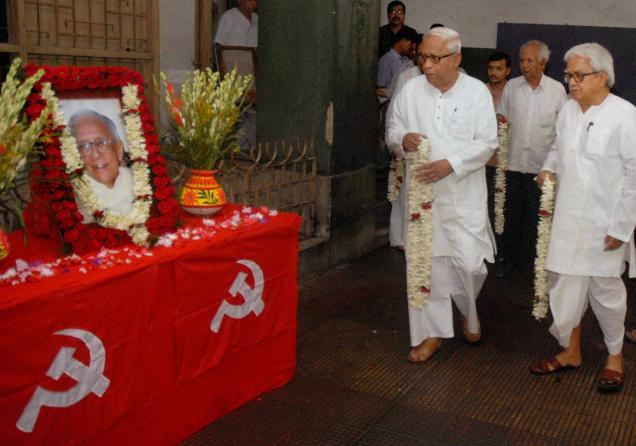
CPI(M) Politburo members Buddhadeb Bhattacharya and Biman Bose arrive to pay tribute to former Chief Minister of West Bengal Jyoti Basu during his centenary birth anniversary at the state party headquarters in Kolkata on Tuesday./ PTI

Elucidating the contribution of veteran Communist leader Jyoti Basu to parliamentary democracy, former Chief Minister and Polit Buro member of the Communist Party of India (Marxist) Buddhadeb Bhattacharjee said here on Tuesday that Mr. Basu had brought the struggle of peasants and working classes to the centre of politics in West Bengal.

Speaking at an event organised to mark the 100th birth centenary of Mr. Basu. he touched on the Communist leader’s conviction to democracy and the faith in secularism.

“He brought the issues of peasants and the workers to the fore in parliamentary democracy. Its origins lay in the workers movement which was followed by strikes and protest in factories. These protests turned into a phenomenon which engulfed the entire industrial sector and workers were successful is ascertaining their rights,” Mr. Bhattachrarjee said. When he came to power, unlike any other Chief Minister, he made it clear that the government will have to stand for the rights of farmers and agricultural workers.

“The fight for land went ahead with giving pattas (land rights) to the farmers and then identifying the rights of share croppers,” Mr. Bhattacharjee said.

The former Chief Minister reflected on how Mr. Basu ensured that the State remained insulated from the communal strife in 1984 after the murder of Indira Gandhi and 1992 after demolition of Babri Masjid.

“He was secular to the core of his heart. He knew that Communist movement and secularism has to go hand in hand,” Mr. Bhattacharjee said.

Recounting that Mr. Basu had even called the then Prime Minister P V Narashima Rao warning him that the developments could take a nasty turn, he said that Mr Basu had even told his colleagues jokingly that the Prime Minister was convinced that people would disperse from the Babri Masjid site only after performing bhajans.

“Jyoti Babu has an unwavering faith in democracy.. Despite himself being arrested a number of times for false charges when the Left Front government came to power in 1977 all political prisoners across political lines were freed. It was like a general amnesty,” he said.

Referring to present times Mr. Bhattacharjee said that it is clear that the politics in the country has taken a “right turn” with the alliance of corporates and Rashtriya Swayamsevak Sangha (RSS) ruling the nation but added that it is imperative for the Left forces to take lessons from Jyoti Basu’s life and put up a fight.

source: http://www.thehindu.com / The Hindu / Home> News> Cities> Kolkata / by Special Correspondent / Kolkata – July 09th, 2014

Veteran Communist leader Vidya Munshi dead

Arguably the first woman journalist of the country, Vidya Munshi was born in Mumbai in 1919 and worked in various newspapers and magazines

Veteran Communist leader, scholar and writer, Vidya Munshi, passed away on Monday in Kolkata. She was 94.

Arguably the first woman journalist of the country, Ms. Munshi was born in Mumbai in 1919 and worked in various newspapers and magazines, including The Blitz.

She stood first among women in the school-leaving examination and left for England to study medicine.

In 1942, Ms. Munshi joined the Communist Party of Great Britain (CPGB) and took part in several programmes of the Communist party in Europe, mainly against the violence and cruelty committed by fascist forces.

In 1945, on behalf of All India Student’s Federation, the student’s wing of the Communist Party of India (CPI), Ms. Munshi participated in an eventful women’s conference (World Federation of Democratic Youth) in Paris.

Ms. Munshi headed the board that publishes the CPI’s mouthpiece, ‘Kalantar’ for several years and was an active member of the party. She headed State Women’s Commission till 2000. She documented her life, the political upheavals and the shaping of women’s movements of her time in great detail in a brilliant memoir, ‘In Retrospect. War-time Memories and Thoughts on Women’s Movement.’

Many important leaders, including members of various political parties, paid their last respects to their favourite ‘Vidya-di’ on Monday afternoon. Her last rites were performed in a city crematorium.

source: http://www.thehindu.com / The Hindu / Home> News> Cities> Kolkata / by Staff Reporter / Kolkata – July 08th, 2014

Ode to women who dared

They charmed audiences with their histrionics on stage and screen. Men sought their company and women envied their acting and singing skills. They didn’t care for the purdah and dared to defy social norms that prohibited women from stepping out in public.

A tribute was paid to 10 actresses of Bengal who have left a lasting impression on the minds of audiences. Titled ‘Songstress’, the programme paid homage to Nati Binodini, Narisundari, Angoorbala, Kanan Debi and Keya Chakraborty among others. The programme weaved in storytelling by popular elocutionist Sujoy Prosad Chatterjee. Songs and dialogues from the plays and films in which they acted were performed.

Commenting on the actresses, an official of 40A Creative Studio that organized the homage said only those who also sang were chosen. Chatterjee also felicitated some prominent actresses of Bengali stage including legendary actress Chitra Sen and veterans like Dolly Basu, Anashua Majumder and Sohag Sen. Actresses Mumtaz Sorcar and Arunima, along with filmmakers Anindya Ghosh and Sekhar Das, were present at the programme.

Students’ tryst with Germany

Students of Birla High Schools Boys and Girls have completed a year-long exchange programme on a project with German partner school Amandus Abendroth Gymnasium in Cuxhaven, Germany. Ten students each from the boys and girls school and 20 from Amandus Adendroth Gymnasium started working on endangered species – mussels in Germany and tigers in India. Each student was hosted by the family of a German student and teachers were hosted by their German counterparts. All the students worked on the project during school hours apart from attending some classes with their German partners in school.

Various educational excursions were organized by the partner school during the stay – Klima Haus, University of Applied Sciences in Bremerhaven, Polar Haus (Alfred Wagner Institute) and Wadden Sea were visited. The entire group visited the mayor’s office where the students had a privilege to meet the mayor of Cuxhaven, Erika Fischer, and interact with her.

Nature in the city captured on lens

Young photographers aged between 16 and 18 years captured glimpses of nature and animals in Kolkata on their lens for a photography exhibition at Harrington Art Gallery. Rashbehari Centre for Ecological Movement (CEMO), an organization that has been spreading awareness on environmental issues for the past few years, held the exhibition on Friday and Saturday. Students from leading city schools put on display around 40 photographs revolving around the theme ‘Nature-watch in Your Backyard’.

The photograph taken by Tiyasa Mal, a student of Shri Shikshayatan School, featuring the flight of three birds in the sky, won the first prize. The second prize went to Kunal De of DPS Newtown for a tiger dragonfly’s photograph. Sweta Karmakar of National High School for Girls bagged the third prize for her excellent snap that featured a squirrel on the hunt for food. Dr Debal Sen, a cardiologist and amateur photographer, inspired the budding shutterbugs to play with light and shadow, striking a balance with their studies. Five members of the host organization exhibited some photographs on wildlife worth between Rs 2,000 and 5,000. “The money raised from the sale of these images will be donated to our organization,” said Purnima Dutt, a member of CEMO.

Show of Bengal tourism

The state tourism department organized a show at Eco Park in Rajarhat New Town to showcase Bengal’s tourism prospects. The venue was the glass house in the Eco island. More than 100 delegates from different parts of the country and also from abroad participated in the show. A presentation was given to the participants on how the tourism department was working towards developing tourism in the state. Hidco authorities handed over a special leaflet and a small souvenir to each of the delegates.

(Contributed by Prithvijit Mitra, Sarthak Ganguly, Jhimli Mukherjee Pandey & Suman Chakraborti. Compiled by Urmi Mukherjee. Photograph by Debobrata Shome)

source: http://www.timesofindia.indiatimes.com / The Times of India / Home> City> Kolkata / TNN / July 07th, 2014

Partha: Not dropping Kabir name from book, adding more stalwarts

SUMMARY
After withdrawing the book last week, Partha Chatterjee had ordered the chairman to revise the book.
___________________________________________________________

Less than a week after it ordered to withdraw a Bengali textbook for Class 12, which contained a long paragraph on contribution of former Trinamool Congress MP and singer Kabir Suman to contemporary Bengali music, the state government Thursday said the book will be relaunched after revision and addition of some more names.

Among others, the revised boom will now detail the contributions of artistes such as legendary singers such as Hemanta Mukherjee, Manna Dey, Shyamal Mitra, Sandhya Mukherjee and Gautam Chatterjee in the book ‘Bangalir Bhasha o Sanskriti’ (The language and culture of Bengali people).

Education Minister, who had ordered the book to be withdrawn, Thursday told the Assembly that it was “unfortunate that the book did not refer to such stalwarts like Hemnata or Manna Dey or Sandhya Mukherhee.”

“But, of course, we are not in favour of dropping anyone from the list. If ‘Pachakanta’ (a derogatory term for Kabir Suman) can be there, other artistes can also be there,” Partha Chatterjee told the House after a meeting with Aveek Majumdar, chairman of the syllabus committee (for classes upto 12).

After withdrawing the book last week, Partha Chatterjee had ordered the chairman to revise the book. “The draft of the revised version will be shown to me on Monday,” the minister said, adding that the government would recruit poet Ganesh Basu and nuclear scientist Bikash Sinha as advisers to the syllabus committee.

Though the government mentioned factual errors in the book as the reason for its withdrawal, sources said, the riling party was not very happy at reference to rebel TMC leader Kabir Suman.

Suman, a Kolkata-based modern Bengali singer-songwriter and musician contested the Lok Sabha election on a Trinamool Congress ticket from Jadavpur constituency in 2009. He was subsequently suspended from the party after he fell out with the party leadership.

source: http://www.indianexpress.com / The Indian Express / Home> Cities> Kolkata / by Express News Service / Kolkata – July 04th, 2014