All India Radio, Kolkata has been awarded as the most ‘effective’ regional news unit in India.
This decision was recently conveyed to the regional head of the Kolkata AIR unit by News Services Division, a unit of AIR in Delhi. AIR Guwahati has also been given the award along with its Kolkata counterpart. According to a AIR Kolkata spokesperson, the award was prestigious for the city regional unit as Kolkata unit of AIR has bagged such an award among 44 regional news unit in past five decades.
The award was given to the AIR Kolkata for broadcasting as many as 13 news bulletins everyday in regional language. Of these, 13 bulletins, 12 are in Bengali language and one in Santhali. This Santhali news has been popular not only with areas such as Bankura, Purulia, Mindapore or other Santhali dominated areas in West Bengal, but in large areas of Odisha, Bihar and Jharkhand. The spokesperson said that AIR Kolkata henceforth will be more careful to choose issues in airing news or news related programmes to cater the needs of the millions of listeners based in West Bengal and its neighbouring states. “The award has given us a sense of confidence and also a sense of responsibility to reach to more listeners,” the AIR (Kolkata) spokesperson said.
source: http://www.timesofindia.indiatimes.com / The Times of India / Home> City> Kolkata / Saikat Ray, TNN / August 16th, 2014
Three and a half years after legendary Rabindrasangeet exponent Suchitra Mitra passed away, her daughter Sudeshna Chatterjee has come forward to bring her legacy alive. Sudeshna has brought together the oldest students of Rabitirtha – the Rabindrasangeet institute started by Suchitra Mitra – to form Rabitirtha Praktoni. The fledgling organization promises to surprise the city with its mammoth Suchitra Smarane – a three-day celebration of Tagore songs and discussions at the ICCR in September on the occasion of Mitra’s 90th birth anniversary.
This is a breakaway from the mother institute that still exists off Lake Market. Towards the last couple of years of Mitra’s life, former minister Subhas Chakraborty and wife Romola took over the reins of Rabitirtha. After Mitra’s death, the media had been rife with reports of how its management changed overnight under Chakraborty’s aegis and how classes became irregular. Mitra’s students complained that teachers, whom she had handpicked, were thrown out of the institute. Interestingly, apart from Rabitirtha, Mitra’s house was also taken over by Romola Chakraborty’s NGO, Pather Panchali, and it was announced that a museum on Mitra would be developed. However, that is yet to come up.
Sudeshna, whom Mitra lovingly called Chiku, has relocated from the US to bring this project alive. Instead of the old world school where the original version is housed, Rabitirtha Praktani is holding its classes inside a state-of-the-art studio for performing arts owned by her. “The classes are being taken by some of my mother’s famous students like Purba Dam, Sumitra Roy and Agnibha Bandyopadhyay. We are bringing back that old tradition at Rabitirtha Praktani,” Sudheshna said.
You will find Sabitri Dutta in her late 70s, Tapati and Bharati Mukherjee, in their 60s, who had been trained by Mitra, happily coming to the class like old times. “We were heartbroken at the old school because training was intermittent and the likes of Kashinath Das, one of Suchitra-di’s handpicked teachers, were asked to leave,” said an old student.
The three-day festival at ICCR is being supported by JU’s School of Cultural Texts and Records that is providing rare photographs of Mitra for an exclusive exhibition and the Rabindra Bharati University.
source: http://www.timesofindia.indiatimes.com / The Times of India / Home> City> Kolkata / by Jhimli Mukherjee Pandey, TNN / August 14th, 2014
Shabnam Ramaswamy, who started life afresh from the streets to become the force behind Jagriti Public School and Stree Shakti women’s co-operative in Katna village of Murshidabad, returned to her alma mater, La Martiniere for Girls, on Friday morning for the first time in 45 years.
The 60-year-old fairy godmother to hundreds of women and children took a walk down her La Martiniere memory lane…
Whenever I’d go over the AJC Bose flyover I’d point at my school and show my driver or some staff member travelling with me in the car: “See, that’s my school!” After I went out of school in 1969 and all these years of struggle, I had never set foot in my school.
As I was addressing students of the school, I was thinking I would have loved my father to be alive today. In those days, picking me from a village, bringing me to the city and admitting me to this school, what a chance it was for me.
I went through all the stereotypes of marriage and conventions but it was the school that really made me what I am in terms of my lateral thinking, turning of views, never to give up against all odds. These are things in the books you read but the teachers put it across in a manner that really changed the way I think.
One book that I loved reading during my school days was Tom Sawyer. He was such a big influence on me. Him painting the wall, the mundane routine of doing that job when everyone else was having fun. At 22 (Shabnam was married off at 16) when I’d see other girls around me having fun and I would think, like Tom I’m going to make everybody come and paint my wall too while I sit on the stool with all my treasures. And today it seems like it’s really happened!
Look at the background I came from. My mother was illiterate, so was my grandmother. My father was in the army. So it was really the school that taught me how to handle life and the education gave me the ability to juxtapose both worlds, not to hate that or look down on it but do something about it. In fact, today I’ll be visiting one such teacher’s house who has baked a cake and waiting for me. I’m just looking forward to meeting her after all these years.
College I did because I desperately needed the graduate degree but it’s the school that made me. Looking at the school after all these years, no matter how much the buildings have changed and new ones have come up, these pillars will remain. The pillars are like pillars of strength for me. Today, with pride I can say that I come from here.
My favourite corner was always the field because I loved sports. I used to throw javelin, discus and do high jumps, long jumps. I used to participate in inter-school sporting events. I wasn’t a hugely academic person.
When I was starting Jagriti (Shabnam’s CBSE-affiliated English-medium co-educational public school for the poor) my reference point was this school. The discipline, the curriculum and the philosophy is modelled on all that I learnt from my own school — La Martiniere.
As told to Mohua Das
source: http://www.telegraphindia.com / The Telegraph, Calcutta / Front Page> Calcutta> Story / by Mohua Das / Saturday – August 098th, 2014
He says he knows Rashtrapati Bhavan like the back of his hand, having spent 15 years there as curator. This time, painter Jogen Choudhury will spend 10 days there as President Pranab Mukherjee’s guest, ‘sketching, painting and working without a specific plan’.
Invited by the President under a new scheme “Artists in Residence”, the Rajya Sabha MP is the first of authors and artists who are set to follow him to Rashtrapati Bhavan.
Choudhury has been put up at the sprawling guest house inside the Presidential address. And he could soon be making a portrait of the President, said the artist. “I have no definite plan but I do intend to create a portrait of the President, provided we can fit enough sittings into his busy schedule,” said Choudhury, who also attended a Parliament session on Tuesday.
But first he needs to get acclimatized to the environment, he said. “You tend to feel a little lost in this huge place although Rashtrapati Bhavan is familiar territory since I spent a considerable amount of time here between 1972 and 1987 as curator.”
He will search for additions and alterations that have come about in the last 25 years. And he could start off with a set of sketches. “It seems likely that I will be doing a few sketches initially. It’s an honour to be the President’s guest and I hope to use the opportunity to come up with something different,” he said.
source: http://www.timesofindia.indiatimes.com / The Times of India / Home> City> Kolkata / TNN / August 06th, 2014
The hub in south Kolkata’s Ballygunge will encourage aspirants to showcase their mastery with words as well as their elocutionary prowess through sessions conducted by leading litterateurs, artists, filmmakers and anybody who is associated with writing and reading.
“The club will have four sessions a month, that is, one session per week every Thursday starting August 7. Guests will have to pay Rs 500 for the four sessions. It is open for all,” Ritika Choudhury, owner of Circle Art 360, one of the organisers, said.
A collaborative effort by AHAVA Communications, Circle Art 360 and Creative Studio, the club will be a haven for book lovers as well with discussions and book launches.Choudhury said the organisers are also mulling international partnerships.
source: http://www.post.jagran.com / Post Jagran / Home> States News> East India News / Jagran Post News Desk – Jagran Post Editorial / August 02nd, 2014
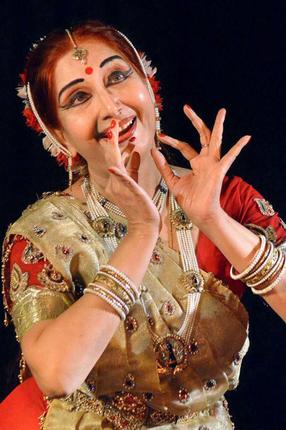
Amita Dutta in performance. Photo: Prashant Arora / The Hindu
Kathak dancer Amita Dutta, recently conferred the first Uday Shankar Award for Lifetime Achievement, talks about pursuing the art form and her endeavour to formalise a Bengal gharana. NITA VIDYARTHI
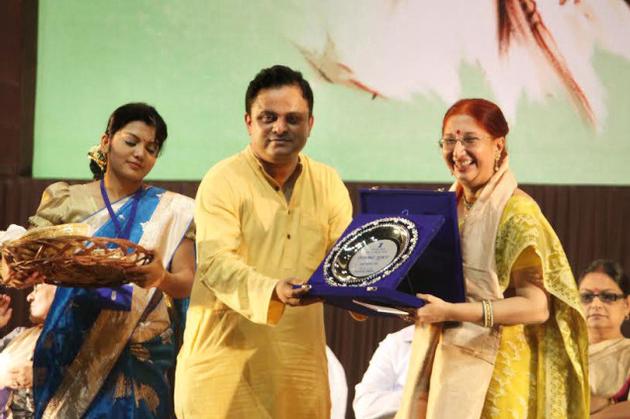
Acclaimed dancer, choreographer, scholar and professor Amita Dutt has recently been conferred the fist Uday Shankar Award for Lifetime Achievement in Dance by the West Bengal Government. Trained in Kathak under stalwarts like Pandit Birju Maharaj, Pandit Vijay Shankar and Bela Arnab, Dutt, the erstwhile Dean of Kolkata’s Rabindra Bharati University, has also been conferred the prestigious Uday Shankar Chair at the University after a gap of 17 years. Dutt, also Director of Performing Arts at the University, has performed and taught extensively at home and abroad and is striving to establish a Bengal gharana of Kathak. Excerpts from an interview:
You have been conferred the prestigious Uday Shankar Chair at Rabindra Bharti University after years. What edge do you think you have over others?
It is not for me ‘to reason why’. One external expert did ask me, how Uday Shankar was important to me as a classical dancer. I had answered that he taught us how to present our dance before a modern audience, on a proscenium stage. Earlier, dancers were engrossed with technicalities and grammar of dance. They did not view the presentation from the angle of the audience. The use of the stage space, lighting, costumes, patterns formed by various dancers and the attention span of the audience were all very important for Uday Shankar. And he was constantly seeking new avenues of expression through dance, never being satisfied with simply copying something that was learnt. In fact, Tagore had also advised Uday Shankar not to be confined within one geographical area or one historical period, but to thirst for new creative expressiveness. I have constantly endeavoured to adhere to these tenets and make my performances attractive and acceptable to a modern-day audience spread across the continents.
Recieving the Uday Shankar Award from the West Bengal Education Minister in Kolkata. Photo: Amrita Dutta / The Hindu
Do you feel any emotional identification with this position?
Yes, I do. My relationship with the great artist is not through blood but through thoughts and ideas. I always consciously carry with me his legacy. Incidentally, there have been many occasions when his name was associated with me. I am the professor in the Uday Shankar Chair, I performed in the first Uday Shankar Festival of the State Government and received the Lifetime Achievement Award in Dance from the Government this year.
How have you justified Uday Shankar’s creativity in your choreography?
I have choreographed many dances using different dance styles. In them, I have gone beyond Kathak. I have used my knowledge and with the inspiration coming from god, Tagore and Uday Shankar, I created many new presentations under the banner of my University. These have been presented in many important festivals across the country.
Your Kathak boundaries have not stretched beyond use of formations…
Yes. I have brought in many creative formations in my choreography. In my presentation on Ganga, I have tried to emulate the movement of the river — sometimes torrential, sometimes meandering, and also the ideas and images associated with the river: both natural and religious. I have also blended our traditional Kathak movements and rhythmic formations within my new creations. The sound of falling rain is shown through footwork and onomatopoeic rhythmic compositions.
How else would you suggest one should expand the boundaries of Kathak? At times, dancers have stretched the boundaries so far that the audience failed to identify the dance numbers as Kathak.
You began to choreograph with works of Tagore, Atul Prasad and Nazrul and then D.L. Roy. How was the creative (setting to music) process different from the classical form?
The creative process is similar. I have always worked on songs and music that have appealed to me, whether traditional or modern, classical or light, eastern or western. Actually, when you are creating a dance piece, you don’t calculate or think with your left brain. Ideas, images, rhythmic compositions and movements dawn on you. Of course, they usually emanate from your storehouse of knowledge, what you have learnt or seen or imbibed. But at times, ideas and images have come to me through my reverie or even my dreams.
Is the use of the celebrated literature a precursor to your establishing the Bengal gharana?
Yes, while working on the various literary works, the idea of an independent Bengal gharana dawned on me. Initially, I had started choreographing on these songs because I loved them. The fact that the audience responded with equal enthusiasm gave me an impetus. And one leading to the other, now the concept of our Bengal gharana has gradually started taking shape. The majority of my performances are for the Bengali audience who enjoy hearing well known Bengali songs. And songs of the last century are still very much alive in the popular Bengali consciousness. In fact, members of my audience participate in D.L. Roy’s patriotic and romantic thoughts more than in Awadhi thumris, chaitis and kaajris. The difference between the Lucknow and Jaipur gharanas was tangible at one time. Today, they are blending into each other as the repertoire is being borrowed or copied and the styles influencing each other. The present-day Benaras gharana artists have learnt from stalwarts of the Lucknow and Jaipur gharanas and there is more of an influence of these gharanas on their dance than an adherence to the precepts of their founder Janki Prasad. I, too, have learnt from stalwarts of the Lucknow and Jaipur gharanas. But what I perform today is not a mere copy of what I have learnt. I have evolved a style of my own which is more melodic than rhythmic, more interpretative than abstract, more lilting than staccato. And I have a large body of choreographic creations on Bengali songs: Tagore, Nazrul, D.L. Roy, Sachin Dev Barman, Salil Choudhury, as well as the traditional Baul songs and kirtans.
Will you be choreographing other poets’ work of that era?
Yes, I wish to. I am working on the lyrics of Vivekananda and Rajani Kanto.
source: http://www.thehindu.com / The Hindu / Home> Features> Friday Review> Dance / by Nita Vidyarthi / August 07th, 2014
S Kabir created hairpieces for many major stars, including Amitabh Bachchan in the 1988 action film Shahenshah / S Kabir – Siraj Sheikh
SURENDRA’S NATURAL HAIR STUDIO isn’t easy to find. But for the wigged wooden heads marking the entrance, this workshop in a grimy alley off Mumbai’s SV Road looks just like any other. Inside, however, it becomes clear that the studio belongs to one of Hindi cinema’s most sought-after wig makers, Surendra Salvi. The foyer walls are lined with photos of Salvi with actors—everyone from Salman Khan to Prem Chopra—sporting his toupees, beards and moustaches.
Salvi ushered me into a workshop where five uniformed employees created mesh bases for new wigs, and wove hairpieces and hair extensions. Almost all of Salvi’s wigs are made of natural hair, but he uses various amounts of synthetic material for those on tight budgets. “Natural hair is expensive,” he explained. Even-length, pre-sorted hair can cost up to Rs 70,000 per kilogram.
Salvi, a Mumbai native, told me he always wanted to be part of the film industry, though it took some time to break into the business. “First I did clerical work,” he said, “then I fitted car lamps for an auto company. Then I worked in a talcum powder factory. Then I had enough.” In the early 1980s, he started assisting the makeup duo of brothers Anil and Pradeep Pemgirikar by making wigs and beards for extras and body doubles. Over the following decades, he made it big on his own. His hairpieces have been used by Boman Irani in 3 Idiots, Shahrukh Khan in Ra.One, Akshay Kumar in Action Replayy, and many other superstars. When I visited two months ago, Salvi was fashioning wigs for director Anurag Kashyap’s upcoming Bombay Velvet. He also does work for regional films, television commercials, and individual clients.
Pradeep Pemgirikar, Salvi’s mentor, oversaw makeup, wigs and prosthetics for the films of director Manmohan Desai in the 1980s. He now runs Mod Wig Centre from his humble three-room house in Dadar, taking whatever work he gets from the Marathi and south Indian film industries. Pemgirikar, who said his best work was on the 1992 film Khuda Gawah, rued changing trends in the movie business. “Everyone wants a natural look now,” he said, “but in those days, every third character in a Manmohan Desai film had a wig.”
If the 1980s and 1990s had the Pemgirikars, the 1960s and 1970s—when bouffants, pompadours and beehives were all the rage—had S Kabir and Victor Pereira. Kabir came to Mumbai from Kolkata in the 1950s to assist his older brother S Amin, who was then already a makeup man and wig maker of repute. Kabir worked with almost all the leading men of the time, his son Siraj told me, and made wigs for such classics as China Town, Mirza Ghalib, Aandhi, Padosan, Sholay, Shahenshah and Kalicharan. But his most illustrious client was Pran, whose memorable get-ups from Upkar and Zanjeer to Amar Akbar Anthony and Don cemented his reputation as one of Hindi cinema’s greatest character actors.
Kabir passed away in 1994. Siraj is keen to keep his father’s legacy alive, and, with his brother Farooque, now runs the wig studio S Kabir & Sons, established by Kabir in the late 1950s, in Andheri East. “Wig making is an art, but it never gets the respect it deserves,” he said. “Even personal drivers and spot boys who serve chai to actors get mentioned in film credits. We often don’t.” An online search showed S Kabir credited for his work on only three movies, though Siraj claimed he actually worked on between seven and eight hundred films. Siraj also lamented the end of the era when prevailing fashions meant greater demand and profits, and more time to craft great wigs. He remembered being called on to make a hairpiece for Amitabh Bachchan several years ago. “They wanted it in three days,” he scoffed. “Is three days enough time to make a wig?” Sorting hair bought from wholesalers is a gruelling process, and the average wig requires at least five to seven days of work.
Victor Pereira, S Kabir’s contemporary, now lives in Mangalore, near his home town of Moodabidri. Although no longer associated with the film industry, he was happy to talk about his glory days over the phone. Having learned his trade in Mumbai from S Amin, Kabir’s brother, Pereira got his break on the 1969 film The Killers, starring Dara Singh and Helen. Although the film was a dud, he went on to craft all of Helen’s wigs from then on, putting his stamp on her looks in song videos such as ‘Piya tu ab toh aaja’ and ‘Mehbooba mehbooba,’ and films such as The Train and Don. Victor also worked, among others, with Hema Malini, Vyjayanthimala, Sharmila Tagore, Mala Sinha and Rekha. His most challenging project, he said, was director Kamal Amrohi’s 1983 release Razia Sultan. “Kamal Amrohi was such a stickler. Woh ek ek baal dekhte the (He used to check each strand of hair). He told me, ‘Hema Malini rani hai (Hema Malini is a queen). I want the best. Nothing else will do.’”
source: http://www.caravanmagazine.in / The Caravan / Home> Reporting & Essays / The Lede / by Roshini Nair / July 01st, 2014
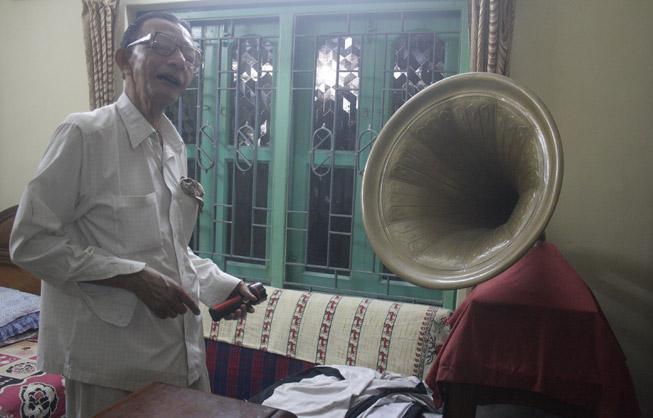
Panchu Gopal Biswas’s gramophone collection includes the first voice recorded in India, that of theatre actress Shoshimukhi – / Photo : SUDHITI NASKAR FOR THE CARAVAN
WHEN FREDERICK WILLIAM GAISBERG ARRIVED in India in 1902, he had a daunting task ahead of him. In a country that had never before encountered sound recording technology, Gaisberg, a recording engineer with the Gramophone and Typewriter Company had been assigned the job of recording promising voices for commercial distribution. On 11 November that year, in a hotel room in Kolkata, Gaisberg recorded the voice of Gauhar Jaan, a singer of Armenian descent.
Gauhar Jaan went on to become the first commercial recording artist in India, and her career and work are now legendary. But hers was not the first voice that Gaisberg recorded.
“It was Shoshimukhi,” said Indrani Majumdar, a Kolkata-based researcher and collector of old Bengali gramophone records. Shoshimukhi, Majumdar told me when I met her in her east Kolkata studio in March, was an actor in the city’s thriving theatre scene at the turn of the 20th century. “The first recorded content was a Bengali song, ‘Ami ki shojoni kusumeri’ (Is my beloved a flower),” Majumdar said. Gaisberg hadn’t been impressed with the voices of Shoshimukhi or Fani Bala, the other singer he recorded in his first session on 8 November. In his diary, he described them as “two little nautch girls … with miserable voices”.
Majumdar has been immersed in the early history of recording in India as part of a project to collect, digitise and archive 78 rpm gramophone recordings of Bengali theatre performed between 1900 and 1930. Her research, now funded by the India Foundation for Arts and the Berlin Phonogramm Archive, began seven years ago, after she chanced upon a collection of 400 records that belonged to her late grandfather. “Some had labels of drama companies on them,” Majumdar said. “Not much was known about the plays of this period. I thought it would be great if I could do something to restore that part of history.” In the course of her work, she has consulted a number of sources, among them Gaisberg’s own published diaries and researcher Michael Kinnear’s detailed book The Gramophone Company’s First Recordings, which identifies the matrix number of Shoshimukhi’s recording, India’s first, as 13024.
Majumdar’s research has given her a sense of how the theatre community in Kolkata reacted to the advent of recording technology. The fact that no recordings have been found of some theatre legends, like the actor, writer and director Girish Ghosh, suggests that not everyone took to the idea. “Probably because the 78 rpm records were considered a fluke”, said Majumdar. “These [records] typically played for two-and-a-half minutes to a minute more. How to cut down an hours-long play, or an elaborate thumri into that tiny time frame was the question.”
But others from the theatre community were enthusiastic, like Amarendra Nath Dutta, who introduced Gaisberg to Shoshimukhi, a performer with his company Classic Theatre. The theatre recordings went on to be successful, with listeners lapping up encore pieces of Bengali plays, theatre songs like Shoshimukhi’s, full plays recorded over multiple discs, and comic skits. “It’s not easy to know all the relevant information for lack of documentation. I have yet to find the song of Shoshimukhi. But the search is on.”
Having left Majumdar’s studio seized with curiosity about Shoshimukhi’s recording, I made some phone calls to friends in the Kolkata recording industry. Two days later, I sat in the Dum Dum house of Panchu Gopal Biswas, a retired employee of the Kolkata Municipal Corporation. “This is my collection,” Biswas said, pointing to the piles of records neatly stashed in cupboards all over the room. Fishing out a brown envelope from one pile, he carefully extracted a disc from it and laid it on the bed. A worn purple label had fading words on it—‘Shoshimukhi’, and in Bengali, the name of the song, ‘Ami ki shojonee kusumeri’. Stamped on the record was the matrix number—13024.
As the record began to spin on the player, the shrill voice of a young girl filled the room. I thought to myself: Gaisberg may not have been too harsh when he described the voice as miserable. The singer sounded nervous and out of breath. Then, midway through the song, she appeared to gain confidence. The breathing grew more controlled, the words clearer. The refrain was a passionate declaration of love—valo bashi, valo bashi.
“Don’t tell too many people about this,” Biswas said after the song was over, smiling apologetically as he put the record back in its pile. I asked if he would be willing to help a researcher like Majumdar. “Of course I will,” he said. “I’m in if it’s for non-commercial use.” As I made my way out of Dum Dum, my mind was filled with thoughts of Shoshimukhi, sitting in a hotel room all those years ago, surrounded by foreigners, singing into a machine.
_________________________________________________________________________
Sudhiti Naskar is a freelance journalist based in Kolkata. She likes to document people’s lives in moments of flux. She is regularly published in international magazines. She is currently represented by Agency Genesis.
_________________________________________________________________________
source: http://www.caravanmagazine.in / The Caravan / Home> Reporting & Essays> The Lede / by Sudhiti Naskar / June 01st, 2013
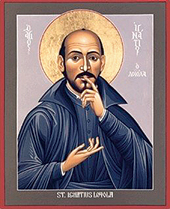
The 20,000 Jesuits and their institutions all over the world celebrate the feast of their founder, St. Ignatius of Loyola, on July 31.
Ignatius was an unusual character of the 16th century, a brave knight and soldier under King Ferdinand of Spain. In 1521, he was wounded in the battle between France and Spain. His life was transformed during his long convalescence and he founded the Jesuit Order, the Society of Jesus, along with Francis Xavier at the University of Paris in 1537, which was approved by the Pope in 1540.
Perhaps Jesuits impart the best-known education in India and elsewhere. They have come to be known in the public mind for their educational work and have acquired the reputation of being among the world’s best educators and educationists.The Jesuit educational network is the largest in the world today.
The Jesuits conduct no less than 50 university colleges, 17 institutes of business administration and 210 high schools across the country; almost all of them are among the most reputable ones. More than 500,000 students belonging to every religious, linguistic and socio-economic group, receive their education at these institutions.
The situation is the same wherever the Society of Jesus has established itself for the greater glory of God. There are 28 Jesuit universities in the US.
As Malachi Martin has said in his book, The Jesuits, “Jesuits always aimed to be the best. And they were. They had a part to play in every major political alliance in Europe and America, in Asia and Africa. They became shapers not only of religious history, but also of world history. Even Nazi generals (incl. Hitler) dreamed of such a cadre of men; and even Lenin envied them.”
Historian Romila Thapar has stated that if India has a written history; the credit goes to the Jesuits.
St. Xavier’s college and school will remain closed on July 31 in honour of their founder. Here’s wishing all Xaverians, present and past, a very happy feast of St. Ignatius of Loyola.
The writer is the principal of St. Xavier’s College, Calcuta
source: http://www.telegraphindia.com / The Telegraph, Calcutta / Front Page> Calcutta> Story / by Fr. Felix Raj / Thursday, July 31st, 2014
On Saturday, a unique memorial service was organized at the Rasgovindpur Airstrip (also known as the Amarda Road Airfield) in Odisha to honour 14 airmen of the Royal Air Force (RAF) who were killed in a mid-air collision between two B-24 Liberator bombers on July 26, 1945. It was Bhubaneswar-based war historian Anil Dhir who dug up this historical fact. He along with Aditya Patnaik of the Gandhi Eye Hospital and school children were among those who laid wreaths in memory of the dead airmen.
“Very few people are aware that 69 years ago two Liberators (EW225 and EW247) collided at low altitude during a practice flight. They were part of a six-aircraft contingent from the Air Fighting Training Unit engaged in a formation flying exercise. The Rasgovindpur Airstrip had the longest runway in Asia (more than 3.5 km). The total length of the runway, taxiways and aprons was more than 60 km. Part of the runway (nearly 11,000 feet) still remains but there is no activity save for the grazing of cattle. This airfield played a very crucial role in the defence of India during World War II. It was a forward airbase against the Japanese and was used for ‘Over the Hump’ operations as well as training pilots for special bombing raids. Unfortunately, there aren’t any details available of the activities that took place here between 1943 and 1945, even in military archives,” Dhir says.
It was during a visit to the Madras military cemetery that Dhir came across the graves of 14 airmen who were killed at the Amarda Road Airstrip crash. It took a lot of doing on his part to find out that the 900 acre airstrip was built at a cost of Rs 3 crore in the 1940’s. During his research, Dhir received assistance from Matthew J Poole from the USA who has studied the crash and prepared a report. With Poole’s assistance, Dhir was able to locate the relatives of none of those killed in the air crash. One of them is 101 years old now.
“The two aircrafts took off from the airfield in Odisha but the crash took place over West Bengal. The debris was strewn across flooded paddy fields in Bengal. I have requested both the Odisha and Bengal governments to erect small memorials at the airfield and the crash site to honour the brave souls who gave up their lives for the defence of our motherland,” Dhir added.
source: http://www.timesofindia.indiatimes.com / The Times of India / Home> City> Kolkata / by Jayanta Gupta, TNN / July 29th, 2014