Category Archives: Arts, Culture & Entertainment

Special 40

Pictures by Arnab Mondal

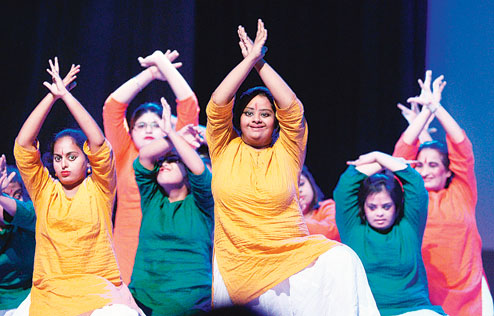
Students of Manovikas Kendra perform at a programme to mark 40 years of the organisation, at Science City auditorium on Thursday.

From tiny tots to students of vocational units, some of them on wheelchairs, everyone joined the celebration.

Sharada Fatehpuria, the founder- director of Manovikas Kendra, turned nostalgic as she remembered the first day of the institute. “It was January 28, 1974, and Saraswati Puja was being celebrated in the foyer of Gyan Manch at Abhinav Bharati High School.

The journey began with two children in one room and today Manovikas Kendra is spread over an acre and it is full of wonderful children who are studying and playing with 160 dedicated personnel,” she said.

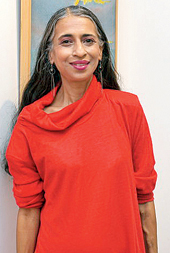
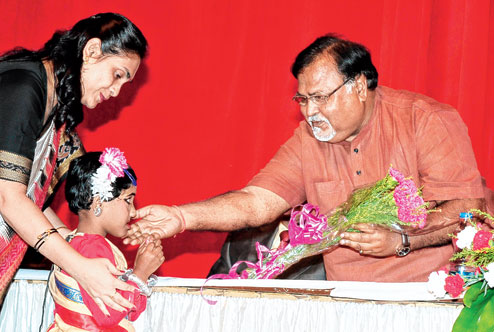
Education minister (below) Partha Chatterjee was the chief guest on the occasion.

Pictures by Arnab Mondal

source: http://www.telegraphindia.com / The Telegraph, Calcutta / Front Page> Calcutta> Story / Friday – September 05th, 2014

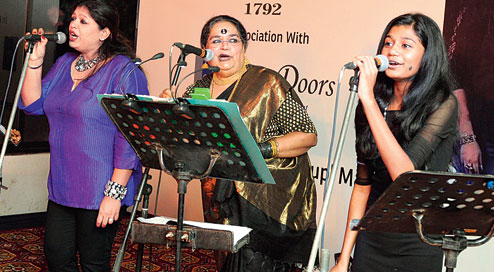
On song, 3G of Uthup women – Usha rocks with daughter Anjali and grandchild Ayesha

UshaUthupKOLKATA09sept2014

ANJALI KURIAN: daughter. She stays in Kochi and works as a radio jockey
USHA UTHUP: the one and only, performs at the CC&FC on Sunday evening
AYESHA JOHN: granddaughter. Called “the boss” of 3G, the Uthup band, the teen is training in vocals in Kochi.
Picture by Arnab Mandal

Uthup 3G jammed for the first time together in Calcutta as Usha Uthup took the stage at the CC&FC on Sunday evening with daughter Anjali Kurian and granddaughter Ayesha John.

If love, laughter and a lot of music keep the three generations — 3G — of Uthup women in concert with each other, they bonded as a band at the INK conference in Kochi a year ago. “When Amma was invited to INK to talk about how her music cuts across boundaries, Ayesha suggested she sings Shine Like A Diamond and Tumhi ho and Amma suggested we join her,” beamed Anjali.

“After a standing ovation at INK, we were invited to perform at GIMA. From there we went to Jaipur and London,” she said.

The Shine Like A Diamond and Tumhi ho mash-up is now a staple at every 3G show, including the one at the CC&FC.

“I don’t know how to explain what I’m feeling. It’s so sentimental today. I feel nostalgic. Everything good and beautiful happened from here in Calcutta. And its extraordinary and historical for us three generations singing here today,” said Usha before belting out old favourites from her Trinca’s days.

Her voice still holding strong as she sang I Believe In Music, Fever and the Bond number Skyfall, she called her “beautiful girls” Anjali and Ayesha to join in.

The crowd clapped, tapped and cheered as the Uthup trio sang Malaika, Oh Carol, La Bamba, I Will Survive, one after the other in perfect harmony.

Usha had a message for her 14-year-old granddaughter: “Remember, this is the most difficult audience to please and if they say yes, 45 years guaranteed.” The crowd applauded even more.

When Metro caught up with 3G on the sidelines, they spoke about how the three inspire one another. “I told my mother everything that girls couldn’t think of telling their mothers and Ayesha too does the same. We always know everything about each other,” said Anjali who lives in Kochi.

Usha described Anjali as somebody similar to herself in terms of “vocal quality and joie de vivre on stage”.

Ayesha, she felt, is different. “She has a huge range, a different timbre and sings old songs with as much ease as the new ones,” said the proud granny.

Anjali couldn’t help gloat over her mom and being the 3G go-between. “Some people excel in cooking or stitching, she excelled as a singer and inspired me to be a good human being. I’m happy being an RJ and dancing but since I seemed to be the missing link between my daughter and my mother I decided to join in and have fun singing.”

Ayesha, the older two agreed, is the “more serious singer” and also “the boss”. “We don’t do it because we are good at it but because we like it,” the junior-most Uthup said with authority.

“To me, she’s a grandmother who cooks, cleans and feeds me and, by the way, sings as well,” laughed Ayesha.

But then, she isn’t the typical grandmother either as she rocks her way through life post-60. “Sometimes we forget our age. She didn’t want me to call her ammachi, naani or daadi. She said, ‘Call me anything, even coconut tree if you want’.” Ayesha calls her umbukka, just a word she coined.

Park Street holds a special place in all the three hearts that beat inside 3G. Anjali exclaimed: “Thank god for Park Street, otherwise my parents wouldn’t have met and I wouldn’t have been born.”

Ayesha, training in vocals in Kochi, is yet to pay a visit to Trinca’s where her grandmother started her music. “She is the one who made me fall in love with singing… so Trinca’s is a must-visit.”

Retiring club CEO Deepankar Nandi said: “What a wonderful evening and such a great parting gift for me. Apart from being a very old club member and a brilliant performer, Usha is my favourite. The added bonus was the performance by Anjali and Ayesha.”

source: http://www.telegraphindia.com / The Telegraph, Calcutta / Front Page> Calcutta> Story / Tuesday – September 09th, 2014

Neel Mukherjee shortlisted for 2014 Man Booker prize

Mukherjee was the only Indian-origin author to be longlisted earlier this year.

London:

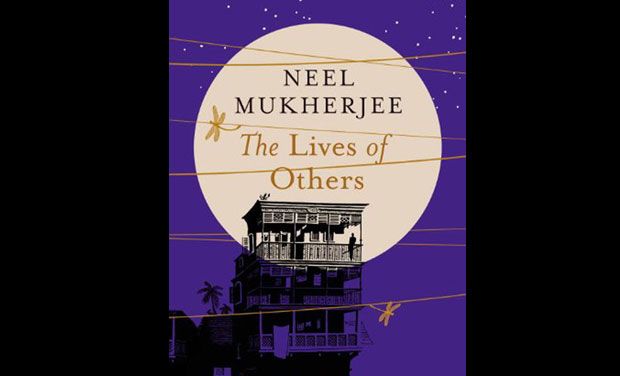
Kolkata-born British author Neel Mukherjee’s latest novel The Lives of Others, set in troubled Bengal of the 1960s and centres around a dysfunctional family, has been shortlisted for the prestigious Booker Prize 2014, in its debut as a global literary award.

Mukherjee, who studied at Oxford and Cambridge, was also the only Indian-origin author to be longlisted earlier this year, the first time the prestigious literary award opened up for anyone writing in English regardless of nationality.

“We are delighted to announce our international shortlist. As the Man Booker Prize expands its borders, these six exceptional books take the reader on journeys around the world, between the UK, New York, Thailand, Italy, Calcutta and times past, present and future,” said A C Grayling, chair of the 2014 judging panel.

“We had a lengthy and intensive debate to whittle the list down to these six. It is a strong, thought-provoking shortlist which we believe demonstrates the wonderful depth and range of contemporary fiction in English,” he added.

Mukherjee, now a British citizen, has been selected for his second novel published in May this year. The book is based in Kolkata and centres around a dysfunctional Ghosh family in the 1960s.

Mukherjee reviews fiction for the Times and the Sunday Telegraph and his first novel, A Life Apart was a joint winner of the Vodafone-Crossword Award in India.

The others on the shortlist include American authors Joshua Ferris for To Rise Again at a Decent Hour and Karen Joy Fowler for We Are All Completely Beside Ourselves; Australian Richard Flanagan for The Narrow Road to the Deep North; and British authors Howard Jacobson for J and Ali Smith for How to be Both.

Previously, the prize was open only to authors from the UK and Commonwealth, Republic of Ireland and Zimbabwe. For the first time in its 46-year history, the 50,000-pound prize has been opened up to writers of any nationality, writing originally in English and published in the UK.

source: http://www.deccanchronicle.com / Deccan Chronicle / Home Lifestyle> Books-Art / PTI / September 09th, 2014

A lesson in history for teachers

caleidoscope

A place steeped in history recently hosted a spirited discussion on the teaching of history. Teachers, academicians and people of letters gathered to take a fresh look at the teaching of India’s Freedom Movement.

The discussion, titled Teaching the history of the Freedom Movement to young children, was organised at Victoria Memorial on August 19, part of a series of critical conversations to be held at the heritage venue in future.

Moderated by Devi Kar, the director of Modern High School for Girls, the participants included history teachers Anirban Mondal of Netaji Nagar Colony High School, Durgapur, Tina Servaia of Calcutta International School, and Amita Prasad of Modern High School and Megha Malhotra of The Seagull Foundation for the Arts.

“At least somebody is thinking of schoolteachers. The onus of making students understand the essence of history lies on us teachers and textbooks. India’s struggle for freedom is usually an emotionally charged topic. Can it be taught?” wondered Kar as she threw open the discussion.

Mondal felt history as a subject is very abstract and often incorrectly interpreted. “History as a discipline may not match with history of everyday life and what is interpreted on screen. We need to blend the two to teach the subject effectively,” he said.

Prasad stressed on making history lessons more approachable and not reducing it to a litany of dates and places. “Teaching history can be difficult, especially when children have little idea about the events. It is the task of a teacher to concretise the knowledge and make it a real-life experience,” she said.

The only non-teacher in the group, Malhotra, spoke about her foundation’s project on teaching conflict to students and how they have a pool of teachers to work with various schools.

The general consensus at the end of the discussion was that teachers need to excite students and teach them in a language they understand. “I like to mix activities. A Class XII student can be involved in an activity meant for junior classes, if it is meaningful. It all depends on the approach,” said Servaia.

The teachers went on to discuss classroom experiences and the advantages of using visuals and staging plays as teaching aids.

Angels on canvas

She returned to India from Israel in 2002, terribly disturbed by what she saw there and that is what inspired her to work on Angels, a collection of paintings in oil and water colour.

Rumi at her exhibition. (Rashbehari Das)

The Angels series by Rumi was part of an exhibition of her works at Chitrakoot Art Gallery.

At the opening of the exhibition on August 23, her birthday, the artist recalled how she read the Bible very seriously after she was left shaken by the Israel experience. “I wished for angels to be sent to earth and protect mankind.”

The exhibition was also a fund-raiser event for Rumi’s dialysis and kidney transplant.

“When I met Rumi at a friend’s place I had a feeling that I had come across a natural artist. Being a musician, I know what it is to be natural. The care and love in her paintings is evident. I wish her speedy recovery,” said Monojit Datta, Rumi’s friend and musician.

Ancient art

It was a world of kings, queens and love. Self-taught artist Devirani Dasgupta’s third solo exhibition, held recently at the Academy of Fine Arts, transported one to ancient India. Heavily influenced by Madhubani art and resplendent in earth colours, Dasgupta’s acrylic-on-canvas compositions tell stories of their own. “I am a surrealistic painter trying to connect the known to the unknown through the association of forms,” said Devirani.

Contributed by Chandreyee Ghose & Samabrita Sen

source: http://www.telegraphindia.com / The Telegraph, Calcutta / Front Page> Calcutta> Story / Sunday – September 07th, 2014

300 Rare Gramophone Recordings Digitised

Kolkata :

A rich collection of over 300 rare recordings, including speeches by Mahatma Gandhi, Jawaharlal Nehru and Netaji Subhas Chandra Bose and old classical music have been given a new lease of life through digitisation.

They can now be heard at a new digital sound archive centre at Weavers Studio here, which was thrown open to the public today.

Weavers Studio founder Darshan Shah said “Our primary objective is to preserve these voices of our ancestors and make them easily and electronically available for researchers, musicians, students of music and the public at large. It is unfortunate that many of our rare records are on the verge of destruction and without timely action, these would be lost forever.”

The oeuvre include Nehru’s speech after the Mahatma’s assassination and the original version of the national anthem sung by Gurudev and his students at Shantiniketan.

Other gems which have been digitised include the songs by Gauhar Jan, the country’s first classical singer to record in 1902, besides Hindustani and Carnatic classical music, music by Bengal artists and folk music.

There are also many versions of ‘Vande Mataram’, ‘Ram Dhun’ by Bismillah Khan and voices of Bal Gangadhar Tilak, Tagore, Rajendra Prasad, Vijayalakshmi Pandit, Aga Khan and Sarojini Naidu, among others.

Anyone visiting the studio can listen to the gems of the bygone era through kiosks and guided listening sessions and acquaint themselves through thematic exhibitions.

Shah said the collection would be taken to the youth in schools and colleges, museums and libraries to provide them a new perspective of looking at Indian history through sound and visuals.

Interested visitors to Weavers Studio are given android phones to listen to the records at the click of a button.

Also on display are the original gramophone records and gramophone players.

Some of the old and rare records collected and restored by the studio, which was set up in 1993, include Nicole and Pathe records dating back to 1900-1910 and the arare Beka grand records.

“We sourced the records from collectors and flea markets. This is an ongoing project and so we are still looking for old records,” Shah said.

In the second phase of the project, Weavers Studio would create an online archive where all these recordings would be uploaded on the web.

During 1902 to 1985, over 300,000 records were issued in India and were released under more than 75 different labels and in various formats, said Suresh Chandvankar of the Society of Indian Record Collectors in Mumbai.

They too are working for the preservation, documentation and dissemination of India’s rich cultural heritage in the field of audio and video recordings.

source: http://www.newindianexpress.com / The New Indian Express / Home> Nation / by PTI / September 05th, 2014

Stories on real life – KNOW YOUR NEIGHBOUR: Caesar Bagchi Writer

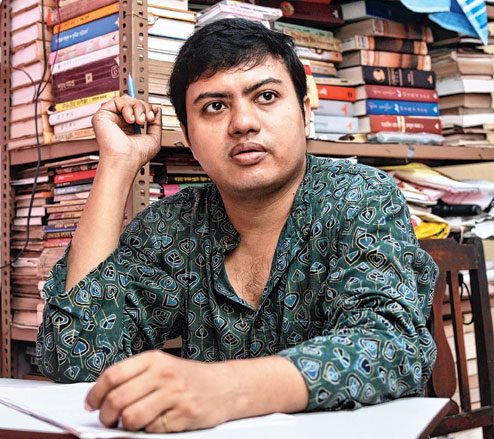
Caesar Bagchi thinks of a plot for his next story. Picture by Anup Bhattacharya

He leaves nothing to imagination. Caesar Bagchi writes real life stories with characters and incidents that exist and have happened. And that makes his novels and stories relevant to his readers. This year, his novel, Thake Sudhu Andhakar, in Saradiya Patrika, is based on a middle class woman’s struggles where he cites real life cases that he has seen or heard. His locations are specific, descriptions vivid, since he actually visits the places where his stories are based.

“I do not like to mention things that do not exist, specially about locations. This helps in giving my story a complete and real feel. Much of the characters in my stories and novels are based on real people. I do not like to take names, but the incidents have taken place around me or have occurred somewhere else and I choose to use them in my writing,” said Caesar.

Since Caesar lives in Bally, most of his stories are in Bally though he has also written about other places. He had once written a story, Shei Dupur, that was published in Desh, based in Dhenkanal in Cuttack, Odisha. “I had gone to watch the shooting of Sandip Ray’s Royal Bengal Rahashya,” said Caesar.

Like most writers, Caesar has had to struggle his way through. He began freelancing as a reporter in a number of media houses at the beginning of his career. “My early life was a struggle because I lost my father when I was only 16. I had to give tuitions and study at the same time. In 1996, I joined a small newspaper called Sonar Bangla as a freelancer and was also studying BA Honours in Bengali,” said Caesar. Studying Bengali after passing out of ISC board was a tough proposition for Caesar. “I wanted to study Bengali because I was used to reading Bengali books at home. I was inspired to study Bengali, mainly by Jibanananda Das whose poetry, Rupasi Bangla, mesmerized me. However, at that time, I was not aware of the syllabus at the honours level for Bengali and it was very difficult,” said Caesar.

The compulsion of earning a livelihood forced Caesar to freelance for eight different media houses at the same time after graduation. After completing a post graduation diploma course in mass communication, he got a job with a Bengali newspaper. Apart from Jibanananda Das’s poetry, Caesar’s favourite writers are Satinath Bhaduri and Ernest Hemmingway. “I have always been surrounded by books and have been reading since I was small because I grew up watching my parents read good literature,” said Caesar.

The turning point in his life came in 2005 when he joined Anandalok. “I improved as a writer and also found inspiration in writing stories. My first story to be published was Reunion, in Desh in 2010 in one of the monthly issues,” said Caesar. This was followed by more short stories in later years like Mukher Araley, Sutopa Boudir Mrityu O Isha, Shei Dupur and Maya. After Desh, Caesar’s short stories were published in other magazines as well. His Bisarjan was published in Sananda in 2012 and Swadhinata Dibas in Sananda Puja Bodhan issue in 2013. The idea of writing a novel had not occurred to Caesar. “I was asked to write a novel for Saradiya issue in 2012 and I wrote Ghare Phera that year. “The plot was based around Section 498A penal code and for that I spoke to people who were victimised by its misuse,” said Caesar. The novel was published in Saradiya Unish Kuri. In 2013, another novel Putul Khela based on domestic violence that was published in Saradiya Unish Kuri again.

Apart from his novels, Caesar had also compiled his short stories into a book, Alo Andhari, that was published in 2012. Although his stories and novels are based on the fast life of modern cities and towns, Caesar hopes to publish stories based on Bengali folk culture. “I travel a lot, specially in remote villages of Bengal to collect information on folk culture in different parts of Bengal,” said Caesar.
_________________________________________________________
MORE ABOUT CAESAR

DOB: December 15,1977

BORN IN: Calcutta

EDUCATION: BA, PG Diploma in Mass Communication

FAMILY: Wife

LOVES: Travelling, reading

HATES: Opportunistic nature

source: http://www.telegraphindia.com / The Telegraph, Calcutta / Front Page> Howrah> Story / Friday – August 29th, 2014

Ganesh thrives, not tradition. Final bastion of old flavour

MaharashtraMandalKOLKATA02sept2014

Ravindra Rekhade played proxy for his 86-year-old father on the first evening of the Ganesh Chaturthi rituals at Maharashtra Nivas on Hazra Road last Friday.

The orthodontist can’t be sure he will have his son play the same role someday. The young man, who is in his early 20s, has already shifted to Bangalore.

The Ganesh Chaturthi celebration organised by the Maharashtra Mandal is among the oldest in Calcutta, a tradition it has upheld since the 1930s. For Maharashtrians based in the city, the Hazra Road address is still the place to be at this time of the year.

The list of VIP visitors over the past couple of years has included Mamata Banerjee, though it might not be gratifying for her to hear that the footfall is fast decreasing. There are hardly any young faces around at the venue because many have chosen to leave Mamata’s Bengal.

“Forget the Sixties or Seventies, as a child I remember playing cricket here in a large group. There were so many people of my age around then. They have all left,” said Ninad Sagade, 22.

Rekhade’s son is an engineer who studied in Calcutta but went to Bangalore to work. Ninad, whose brother has already shifted base to Pune, is planning to move out after completing his BCom. “All my friends have left. There are few job opportunities in the city,” he rued.

Ninad’s brother Yati works for a software company in Pune and has fond memories of the celebration at Maharashtra Mandal and of Durga Puja in the company of family and friends.

Yati, who left town in 2012, said: “I moved out because there was no opportunity for the kind of work I wanted to do. But I will be back during Durga Puja because I was born and raised in Calcutta. I love the festivity of the four days.”

Subhas Mantri, the 68-year-old president of the Maharashtra Mandal, remembers his college days when there would be at least 30 young men and women at the venue on each evening of the 11-day celebration. “The Ganesh Puja at Maharashtra Nivas had more visitors then. We had about 450 families as members,” Mantri said.

The Maharashtra Mandal may be struggling to retain members but Ganesh Chaturthi has become a major event in the city’s festival calendar. An officer at Lalbazar, the city police headquarters, said the increase in the number of Ganesh pujas had prompted the police brass to consider “deployment of forces” from next year like they do for Durga Puja and Kali Puja.

According to one estimate, there are around 1,000 Ganesh pujas across the city. Many are small roadside affairs controlled by local political leaders who do not yet have the deep pockets to finance a Durga Puja with budgets running into crores of rupees.

Most of these pujas bypass the niceties of tradition, unlike at Maharashtra Mandal where care is taken to retain the flavour of a Maharashtrian celebration. Khichudi and alur dam may be the staple of the new Ganesh pujas in town but the organisers of the Maharashtra Nivas event won’t compromise on their modak, the traditional sweet that is offered as prasad to visitors.

The modak looks like a samosa from outside. Bite through the crisp outer layer — there is a steamed variety too — and you find the sweetness of ground coconut rolled into a ball like the old Bengali favourite called narkel nadu (coconut dumplings).

The second Sunday of the 11-day festival is reserved for mahaprasad, where a traditional Maharashtrian meal of matki, masala rice and jalebi, among other dishes, is served.

Marathi theatre and recitals are a part of the celebration on each day. This year’s highlight is an hour-and-a-half-long oration called Athavave Shivaraiyanche Pratap, commemorating the deeds of Shivaji.

The programmes organised by the Maharashtra Mandal round the year include Gopal Kala, celebrated the day after Janmashtami when people climb on each other to break a handi. “We do not climb on one another here because we are all old people! But we do break the handi,” said Mantri, who was a commentator on Doordarshan during the 1982 Asian Games.

What makes the celebration extra special is the repository of stories that does the rounds, recalling the moods and manners of a different era.

An old-timer said Ganesh Chaturthi used to be a private celebration in homes before the late 19th century, when Lokmanya Tilak’s initiative turned it into a community event. “The British had imposed stringent restrictions on the assembly of people. But such restrictions were waived for religious aggregations. Tilak used the opportunity and turned Ganesh Puja into a sarbojanin puja,” Mantri said.

The Maharashtra Mandal was established in 1924 while Maharashtra Nivas came into being in 1932 as a guesthouse for Maharashtrians visiting Calcutta. “It was to give them the feel of home away from home,” Rekhade said.

The large auditorium on the ground floor where all cultural programmes are held has large portraits of Subhas Chandra Bose and Rabindranath Tagore alongside those of Lokmanya Tilak and Chhatrapati Shivaji.

Chief minister Mamata, who visited Maharashtra Nivas on Friday, has held several meetings at the address over the years. Immediately after her victory in the 2011 Assembly elections, Mamata had assembled her MLAs and MPs at the venue. She had also presided over party meetings there during her stints as the railway minister.

source: http://www.telegraphindia.com / The Telegraph, Calcutta / Front Page> Calcutta> Story / by Subhajoy Roy / Tuesday – September 02nd, 2014
Bengal girl joins Malala in Dutch book

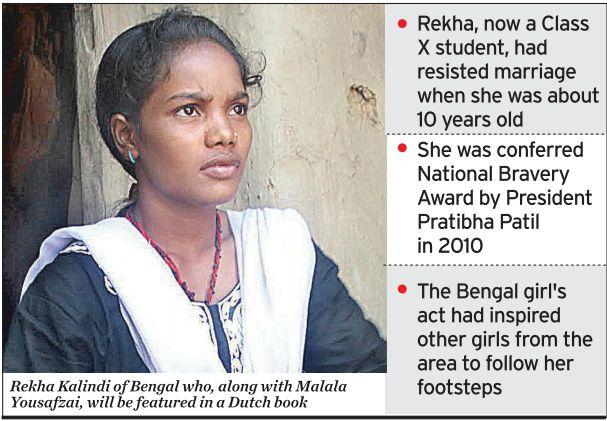
RekhaKOLKATA02sept2014

What is common among Malala Yousafzai, Anne Frank, Hellen Keller and 16-year-old Rekha Kalindi from Purulia in West Bengal?

The braveheart from the State will feature along with Malala and Anne Frank in the book Children who changed the world to be released in November in Amsterdam marking the 25th anniversary of the UN Declaration of the Rights of the Child.

Rekha, now a student of Class X, resisted marriage when she was about 10 years old. Her resistance led to other girls in the area following in her footsteps. She, along with two other girls from the district, was conferred the National Bravery Award by then President Pratibha Devisingh Patil in 2010.

The book is written by Dutch Newspaper NRC Handelsblad’scorrespondents who live and work in the countries of the children featured in the book.

It profiles 20 children and the chapter on Rekha is written by journalist Aletta Andre.

Girls inspired
“Rekha’s story fits very well in this theme (the book’s theme), as she resisted a very common but not so great practice in her area, when she was about 10 years old and has with her act inspired other girls to do the same. It shows that very young children, even very young girls in a patriarchal society, have the power to make a difference,” she said in an email response.

Speaking to The Hindu, Rekha said she was very happy that the story about her is being published in other countries. Since the time she and other girls from Purulia had resisted child marriage, many girls came forward to oppose the practice, she said, adding that poverty and lack of education are still resulting in such marriages.

She also pointed out that a Class V textbook of the State Board has a chapter on child marriage where her and another girl’s names feature.

“Such stories (like Rekha’s) encourage adolescents to protest and raise their voice against child marriage,” Asadur Rahaman, chief of field office UNICEF in West Bengal, said. Pointing out that child marriage and trafficking of girls continue to be a concern in States like West Bengal, Mr. Rahaman said that a scheme like Kanyasree providing scholarship to school-going girls is a significant
initiative.

source: http://www.thehindu.com / The Hindu / Home> News> Cities> Kolkata / by Shiv Sahay Singh / Kolkata – August 28th, 2014

INDIA ON WAX – Record discs that helped defeat the British empire: Tagore sings ‘Bande Mataram’

During the freedom struggle, recordings of patriotic speeches and songs helped rally support.
PhonographKOLKATA01sept2014
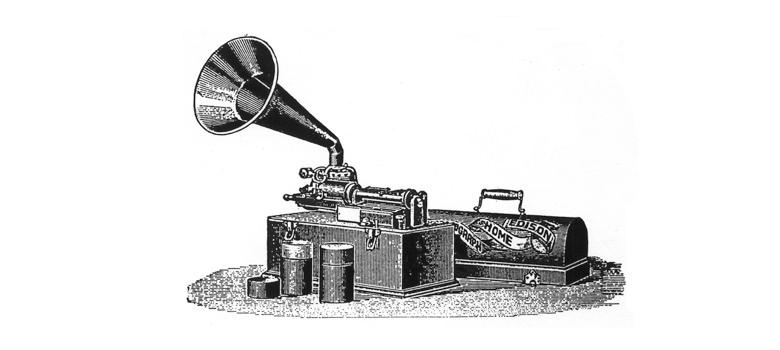
Between 1877 and 1878, Thomas Alva Edison submitted patent applications for the phonograph in many countries, including British India. It is not known when these patents were granted, but it is known that in December 1878, the first phonograph recording was demonstrated in Kolkata.

For the next 30 years, recordings on the phonograph cylinder became quite popular, remaining so even in the early years of disc records.

Many members of royal families and wealthy people bought cylinder phonograph machines and recorded musicians and religious personalities. The Maharajah of Khetri recorded Swami Vivekananad’s speeches and discourses much before he went to America and gave his famous talks on religion. The internet is full of versions of his celebrated speeches.

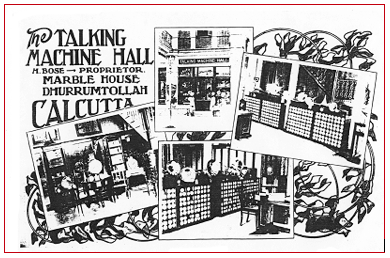
Hemendra Mohan Bose (1864-1916) opened the Talking Machine Hall in Kolkata, a shop where one could get one’s voice recorded. Bose was a sound recording expert and also had an agency to sell Edison and Pathe brand phonograph machines. Many great writers, poets and political leaders would visit him and he would record their recitations and speeches.

A 1906 catalogue lists several cylinder recordings of Rabindranath Tagore. Unlike disc records, cylinders could not be reproduced for sale. Most of these cylinders have been lost. Some museums have broken or damaged copies of cylinders as artefacts but no audible sound can be extracted from them.

TagoreAdsKOLKATA01sept2014
During agitations against the partition of Bengal in 1905, H Bose recorded many political speeches and songs, such as Bande Mataram, both on phonographs and disc records, and they became very popular. But his factory and shops were sealed, machines and discs destroyed ruthlessly by police. As a result, nothing has survived today except a very short piece from Bande Mataram, sung by Tagore.

Recording experts from Beka, a German company, were in Kolkata in November 1907. The British government went about destroying all nationalistic material, whereas the German company was the first to record a political speech right under the nose of the British.

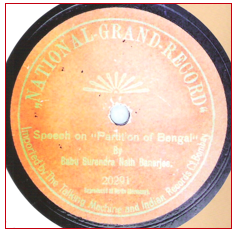
The National Grand Record label had a saffron disc with a rising sun as the logo. On it was recorded a speech by Babu Surendranath Banerjee, on the partition of Bengal. The flipside of this unusual 78-rpm disc has a speech on Bande Mataram.
DiskKOLKATA01sept2014

The man responsible for producing this disc was Sir Abdul Halim Guznavi, a political leader and agent for the Beka record company in Kolkata. Only few copies have survived. We have the image of the label only but no access to the audio file of this historically important recording.

We welcome your comments at letters@scroll.in.

source: http://www.scroll.in / Scroll.in / Home> All News / by Suresh Chandvankar / August 15th, 2014

DOWN MEMORY LANE – A legendary doc

Dr. Hem Chandra Sen
Dr. Hem Chandra Sen

From curing ailments common and uncommon to initiating Durga Puja in Delhi, Dr. Hem Chandra Sen left behind an unforgettable legacy

Doc Holliday may have been a favourite with youngsters watching Western cowboy films over five decades ago, but long before that Delhi had its own bearded Doc whom few remember now. There were no motorised vehicles in 1879 when Dr. Hem Chandra Sen came here in a bullock cart all the way from Agra. Rich people travelled in palanquins, buggies or four-wheeled landaus and the poor in ekkas and carts. Women hardly showed their faces in public, they either wore burqas or ghoonghats and there was no electricity and piped water supply. In this milieu Dr. Sen became the first Indian allopathic doctor of Delhi.

From dispensing medicines to those building the E.I. Railways’ Agra-Delhi line, he started treating the local populace; women did not mind uncovering their heads and faces before him. Dr Sen was credited with “miraculous healing powers”, his day beginning at 4 a.m. and ending late at night. Rich and poor alike were treated by him. Those who couldn’t come to his chambers were visited by him, for which he used two sets of horse carriages — one for the morning and the other for the evening. He charged Rs. 2 (for the full treatment) from those whom he visited at home and nothing from patients who came to his clinic. He set up a pharmacy also, as getting medicines from Calcutta took a lot of time. Later it became a separate unit known as H.C. Sen and Company.

In 1883 Dr. Sen, founder of the Imperial Medical Hall, set up the Imperial Medical Press and type-setting moulding unit adjacent to his clinic. It was afterwards run by his nephew A.T. Roy, and the latter’s sons and grandsons, as one of the leading presses of Delhi. Member of the first management committee of Hindu College, Dr. Sen played a leading role in youth education along with Lala Shri Krishna Dass Gurwala (one of the founders of the college), M. M. Malaviya and many others of note.

Lala Krishan Dass Gurwala was among the seths who persuaded Dr. Sen to settle down in Delhi. It is interesting to note that the name Gurwala was appended to the family as it used to provide gur and gram to pilgrims, says the centenary brochure on Dr. Sen brought out in 1980. Gurwala’s grandfather was hanged by the British for supporting Bahadur Shah Zafar. The family traces its history to 1560 and Lala Nodhamal of Akbar’s reign. After Gurwala helped establish the Delhi Cloth and General Mills, it meant an extended practice for Dr. Sen. However when the good doctor fell seriously ill due to his exertions (“grace under pressure”, to quote Hemingway), the British Chief Commissioner of Delhi ensured that there was complete silence in the Fountain area of Chandni Chowk so that he was not disturbed. It’s worth mentioning that when Unani medicines were ineffective even the famous Ballimaran hakims did not hesitate in referring patients to Dr. Sen for a speedier cure.

Europeans also came to Dr. Sen, a Freemason, for treatment and for advice even on personal matters. Born in Calcutta before the 1857 Revolt, he died in 1906 and the Delhi markets were closed for a week as a mark of respect. He was succeeded by his sons, Dr B. C. Sen and Dr R.B. Sen (Adu Babu). From 1880 till his death Dr. Sen had stayed on in Delhi and among his guests were Rabindranath Tagore, Swami Vivekananda, novelist Sarat Chandra, Sir Surendranath Banerjee, Subhas Chandra Bose, Madan Mohan Malaviya, Hakim Ajmal Khan and the Maharajas of Jaipur and Jodhpur.

Interestingly, Vivekananda used to walk to the Yamuna every day through Chandni Chowk so long as he stayed in Delhi. The road from the Fountain leading to Old Delhi station is named after Dr. Sen and on Ansari Road in Daryaganj his descendants continue to maintain their 100-year-old pharmacy. Now a book on the legendary doctor, an initiator of Durga Puja in Delhi, is being written (at the behest of Anees Enterprises) by Shipra Sen to commemorate her ancestor whose medicines for curing diseases like jaundice, other liver infections and malaria are still popular. May be Doc Holliday too would have got rid of his bottle-induced problems had he cared to saunter (shoulder-strapped gun and all) into Dr. Sen’s celebrated 19th Century “Maktab” at the Fuwarra!

source: http://www.thehindu.com / The Hindu / Home> Features> FridayReview> History & Culture / by R. V. Smith / August 31st, 2014