Maharaja Nandakumar was hanged by the British 240 years ago
: With his head held high, he faced the wrath of the mighty British Raj when he raised allegations of corruption against India’s first Governor General Warren Hastings. Now, more than 240 years after Maharaja Nandakumar was hanged in 1775, the turban that adorned his head will be put on display at the Victoria Memorial Hall in Kolkata.
Some historians have described the hanging of Maharaja Nandakumar, primarily a revenue officer under the Nawab of Bengal, as one of the first ‘judicial murders’ in the country.
“Decorated with a straight zari ribbon, light brown and cream in colour, the turban was purchased by the Art Purchase Committee of the Victoria Memorial Hall in 1984 from Gauri Shankar Roy of Murshidabad,” Jayanta Sengupta, Secretary and Curator of Victoria Memorial Hall told The Hindu.
This rare textile artefact will be put up on display in October, VMH authorities said.
With an aim to preserve the turban and other textile artefacts, in December 2013, the VMH had organised an in-house workshop in which international textile conservation expert Jamie Lightfoot had participated.
Although, Nandakumar had assisted the British during the Battle of Plassey (1757), he generally was hostile to the British, historians have said.
It was in 1775, a year after Warren Hastings became Governor General of India that Nandakumar accused him of having accepted bribes from the nawab and others. However, Nandakumar himself was in turn accused by Hastings of conspiring to coerce a third party to make the bribery accusation against him.
This charge against the revenue collector was soon dismissed, but in an unrelated case an accusation of forgery was brought against him. Despite the fact that the person who had levelled the charges against him was an Indian, Nandakumar’s case was judged under British laws where forgery was a capital punishment. A newly established British court at Kolkata sentenced him to death.
“Maharaja Nandakumar was publicly hanged on the banks of the Hooghly at Kidderpur at a place known as Collie Bajar,” Sankar Kumar Nath, who has worked extensively on the history of Calcutta told the Hindu.
Pointing out that Sir Elijah Impey, the presiding judge who imposed the death sentence on Nandakumar, was a close friend of Warren Hastings, Dr Nath, an oncologist by training, said that eminent statesmen like Edmund Burke and Lord Thomas Babington Macaulay had described Nandakumar’s hanging as a ‘judicial murder’. Dr Nath also pointed out that the turban is an artefact of great significance as Nandakumar’s story can actually be called one of the early acts of rebellion against the British rule, and heralded one of the most important periods of British history in India.
source: http://www.thehindu.com / The Hindu / Home> News> Cities> Kolkata / by Shiv Sahay Singh / Kolkata – September 29th, 2014
They live in a country that is practically at war. Violent clashes between Russia-backed separatists and Ukranian forces has already claimed around 300 lives after a Malaysia Airlines flight was brought down near Donetsk in July. Advisories from nearly all countries, including India, have warned citizens against taking risks and avoiding mobs.
But the Indian community in Kiev has not allowed these developments to come in the way of Durga Puja and Navratri celebrations.
For the third year running, Indians in Kiev, nearly 5,200km away from home, will celebrate Durga Puja. The idol has already reached Ukraine from Kumartuli, and the purohit is from the Delhi Kali Bari. The community also encourages Ukrainians to participate in the festivities. “We have been celebrating Puja here for the last two years. Due to the unstable condition here in Ukraine, we have decided to celebrate Puja at my residence this year, around 20km from Kiev.
The Indian community here is very small and we all get together and prepare for the celebrations. We have cultural programmes on all days after the evening arti,” said Kasturi Saraiya, who hails from Assam but was born and brought up in Kolkata.
Saraiya is a member of Sanskriti, Centre for Indian Culture, in Kiev. This organization celebrates all Indian festivals and spreads awareness about them among locals. So much so, that Ukrainian dancers perform during the Puja celebrations.
The small community of Indians might be living thousands of kilometers away from home, but they celebrate in style, trying to maintain a lot of the traditions. As far as the actual puja is concerned, there is no compromise. “Our aim is to present and popularize Indian art and culture.
We want to create awareness among the local community about Indian culture, traditions and ethics. Nowadays, there are many Ukrainians who look forward to attending our prgrammes,” said a member of Sanskriti.
source: http://www.timesofindia.indiatimes.com / The Times of India / Home> City> Kolkata / by Jayanta Gupta, TNN / October 03rd, 2014
The synagogues in Israel may be caught in cross-firing, but those in India are going to be spruced up soon, courtesy the Modi-led BJP government. The files started moving with speed within the Culture Ministry when the Palestine issue got worse — signifying the BJP government’s political stance in the Israel-Palestine conflict.
Though the move to protect the synagogues was initiated during the UPA rule, the Manmohan Singh government developed cold feet later as Israel and Palestine has always been a volatile subject in our country. “Our team had visited the synagogues in Kolkata and had even finalised the sketches way back in 2010. But the project did not go beyond that, as there was some terse communication to go slow,” said an ASI source.
The Archaeological Survey of India is busy moving the files and renovation is expected to start soon. Sources admit that the renovation of synagogues is a political decision. “Home Minister Rajnath Singh and Minister of External Affairs Sushma Swaraj are planning to visit Israel towards the year end and there are enough reasons to believe the renovation is closely connected to the visits,’’ said a government source.
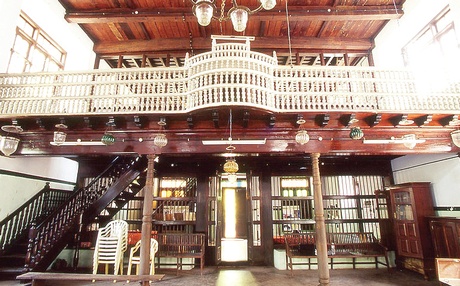
There are around 35 synagogues in India—most of them in Kochi, Kolkata, Mumbai and Ahmedabad. “The synagogues in our country represent a rich cultural and religious tradition. The ASI is actively thinking of renovating the synagogues across the country. Most of them have been encroached upon by private parties and some, even by governments,’’ said a source in the Ministry of Culture.
The source added that the renovation work will start initially in Kochi’s Thekkumbhagam Synagogue and the Beth El Synagogue and the Maghen David Synagogue in Kolkata. The government is also planning to start a “Jewish tourism circuit” connecting all synagogues in the country, the source added. Though the government gave in following pressure and even vouched its support to the ‘‘Palestinian cause’’, it is an open secret that many BJP leaders, including PM Modi, have a close affiliation with Israel. Modi visited Tel Aviv as the CM of Gujarat, a state which has old diamond trade ties with Israel.
Transport and rural development minister Nitin Gadkari, too, visited Israel three years ago when he was the BJP chief while Sushma Swaraj is a self-declared “fan” of Israel. She, as the chief of India-Israeli Parliamentary Friendship Forum in the past, visited Israel last year.
“Both countries are victims of the growing religious fundamentalism and it is natural that they grow closer. It also helps that both share unique ethnic and religious aspects,’’ said a Culture Ministry official, who is part of the renovation project.
source: http://www.newindianexpress.com / The New Indian Express / Home> The Sunday Standard / September 28th, 2014
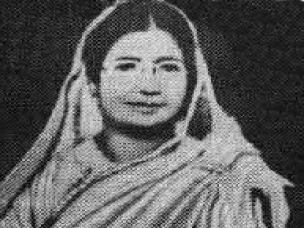
One of the rare rebellions of her time, Roquia Sakhawat Hussain is a name that echoes ceaseless struggle to bring women under the ambit of social respect and admiration. Born in 1880, this gritty and composed lady from a small village of Pairabondh in the then undivided Bengal gave her all towards cementing a respectable position of women during her epoch.
A livid exponent of feminist movement in eastern India, Begum Rokeya conceived and implemented the idea of establishing the first school mainly aimed at Muslim girls. Issues like gender equality and women’s emancipation found a new dimension under her prudent leadership. Being the precursor of future feminist movement in India and Bangladesh, Rokeya did her bit to bolster the position of the so called ‘second sex’ in a puritanical society stuffed with orthodox ideologies.
Married off at an early age, hers was in no way a beginning worth remembering. However, the indomitable urge to stand out for a cause and be the guiding star for he contemporaries and the ages to come drove her forward.
Begum Rokeya had the funny bone as well as the tinge of sarcasm that helped her euphemism narrate real-life incidents of injustice forced upon Bengali-speaking Muslim women. She displayed enough valiance to tell it on the face of the oppressors that they are adopting immoral ways distorting version of Islam.
Oborodhbashini (“The woman in captivity”), Paddorag (“Essence of the Lotus”) and Narir Adhikar (“The Rights of Women”) are among her widely read books that openly defied restrictions on women.
source: http://www.headlinesindia.mapsofindia.com / Headlines India / Home> Social Interest News> Women / Friday – March 04th, 2011
As people in the city started opening their sleepy eyes on Friday morning, many early train catchers halted for a while seeing a group of white sari-clad elderly women coming out of Howrah station chanting “Radhe, Radhe, Radhe, Radhe”.
About 70 widows reached Kolkata from various ashrams in Vrindavan on Friday to visit the city and witness the spirit of festivity here.
Kanaklata Devi (105), who left the city 70 years ago, pointed at an advertising hoarding with a Hema Malini photograph and shot a humorous comment: “Tumi to asechho amader sahore, amra gele dosh ki?” (You have come to our city, so what is our fault if we stay at Vrindavan?”
BJP’s Mathura MP Hema Malini’s recent comment on the presence of many widows from Bengal in Vrindavan created a furore among various people and activists. The actor-turned-MP later clarified that these widows should not be thrown out of their native state by their relatives after their husband’s death. They should rather be treated with care and affection by their own people in their own state.
Kanaklata had a point to counter Hema Malini. “I am coming to this city after 70 years. Because I did not want to miss the chance of attaining ‘moksha’ by not passing away in that divine land of Vrindavan. According to myth, a person attains ‘moksha’ if he dies in Vrindavan. But this year, I could not refuse Pathak babaji’s requests to visit my hometown.”
Sunitra Devi (79) was nostalgic as she got down from the bus in which they were brought to Raj Bhavan to meet the governor. The lady, who lost her husband at the age of 26, used to live at Maniktala. “After our marriage, he brought me here to show Raj Bhavan. But at that time, we could see Raj Bhavan only from a distance,” she said.
The widows of Vrindavan will be in the city for two more days, during which they plan to visit the artisan’s hub at Kumartuli, hop some Puja pandals and enjoy a tram ride. “Getting an opportunity to see their favourite spots in and around the city after so long, the elderly women were behaving like teenagers,” said Bindheswar Pathak, founder of Sulabh Foundation, which is looking after about 1000 widows in Vrindavan.
source: http://www.timesofindia.indiatimes.com / Th Times of India / Home> City> Kolkata / by Kamalendu Bhadra, TNN / September 27th, 2014
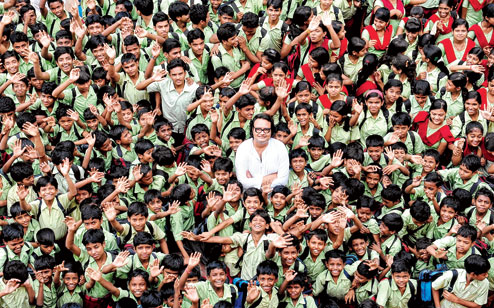
Vinayak Lohani basks in the love of his 900-strong Parivaar comprising destitute children whom he feeds, clothes and educates in Thakurpukur. Picture by Sanjoy Chattopadhyaya
His sartorial style is a crisp, white kurta-pyjama teamed with thick, black-rimmed glasses. He idolises Sri Ramakrishna and Swami Vivekananda and quotes Sunil Gangopadhyay. He worships Satyajit Ray and Ritwik Ghatak and unwinds with Anjan Dutt’s songs. He loves eating fish and roaming the old lanes and bylanes of Calcutta at night.
If 37-year-old Vinayak Lohani is catholic in his tastes, he is single-minded when it comes to his cause: providing home, hearth and education to the poorest and most vulnerable of children through the largest free residential school in eastern India.
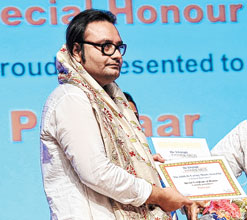
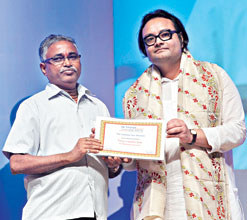
Vinayak receives a special certificate of honour on behalf of Parivaar in the ‘A School that Cares’ category of The Addlife Caring Minds Awards, along with a special honour from The Telegraph Education Foundation at The Telegraph School Awards for Excellence 2014, presented by Peerless in association with Parle-G and powered by Adamas University. The awards were given away at the Science City auditorium on Saturday
Vinayak, winner of The Telegraph Education Foundation’s certificate of honour at The Telegraph School Awards for Excellence 2014 on Saturday, was born in Bhopal but has made Bengal his home.
Vinayak had come to Bengal as a student, first to earn a degree in mining engineering from IIT Kharagpur and later an MBA from IIM Calcutta. It was while studying for his MBA that the then 20-something engineer sprang the first surprise of his career. He opted out of campus placements.
“I was the only one in IIM Calcutta’s history to do so!” he says with a laugh. “I wanted to do something in the social space. I wasn’t interested in a corporate career.”
By then, Vinayak had started skipping classes, writing journalistic pieces on social initiatives and volunteering with NGOs. He had worked with Infosys for a year in between his stints at IIT and IIM and realised that his calling lay elsewhere. Calcutta, with its “rich history of leaders and reformers”, fuelled his desire to be different.
“Being a good student from a middle-class family, engineering and MBA happened by default. But soon I found myself losing interest in a mainstream job and the corporate environment,” recalls Vinayak.
Vision & Vivekananda
For inspiration, Vinayak had Vivekananda. “I have always been inspired by the agents of change in society and the sense of sacrifice, service and devotion, especially Swami Vivekananda’s. I took diksha from the Ramakrishna Mission…spent time with monks. Mother Teresa’s influence was strong, as was the legacy of our freedom movement. I found no momentum to return to my hometown. All my thoughts became very Calcutta-centric.”
At 25, Vinayak became quite the non-conformist, determined to establish a reformatory institution of his own rather than be in the so-called rat race. “Doing what everybody else was doing didn’t excite me. My notion of success was different. I had been to the best of educational institutions, so I didn’t need to prove my abilities to anyone. I knew that if I put in my best I might be able to make it happen.”
Vinayak’s plans did irk his civil servant father, though. “My folks were worried whether I had the kind of maturity needed to carry out the responsibility of running an organisation, dealing with different domains and steering it safely and successfully.”
After moving out of IIM, he rented a small house in Sakherbazar in Behala. His plan was to start a free residential school for deprived children — the kind he had seen loitering on railway platforms and in red light areas. A few friends, researchers and professors from IIM were Vinayak’s “sounding board”.
Parivaar was born in 2003 but bringing up the child proved far from easy. “I prepared proposals, met people here and there, but all in vain because no one wanted to support something that was the wishful thinking of one individual,” says Vinayak.
With his efforts to raise funds leading nowhere, he rented a building near Thakurpukur with his earnings from lectures and tuitions to MBA aspirants. Vinayak started his mission with three kids, often not knowing where the next meal would come from. “It was a hand-to-mouth existence. I was spending whatever I was earning. My mother was my first donor,” he recounts.
In another six months, Vinayak had 55 children under his small roof, thanks to the support of “well-placed” IIM alumni who responded to his emailed appeal.
By the end of 2004, he had purchased a two-acre plot in Thakurpukur to build his dream brick by brick. Parivaar is currently spread across 20 acres. “Surely this is eastern India’s largest free residential institution for children today but not too many people know about it,” says Vinayak.
Vinayak presents The Shining Star Honour to Purna Chandra Rout, a non-teaching employee of La Martiniere for Girls for 37 years, at the Science City auditorium on Saturday. Pictures by Rashbehari Das
Parivaar path
Parivaar is today an institution that houses 672 boys and 298 girls whose lives have changed because of education and Vinayak’s encouragement. Some have gone on to get university degrees. “We have had a significant number of very inspired volunteers. They were mostly our donors who became our campaigners and spread the word actively,” says Vinayak.
Parivaar has two campuses that take in children between the ages of four and 10. The one for boys is called Parivaar Ashram. Located a few blocks away is the girls’ campus, called Parivaar Sarada Teertha. Each campus has dorm-like housing, a library, computer room, dining area, a soccer field and a volleyball court.
Parivaar also has its own co-educational school till Class X called Amar Bharat Vidyapeeth, located on the boys’ campus. “It’s not as if the kids’ stay is over once they are through with their education here. Would a parent ask a child to leave home? The older ones tutor the younger kids, earn pocket money and can move out of their own free will once they feel they are ready,” says Vinayak.
There are a few rules that set Vinayak’s initiative apart from others of its kind. “We don’t accept institutional support from any foreign agency. Ninety per cent of our donors are individuals of Indian origin, whether they are living in India or abroad. No government support. That’s how I could build it my own way because foreign or government agencies have their own parameters. I wanted to design my school my way, just like an artist would create his own piece of art,” he reveals.
Target 5,000
While his field teams are scouting for destitute children to bring home, Vinayak’s mind is preoccupied with the future challenges of the mission. “I hope to touch 1,200 by December. Since we have limited capacity at the moment, we admit children based on their neediness. Primarily orphans and the homeless are picked up from railway platforms and pavements, or those with one parent and incapable of taking care of the child.”
Apart from the city, Parivaar reaches out to rural areas, including the tribal belts of Midnapore, Bankura, Purulia and Jharkhand. The emphasis is on giving girls vulnerable to exploitation an opportunity to build their lives.
Vinayak’s IIT and IIM education hasn’t gone waste either. Parivaar is an example for institutions on how to “scale up” operations using entrepreneurial skills.
Unlike many social welfare organisations that are cagey talking about finances, Vinayak is upfront about money. “We raise around Rs 14 crore every year. I can raise Rs 100 crore over the next 10 years but I am not satisfied with that. For me, sky is the limit. I am taking Parivaar to 5,000 children in the next seven years. My aim is to convert Parivaar into the largest free residential school in the country.”
Model mission
The Parivaar model is already a case study at business schools. “A lot of people want to do things but don’t know how to get started. There’s a huge possibility of social enterprise and since I understand how it works, I want to help those who want to be agents of change — be it in education, health or livelihood,” says Vinayak.
His personal turning point was the decision to take the road less travelled, away from home and family. “When I took up the responsibility of these children I decided that I was not going to marry and raise a family. Otherwise, it wouldn’t have been possible for me to give myself completely, emotionally. I would have become nervous, I would have collapsed. So a strong focus was the emotional focus. I closed the door on any thoughts or feelings that might be distracting. And see what I have today, a family of 900!” he smiles.
Vinayak is now comfortable letting the institution run on “auto-pilot”. The faculty and his 179-strong office team take care of everything, his role being limited to “reviewing, mentoring and monitoring”. That is when he isn’t busy giving lectures at youth forums or in his new role as member of a special taskforce under the Union ministries of finance and women and child welfare. He also makes time for helping, mentoring and handholding young social entrepreneurs.
If there is one thing Vinayak is touchy about, it is about not being identified as “a Bengali”. His Bengali look, he says, has been “acquired through effort”. The dhuti was his choice of everyday attire until two years ago, when he switched to his trademark white kurta-pyjama.
“I would get offended when people wouldn’t take me as a Bengali. I have always identified with the Calcutta of the 1960s and ‘70s — the shilpis, buddhijibis and their simple-living-high-thinking philosophy that defined the city’s cultural aristocracy. Emotionally, I see myself as that and I have really tried to become one for all these years,” smiles Vinayak.
What message do you have for Vinayak Lohani? Tell ttmetro@abpmail.com
source: http://www.telegraphindia.com / The Telegraph, Calcutta / Front Page> Calcutta> Story / by Mohua Das / Monday – September 01st, 2014
He was born and brought up in Belgrade by his Bengali mother and Serbian father. He got his degrees, including a Masters, in Austria, where he spent eight-odd years. But with a name like Robindro, he could not escape music.
Barcelona Gipsy Klezmer Orchestra’s clarinet player-scholar Robindro Nikolic is in town, holding workshops and bringing the worlds of gypsies and bauls together.
“My mother, Manjula Mukherjee had gone to Europe with her parents who were diplomats based in Yugoslavia. She studied medicine, but later took up Ayurveda. She met my father, who is a Serbian, at Belgrade,” Robindro narrated in his accent.
He further explained what brought him to Kolkata for the first time, four years ago.
“In Switzerland in 2007, I was performing with Zubin Mehta when I met Pandit Tanmoy Bose, who was collaborating with Anushka Shankar. We exchanged numbers, spoke about music. He urged me to make my own music as I was part of a huge orchestra. He really inspired me. In 2010, I came to Kolkata, where Bose introduced me to many people — musicians like guitarist Bodhisattwa Ghosh with whom I jammed at Someplace Else, and the cultural organization Banglanatak. I was keen to research on music medicine and music therapy, so Bose’s wife, Bonnya, who was with ITC Sangeet Research Academy at the time, introduced me to their archive where I spent considerable time,” he told TOI on Wednesday.
“Many people think my name is Brazilian or Portuguese. But I tell them no, it’s Bengali,” he said.
When prodded on his association with Indian music, he said, “I have researched on the broad science of Indian ragas and music therapy in India. But this is the first time I’m having a musical exchange with Bengal folk musicians. We found many similarities between the folk forms of the two worlds. ‘Doina’, a Jewish folk form from East Europe, is very similar to Baul, as my fellow musicians pointed out. It’s about spirituality and not religion. I’m also keen on exploring the Bengal wind instruments.”
But Baul is not a “new love” for him, he said. “When I was little my mother would travel back home and get, among others, Baul music recordings for me.”
Singer Dipanwita Acharya, who was part of the workshop, said, “It was a wonderful experience. And I’m so happy to learn about ‘Doina’. So many similarities with our Baul music and the storyline of these music forms are the same globally.”
Percussionist Sandip Bag, who played ‘dubuka’, an instrument from Middle East, at the workshop, said the rhythms Robindro played were quite different, and this was a refreshing experience.
Arpan Thakur Chakraborty, a guitarist, added, “This was very helpful for me. I learnt a lot about scale variation and progression while playing ‘jazz manouche’ or gypsy jazz with him.”
source: http://www.timesofindia.indiatimes.com / The Times of India / Home> City> Kolkata / by Shounak Ghosal, TNN / September 25th, 2014
Actress Tanusree, who was a judge of the CESC The Telegraph True Spirit Puja 2013, at a pandal
More than 70 new puja organisers with varied age, budget and popularity quotients have joined a movement that is dozen years old, has 300 members and growing — the CESC The Telegraph True Spirit Puja.
In the true spirit of the movement for a safe, clean and people-friendly festival, the newcomers — from 10-year-old pujas to seasoned 44-year-olds — received their induction briefing at Spring Club on Saturday.
“The CESC The Telegraph True Spirit Puja is not about big idols or big pandals but something else. It is about whether you are environment-friendly or not, whether you are taking care of the pandal-hoppers or not, whether you have taken proper steps for their safety or not,” said Arijit Basu, the deputy general manager for customer relations of CESC, at the first club meet.
The movement started in 2003 with around 70 puja clubs and committees, swelling to 300 participating members in over a decade. The CESC The Telegraph True Spirit Puja judges pandals on three broad parameters:
n Safety measures top the list. Judges look into the organisers’ efficiency in crowd management and their capability in handling crisis situations, availability of first-aid, presence of fire safety measures and more.
n Civic consciousness comes next. Are the pandals following sound pollution norms? Are they eco-friendly? Is their waste disposal system efficient? Are they retaining or restoring public property in the locality?
n Social commitment of the organisers is the final category. Do the pandals have help desks to assist pandal-hoppers and how efficiently are these being managed? What facilities do they offer to people with special needs, like someone on a wheelchair or senior citizens? Do they have toilets and drinking water taps? Are the organisers committed to charity and community engagement?
The Model Puja award goes to the best pandal after two rigorous rounds of judging. A Viewers’ Choice Award has been added this year where pandals with the highest upvotes on the CESC Facebook page will get the trophy.
According to some of the new entrants, the best thing about the movement is that the CESC The Telegraph True Spirit Puja is not about big budgets but encouragement it offers to homely and small-scale pujas, such as the Dakhineswar Adi Sarbojanin Durgotsav O Dol Utsav Samity — in its 75th years this season.
“We don’t have a theme and we cannot compete with the grandeur of other pujas but we are committed to the spirit of the festival and we care about all those who drop in. Everyone is a VIP for us. The awareness this movement is creating is necessary and we fit into the spirit of it,” said Tarashankar Pramanik, the vice-president of the organisation.
Others have other reasons like civic and environmental aspects. For 21-year-old Sankha Ghosh and 18-year-old Ankit Saha of Pallibasi Durgotsav Committee in north Calcutta, the biggest draws are the issues the movement espouses.
“This is the first year our generation has taken the reins of the 44-year-old puja. We felt the need to participate in a movement like this. If we don’t take things like sound pollution, eco-friendliness and social commitment seriously, what will we leave for the next generation?” asked Sankha.
“Ours is a small puja, very homely… but it is the heart of it that counts, not the budget or the popularity,” added Ankit.
source: http://www.telegraphindia.com / The Telegraph, Calcutta / Front Page> Calcutta> Story / Monday – September 22nd, 2014
Kajal and Anirban Banerjee at the Rotary Sadan programme on Sunday. / Picture by Arnab Mondal
An adoption agency had turned him away. “Are you blind?” an official had asked him as he entered the office with his wife. He was blind and was supported by his stick. “No child wants to have a blind father,” he was told. He left. He felt that though gifted with eyes, the officials couldn’t see.
Later, encouraged by a well-known social worker, he adopted a girl from another agency. Today he and his wife are very proud parents.
“It was the best decision of my life,” said the gentleman.
As it rained hard outside, Rotary Sadan on Sunday morning heard a number of heart-warming stories.
Adoptive parent Indrajyoti Sengupta read poems he had written on adoption. Kajal and Anirban Banerjee, who have an adopted daughter, regaled the audience with their stories. These parents were only happy that they had gone ahead, despite obstacles, inhibitions and apprehensions, and taken the step of adopting a child.
The occasion was “Lifeline”, an event organised by Rotary Club of Calcutta Renaissance, with Round Table India and Ladies Circle, two Rotary wings, to promote adoption. It was an open forum that brought together couples who have adopted children, couples who are contemplating adoption, representatives of adoption agencies and government organisations.
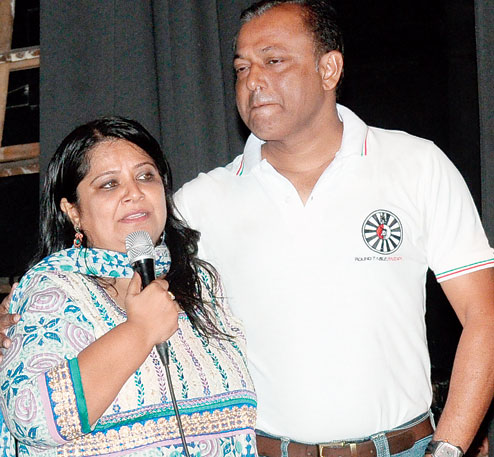
Round Table India national president Deepak Menda spoke about how the organisation in the last 17 years had built 1,700 schools in the country and helped with the education of 5.3 million children.
Lifeline is a recent initiative, he said, to advocate adoption, the need of the hour.
Adoption is a far better option than a long period of infertility treatment that can cause inconvenience and cost a lot of money, a Rotary official said.
The event also saw the launch of the website www.adoptionlifeline.in by the organisers.
Adoption can be a beautiful experience, but as many adoptive parents and prospective ones will attest, the process is not always easy. It is complex and there are inordinate delays.
The website, which people can access shortly, is meant to be an interface between prospective adoptive parents, adoption agencies and government agencies to facilitate more adoption, beside being a network for adoptive parents.
source: http://www.telegraphindia.com / The Telegraph, Calcutta / Front Page> Calcutta> Story / by Chandrima Bhattacharya / Monday – September 22nd, 2014
The morning durbars under the portico of the delightfully eccentric Fairlawn Hotel on Sudder Street have just become history. The ‘Duchess of Sudder Street’, as Vi (Violet) Smith was popularly called, will not be holding ‘court’ there anymore. And legions of her fans, as well as the galaxy of loyal customers of her hotel, will no longer be regaled by her stories about the Kolkata of yore. Smith passed away at her first-floor quarters of Fairlawn Hotel on Saturday at an age of 93.
The stories she narrated were as eclectic as her personality, and the hotel itself. One of her favourites was how Shashi Kapoor (“drop-dead gorgeous he was,” recalled Vi) met and fell in love with Jennifer Kendall. In the spring of 1965, the Kendals, who used to own a mobile theatre company called ‘Shakespeareana’, were putting up at Fairlawn and Prithvi Theatre (owned by Shashi’s father Prithviraj Kapoor) also happened to staging shows at New Empire at the same time. Jennifer had gone to watch a show there and it was “love at first sight” for Shashi, who courted Jennifer, joined ‘Shakespeareana’ and eloped with her to Bombay to get married after her father Geoffrey refused permission for marriage. The couple spent their honeymoon in Room No 17 of Fairlawn, and Vi named it ‘The Shashi Kapoor Room’.
Vi was also very fond of telling visitors about Patrick Swayze who stayed at the Fairlawn while shooting for ‘The City Of Joy’ in 1991. “He was very nice and soft-spoken. He had told me about the ranches he owned in California and New Mexico, about his wife Lisa and his childhood,” the coiffed and elaborately made-up Vi told this correspondent a couple of years ago. She was also an encyclopedia on the Calcutta of the glorious past.
Violet Smith was an Armenian whose grandfather escaped the genocide of the Armenians by the Ottomans in Turkey in 1915 and reached India through Iran and Afghanistan. Violet married Edward Frederick Smith, a British army officer, in 1944 and moved to England later, but returned in 1962 to take over the affairs of Fairlawn. Violet’s mother Rosie Sarkies had bought the property from two British ladies in 1936. The sprawling structure that houses the hotel is 231 years old now, having been constructed by one William Ford in 1783.
Vi lent her personality to the hotel she dearly loved. Stepping in through the iron gates of the hotel is like entering a green oasis set amidst the bustle of the city. A profusion of plants, mostly palms, provides an immediate soothing experience and leads to the portico where, every morning, the redoubtable Violet used to hold court. Not just the abundance of potted plants, the colour of the walls, linen, wicker and cane chairs, settees and stools, many of the draperies and even some of the crockery are green or have splashes of it. It’s Violet’s favourite colour. “Green symbolizes freshness, vibrancy and reminds one of nature,” she used to say.
Other regular guests at Fairlawn that Vi would often talk about were filmmakers Ismail Merchant and James Ivory, actors Melvyn Douglas, Penelope Cruz, Julie Christie, Felicity Kendal (Jennifer Kapoor’s sister) and Om Puri, writers Gunter Grass, Eric Newby, Dominique Lapierre, Ian Hislop and Glen Balfour-Paul, British playwright Tom Stoppard, TV presenters Dan Cruikshank and Clive Anderson, and even Gordon Matthew Thomas Sumner (Sting, for the uninformed)!
And all have paid glowing tributes to the hotel and its wonderfully charming owner Violet Smith. Lapierre went to the extent of wishing he loses his passport when he stays at Fairlawn the next time so that he can stay on at the hotel forever. Newby calls Fairlawn his “most favourite hotel”. Vi would often say her motto was to “receive tourists as guests and send them away as friends”. For her innumerable friends all over the world, Fairlawn, and Kolkata, will never be the same without Vi.
source: http://www.timesofindia.indiatimes.com / The Times of India / Home> Cities> Kolkata / by Jaideep Mazumdar, TNN / September 22nd, 2014