Category Archives: Arts, Culture & Entertainment

Three-day astronomy exhibition

Siliguri :

The Sky Watchers’ Association of North Bengal (SWAN) will hold a three-day astronomy exhibition and a Live Lunar show here from October 31.

“This year, we are hosting our annual exhibition in association with the state department of information and cultural affairs. Lot of activities involving school students and youths would be organised at the Ramkinkar Exhibition hall in Dinabandhu Mancha during the three-day exhibition which will commence at 11am and conclude at 8pm everyday,” Debasis Sarkar, the SWAN secretary, said at a news conference here today.

Astronomical equipment like telescopes and imager and images of the space, planets and stars would be displayed at the exhibition. A video show on celestial events like eclipses and transit of Venus and an on-screen presentation on Mangalyaan would also be organised.

“We will also organise a quiz contest for students on astronomy and space science, discussion on science and astrophotography. We are expecting footfall of a considerable number of students, youths and senior citizens from Siliguri and the surrounding areas who are interested in learning more about astronomy. It is an open-to-all exhibition and the entry is free. We will distribute software and study material among enthusiasts,” Sarkar said. “As far as we know, it is the only integrated exhibition on astronomy in eastern India.”

By an integrated exhibition Sarkar meant a display of pictures, videos, equipment and holding of competition and discussions.

On the evening of November 2, the final day of the event, a live moon viewing through telescope would be organised on Siliguri Boys’ High School ground (next to Dinabandhu Mancha). “The basic idea is to popularise astronomy and inculcate interest in the subject and allied sciences in the common people and students. We appreciate SWAN’s initiative and we feel good to be associated with the event,” said Miten Chhetri, the subdivisional information and cultural officer of Siliguri, who was present at the news conference.

source: http://www.telegraphindia.com / The Telegraph, Calcutta / Front Page> Story> North Bengal / by The Telegraph, Correspondent / Thursday – October 30th, 2014

Bengali film ‘Chotushkone’ to release nationally on demand

chotushkoneKOLKATA29oct2014

Mumbai:

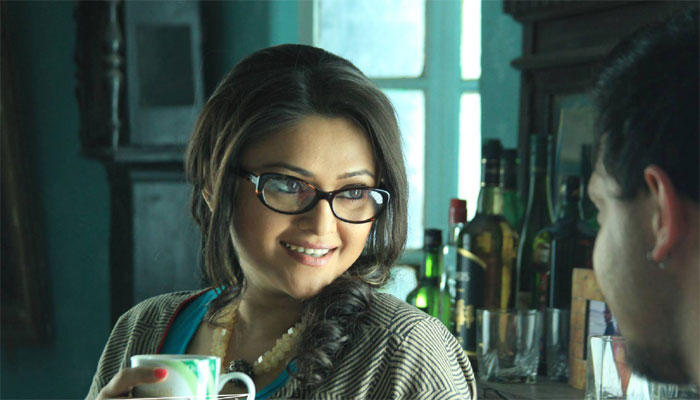
Bengali movie “Chotushkone”, starring talents as versatile as Aparna Sen and Parambrata Chatterjee, will release in five Indian cities Friday by popular demand. It will be subtitled in English for non Bengali-speaking audiences.

The Reliance Entertainment movie will open in select theatres in Mumbai, Delhi, Pune, Bangalore and Hyderabad.

This is a step towards catering to the growing demand of regional cinema across the length and breadth of the nation.

“The metros are home to a large Bengali-speaking migratory population who expresses a keen interest in local cinema. By releasing the movie nationally, it is our effort to reach out to them and other cinema enthusiasts favouring good content in various languages,” Sanjeev Lamba, CEO, Reliance Entertainment, said in a statement.

“Chotushkone” or “The Quadrangle” is a film about love, ambition, unconventional relationships and above all, vengeance.

IANS
source: http://www.zeenews.india.com / Z News / Home> Entertainment> Regional / Wednesday – October 29th, 2014

Olympiad to put Kolkata on fashion world map

Kolkata :

The City of Joy is getting ready to host the regional chapter of the National Fashion Olympiad. Organized jointly by the National Institute of Fashion Technology and the Union textiles ministry, the idea of the event is to put Kolkata on the world fashion map.

The Olympiad, which will highlight Kolkata’s young fashion talent, will be organized during November 11-13. The motto of this year’s fashion contest is “Sanyogam” or eternal connectivity of youth.

Students from Kolkata’s leading educational institutes, such as the La Martieniere for Boy and Girls, St Xavier’s College, Presidency University, Jadavpur University and Calcutta University, will take part in the National Fashion Olympiad (NFO). The competition will be open to students between 15 and 24 years of age. Students from IIT-Kharagpur and IIM-Kolkata will also be asked to take part at the Fashion Olympiad on the NIFT Kolkata campus.

The premier fashion institute has pioneered the unique initiative so that a platform can be offered to young talented individuals to test their skill and talent in specialized field of fashion. The regional-level competition will be held at various NIFT centres across the country, while the finale will take place in a metro city.

Though fashion designing is still in its nascent stage in Kolkata, the fashion Olympiad promises to catapult young talents with its beehive of activities showcasing what’s chic in fashion, interspersed with shows, exhibition, workshop and symposia.

“It has been our constant endeavour to hone new talents. Now, fashion students of the city will get the opportunity to display their creativity at this platform ,” said Bibekananda Banerjee, director of NIFT, Kolkata.

source: http://www.timesofindia.indiatimes.com / The Times of India / Home> City> Kolkata / by Ajanta Chakraborty, TNN / October 29th, 2014

Kolkata girl bags Panda award

Ashwika Kapur / by Special Arrangement

Ashwika Kapur is the first Indian woman to win the wildlife photography prize

Ashwika Kapur of Kolkata on Friday won the prestigious Panda Award, aspart of the annual Wildscreen Film Festival held at Bristol, U.K. She is the first Indian woman to win the coveted wildlife photography award for her film on a Kakapo parrot.

The tale of a parrot
Ms. Kapur’s film “Sirocco — how a dud became a stud” is based on Sirocco, a Kakapo parrot, which is perhaps the only bird to have bagged a government job.

The male bird was appointed as the Official Spokesbird for Conservation in New Zealand and it helps in conservation advocacy on social media.

The film earned 26-year-old Ms. Kapur a nomination for the best Newcomer category, competing against two other nominees. This year, the Windscreen Film Festival received 488 entries from 42 countries.

In an email statement, Ms. Kapur said the film was a solo project and she single-handedly managed the film’s scientific research, scripting, camera work, editing and music direction. She is currently involved in the filming and production of two international television programmes in India.

After finishing her school and college education in Kolkata, Ms. Kapur graduated in Science and Natural History Filmmaking from the University of Otago, New Zealand.

The Kakapo parrot, a nocturnal and flightless species of the parrot, is classified as a critically endangered species since 2012 on the IUCN Red List.

The bird, found in New Zealand, is known to be one of the longest-living birds and its known population is 125. Over 14,000 people from 162 countries voted the Kakapo the world’s favourite species in 2013.

The tiger and the African elephant came second and third, respectively.

source: http://www.thehindu.com / The Hindu / Home> News> Cities> Kolkata / by Staff Reporter / Kolkata – October 25th, 2014

Bengal just got older by 22000 yrs

AyodhyaKOLKATA22oct2014

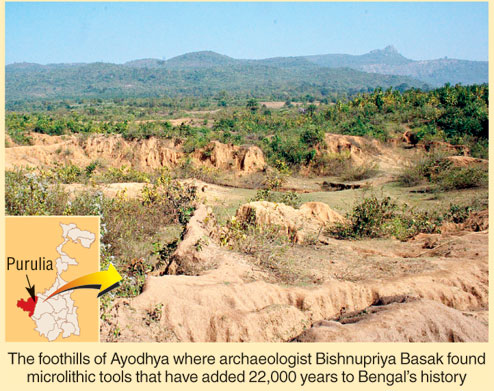
Multi-disciplinary research led by a city-based archaeologist has confirmed the presence of humans in the Ayodhya hills of Purulia about 42,000 years ago, a finding that pushes Bengal’s archaeological calendar 22,000 years back.

Bishnupriya Basak, who teaches archaeology at Calcutta University, sealed the findings after more than 12 years of intensive exploration and excavation of 25 stone-age sites she had discovered between 1998 and 2000 while working with the Centre for Archaeological Studies & Training, Eastern India.

The breakthrough came when Basak, 47, returned to the forests of the Ayodhya hills in 2011 to build on her findings using a technique called Optically Stimulated Luminescence (OSL) that establishes the antiquity of tools of a particular age.

Before Basak’s discovery, the earliest evidence of human presence in Bengal was at Sagardighi, in Murshidabad. The tools found there were dated to approximately 20,000 years ago.

“This is an extraordinary development and a breakthrough in the otherwise hazy chronology of eastern India. It marks a welcome trend in research. In this day and age, multi-disciplinary initiatives are indispensable,” said Gautam Sengupta, former director-general of the Archaeological Survey of India.

In the subcontinent, the earliest evidence of microlith-using cultures — hunter-gatherer populations that made and used the types of light stone implements found in the Ayodhya hills — is in Metakheri, Madhya Pradesh. They date back to 48,000 years ago.
BishnupriyaKOLKATA22oct2014

Microlithic tools found at Jwalapuram, in Andhra Pradesh, are from 35,000 years ago and those discovered in Sri Lanka are from 25,000 years ago.

Basak’s discovery was reported recently in the fortnightly research journal Current Science (Vol. 107, No. 11687).

The 47-year-old had conducted part of her research under police protection in the midst of Maoist insurgency in the region, her bold quest yielding 4,000-odd microlithic tools from excavation sites at Mahadebbera and Kana alone. Mahadebbera is located 500 metres northwest of Ghatbera village, in the catchment area of the Kumari river. Kana is around the same distance northwest of Ghatbera.

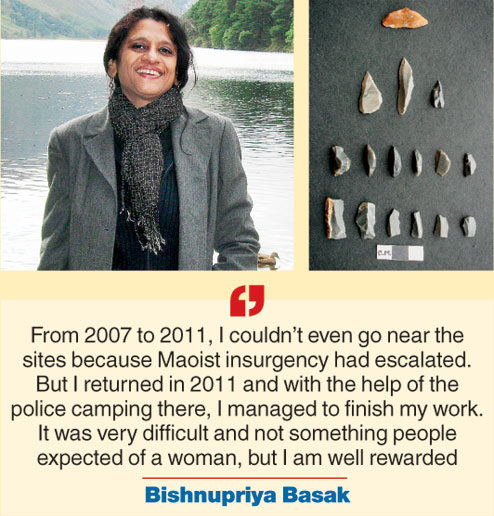
“From 2007 to 2011, I couldn’t even go near the sites because Maoist insurgency had escalated. But I returned in 2011 and with the help of the police camping there, I managed to finish my work. It was very difficult and not something people expected of a woman, but I am well rewarded,” Basak told Metro.

The experts who collaborated with Basak include S.N. Rajguru, a veteran geo-archaeologist who formerly taught at Pune’s Deccan College, Pradeep Srivastava and Anil Kumar from the Wadia Institute of Himalayan Geology, Dehradun, and Sujit Dasgupta, formerly of the Geological Survey of India.

Current Science states that the microlithic tools excavated from the colluvium-covered pediment surface in Kana are from “42,000 (plus or minus 4,000) years before the present” and “between 34,000 (plus or minus 3,000) and 25,000 years before the present in Mahadebbera”.

In the subcontinent, most microlithic sites are reported from alluvial context, sand dunes or rock shelters. There are very few late Pleistocene colluvial sites. Colluvium is the material that accumulates at the foot of the hill ranges — a mix of sediment, gravel and pebbles, all brought down the hill slope through natural gravitational flow. When they form a stable surface, as in the Ayodhya hills, they are a good location for prehistoric populations to settle.

According to geoarchaeologists, the Ayodhya discoveries hold the key to research in several fields, from environmental studies to palaeontology.

“The OSL technique we used helps date sediment samples in which the tools occur to a time they were last exposed to the sun before burial or sealed by later deposits. Our samples were collected from 0.50-1.85 metres below the surface in specially-made steel/iron cylindrical tubes, making sure no light entered the trench during the process. In most cases, we had a plastic black sheet covering the top of the trench and the samples were usually collected early morning or around dusk,” Basak said.

Metakheri had been dated using the OSL method while the tools found in Jwalapuram required dating through a technique called AMS radiocarbon dating. Since there was no presence of carbon in the Ayodhya samples, the OSL method was the only reliable option, Basak said.

The samples had been first sent for pre-treatment and chemical analysis to the Wadia Institute of Himalayan Geology, where senior scientist Pradeep Srivastava dated them as belonging to the Late Pleistocene period, roughly in the bracket of “42,000-25,000 years before the present”. The rocks from which these tools had been made were identified by the Geological Survey of India as “chert and felsic tuff”.

At Sagardighi, a team led by the late Amal Roy had found microliths made of agate, chert, chalcedony and quartz. They were not scientifically dated, though. The antiquity of the tools was assumed to be 20,000 years ago on the basis of geological factors.

Subrata Chakraborty, professor of prehistory at Visva-Bharati, said accurate dating had long been a problem in Bengal because of inadequate infrastructure.

“There is no institutional set-up for accurate scientific dating in Bengal.”

The 4,000-odd Ayodhya microliths include blades and backed tools. Micro blades are small — maximum length up to 4cm — parallel-sided tools that are very sharp and suitable for cutting. Backed microliths are those that are further retouched and attached to bows, arrows and spears to hunt small animals and birds.

An intriguing facet of the discovery is that no trace of the raw material used in these tools was found in the near vicinity, suggesting that the early hunter-gatherers had travelled quite a distance to get their stones. Such instances are, of course, not uncommon even among living hunter-gatherers.

Geo-archaeologist Rajguru said the Ayodhya discoveries had opened a whole new chapter in Bengal’s history.

“We can, for instance, assert that Bengal was very much a part of the climatic changes during the last glacial period. So far it had been assumed that Bengal was always humid with plenty of rainfall. Now we have evidence that the whole of the Rahr region also experienced the dry climate that was caused by the period’s peak in glaciation. We also know that the sea level must have been lower by about 100 metres.”

Rajguru, who has been a mentor to Basak, added: “Let this instance of sustained perseverance in the face of all odds and collaboration of skills and expertise across boundaries be an example and encourage many others to follow suit.”

What message do you have for Bishnupriya Basak? Tell ttmetro@abpmail.com

source: http://www.telegraphindia.com / The Telegraph, Calcutta / Front Page> Calcutta> Story / by Sebanti Sarkar / Tuesday – October 21st, 2014
Curry King brings 14 new marinations

Kolkata :

Marination, that familiar method of flavouring and tenderizing food by coating them in a seasoned, and often acidic, liquid prior to cooking, lies at the core of a cuisine, lending character to the dish even as it provides a signature of the region. When Barbeque Nation, the casual dining chain which has an outlet at Sector V, decided to broaden the menu on their live on-the-table grill, not many could have fitted the bill better than Pat Chapman.

The Englishman, a chef, food writer, broadcaster and author, has a strong Indian connection and, perhaps more importantly, a passion for her cuisines. The Curry Club, which the London-born chef founded back home, has not just helped many a Brit take that bold leap from the bland to the spicy but has had them delve deeper into Indian cuisines.

“I’m not here to teach Indian marination to the chefs here; they know that better than me. But I do know the Indian palate,” said Chapman, who has brought 14 different marinations from round the world to add to what was being put on the table in the DIY (do-it-yourself) menu before the main buffet. “Putting the grill on the table is a fantastic concept and we don’t have it as yet in Britain,” added the 73-year-old, who had seven generations of his family living in India since 1715.

“My mother was born in Mhow and she was a terrific cook. She taught me and I have been cooking Indian food since I was eight,” said Chapman, who has earned sobriquets like ‘Ambassador of Indian food’ and ‘Curry King’ from British food reviewers. The man who has authored 36 recipe books with cumulative sales of over 1.5 million copies reminded that he has had no formal training as a chef. “But I’ve worked hard and learnt from so many of them. These chefs are my gurus,”
he added.

Giving a ‘demo’ of three of the marinations he has brought here — a Lebanese-Arabian coating of broccoli, a Thai preparation of Basa fish and Jamaican Jerk chicken — Chapman pointed out that the essence of marination is tenderizing for penetration of the flavours and that acid helps do that.

“Marination works particularly well for starters. Indian and Middle-East starters use it very cleverly,” he said. “In my view, Indian is the best food in the world. The curry is a wonderful thing, the food of a nation,” he added, and pointed to the phenomenal spread of Indian cuisine in the UK.

“I came to India for the first time in 1965 and have been here some 43-44 times since then; my wife Dominique has been here about 20 times. The visits have been more frequent since the 1980s, when I started The Curry Club. I bring groups and have them meet chefs here. Most members are British but we have Americans and people from other regions on board too,” he said. “Indian food is addictive. When I was a kid, garlic had to be bought from the chemist in the UK. Now you get it everywhere. Every region of India is represented in London through its restaurant and they are all doing well.”

Yorkshire Lamb, Spanish Valencia Prawns, English Mushrooms, Persian Veg Patties, New Orleans Corn, Mexican Veg Shashlik… As the skewers were laid on the table grills for the gastronomes to baste them in Vinegar Chili, Lemon Butter or Oriental Garlic to add that sheen of personal preferences, Chapman went around for the interactions. As the items disappeared quickly from the plates in the company of barbeque, tartar and mild mustard sauces, the beaming Englishman would have known he had connected well with the Indian palate.

source: http://www.timesofindia.indiatimes.com / The Times of India / Home> City> Kolkata / by Arup Chatterjee, TNN / October 18th, 2014

Book to renew Kolkata’s tie with Wajid Ali Shah

Kolkata :

“It’s the only book I’ve read twice. And my favourite line is ‘life can’t be divided into chapters’,” mused Shahanshah Mirza, great-great-grandson of Wajid Ali Shah, referring to ‘The Last King in India’ by Rosie Llewellyn-Jones. The British historian has made waves by compiling facts about the legendary nawab whose memory still divides opinion.

Rosie smiled: “Thanks for helping me investigate the mind of the last king. The British opposed him because they wanted to take his kingdom. Mirza nodded: “You’ve dealt with his seclusion rather well.” He thought the agony associated with the annexation of Awadh is well portrayed in the book.

Rosie begins with a chapter following this act, when the nawab’s mother travels to petition Queen Victoria for justice. Unknown to her, the Queen had no power to return Awadh. The bleak start sets the tone for the book — the British duplicity, with the king caught between forces over which he had no control.

For inputs, Rosie has watched ‘Shatranj Ke Khilari’ “several times”. “Ray did a lot of research,” said Rosie. “When Ray met my father in 1978, he was asked if it was easy getting Amjad Khan into Wajid’s skin. He had said ‘Amjad was blinking a lot. When a ruler is angry, he doesn’t blink. His eyes are wide open’,”
said Mirza.

Rosie’s Kolkata connect goes a long way — since she found Mirza on the royal family website in 2004. “I came here and we did a lot of research together,” she said. The cover is a painting of the nawab which belongs to Mirza’s relative Sultan Ali Sadiq.

Rosie pointed out: “In nearly all his pictures, the king has his left breast exposed.” Mirza explained: “I guess the poet in the nawab wanted to show that his heart was always open.”

The book will be unveiled for the third time on Sunday after a London launch in June followed by another such ceremony in the nawab’s very own Lucknow last month. “Now it is Kolkata’s turn and we had to have Shahanshah,” said Rosie. Mirza has given Rosie inputs on the king settling down in Metiabruz (or Metiaburj, which literally means a clay tower). An old watchtower had once stood there, guarding the Hooghly river bend, giving the place its name.

“The book shows that even 127 years after his death,
Wajid Ali Shah, who himself authored 117 books (Rosie found some of them at the London Library), is still a subject of interest.”

The king contributed greatly to Kolkata’s culture. Kathak and kite-flying were introduced by him. He opened a menagerie which attracted a lot of visitors. According to Rosie, the king tried, within his limited resources (he had to live off a pension given to him by the British), to recreate a miniature Lucknow in Garden Reach-Metiabruz where he lived his last 31 years. He brought with him the music, the poetry, the cuisine, the adab that had made Lucknow under him the byword of culture and etiquette.

“His Calcutta stay changed many aspects of its social life. The British failed to fathom (deliberately) the love that he enjoyed from his subjects,” said his great-great-grandson.

The British, who deposed him to Calcutta in 1856, could hardly accept a ruler who believed that his subjects singing his songs was enough guarantee that he was seen as a good ruler. “Do Queen Victoria’s subjects sing her songs?” Satyajit Ray makes Wajid ask his chief minister in ‘Shatranj Ke Khilari’, thus capturing the differing notions of kingship.

source: http://www.timesofindia.indiatimes.com / The Times of India / Home> City> Kolkata / by Ajanta Chakraborty, TNN / October 12th, 2014

Oscars boy Avijit Halder scripts ‘inside’ story

Kolkata :

The day the makers of the documentary ‘Born Into Brothels’ thrust a camera in the hands of young Avijit Halder, little did he know it would change his life, propelling him to Oscars glory and land him on the sets of a Hollywood film. Ten years on, he is a green-card holder in the US, armed with a degree from New York University, with his name on the Donald Sutherland-starrer ‘Basmati Blues’ credit list.

Back in Kolkata on a ‘break’, he has just finished scripting a short film on life in the brothels while mentoring his younger co-actor in the art of photography. “I have no reason to shift from Sonagachhi. It’s my home,” he says.

Halder’s journey started when he caught public attention with the photographs he took for the documentary — snippets of life in Sonagachhi, his own house. The documentary-makers had set up a charity, ‘Kids With Cameras’, to help Halder and the other children pursue an education. Photography exhibitions were held in several locations including Kolkata, New York and Europe. “A fund was set up from the photos we sold in the exhibitions. I was told several prints of my photos were bought as souvenirs of the docu-film. That paid for my education as well as my trips to my home,” he told TOI.

On Monday, Halder revealed that he has just finished writing a script, which is an account of a Sonagachhi “insider”. He said: “Every film or documentation on the brothels depicts it as a place of doom, trafficking, political equations. But I have explored how the brothel residents see the society outside. Personally, I can say whenever I return to the place, there is visible negativity as some believe they are being exploited with the lens. So I first live there for a month, get myself accepted and then people don’t notice the camera.” Halder’s grandmom still lives there and when asked if he considered moving her elsewhere, he replied: “Why
would I? I see no reason. It’s my home.”

Halder is mentoring another boy from the documentary, Manik Das, who is in the final year of BCom, into the world of photography. Das, along with his siblings and some of the other children were adopted by a city NGO. “There were initially eight children and we were joined by one more. Barring a couple, we are all in touch with each other,” said Das.

What about his future plans? “I’d love to come to Kolkata and make films. The evolution of the red-light area fascinates me. Now there are much less crowd and lot more cellphones. Talks revolve around ‘miss calls’ and ringtones. But what is really striking is the brothel, one of the most liberal places in the world, is deeply conservative in its core.”

He is travelling back and forth two continents. This time he has brought his girlfriend Marcia along, but he says he’s not yet “there”. And he has no illusion of playing a saviour for children with his history. “I’m merely trying to be a role model so that the kids like me look at me and believe in themselves,” he said.

source: http://www.timesofindia.indiatimes.com / The Times of India / Home> City> Kolkata / by Shounak Ghosal, TNN / October 21st, 2014

City organization wins US ambassador grant to document folk music

Kolkata :

After seven years, a Kolkata-based organization—Banglanatak.com—has won a prestigious grant from the Ambassador’s Fund for Cultural Preservation (AFCP) 2014 for their project “Documentation of Bengal folk music genres Bhawaiya, Bhatiali, and Bangla Qawwali”. The city chapter of Indian National Trust for Art and Cultural Heritage (Intach) was the last to win the grant in 2007 for restoration of the Lalgola project in Murshidabad.

Announcing the grant award to Banglanatak.com at the American Centre on Friday, director Joanne Joria expressed hope that the documentation of three music genres would help preserve and popularise them again. Musicians of all three genres performed on the occasion.

According to Banglanatak.com founder director Amitabh Bhattacharya, the project will document and preserve folk music traditions—Bhawaiya songs of North Bengal, Bhatiali songs of Sunderbans in South Bengal and Bangla Qawwali of Kolkata, Nadia, and Murshidabad that are fast losing ground to other modern forms of entertainment and being pushed to the point of near extinction.

An initiative by the Bureau of Educational and Cultural Affairs of the US State Department, AFCP supports preservation of cultural sites, cultural objects, and forms of traditional cultural expression in more than 100 countries around the world. AFCP-supported projects include the restoration of ancient and historic buildings, assessment and conservation of rare manuscripts and museum collections, preservation and protection of important archaeological sites, and the documentation of vanishing traditional craft techniques and indigenous languages.

“By taking a leading role in efforts to preserve cultural heritage, the US shows its respect for other cultures,” Joria explained.

The last time a Kolkata organization won this grant was in 2007 when the Indian National Trust for Art and Cultural Heritage (INTACH) won the grant for restoration of the Lalgola project in Murshidabad.

source: http://www.timesofindia.indiatimes.com / The Times of India / Home> City> Kolkata / TNN / October 17th, 2014

For Malala, this West Bengal teenager is a true hero

Anoyara Khatun.— Photo: Sushanta Patronobish / The Hindu

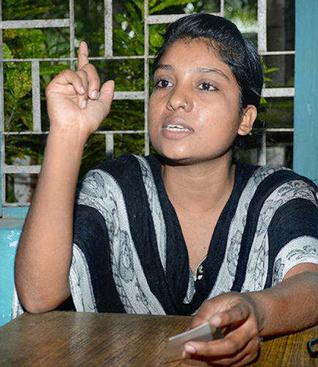
As the world celebrates Pakistani teenager Malala Yousafzai winning the Nobel Peace Prize, Malala herself is celebrating the courage of a little known young girl from West Bengal’s Sandeshkhali area who has been quietly working against the trafficking of young girls from the region.

Anoyara Khatun, 18, from North 24 Parganas, has, with the support of other children and non-governmental organisations, built a strong network to resist trafficking of young girls and prevent child marriages in the region.

“Malala and the Malala Fund celebrate Anoyara’s exemplary courage and leadership. She has helped reunite more than 180 trafficked children with their families, prevented 35 child marriages, rescued 85 children from the clutches of child labour and registered 200 out-of-schools (drop-outs) into schools,” says a Facebook post by the Malalafund, an initiative by Malala.

The post made on October 13, International Day of the Girl, only a few days after Ms. Malala was awarded the Nobel Prize, has described Anoyara as “a true girl hero.”

When The Hindu met Anoyara at Sandeshkhali on Wednesday, she was aware of the Facebook post and could not stop talking about Malala. The first year student of a local college has also collected a number of vernacular newspapers that published news of Ms. Malala’s award and shared it with her friends.

“Though I have not met Malala, I did meet her father Ziauddin Yousafzai at Brussels in June 2012,” she said. She made the trip to Belgium when she was nominated for The International Children’s Peace Prize.

“Trafficking of young girls and child marriages were rampant in the villages here. Poverty and lack of awareness and education provided the ideal conditions for traffickers to operate here,” Ms. Anoyara said.

In 2008, Save the Children, an international non-governmental organisation working for child rights, helped establish a number of multi activity centres in the Sandeshkhali area. These centres help create awareness among the children of the region about the dangers of trafficking and similar crimes. Anoyara recalls stories of how she and others chased away traffickers who came offering jobs and marriage to young girls in the region.

Jatin Mondar, the State Programme Manager of Save the Children, West Bengal said that through these centres, the organisation had managed to put in place a “committee-based child protection model” in Sandeshkhali since 2004.

“Now, if someone approaches the villagers with the proposal to take a girl to Delhi or anywhere else for work, that person is sure to be handed over to the police by us,” Anoyara said.

source: http://www.thehindu.com / The Hindu / Home / by Shiv Sahay Singh / Sandeshkhali (North 24 Parganas) / October 16th, 2014