Category Archives: Arts, Culture & Entertainment

Kaushiki forms first all-woman classical band

Kolkata :

Some of the country’s best-known young women performers have come forward to form the first ever ensemble of Indian classical music to “celebrate womanhood”.

Vocalist Kaushiki Chakraborty and her ensemble ‘Sakhi’ will make their debut at Kalamandir on January 20.

“Sakhi means friend. We will tell stories of womanhood through music and dance. It is our humble effort to pay tribute to the Indian women — Ganga, Saraswati, Durga, Lakshmi, Draupadi, Kunti, Sita, Radha and Meera — whose contribution to Indian music and dance remains as anonymous as their existence,” says Kaushiki, who is also the producer of the project.

But, is it really essential to form a women-only band to celebrate womanhood?

“Most of the legends in the classical music fraternity are male. We respect them. We are not trying to establish a counter platform. But, who else can portray womanhood better than women themselves?” insists a member of the group.

Shaoni Talwalkar, the daughter of tabla player Pandit Suresh Talwalkar and vocalist Bidushi Padma Talwalkar, will be on the tabla. Mahima Upadhyay, daughter of pakhwaj player Pandit Ravi Shankar Upadhyay, will play the pakhwaj. Debopriya Chatterjee, a disciple of Pandit Hariprasad Chaurasia, will play the flute. Bidushi N Rajam’s granddaughter Nandini Shankar will be on the violin, while Pandit Birju Maharaj’s disciple Bhakti Deshpande will perform Kathak.

Together, they will perform diverse genres of traditional repertoires of Hindustani and Carnatic music, such as khayal, thumri, dadra, chaiti, hori, kajari, tarana, tillana and bhajan, and kathak to explore the diverse spectrum of womanhood.

“Here we are together only for fusing various elements of Indian music, but nothing non-Indian,” says flautist Debopriya, who arrived in the city from Mumbai on Sunday.

“My challenge is to present a new interpretative form of classical music to the audience without diluting the standards by any means. I was never interested in forming a group just for its sake. But in this project, Kaushiki the girl and Kaushiki the singer will come together. We have programmes of our group lined up in Mumbai, Europe and America in the next few months. But I chose Kolkata to be the venue for our debut because of my emotional attachment with the city,” says Kaushiki.

“Kaushiki was actually inspired by Ustad Zakir Hussain in forming the musical group. Zakir bhai loves my daughter like her own daughter. She has formed the first women’s group of classical music in the country. On my part, I always wanted her to understand the real value of our music. I believe that the values that I and my wife have instilled in her will help her remain on track. She will not deviate from the core values of the purest forms of our music in whatever way she experiments,” assures Kaushiki’s father Pandit Ajoy Chakraborty.

source: http://www.timesofindia.indiatimes.com / The Times of India / Home> City> Kolkata / by Tathagata Ray Chowdhury, TNN /January 19th, 2015
80 years that are lighter than roses

Kolkata :

The ‘Teen Bhubaner Pare’ pair of 1969 showed their chemistry is intact even in 2015 when the graceful Tanuja met the evergreen Soumitra to wish him on his 81st on Monday.

When Soumitra’s Chatterjee’s daughter Poulami pointed out that their ethnic attires complemented each other, Tanuja responded: “It’s unintentionally coordinated. We’re the best,” giving the original Feluda a playful nudge.

And it was not just the chemistry, but the energy too that had a renewed vigour to it. As the camera flashes threatened not to cease in the greenroom, Tanuja exclaimed: “So many people! If we do a movie together now it’ll be an instant hit.”

Soumitra, ‘Pulu’ to Tanuja, nodded vigorously. “Yes, we must do another film as the lead pair.” When someone asked how he was enjoying his birthday, he said: “I’m not enjoying it at all. I haven’t had the chance to eat, sleep or bathe.”

Tanuja said: “May you live a 100 years.” He replied: “But that would be too painful.” Soumitra had high fever and had to take paracetamol tablets through the day.

But once they hit the stage for a conversation moderated by poet Srijato, the warmth that could be felt wasn’t because of a virus. The moderator asked him whether having nothing left to unveil on his life was a curse or boon, Soumitra said: “If you spend so many decades under public glare, you have to forego a private life. But such long stints also produce friends, like I have one in Tanuja. Not because we have worked in many films together, but more like things happen in home. You strike a certain understanding. Now the industry has changed a lot. Back then, it was so homely that if I had a headache, she would say ‘shhh’ and take out an ointment to rub on my temple.”

When Srijato asked her about her bond with the Chatterjee family, Tanuja said: “How to explain… When I met Pulu he didn’t feel like a stranger.” Srijato interjected: “Did you know he still has a cheque signed by you with him?” Tanuja was astounded. “You mean you didn’t encash it?”

Soumitra explained: “She had a plan to launch Kajol in a film that also featured me. She had even given me a cheque in advance. But the film didn’t happen.” Tanuja repeated: “You seriously didn’t encash it?”

The real impatient, inspired Soumitra came out when he was asked: “Despite so much success how are you still not complacent?” “I’m unsatisfied by nature. Even if I like my work in a particular field, it is so short-lived that it’s negligible. My icon is Rabindranath Tagore, the most successful of them all. He achieved everything, but didn’t sit back in complacence. He had grievances and they reflected in his art. With such an example before me, how can I be satisfied!” he said.

Tanuja said she feels the same way but this was a lesson she “learned anew this evening”. She elaborated: “When someone asks me: ‘What’s your best film?’ I say: ‘I haven’t done it yet.’ I love your attitude.”

Despite a sore throat, Soumitra recited one of his poems selected by Srijato and went on to recite one more. A book on him by Tapan Sinha Foundation was launched on the occasion while theatre group Mukhomukhi felicitated Tanuja. Sketch artist Ekta Bhattacharjee was invited to present her hand-drawn portrait to Soumitra while veteran artist Rabin Mandal presented him with a book on his artwork recently published by Delhi Art Gallery.

And the moment the audience cheered the most? When the onscreen pair hugged. Before signing off, Soumitra had one last witty bomb to drop. “Back in the greenroom, a person came up and presented me with a bouquet of roses. He said there were 80 of them. I realised that 80 years were not as heavy as that many flowers.”

source: http://www.timesofindia.indiatimes.com / The Times of India / Home> City> Kolkata / by Shounak Ghosal, TNN / January 20th, 2015

A festival adds to the woes of Sagar

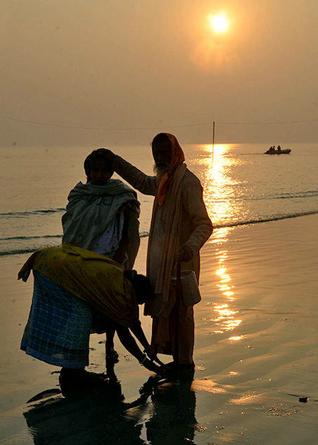
A sadhu blesses two women at Sagar island on Monday. Photo: Sushanta Patronobish

Devotees gathering for Makar Sankranti almost thrice the island’s population

In the next few days, lakhs of devotees will descend on the Sagar Island in the Sunderbans archipelago of West Bengal to take a holy dip, where the Hooghly river enters the Bay of Bengal, on the occasion of Makar Sankranti. They are unaware of the festival’s environmental impact on the island.

Sagar is the largest island in the Indian Sunderbans system, boasting an area of 251 square km and a population of 2.10 lakh as per the 2011 census. Despite its size, the erosion of certain parts owing to the rising sea level is causing its residents concern.

In July 2014, at least 10 villages were submerged in high tide, and this exposed the vulnerability of the island, like the other smaller islands of the unique ecosystem.

While State government officials admit that no detailed environmental assessment has been done in the recent past, some recent studies show that on the one hand, the issue of pollution has not been addressed and on the other, the island’s tourism potential has not been tapped.

Experts say the number of devotees gathering on a particular beach during the Mela is five to six lakhs, almost three times the island’s population.

At least two recent papers, produced by researchers of the School of Oceanographic Studies (SOS), Jadavpur University, have looked at the issue of sustainability of the Mela and the island’s tourism potential.

‘Impact of Gangasagar Mela on Sustainability of Sagar Island,’ published in 2012 in the International Journal of Research in Chemistry and Environment, pointed to an increase in fecal coliform bacteria in the surface water of the beach used by the pilgrims. The paper said the inhabitants of the island living near the Mela ground complained of obnoxious smell and communicable diseases.

“The authority needs to limit the gathering according to the… capacity of the Gangasagar Mela ground which depends on infrastructure such as housing, latrine, toilet and bathing ghat [so as] to minimise pollution,” said the paper authored by Tuhin Ghosh of the SOS and Rituparna Hazra and Rajarshi Mitra.

Another paper published by Prof. Ghosh and others at International Journal of Innovative Research & Development in 2014 looks at the tourism potential of the island under the Global Sustainable Tourism Criteria.

source: http://www.thehindu.com / The Hindu / Home> News> Cities> Kolkata / by Shiv Sahay Singh / Sagar (South 24 Parganas) / January 13th, 2015

Hazarduari gets ‘Adarsh’ tag from ASI

Kolkata :

Hazarduari Palace in Murshidabad has been declared an Adarsh Monument by the Archaeological Survey of India (ASI) along with three others in eastern India.

The other three monuments are Vaishali-Kolhua in Bihar, Rang Ghar in Assam’s Sibsagar and the Konark Sun Temple in Odisha. These
will be in the focus of international tourism promotion plan developed by the central government.

ASI has selected only 25 out of 3,680 protected monuments under the Adarsh Samarak Yojona. The list was made on the basis of the number of tourists these monuments attract annually. The list includes some of the biggest crowd-pullers like Taj Mahal, Khajuraho, Qutab complex and Red Fort.

All of them can be of great interest to international tourists, believes the ministry of culture. “Keeping that in mind, we are developing amenities of international standards, including washrooms, drinking water, signs, cafeterias, audio-visual centres, Wi-Fi connectivity, interpretation centres and encroachment-free areas,” said ASI regional director (eastern region) P K Mishra.

But more than anything else, security will be enhanced. The Centre is thinking of introducing the ‘tourism police’ force that is quite common across the world.

Hazarduari Palace, earlier known as Bara Kothi, is located on the campus of Kila Nizamat in Murshidabad, on the banks of the Bhagirathi. It was built in the early 19th century by Duncan MacLeod under the reign of Nawab Nazim Humayun Jah of Bengal, Bihar and Orissa (1824-1838). In 1985, the palace was handed over to ASI. Kila Nizamat or Nizamat Kila was the old fort of Murshidabad which was demolished to build this grand palace.

Built in the 13th century, the Konark Sun Temple is shaped like a chariot of the Sun God with 12 pairs of ornamented wheels dragged by seven horses.

Rong Ghor, meaning ‘House of Entertainment’, is a two-storied building that used to serve as the royal sports pavilion. Ahom kings and nobles used to watch buffalo fights and other sports at Rupahi Pathar in Rangpur, particularly during the Rangali Bihu. Said to be one of the oldest surviving amphitheaters in Asia, the building was constructed during the reign of Swargadeo Pramatta Singha in 1744-1750.

Kolhua in Vaishali is where the Buddha is said to have preached his last sermon. To commemorate the event, emperor Ashoka erected one of his famous lion pillars here in the third century BC. A hundred years after the Buddha’s death, Vaishali hosted the second great Buddhist council. Two stupas were erected to commemorate it.

Jainism, too, has its origins in Vaishali. In 527 BC, Lord Mahavir was born on the outskirts of the city and lived in Vaishali till he was 22. Vaishali remains an important pilgrimage centre for both Buddhists and Jains.

source: http://www.timesofindia.indiatimes.com / The Times of India / Home> City> Kolkata / by Krishnendu Bandyopadhyay, TNN / January 11th, 2015

Feminist Jasodhara passes away

Eminent Leftist feminist Jasodhara Bagchi breathed her last here on Friday morning. She was 77.

She suffered a cardiac arrest and multiple organ failure, her daughter Tista Bagchi told The Hindu .

Educated at the city’s Presidency University, Oxford University and Cambridge University, she taught English briefly at the Lady Brabourne College here. From 1964, she spent a major part of her life teaching English at Jadavpur University and went to become the founder-director of the School of Women’s Studies there. Although Ms.Bagchi retired in 1997, she continued to teach at the School of Women’s Studies as an emeritus professor till her death.

Married to renowned economist Amiya Bagchi, she was the former chairperson of the West Bengal Commission for Women. She wrote extensively on social and women’s issues and has been vocal in supporting women movements.

source: http://www.thehindu.com / The Hindu / Home> News> Cities> Kolkata / by Special Correspondent / Kolkata – January 10th, 2015

Anthology on Jesuit Fathers’ contribution

The Goethals Indian Library and Research Centre of St. Xavier’s College has published a book on the lives of the Jesuits who lived and worked in India, especially in Bengal, since the early 19th century.

The anthology was released by Father P. Franck Janin, Jesuit Provincial, South Belgian Province and Luxembourg, at Dhyan Ashram in Joka on Sunday.

Edited by Father Albert Huart and Father J. Felix Raj, Discovery of Bengal: The Jesuit Design marks the 200th year of the Restoration of the Society of Jesus. The book records the academic, social, cultural and spiritual contributions of the Jesuit fathers in shaping the moral growth of the race and the country.

Among the Jesuits who feature in the book are Fathers Henry Depelchin, Achille Verstraeten, Paul Joris, Cardinal Lawrence Picachy, Camille Bouche and Andre Bruylants.

“They attracted heartsby the qualities they displayed and posterity retains them as lessons of life learnt forever. Even after 200 years, their words and works reach those for whom they were intended – the inhabitants of The Kingdom of God. These men of moral might were armed with supreme sense of sacrifice and were gifted with grace and the zeal to establish ‘Good News of God’ and the promise of justice for humanity,” said Felix Raj, the principal of St. Xavier’s College.

“Humility, fortitude, power of prayer and passion for performing God’s will on earth endowed these Samaritans with the benediction that brought the light of the Lord to the masses of Bengal. This collection scripts the eternal immortal lives of the Jesuits who are today and forever in fellowship with us and with God.”

Copies of the anthology are available from the Goethals library at the college.

source: http://www.telegraphindia.com / The Telegraph, Calcutta / Front Page> Calcutta> Story / by Staff Reporter / Monday – December 29th, 2014

Sky’s the limit for these girls

BirlaGirlsKOLKATA30dec2014

Lying on blankets at a height of 9,200ft, they gazed up at the sky and couldn’t believe what they saw. Khushi Goenka and two of her schoolmates from Modern High School for Girls were staring up at the Milky Way. With the naked eye.

In Hawaii to attend the second edition of the Pacific Astronomy & Engineering Summit at Imiloa Astronomy Center, the girls had seen the constellation through a telescope just the day before. “It was unbelievable because the previous day at the astronomy centre we had seen the constellation and other stars and there we were, seeing it again, this time with the naked eye,” said Khushi, a Class XII student.

Khushi, along with Class XI students Adwitiya Dawn and Shruti Keoliya, made up the only team from India invited to the five-day conference. Accompanied by their physics teacher Pamela Dutta, the girls worked in collaboration with Puragra (Raja) Guha Thakurta of the department of astronomy and astrophysics at University of California, Santa Cruz, and PhD student Emily Cunningham on the Halo 7D project.

The conference included presentations by scientists and astronomers from China, Japan, Canada and the US but the high point for the city girls was a meeting with five scientists who had spent four months in isolation in simulated Mars-like conditions.

“We met the HI-SEAS crew, a group of five scientists who had spent four months in isolation on a Mars-like surface on top of a mountain. We got hold of an aeronautical engineer and kept asking him absurd questions to satiate our curiosity and not letting him eat his plate of chicken that he hadn’t in the past months,” recalled Shruti.

After the girls returned to the city, Guha Thakurta visited their school and shared with Metro the importance of research and how the trip not only opened new avenues for the girls but also opened their minds to new ideas.

“It opens the eyes of students, especially those who are used to finding exact answers even to difficult problems, to the fact that there are problems that do not have a right answer. In research you have some idea of the question you are trying to answer but there is no guarantee you will find the answer,” explained Guha Thakurta, an astronomer for 30 years. “In most high schools, students are taught there is a correct answer and there is an incorrect answer. To know that there are many shades of grey in between is an eye-opener. The girls, on several occasions, were looking for answers but we would tell them we don’t know the answers or the answer is not known.”

Guha Thakurta said the girls understood the need for research and saw “some laws of physics, some of which they put in their presentation. Some of it they had learnt in class but what they had probably not seen is how someone who making a career as a researcher still uses the formula that they are learning in high schools”.

“In the initial document sent to us, the astronomy terms seemed alien and too technical. But as we started researching, the concepts became clear and we tried to make our presentation (calculating the mass and structure of Milky Way) as comprehensible as possible for the layman,” Adwitiya said.

The five-day trip included sessions by scientists and astronomers, visits to museums, trekking and cultural presentations and some bhangra and dandiya to get everyone at the conference on their feet.

“As far as education is concerned, travelling contributes hugely as does mixing with people and working together as a team on research. The girls had to Skype with California early in the morning before school and be there in time to attend school,” said Devi Kar, the director of Modern High School for Girls.

source: http://www.telegraphindia.com / The Telegraph, Calcutta / Front Page> Calcutta> Story / by Jhinuk Mazumdar / Tuesday – December 30th, 2014

History in mint condition

Coins from Bengal are on display as part of Mudra Utsav, the annual exhibition and conference organised by Numismatic Society of Calcutta, at Haldiram Banquet Hall in Ballygunge till Sunday.

“Coins make history speak. They are not just a means of exchange but also a store of value. Their metallic quality helps judge the economic state of a reign while their spread indicates how far a ruler’s sovereignty extended,” said former finance minister and economics teacher, Asim Dasgupta, at the inauguration. He also referred to remarkable work by the numismatist fraternity, singling out Bratindra Nath Mukherjee’s discovery of an ancient script called Shell lipi.

Chhanda Mukherjee, former deputy keeper, numismatics and epigraphy, at Indian Museum, referred to areas in Bengal such as Chandraketugarh, Murshidabad and Pandua-Mahanad area of Hooghly where coins have been found. “The earliest hoard of Gupta coins was found right here in Kalighat,” she said.

Some of the coins mentioned by Mukherjee are on display at the exhibition. Ujjwal Kumar Saha’s Gupta coins date back to the reigns of Samudragupta and Chandragupta I. There are also gold dinars of the Kushan era. Somnath Basu’s collection is on independent rulers of Bengal, from Fakr al Din Mubarak Shah (1334-1349) to Daud Shah Karanani (1572-1576). Ravi Shankar Sharma has displayed Mughal coins from Bengal mints. There are Akbar rupees minted in Satgaon (also known as Saptagram, now in Bangladesh) and in Bang, a soobah of Bengal. “These coins were minted after Akbar’s conquest of Satgaon,” Sharma said.

Mints were there in Patna too, built by Magadh ruler Ajatashatru around 490 BC. A Shah Jahan rupee represents the Patna mint. The only Mughal coin in Bengali script was issued from Alamgirnagar, Aurangzeb’s name for Cooch Behar. “The coin is rare as the area changed hands soon,” Sharma added.

The East India Company, too, had issued bilingual sikkas, with both Bengali and Persian scripts, from their Benaras, Farukabad and Calcutta mints once they realised the Shah Jahan II Mughal coins that they had been copying did not suit the largely Bengali-speaking populace of the Bengal Presidency.

Another notable exhibit is a punch-marked coin from the Bari-Wateshwar area of present-day Bangladesh. Carrying a sun, a boat, an open cross and a six-armed symbol, the silver alloy coin dates back to 3rd to 2nd century BC. “I procured the coin just last week,” said Anup Mitra, president of the society.

Collectors of coins and stamps will also find a lot of interesting items on sale at stalls put up by dealers.

source: http://www.telegraphindia.com / The Telegraph, Calcutta / Front Page> Calcutta> Story> Caleidoscope / Sunday – December 28th, 2014

Researchers trace 57 addresses of Tagore

Kolkata :

“All our dwelling places contain varied partnerships of love…” Tagore wrote in 1935. What about is own spaces? Have they withstood the onslaught of time?

Not quite. One of the revered addresses that have been deleted forever is 49 Park Street where ‘Gitabitan’ and ‘Mayar Khela’ were composed. Researchers have recently recorded 57 places where the bard lived. Sixteen of them were in Kolkata, 14 in the Hills and 27 in south Bengal.

In a prelude to an ambitious heritage-tourism project of the government titled Tagore Circuit, history professors Shouvik Mukhopadhyay, Partha Sankha Majumdar and Ramanuj Mukherjee, at the behest of the West Bengal Heritage Commission (WBHRC), have come up with dates, anecdotes, addresses and several startling revelations about the poet.

Take Birjitalao where ‘Raja O Rani’ was staged and Tagore played Bikram in the 19th century. Wife Mrinalini played Narayani — her only stage appearance. The poet would frequent this house, rented by brother Satyendranath, next to the St Paul’s Cathedral.

“Indira Devi in her memoirs attests that the present day Calcutta Club was located on this land,” reads the study in its avatar as a coffee-table book. Chief minister Mamata Banerjee has a foreword: “Tagore has stayed in many different places which have earned for themselves the distinction of being temples of creativity, knowledge, literature, beyond any parallel.”

WBHRC chairman Shuvaprasanna writes: “The history of these abodes… testifies to the insight of a complete artist… throw light on the mental upheaval of a creative person who was never confided to a single place.”

Tagore would keep visiting the Hills; some of these structures continue to exist. The house that Scottish shipping magnate Daniel Hamilton built for the poet at Gosaba is one of the best maintained structures. But 16 such dwellings in Kolkata don’t exist any longer. The list includes 52/2 Park Street, 50 Park Street, 14 Lower Circular Road (now AJC Bose Road) and 237 Lower Circular Road. Soon after his marriage, the poet started living here and Mrinalini was admitted to Loreto House. Tagore wrote ‘Chhobi O Gaan’ here. Businessman Naliniranjan Sarkar later erected a building here. It’s now the Kolkata Police’s Foreigners Regional Registration Office.

“In a country like ours, it’s not possible to protect such buildings unless they are enlisted. The research on Tagoreean abodes is a significant beginning for such initiatives,” said Partha Ranjan Das, member, WBHR.

Places like 10 Sudder Street where Tagore lived with Jyotirindranath and his wife Kadambari Devi continue to exist. But the only trace of Tagore here is a plaque that reads that ‘Nirjharer Swapnobhango’ was composed here. After changing hands, the building is now Hotel Plaza.

The grand exception is the Art College, an enlisted heritage building. From 1928, the poet frequented the residential quarters of then principal Mukul Dey here and exhibited his paintings in February, 1932.

“His journey was external, physical as well as internal. The constraint of space often made him impatient and he continuously changed his locations, not only by moving outside but also relentlessly changing his dwelling places. Fluidity was integral to his creative genius,” write the researchers.

“The research is our labour of love, but there’s no stopping here. We are working on how the constant change of residences played a crucial role in Tagore’s creative genius,” said Mukhopadhyay. Both he and Majumdar have studied in Santiniketan.

source: http://www.timesofindia.indiatimes.com / The Times of India / Home> City> Kolkata / by Ajanta Chakraborty, TNN / December 28th, 2014

Rabindra Bharati University theatre repertory makes debut

Kolkata :

Rabindra Bharati University’s theatre repertory staged its debut production ‘Bandi Bihanga’ at Jorasanko on Friday.

Kolkata has professional theatre repertories like Minerva and Binodini, but this is the first time a university in eastern India has set up one of its own where former students of the department of drama can work and perform as professional artists, said university authorities.

“These former students will be paid for their work, unlike such productions by other universities. We aim at producing six plays,” said Haimanti Chattopadhyay, member-secretary of West Bengal State Akademi of Dance Drama Music and Visual Art.

‘Bandi Bihanga’, based on Tagore’s ‘Tota Kahini’, is an open-air play directed by Debashish Chakraborty, an RBU ex-student. The next production will be a Bengali adaptation of Shakespeare’s ‘A Midsummer Night’s Dream’.

source: http://www.timesofindia.indiatimes.com / The Times of India / Home> City> Kolkata / TNN / December 26th, 2014