Category Archives: Arts, Culture & Entertainment

Sarala Birla passes away

Sarala Birla, wife of industrialist Basant Kumar Birla passed away on Saturday in Delhi.

She was 91 and is survived by her husband and two daughters — Manjushree and Jayashree.

Birla group sources said that the death came unexpectedly.

Born on November 23, 1924 in Rajasthan, Sarala played an active role in the expansion of the Birla empire as her husband Basant Kumar Birla stepped into new areas that shaped the course of Indian business.

“In the Birla household where enterprise, culture and convention went side by side, Sarala stepped out of her role as an exclusive home-maker to carve a niche of her own in the spheres of education, art, culture and philanthropy.

In partnership with her husband, she laid the foundation of some 45 educational institutions including the Birla Institute of Technology & Science.

source: http://www.thehindu.com / The Hindu / Home> News> Cities> Kolkata / by Special Correspondent / Kolkata – March 29th, 2015

It’s a pat for Bengali film industry

Last year, your ‘Jaatishwar’ won four National Awards. Did you regret missing out the Best Direction award?

I genuinely feel it’s a team effort. Like last year, this time too I feel all the awards belong as much to me as my team. After a very long time, a director has got two awards — Best Direction and Best Screenplay (Original) — at the same time. In fact, I don’t remember when such a thing happened last. It’s a top-of-the-world feeling and a validation of all the hard work that has gone into making this film, especially in this part of the world where budgets and logistics are a fraction of what the biggies enjoy. I think it’s a huge pat on the back for the Bengali film industry. That Bengali cinema can hold its own on a national stage is a huge feat for us. Bengali directors are on a roll.

It’s not been many years since you started out. This is indeed a big win…

There is something which Rituda (Rituparno Ghosh) used to tell me — don’t think about awards, just keep doing your stuff the way you want to. If the content is good, you will get noticed, he said…

In 2009, Rituparno Ghosh got the Best Direction award for ‘Abohoman’. ‘Chotushkone’ too was supposed to feature him.

Life seems to have come full circle. Rituda was an integral part of ‘Chotushkone’. I started writing the script right after ‘Autograph’. Rituda loved this concept and was keen to act in it. My intimacy with him started because of ‘Chotushkone’. When I was writing the script, he would call me very early in morning when I was about to crash. ‘Chotushkone’ brought us together. Rituda was supposed to play the role, which was ultimately essayed by Parambrata Chatterjee. The last conversation I had with Rituda was about the wig, which I was trying to get from Mumbai. I wanted him to sport curly hair and round glasses. He said, ‘Then I’ll have to put on weight.’ I miss him today. I dedicate this award to him, along with all the members of ‘Chotushkone’.

You crossed many hurdles to make this film…

Yes, I’ve gone through troubled times. After ‘Jaatishwar’, I wasn’t keeping well and ‘Chotushkone’ got pushed back. Because of this, Soumik Halder (DoP) pulled out. Ironically, Sudip Chatterjee has now got the award for Best Cinematography. I would call it a twist of fate. Anjan Dutt was supposed to be a part of the cast; he too pulled out because of differences with the producer. But two people stood by me — Aparna Sen and Goutam Ghose. I’ll be eternally indebted to both of them. Of course, I have to give it to the producers — Reliance and Rana Sarkar.

Weren’t you expecting the award this year?

‘Autograph’ onwards, all my films have been sent for the National Awards. Since ‘Jaatishwar’ was the toast of the 61st National Film Awards, I knew ‘Chotushkone’ will be in the reckoning too. But I didn’t know I would win the Swarna Kamal.

Detractors said ‘Chotushkone’ wasn’t even a hit…

Green-eyed monsters will always be there. People had doubted ‘Chotushkone’s run. The film completed 100 days and it shut them up. It was certified as the first hit of 2014 and it was a milestone as it brought back Bengali audience to the theatre after the post-‘Chander Pahar’ drought.

There are also allegations of lobbying at the Awards…

There’s lobbying in Oscars too, isn’t it? Where’s the harm in that? The biggest lobby is a good film. First, you need to make one. My detractors have nothing to show for their efforts. I have nothing for them but pity.

Do awards make a difference to your life?

Yes, of course. I’m now in the august company of huge names. That’s intimidating as well. The burden of expectation will be huge. Once you touch a pinnacle, you have to sustain being there. That’s a huge responsibility. But awards do make you feel good.

So today, there’s something called Brand Srijit…

Talk of brands and I feel like a toothpaste or a soap. I make films, I tell my stories the way I want to, that’s it. Consumer behaviour is not for me.

source: http://www.timesofindia.indiatimes.com / The Times of India / Home> City> Kolkata / by Zinia Sen, TNN / March 25th, 2015

Jatiya Sangha turns 70

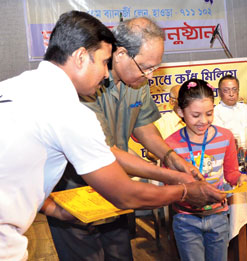
Prize distribution at Jatiya Sangha’s programme

The members of Jatiya Sangha, Shibpur celebrated the club’s 70th anniversary with cultural programmes on February 28 and March 1 at the Shibpur Public Library. The prize distribution ceremony of various competitions held through the past year took place on the first day, which was followed by a sarod recital by Rupak Dey.

On the second day, members felicitated two founder members of the club, who are still alive. Amarnath Chatterjee, 93, and Nirmal Kanti Chatterjee, 89, were members of the first committee that was formed after Jatiya Sangha took shape. Kinjal Chatterjee of Zee Bangla Sa Re Ga Ma Pa fame regaled the audience with both old and
new popular Bengali and Hindi numbers.

source: http://www.telegraphindia.com / The Telegraph, Calcutta / Front Page> Howrah> Story / by Amrita Ghosh / Friday – March 20th, 2015

Honours galore at Howrah salon

Vladimir Proshin’s photograph ‘In the River’

Vladimir Proshin caught five country boats floating together on a river. Their masts high, the boats were setting sail at dawn, through thick fog that was beginning to clear as the sun came up. Vladimir named this picture, ‘In The River’, which won a gold medal from the Fèdèration Internationale de l’Art Photographique (FIAP) at the Society of Photographers’ (SOP) 47th Howrah Colour Salon 2015.

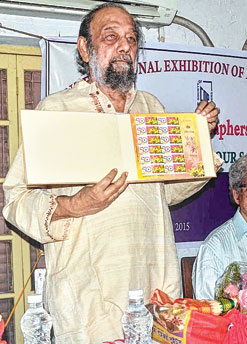
FIAP gold medal is considered to be the highest honour for photographers, who participate in competitions. At the 47th Howrah Colour Salon, 440 photographers from 41 countries sent in 3,120 entries. The panel of seven judges selected 761 photographs which were displayed through a slide show every evening from February 28 to March 1 at the Howrah Medical Club hall. There were three segments of the colour salon, open, creative and nature. This year’s colour salon was inaugurated by artist Nikhilesh Das. Also, a postal stamp with the SOP logo was launched on that day, marking the 50th year of the society.

Artist Nikhilesh Das launches a postal stamp with the SOP logo. Picture by Gopal Senapati

FIAP contributed three gold medals at the Howrah Colour Salon and Vladimir Proshin received one. Marcel Gustave Beauraind from Belgium won the second and Prabir Kumar Das from India won the third. The Photographic Society of America (PSA) contributed three gold medals and one silver medal at the competition. Martina Wolf’s photograph of a woman draped in lace won a PSA gold medal. India’s S P Nagendra’s wildlife shot of a cheetah chasing a deer, in the nature segment won the second PSA gold medal while the third went to India’s Shantanu Saha. Ian Whiston of UK won the PSA silver for the photograph of a lion and lioness in a fight.

“The quality of photographs have improved over the years,” said Asim Bhattacharjee, the secretary of SOP. Since digital photography is the order of the day, there is also place for experimentation in this art form. “A lot of photographs in the creative and open section may look less like photographs and more like creation through software. It is up to the experienced eyes of the judges to decide how much of the image is a photograph and how much has been created,” said Bhattacharjee.

Apart from the foreign medals and honour mentions, SOP gives away 10 gold medals and also certificates of merit. Memorial awards in the name of veteran photographers, Benu Sen, KG Maheswari and T D Pal were given away. The Benu Sen Memorial Award went to John Harding from the UK. The KG Maheswari Memorial award has been introduced this year as a tribute to the photographer, who died in December last year. Danielle Rovangati from Argentina won this award. TD Pal Memorial award went to Daniel Lybaert from The Netherlands.

source: http://www.telegraphindia.com / The Telegraph, Calcutta / Front Page> Howrah> Story / by Dalia Mukherjee / Friday – March 13th, 2015

All-Women Police Station Opened in Howrah

An all-women police station was today opened in Howrah (rural) district.

The police station was inaugurated by state correctional home minister Hyder Azid Safi at the Uluberia police station.

Parliamentry secretaries and MLAs Nirmal Majhi and Pulok Roy alongwith DIS Subroto Mitra was present on the occasion.

source: http://www.outlookindia.com / Outlook / Home> Howrah / March 16th, 2015

On the wrong side of a highway

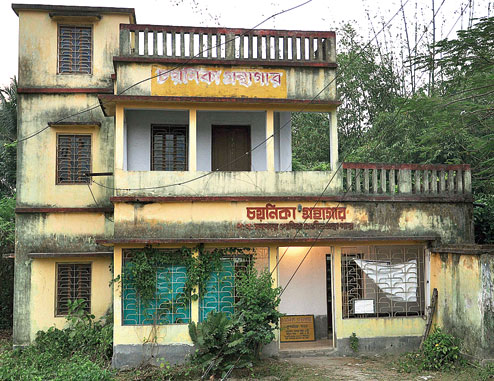
Chayanika Granthagar beside NH6

A small building beside NH6 is where Chayanika Granthagar is. The isolated two-storeyed structure is symbolic of how this once popular library has now become a lone building by the road which few people visit. Members and readers alike, prefer to go to other libraries in Uluberia and Bagnan instead of crossing the highway to come to this library. Ever since the national highway was commissioned, people have abandoned this institution that has, unfortunately, fallen on the wrong side of the road.

“The habitations are on the other side of the road. Kushberia village is actually on the other side of NH6 and that is where our members mostly reside. No one takes the risk of crossing this stretch of the highway as vehicles are always speeding,” said Sujata Ghosh, the librarian of Chayanika Granthagar.

The library was initially run from a local club in Kushberia. At that time, this was the only library in this village and area. The area had a number of jute mills at that time, and the level of education here was moderate. However, when the state government declared that it would give aid to public libraries, some educated locals took the initiative of starting a separate library. Chayanika Granthagar started at the present building in 1980 on the initiative of the founder and first librarian, Tulsi Charan Khan, Joydeb Mondal, Sukumar Basu and others. It is a rural library and was the sole source of books for many people who lived in this area, until the highway came up. “There is a library in Jaduberia. It is the nearest library now and members of this library have moved there since it is close by and they don’t have to cross the road,” said Ghosh.

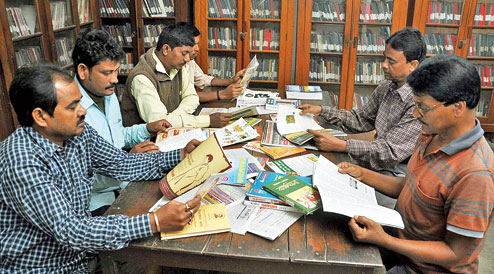
The reading room. Pictures by Anup Bhattacharya

At present, the library has 6,551 books. A separate children’s section has been made on the first floor of the building, but it remains closed most of the times. “Few child members visit the library because they cannot come on their own. They need a guardian to help them cross the road,” said Ghosh. However, there is no career guidance section here. “We have a few books for competitive exams at the library but we do not have an entire section dedicated to it,” said Ghosh.

In 2008, the library had received a book and furniture grant worth Rs 50,000. The annual grant of Rs 19,500 comes regularly. The library authorities have applied for a building grant some time back for making toilets and repairing the present building. While the library authorities are maintaining the institution with the hope that some day things will change, they had also sent written requests to the National Highway Authorities of India for building an underpass near the library. “We had sent a letter to the NHAI and also to the construction company, requesting them to make an underpass near the library. However, our request fell on deaf ears. The underpass is coming up further down the road, from where this library would be too far,” said Ghosh.

FACTFILE

Name:Chayanika Granthagar
Estd: 1978
Address: Village and PO – Kushberia, PS – Uluberia
No. of members: 261
Membership fees: Rs 2 per month for general members, free for children

source: http://www.telegraphindia.com / The Telegraph, Calcutta / Front Page> Howrah> Story / by Dalia Mukherjee / Friday – February 27th, 2015

American ‘bansuria’ revives his Bong links

Kolkata :

He was born in Woodstock and became a raga exponent in Kolkata, his bansuri featuring in a Grammy-winning album and Oscar-winning film along the way.

Flautist Steve Gorn is in town to perform at a concert presented by Calcutta Classical Guitar Society in association with Flute Lover’s Association on Wednesday.

Gorn had first come to India in 1970. He visited Kolkata a year later. “I had a Western music background. My father was a pianist and I played jazz saxophone and Western flute. During the late 1960s, though, many in our generation got influenced by Ustad Bismillah Khan’s shehnai. I came to Varanasi to explore Indian classical music and even tried the the shehnai. But since I was already playing the flute, I shifted to bansuri,” he said.

Gorn next travelled to Kolkata and began learning bansuri from Gaur Goswami, a disciple of the legendary Pandit Pannalal Ghosh. “I stayed around Gariahat and would take a tram to Shyambazar. That year, 1971, was a troubled time because of the Bangladesh war. Bombs were going off, curfews were imposed and thousands of refugees strea- med in. But I was young and couldn’t gauge the political situation. Now of course I know things better,” he told TOI.

“But back then, the music used to be a lot different from what it is now. Kolkata had an old-world charm and the music I love comes from that era — the music of stalwarts such as sitar maestro Pandit Nikhil Banerjee. For me, it is the ‘bhav’ or ‘ras’ of Indian classical music that is more important than anything else,” he said.

By 1972, Gorn and his wife had spent about 16 months in India. Then came a long gap and he returned again in 1986. “But Indian classical music continued to influence my compositions for films, dance shows and theaters,” he said. It also took him around the globe. Last year, he performed in China, Japan, Bulgaria, Czech Republic and Holland. “That’s why I speak only smattering of Hindi and Bengali,” he says apologetically.

Pandit Hariprasad Chaurasia heaps praises on Gorn. “He is a very good musician and a nice human being. We are very good friends and I have visited his home many times,” the flute maestro told TOI on Tuesday.

In 2004, Gorn played the flute for “Born Into Brothels” which was shot in Sonagachi and bagged an Oscar. “One scene is very close to my heart — a boy flies a kite and the flute melody also rises with its flight,” he said.

In 2011, he featured in the Grammy-winning album “Miho – Journey to the Mountain”. “Dhruba, the nephew of Pannalal Ghosh, played sarangi in the album. Miho is a museum in Japan and the music director was invited to visit and create music reflect the Asian artworks that were on display,” he told TOI.

Gorn has also been a part of several Grammy-nominated albums, including two this year.

source: http://www.timesofindia.indiatimes.com / The Times of India / Home> City> Kolkata / by Shounak Ghosal, TNN / March 11th, 2015

Shades of grey, stark & sombre

SaibalDas01KOLKATA11mar2015

Saibal Das’s exhibition of black-and-white photographs (silver gelatin prints), Before the birth of Time, at The Harrington Street Arts Centre in collaboration with Tasveer lifts the veil over a world that once India was identified with, but is hardly visible anymore, now that the entire country has turned into a marketplace which has no connect with the more contemplative side of life.

Das, a veteran photojournalist, began his quest for a way of life where money and the principles it represents have little value, about four years ago when he visited Nabadwip, where the Vaishnavs have little use for material possessions. Over the next three years he travelled to Vrindaban, Puri and Manipur, which are regarded as the seats of Vaishnavism in India.

This world is sombre, pensive and at times sad, but it can also be charming and even quaint. A woman stands alone by the tulsimancha in Vishnupriya’s home in Nabadwip. The effigy of her beautiful, lotus-eyed husband, Chaitanya Mahaprabhu, is worshipped in a shrine in Puri. Whether by accident or design, behind him is a mural of Hanuman, the symbol of strength and prowess. A young woman, who has come to worship the sun during Chhat puja, is lost in thought. Behind her is a vast expanse of water from which sugarcane sprout like rushes. A smile plays on the lips of a buxom woman who has also come to the riverside along with other worshippers.

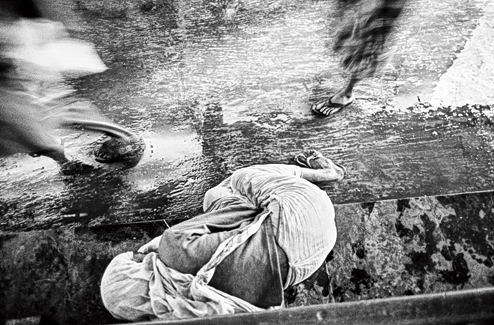
Two photographs from Saibal Das’s exhibition

An old woman with an unlined face in a white sari and folded hands sits alone in a huge hall. A pinpoint of light illumines her dark eyes. She is calm and no sorrow can touch her any longer. Another old woman lies beneath the staircase of a shrine as people pass by hurriedly, their feet blurred by speed. But not all women are so resigned. The old women who are being initiated into Nagahood look tough and strong, both physically and mentally. A royal lady is the very picture of dignity as she sits on her bed.

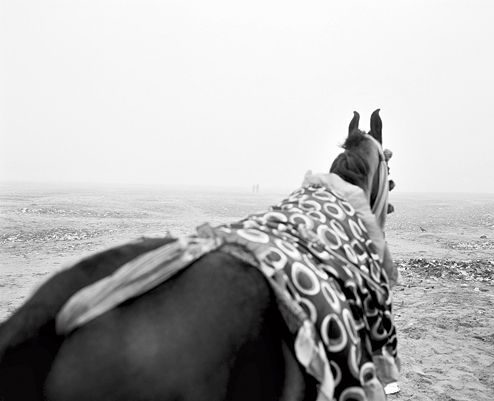
In this world one walks alone. This is perhaps symbolised by the stray pair of rubber slippers resting upright on a wall clawed and mutilated by the hands of time. There are also the ash-covered mendicants who are absorbed in their own world while playing the flute or telling their rosary. As solitary as these wandering figures is a horse standing in a dry riverbed. On the horizon are two human beings reduced to specks.

But it is not all sadness and gloom. An unwilling child dressed as Krishna holds on desperately to the waistband of a man as he is perhaps being led to a dais. The ceremonial guards of a temple in Manipur sit with their spears amidst a vast hall. The turbaned cooks with statuesque physique of the same temple have their mouths covered with cloth so as not to pollute the food for god.

Das’s most powerful photographs are those of the Manikarnika burning ghat where countless human beings are cremated. He never shows the grotesque half-burnt bodies floating in the river. Instead, his focus is on the mountains of logs used for the funeral pyres. They are piled up on the staircases and on the boats by the bank. The wood is being sold by the kilogram. An old woman is busy tying something in the pallu of her sari. She looks elsewhere. Her attention has been distracted. Behind her rises a wall of logs. In another photograph, smoke rises from a pyre in the distance, blurring the buildings behind it. In the foreground is the massive back of a man with a shaven head.

source: http://www.telegraphindia.com / The Telegraph, Calcutta / Front Page> Calcutta> Story / by Soumitra Das / Sunday – March 08th, 2015

Civic treasures digitised

ArtKOLKATA05mar2015

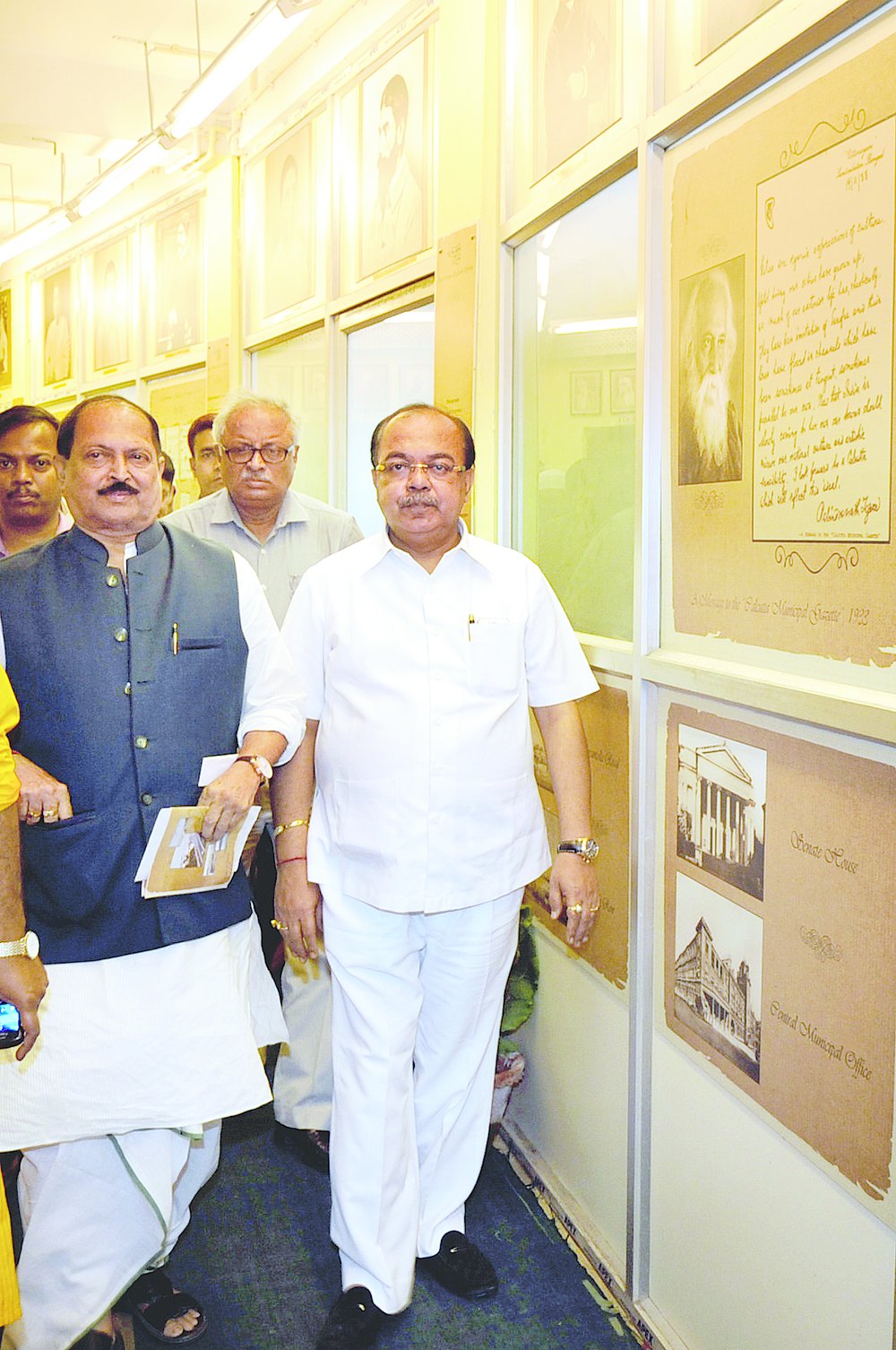
Mayor Sovan Chatterjee and former mayor Subrata Mukherjee at an exhibition in the Calcutta Municipal Corporation headquarters on the occasion of the inauguration of a digital archive.

The rare pictures on display are among the hundreds that will be stored, along with significant documents, in the Amol Home Digital Archive. The collections include a photograph of a pensive Gandhiji at Keoratala during Chittaranjan Das’s cremation.

The archive has been named after scholar Amal Home, who used to edit the Calcutta Municipal Gazette when its publication started in 1924.

source: http://www.telegraphindia.com / The Telegraph, Calcutta / Front Page> Calcutta> Story / Wednesday – March 04th, 2015

Unique initiative for mentally-ill patients

A unique initiative involving the West Bengal Health Department and a non-government organisation here on Monday has brought hope to mentally ill patients of Kolkata’s Pavlov Hospital.

Ostracized by society and abandoned by their family members, patients of the biggest mental health facility in West Bengal can now dream of financial independence and a life beyond the confines of the hospital.

A memorandum of understanding for Dhobhi Ghar, a laundry project, was signed between the representative of State Health Department and Anjali, a mental health rights NGO, which at the outset will involve at least 12 patients who have recovered from their ailment but are unable to return home.

“Initially, we will be dry-cleaning clothes from hospitals and slowly we will take orders from hotels and restaurants. The 12 people who are involved in the project will be paid Rs 232 per day as per minimum wages laws,” said Ratnaboli Ray, who signed the MoU on behalf on Anjali.

While the machines for starting the project have been imported by the NGO, the Bengal government has provided necessary infrastructure and ensured water and electricity supply for the project.

“We thought that it was a good proposal to provide livelihood and rehabilitation to mental health patients. This is the first such initiative taken in Bengal involving mental health patients,” Moloy De, Principal Secretary of Bengal’s Health Department told The Hindu .

According to mental health activists like Ms Ray this is first such initiative tried anywhere in the country and it comes as good news from the mental health instruction of Bengal after many years.

In the past, the mental hospitals of Bengal particularly the Pavlov Hospital were in the news for unnatural deaths and human rights violations.

The death of 84 inmates in the mental health facility of Bengal in 2013 over the past three years had resulted in strong criticism by activists.

source: http://www.thehindu.com / The Hindu / Home> News> Cities> Kolkata / by Shiv Sahay Singh / Kolkata – March 03rd, 2015