Category Archives: Arts, Culture & Entertainment

Lights, camera, action: Kolkata film fest a hit

Day 4 of the Kolkata International Film Festival 2018
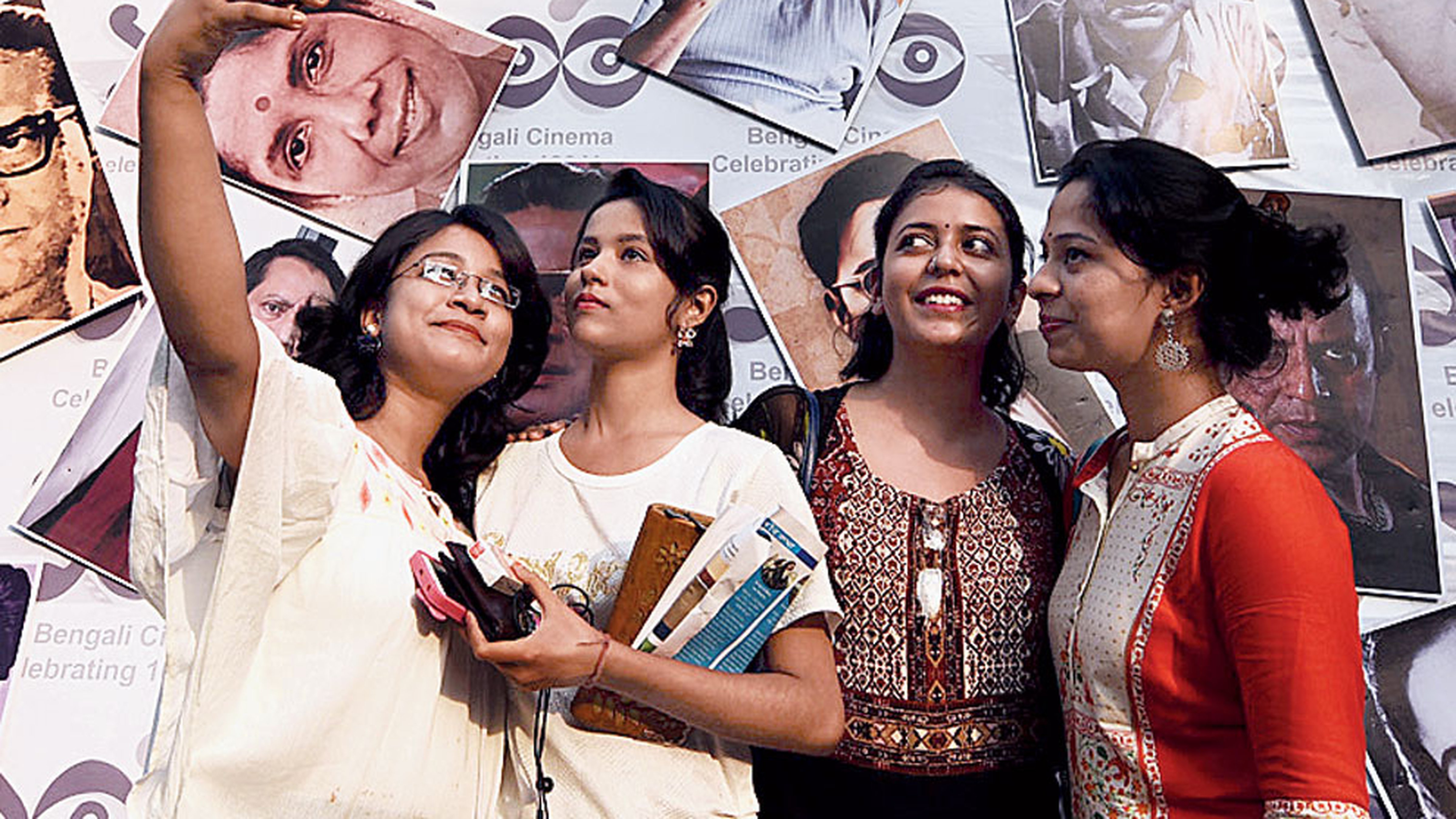
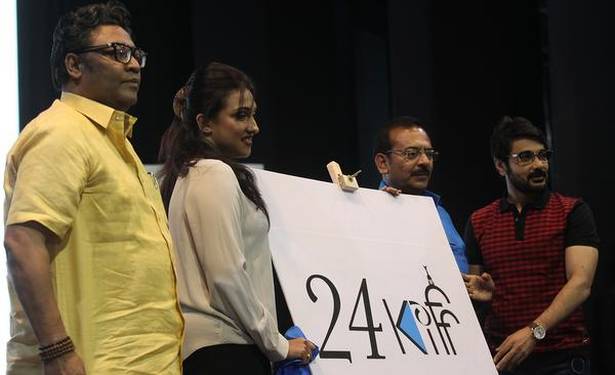
Time for a groupfie at the Kolkata International Film Festival in Nandan.
Picture by Pradip Sanyal

The Nandan promenade was crowded as usual around 4pm on Wednesday on the 4th day of the Kolkata International Film Festival.

At any point, at least five smells hung in the air. Arcane hobby publications, little magazines, festival pamphlets, and food — all vied for the visitors’ attention.

In addition to a stall devoted to promoting Bengali cinema’s 100-year-long heritage, the festival’s background score whirled in the air like an anthem.

Cigarettes went around youngsters freely. A group of three men played the role of festival troubadours with characteristic Bengali elan. While one was tall, long-haired and seemed to be holding a journal in his hands, his short friend sported a long beard and a wooden flute. The third was a jokester, shoving the other two around with a cigarette in hand while they tried to work at their craft in front of Nandan I.

At the Nandan foyer, an Australian documentary film-maker was being interviewed by a news channel. “Spicy food? Yeah, I like it, but I’m not the biggest fan. I can handle it. But really, I’m just floored by the whole festive air here. It’s like a carnival, really great. Can’t wait to see more.”

Used paper plates were laid generously at the feet of a cluster of large garbage bins. This benefited the two or three mutts, who honed in on the area once the stash was substantial.

An eager quizmaster paused onstage at the makeshift but large Ektara Manch abutting Rabindra Sadan and said: “This next question is for biological males only, please.”

Unoffended, winter picknickers at the garden venue giggled, moving around the carpeted audience area for coffee and kobiraji.

The quizmaster’s mystery soundtrack —Sob Khelar Shera by Manna Dey — came and before he could ask a question, many women raised their hands in laughing abandon. “What was the final score in the match at the end of the film?” Some backed down, now laughing meekly.

A group of students seated on the grass were heard saying, “That’s not the message of the film…. I’ve watched it more than once…. You have to perceive it in the spirit of what Vivekananda once said. You will be nearer to Heaven through football than through the study of the Gita.”

An artist seated beside a tea vendor in Nandan I called out to the occasional passer-by, “I’m not begging, you know. If you’d give me five minutes, I could show you. I really have to make a living, too. But I won’t beg. So, don’t ignore me as if I’m a beggar, please.”

On 9th November, at the inaugural ceremony of the 24th edition of the festival, chief minister Mamata Banerjee had said: “The status of the festival was on a downslide before we came to power. We showed things could be done if you wanted to.”

At Nandan, the air of legacy was ripe in the air. In addition to the tall banners mounting the Nandan buildings, the rear promenade saw a cultural exhibition commemorating 100 years of Bengali cinema. A rotunda behind Sisir Mancha had a 10-panel retrospective curated by Prosenjit and Suvaprasanna.

The panels documented the dates, personalities and photographs of all those who have made Bengali cinema proud — Satyajit Ray, Manna Dey, Tapan Sinha and Mrinal Sen to name a few.

The quizmaster, flanked by two 30ft ektaras, ended by reminding the audience to enjoy this “Carnival of Cinema in the City of Joy”.

source: http://www.telegraphindia.com / The Telegraph Online Edition / Home> West Bengal / by Aditya Nag in Kolkata / November 16th, 2018

Kolkata International Film Festival screens rare Indian language films

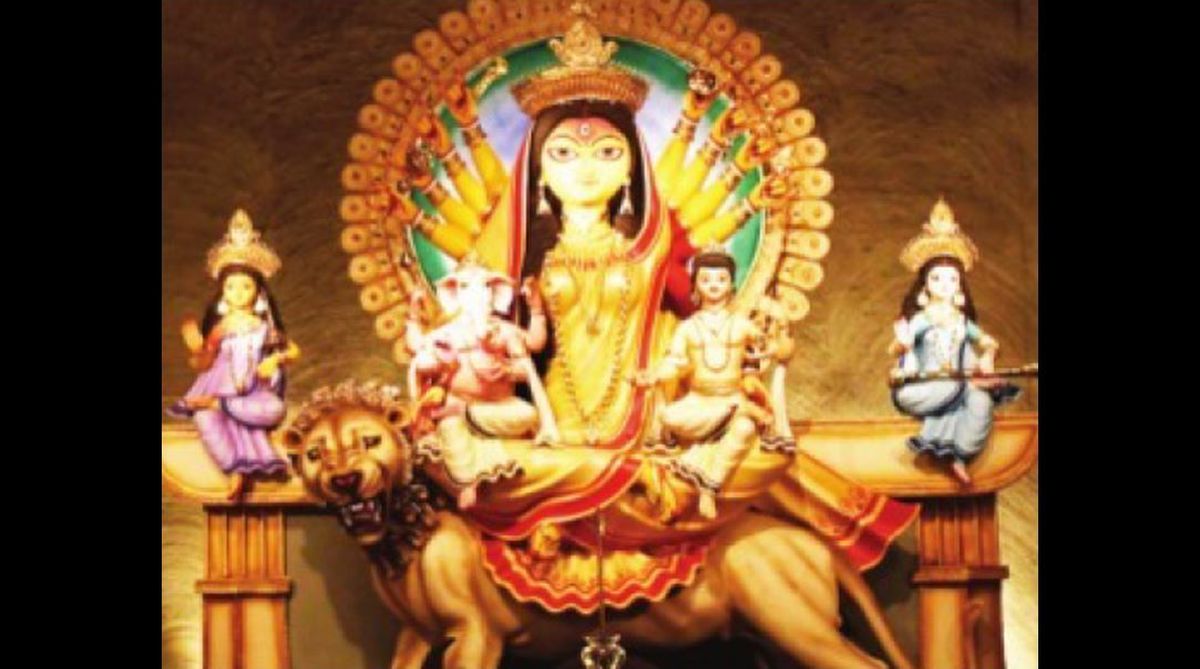
Films like “Kittath Preeti” (in Koda), “Boldu” (Tulu), “Navleri” (Lambani), “Death Certificate” (Kurmi) and “Nabon” (Khasi) are being screened under this section at the festival.

KIFF is showcasing a bouquet of rare Indian Language films (Photo courtesy : KIFF Official website)

Kolkata :

Giving light to the diversity of India, Kolkata International Film Festival (KIFF) is showcasing a bouquet of rare Indian Language films including Nagasmese, Lambani, Jasari, Kurbi languages for the first time.

“I got many film entries from these languages. Maybe the quality of the films are not that good like that of a ‘Pather Panchali’ or ‘Sholay’ but they are good in their own way,” curator of ‘Unheard India’ Shantanu Ganguly, told the media here.

“Moreover, people need to know about these languages,” he added.

He mentioned that people came to know about the Jasari language cinema only after “Sinjar” directed by Sandeep Pampally won the Best Feature Film in Jasari award at the National Film Awards in April.

“‘Sinjar’ is also India’s first island film as it was entirely shot in Lakshwadeep. Jasari is the colloquial language spoken there,” Ganguly said.

The film stands against terrorism and speaks about two women held as captives by the Islamic State terror group, their ordeal and how they survive a communal situation in capital Kavaratti.

It stars Malayalam actors Srinda Arhaan, Mythili, Musthafa and Sethulaksmi.

“Nana A Tale Of Us” directed by Tiakumzuk Aier is a film in Nagamese language spoken by a section of people in Nagaland.

“There are filmmakers making Nagamese films since the 1990s but it doesn’t make a cut to the film festivals. There are documentary filmmakers but for fiction — there are few,” Aier told IANS.

He said that the Church is supporting ‘clean election campaign’ in his state and they have produced the film as it is based on the specific issue. It talks about the moral sense and how societal evils have affected their lives.

Naganatha N. Joshi, the producer of the film “Saakibaayi” in Banjaara language (also known as Lambani) spoken in Karnataka, had to mortgage his house to make the film. His wife Premalatha N. Joshi is the director.

“We didn’t have any artist, we taught commoners and made them act. My film is based on the life of a woman of Banjaara community,” Naganatha said.

Films like “Kittath Preeti” (in Koda), “Boldu” (Tulu), “Navleri” (Lambani), “Death Certificate” (Kurmi) and “Nabon” (Khasi) are being screened under this section at the festival.

source: http://www.newindianexpress.com / The New Indian Express / Home> Nation / by IANS / November 15th, 2018

KMC gives away Kolkata Shree awards

The Kolkata Municipal Corporation (KMC) on Monday announced the name of the Puja committees that have secured the winning position in the Kolkata Shree 2018 that is given out every year to best Pujas by the civic body.

Mayor Sovan Chatterjee on Monday announced the name of Puja committees that have won the Kolkata Shree award 2018. Around 100 Puja committees participated in the competition. The competition was judged by several eminent personalities who have shortlisted the winning Pujas.

A total of 10 categories had been reserved for shortlisting winners which are ‘Serar Sera’, ‘Sera Pujo’, ‘Sera Pratima’, ‘Sera Sailpik Utkorsho’, ‘Sera Bishoy’, ‘Sera Aloksajja’, ‘Sera Paribesh’, ‘Sera Parichana Pujo’, ‘Sera Sambhabana’ and ‘Mayor’s Choice’.

The following Pujas have won in the category of ‘Serar Sera’: Chetla Agrani, 95 Palli, Suruchi Sangha and Tridhara Akalbodhan. In the ‘Sera Pujo’ category the winners are: Naktala Udayan Sangha , Rajdanga Nabauday Sangha, Hindustan Club and Abasar Sarbojanin.

For ‘Sera Pratima’ category: Baghbazar Sarbojanin, Tala Pratay, Kashi Bose Lane and Behala Natun Dal.

The awards for ‘Sera Salpik Utkorsho’ category have been secured by: Shib Mandir Sarbojanin, Selimpur Pally Sarbajanin, 66 Pally and Bosepukur Sitala Mandir; ‘Sera Bishoy’ category: Bhawanipur Sadhin Sangha, 75 Pally Sarbojanin, Bosepukur Talbagan and Samaj Sebi Sangha; ‘Sera Aloksajja’ category: Ekdalia Evergreen, Badamtala Ashar Sangha, Dakshin Kalikata Sarbojanin and Kalighat Milan Samity. A total of 45 Puja committees have won in the category of ‘Mayor’s Choice’.

source: http://www.thestatesman.com / The Statesman / Home> Cities / by Statesman News Service, Kolkata / October 16th, 2018

Graphic novels give a push to Bengal’s dying folk arts

In a unique initiative, three graphic novels have been published on three different art forms of the State, both in Bengali and English in 2018.

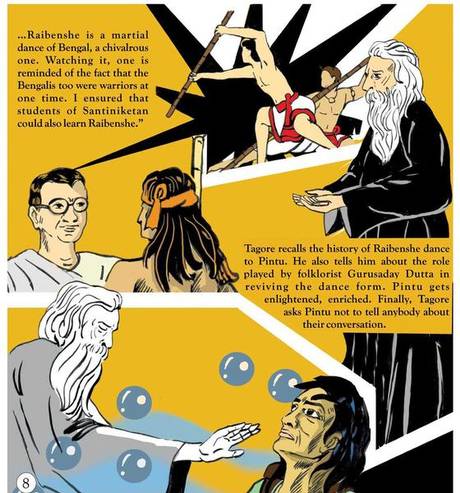
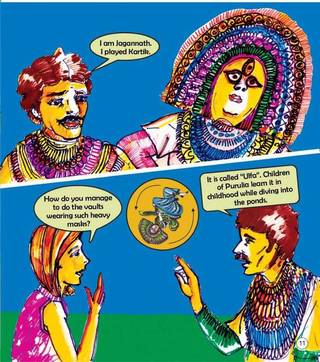
Pintu, a teenager from Murshidabad is surprised to hear it from Gurudev Rabindranath Tagore that he wanted to introduce Raibenshe, a genre of folk martial dance, at Santinketan, while Tito, a boy from Kolkata is amazed that behind the Chhau masks, there are real people dancing.

These are excerpts from graphic novels published by the West Bengal government, the UNESCO and Banglanatk.com for promotion of traditional crafts of West Bengal. In a unique initiative, three such graphic novels have been published on three different art forms of the State, both in Bengali and English in 2018.

The graphic story on the Purulia’s famous Chhau dance is called Experiencing Chhau (Dekhe Elam Chhau) while the book on Raibenshe, folk martial dance form south Bengal is called Raibenshe Rocks ( Ajo Aache Raibenshe). The third publication is on the little known puppetry from Nadia titled The tale of a lost leg ( Harano Payer Kissa).

“These graphic novels are part of our efforts to promote cultural industries in different parts of the State under the project Rural Crafts & Cultural Hubs, which is supported by Department of Micro Small and Medium Enterprises and UNESCO,” said Ananya Bhattacharya, director of Banglanatak.com, a social enterprise working with artisans across different States of the country.

Ms. Bhattacharya said that the idea behind the publication is to engage young minds so that they become aware about folk tradition of the State.

“These graphic stories or short novels, whatever you call them, are not more than 50 pages and are designed with lots of colourful sketches to engage young readers. While the characters are fictional, it has been our effort to pack as much information about the folk art forms as possible in these stories,” Ranjan Sen, author of these publications said.

These stories also provide a glimpse of efforts taken up to revive these dying folk art form. Mr Sen said, adding that such initiative to encourage awareness about folk art has not been taken anywhere in the country.

These graphic novels are being distributed to children through school outreach programmes and at different fairs and festival.

There are plans to publish more of such graphic novels and one publication on Baul singers of the State is in the offing. Mr. Bhattacharya said that under the Rural Crafts & Cultural Hub initiative, work is going on 15 different crafts of the State and similar publications engaging young minds will be brought on most of these art forms.

source: http://www.thehindu.com / The Hindu / Home> Books / by Shiv Sahay Singh / Kolkata – November 12th, 2018

KIFF, marking 100 years of Bengali cinema, to focus on restoration

Kolkata fest to focus on preservation work with a workshop and screening of 13 restored movies

One hundred years after the first Bengali film, Bilwamangal, was screened, the 24th Kolkata International Film Festival (KIFF), to be held from November 10 to 17, will not only celebrate the journey through the past century but also focus on preservation and restoration of Bengali classics.

One of the major draws of this year’s KIFF is a workshop on film preservation organised by the Film Heritage Foundation (FHF). The workshop, which will train 60 resource personnel in the art of preservation and restoration, also aims to create awareness on the urgent need to preserve the moving image heritage of the Bengali film industry.

‘Silent films lost’
Shivendra Singh Dungarpur, founder director of FHF, said that Bengali films were the most affected when it came to preservation. “We have lost all the silent films made here between 1918 and early 1930s, except one film, Jamaibabu, of 1931,” Mr. Dungarpur said.

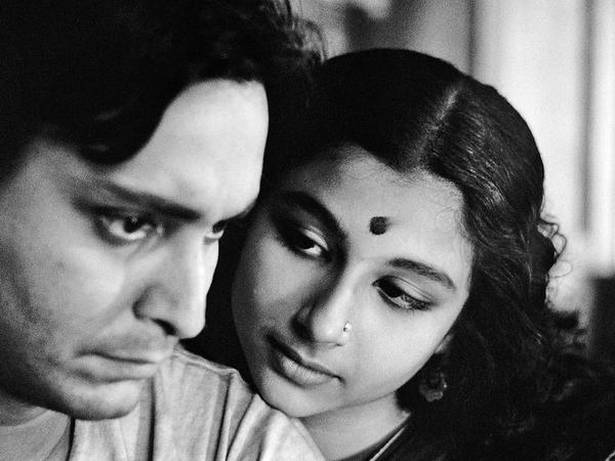
The FHF has compiled a list of 100 Bengali films that are in urgent need of preservation and restoration. They include Bimal Roy’s Udayer Pathe (1944), Suchitra Sen-Uttam Kumar starrer Harano Sur (1957), Tapan Sinha’s Kabuliwala (1957), Satyajit Ray’s Parash Pathar (1958) and Teen Kanya (1961), and Mrinal Sen’s Padatik (1973), among others. Most of these films are lying with individual producers or with the State government.

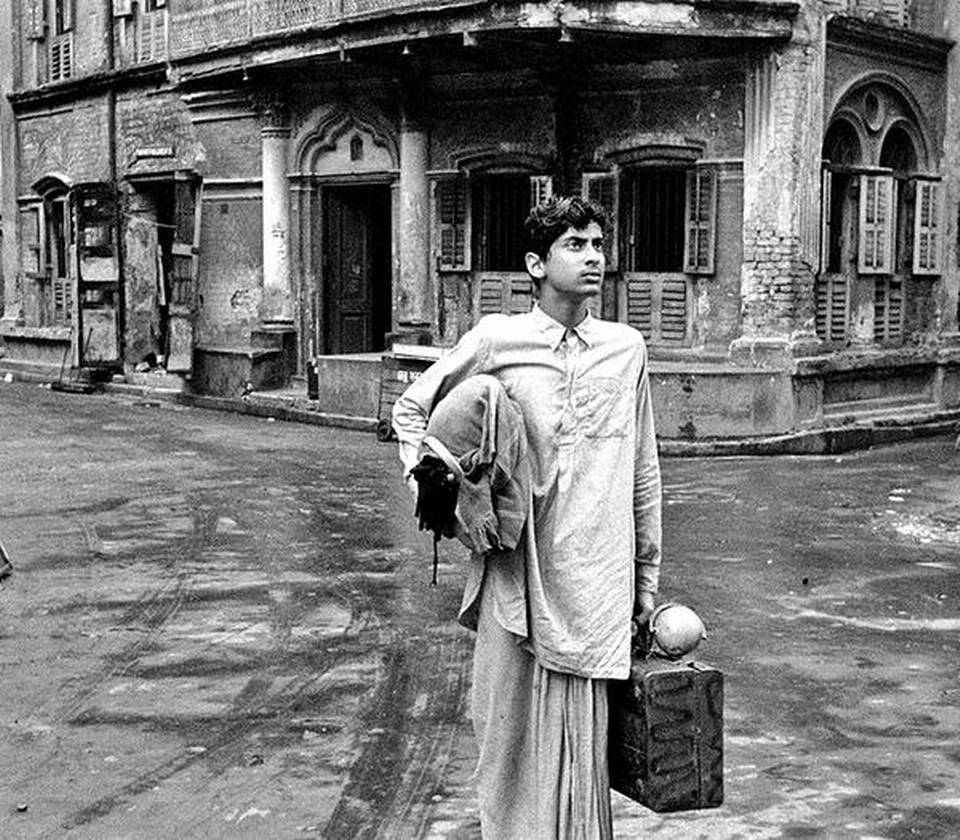
What makes the workshop and this year’s KIFF more interesting is that 13 classics of world cinema — including The Apu Trilogy (Pather Panchali, Aparajito and Apur Sansar) of Satyajit Ray, Bicycle Thieves of Vittiorio De Sica and Blow Up of Michelangelo Antonioni — will be screened as ‘restored classics’. Before each screening, an expert on film restoration will talk about the restoration process of that particular film.

“Restoration is an art form and we have to train people in this aspect so that our heritage of moving images can be preserved. Moreover, we have to also understand that restoration is more costly that creation,” Mr. Dungarpur said.

Vivek Kumar, director general of KIFF, said the workshop — whose organisers include Viacom18 and International Federation of Film Archives — is a “very important” component of the festival. “Eleven of the most qualified archivist and film restorers of the world will participate in the workshop,”” Mr. Kumar said.

There will be a number of other events to commemorate 100 years of Bengali cinema . This includes an exhibition and also conferring of a special award named after one of the first filmmakers of Bengal, Hiralal Sen. The 24th edition of KIFF will also publish a directory of Bengali films of the past hundred years, a brochure on historical significance of Bengali cinema and a special screening of 14 Bengali films. The inaugural film at the festival will be Uttam Kumar-Tanuja-starrer Bengali film Antony Firingee (1967).

As many as 171 feature films and 150 short films and documentaries from 70 countries will be screened at 16 different venues in the city and suburbs.

“The focus country is Australia, which is also celebrating 100 years of their cinema,” Mr. Kumar said, adding that a delegation of artist and film personalities from that country will be attending the KIFF. The master class, a regular event at the KIFF for film students and cinema enthusiasts, will be conducted by Australian director Philip Noyce.

source: http://www.thehindu.com / The Hindu / Home> Entertainment> Movies / by Shiv Sahay Singh / Kolkata – November 03rd, 2018

Siliguri artist Biplab Sarkar shines in Scotland, recalls struggle

Meet Biplab Sarkar, who was in Scotland for three months for his creative work, and who recently returned to Delhi, where he has established himself as an artist after a long struggle since his school days.

Biplab Sarkar. (Photo: Facebook/@serendipityartsfestival)

True to a proverb that says ‘a wise man does not have proper recognition in his area,’ this Siliguri resident is also a fitting example of a Bengali saying ‘Geyo Yogi Bhik Payna.’

Meet Biplab Sarkar, who was in Scotland for three months for his creative work, and who recently returned to Delhi, where he has established himself as an artist after a long struggle since his school days.

Mr Sarkar, 28, a former student of the Siliguri Baradakanta Vidyapith, says he has not looked backed ever since he has been selected to receive the Glenfiddich International Artists Residency award as an emerging artist of the year 2018.

“Significantly, my artwork was re-coloured in a Kali Puja pandal in Siliguri some time ago, but I did not bother to protest,” says Mr Sarkar, who is in town to celebrate the Pujas. He says he will return to Delhi after Bhai Phonta, which falls on Friday.

Mr Sarkar was chosen as an emerging artist of the year 2018 in March this year after an exhibition of the top five finalists’ works, whose names were shortlisted from nearly 2,500 participants across the country.

He represented India in Scotland as part of the Glenfiddich Artists in Residence programme, where he worked for three months at the Glenfiddich Distillery with a group of eight artists from around the world.

Mr Sarkar, who dreamed to be an artist and wanted to continue his studies in an art college, completed his BA degree in History from the Bagdogra KGTM college. After that, he had to earn his livelihood as an art teacher in private schools in Siliguri and he finally left for Santiniketan on guidance from his art teacher here.

“Only a mad man can make himself an artist after struggling hard and even without food for half a day due to paucity of support. If I can do something, why don’t you take the risk in your life,” his teacher told him once when he was in a dilemma over his future studies, he recalls.

He finally appeared in an examination for admission in Santiniketan and his dream came true after he qualified as a student of Kala Bhawan in Viswa Bharati University.

Later, as he decided to leave Santiniketan to build for himself a “brighter career,” he qualified for admissions in the Delhi University for Masters, where he says he faced acute financial crunch and could not manage admission fees amounting to around Rs 26,000.

“My English teacher, who loved me, helped me a lot by providing part of the admission fees for the Delhi University,” Mr Sarkar recalls.

Mr Sarkar hung around with his old friends in a forest area on the banks of the river Sahu in Siliguri on Diwali.

Mr Sarkar, who works on water colour, got a significant break in his life from India Gate in Delhi where he started working on several hawkers and their struggles and hardworking lifestyle.

“I did not prefer to showcase the misery of the life of hawkers, but tried to portray their joys and sorrows,” Mr Sarkar said. He later worked in Scotland on manufacturing of drums for storing whisky and presented a series of paintings on them with a “natural sound effect,” which was much appreciated there.

source: http://www.thestatesman.com / The Statesman / Home> Cities> Siliguri / by Manas R Banerjee / Siliguri – November 09th, 2018

No priest, women perform Kali Puja in Siliguri

The managing committee of the Ashram’s Siliguri branch has also roped in people from all communities and religions like Hindu, Muslim, Sikh, Buddhism, and Jainism.

(Photo: SNS)

At a time when the Sabarimala Ayyappa Temple has closed its doors for girls and women despite a Supreme Court order, Kali Puja organisers in Siliguri have shunned traditions and allowed a group of women in Siliguri to worship Adya Maa (Kali), while they have organised the puja without a priest.

Significantly, when the puja organised by the Matrisangha Jankalyan Ashram was inaugurated, a group of five women welcomed Goddess Adha Kali by presenting a dance and a song.

Women were directly involved in organising the puja since Tuesday midnight to dawn on Wednesday, while hundreds of Siliguri people witnessed the unique presentation.

The managing committee of the Ashram’s Siliguri branch has also roped in people from all communities and religions like Hindu, Muslim, Sikh, Buddhism, and Jainism.

“Devotees have been offering their prayers and presenting various devotional songs, hymns and even Rabindra Sangeet,” organisers said.

As the Yajna went on, hundreds of people visiting the pandal were greeted by a Rabindra Sangeet ‘Agun’r Parosh Moni Chhoao Prane…’, while the music continues till the oblation of fire.

Notably, the Late Sudin Kumar Mitra, an employee of the Central excise department, established the Matrisangha Jankalyan Ashram, at different locations, including Kolkata and Siliguri.

Mitra organised the first puja in Siliguri in 1978, and termed it the ‘Sarba Bharatiya Adya Kali Puja’ and then set up the Ashram on Balaidas Chatterjee Road at Hakimpara in Siliguri.

Several devotees of Mitra, after his death in 1984, maintain the tradition by showcasing his photograph and his method of worship.

“Our Gurudev Sri Sudin Kumar Mitra has asked us to perform the Kali Puja without a priest, but by involving many people from the society. We maintain the tradition, the method of worship popularized by him and especially his guidance during the puja here. ‘No priest is required for the puja, you do your own puja,’ he used to say,” a member of the managing committee of the Ashram, Bikash Das, said.

“You will not be getting Ma (mother) by ignoring the people (Manush), because the first letter of Manush is Ma,” Sudin Kumar Mitra wrote on 29 July 1969.

Mitra, a resident of Kolkata, started the first puja in Allahabad, as he was posted there and went to many places in India and finally settled in Siliguri.

A poet, Subhan Das, who curiously witnessed that puja throughout the night, said: “Women took part directly to organise the puja when women are being prevented in a temple at Sabarimala in Kerala. Such puja is so significant at the present times we are experiencing.”

“I was delighted as the Rabindra Sangeet ‘Aguner Parosh Moni’ was played during the Yajna,” he added.

source: http://www.thestatesman.com / The Statesman / Home> Cities / by Manas R Banerjee / Siliguri – November 08th, 2018

Here lies Hindoo Stuart: Inside the 250-year-old Park Street cemetery

The Park Street cemetery, which is now 250 years old, is home to stories of Kolkata’s past and present.

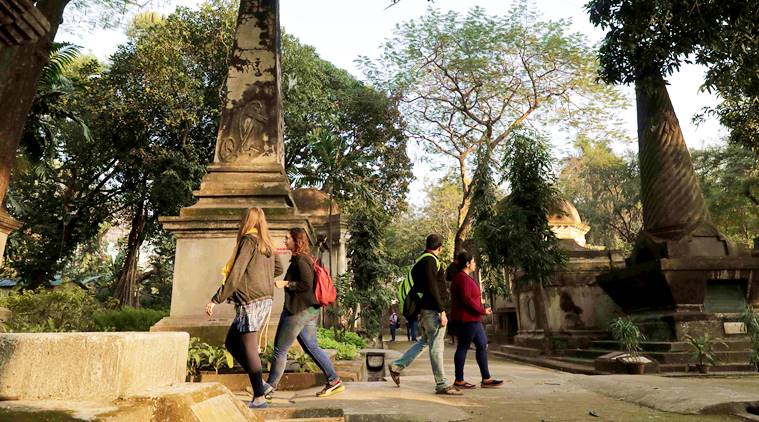
South Park Street Cemetery , one of the oldest Christian cemeteries celebrates 250th birthday on Saturday, January 06, 2018.It is a consecrated Christian Cemetery with mortal remains underneath each of the 1600 plus vaults with remarkable Tombs . Locals , tourist ,as well as embassy people seen in the cemetery during the programme Express photo by Partha Paul.

In the 250 years of its existence, the Park Street cemetery in Kolkata has seen its share of stolen kisses and frantic lovers, both gay and straight. In Vikram Seth’s 1993 novel, Suitable Boy, Lata takes a leisurely through the Park Street cemetery along with a friend, Amit. They visit the tomb of Rose Aylmer, a Welsh girl who sailed to India with an aunt in 1798, and died of cholera two years later. Famous British poet Walter Savage Landor, a suitor of Rose, immortalised her in a poem Rose Aylmer. Amit and Lata recite the poem together at the spot.

Not far from the bustle of one of Kolkata’s busiest streets, is the South Park Street Cemetery, with two functional old iron gates at the entrance. Inside, rows of obelisks and gazebos spread out on both sides in no particular order. A marble plaque on the left pillar declares that the cemetery opened in 1769 and closed in 1790, but historians will tell you that burials continued into the 1830s.

The cemetery is the final resting place of many like Rose Aylmer. As Souvik Mukherjee, assistant professor of English, Presidency University points out, most Europeans who would land in the muggy, mosquito-ridden city, would last only “two monsoons”. “They would almost always fall prey to malaria,” says Mukherjee, who specialises in the cemeteries of Bengal. The truncated pillars that dot the cemetery signify lives lost too soon. “You will find graves of many, many children here,” says Mukherjee.

According to Susan Hosking’s book, The Great Burial Ground at Chowringhee: Reflections on the South Park Street Cemetery in Kolkata, this is one of the oldest non-church cemeteries in the world. Hosking says that by the mid-18th century, the old Christian burial grounds in the ruins of the first Fort William, established in 1665, had become inadequate. Eight acres of relatively high ground in an uneven and swampy area were marked out for a new cemetery on what was then the southern outskirt of the town.

The oldest tomb in the cemetery, according to Mukherjee, is that of Mrs Sarah Pearson, who died on September 8, 1768. Very little is known of the oldest resident of the place but tomes have been written on the one who has the most prominent tomb of the cemetery — a blindingly white structure in a maze of greys. The tomb of Sir William Jones, renowned philologist and founder of Asiatic Society of Bengal, finds pride of place bang in the middle of the cemetery.

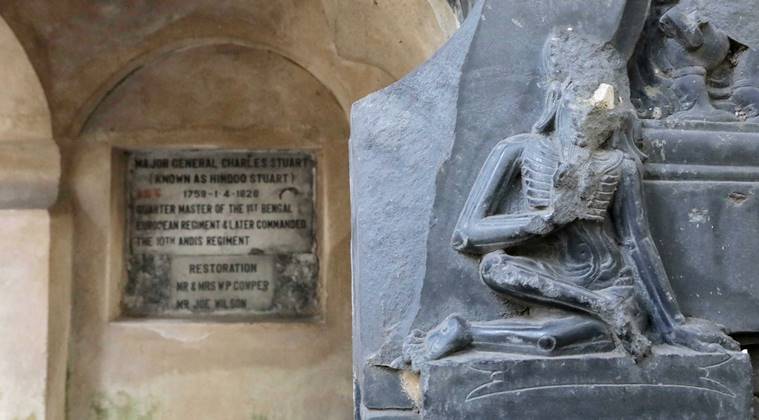
Major General Charles Stuart, known as Hindoo Stuart tomb at South Park Street Cemetery , one of the oldest Christian cemeteries celebrates 250th birthday on Saturday, January 06, 2018.It is a consecrated Christian Cemetery with mortal remains underneath each of the 1600 plus vaults with remarkable Tombs . Locals along as well as embassy people seen in the cemetery during the programme Express photo by Partha Paul.

It is definitely not the most beautiful structure in the premises. That distinction belongs to the tomb of Charles Stuart (1758- 1828) or as the officer of the East India Company was popularly known, Hindoo Stuart. A beautiful synthesis of Hindu, European and Islamic styles, the tomb looks like an exotic guest in a genteel gathering. “He was one of the few British officers to embrace Indian culture,” says Mukherjee. CP Hodson’s biography of Stuart mentions that he “had studied the language, manners and customs of the natives of this country with much enthusiasm, his intimacy with them … obtained for him the name of Hindoo Stuart.”

However, in 1984, this very tomb almost fell prey to the greed of realtors. “The cemetery continues to exist thanks to a legal intervention by the Calcutta High Court. An order was issued stopping a well known family business from turning the cemetery into an arts centre. The demolition work had already begun and the damage can still be seen. Innumerable graves have been lost, replaced by strewn rubble and a multi-storey car park. The tomb of Charles Stuart was demolished, later restored, and the demolition of DeRozio’s grave had begun. Justice Bagbati Banerjee saved the South Park Street Cemetery,” says Anthony Khatchaturian writer, guide and Kolkata Heritage activist.

Deepanjan Ghosh, who runs an exhaustive blog on forgotten chapters of the city’s history, says one of the most interesting personalities to be buried in the cemetery is Elizabeth Jane Barwell, popularly known as Miss Sanderson. The “celebrated Miss Sanderson”, daughter of a colonel in East India Company’s army, was widely known as the most beautiful girl in Calcutta when she arrived. She was also notoriously mischievous. “A popular story about her is that she told 16 of her suitors that she would be going to a ball in a Parisian dress and it would be marvellous if they wore a similar costume of pea-green, with pink silk trimmings. All of the men turned up in the exact same ridiculous outfit!” says Ghosh.

Not very far away from her tomb is the modest one of Henry Louis Vivian Derozio (died 1831), the revolutionary thinker and poet who, in many ways, shaped the then Bengali intelligentsia. At the age of 18, he got the post of a lecturer in English literature and history at the Hindu College. He was considered to be a rabble-rouser by the orthodox, Hindu-dominated management of the college as he encouraged his students to question social evils. Eventually, he was expelled. His untimely death soon followed. But his legacy lived on. “His grave is the most visited one in the cemetery,” says Ghosh.

Not surprisingly, the cemetery has inspired its share of ghost stories. There were rumours of a priest in white cassock haunting the premises. Mukherjee dismisses it with a simple, irrefutable logic. “Priests in India wear black cassocks,” he says.

source:http://www.indianexpress.com / The Indian Express / Home> Eye / by Premankur Biswas / January 28th, 2018

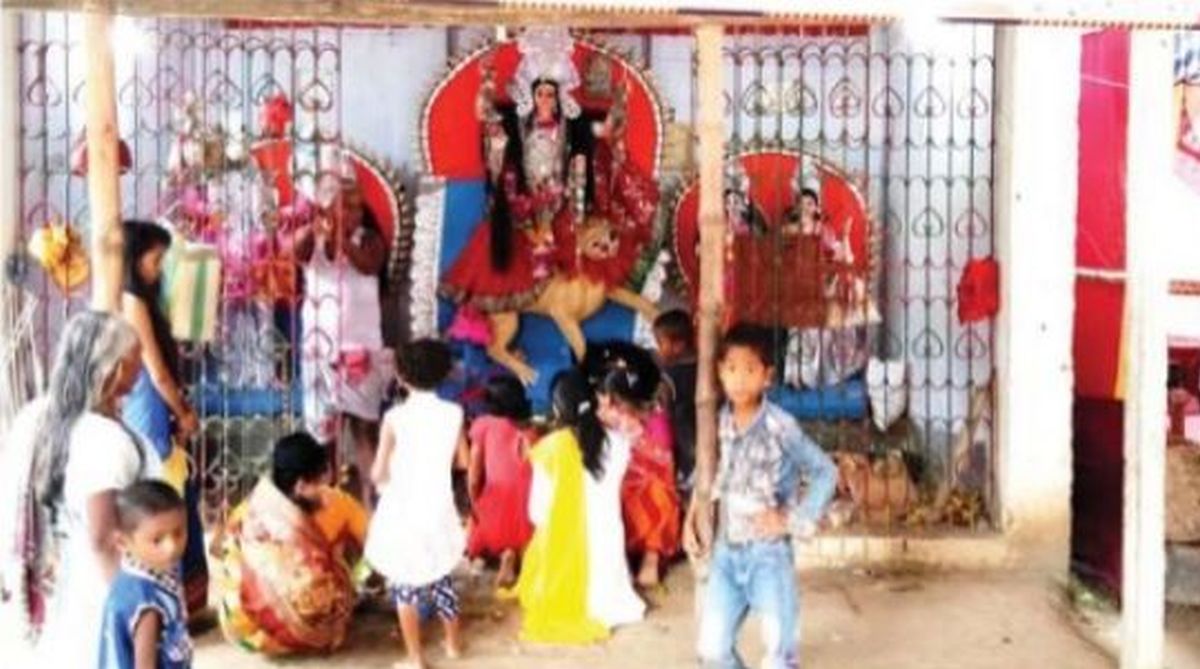
Balaichandi Durga Puja: In this Bengal village, Durga Puja starts on Dashami

Khadimpur village has celebrated Balaichandi Durga Puja for the last 500 years. The Durga idol here has four hands instead of 10, and you cannot find demon Mahisasur and his buffalo with Goddess Durga

(Photo: SNS)

Durga Puja may be over for all of us now, but things are different for the residents of Khadimpur village in Kamlabari-2 gram panchayat, 12 km away from Raiganj town in North Dinajpur district. The villagers here are still in a festive mood. As every year, Khadimpur is engrossed in observing the traditional Balaichandi Durga Puja that started on the night of Vijaya Dashami.

Around 7,500 members of 1,500 families living in the village began celebrating the Durga Puja with all pomp and grandeur on the day.

According to Puja organisers, the village has celebrated Balaichandi Durga Puja for the last 500 years. The Durga idol here has four hands instead of the usual 10. All the deities, including Goddesses Lakshmi and Saraswati, and Lord Kartik and Ganesh are present with the Goddess Balaichandi. However, the demon king Mahisasur and his buffalo are not worshipped here.

Numerous visitors even from outside the district visit the Puja pandals in Khadimpur in huge numbers every year.

“The Balaichandi Puja is being observed in our village since the past 500 years for the well-being of the village. According to rituals, the Puja starts on the night of Dashami and continues for the next five days. All wear new clothes during the Puja and eat vegetarian food in their houses till the Puja is over. An animal sacrifice is also a part of the Puja observed here,” the Secretary of the Khadimpur Balaichandi Puja Committee, Sreekanta Barman, said.

The priest of the Puja committee, Basudev Chakraborty, said, “Our forefathers used to worship Ma Blaichandi here and the Puja is observed here even after 500 years of its commencement.

“Once upon a time, on the day of Dashami during the regular Durga Puja, our crops got damaged due to drought which led to the death of several villagers due to starvation. Since then, on the day of Dashami, villagers here started the Balaichandi Puja. As predecessors, we will have to keep the tradition going. People from nearby villages and from outside the district turn up here to witness our Puja. We will be organizing different cultural programmes with participation of students of our village for the next five days. Villagers enjoy it with great enthusiasm,” added Mr Chakraborty.

source: http://www.thestatesman.com / The Statesman / Home> India / by Statesman News Service, Raiganj / October 23rd, 2018

The Downton Abbeys of Dhanyakuria

Wandering in the Bengal countryside could bring you to these accidental Indo-English castles

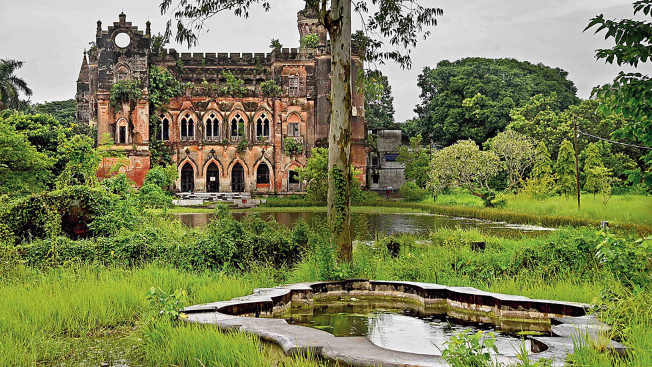
Gaine Garden on the Barasat-Taki highway looks every bit the English castle
Image: Ankit Datta

Anyone who has travelled along the Barasat-Taki road — northwards from Calcutta, towards Basirhat — would have noticed the picture-postcard castle. Visitors are not allowed inside the gated compound, but you can stop and admire the turrets, spires, the uneven roofline broken by stepped gables.

But that afternoon, when we reach the place, the gates are wide open. A truck is downloading bricks — we learn they are for the construction of a government office building. It is a 30-acre campus and we are eager to explore it. We sneak in and manage some quick clicks, when some security guards spring into action. We are chased out with a stern — “You need permission from the [social welfare] department.”

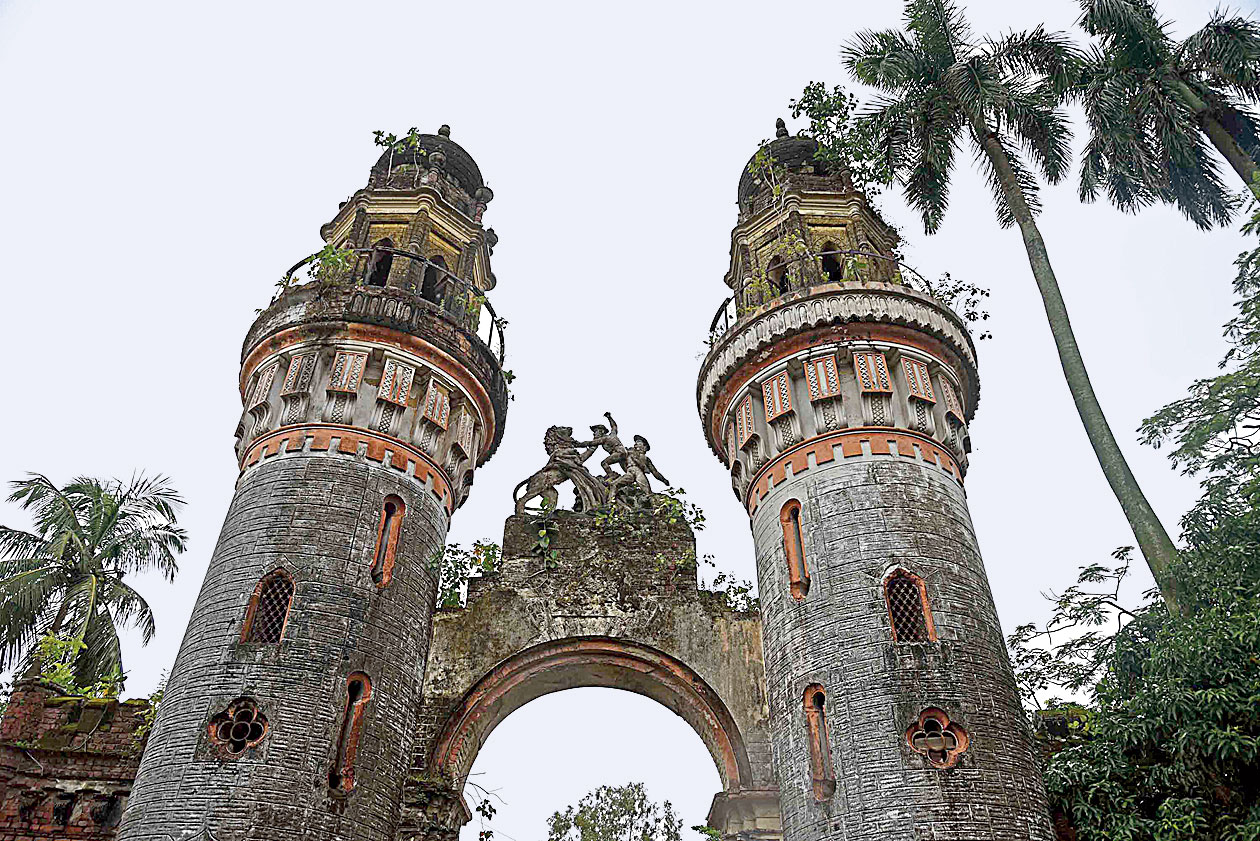
Atop the Gaine Garden gateway is some colonial baggage in stone — figures of two Englishmen overpowering a lion with bare hands
Image: Ankit Datta

Out on the road, we ask a passerby what this grand structure is called and what it’s meant to be. “This used to be called Gaine Garden, property of the Gaines,” he informs us, and for details redirects us to the Gaine progeny living in Dhanyakuria village in North 24-Parganas.

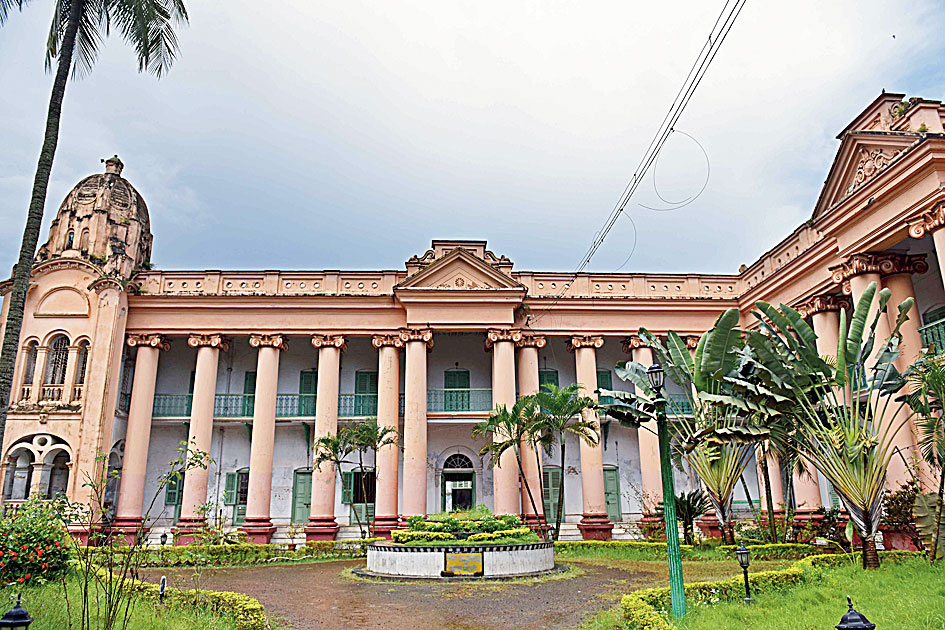
Teacher and writer Monjit Gaine lives with his elderly father, Kanchan Gaine, and his family in a portion of yet another grand structure of long, open corridors and many wings called the Gaine Rajbari. Monjit ushers us into the majestic thakurdalan or collonaded altar for Durga worship. He says, “Every other month some tele-serial or movie is shot here. Villagers call this ‘shooting bari’.” According to him, it is the rent from film production companies that aids the upkeep and maintenance of the huge mansion.

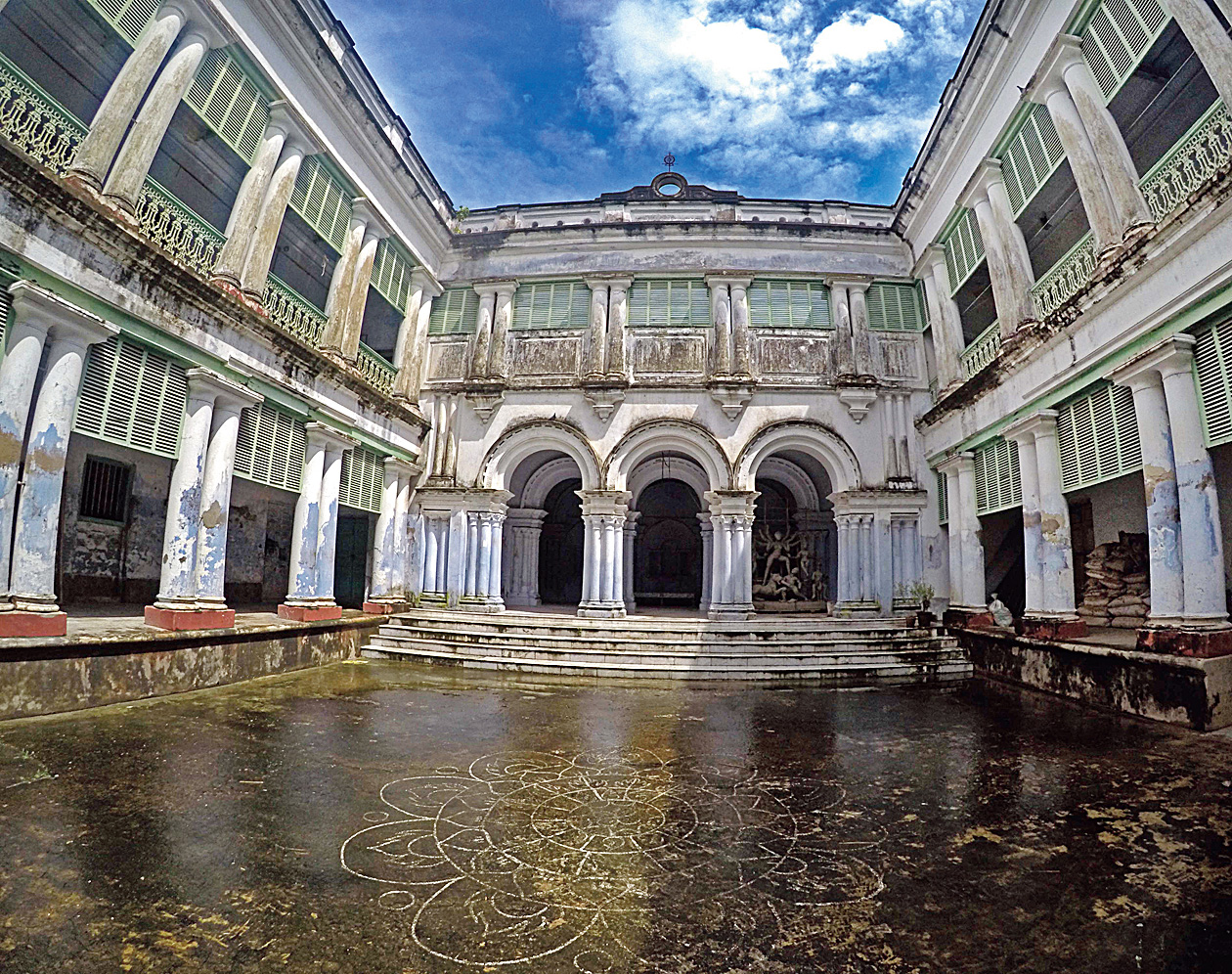
Unlike Gaine Garden, Gaine Rajbari was meant to serve as residential quarters and is located inside Dhanyakuria village
Image: Ankit Datta

The Gaines made a fortune trading in jute, jaggery and other agricultural products. They worked in partnership with two other families of Dhanyakuria — the Sawoos and the Ballavs. All of them enjoyed the patronage of the British. “Huge tracts of agricultural fields and land ownership turned them into zamindars,” says Monjit. “Family lore goes that our ancestral properties extended to Satkhira in present-day Bangladesh, and in north, central and south Calcutta,” he adds.

Gaine Mansion was built in parts, primarily by Gobinda Chandra Gaine and his son, Mahendranath Gaine, mid-19th century onwards. Mahendranath was a prominent member of the Bengal Chamber of Commerce and owned quite a few jute mills too. He was the one who built Gaine Garden by the main road. Post Independence, the state government acquired the property. Says Monjit, “A few years ago we heard it had acquired the heritage tag. [Once a property gets this tag, it cannot be defaced, its basic structure cannot be changed either.]” He has no clue about the ongoing construction.

Its thakurdalan has featured in films such as Guru Dutt’s Sahib Bibi Ghulam, the Indo-French production La Nuit Bengali and the Uttam Kumar-starrer Suryatapa. You can spy a Durga idol in one corner of the thakurdalan of the Gaine Rajbari. The Gaines have been commissioning the idols to the same family of artisans for nearly 200 years
Image: Ankit Datta

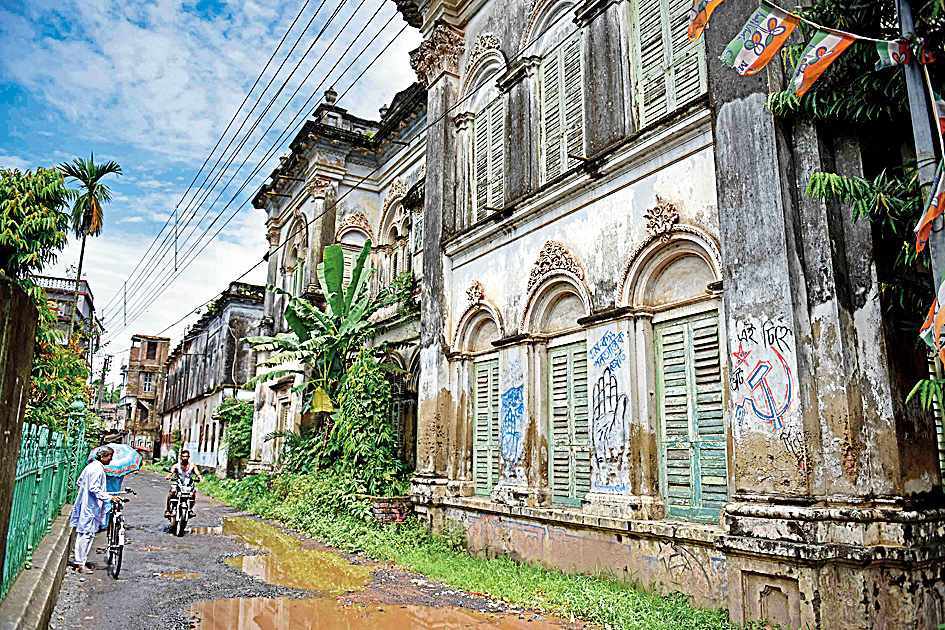
According to Monjit, the three leading families worked for the development of the area. They built hospitals, roads and schools. We cross the Sanskrit primary school-turned-private English medium prep-school founded by the Gaines. Beyond it, a little ahead of the trisection is the mansion of the Sawoos. The gate is locked, a neighbour says the caretaker has gone to the market and the owners don’t live here.

We peep through the collapsible gate and spy a thakurdalan almost as majestic as the Gaines’. Here too, there is a solitary and stark frame of an under-construction Durga idol. Later, we call Ashok Sawoo, who lives in north Calcutta. The house was built by his forefather, Patit Chandra Sawoo, 200 years ago.

The Sawoo Mansion usually remains closed; most of the family lives in Calcutta now. The house was founded by Patit Chandra Sawoo 200 years ago and extended by his son Rai Bahadur Upendra Nath Sawoo
Image: Ankit Datta

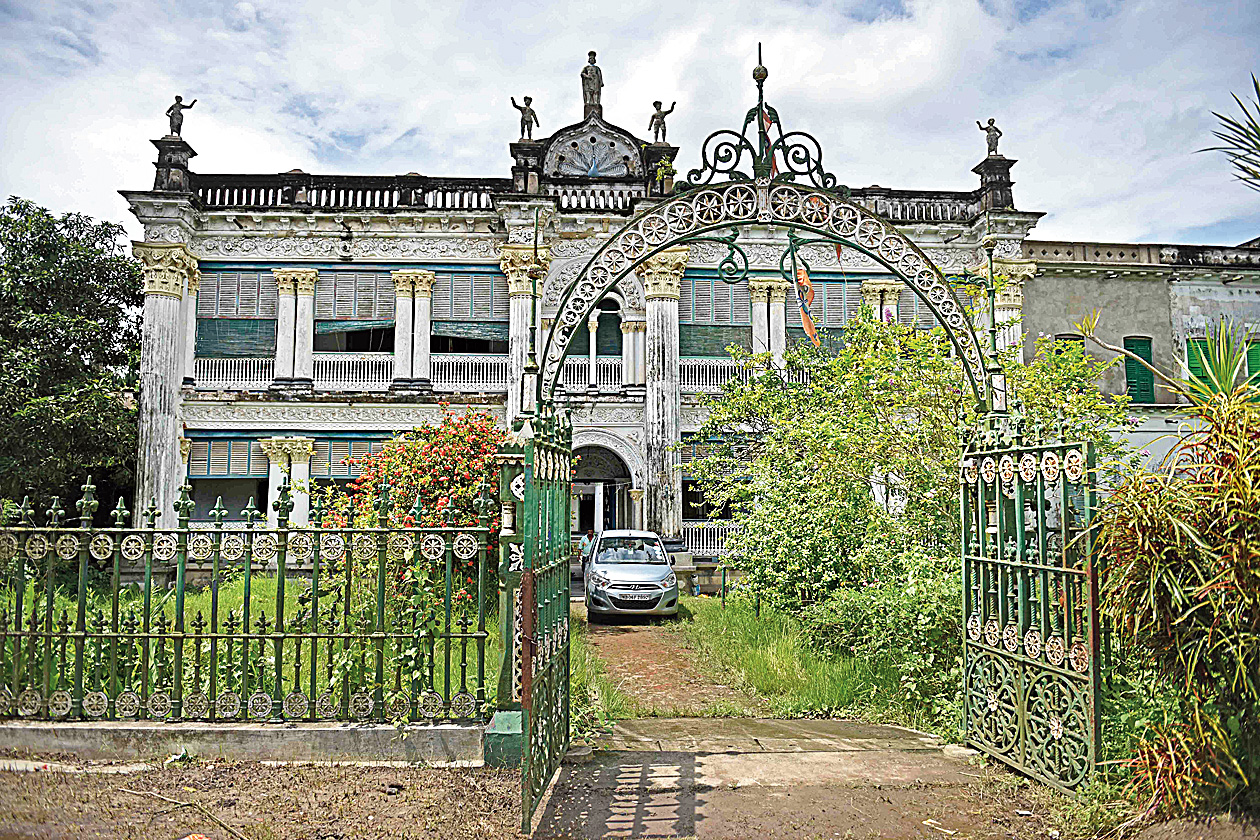
We walk down to Ballav Mansion next. Painted in green and white, the mansion has ornate cast iron gates and fencing. The Corinthian pillars, stucco work in the verandah and the grand thakurdalan reflect the wealth of the family. There is a well-kept garden too. Says family member Uma Ballav Biswas, “The house was built by my great-grandfather, Shyamacharan Ballav, 150 years ago. He made his fortune mainly in jute trade.”

At the time of filing this piece, Uma is looking forward to the annual family reunion on the occasion of Durga Puja. It seems the same artisans make the Durga idols for the Gaines, the Sawoos and the Ballavs. The same family of priests presides over the festivities. Says Monjit, “If anyone wishes to see our houses in full grandeur, this is the time. There’s no restriction on entries at this time. Just like our ancestors, we welcome villagers and visitors.”

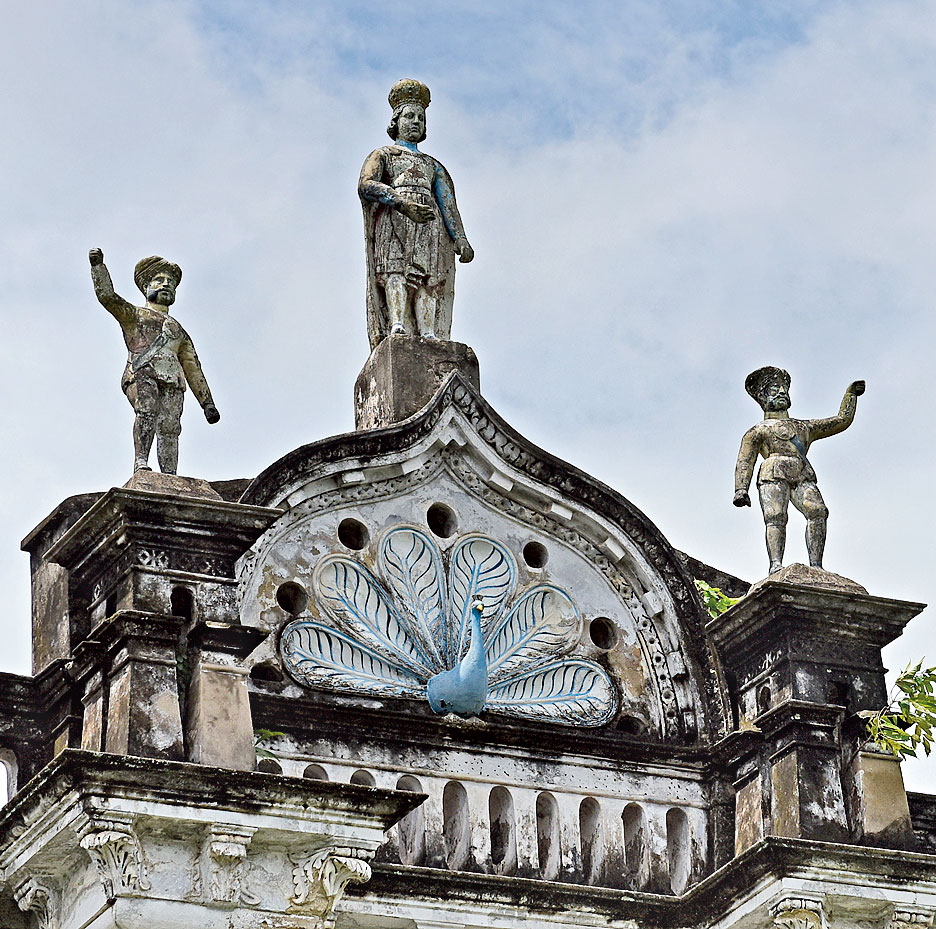
Ballav Mansion is referred to as ‘putul bari’ or dolls’ house by locals — after the figurines on the central arch and those on either end of the roof
Image: Ankit Datta
The centrepiece is a princely figure wearing a cape and fancy headgear; the rest of the figurines include moustachioed Indian sentries and a lone peacock
Ankit Datta

source: http://www.telegraphindia.com / The Telegraph,Calcutta,India – Online edition / Home> Heritage / by Prasun Chaudhuri / October 21st, 2018