Category Archives: Amazing Feats

RIP, Sister

SisterKOLKATA07dec2015

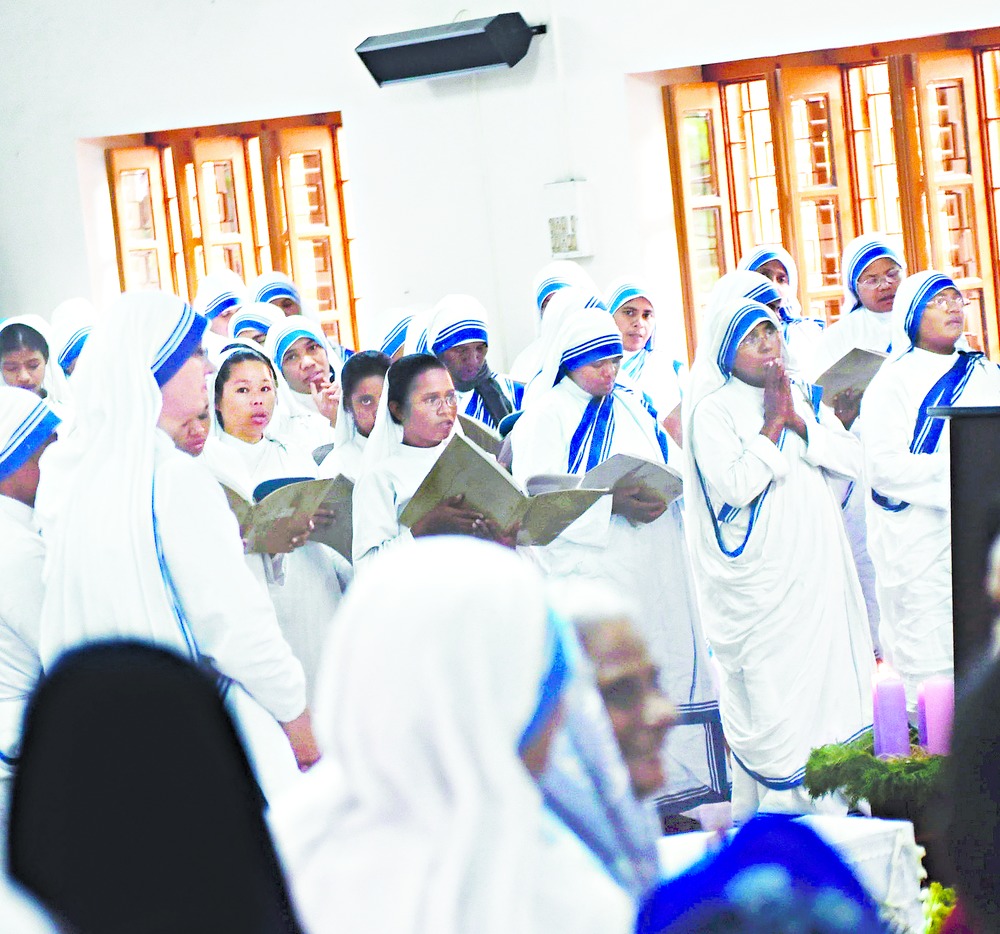
Nuns of Missionaries of Charity at a prayer service for Sr. Gertrude MC at Mother House on Sunday. Sister Gertrude, the second woman to join Mother Teresa in starting the Missionaries of Charity, passed away in the morning.

Born on March 8, 1929, Sr. Gertrude was a doctor. She was Mother Teresa’s student at St. Mary’s High School in Calcutta in the 1940s. Mother Teresa was then the headmistress and in-charge of the boarders at the school.

Inspired by Mother, Sr. Gertrude spent her life serving the poor.

She was by Mother’s side when she passed away at Mother House in September 1997. “We became truly mother and daughter, more than a sister or a doctor,” Sr. Gertrude had written about her relationship with Mother Teresa.

source: http://www.telegraphindia.com / The Telegraph, Calcutta / Front Page> Calcutta> Story / Monday – December 07th, 2015

ISI faculty bags Bhatnagar award for maths breakthrough

Kolkata :

Mathematicians all over the world have been trying to solve a 150-year-old problem, popularly called the Holy Grail of maths, and a city mathematician has just been able to give a major insight into it. Ritabrata Munshi has stunned the world and no wonder, he has bagged the Shanti Swarup Bhatnagar award.

A number theorist, Munshi, who has taken lien from TIFR, Mumbai, to join his alma mater Indian Statistical Institute as faculty, seemed unfazed by all this adulation. In fact, one could sense an urgency in his voice, an urge to carry on with the third degree of the Lindelof hypothesis, which is the route that he is taking along with his co-researchers abroad to finally progress on the line of the ever elusive Reimann hypothesis that was formulated in 1859 by Bernhard Riemann.

It took 60 years to solve the first degree of the L theory and progress on to the second degree that again took 35 years to be resolved. Finally, Munshi has been able to make a global start on the third degree and make a considerable progress.

“The properties of prime numbers, their distribution pattern in the realm of the abstract simply bowled me over and I made up my mind to study maths after plus two despite ranking 25th in the WBJEE and under 400 in IITJEE,” said Munshi. He studied B Stat and M Stat at ISI and then enrolled for Phd at the Princeton University under legendary mathematician Andrew Wiles. He enrolled at Rutgers University, US, for his post doctoral degree.

source: http://www.timesofindia.indiatimes.com / Times of India / News Home> City> Kolkata / by Jhimli Mukherjee Pandey, TNN / September 30th, 2015

Shy boy to tech showstopper – ‘Sundi’ who sang Anjali

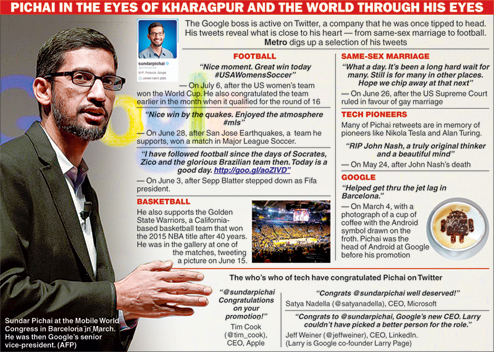
Sundar Pichai, the toast of the technology world, learnt his engineering 110km from Calcutta two decades ago.

In the records of IIT Kharagpur, P. Sundararajan was the topper in metallurgy and material science in the Class of 1993. Outside the classroom, he was known as the ” chhupa rustam” who had wooed and won his life partner from the chemical engineering class without any of his hostel mates getting a whiff of it.

Metro spoke to some of the new Google CEO’s old friends and teachers to get an insight into the man that holds that brilliant mind.

Sourav Mukherji, dean of academic programmes at IIM Bangalore; studied civil engineering at IIT-K and shared the Nehru Hall with Pichai

The world may be hailing Sundar Pichai but to us in Kharagpur, he was Sundi. And he would sing ” Anjali Anjali, pyari Anjali ” all the time.

SundiKOLKATA12AUG2015

We would often hear Sundi hum the lines from the title song of a popular film of our time: Anjali (1990). He loved music and we all thought he sang the song because he liked it. It was much later, after we left Kharagpur, that we realised why he loved this particular song.

It was probably meant for Anjali, the girl from chemical engineering who would become his wife. We all knew Anjali and Sundi knew each other but we never came to know of their relationship in our four years on the campus. It was ‘surprise-surprise’ when we came to know that Sundi and Anjali were seeing each other.

He was a brilliant guy. In fact, a lot of people in the IITs are brilliant. But Sundi was absolutely brilliant. He was the topper in most exams when we were students at IIT. But nobody would call him bookish.

I feel that this (Pichai’s elevation at Google) is a moment of great joy and pride for us as Indians because two of the world’s most powerful IT companies now have Indians as their CEOs (Satya Nadella is the CEO of Microsoft). These gentlemen have truly been able to break the so-called glass ceiling. Twenty years ago, who would have thought that Indians would head powerful American companies, especially companies at the forefront of technology?

Sanat Kumar Roy, professor metallurgy and material science, who taught Pichai

At IIT Kharagpur, we all knew him as P. Sundararajan and it was only in 2012 that we came to know his new name: Sundar Pichai.

It was December 2012 when we got a call from the Wall Street Journal, informing us that Sundar Pichai, an alumnus of our institute, had been appointed vice-president of Google. The journalist wanted details about him.
PichaiKOLKATA12aug2015

We checked our records but couldn’t trace anyone by that name. Later, the journalist gave us a clue: that he had been a recipient of a silver medal. That helped us track P. Sundararajan. Later, we contacted our alumni office in the US to check whether P. Sundararajan and Sundar Pichai were the same person and finally it was they who confirmed it.

I had taught him in all the four years he studied metallurgy and material science here. I found him exceptionally bright.

The IIT selected him for its Distinguished Alumni award this year and he was supposed to receive the honour at the annual convocation that was held recently. He couldn’t attend the event this time but he has promised to visit the institute when he comes to India next.

Phani Bhushan, co-founder of Anant Computing and Pichai’s batchmate and co-boarder at Nehru Hall, where he had stayed at “CTM” (that’s section C, top floor, middle wing)

Sundararajan was a shy person who was more comfortable in small groups, and now he is making speeches and heading a global conglomerate like Google. It is like he has had a personality U-turn.

We are super excited that our batchmate and hall mate has achieved such a feat, although it isn’t as surprising as the news that he married a fellow KGPian, Anjali!

We hall mates and batch mates tend to spend a lot of time together and we thought he was shy about talking to girls. But he turned out to be a chhupa rustam! We wonder how he managed to have a girlfriend without us knowing about it.

Partha Pratim Chakrabarti, director, IIT-KGP

We are all delighted that a student from Kharagpur has achieved this. Sundar Pichai was always a very quiet and studious person. I never taught him but have interacted with him several times. He recently did a video chat with an auditorium full of students who talked to him about everything from life to technology and leadership.

He hasn’t made any public statement as yet. That’s the kind of person he is. He likes to do his work. Sundar has proved that technological leadership can lead to global leadership and has given aspiration to a new generation of IITKgpians that you can achieve global leadership through technological leadership.

He is a quiet worker, a technical wizard, a great thinker and visionary who is also an extremely humble person, quite in sync with his alma mater IIT Kharagpur. He is an Indian who is a global leader and epitomises future generations of Indians.

source: http://www.telegraphindia.com / The Telegraph, Calcutta,India / Front Page> Calcutta> Story / Wednesday – August 12th, 2015

Nadia gets U.N. pat forachieving total sanitation

The district Magistrate of Nadia along with chief of Nadia Zilla Parishad in West Bengal was on Saturday presented the United Nations Public Services Award 2015 for eliminating open defecation in the district.

Nadia district, located in south Bengal, had half of its population defecating in open till October 2013. The district administration, under a programme called Sabar Souchagar, built 3.56 lakh toilets in the district. As a result, the number of people continuing with the practice dropped to mere 0.2 per cent.

The award was presented by the acting Secretary-General of the U.N., Lenni Montiel, along with Head U.N. Women Stefani Senese, on conclusion of the U.N. Day celebrations 2015, on June 26 at Medellin in Colombia, District Magistrate P.B. Salim informed The Hindu over email.

Banikumar Roy, chief, Nadia ZP, was also present.

‘Unique model’
The U.N. has described Sabar Shouchagar (Toilets for All) as a “unique model developed to generate awareness, improve access to sanitary toilets, and bring substantial health improvement through improved sanitation.”

The U.N. added that the scheme has mobilised all stakeholders, “especially women and schoolchildren and saw involvement of faith-based organisations” and “if replicated, it has the potential to eliminate open defecation from across the world.”

West Bengal Chief Minister Mamata Banerjee had on April 30 held a programme in Nadia district highlighting the success of the scheme and announced that ‘Nirmal Bangla Divas’ will be observed across the State every year.

source: http://www.thehindu.com / The Hindu / Home> News> National / by Special Correspondent / Kolkata – June 28th, 2015

Bengali on Queen’s honour list

Kolkata :

Seventy-year-old Pratima Sengupta, who pressed on with her charity and social activities despite debilitating arthritis, is among those being appointed Member of the Order of the British Empire (MBE) in the birthday 2015 Honour List of the Queen.

The honour is recognition for her services to the community in East Renfrewshire, Scotland. Sengupta has been living in Glasgow since 1969 and is now confused about which of her five grandchildren she will take along to accept the honour from the Queen.

On April 30, Sengupta got a letter from the Cabinet Office stating that the British Prime Minister had proposed her name to the Queen. On June 12, her name was published in the London Gazette. “I started shivering when I heard this news. All those who are on the Honour List will be invited to an investiture. The events are organized by the Central Chancery of the Orders of Knighthood in St James’ Palace. I was told that I will receive the invitation about five weeks before the event,” Sengupta told TOI from Glasgow.

Sengupta had spent her early years in Kolkata where her father, Dr Promodranjan Dasgupta, was a teacher at Presidency College. After marriage, she moved to Glasgow where she worked at the tax office. Due to arthritis, she was forced her to take early retirement in 2002. Pain in her joints notwithstanding, she continues to do voluntary service at a hospital.

“I started the Women’s Voluntary Royal Service (WVRS) at the Victoria Infirmary. I loved to give company to patients. Some of them couldn’t speak English and I worked as their translator,” she said. But her failing health didn’t make it easy. “They made special shoes so that I could walk properly. I refused to use a wheelchair. Sometimes, I’d fall down or bleed from my hands. At night, I’d cry in pain. Yet, I never stopped working,” she said.

Wearing a sari with a red bindi, Sengupta would stand out in the crowd. “Initially, people would ask me about the red blot on my forehead!” she laughs. She became a director with Voluntary Action group in Glasgow that worked with children who couldn’t afford higher education. “I’d sing ‘Phule phule dhole dhole’ to them. I also got in touch with an NGO in Tollygunge that worked with impaired children,” she added. She joined an organization called Women Across the World. “I’d go door to door asking for donations. I remember telling people: ‘You don’t need to give me more. Even one penny is enough.”

Meeting the Queen is the big event on her calendar now. “My husband and I had once attended the Queen’s Garden party at Edinburgh. I have been told that I can take four guests to this event. But I have five grandchildren. And all of them want to go to see the Queen,” Sengupta laughed.

source: http://www.timesofindia.indiatimes.com / The Times of India / Home> City> Kolkata / by Priyanka Dasgupta, TNN / June 16th, 2015

India’s only double coconut tree artificially pollinated

The palm species bears largest seed known to science

A double coconut tree stands at the Indian Botanical garden at Shibpur in Howrah district.— Photo: Sanjoy Ghosh

Scientists at the Indian Botanical Garden in West Bengal’s Howrah district have carried out artificial pollination of the only double coconut tree in India, which bears the largest seed known to science.

One of the rare and globally threatened species of palm, the double coconut ( Lodoicea maldivica ) tree was planted at the botanical garden in 1894 and the artificial pollination is a result of decades of work by scientists of the Botanical Survey of India (BSI).

“The tree took almost a hundred years to mature and when it started flowering, we started looking for this particular palm species in this part of world. We collected some pollen from palms from Sri Lanka but could not successfully pollinate it. Finally, with the help of pollen from another tree in Thailand, the pollination process was successful,” BSI Director Paramjit Singh told The Hindu .

Longest surviving palm

The Double Coconut tree not only bears the largest seed known to science — weighing around 25 kg — but this unique species is also the longest surviving palm which can live for as long as 1,000 years, he says. The palm tree also bears the largest leaf among palms and one leaf can thatch a small hut.

“Successful pollination means that we can have another Lodoicea maldivica in the country. In fact we have two fruits and it might take them another couple of years to mature,” said S.S. Hameed, BSI scientist who has been working on the pollination project since 2006.

This species of palm is diecious (where male and female flowers are borne on different plants). “Fortunately at the Botanical Garden, we had the female plant which can fruit and produce seeds,” Mr. Hameed said. The Indian Botanical Garden which serves as the repository 12,000 trees from 1,400 different species is careful in nurturing the palm.

The palm tree is located in the large palm house of the Botanical Garden which has the largest collection of palms in South East Asia with around 110 palm species.

This rare tree can be found in only two of the 115 Seychelles islands and is also called Coco de Mer (coconut of the sea), says Mr. Hameed

Legend

Legend bestows the seed with the power to bring good fortune to its owners. “There has also been a tradition of making kamandals [drinking vessels] from the double coconut by bisecting the shell. It was believed that those who consume water from these kamandals will be protected from poisoning,” Mr. Hameed said. Subsequently, sadhus started using Kamandals and it got its place in religious rituals.

source: http://www.timesofindia.indiatimes.com / The Times of India / Home> National / by Shiv Sahay Singh / Kolkata – June 13th, 2015

A rare felicity

Joydeep Ghosh
Joydeep Ghosh

Sarod exponent Joydeep Ghosh tells Meena Banerjee his musical education allowed him to take uncommon ragas in his stride.

One discovered an intriguing fact from versatile musician Joydeep Ghosh, the concluding artiste of the annual soiree organised recently by Kolkata’s Ballygunge Maitreyee Music Circle, dedicated to the late Sangeetacharya Radhika Mohan Moitra (Radhubabu). On this occasion his sarod etched a rare raga, Kedari-Marwa, with admirable clarity. In this both Kedar and Marwa remained intertwined; like in a braid; without giving up their identity. Such an interpretation, replete with unexpected bends, does not allow complacency, either to the player or to his listeners. This was definitely a show by a maestro for initiated listeners only. The latter is a dwindling community even in Kolkata nowadays; but going by Ghosh’s usual selection of ragas, one was inspired to ask:

What encourages you to choose rare ragas for concerts?

I was only five when I started learning at the feet of great masters Anil Roychoudhury and Radhubabu; and later from Buddhadev Dasgupta. They all belong to the famous Senia Shahajahanpur sarod gharana and they are revered for their enviable melodic treasures. I also learnt tabla and vocal music from venerable gurus. Subsequently, I came under the wings of the erudite and versatile master Bimalendu Mukherjee, a doyen of the famous Imdadkhani gharana of sitar and surbahar. Under their priceless guidance I assimilated vocalism, instrumentalism and the style of rhythmic play along with raga elaboration.

The simple fact is that my gurus did not tell me what were common and what ‘rare’ ragas were. They all came naturally as sister ragas, with their key phrases loud and clear, during the learning process of one major raga; even the jod-ragas (blend of more than one) were taught to me without much ado; just as they did not categorise any instrument and made me learn to play sarod, surshringar and mohanveena.

Isn’t the mohanveena a newly invented instrument?

Radhubabu's mohanveena.
Radhubabu’s mohanveena.

Unfortunately, very few remember the history of the original mohanveena, conceived and invented by Radhubabu in early 1948! Once, around 1944, he played the surshringar in a jugalbandi (duet) with the famous beenkar (Rudra veena player) Ustad Sadiq Ali Khan in Lucknow. The concert inspired him to design a unique instrument in which the playable materials of both the sitar and the sarod could be appropriately exploited and the tonal quality of the Rudra veena could be equally maintained. Since he was proficient in both, having had his training from Ustad Mohammad Ameer Khan of the Shahajahanpur gharana and Ustad Inayat Khan of the Etawah gharana in the sarod and the sitar respectively, Radhubabu’s experiment succeeded.

The instrument’s majestic tonality impressed Thakur Jaidev Singh, the renowned musicologist who was then Chief Producer, All India Radio, Delhi. In 1950, Thakur Saheb named the instrument ‘mohanveena’ and also arranged an archival recording for AIR, followed by an extensive interview of Radhubabu, its inventor. Radhubabu was invited in several music festivals all over India to play the mohanveena. Some of his rare recordings for AIR archives are available in compact discs as precious documents.

So, despite the emergence of another, Hawaiian guitar-based instrument of the same name almost fifty years later, the original mohanveena exists along with its own unique excellence till date, through some of the devoted torchbearers of Radhubabu’s legacy. I am also a humble exponent of the mohanveena.

source:http://www.thehindu.com / The Hindu / Home> Features. Friday Review / by Meena Banerjee / February 27th, 2015

Country’s highest zoo attempts to save high altitude herbivores from extinction

The initiative taken by Darjeeling’s Padmaja Naidu Himalayan Zoological Park (PNHZP) in conserving high altitude herbivores that have been on the path of extinction, has served to stem the rapid decline in their numbers.

Some of the animals that have been included in the conservation programme of PNHZP, the countries highest altitude zoo located at over 7,000 ft, are the Blue Sheep, the Himalayan Tahr, the Himalayan Goral and the Markhor.

All the four herbivores have been placed in the Schedule I of the Wildlife Protection Act, 1972, which denotes that the species are ‘threatened’.

The conservation of these animals is also crucial for the Himalayan ecosystem.

“All the four herbivores are the main prey of the much endangered Snow leopard. A decrease in their numbers will naturally affect the existence of the elusive mountain cat,” Upashna Rai, the biologist in the PNHZP told The Hindu. Conserving these herbivores serves the dual purpose of protecting the snow leopard as well. The PNHZP is also involved in the global conservation and breeding programme of the snow leopard.

The Darjeeling Zoo has taken the initiative of breeding these high altitude herbivores and is also involving the other high altitude zoos in breeding and conservation of the species.

It has provided to each of the main zoos of Sikkim and Nainital one pair of the Blue Sheep and the Himalayan Goral as a part of an exchange programme.

In the PNHZP there are 11 Blue sheep (seven males, four females) eight Himalayan Tahrs ( three males, five females) 11 Himalayan Gorals (eight males, three females) and eight Markhors (three males, five females). Interestingly Markhor, an endangered species of goat, is the national animal of Pakistan.

“Our immediate goal is to distribute the species to the high altitude zoos of Sikkim, Nainital and Shimla. We are also testing the genetic purity of the animals before introducing new breeding lines,” A K Jha, the director of the PNHZP told The Hindu.

Dr Jha said that the conservation of the herbivores was aimed at having a healthy population of the animals in the zoos in case the species get extinct in the wild.

source: http://www.thehindu.com / The Hindu / Home> News> Cities> Kolkata / by Shiv Sahay Singh / Kolkata – January 11th, 2015

Bringing smiles to a thousand lips

Kolkata :

About 25 years ago, a surgeon at the state-run SSKM Hospital, Sankar Chatterjee, had applied stitches on the scalp of a Congress leader, a woman who was to create history in Bengal by single-handedly dislodging the Left Front from power.

Today, Chatterjee has created a sort of record by himself. As a project director of Smile Train programme, he has performed cleft lip and cleft palate surgeries on 1,000 underprivileged children in Tripura and Assam over the last six years.

“On August 16, 1990, I was on duty at SSKM Hospital when Mamata Banerjee was wheeled in with two deep injuries on her scalp. She had fended off a third blow with her left arm and fractured it. I was called in to repair the injuries to her scalp as a micro-surgeon. I applied 18 stitches on her scalp under local anesthesia. She didn’t even wince when I applied local anesthesia for the stitches,” Chatterjee recalled.

He took early retirement from state health service and became a part of Smile Train in 2008. He was assigned two hospitals at Agartala and Silchar where cleft surgeries were to be conducted free of cost.

“In Agartala and Silchar, my experience have been heartwarming. The smiles on the faces of the children after they see their ‘new’ faces on mirrors are worth dying for. I still remember a 14-year-old girl from Silchar who turned up a month after her surgery. She told me: ‘Daktarbabu, ami jiboney prothom baar lipstick lagiyechhi (Doctor, I have applied lipstick for the first time in my life).’ I was overwhelmed,” Chatterjee added.

Chatterjee completed his 100th cleft lip surgery in Silchar around the time when the film “Smile Pinki” bagged an Academy Award in 2008.

source: http://www.timesofindia.indiatimes.com / The Times of India / Home> City> Kolkata / by Jayanta Gupta, TNN / January 11th, 2015

Kolkata girl bags Panda award

Ashwika Kapur / by Special Arrangement

Ashwika Kapur is the first Indian woman to win the wildlife photography prize

Ashwika Kapur of Kolkata on Friday won the prestigious Panda Award, aspart of the annual Wildscreen Film Festival held at Bristol, U.K. She is the first Indian woman to win the coveted wildlife photography award for her film on a Kakapo parrot.

The tale of a parrot
Ms. Kapur’s film “Sirocco — how a dud became a stud” is based on Sirocco, a Kakapo parrot, which is perhaps the only bird to have bagged a government job.

The male bird was appointed as the Official Spokesbird for Conservation in New Zealand and it helps in conservation advocacy on social media.

The film earned 26-year-old Ms. Kapur a nomination for the best Newcomer category, competing against two other nominees. This year, the Windscreen Film Festival received 488 entries from 42 countries.

In an email statement, Ms. Kapur said the film was a solo project and she single-handedly managed the film’s scientific research, scripting, camera work, editing and music direction. She is currently involved in the filming and production of two international television programmes in India.

After finishing her school and college education in Kolkata, Ms. Kapur graduated in Science and Natural History Filmmaking from the University of Otago, New Zealand.

The Kakapo parrot, a nocturnal and flightless species of the parrot, is classified as a critically endangered species since 2012 on the IUCN Red List.

The bird, found in New Zealand, is known to be one of the longest-living birds and its known population is 125. Over 14,000 people from 162 countries voted the Kakapo the world’s favourite species in 2013.

The tiger and the African elephant came second and third, respectively.

source: http://www.thehindu.com / The Hindu / Home> News> Cities> Kolkata / by Staff Reporter / Kolkata – October 25th, 2014