Category Archives: Amazing Feats

A Kolkata Laundry Helps People With Special Needs Find Employment

Kolkata :

A laundry service launched at Kolkata’s Pavlov Hospital, ‘Dhobi Ghar’ is being called a laundry with a difference.

The service will be run by people who have suffered stigma and often been abandoned by their families due to mental illness and aims to provide them an opportunity to a live a life of dignity.

Health and Family Welfare Minister of West Bengal Shashi Panja told NDTV, “This is the first of its kind project taking off in West Bengal. This laundry project empowers these individuals who are going to work here who have been through mental illness and recovered. It is about empowerment, self-respect and hygiene.”

The West Bengal government says it wants to improve conditions at hospitals for persons with mental illness. The government says they will work with NGOs and private players to create more such opportunities to integrate them into the work force.

The laundry project was set up by Anjali in collaboration with state government’s health and family welfare department. It has Sparsh Foundation as a technical partner and is enabled by The Hans Foundation.

Executive Director of The Hans Foundation Dr G V Rao told NDTV, “We are going to continue to see how we can replicate this and take it to the next level in order to increase the numbers.”

Those who have found work at the laundry say they want to be independent. Gita Kundu, who is undergoing treatment at Pavlov Hospital, told NDTV, “We feel nice doing this work. I am ironing these days. I feel better.”

“If we can do what we have been told to do here, then I can call myself successful as being able to earn and live independently is a man’s first responsibility,” added Ratan Nandi.

source: http://www.ndtv.com / NDTV / Home> Kolkata / by Saurabh Gupta / May29th, 2016

Indian-American scientist wins Springer Theses Award

Mr. De has dedicated his PhD thesis to cricketing legend Sachin Tendulkar and his alma mater, Kolkata’s Presidency University.

An Indian-American scientist has received the prestigious Springer Theses Award in recognition for his outstanding research in which he developed transgenic mice to study a critical tumour-suppressor called A20.

Arnab De’s thesis was nominated by New York’s Columbia University. Before this, Mr. De, who has also developed peptide-based prodrugs as therapeutics for diabetes, had received the Young Investigator Award at the American Peptide Symposium.

The thesis prize is awarded by Springer, a leading global publisher of renowned scientific journals and books, to recognise outstanding PhD research.

Internationally top-ranked research institutes select their best thesis annually for publication in the book series: “Springer Theses: Recognising Outstanding PhD research”.

Additionally, winners also get a cash prize of 500 euros.

The research work was highlighted by the European Molecular Biology Organization (EMBO) Reports.

Only research considered to be of ‘fundamental relevance to a general readership’ is chosen to be highlighted by EMBO.

Mr. De has dedicated his PhD thesis to cricketing legend Sachin Tendulkar and his alma mater, Kolkata’s Presidency University.

Mr. De said: “Two things that have influenced me the most is sports and education. This thesis is dedicated to Sachin Tendulkar not only for the cricketing joy he provided me, but also for being a constant source of inspiration to all Indian youth.”

Ole John Nielsen (University of Copenhagen), who shared the 2007 Nobel peace Prize as a member of the Intergovernmental Panel on Climate Change along with US vice president Al Gore, had in 2012 described the Springer award as an “insanely great honour”.

source: http://www.thehindu.com / The Hindu / Home> International / PTI / Singapore – May 28th, 2016

Flower power pushes Kolkata Jewish population up by 1

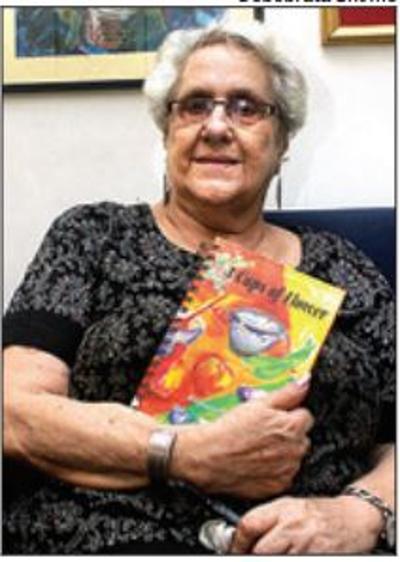
CHRONICLER OF TASTE : Flower Silliman

Kolkata :

For 30 years, Flower Silliman lived abroad, keenly observing and recording Jewish life in the Middle East, Europe and the US.

Now, the 86-year-old is back in the city she was born taking the community count up by one. And, she has taken upon herself the onerous task of keeping the authentic Jewish flavours alive for her nine-member strong community. Yes, you read it right: nine.

Demographers put the strength of the Jewish community in the city at less than 20, but the members are rather strict about who they call “pure”. Those that have married “outside” the community are strictly not “pure” Jews.

“I have come back to the city because this is where the Jews have lived most safe and free, but unfortunately , this is where our numbers have dwindled the most…but I am keeping the flame alive,” she says.

Silliman also happens to be among the last keepers of the community’s ancient recipes and has decided to chronicle the unique tastes for posterity.

“Even the food that Jews here have today is not what we are permitted by our religion. There’s so much of mix and match that most of the authentic cuisine that is over 5,000 years old and has its roots in the Middle East, is lost. I am trying to keep the tradition alive by documenting the recipes and rustling up dishes for feasts,” says Silliman.

Jewish food is special because Jews just can’t eat cause Jews just can’t eat anything and everything, Silliman says.

Their food -kosher -has to abide by strict dietary laws which not only lay down what is forbidden but also the process of cooking, the ingredients and the kitchen specifications. Kosher, for example, does not permit meat to be mixed with milk or milk products.So, neither can you mix the two while cooking, nor can you consume milk or milk products after having meat.

Flower Silliman says: “Judaism has a great similarity with Hinduism so far as its antiquity and dietary specifications go.

It’s another matter that most followers of both religions have drifted away from these guidelines… perhaps because they have often found it difficult to cope with such restrictions. I am not saying this by way of criticism, but the fact is that cuisines, and even cultures, become extinct because of such interpolation.”

A traditional sit-down Jewish feast on Friday night can ideally start with beet khatta with koobah (beet soup with chicken or vegetable balls), followed by Jewish roast chicken, which is different from the European roast in the kind of marinades and spices used. “The authentic Jewish roast will be far milder, both in flavour and sharpness, compared to the European roast,” Silliman says.

Kosher allows Jews to only have fish that have scales, and not those with shells (prawns, crabs or lobsters). “So you have items like fish shoofta, which is minced fish skewers. Vegetable lovers have choices like vegetable mahashas, which is stuffed tomatoes and capsicum.But the magic is in the recipe for the stuffing. The authenticity of the dish is heightened when served with aloo makalla (a special potato fry), hulba (a sort of fenugreek, mint and coriander chutney) and cucum ber zalata. Another speciality is mutton or vegetable ingree -a layered meat dish baked with brinjals, tomatoes and potatoes -not unlike the Greek moussaka, but without dairy to keep within kosher limits,” Silliman explains with the lucidity of an expert.

And why not? While abroad, Silliman served as a souschef at the Plaza in Jerusalem and launched the world’s only kosher Jewish restaurant, Maharaja.

She taught cooking and ran masterchef shows in US and London and authored two books. “I have come back to Kolkata because this is where the Jews have lived most safe and free, but unfortunately , this is where our numbers have dwindled the most… but I am keeping the flame alive.”

source: http://www.timesofindia.indiatimes.com / The Times of India / News Home> City> Kolkata / by Jhimli Mukherjee Pandey / TNN / April 29th, 2016

Meet Annie Roy, the only woman tunnel engineer of country

AnnieRoyKOLK29apr2016

Bengaluru:

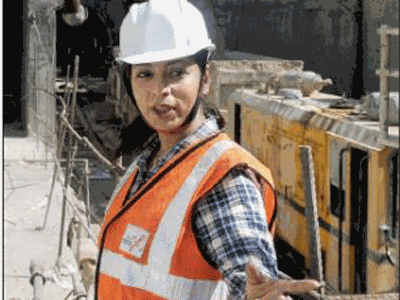
“She must be a visitor.” That’s the murmur she heard when Annie Sinha Roy walked into the construction site of Delhi Metro on the first day of her job. “There were about 100 men, most of them labourers and a few engineers. They thought I would not last long. There were no toilets, no place to sit and debris all around,” the country’s first and only woman tunnel engineer recalls.

“After a couple of hours, I was standing in front of a huge machine that had to break the ground but it was stuck. A German engineer and my boss asked me to get inside it and open a nut. Even before I realized what I was doing, my face was gushed by hydraulic oil. The colleague said my face would glow for the rest of my life. Today tunnelling is my life,” says Annie, 35, ahead of the inauguration of South India’s first underground Metro rail on Friday.

In Bengaluru, she alone steered Godavari, the tunnelboring machine that recently finished boring underground from Sampige Road to Majestic. She calls it her tunnel because the machine had got damaged just when she joined as assistant engineer in Bangalore Metro Rail Corporation (BMRC) in May 2015. After that, she used to spend eight hours in the tunnel every day. “Sometimes when people see me with the helmet and jacket and learn that I work for Namma Metro, they would only ask when the work will get over,” she says. Recalling her long journey, she said she wanted to pursue her masters after completing degree in mechanical engineering from Nagpur University.

“But I lost my father and I had to get a job to bail out my family from financial crisis. I got a job offer from Senbo, a contractor with Delhi Metro, and took it up in October 2007,” says Annie, who hails from a middle class family in north Kolkata.

In 2009, she joined Chennai Metro. And then went to Doha for six months in 2014. “My visa application was rejected thrice by Qatar because they do now allow unmarried women to go and work there. But the fourth time, I fought it out with them,” she laughs.

Annie is proud of her work in the tough male world around her, which has helped her “not bother about what is going to happen tomorrow”.

She wants women to break stereotypes and work in the male-dominated professions. “I want women to drive a tunnel boring machine. I want them to work in the tunnel,” said Annie who lives in HSR Layout with her husband, a techie.

source: http://www.timesofindia.indiatimes.com / The Times of India / News Home> City> Bangalore / by Aparjita Ray, TNN / April 29th, 2016

Armenia still lives in the heart of Kolkata

City’s 195-year-old Armenian school had a near-death experience when its student body shrank to one. But it has now returned to life, thanks to immigrant students.

What Parsis were to Mumbai, Armenians were to Kolkata -a refugee race that washed up on Indian shores before the British, and proceeded to establish iconic businesses and institutions that live to this day.One such in Kolkata is the Armenian College and Philanthropic Academy (ACPA), nearly two centuries old.

Built in 1821 as a residential school for children of Armenian descent, ACPA was founded by two Armenian merchants, Astvatsatur Muradkhanian and Manatsakan Vardanian who hailed from Julfa (now in Iran). The school was founded to impart an `Armenian’ education to its students, in their language, and about their culture.

In the early 19th century, the Armenians were a prominent business community in Kolkata that ran coal mines, indigo and shellac businesses, and built some of the city’s famous landmarks, including Stephen Court on Park Street and Grand Hotel (today Oberoi Grand).

But after the British quit India, so did most of the Armenians, who migrated abroad. Half a century ago, Kolkata’s Armenian population dwindled to just 2,000, vanishing still further to leave behind only around 150. Two of these Indo-Armenians are counted among the 68 students currently studying at the school; the rest are immigrant Armenians from Iraq, Iran, Russia and Armenia.

The school -in whose original building novelist William Makepeace Thackeray was born -has had its ups and downs. Its student body shrank and expanded -going from 138 in 1932, to 149 in 2003, and even plummeting to a solitary student in 1990, perhaps marking the most trying year in the school’s long history.

In February 1999, a Calcutta high court ruling transferred the school’s administration to Armenia’s Mother See of Holy Etch miadzin, the administrative headquarters of the Armenian Apostolic Church. It is now the Pope of Armenia who appoints the school manager.

“Since the institution’s guardianship was vested with the church, the school has maintained its standards and a minimum number of students,” said Rev. Zaven Ya zichyan, manager of Armenian College and pastor of the Indian-Armenian Spiritual Pastorate.

Following the transfer of power, the first batch of 34 immigrant students reached Kolkata from Iraq, Iran, Russia and Armenia -sent here for the free education and boarding provided by the school. Often, Armenian families in places like Iraq and Iran send their children here even as they plan to migrate to the West, the school be coming an interim harbour for their children. ACPA now routinely invites the diaspora abroad to enroll their children here.

In the run-up to their 200th year celebrations in 2021, Rev. Yazichyan has been at tempting to revive the institution. Among the ambitious projects is the preservation and digitization of the Araratian library, set up in 1828 and named after Mount Ara rat, the place where Noah’s Ark landed after the Flood. Other efforts include the creation of a databank of all Armenians from Kolkata (the last was created in 1956) and for malassociations with other international educational organizations.

To retain a cultural identity , ACPA teaches Armenian history , language and religion.

On visiting the campus on Free School Street (some say it got its name from the free Armenian school), the students seem content. Hovhannes Saringulyar, who teach es Armenian history, says, “If they miss their parents, they talk to them on Skype.”

Incidentally , the school also provides boarders with a free passage back home once every three years.

source: http://www.timesofindia.indiatimes.com / The Times of India / News Home> City> Kolkata / Ajanta Chakraborty / TNN / April 24th, 2016

Gravitational waves ‘sixth sense’ to understand universe: US-based Indian researchers

Kolkata (IANS):

Thrilled at the detection of the elusive gravitational waves a century after Albert Einstein’s prediction and the first observation of collision of two black holes at the Interferometer Gravitational-wave Observatory (LIGO), two young US-based Indian researchers working on the project say the waves act as a sixth sense for humans to comprehend the universe.

In fact, these “ripples in the curvature of space and time” will provide information on the cosmos that wouldn’t have been possible by peering through any kind of telescope, say Karan P. Jani and Nancy Aggarwal, who are elated at the prospect of India getting a third LIGO (observatory) and being at the forefront of new-age astrophysics.

Last month, India and the US signed an agreement for a new LIGO project in India during Prime Minister Narendra Modi’s visit to Washington. The agreement was signed between India’s Department of Atomic Energy and the US’ National Science Foundation (NSF).

The prime minister also met Indian student scientists, including Aggarwal and Jani, associated with the LIGO project.

“Gravitational waves are a completely new way of seeing the universe. It’s like humans can now perceive the sixth sense beyond the five, to comprehend the universe,” Jani, a fourth year PhD researcher in astrophysics at the Georgia Institute of Technology, told IANS via email.

The gravitational waves were detected on September 14, 2015, by both of the twin LIGO detectors, located in Livingston, Louisiana, and Hanford, Washington. The LIGO Observatories are funded by the NSF and were conceived, built, and are operated by Caltech and the Massachusetts Institute of Technology (MIT).

Physicists have concluded that the detected gravitational waves were produced during the final fraction of a second of the merger of two black holes to produce a single, more massive spinning black hole. This collision of two black holes had been predicted but never observed.

Jani and Aggarwal explained the detectors led to “direct observation of existence of black holes as also a direct observation of mergers of two black holes into a bigger black hole.”

“The energy released during collision was 50 times more than all the stars in the universe combined at that instance,” added Jani, whose work involves simulating black holes on supercomputers and searching for massive black hole collisions in LIGO data.

The breakthrough was made by the LIGO Scientific Collaboration (LSC) (which includes the GEO Collaboration and the Australian Consortium for Interferometric Gravitational Astronomy) and the Virgo Collaboration using data from the two LIGO detectors.

The LSC currently includes over 1,000 members from 90 institutes and 16 countries. India is the third highest right now in terms of membership.

At the heart of the mammoth hunting game to catch the unicorn are tools called interferometers which work by merging two or more sources of light to create an interference pattern that can be measured and analyzed.

“It is a four km light interferometer… in fact LIGO is the most precise measurement ever done. This means a lot of technology research has to be done to make LIGO,” Aggarwal, a fourth year Ph D student at MIT LIGO Lab, told IANS via email.

Aggarwal is studying quantum mechanics to improve the precision of gravitational wave detectors and is glad that the starting of the LIGO India project opens up a new opportunity for her to work in her native country.

“A lot of technological developments that were made for LIGO have found independent applications in science as well as industry and LIGO India will create a lot of opportunities for Indian scientists and engineers and improve the general scientific and technological environment,” Aggarwal emphasised.

They hope to “share the discovery with a larger audience”, a request put in by Modi during their meeting.

“During our meeting, the prime minister said he would like the LIGO scientists to make frequent India trips to popularize the science in colleges in India. We also talked about physics outreach in India for school children, the importance of hands-on demos and the importance of learning material in languages other than English,” Aggarwal informed.

“Also, due to the participation, the travelling of Indian scientists abroad and international scientists to India will definitely strengthen the international relations for India,” she said.

(Sahana Ghosh can be contacted at sahana.g@ians.in)

source: http://www.timesofindia.indiatimes.com / The Times of India / News Home> City> Kolkata / IANS / april 22nd, 2016

Faculty of Heritage Institute of Technology receives Gandhian Young Technological Award 2016

It was a proud moment for Heritage Institute of Technology Kolkata when one of its faculty members, Debjyoti Chowdhury, received the Gandhian Young Technological Innovations Award 2016 from the President of India on March 12, 2016.

Chowdhury was previously a student of the Department of Applied Electronics and Instrumentation, of the institute and was guided by Madhurima Chattopadhyay, head of the department of Applied Electronics and Instrumentation of the institute under whom he completed the project for which he received the award.

Chowdhury had created a “Cost effective self-stabilizing smart hand held platform (spoon/pen) for the elderly or Parkinson’s disease patients” under the guidance of Chattopadhyay. The project introduces an easy to adopt hand mount device that can be used to support the tremors in hands of old people with the disease for day to day normal activities like writing with a pen,having food with a spoon and also holding crockery/knifes.

More than 500 Institutions competed for the award and a total of 1,80,000 projects were submitted for the award.

source: http://www.timesofindia.indiatimes.com / The Times of India / News Home> City> Kolkata / by Jhimli Mukherjee Pandey / TNN / March 15th, 2016

In Calcutta, from trick to truth

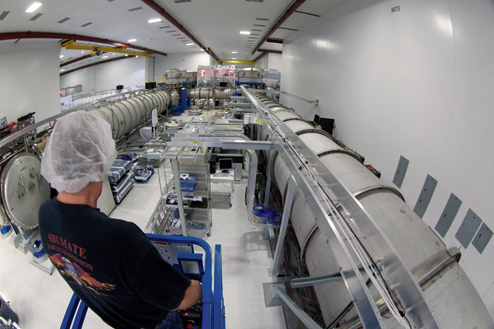
A bird’s eye view of a Ligo laboratory’s laser and vacuum equipment area near Hanford, Washington. (Reuters)

New Delhi :

Anuradha Samajdar, a research scholar in Calcutta, initially thought the first email alert she received about a possible gravitational wave signal was a “blind injection”, the community jargon for a simulation, a trick to test the integrity of the data analysis process.

The email was from Marco Drago, a scientist at the Max Planck Institute for Gravitational Physics, Hannover, Germany, telling a global consortium of physicists that two giant instruments on Earth had sensed (for just a fleeting one-fifth of a second) a signal.

The arrays of lasers, mirrors and control electronics that make up the detectors of the Laser Interferometer Gravitational Wave Observatory (Ligo), located 3,000km apart in the US, had recorded what appeared to be ripples in space-time – possibly the first direct observation of gravitational waves.

It would be up to the data analysis groups scattered across the world, including in Bangalore, Calcutta, Gandhinagar, Pune and Thiruvananthapuram, to determine that they were genuine effects of gravitational waves – and not just noise from the cosmos masquerading as gravitational waves.

“I had heard about blind injections – where a very select few senior scientists release signals and data analysis teams work on them only to be told later that this was a test,” said Samajdar, a scholar working towards her PhD at the Indian Institute of Science Education and Research, Calcutta.

Drago, an Italian and a member of the Ligo consortium, was among the first scientists to be alerted that something interesting had been turned up by an automatic “pipeline” that scans and filters the signals picked up by the detectors.

Shortly before noon on September 14, Drago received the automated pipeline alert. “The signal was so nice, so perfect, it looked like it was coming from a binary (a pair of objects),” Drago told The Telegraph .

After telephone consultations with colleagues, he sent out the alert to the 900-odd consortium members.

Samajdar and physicist Rajesh Nayak at IISER were among scientists in India analysing the signals, trying to determine whether the patterns of ripples observed indeed matched theoretical predictions of what patterns would look like, depending on the source of the gravitational waves.

Nayak, a faculty member at the IISER department of physical sciences, said: “We first match the detected signal pattern with the theoretical predicted pattern, if there is a match, we try and use the signal to estimate various parameters of the source event.”

Supervised by Nayak, Samajdar, who graduated in physics from the Lady Brabourne College, Calcutta, before joining IISER’s integrated PhD programme, while still a bit sceptical about the nature of the signal, began the process of extracting information about the source.

“We began to calculate the masses of the (merging) black holes, their distance – and our estimates were similar to what others in the consortium were reporting,” Samajdar said. “We told ourselves noise wouldn’t give us such nice outputs – that’s when I wondered ‘is this really the big thing’?”

Scientists at the Inter-University Centre for Astronomy and Astrophysics, Pune, the Indian Institute of Technology, Gandhinagar, IISER, Thiruvananthapuram, and the International Centre for Theoretical Sciences, Bangalore, also played key roles in the data analysis.

The multiple efforts across the consortium converged on the same results – the signal had emerged from (the merger of two black holes) a distant part of the universe, perhaps a galaxy.

Physicists are celebrating the discovery for multiple reasons.

“This is an example of big science supported by big engineering,” said Dibyendu Nandi, a physicist at IISER, Calcutta, and head of the Centre for Excellence in Space Sciences, India, a facility supported by the Union human resources development ministry.

The Ligo detectors are marvels of engineering precision, designed to detect ripples or displacements in space billionths of the width of an atom using laser beams that are bounced off mirrors after travelling along two arms of the instrument, each 4km long.

“Gravitational waves was the one prediction of Einstein’s general relativity theory that had not been directly detected – until now,” said Nayak. “This discovery is important for another reason – it will open a new branch of astronomy, we can observe and study things we have never seen or observed before.”

Some physicists also point out that the signal represents the first direct evidence of black holes merging.

“There is no other way we could have detected such exotic events,” said Nandi, who is not associated with the search for gravitational waves. “This observation tells us that such events are not just theorists’ dreams, that the universe is as exotic as we have imagined it to be.”

source: http://www.telegraphindia.com / The Telegraph,Calcutta,India / Front Page> Story / by G.S. Mudur / Friday – February 12th, 2016

Kolkata girl creates underwater drone

Sampriti Bhattacharya

Kolkata :

At 28, she has created an underwater drone that can map ocean floors and explore the deep sea, where even GPS doesn’t work. Kolkata girl Sampriti Bhattacharya’s invention — the Hydroswarm — has been patented and is quite a rage with the defence sector and oil giants.

What’s more, Forbes has featured her among the top 30 most powerful young change agents of the world. Sampriti, who left the city about seven years back for her masters, is now a PhD scholar at Massachusetts Institute of Technology (MIT).

Hydroswarm was created as part of her research thesis. “Underwater navigation has been a reality for many years but for advanced searches you need maps that are as refined as, say, the Google map. This is where my drone comes in. It can map the ocean, sitting on its bed, and you can zero in on the minutest objects, living or non-living.

You can even map underwater pollution with the help of this drone,” said Sampriti, who was in Kolkata for a short while and returned to the US on Thursday. A South Point alumnus, she studied engineering at St Thomas College and did her masters in aerospace engineering at Ohio State University before switching to robotics at MIT.

She told TOI that she always wanted to create an underwater robot because there was no easy way to study the ocean floor. The only option was the very expensive remotely operated underwater vehicles generally used to track warships.

source: http://www.timesofindia.indiatimes.com / The Times of India / News Home> City> Kolkata / TNN / January 29th, 2016

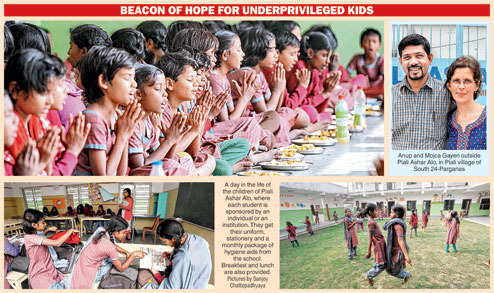
Bengal school with Slovenia heart – Couple united by a calling

SloveniaKOLKATA01FEB2016

• Name of school: Piali Ashar Alo
• Where: In Piali village, around 27km from Calcutta
• Students: Underprivileged children
• Founders: Anup and Mojca Gayen
• Sponsors: Slovenian schoolchildren and various other individuals and families; two German NGOs

A bright village boy who might have been grazing cattle had a German lady not funded his education is giving many others a shot at education through a school he and his Slovenian wife have set up with donations from Europe.

Anup and Mojca Gayen’s Piali Ashar Alo, in Piali village of South 24-Parganas, isn’t just an extraordinary act of charity. It is a mission spanning continents and small contributions – from Mojca digging into her personal savings to provide Rs 12,000 as seed money to students of 30 schools in Slovenia collecting newspapers over two years to sell them in bulk and raise Rs 4.5 lakh for a plot of land.

The school, which had started out from a rented space in February 2008, has since gone from a class of 12 students to a roll call of 140, mostly children of daily-wage earners, van rickshaw-pullers, fisherfolk and brick kiln workers. Most of the students are girls.

The genesis

Anup, 45, had always wanted to do something for the underprivileged, a feeling that found an echo in wife Mojca, 38. She was on a six-month internship in India in 2006 when she decided to leave her job as a psychologist in Slovenia and stay back.

“If there is no education, children of the poor will continue to remain poor. I believe that if not all, at least 50 per cent of our students will grow up and stand by another poor child,” says Anup.

In the early days, Anup and Mojca would go from door to door to convince parents to send their children to Ashar Alo. The school still sends teachers to homes in the village, but only to ensure that the seats are filled by children who wish to study.

Each student, from kindergarten to Class VII, is sponsored by an individual or an institution, most of them based abroad. They get their uniform, stationery and a monthly package of hygiene aids from the school. Breakfast and lunch are provided too.

The school has two floors with open-plan classrooms and a playground spread across a bigha and two cottahs of land. The building was designed by a Slovenian who was then studying architecture and had spent a year in Piali observing the place, its people and climate.

“He took note of how most villagers spend a lot of time on the verandas of their home and felt that his design should reflect that. So we have open classrooms,” explains Mojca.

The playground bustles with energy during a break between classes, badminton and skipping being the students’ favourite activities. This they are allowed to do only after they have finished their meal and cleaned up, for etiquette and discipline are as important at Ashar Alo as learning to read and write.

The school also teaches its students to dream. Twelve-year-old Sanchita Mondal’s father earns a living as a hawker on local trains, but she aspires to be a doctor. She is one of three students from Ashar Alo who now go to a CBSE-affiliated English-medium school in Sonarpur, about 5km away.

“We are not from rich backgrounds but the importance of education was obvious to our families when we were young. But the importance of education is not obvious to many in Piali,” says Mojca.

Ashar Alo’s focus is on educating girls, although the school remains a co-ed institute. “Women must learn to read and write. Even at home, they should not have to listen quietly to everyone who has an opinion. They should be able to speak and go to the bank or the post office,” says Mojca.

According to Anup, “80 per cent of the girls in the area” wouldn’t go to school until the start of the previous decade.

Momina Bibi, who works in the school’s kitchen, is one of them. Her daughter Jasmina Khatoon is a Class VI student, though. “I couldn’t study but I want my daughter to earn a decent living,” says the 29-year-old.

Many girls leave their education midway to get married. A six-year-old who studies in the school also accompanies her grandmother to beg.

A couple of years ago, the school started charging between Rs 30 and Rs 50 a month from the parents of some children who can afford to pay the fees. “Otherwise, they tend to take everything for granted,” explains Anup.

Flashback

Anup remembers carrying hay on his head and helping his grandfather graze cattle. It was a life he would have probably continued to lead in Champahati, the village next to Piali, had his mother not sent him off “with a pair of clothes, a plate and a glass in an aluminium box” to catch a train to Sealdah and from there to Behrampur.

He was eight then and headed for the Children’s Home run by the Christian Mission Service. He next moved to Azimganj, then Bhadrakali and again to Konnagar College to complete his education. In 1993, Anup enrolled for a mechanical and motor vehicles training course at the Industrial Training Institute near Kanyakumari. He topped his batch.

His first job was with a courier service in Calcutta that earned him Rs 700 a month. A succession of jobs later, he found his calling in educating needy children. “I owe my education to a German lady. We would write to each other but I never got a chance to meet her then, because it was meant to be confidential,” says Anup.

But he finally did manage to meet her in the middle of 2008 when his wife helped track Haide Marie Schneider in Germany through a friend who had searched the “telephone dictionary and managed to locate her despite Schneider being a common name”.

“I travelled to Germany to meet her,” he recalls.

Wife Mojca first came to India in 2006. “I had always wanted to serve poor children…and I went to Africa and then came to India…not to travel but to serve. But my work was for a limited period and I didn’t intend to stay,” she recalls.

That was, of course, until she met Anup. “I had a wish and he had more experience in the field and we decided to do it together,” says Mojca.

Funding

After Ashar Alo started, Mojca wrote to people she knew in Slovenia for help. One of them, Romana Jordan, mobilised schoolchildren to collect newspapers and sell them to raise the money that helped buy a plot.

Christlicher Entwicklungsdienst, a German NGO, came into the picture after one of its members visited the “empty plot with a gate” and offered to help. “Given our resources, we would have maybe built 10 rooms in 10 years!” says Mojca.

Another German organisation called FAMI helped the couple build the boundary wall. “Before them, there were only individuals and families sponsoring us,” says Mojca.

Today, she and Anup can look back at a job well done, altgough far from complete. “Not many might know about us in Bengal, but not less than a million people know us in Slovenia,” smiles Anup.

What message do you have for Anup and Mojca? Tell ttmetro@abpmail.com

source: http://www.telegraphindia.com / The Telegraph,Calcutta,India / Front Page> Calcutta> Story / by Jhinuk Mazumdar / Monday – February 01st, 2016