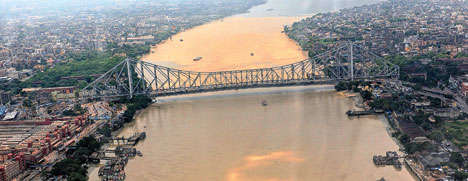
• When Howrah bridge was built in the late 1930s, nearly 90 per cent of its steel was made in India.
• When Vidyasagar Setu was built in the 1980s, all the steel was imported.
• The 705m-long Howrah bridge was built in 41 months. The 823m-long Vidyasagar Setu took 14 years to be built.
Calcutta:
These and more such nuggets of information about the two bridges across the Hooghly were shared at the Bengal Chamber of Commerce and Industry on Wednesday during a lecture on the completion of the Howrah bridge’s 75 years.
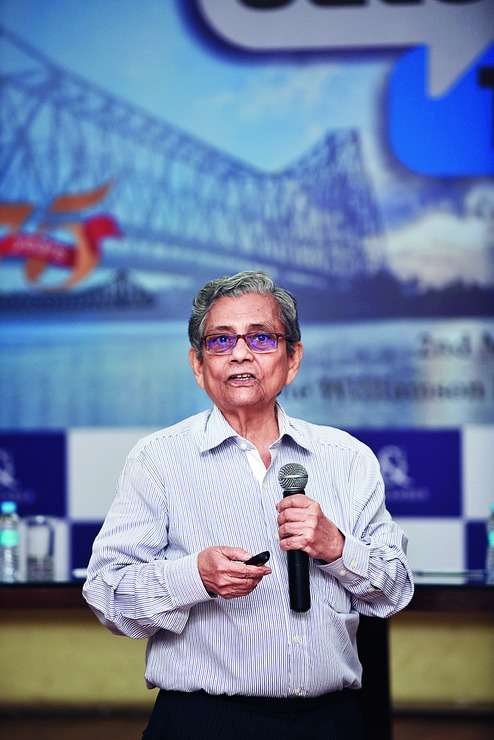
Amitabha Ghosal, an engineer who was part of the team that built Vidyasagar Setu, spoke about the history of the Howrah bridge and its engineering.
Ghosal began by saying why the Howrah bridge was built. Traffic to and from Howrah station had been slowly but gradually on the rise. A pontoon bridge that stood over the Hooghly and connected Calcutta and Howrah had to be lifted whenever a large ship came under it.
“River traffic was then more important than road traffic, which was however increasing. So a need was felt to build a bridge,” said Ghosal, who studied the design, construction and tendering of the Howrah bridge while working on Vidyasagar Setu.
There had been talk about building a bridge since 1900 but the actual planning didn’t begin till 1921. World War I was one of the reasons for the delay.
Amitabha Ghosal at the Bengal Chamber of Commerce and Industry. (Sanjoy Chattopadhyaya)
The pontoon bridge was commissioned in 1874 for 25 years, but remained in use till 1943, when the Howrah bridge was commissioned. Construction began in November 1938 and carried on till March 1942.
Four companies from England, Scotland, Germany and India had placed bids in a global tender floated for the construction of the Howrah bridge. The German company was rejected because World War II was brewing.
Cleveland Bridge of England won the bid but British-owned Indian company opposed it. “It was a tiff between the British in India and the British in England. The British in India managed to convince the authorities that the entire work cannot be given to an England-based company,” said Ghosal.
A compromise was worked out. The Indian company – BBJ Construction Company Limited, a consortium of Braithwaite, Burn and Jessop – was asked to make the steel. Most of the steel – 23,500 tonnes out of 26,500 tonnes – was manufactured and supplied by Tata Iron and Steel Company (Tisco), now Tata Steel.
The foundation of the bridge was built by the Indian-owned Hindustan Construction Company, which is now building the Parama flyover in Calcutta.
source: http://www.telegraphindia.com / The Telegraph,Calcutta,India / Home> Calcutta / by Subhajoy Roy / May 03rd, 2018
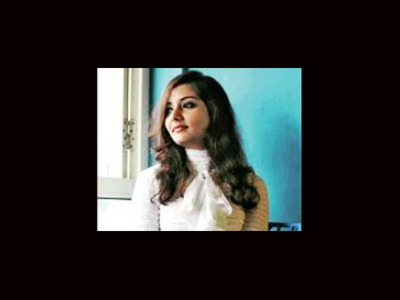
Years before she was selected to train as the first woman firefighter at the Airports Authority of India (AAI), a chemistry teacher had given Tanya Sanyal the moniker birangana meaning ‘brave woman’. Tanya’s elder sister Tanima had always known her to be fearless.
“One evening at the chemistry class, the girls suddenly screamed and scrambled up on to the chairs. I realised it was a cockroach that had caused the panic. I caught it and threw it out of the window. The teacher was shocked and named me Birangana,” recounted the Dum Dum girl who suddenly finds herself in the limelight in an allmale profession.
Good at classical dance and painting, Tanya wasn’t aware of where she was headed till she bumped upon the AAI advertisement that changed the course of her life.
“I had a desire to do something different, but didn’t know what till this opportunity came by. The exam went off well. On Panchami, a letter arrived stating that I had qualified and had to report to Bhubaneswar for physical fitness and medical tests. Thrilled, I forgot about Durga Puja and began to train for the fitness exam,” she narrated.
She passed the test, that included a 100-metre sprint within 20 seconds, lifting 40kg and climbing up a rope.
Currently undergoing training in Delhi, Tanya is enjoying the course. “Since I am the first woman, everyone is very supportive and encouraging. I consider myself extremely lucky,” said Tanya.
She is aware of the challenges that the job entails. Tanya says the biggest thrill in the job is the lightning speed with which the team has to head into a crisis. “At an airport, there is the criticality of time. The Rosenberg tenders have to move out within 90 seconds. If a plane catches fire, it must be doused within 2 minutes and 18 seconds. For that is as much one can get before the fuel tank catches fire and explodes,” she explained excitedly.
She can’t wait till June 9 when she gradutes and is given the first posting at an airport.
source: http://www.timesofindia.indiatimes.com / The Times of India / Home> News> City News> Kolkata News> Civic Issues / by Subhro Niyogi / TNN / April 26th, 2018
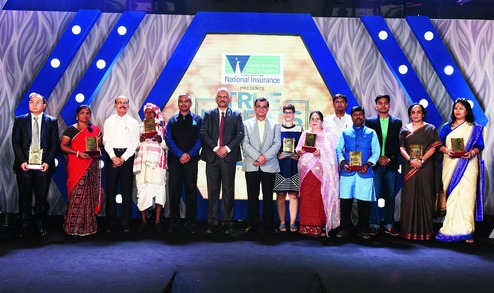
(From left) Thyelnai Dawn Khaling, Jamuna Tuddu, Subhas Datta, Simon Oraon, Major General A.K. Sanyal, GOC, Bengal Sub Area, Vijay Srinivas of National Insurance, D.D. Purkayastha, MD and CEO, ABP Group, Eva Katherina Kleekamm, Moirangthem Muktamani Devi, Surya Prakash Rai, Sankar Halder, Vikash Das, Sharda Radhakrishnan and Rosalin Patasani Mishra at the National Insurance presents True Legends Awards 2018 in association with The Telegraph, at Taj Bengal on Monday. Maj. Gen. Sanyal, Purkayastha and Srinivas were among those who gave away the awards. Pictures by Pradip Sanyal and Bishwarup Dutta
Alipore: Eleven heroes. Eleven battles. One award.
National Insurance presents True Legends Awards 2018, in association with The Telegraph, honoured men and women for changing lives in their own unique ways at the Crystal Hall of Taj Bengal on Monday.
The award recognised their outstanding perseverance, contribution and dedication to go beyond their calling, overcome obstacles to make this world a better place for many.
From health care to animal welfare and education to environment, this year’s legends contributed in varied ways in Bengal, Jharkhand, Bihar, Odisha and the North-east.
An audience comprising diplomats, doctors, educationists and more listened with rapt attention and broke into applause every time a story unfolded.
K.B. Vijay Srinivas, general manager, National Insurance Company, saluted the legends. “In our society there are people who do big things, who do great things, they are marked, they are revered, they are talked about. Yet, society carries on through the works of innumerable men and women who take small steps to answer unfulfilled needs. These are people who care, who have a passion for taking it upon themselves to do something meaningful.”
Metro salutes the True Legends
Bengal
SUBHAS DATTA, 70
A chartered accountant by training, a crusader by choice. Subhas Datta fought for issues that most people didn’t recognise as significant.
Datta proved in Calcutta High Court, citing the state pollution control board’s data, that the fair Calcutta so loved could actually kill its people. The air pollution level in the Maidan area took a leap during the Book Fair. “A Telegraph journalist helped me find the pollution control board report,” he says. The court ordered the Book Fair to be shifted away from the Maidan. Even the then chief minister Buddhadeb Bhattacharjee’s complaints didn’t make Datta relent.
He is also the man behind the phasing out of two-stroke autorickshaws from the city roads, to be replaced by four-stroke ones with better emission standards.
Datta is now fighting the state government for a switch to CNG vehicles.
Spotlight speak: I consider myself to be the scavenger of this city. I was once featured in a book with a broom in my hands. It is really nice that the Unputdownable is recognising the down-to-earth activist.
SANKAR HALDER, 43
The IT professional founded a non-profit organisation in 2003 to “repay” his neighbour who had sponsored his education. Fifteen years later. NGO MUKTI is synonymous with a better life in the Sunderbans.
In 2017-18, the NGO arranged sponsorship for 129 students from poor families, including 28 who are studying to be doctors and 33 who have enrolled for engineering.
MUKTI has also built more than 20,000 toilets in villages, set up a book bank and created women’s self-help groups. One of its newer projects focuses on educating farmers to switch to organic agriculture and marketing their produce.
Spotlight speak: It is not an individual’s recognition. This is a recognition of the people I want to help and the people who help me do this.
EVA KATHERINA KLEEKAMM, 47
The former banker from Munich is godmother to about 25 children in the city. She admitted them to school and pays for their education from her own savings and with some help from friends in Germany.
It all started in 2004, when a seven-year-old girl’s face peeped out from behind her mother and said she wanted to go to school. The little girl is now a student at a hotel management institute in the city.
Eva has settled down in the city and goes to Germany only on vacation. Even when she was diagnosed with breast cancer in 2016, she decided to stay back in Calcutta to be with “her children”.
Spotlight speak: When I first heard (about the award) I was speechless because I thought very important people get such awards. I do not give too much importance to myself. But this award will be a big support for my children and when I show it to my friends in Germany they will be proud too.
SHARDA RADHAKRISHNAN, 59
A hospital for animals in Sonarpur that is home to 500 dogs, seven horses, several cows and even injured kites has been this animal lover’s life and passion for the past 10 years.
The dogs at Chhaya include strays injured in accidents as well as pets of various breeds – Rottweiler, German shepherd, Great Dane, bull mastiff, spitz, golden retriever and Labrador – abandoned because of old age or sickness.
When a horse named Moti was found lying on the Maidan last month, Chhaya took it in and nursed it back to health.
Radhakrishnan has trained youths of the neighbourhood around Chhaya as para vets, who manage the hospital and take the ambulance to north and south Calcutta on alternate days to pick up stray dogs that need treatment. When Radhakrishnan started the hospital, she would ferry ailing and injured dogs in her own car.
Spotlight speak: I never thought the kind of work I do is worthy of such recognition and I thank The Telegraph for it. But, on second thoughts, this award is important for people to realise there are animals who need to be cared for and that it is our responsibility to help them.
BIHAR
SURYA PRAKASH RAI, 36
A community library in a small village in Bihar’s Gopalganj district, some 200km from Patna, has changed the way 400-odd students and their parents think about education.
Rai wants to help eliminate the caste system and encourage students of different backgrounds to come together in the same room to read, study, and interact with each other.
Spotlight speak: This is a huge recognition. Our efforts are bearing fruit and this will give us a lot of impetus going forward.
Jharkhand
SIMON ORAON, 84
Born into a family of farmers who relied heavily on rainwater for agriculture, this Class I dropout went on to build five irrigation reservoirs.
He is the man behind mass tree plantation, digging of wells and ponds in the Bero block near Ranchi that covers 51 villages.
Back in 1961, Oraon tried building a reservoir at the foot of a hill. He succeeded after two failed attempts. The waterman, as he is popularly known, received the Padma Shri in 2016.
Spotlight speak: I am happy to receive the award but I would be happier if the farmers back home got enough water to farm and drink. Only when that happens would I be truly happy.
JAMUNA TUDDU, 38
The resident of Muturkham village in Chakulia, Jharkhand, has been protecting forests in the area since she was 18.
She began her crusade against the timber mafia with just five women by her side. Together, they would visit the forests thrice a day and fight those who tried to cut trees. Tuddu’s arms include bows and arrows.
Twenty years on, Tuddu has 200 Van Suraksha Samitis in East Singhbhum district to patrol and protect the forests. Each committee has 15 women and 10 men.
“I have been pelted with stones, my home has been robbed but I have not given up,” said Tuddu.
Spotlight speak: It makes me proud that The Telegraph is acknowledging the efforts of women working in remote villages and honouring them in the city. We never thought when we started that so many people outside our district would know about us.
Odisha
VIKASH DAS, 29
A social enterprise set up in 2014 has built a network of nearly 2,300 women across four states and changed their lives.
The organisation has developed a sustainable business model to ensure financial independence for women in Odisha, Jharkhand, Chhattisgarh and Bengal.
Das’s life changed when he saw a tribal woman being dragged out of a festival for being a “lowborn”. He left his cushy IT job and set up Vat Vrikshya.
Spotlight speak: We don’t work for awards. But this incredible recognition puts a lot of responsibility on my shoulders. I hope I can live up to that.
ROSALIN PATASANI MISHRA, 36
The founder of Parichay Foundation, that works for empowerment of women, education for underprivileged children and promotion of Odiya art and culture, has taken up a new project in Salia Sahi Slum, the largest slum in Bhubaneswar.
Spotlight speak: We go through a lot of stress and pain. It is good to get such recognition at times. This will motivate me to keep going.
Manipur
THYELNAI DAWN KHALING, 42
A doctor and an Indian Air Force wing commander, he set up a classroom in his house for children whose parents could not afford to send them to school,
Khaling, who hails from a village in Khangshim, Manipur, stressed the need for education. The school he started was an attempt to educate the children of a domestic help working at his home.
“People should not miss out on education because they can’t afford it. Education empowers children to face the challenges of the future with dignity,” Khaling said.
His father was the first person from the Uipo Naga community to pass the matric examination.
Khaling’s classroom has grown over the years and today it has more than 30 children. He takes classes after his shift ends at 5pm.
Khaling’s Ascension Educational Trust (AET) also provides free coaching for MBBS entrance test besides CPR and first-aid training.
His colleagues from the air force also contribute to the project as volunteers whenever possible.
Spotlight speak: It is a recognition of what we have been doing though we never sought any recognition. So it came as a surprise.
MOIRANGTHEM MUKTAMANI DEVI, 59
In 1989, Muktamani Devi couldn’t afford a pair of shoes for her daughter. She knitted a pair on the sole of a torn shoe with woollen threads for her second daughter. At school, her daughter was scared when her teacher approached her during assembly. The girl knew the shoe she was wearing didn’t conform to the school uniform. But the teacher smiled and asked, “Who made these?”. The teacher wanted the same shoes for his daughter.
This was how Muktamani Devi’s journey in shoe-making began. Today, she exports shoes to Australia, the UK, France, Mexico and some African countries. She set up Mukta Shoes Industry in 1990-91.
Over the years she has helped train many unemployed women in Manipur so that they could earn a living making shoes.
Spotlight speak: I would dedicate this award to women back home who have been working relentlessly along with me. In the beginning, I only knew how to make ends meet in my family but today I am proud to bring in so many women like me to follow their dreams. My story of adversity gave birth to Mukta Shoes Industry.
source: http://www.telegraphindia.com / The Telegraph,Calcutta,India / Home> Calcutta / The Telegraph Bureau / April 24th, 2018
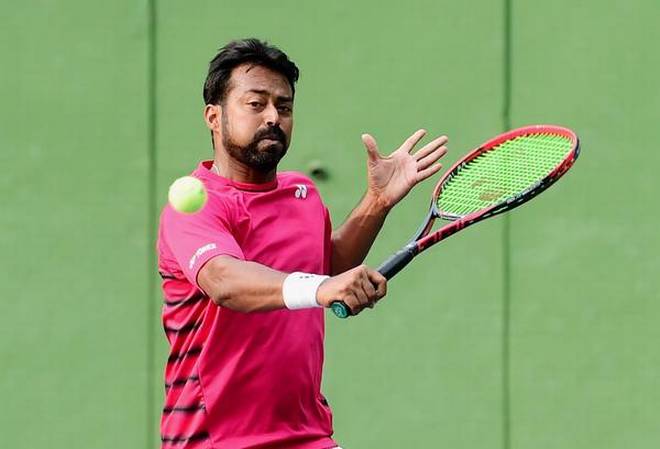
1990: Starts his Davis Cup career at the age of 16, with Zeeshan Ali his first doubles partner.
1991: Wins junior titles at the US Open and Wimbledon to become Junior World number 1.
1995: Ranked No. 130, manages to beat World No.7 Goran Ivanisevic in a five-setter on grass in the Davis Cup.
1996: At the Atlanta Olympics, beats Fernando Meligeni to win India’s first individual bronze in 44 years.
1998: Bags the Newport ATP title and beats Pete Sampras at New Haven.
1999: Along with Mahesh Bhupathi reaches the finals of all four Grand Slams, winning Wimbledon and French Open. Reaches the No.1 ranking in doubles.
2000: Given the honour of carrying the Indian flag at the Sydney Olympics.
2003: Wins the mixed doubles events at the Australian Open and Wimbledon partnering the legendary Martina Navratilova.
2006: Leads the Indian tennis contingent at the Doha Asian Games. Bags two golds with Mahesh Bhupathi and Sania Mirza.
2013: Clinches the US Open doubles title with Radek Stepanek to become the oldest male Grand Slam winner at 40. Bestowed the country’s third-highest civilian award, the Padma Bhushan.
2016: Secures his 42nd Davis Cup doubles win (partner Rohan Bopanna) with a victory over South Korea. Ties with Italian Nicola Pietrangeli for the all-time record.
2018: Claims a record-breaking 43rd Davis Cup doubles win in the Asia Oceania Group I tie against China. Paes also has the most number of wins (doubles and singles combined) among active players at 91.
source: http://www.thehindu.com / The Hindu / Home> Sport> Tennis / April 08th, 2018
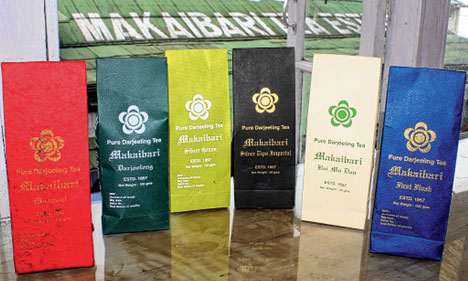
Makaibari tea packets kept in a room at the garden
Makaibari (Kurseong):
The “Rajah” of Makaibari tea has decided to “gift” his crown to workers.
Swaraj Kumar Banerjee, more famous as Rajah Banerjee, said on Thursday he would “gift” his 12 per cent shares in the marquee estate to the workers.
Barely a fortnight ago on March 16, Rajah had declared that he would exit Makaibari by selling his 12 per cent share to the management of the garden led by the Calcutta-based Luxmi Group.
That announcement had come exactly a year after Rajah’s bungalow at Makaibari was gutted in a fire, hastening the 70-year-old’s plans to hang up his planter’s boots.
If the decision is approved under corporate laws, this will possibly be the first time in the history of Darjeeling tea that the owner of a garden will give up his shares for the workers.
“I will gift my 12 per cent share to the workers,” Rajah told a meeting in the garden on Thursday, stressing his aim was to empower the 600-odd workers.
Sources in the Luxmi Group in Calcutta welcomed the move “as long as it is permissible under the Companies Act”. “We have no problem if he wants to give away his shares. It is a welcome gesture. We have to see if this is permissible under the Companies Act,” a source said.
Industry observers said, however, that the share transfer could turn risky, especially in years of poor earnings. “If the garden does not make enough profits and distributes dividends, workers may feel let down and this could be a tricky situation,” one observer said.
Rajah had forged a “strategic tie-up” with the Luxmi Group in 2013 and retained the 12 per cent stake in the estate that his family had been running since taking it over in 1859.
Members of the Makaibari Joint Committee, which represents the workers, on Thursday expressed “gratitude” for the “gift”. Rajah made it clear, though, that “the management representative on the panel will not be entitled to the shares”.
Additional reporting by Sambit Saha in Calcutta
source: http://www.telegraphindia.com / The Telegraph,Calcutta,India / Home> West Bengal / by Vivek Chhetri / March 30th, 2018
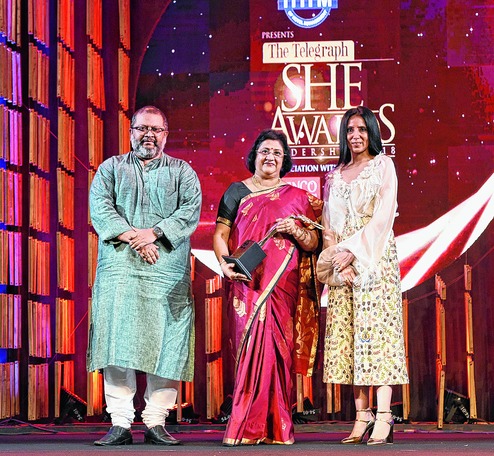
The second edition of The Telegraph She Awards, presented by IIHM in association with Senco Gold & Diamonds and StarOm Realty, celebrated the achievements of seven extraordinary women from Bengal at JW Marriott on Thursday evening.
The winners were selected by a jury comprising US consul-general Craig L. Hall, danseuse Tanusree Shankar and actress Koel Mallick. Arundhati Bhattacharya, the former chairperson of State Bank of India, was inducted into The Telegraph She Awards Hall of Fame.
“If you really want to do something and find it interesting, you will always find a way of learning what you need to learn. So one needs to be learning throughout life,” said Bhattacharya, after receiving the award from filmmaker Aniruddha Roy Chowdhury and fashion designer Anamika Khanna.
source: http://www.telegraphindia.com / The Telegraph,Calcutta,India / Home> Calcutta / March 30th, 2018
Aerospace Engineering researcher Professor Santanu Bhowmick, who hails from Jhargram district of West Bengal, has discovered a unique raw material to manufacture light weight anti landmine-vehicles.
The anti-landmine vehicles used by the defence organisations in India usually weigh 10-15 tonnes. Whereas vehicles manufactured using raw material discovered by Profesor Bhowmick will weigh only 5 tonnes, resulting in faster spped and greater mobility, especially in hilly terrains. The new material is also capable of withstanding heat upto 2400 degrees celcius. Usually, heat generated during a landmine blast measures upto 2000 degrees celcius.
Professor Bhowmick has already discovered a light weight bulletproof jacket which has been approved by the empowered committee of the Ministry of Defence. The jacket is made from indigenous ultra modern lightweight thermoplastic technology. It has been included in the Prime Minister’s ‘Make in India’ project.
Anti-landmine vehicles used in India are made of steel which tends to melt by the heat generated by landmine blasts, resulting in the death of its occupants -namely security personnel and jawans.
According to Professor Bhowmick, “Primarily the new vehicle will be provided with a heat withstanding ceramic and steel plate fitted to its base. The other portions of the vehicle will be made of steel. Later the entire vehicle can be made entirely of this material which will make it lighter. The material remains unchnged even at the highest temperature limit of 2400 degrees celcius.”
The vehicle base will be made of three layers of heat resistant ceramic plates of 60mm thickness.
Professor Bhowmick claims that the new anti-landmine vehicle will be made by the Tata group at their Jamshedpur workshop. On January 4, a meeting was held between him and the representatives of Tata group. According to Bhowmick, “Tata will supply high quality steel. The vehicle will be entirely made by Indian technology.”
The newly discovered material’s patent has been secured by Bhowmick. The new series of vehicles will be ready by 2020, confirms the scientist.
On Monday, the professor delivered a presentation about the newly discovered technology at the Army Technology Seminar 2018 using slide shows to illustrate his findings. According to him, “In the future this raw material may be used in building army bunkers, tanks, missiles and space research centres too.”
Bhowmick has been assisted in the research by three other scientists – Govindraju M, G Ajesh and V Shivakumar.
Monday’s presentation was attended by the Indian Army chief Gen. Bipin Rawat and many top ranking Army officers. DRDO director S Christopher was also present at the show together with scientists from the Chennai and Gandhinagar IITs.
Professor Bhowmick’s discovery is considered an important progress towards Prime Minister Narendra Modi’s Make In India project especially in the Defence sector.
source: http://www.telegraphindia.com / The Telegraph, Calcutta,India / Home> News> City News> Kolkata News / by El Samay / January 09th, 2018
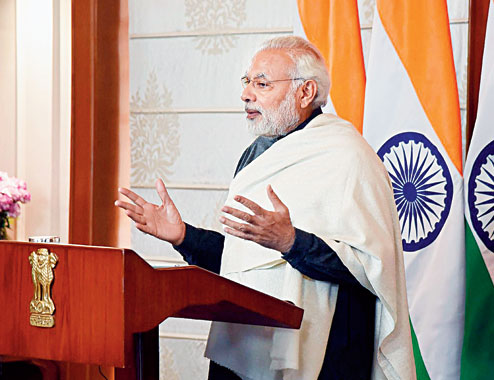
Prime Minister Narendra Modi pays tribute to S.N. Bose (below) on his 125th birth anniversary via video-conferencing from New Delhi on Monday. (PTI)
Calcutta:
Physics was his calling but he could play a complex classical raga on the esraj with as much dexterity as he could read out a French novel in impromptu English translation.
Stories highlighting the multifaceted genius of Satyendra Nath Bose, after whom the Boson particle is named, on Monday filled the curtain-raiser to a yearlong commemoration of his 125th birth anniversary.
Prime Minister Narendra Modi inaugurated the event from Delhi through video-conferencing, reminding the audience at the SN Bose National Centre for Basic Sciences in Salt Lake that “just as a quantum particle does not exist in isolation, we should also get out of isolation”.
Modi said the scientific ecosystem needed to connect with innovators, entrepreneurs and technocrats to work on artificial intelligence, big data analytics, machine learning, genomics and electrical vehicles. “These are some of the rising technologies on which we need to get ahead,” he pointed out, holding up Bose as the inspiration to test new frontiers.
Born on January 1, 1894, Bose had collaborated with Albert Einstein to create what came to be called the “Bose-Einstein Condensation”. Physicist and author Partha Ghose, who did his PhD under Bose, recounted one among many instances of how humble he could be despite his brilliance.
“He was in a reflective mood one day and spoke about the ‘photon spin’ aspect in his derivation of Planck’s law. But then, with a mischievous smile, he said, “But the old man (Einstein) struck it off”.
Ghose said the anecdote left him flabbergasted because Nobel laureate C.V. Raman’s research later vindicated Bose’s derivation.
“When I asked him why he didn’t claim credit for his discovery, he said, ” Ki ba eshe gelo? Ke baar korechhilo tatey ki eshe jaye? Baar to hoyechhilo (How does it matter? Who discovered it is not the main thing, is it? At least it was discovered)’,” he reminisced.
Planck’s law is the basis of quantum theory.
In his speech, the Prime Minister said many Nobel prizes had been won for work based on Bose’s research.
Union science and technology minister Harsh Vardhan also paid tribute to Bose.
source: http://www.telegraphindia.com / The Telegraph, Calcutta,India / Home> Calcutta / by Anasuya Basu / January 02nd, 2018
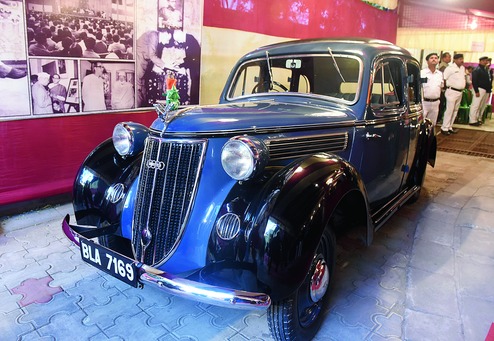
Netaji Subhas Chandra Bose’s Great Escape car, the 1937 Wanderer, was taken apart – on slides – and its restoration story told at the Calcutta Club on Saturday.
Restorer Pallab Ray (right in picture by Sanat Kr Sinha) gave an audiovisual presentation on how he was picked to restore the vintage car that was part of “such a thrilling history”.
In fact, the Bose family had two cars – a Studebaker President and the Wanderer. Apparently, Netaji wanted to escape in the Studebaker. But the Wanderer was chosen as everyone thought people would easily recognise the Studebaker.
Netaji’s nephew Sisir Bose ran an endurance test with the Wanderer till Burdwan.
On the night of the Escape, the Wanderer made a noisy start as it moved out of the Elgin Road house, turned right and then again right to get on to Allenby Road. Netaji held on to his door tightly without closing it so that anyone who was awake would hear only one door being shut. He shut the door after the car had crossed Allenby Road.
On the 75th anniversary of the Great Escape, the restored Wanderer (top in picture by Pradip Sanyal) was unveiled by then President Pranab Mukherjee.
The car had been on display at the Netaji Research Bureau (NRB) since 1970.
The NRB director appointed Audi Calcutta for its restoration. As Wanderer was built by Auto Union, which Audi bought later, they had been contracted to do the job. The Audi Calcutta CEO zeroed in on Ray who had restored his family’s Studebaker President.
Ray said he found the car in a shambles. He was asked to do just a visual restoration, but he decided to make it run again. And he did that with the help of his team. From overhauling the engine to working on the transmission and unique Wanderer suspensions, rebuilding the dashboard and stitching the upholstery, Ray restored the vehicle completely.
Reporting by Anasuya Basu
source: http://www.telegraphindia.com / The Telegraph, Calcutta,India / Home> Calcutta / by Anasuya Basu / December 06th, 2017
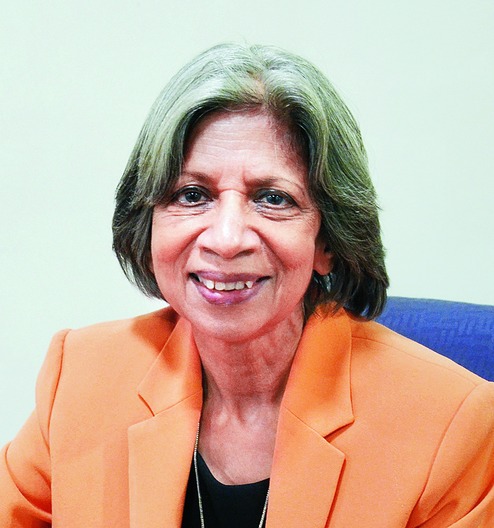
Calcutta-born Millie Banerjee has been appointed the new chairman of the UK’s College of Policing.
Actually, she has been interim chairman since November last year so her appointment was today made permanent by the home secretary, Amber Rudd.
“Working with Millie over the last year I have been impressed by the insight she brings from her time leading other public and commercial organisations, including the British Transport Police,” Rudd said on Thursday.
Millie’s responsibilities are highly sensitive – keep an eye on “standards in policing” across the 43 police forces in England and Wales; developing knowledge and “what works”; and assisting with education and career development.
It is possible she will want to exchange notes on policing in Calcutta.
“Millie” is really her nickname but it has come to stay as she has become part of the great and good in Britain. She was born Urmila Ray-Chaudhuri in Calcutta on June 30, 1946, and is friendly with a number of prominent figures in the city, among them the physicist Bikash Sinha.
Millie, who was honoured with a CBE on the Queen’s Birthday Honours list in 2002 and was High Sheriff of Greater London in 2012-13, was chairman of the British Transport Police Authority for seven years and spent 30 years in the telecommunications and satellite industries. This included 25 years with BT in senior positions.
She is currently the chairman of NHS Blood and Transplant and a board member of East London NHS Foundation Trust.
Reacting to her confirmation, Millie said: “I have spent many years in policing and it has been a privilege to witness the dedication and compassion of officers and staff to protect the public. This is evident when I see that public approval for police has remained high despite officers and staff being faced with ever more complex crime, a reduced workforce and greater demand.
“We are dedicated to providing access to the best knowledge and skills which sits behind the bravery, dedication and compassion shown by police on a daily basis. We have ambitious plans ahead and I intend on working with people across policing to continue building a professional body that supports all officers and staff.”
source: http://www.telegraphindia.com / The Telegraph, Calcutta,India / Home> Calcuttu / by Amit Roy / November 17th, 2017