Dr Aditi Sen De is the only female winner this year
On the occasion of its foundation day, the Council of Scientific and Industrial Research (CSIR) has put out the list of recipients of the Shanti Swarup Bhatnagar Prize for Science and Technology for 2018.
Every year, several scientists below the age of 45 are selected from various institutions across the country and awarded for their outstanding scientific work in the last five years.
Here is the full list of winners this year in various categories
Category Winner Affiliation
Biological Sciences
Dr Ganesh Nagaraju IISc Bengaluru
Dr Thomas Pucadyil IISER Pune
Chemical Sciences
Dr Rahul Banerjee IISER Kolkata
Dr Swadhin Kumar Mandal IISER Kolkata
Earth, Atmosphere, Ocean and Planetary Sciences
Dr Madineni Venkat Ratnam National Atmospheric Research Laboratory, Tirupati
Dr Parthasarathi Chakraborty CSIR-NIO, Goa
Engineering Sciences
Dr Amit Agrawal IIT Bombay
Dr Ashwin Anil Gumaste IIT Bombay
Mathematical Sciences
Dr Amit Kumar IIT Delhi
Dr Nitin Saxena IIT Kanpur
Medical Sciences
Dr Ganesan Venkatasubramanian NIMHANS, Bengaluru
Physical Sciences
Dr Aditi Sen De Harish-Chandra Research Institute, Allahabad
Dr Ambarish Ghosh IISc Bengaluru
source: http://www.thehindu.com / The Hindu / Home> Sci-Tech / by The Hindu Net Desk / September 26th, 2018
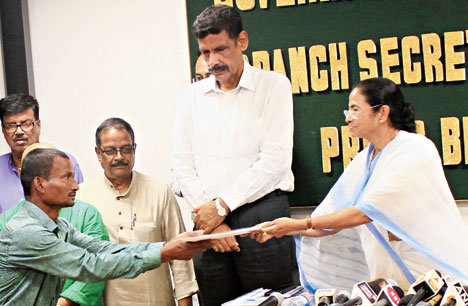
Mamata hands over a job letter to one of the former KLO rebels. (Passang Yolmo)
Siliguri:
Thirty-six former militants of the Kamtapur Liberation Organisation (KLO) were on Thursday hired as home guard volunteers in the Mamata Banerjee government’s first initiative to rehabilitate the ex-rebels who wanted a separate state.
Mamata handed over job letters to the group, including Mihir Das and Madhusudan Das, once prominent faces of the KLO. The 36 – 21 from Alipurduar and 15 from Jalpaiguri – will be engaged in their districts.
The former rebels – most were arrested during Operation Flushout in 2003-04 by the Royal Bhutan Army – have been disgruntled and long demanded rehabilitation. “They have been provided jobs and will work for the interest of the society. The initiative was taken by the chief minister,” said Amitabha Maiti, the Jalpaiguri police chief.
The decision to address the grievances of those who had resorted to armed struggle demanding a separate Kamtapur state – most were from the Rajbangshi community – follows another important decision the chief minister took during her ongoing trip of north Bengal.
On Tuesday, she had announced the elevation of Bangshibadan Burman as the chairman of the West Bengal Rajbangshi Development and Cultural Board. Burman, board vice-chairman till then, is a top leader of the Greater Cooch Behar Peoples’ Association, also formed to demand a separate state.
A section of the former militants had shunned Trinamul and supported the BJP in the May rural polls in some pockets of Alipurduar. “This had helped the BJP score well in some areas, particularly in the Kumargram block that borders (BJP-ruled) Assam,” an observer said.
The former rebels expressed satisfaction. “We have been raising the demand for 15 years. Some others like us who have been left out should also be provided similar jobs or some other assistance,” said Mihir Das, who hails from Kumargram.
Additional reporting by Anirban Choudhury in Alipurduar
source: http://www.telegraphindia.com / The Telegraph,Calcutta,India / Home> West Bengal / by Avijit Sinha / July 13th, 2018
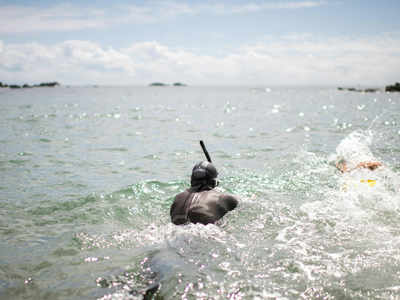
Shark Spotter has been deployed in 11 beaches in north New South Wales such as Byron Bay, Ballina (picture for representation only)
Jalpaiguri :
Remember Jaws, the 1975 Hollywood thriller on a giant man-eating great white shark that struck terror on fictional resort town Amity Island? In beaches across Australia, the Steven Spielberg reel horror is real with the country recording the largest number of unprovoked shark encounters with humans after the United States.
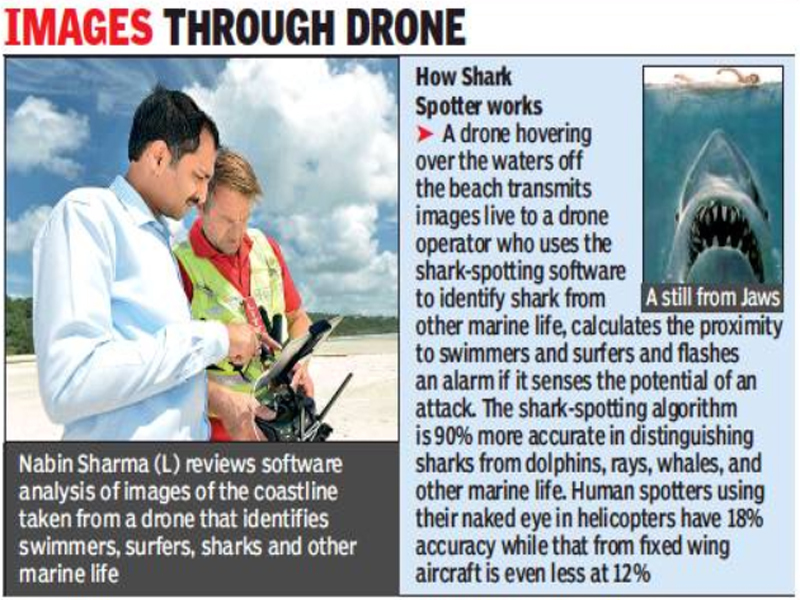
Now several Australian beaches have deployed a technology co-developed by a technologist from north Bengal that uses artificial intelligence to seek out sharks based on aerial footage from drones and warn swimmers to get out of the water quickly.
Dubbed as Shark Spotter, the software uses an algorithm capable of using video footage streamed from drones to detect sharks and alert swimmers. “The Shark Spotter is the world’s first, non-destructive technology able to detect sharks and other potential threats using real-time aerial video imagery. The new algorithm is 90% accurate in distinguishing sharks from other marine life. Human spotters from fixedwing aircraft or helicopter have accuracy of 12%-18%,” said Nabin Sharma, a lecturer at the University of Technology Sydney, who along with Michael Blumenstein developed the software that is making waves Down Under.
Shark Spotter has been deployed in 11 beaches in north New South Wales such as Byron Bay, Ballina, where shark attack was a major problem. And they have already saved lives. Shark attack reports from these beaches have declined significantly, prompting authorities in beach towns in the US and Europe to also consider the technology.
The Shark Spotter technology has won in three major categories (Research & Development Project of the year, Artificial Intelligence or Machine Learning Innovation of the year and Community Service Markets) in the Australia Information Industry Association, iAward 2018, New South Wales.
Sharma did his schooling in Holy Child School, Jalpaiguri, before graduating from Ananda Chandra College in the town. He then did Master of Computer Application (MCA) and Bachelor of Science from Siliguri Institute of Technology, before doing his PhD from the School of ICT, Griffith University. He is currently a lecturer with the School of Software, University of Technology Sydney (UTS).
Of more than 500 known shark species, 26 have been involved in unprovoked attacks on humans. Of these, Australia has 22 shark species. Australia records an average 1.5 deaths per year from shark .
source: http://www.timesofindia.indiatimes.com / The Times of India / Home> City News> Kolkata News / by Pinak Priya Bhattacharya / TNN / June 24th, 2018
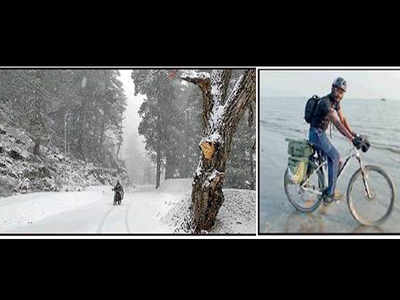
City mountaineer and trekker Samrat Moulik recently cycled 3,000km from Gangotri in Uttarakhand to Kuakata in Bangladesh
Kolkata :
A mountaineer and trekker from Kolkata, who quit a corporate job to pursue his passion, is preparing for a mega cycling expedition of 5,500km – from Nubra Valley near Ladakh to Kanyakumari and onward to Sri Lanka.
Three months ago, he completed a 3,000km solo cycling journey from Gangotri in Uttarakhand to Kuakata in Bangladesh, traversing the entire length of the Ganga as it meandered through five states before entering Bangladesh.
“The condition of the Ganga – that we consider sacred and yet pollute – prompted me to undertake the ‘Save Ganga’ campaign in February-March. I wanted to know what was polluting the river and its impact on the population living along its length,” said Samrat Moulik. He began the journey on February 8 this year and finished on March 21.
While the condition of the river is good in Uttarakhand, its deterioration was visible after Haridwar. “Pollution actually began at Nagina – a town in Uttar Pradesh. In Moradabad, there is cremation ground at the ghat, a picture that one sees all along the river thereafter. From there on, the river water gets murkier as it flows. The effects of Ganga Action Plan, about which I had heard for years, were not visible. The pollution load of the Ganga increases as polluted tributaries flow into it,” said Moulik.
As the river flows downstream, industrial waste becomes the major pollutant. The situation improved in Jharkhand. But when the river bifurcates into the Hooghly and the Padma near Rajmahal, its condition again deteriorates. “The situation is better in Bangladesh because of people’s dependence on the river,” he said.
Moulik plans to start his journey in September. He will cover several rivers in central, west and south India before travelling to Sri Lanka and cycle along the rivers there.
source: http://www.timesofindia.indiatimes.com / The Times of India / Home> News> City News> Kolkata News / TNN / June 14th, 2018
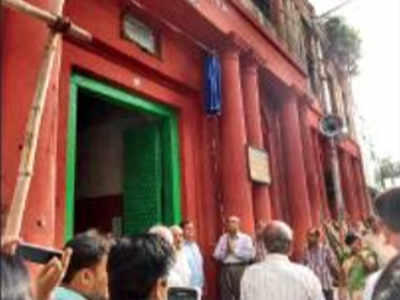
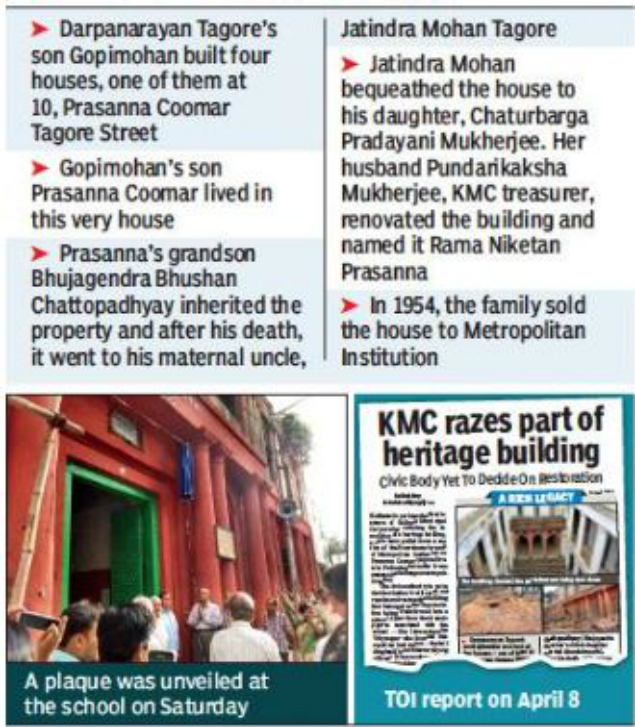
A dilapidated portion of the Burrabazar branch of Metropolitan Institution, which was pulled down by the KMC on April 7, is getting a new lease of life with a group of residents taking the initiative to restore the heritage structure to its old glory. The initial, rudimentary repairs have been carried out with school funds and the subsequent renovation is likely to depend on government assistance as well as crowdfunding.
Members of ‘Purono Kolkatar Golpo’, a Facebook group that has taken up the project, organized a programme on the premises of the institution on Prasanna Coomar Tagore Street at Pathuriaghata on Saturday, when they unveiled a plaque, with the building’s “heritage status” written on it.
This plaque, they hope, would make Kolkatans and authorities aware of the historical significance of the school, which was founded by Ishwarchandra Vidyasagar.
The unveiling was followed by discussions and a cultural programme, which was attended by current and old students, teachers, neighbours and local councillor, Ellora Saha, who advised to form a development committee that would work towards procuring money from the government. “It is a proud moment that ordinary people have come together to conserve the historical institution. Our aim is to restore the building,” said P N Palit, secretary at Vidyasagar Institute trustee board. He added the initial repair, white-wash and clearing trees and undergrowth from the compound were carried out with school money.
Heritage enthusiast Swarnali Chattopadhyay said, “It’s high time we did something to save such structures of architectural and historical significance. For restoration, we are looking to state help and crowdfunding as and when required.”
Till 1954, the building belonged to the Tagores and was known as Rama Niketan.
Thereafter, the Burrabazar branch of Metropolitan Institution was set up on the premises, where the school ran out of rooms on the ground and first floors. Now, with only 60 students on the roll, classes are held only on the ground floor. The Pathuriaghata post office shared the same compound. “To save the building, it is important to save the school.
Different activities have to be started there as the institution and the building are interdependent. A proposal has been given that other small schools in the area may use the huge compound, and if need be, they can be merged into one institution,” said Jayanta Sen, heritage activist and another member of Purono Kolkatar Golpo.
Councillor Saha said, “The building still has Vidyasagar’s chair and it is where Madhusudan Dutta composed ‘Sharmistha’. It is my duty to help people conserve the place.”
Conservation architect Kamalika Bose hailed the initiative: “This is a great example of residents doing something at the grassroots level, without expecting the government to take the first step.”
source: http://www.timesofindia.indiatimes.com / The Times of India / Home> City News> Kolkata News> Schools & Colleges / by Dipawali Mitra / TNN / June 17th, 2018
Shib Shankar Patra is one among thousands of die-hard Argentina fans in Kolkata and there’s nothing unusual about it.
But then die-hard fans at times can be weird too and the 53-year-old Patra has that weird streak in him.
Trying to garner enough savings from his modest earnings through a tea stall, Patra harboured a dream — to watch ‘The Albiceleste’ live from the stands in Russia.
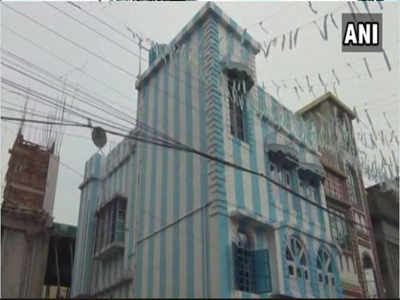
But when a Kolkata-based travel agent informed him that his savings — a princely amount of Rs 60,000 (USD 900) is not enough to fund his World Cup trip (travel agent gave him a budget of Rs 1.5 lakh), he decided the next best thing –paint his entire three-storied building in Argentina colours.
“I don’t smoke or drink. I have only one addiction and that is Lionel Messi and Argentina. I don’t earn much but ensure that bulk of my earnings is kept aside for these indulgences when World Cup comes calling,” Patra, owner of a tea and snack stall in North 24 Parganas’ Nawabganj township, told PTI.
You don’t need a GPS to track Patra’s house once you get down to Ichhapore Railway Station. Ask any cocky teenager or elderly uncle about “Argentina Chaayer Dokan” (Argentina Tea Stall), they will be more than happy to oblige.
The street leading up to his tea stall cum house is dotted with Argentina flags while a giant one flutters high making its presence felt.
Every four years coinciding with the World Cup, Patra, who runs his tea stall from the ground floor of his three-storied building, gives his building a fresh coat of light blue and white shade.
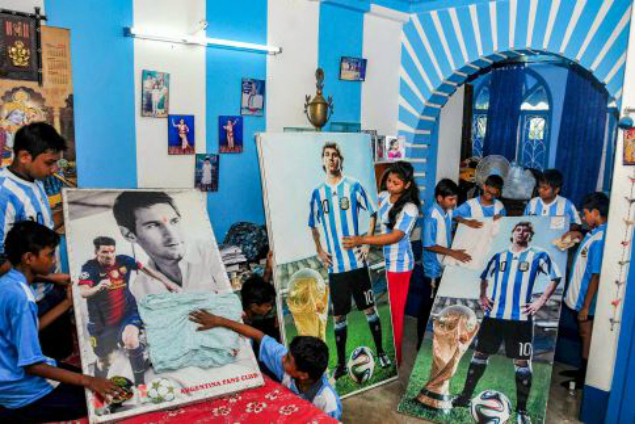
Enter his three-room apartment and the craziness hits you instantly. All the walls are painted in Argentina colour, even the small ‘puja sthal’ (where the idols of Gods and Goddesses are placed). The walls of each room adorns a life-size vinyl flex print poster of Messi.
Addiction can be contagious but if its ‘Messi mania’, Patra doesn’t mind that his wife Swapna along with his children — 20 year-old daughter Neha and 10-year -old son Shubham are equally mad about the fleet footed genius.
“My kids know everything about Messi. The food he likes, the car he drives, everything,” Patra says with a glint of pride in his eyes.
“They don’t miss a single match of Messi. If there’s a late night match during the exams, they will pretend to sleep early but will watch live streaming on their cell phones,” wife Sapna said.
There is one common thread of all Argentina fans in Bengal. The 1986 World Cup, which was aired live on Doordarshan turned Kolkatans into ‘Maradona devotees’. Messi is an extension of Maradona.
“I have watched the Argnetina friendly at the Salt Lake Stadium. I lived a dream that day,” Patra recollected.
It was the first time, he painted his house in Argentina colours, something he repeated in the 2014 edition of the World Cup as well.
Since 2012, the Patra family celebrates every Messi birthday with fanfare like cutting cake to organsing blood donation camp.
And it goes without saying that tea and samosas (staple diet for Bongs during their football adda sessions) is complimentary on all Argentina match days.
With Messi’s birthday coinciding with the World Cup, they have cancelled the blood donation camp, which is held every year.
Instead a 30-pound cake will be cut and 100 Argentina jerseys will be distributed amonmg local kids with Messi’s photograph embossed.
In attendance would be the local MLA and India U-17 World Cupper Rahim Ali.
By his own admission, he has never taken any loans for his personal indulgences.
“I’ve never sought money from anyone but we never fell short, and somehow everything falls in place in time,” Patra said.
“People here also happily come forward. Someone sponsors the food, someone gets the cake and we make it a mini-Argentina here,” Patra says.
Even there will be prayers for Messi with the priest of the local Hanuman temple — his regular client — offering special prayers for the Argentine wizard.
“He gets me the ‘sindoor’ from Hanuman’s left leg (the connection is Messi being a left-footed player) and the vermilion is applied on Messi’s poster during every match. We hope he lift the Cup this time,” Patra signed off.
source: http://www.timesofindia.indiatimes.com / The Times of India / Home> News> City News> Kolkata News / PTI / June 13th, 2018
ICSE and ISC exam results throw up stories of success in the face of extreme adversity
Neelangshu Saha
Calcutta:
The weekend before his ISC mathematics paper, Neelangshu Saha was in hospital for chemotherapy. When the examination results were declared at 3pm on Monday, he was undergoing a PET scan in a Mumbai hospital.
Neelangshu scored 84 in mathematics, each mark bearing testimony to his effort in writing a paper for three hours after having been discharged from hospital just the night before.
The student of Adamas International School in Belghoria did even better in terms of aggregate – 86.75 per cent – after battling a relapse in the middle of the examination. His individual scores are 78 in English, 88 in physics, 82 in chemistry and 97 in computer science.
The 18-year-old had been diagnosed with alveolar rhabdomyosarcoma, a cancer originating in the muscles, in 2016. He seemed to be in remission after treatment, but the cancer returned in two years.
Doctors had told Neelangshu that he wouldn’t be able to write an examination immediately after chemotherapy, but he wasn’t ready to give up.
“I had already lost a year during the first spell of illness (with 33 cycles of chemotherapy and 51 rounds of radiation) and could not write the examination along with batchmates I had studied with for 10 years. That was a major push for me. My mother encouraged me to do so,” Neelangshu said from Mumbai.
The relapse was diagnosed two days after the teenager wrote his physics paper. His mother went to Mumbai to consult doctors on postponing treatment till the ISC examination was over.
“Doctors at the Tata Memorial Centre in Mumbai said treatment was more important than writing the examination. We then decided to get chemotherapy done in a Calcutta hospital,” said mother Aditi Roy, an economics teacher.
“It was a Monday, the day of his mathematics paper. He was so weak that he could barely open his eyes. But he showed tremendous mental strength and went to school,” Aditi recounted.
Despite the side effects of chemotherapy like nausea and not being able to sit for long hours, Neelangshu wanted to write the examination with his classmates.
“Chemotherapy would leave me feeling very hot and I could not continue in the examination hall. My school then arranged for me to write the examination in an air-conditioned room. Had it not been for my school’s support and that of my teachers, I would not have been able to write the exam,” Neelangshu said.
Before being diagnosed with cancer, Neelangshu had been an athlete with two gold medals in sprinting events in his last school sports meet in 2015. “The way he has fought illness is amazing, especially to write an exam between chemotherapy sessions,” said Mittra Sinha Roy, principal of Adamas International School.
A swelling in his left leg last January was the first sign of a relapse. “It (alveolar rhabdomyosarcoma) is a rare cancer with an unpredictable outcome. If it has not spread to the lungs and liver and is limited to the local area and site of origin, there are chances of the cancer being cured. The boy’s willpower is inspirational,” said oncologist Gautam Mukhopadhyay, although he hasn’t treated Neelangshu.
source: http://www.telegraphindia.com / The Telegraph,Calcutta,India / Home> Calcutta / by Jhinuk Mazumdar / May 15th, 2018
Briton married to Bengali finds new calling after living in village
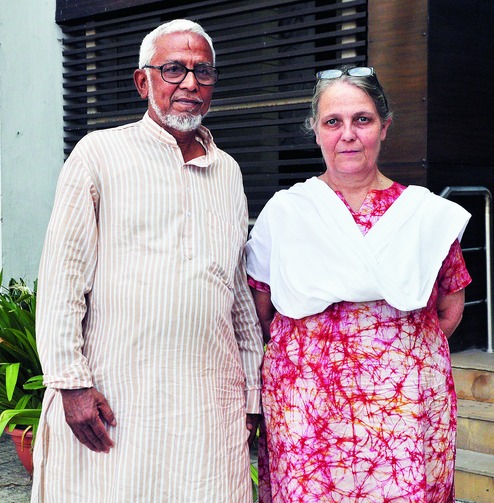
Ranjan Ghosh and Lindsay Barnes. Picture by Anup Bhattacharya
Calcutta:
She is from Lancashire in north-west England, he is from Bally in Howrah. Lindsay Barnes and Ranjan Ghoshhad met in the Eighties as students at Jawaharlal Nehru University and, fired by a shared idealism and sense of adventure, set up home in a village near Bokaro.
Sometime in 1993, Lindsay was forced by circumstance to help a village woman deliver a baby. She had no medical degree, only a book to help her. Since then, Lindsay has played midwife to scores of mothers and set up a 12-bed health centre with her husband Ranjan Ghosh to provide hundreds of others a safe place to give birth.
The couple have also brought together more than 7,000 women from 120 villages under various self-help groups, with Ranjan using his expertise to induct them into microfinance.
Lindsay and Ranjan, who were in Calcutta to attend a Mother’s Day programme organised by an infertility clinic in Kasba, said they planned to train junior doctors and nurses to deliver babies under limiting circumstances in rural areas.
Health care was, of course, not a choice Lindsay had made when she started living in Chambrabad village, 25km from Bokaro. A student of sociology, she was there primarily for research on life in the coal belt when a call for help changed her calling.
“Some neighbours approached me to help a mother-to-be,” she recounted. “I was astounded. I had no clue what to do. I was trying to put them off with excuses. It was my husband who goaded me to go,” 58-year-old Lindsay told Metro.
Armed with a book titled Where there is no doctor: A village healthcare handbook, Lindsay left home to help deliver the baby. “The local women who gathered around me knew I had no knowledge of midwifery, yet they were relieved to see me. They knew I would find a way out. That’s when it hit me that I must do something to help them,” she said.
Lindsay, now a mother of two, soon started receiving similar requests from other villages. “After a few home deliveries, I decided to educate myself in hospitals and nursing homes. I learnt a little and read a lot more to perfect my job,” she said.
After almost 100 home deliveries, Lindsaybegan hiring rooms for deliveries. She set up the 12-bed health centre in 2001. “The village girls now run the health centre with minimal support from qualified doctors. I am still called to handle critical cases. Ninety-five per cent of women have normal delivery. We refer critical cases to nearby hospitals,” she said.
According to gynaecologist and infertility specialist Sudip Basu, what sets Lindsay apart is her “practical knowledge”.
“It will be good if she can train our junior doctors and nurses how to treat patients under limiting circumstances. My team, in turn, can volunteer at her health centre. We plan to replicate the model in other villages.”
source: http://www.telegraphindia.com / The Telegraph,Calcutta,India / Home> Calcutta / by Chandreyee Ghose / May 14th, 2018
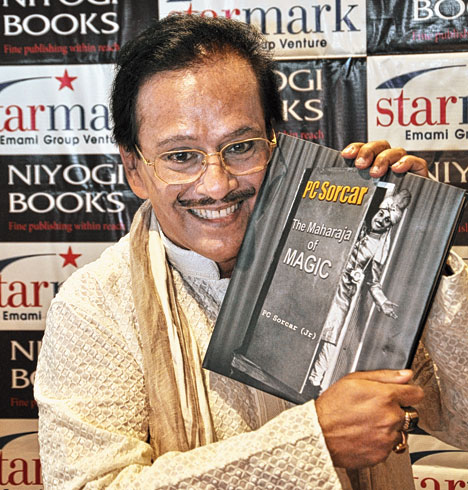
P.C. Sorcar (Jr) at the launch of a memoir of his father on Friday. (Anup Bhattacharya)
Calcutta:
On April 9, 1956, a live telecast of a magic show in London seemed to have gone awfully wrong. The scheduled 15-minute slot on BBC was almost over but the assistant cut in half by the turbaned Indian magician was not coming back to life.
As the channel switched to the news bulletin, viewers jammed the studio lines with calls, convinced that the woman had been murdered. Such was the furore that the event made the next day’s headlines, with interviews of the assistant, alive and well.
“It had all been part of a grand plan. He had deliberately instructed the lady assistant to lie unresponsive… at the critical moment… This man was Protul Chandra Sorcar. He was also my father,” the writer of a book titled PC Sorcar: The Maharaja of Magic describes the incident.
A memoir of the illustrious father Protul Chandra Sorcar penned by his torch-bearer and son Prodip Chandra Sorcar or P.C. Sorcar (Jr) was launched on Friday at Starmark. It is replete with anecdotes that demonstrate how the senior Sorcar single-handedly revived a dying Indian art and went on to be hailed by the International Brotherhood of Magicians in 1948 as “The World’s Greatest Magician”.
The book is also a storehouse of photographs, publicity material, newspaper clippings and cartoons on the phenomenon that was P.C. Sorcar. His reception in the 35 nations where he performed is nothing short of spectacular. If The Sunday Times carried a photo of him reading the newspaper blindfolded, one of Japan’s top newspapers The Yomiuri Shimbun ran the headline on an article on him “Invaluable Living Asset From India Brings Black Art” while The Australian Women’s Weekly did a full page feature on him when he was touring the continent in 1958.
“The book was five years in the making,” said Bikash D. Niyogi, the managing director of the publisher Niyogi Books.
At the launch of the book on Friday, Sorcar (Jr) revealed that his grandfather was bitterly against his son taking up magic as a profession. “‘Do not do public shows. Society is not ready. You will be taken as a dabbler in hocus pocus,’ he kept telling his son. He wanted him to become an engineer instead,” said Sorcar (Jr).
In a way, he was right. “Even after my father’s body was flown in from Japan where he suddenly passed away in January 1971, people gathered outside our house at night expecting him to return, much like he would at the end of his disappearing tricks, appearing from a distant corner with the shout ‘I am here’. People were so gullible that they could not distinguish between his stage persona and the person he was in real life.”
Sorcar, as a child, had an opposite problem. He took the sombre man keeping a strict eye over his son and the smiling magician on stage as different people. The book is a testimony as to how the two avatars of PC Sorcar come together in the eyes of a fellow magician who is also his son.
source: http://www.telegraphindia.com / The Telegraph,Calcutta,India / Home> Calcutta / by Sudeshna Banerjee / May 12th, 2018
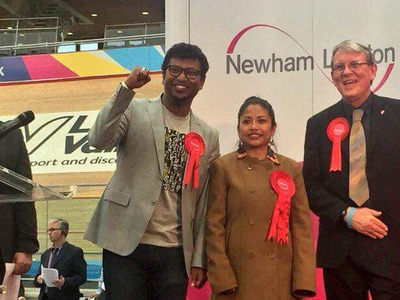
Rohit K Dasgupta, 30, has become the first Bengali from India to be elected as councillor in the London Borough of Newham. An alumnus of St James’ School and Jadavpur University, Dasgupta had joined UK politics in 2009, when he shifted to London to pursue his masters in English.
Last year, Dasgupta had unsuccessfully contested as the Labour Party’s parliamentary candidate for East Hampshire against the Theresa May government. This year, he won with 70% votes.
His parents — Mukut and Joyasree — are ecstatic. “My mother said my hard work paid off. My parents were up all night waiting for the results. They will have a celebration dinner,” Dasgupta said. After results, Dasgupta partied with all the Labour activists who contributed to his win.
Though he comes from a Left political tradition, none of Dasgupta’s parents have been involved in active politics. “I joined the Labour Party as I thought Gordon Brown was a fantastic leader and deserved to remain UK’s PM,” he explained. As for contemporary Indian politics, Dasgupta is against the “kind of Hindutva nationalism being espoused by the BJP”. “I was born in a secular country and to see that secularism being eroded makes me angry. I’m glad Bengal is one of the few states that has remained immune to Hindutva politics,” he said.
However, the recent Metro incident at Dum Dum — where his parents live — has left him ashamed. “Kolkata has been a bastion of liberal values compared to many other Indian cities. Moral policing is unacceptable. Showing affection should not be something we should be ashamed of or be censured for,” he said.
He will now he busy balancing his academic job at the Loughborough University and responsibilities as a councillor. Both jobs, he said, complement each other. As an elected representative, his priority is to expand “the equalities agenda of the council, repair and maintain all council homes and increase crime prevention”. Housing, he pointed out, is a big issue in Newham. “I’d like to see our council build more affordable homes for everyone,” he said.
Looking forward to strengthening the connection between Kolkata and London, he said, “Newham also has a sizeable number of Indian and Bangladeshi communities. There is opportunity for all kinds of cultural exchange with Kolkata and also learning good practices from each other.”
source: http://www.timesofindia.indiatimes.com / The Times of India / Home> City News> Kolkata News / by Priyanka Dasgupta / TNN / May 06th, 2018