Category Archives: World Opinion

Birds of Bengal at Sweden auction

The paintings by Zayn al-Din were commissioned by Mary Impey, an English natural historian and patron of the arts in Bengal
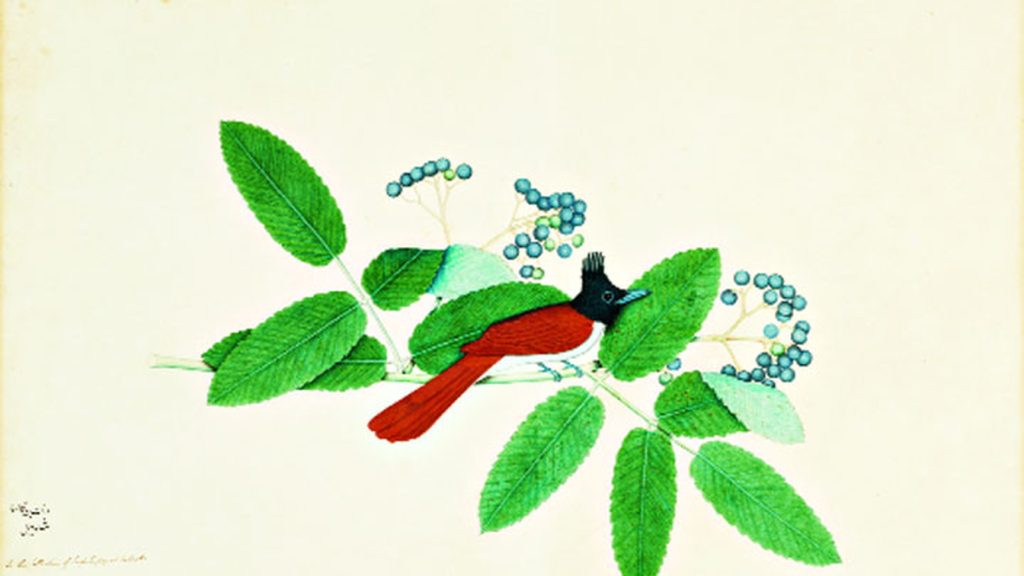
Falsa Tree with King’s Nightingale was painted on a 53.5cm x 75cm canvas by Zayn al-Din in 1782 . / Picture courtesy: Stockholm Auction House

Two watercolour and pencil-on-paper artworks painted in Calcutta in the late 18th century by one of the most famous exponents of the Company School of Art will go under the hammer at the world’s oldest auction house in Sweden on June 12.

The paintings by Zayn al-Din were commissioned by Mary Impey (March 2, 1749 -February 20, 1818), an English natural historian and patron of the arts in Bengal. She was the wife of Elijah Impey, the first chief justice of the Supreme Court at Calcutta (1774-82), who had infamously sent Maharaja Nandakumar — a highly-placed officer in the nawabi administration — to the gallows on charges of perjury.

Falsa Tree with King’s Nightingale, dated 1782, and Parrot in a Parkar Tree, dated 1779, have been in the possession of a Swedish family for long.

“We are immensely proud to present these rare artworks. We are not sure how they reached Sweden. They have been in the same Swedish family for a long time and this is the first time that they reach the market,” Victoria Svederberg Bojsen, a specialist in classic and modern art at the Stockholms Auktionsverk (Stockholm Auction House), founded in 1674, told Metro over phone from Stockholm.

“The estimate price is Euro 51,000 (Rs 40 lakh) to 61,500 (Rs 48 lakh). However, we believe they will reach an even higher price. Our hope is naturally that they will now be returned to India where they originated,” she said.

Birds are the subjects of both the paintings. Falsa Tree with King’s Nightingale is a 53.5cm x 75cm canvas.

The inscriptions on both pictures read: In the Collection of Lady Impey of Calcutta. Painted by Zayn al-Din Native of Patna 1782.

“Both paintings include a description of the subject in Persian — Darakht ban falsa, Shah Bulbul in the first and Madna Tota, Darkaht Pakar in the other. The artist’s name is also written in Persian,” said Nandini Chatterjee, associate professor of history at the University of Exeter in the UK.
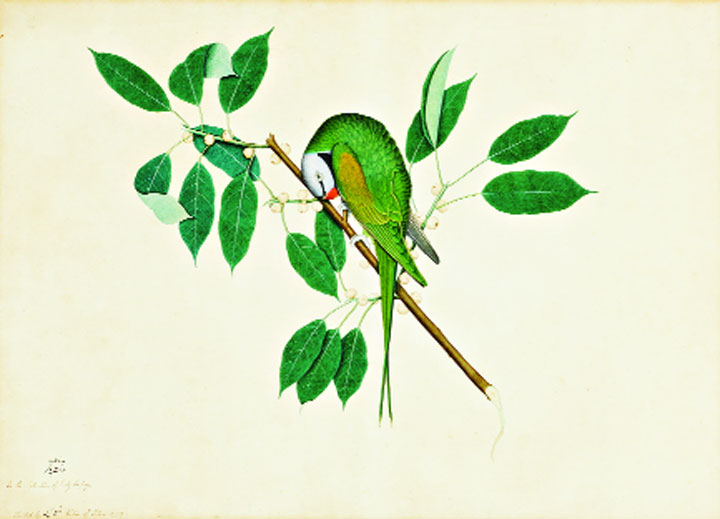
The painting (right), titled Parrot in a Parkar Tree, is signed and dated 1779. The inscriptions on both artworks read: “In the Collection of Lady Impey of Calcutta. Painted by Zayn al-Din Native of Patna 1782”. / Picture courtesy: Stockholm Auction House

Metro had sent the images to Chatterjee, who is part of a research on two sets of natural history drawings produced between the late 18th and early 19th centuries in Calcutta. The drawings are held at the Victoria Memorial Hall and the Royal Albert Memorial Museum & Art Gallery in Exeter.

The Impeys moved to India in 1773 after Elijah Impey was made the chief justice of Bengal. They set up a menagerie at their house in Calcutta’s Middleton Row. When they shifted to Fort William two years later, they started a collection of native birds and animals on the extensive gardens of the estate.

Mary Impey commissioned several local artists to paint the fauna and flora they had collected. Her three principal artists were Sheikh Zayn al-Din, and brothers Bhawani Das and Ram Das. All three had come from Patna.

Together, Zayn al-Din and the Das brothers painted more than 300 artworks, half of them of birds. The collection, often known as the Impey Album, is an important example of Company style painting.

“With the decline of the Mughal courts, the artists sought the patronage of Europeans. These artists had to change their traditional techniques to suit their new masters. These revisions included a more accurate representation of the subject and a change in perspectives,” said Jayanta Sengupta, the curator of the Victoria Memorial.

Little is known of Zayn al-Din, the artist whose works will be auctioned in Sweden next month. He is known for his extraordinarily detailed paintings for the Impey Album. His drawings of mountain rats, hanging bats, parrots and storks serve as interesting zoological studies and are now preserved at the Ashmolean Museum in Oxford.

“The artworks from the Impey Album rarely reach the international market and the few that have been sold previously at Christies, Sothebys and Bonhams have fetched between $80,000 (Rs 55.5 lakh) and $140 000 (Rs 97.7 lakh),” Bojsen said.

The real study of the Indian subcontinent’s natural history is said to have started with the Mughals. Baburnama — the memoirs of the first Mughal ruler — has beautiful illustrations of birds and animals. Shah Jahan also took a keen interest in the flora and fauna.

With the fall of the Mughals, the artists sought the patronage of Europeans. Calcutta became a thriving centre of the (East India) Company school of painting.

“India was an unknown land for Europeans and along with its indigenous archaeology and history, they also wanted to explore its abundant flora and fauna. Imperial documentation differs from its Mughal predecessor in scale and systematic approach,” Sengupta said.

“Mary Impey was part of a circuit of Europeans who commissioned paintings of Indian natural history. Apart from the pictorial documentation of flora and fauna, the extensive notes kept by her about their habitat and behaviour were of great use to later biologists,” he said.

The collection went to England with the Impeys in 1783 and were sold at a London auction in 1810. Several pieces are in various museums, including the Metropolitan Museum of Art in New York and the Victoria and Albert Museum in London.

“The style of inscription, and the handwriting is identical to other paintings all around the world. I do not believe Zayn al-Din’s name is in his own handwriting. It was probably written by a British collector, maybe Lady Impey herself. Many such British Orientalists (and perhaps some of their spouses) knew Persian,” Chatterjee said.

Some of Zayn al-Din’s works are at the Royal Albert Memorial Museum too. “But those have his name written in English and Bengali, perhaps by a collector who was interested more in the vernacular language, than Persian, which was the Mughal language of administration and courtly culture,” Chatterjee said.

source: http://www.telegraphindia.com / The Telegraph, online edition / Home> West Bengal / by Debraj Mitra in Calcutta / May 28th, 2019
The romantic story behind Odisha’s Belgadia Palace

A 200-year-old palace in Odisha has a Bengal connection — a little-known love story

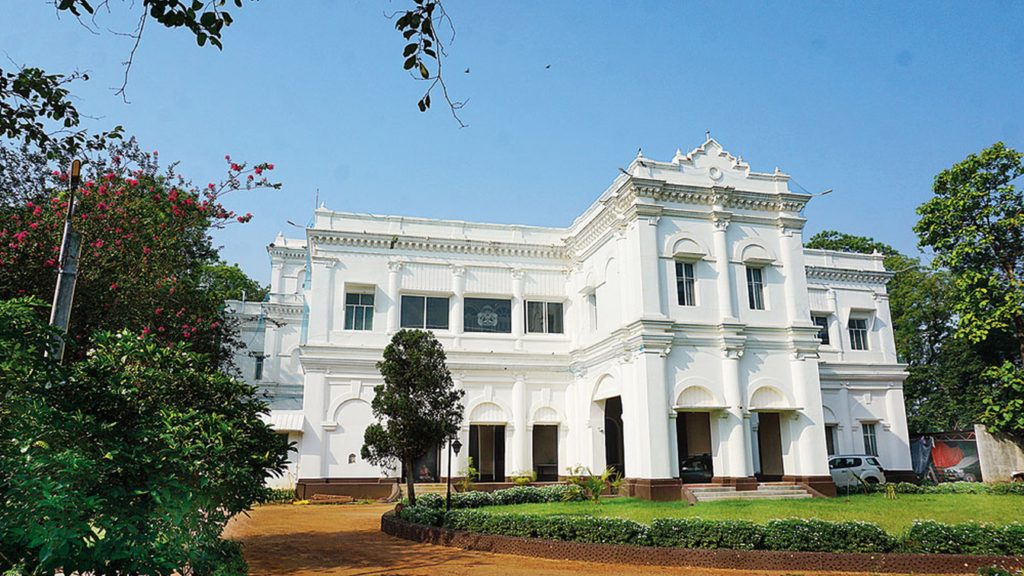
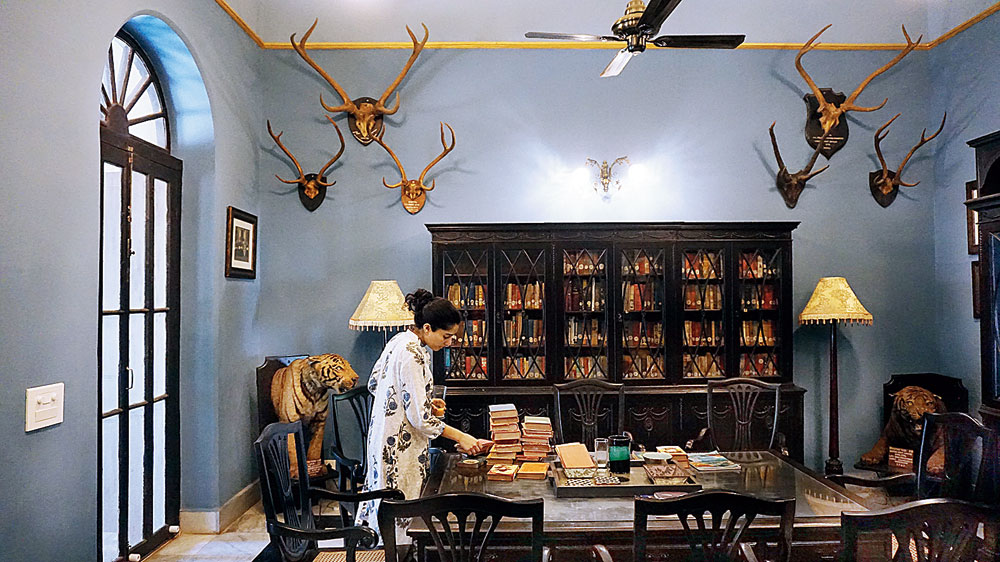
The Belgadia Palace was built in the early 19th century but repurposed by Sriram Chandra Bhanj Deo for his second wife, Sucharu Devi. The king, however, could never live in this palace with his wife / Picture: Prasun Chaudhuri

For most tourists, Baripada is nothing more than a gateway to the Simlipal National Park, famous for its tigers and elephants, in Odisha. That there could be tucked deep within the small town an iridescent palace with an untold love story at its core, is not common knowledge.

Belgadia Palace is now home to the descendants of the erstwhile kings of Mayurbhanj, the Bhanj Deos. Praveen Chandra Bhanj Deo belongs to the 47th generation. He lives in a part of the palace with his wife, two daughters and his 91-year-old mother. On the initiative of his daughters, Mrinalika and Akshita, most of this 215-year-old palace is now open for pubic viewing. Says Akshita, “We want to make people aware of the legacy of our ancestors in the district as well as in the state of Odisha.”

Before throwing open the palace doors, the sisters undertook a thorough recce of the place that revealed a gem too many. One such was the tumultuous love story of their ancestor Sriram Chandra Bhanj Deo and Sucharu Devi, the third daughter of Keshub Chandra Sen, philosopher and social reformer of 19th century Bengal.

Akshita Manjari, the daughter of the current owner of the Belgadia Palace, Praveen Chandra Bhanj Deo, in the palace library / Picture: Prasun Chaudhuri

Sriram Chandra met Sucharu Devi in Darjeeling. She was educated, enlightened and a 15-year-old girl who was not in purdah. He was 18 and looking for a wife who would be his companion. After a brief courtship they got engaged.

That was in 1889. But the crown prince’s family vehemently opposed the match. “The daughter of Keshub Chunder Sen as Maharani of Mayurbhanj! The daughter of that rebel, that revolutionary! To the conservative, orthodox powers in the Hindu state this was preposterous,” reads Sucharu Devi’s biography written by her daughter, Joyoti.

The young prince was no rebel; he toed the family line and married a girl from a local royal family. But the romance between him and Sucharu Devi did not die. “We tried to persuade her to marry but nothing would induce her to forget her lover,” writes Suniti Devi, her elder sister — the erstwhile queen of Coochbehar — in her autobiography.

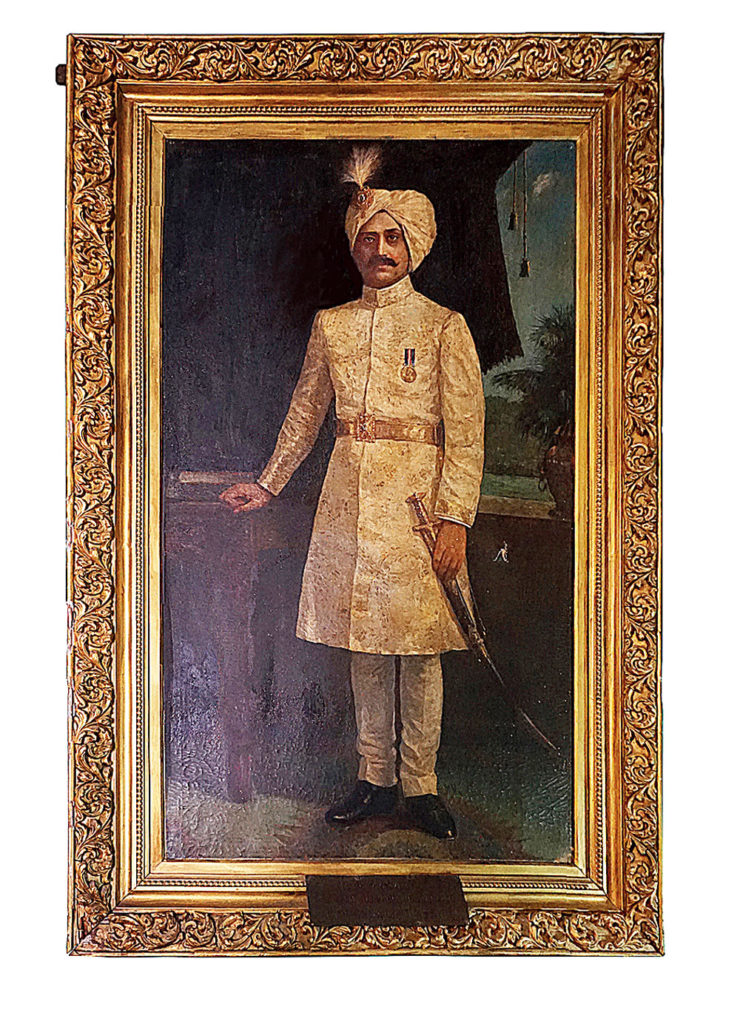
An oil painting of Sriram Chandra Bhanj Deo that adorns the palace walls along with spoils from the countless royal hunting expeditions / Picture: Prasun Chaudhuri

Sriram Chandra’s first wife, Lakshmi Devi, gave birth to two sons and a daughter and thereafter, she died of smallpox. Writes Suniti Devi, “The Maharaja’s wife died, and he came back to ask my sister to marry him. The marriage (sic) took place in Calcutta, and for some time they led the happiest lives.” This was 1904.

Since the Maharaja never dared to take Sucharu Devi to his native state, he built for her the Rajabagh Palace in Calcutta’s Mayurbhanj Road — now the building houses the J.C. Ghosh Polytechnic. They had two children — Dhrubo Narayan and Joyoti. Sriram Chandra met with an untimely and mysterious end in 1912. The accepted version is that he was accidentally shot while he was out on shikar.

Even though the construction of the palace began in 1804, it was developed in several phases. The present interiors were especially designed for Sucharu Devi since she was not welcome in the main Mayurbhanj Palace. But she visited Mayurbhanj and her palace for the first time only after her husband’s death, on invitation of her stepson, Purnachandra Bhanj Deo.

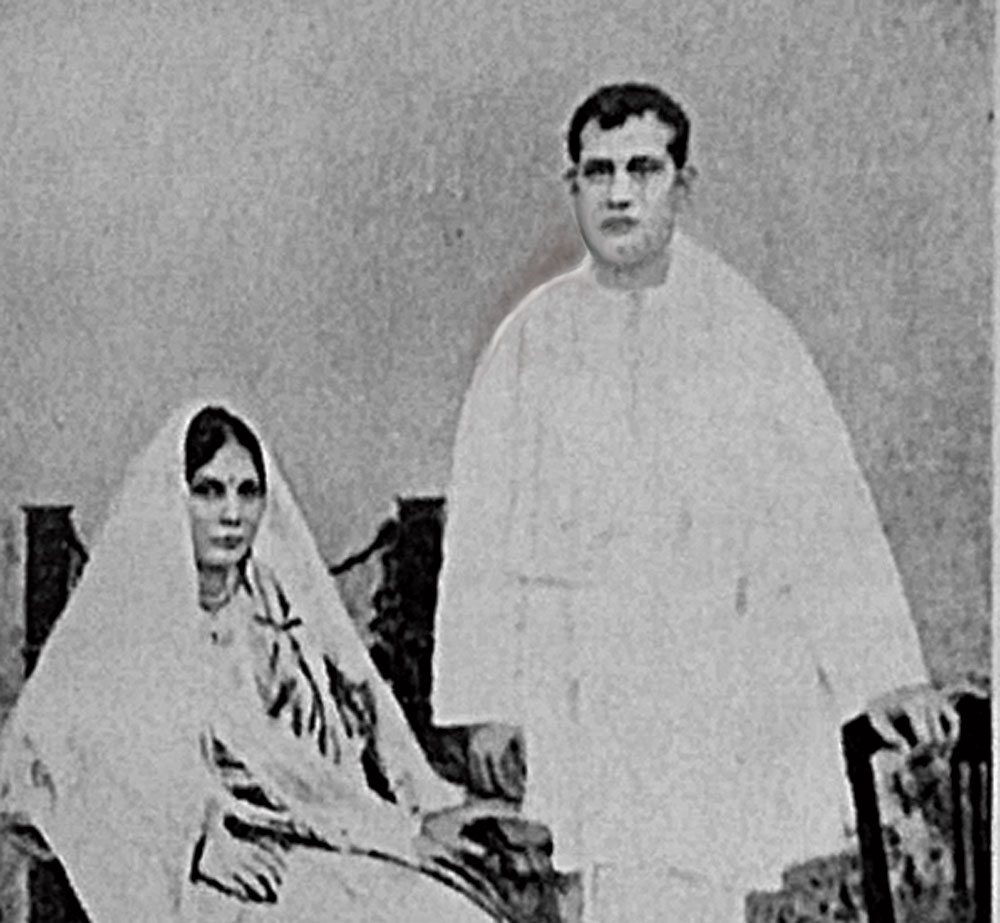
Sucharu Devi and Sriram Chandra on their wedding day. The photograph is from An Illustrated Biography: Sucharu Devi Maharani of Mayurbhanj by Joyoti Devi Kaye, their daughter

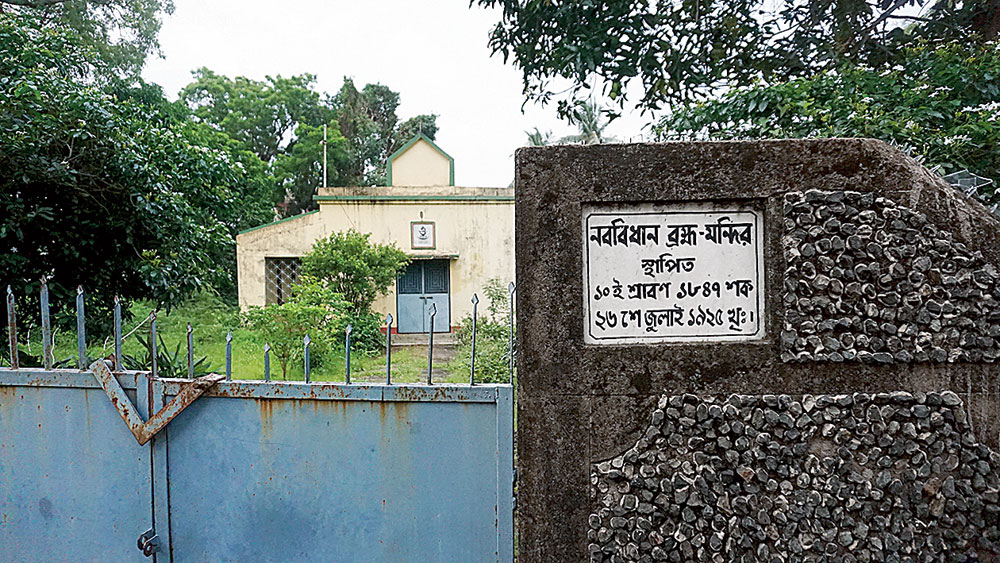
She continued to visit Mayurbhanj occasionally and was associated with social work and spiritual work in Baripada. Her involvement with the Nababidhan Brahma-Mandir in the centre of the town is known. A torch-bearer of feminism in India, she was elected president of Bengal Women’s Education League in 1931.

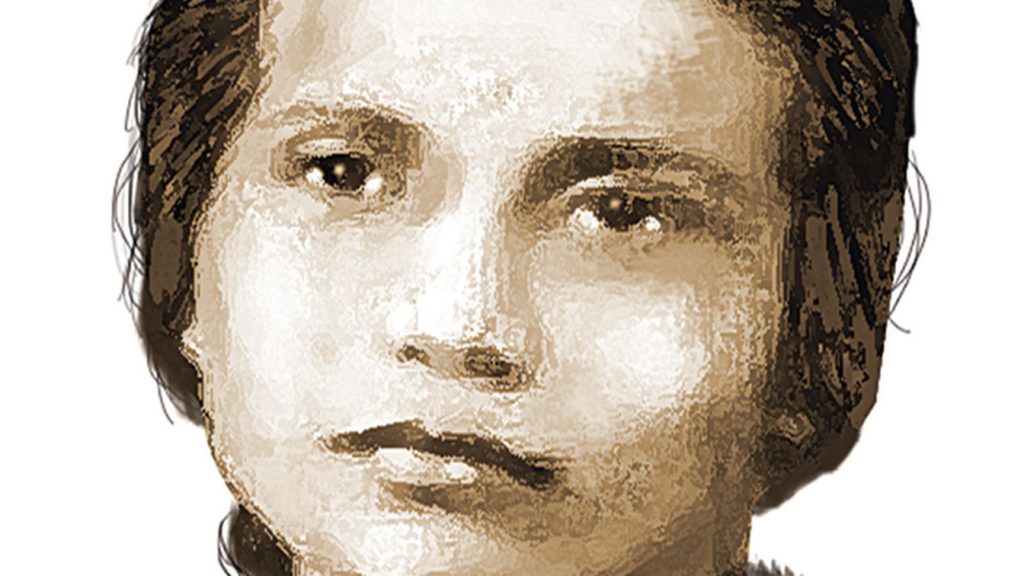
Sucharu Devi died in 1961 in Calcutta. To date, the rooms and verandahs of Belgadia Palace, we are told, are imbued with her refined sensibilities. As she was an accomplished painter it is believed that artists like Jamini Roy and Hemendra Nath Majumder had visited the palace.The furniture, furnishings, paintings and photographs in the palace continue to reflect her touches. Says Akshita, “She had a deep influence on most of the activities of the Maharaja, who was known as the philosopher king and also revered for his public welfare efforts.” And that is what makes intriguing the fact that to date, there is no portrait of the woman herself on display at Belgadia Palace. “This happened probably because she was never accepted wholeheartedly by the larger family and state subjects because of the difference in caste, creed and religion,” reasons Akshita. She and Mrinalika have plans to find and display the love letters and photographs of Sriram Chandra and Sucharu Devi, for all to see and appreciate.

In a letter dated January 31, 1904, the 32- year-old Sriram Chandra writes to Sucharu Devi proposing marriage once again. It goes: “Dear S… Will you then share my sacrifices if I ask you to sacrifice all worldly pleasures and to be my spiritual companion? That seems to me at present to be the voice of the Almighty. Yours S.R.C. Bhanj Deo.”

The Nababidhan Brahma-Mandir in Baripada / Picture: Prasun Chaudhuri

source: http://www.telegraphindia.com / The Telegraph, online edition / Home> Heritage / by Prasun Chaudhuri / June 02nd, 2019

The story of the fifth Bishop of Calcutta

When engineers chanced upon a vault in Calcutta’s St Paul’s Cathedral, they also unearthed a singular story of a singular man


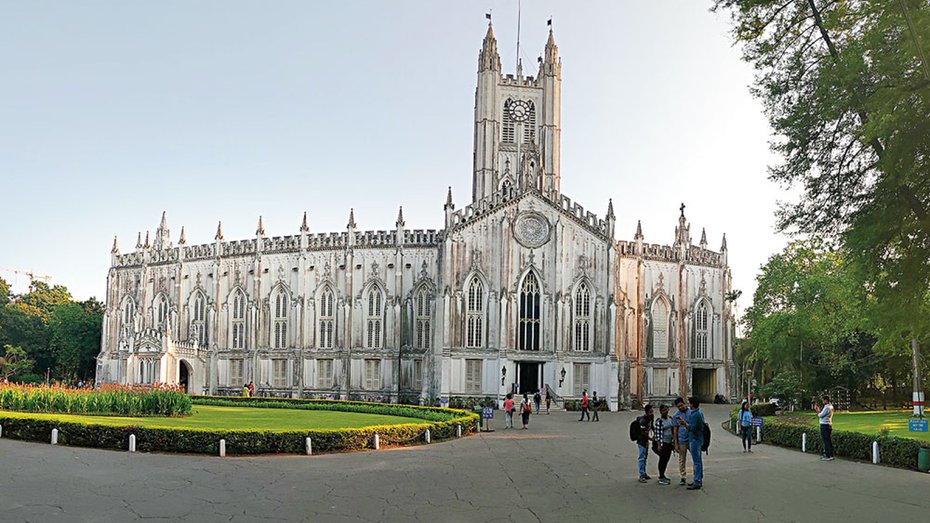
St Paul’s Cathedral in Calcutta / Picture by Pradip Sanyal

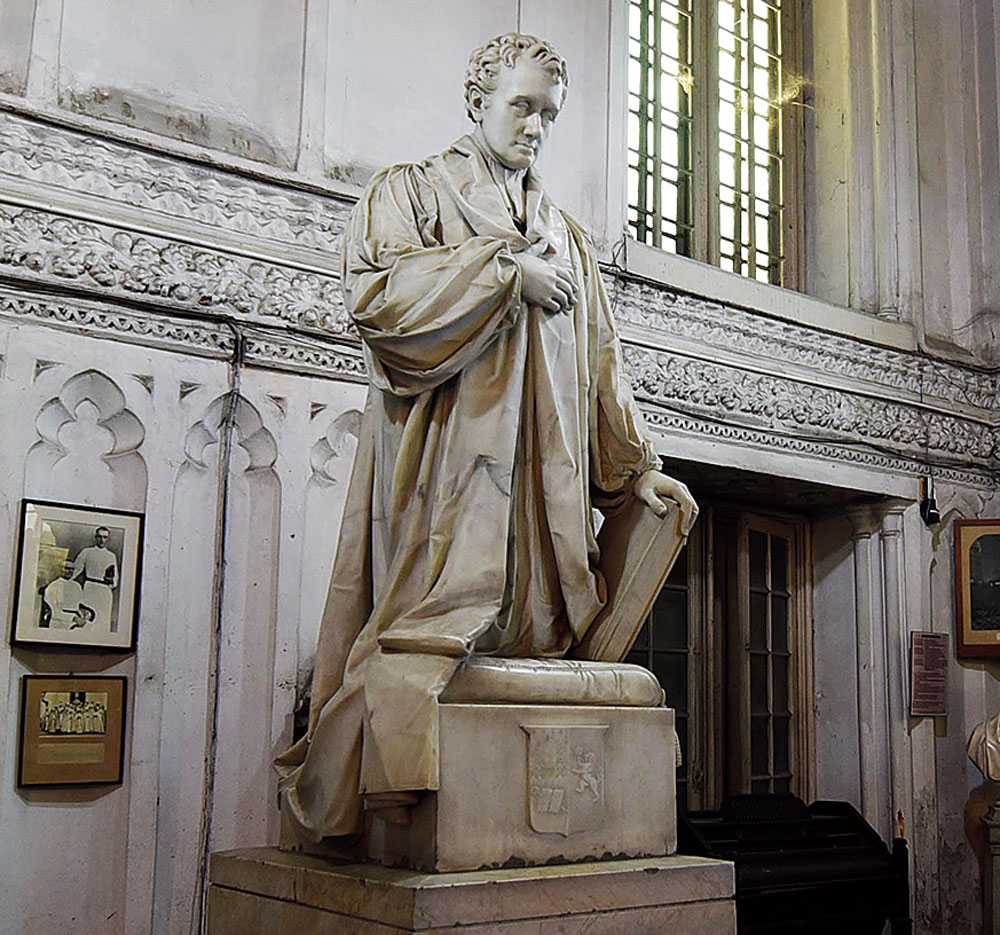
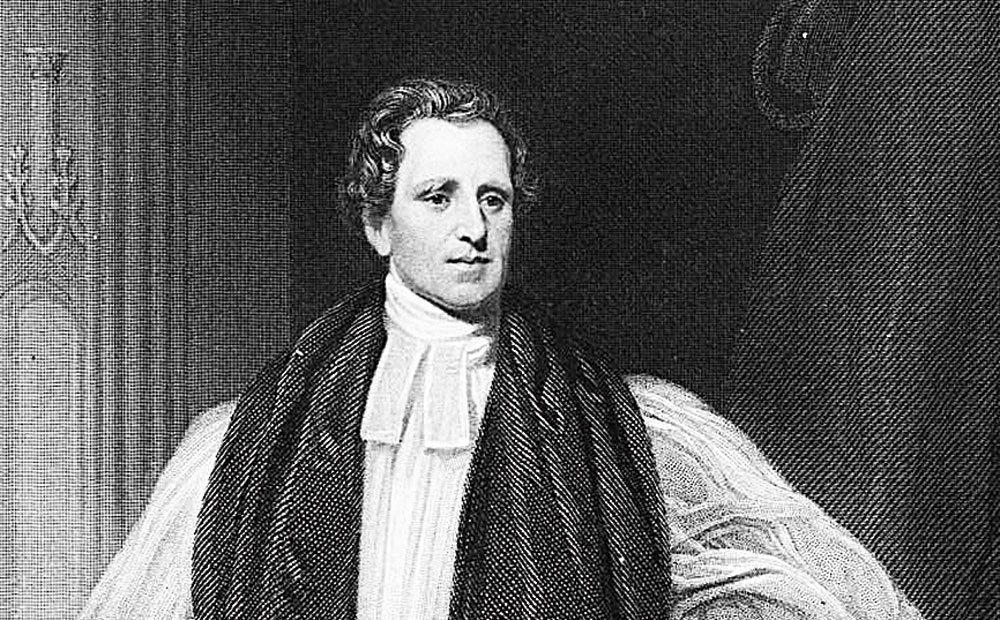
Sometime ago it was reported that the coffin of Daniel Wilson was found in a vault under the main altar of Calcutta’s St. Paul’s Cathedral. Wilson was the fifth Bishop of Calcutta and founder of St. Paul’s, which came up in 1847.

“This is not some out-of-the-box discovery. We were all aware that the coffin was kept there,” says an official from St. Paul’s Cathedral who does not want to be identified. He continues, “In fact, there is a small opening on the outer wall of the cathedral for ventilation. It was kept covered so that no stray dogs could go in. We could see the ornamentation on the coffin. The remains of the bishop were never missing. It was just that we had never gone down into the vault.”

It seems Wilson himself had made provision for the vault under the altar. “There is a reference to his musings in the book, The Final Report of St. Paul’s Cathedral, Calcutta, written by Archdeacon Pratt, who was a close associate,” says senior researcher Mary Ann Dasgupta.

St. Paul’s is said to be the first Anglican cathedral of the Victorian age. In his book, Splendours of the Raj: British Architecture in India, 1160-1947, Phillip Davies writes: “The building was constructed in a peculiar brick especially prepared for the purpose, which combined lightness with compressional strength; the dressings were of Chunar stone, and the whole edifice was covered inside and out with polished chunam.” Up the stairs of the cathedral and next to the main door is a marble bust. Would that be of Wilson? No, it belongs to Reginald Heber, who was Bishop of Calcutta in 1827.


The bust of Reginald Heber in the cathedral / Picture by Pradip Sanyal

The story goes that when Heber’s bust was sent from England, Wilson couldn’t find a suitable space to display it. St. Paul’s hadn’t been built and St. John’s Church in BBD Bag, often referred to as the “old cathedral” in later years, was not spacious enough.

In a proposal written in 1839, Wilson wrote, “…subject of reproach, not only to the good taste, but to the piety of the greatest Empire in the Eastern world, that our Government House, our Mint, our Town Hall, our Custom House, our Bridges and even our Ghats… to say nothing of our official residences and private dwellings… should be upon a scale in some measure correspondent with the position we hold in India, whilst our Cathedral [St. John’s Church, built in 1787] is mean, inappropriate and incommodious…”

Heber’s bust became the peg on which Wilson put forth an application to the government for a site for a new cathedral. He wrote to Lord Auckland: “I beg permission to enquire of your Honour and the Government of India whether it would be possible to grant me a small angle of ground on the Esplanade near the Chowringhee Road for the purpose of erecting a Church.” Auckland gave consent and land and signed his missive “I am Your Lordship’s most truly Auckland”. That was May 1839. Eight years later, St. Paul’s Cathedral was ready.

Dasgupta is working on the history of St. Paul’s. She says, “It is not possible to explore the history of the cathedral without delving into the history of the man who founded it.” She has visited the library at Bishop’s College, St. Xavier’s College archives and the Asiatic Society.

Daniel Wilson was born in central England’s Spitalfields in 1778. The eldest son of a wealthy silk manufacturer, he was barely in his teens when he joined his uncle — an even wealthier silk manufacturer in London — as an apprentice. The young Wilson was, however, more inclined to religious studies than business. He pursued higher studies and eventually graduated from Oxford University and was ordained a priest in 1802.

Wilson was a vicar in north London when he accepted the call to become the Bishop of Calcutta. In Wilson’s biography, his son-in-law Josiah Bateman, writes: “In October 1797, Daniel Wilson felt his spirit stirred to go as a missionary to heathen lands; and in October 1832, he stood on the banks of the Hooghly as Bishop of Calcutta.”

From her explorings, Dasgupta has pieced together a portrait of Wilson. Wilson, the disciplined man. Wilson, who did not like wasting time. Says Dasgupta, “Most of the previous bishops of Calcutta did not survive for long, most probably due to the hectic schedules they had to follow. They used to go for long tours — Burma, China, Malaysia. Bishop Wilson did not do this at the onset. He waited for some time to adjust to the climes. He took care of his health.”

Bateman writes, “His personal habits at this time were very simple and regular. He rose early, and rode on a small black horse, brought from the Cape, which for a time, was able to take care both of itself and its master…”

We learn that he was a prolific letter writer and well-read in the classics.

“He had friends back in London with whom he would correspond,” says Dasgupta. In one letter to his children dated 1840, he wrote about the construction of the cathedral. It read, “Every morning I ride round on my horse and watch the different views which the Cathedral will present (sic).”

Besides being a devout Christian, Wilson was a dynamic man, full of energy. According to his biography, the jurisdiction of the Bishop of Calcutta in 1832 was far-reaching.

Bateman writes, “It was manifestly a burden too heavy to be borne. It must not be supposed that he found abundant records, well-defined duties; and established precedents… The Palace was a blank, the correspondence of his predecessors with the Government and clergy had disappeared, and the Registry contained little but a list of licensed chaplains.”


The coffin of Daniel Wilson was found recently at St Paul’s Cathedral in a vault under the main altar / Wikipedia

Bateman elaborates, “Sixty or seventy servants, turned loose into the house, and speaking an unknown tongue, had to be recognised and mastered. Guests were to be entertained, and sick friends watched over, nursed, and cheered. It will easily be imagined that some time elapsed ere light shone upon this darkness, and order issued from this chaos.”

Wilson loved good food and people and had a reputation of being a great host. Dasgupta has read his journal entries where he writes how “the wonderful young editor of Friend of India” had breakfast with him and so also “Mr Hunt, the great railway man” and Mr Wylie, “who is one of those noble, kind-hearted, thoroughly good men, of whom there are so few in the world”. Yet another entry reads, “This morning I had all my Cathedral clergy and their wives to breakfast… there were 46 present.”

But when engrossed in work, the same man did not like being disturbed and could be very impatient. Dasgupta says, “Before the visitor would settle down in his chair, Wilson would start up in a hurried but determined way and say, ‘Well, my dear friend, you must excuse me; good morning, good morning, here is your hat and here is your umbrella,’ and before the visitor left the room, he would again be buried in his books and papers. But he was always polite in his approach.”

The day Wilson formed the St. Paul’s Cathedral Committee, he also announced that he had signed his will. Dasgupta came across a photocopy of it. In it, he states that he has given Rs 1 lakh for the building of the cathedral and another lakh will be paid out after his death. He also bequeathed his grand collection of 8,000 books to the cathedral library.

He died in 1858. Fifteen years before that he had inspected the vault which was being built for him under the communion table. He wrote in his journal:

“I could not but think as I walked up and down the abode of death how soon I might be called to lay down my pastoral staff and rest in that bed or grave as to my mortal frame, till the Resurrection morn (sic).

source: http://www.telegraphindia.com / The Telegraph – online edition / Home> Heritage / by Moumita Chaudhuri / April 28th, 2019

Two decades of Sabyasachi

The designer rewinds with The Telegraph to pick 20 landmarks that made Sabyasachi the brand that it is today!


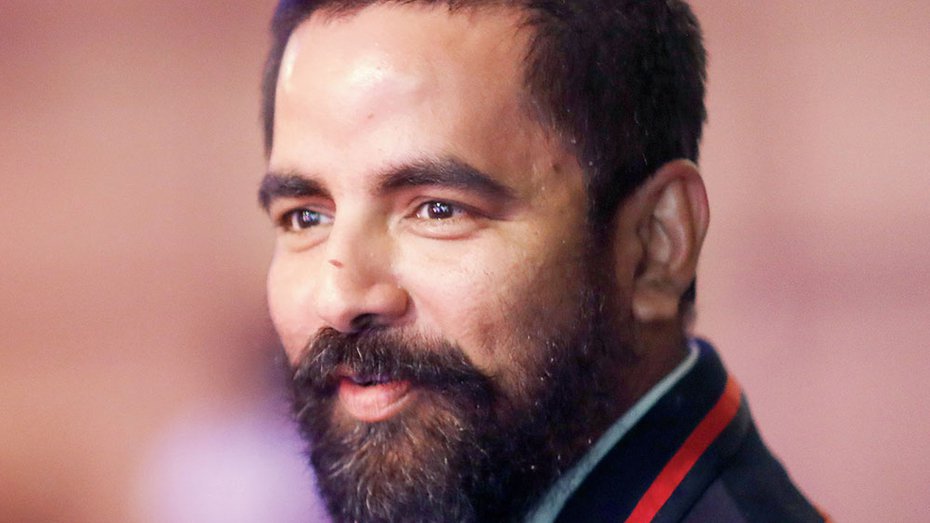
Sabyasachi Mukherji / Telegraph file picture
  • Sabyasachi considers his graduation show at National Institute of Fashion Technology, Calcutta, as the first landmark of his career. The show had won him three awards — the Best Design Collection from NIFT Calcutta, the Ritu Kumar Award for Excellence in Textile, and the critic’s award in Confluence, which was the best among students from all the NIFTs. “That gave me my first foray into the fact that I could start becoming a designer, it gave me the confidence and the boost that I will not take up a job but start my own label. If those awards did not come my way I would probably be working in an export house now. It made me believe in myself,” says Sabya.
  • The second was being adjudged best designer at a contest called Khadi Goes International, which won him a scholarship to go to London and an internship with the Victoria and Albert Museum. “It was my first trip outside India… I had never really been anywhere except for Delhi and Bombay. So it was my first international flight. I got a lot of independence, because you know, Bengali kids are very protected, in the middle class you don’t really go out that much, so I didn’t have much exposure. So it opened my eyes about possibilities that there exists a market outside India as well.”
  • Sabya feels that his debut at Lakme India Fashion Week with his collection Kashgar Baazar in 2002 was the third and possibly the biggest landmark. “I became a star overnight. It put a lot of pressure on me. Because I did not even make it to Page 3, I made it to Page 1. I remember, The Telegraph coming up with the headline, ‘Fashion star rises from the east’. It came on the main newspaper, not in a supplement. It became a national news everywhere… I became a big star. It catapulted me into the brand that it is today.”
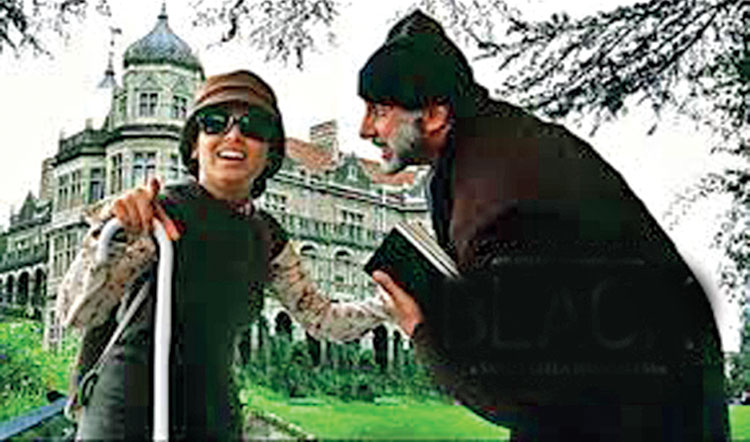
  • His first Bollywood film, Sanjay Leela Bhansali’s Black, which won him his first ever national award for costumes, is very special to him. “When he (Bhansali) had first called me for the movie I did not even know who he was and what kind of films he made. I was a big fan of Mr Bachchan and the fact that I got to work with Rani Mukerji and Mr Bachchan in my first film was enormous.”

A scene from the film, Black
  • Retailing from Espee, one of the first multi-designer fashion stores of Calcutta by Sangita Kejriwal and Purnima Chawla, holds a very special spot in Sabya’s heart. “I remember I used to cycle to Espee to see my clothes hanging; I could not believe that a store would actually put my clothes in their window.”
  • Winning the Mercedes-Benz Asia Fashion Award in Singapore got him a ticket to Paris and the chance to intern with global fashion stalwarts Jean Paul Gaultier and Azzedine Alaia. “I came back feeling much more confident about my body of work.”

Sabya’s Spring/Summer 2005 collection Frog Princess / A Telegraph picture
  • His Spring/Summer 2005 collection Frog Princess got him his first ever international store display — Browns in London. “Ms Burstein, who owns Browns, is considered to be a fashion legend. She was the first person to retail John Galliano, Alexander McQueen and all of these people, and legend has it that if Browns puts somebody in the window of the store during London Fashion Week, that person is supposed to be a huge star in the future. She put me on the same platform. I was in the window of Browns during London Fashion Week. Of course, I became a big star in India, I did not become a big star internationally, but she must have seen some potential.” Frog Princess opened many doors and he got a chance to showcase at his first ever international fashion week — Milan Fashion Week. His next collection after that was Snail in Autumn/Winter 2006, with which he had the opportunity of showing at New York Fashion Week.
  • It was Chand Bibi in Autumn/Winter 2007 that saw Sabya flirt with a full Indian show. “Chand Bibi and much later Bridal Sutra were my first taste of how beautiful Indian clothes could be. Full Indian shows I did and I think they paved the way for the future of the brand. And if I were to give a collection for commercial success… Chand Bibi actually paved the way for the brand that Sabyasachi is today. It consolidated my position as an emerging bridal-wear designer.”

The Calcutta store was about 40 per cent retail and 60 per cent experience /
A Telegraph picture
  • The next big landmark was Opium, which he had shown at the India Couture Week in Delhi and which got rave reviews everywhere. Till today, it is one of Sabya’s biggest commercial successes.
  • A big feather in the cap of the brand was his collaborations — Christian Louboutin, Pottery Barn, Asian Paints, Forevermark — each of these have been very big landmarks for the brand. His collaboration Sabyasachi X L’Oreal Paris in 2018 was his foray into beauty.

Another huge collection was Big Love in 2015 / A Telegraph picture
  • Another huge collection was Big Love in 2015, when the brand started flirting with modern Indian clothing. It was still lehngas and everything, but it was a modern concept, which is still continuing today. A big landmark for the brand was introducing the Royal Bengal Tiger logo and it started with Big Love. “I thought the brand was getting bigger and bigger and it was important to anchor the brand with a signage which could replace my name Sabyasachi. And the Royal Bengal Tiger was a beautiful logo and it has become a bestseller because we have started putting it into the waistbands of lehngas, on belts and bags. I think the logo would find many iterations in many things to come.”
  • The brand’s first Cannes red-carpet appearance was with Aishwarya Rai Bachchan wearing a Sabyasachi sari. “That was my first red-carpet moment. She wore a sari of mine at Cannes and the kind of traffic it generated it has never generated that kind of traffic again.” His first public criticism was dressing up Vidya Balan for Cannes and Sabya considers that a landmark, too. “I learnt a very important lesson that when you are a very big brand the onus lies with the public too. So the people who praise you today are the ones who are going to criticise you tomorrow. You need to understand that people are going to criticise and you have got to respect that but you still got to move on and do what you want to do and not get shaken by public criticism. It made me stronger.”
  • The first interior designing project that Sabya did was for Taj 51 Buckingham Gate in London. Sabya designed the hotel’s iconic Cinema Suites.
  • A game-changer for the brand from the communication point of view was opening Sabyasachi Instagram and the first Instagram show that was Firdaus (2016). “I think I changed the format and a lot of big designers ever since have shifted away from doing fashion shows and switched to doing shows on Instagram. So we changed the way fashion communication was done in India.”

Sabya started his jewellery line in 2017 / The Telegraph picture
  • Sabya started his jewellery line in 2017. “I have ambitions to make it India’s number one jewellery brand. I started it two-and-a-half years ago and it is already over-performing. There are conversations with big stores overseas to stock Sabyasachi jewellery.”
  • The year of the big weddings in India saw Sabyasachi become the go-to name for weddings. In a span of a year he did the wardrobes for all the big weddings in India —Anushka Sharma, Deepika Padukone, Priyanka Chopra and then Isha Ambani and Shloka Mehta. 
  • One important personal landmark for Sabya was speaking at House of Commons and going to Buckingham Palace for dinner. “(The experience was) surreal! I had always seen Buckingham Palace from outside, to go inside… I remember I went with Manav (from his team), and Manav pressed his nose against the glass window and said ‘Oh so this is how it feels to look at people outside’. We could see all the people outside staring at the palace and we thought we could have been one of them.”
  • His show Band Baajaa Bride has been one of the most popular programmes on Indian television. It ran for eight seasons and won numerous awards.
  • His foray into the Far East with Lane Crawford and his White Wedding line with them was very important because “I want to own the wedding space not only in India but internationally as well”.

source: http://www.telegraphindia.com / The Telegraph, online edition / Home> Culture / by Smita Roy Chowdhury / April 27th, 2019

The invisible women in science

Bibha Chowdhuri and Jocelyn Bell Burnell were denied the Nobel, and Donna Strickland was denied a Wikipedia page


Bibha Chowdhuri developed the basic principles of identifying new particles by studying their tracks in cloud chambers and on photographic emulsion plates. Illustration by Suman Choudhury

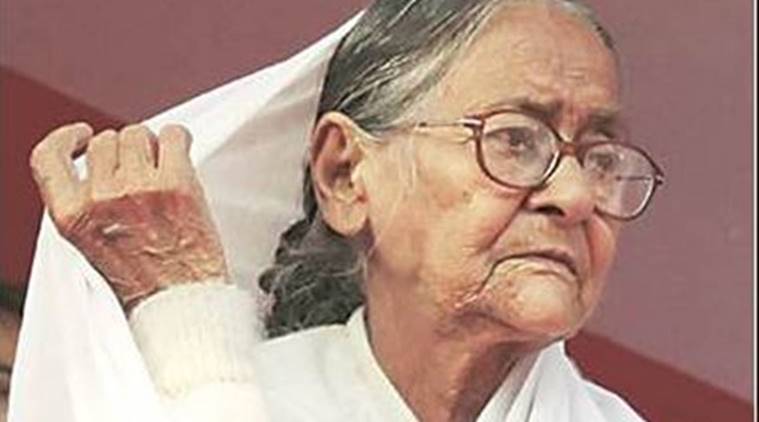
One evening during my MSc nuclear physics practicals, a frail, slightly stooped lady with round gold-rimmed glasses and dressed in a spotlessly white attire enquired of me as to what I was doing. She was Bibha Chowdhuri, the lady who had been denied the Nobel Prize even though she had been the first to discover the pi-meson (pion).

Chowdhuri developed the basic principles of identifying new particles by studying their tracks in cloud chambers and on photographic emulsion plates. Accelerators were unknown in those days. The only source of high energy particles were the cosmic rays. As a student of D.M. Bose, she studied cosmic ray showers during 1938-1942 in Darjeeling. After meticulously exposing and observing half-tone photographic plates, she found new tracks created by a new subatomic particle with 200 times the electronic mass. This was the pion!

The results were published in Nature. Chowdhuri and Bose could not access full-tone photographic plates because World War II was raging at the time. Using the same technique, but with high quality full-tone photographic plates, the British physicist, Cecil Frank Powell, identified the pion at least four years later and won the Nobel in 1950. Powell, however, acknowledged the work of Chowdhuri and Bose.

Subsequently, Chowdhuri went to Manchester and obtained her doctorate degree in 1952. She was a researcher right till her death in 1991. She was never made a member of any national academy of sciences; she was not mentioned in a compendium of 98 women scientists edited by a Padma Shri winner. A handful of people have come to know about her only recently — thanks to Bose Institute authorities and a recent biography by R. Singh and S.C. Roy. But Chowdhuri never complained about anything.

In November 1988, I met Antony Hewish while visiting Physical Research Laboratory, Ahmedabad. Hewish’s winning of the Nobel in 1974 (along with Martin Ryle) was mired in controversy because his Irish student, Jocelyn Bell Burnell, had not been a co-recipient. Her discovery of the first pulsar changed the picture of the universe and served as a pointer to later discoveries of black holes and gravitational radiation. Pulsars are born when a massive star exhausts its fuel, its outer layers explode in a supernova and the core collapses. For core masses greater than three solar masses we get a black hole. For lesser masses, the huge pressure and density fuse electrons and protons into neutrons. Some neutron stars, spinning at huge speed and with powerful magnetic fields, accelerate local electrons and produce radiation, which is observed as periodic flashes (‘pulses’) by distant observers. There are millions of these exotic objects in our galaxy alone. Bell Burnell discovered the signals in 1967 by analysing voluminous data from the Cambridge dipole array telescope. Strangely, Hewish always maintained that Bell Burnell discovered the pulsar first. Her cryptic reaction was that the Nobel Committee does not consider graduate students for the prize. Last year, she was awarded the Special Breakthrough Prize in Fundamental Physics. To counter the existing ‘unconscious bias’, she donated the prize money of three million dollars to the Institute of Physics in Britain to fund scholarships for women and marginalized groups.

Donna Strickland developed a major portion of the physics associated with laser surgery. She was awarded the 2018 Physics Nobel Prize along with two others. She is the third woman to win the Physics Nobel in 118 years. The medical and industrial applications of her technique are infinite and will influence future technology. Yet, she was denied a Wikipedia page before she won her Nobel although she has been an authority on lasers since the mid-1990s. Strickland sees herself as a scientist — not as a woman in science. Dignity of an unusual kind is at work here again.

source: http://www.telegraphindia.com / The Telegraph, online edition / Home> Opinion / by Debashis Gangopadhyay / April 01st, 2019

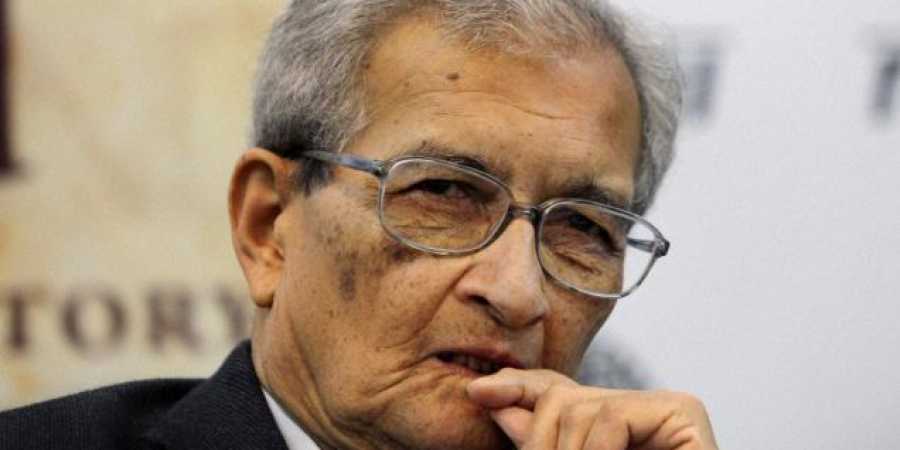
Amartya Sen awarded Oxford University Bodley Medal

The Medal is awarded to individuals who have made outstanding contributions to the fields in which the Bodleian is active, including literature, culture, science and communication.


Noted Indian economist Amartya Sen. (File | PTI)

London :

Nobel Prize-winning economist Amartya Sen has been awarded the prestigious Bodley Medal, the highest honour bestowed by the University of Oxford’s world-famous Bodleian Libraries.

The Medal is awarded to individuals who have made outstanding contributions to the fields in which the Bodleian is active, including literature, culture, science and communication.

“The honour was awarded (to Sen) during the Founder’s Lunch on 15 March, an annual event commemorating the birth of the Libraries’ founder, Sir Thomas Bodley, and his legacy of philanthropy,” the Library said in a statement on Wednesday.

The 85-year-old winner of the Nobel Memorial Prize in Economic Sciences, who is the Thomas W Lamont University Professor at Harvard University and a member of faculty at Harvard Law School, received the Medal from Lord Patten of Barnes, Chancellor of the University of Oxford, and Bodley’s Librarian Richard Ovenden.

This year’s other winner of the Bodley Medal is Nobel Prize-winning novelist Kazuo Ishiguro, who will hold an in-conversation event with Ovenden next week to celebrate the honour.

Past winners of the honour include physicist Stephen Hawking, novelist Hilary Mantel and inventor of the World Wide Web Tim Berners-Lee.

source: http://www.newindianexpress.com / The New Indian Express / Home> World / by PTI / March 28th, 2019

Meet the survivors of the 1943 Bengal Famine

In the 75th anniversary year of the Bengal Famine, Prasun Chaudhuri travels to K-Plot in the Sunderbans to meet survivors .


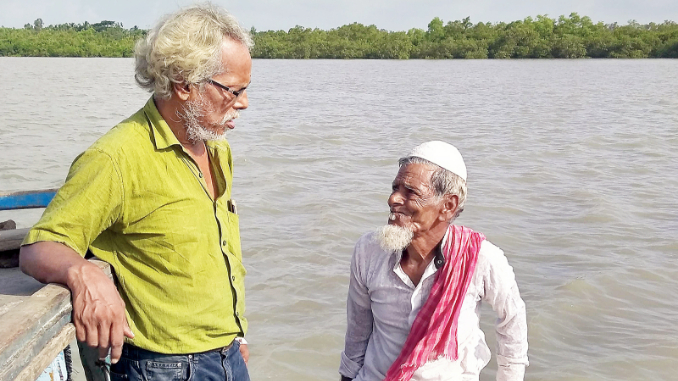
Memory Bank: Writer Sailen Sarkar hears out Khoshain Sheikh, who was 16 when he came to K-Plot / Prasun Chaudhuri

The island is called K-Plot. It might be only 130 kilometres south of Calcutta, but it is not easy to access. First, you have to take the Lakshmikantapur-bound local train from Sealdah. Get off at Mathurapur. Pack yourself into a crowded mini-van to reach Raidighi. Get off it and into another shared vehicle that will drop you to the Raidighi ferry ghat. Then board a motorised country boat to Bamunghat in K-Plot. In all, you need about six hours to touch this southern tip of the Sunderbans surrounded by Thakuran river on the east and west, Shibua river on the north and the Bay of Bengal on the south.

The name K-Plot is a British legacy. Successive officials of the East India Company had unimaginatively named these islands after the English alphabet sometime in the late 18th century. These settlements had been conceived by Collector General Claude Russell in 1771, soon after the company got Diwani rights or the permission to collect taxes on behalf of the Mughal emperor. Russell had initiated extensive reclamation of mangrove forests and offered pieces of land ranging from five to 10,000 bighas to businessmen, landlords and government employees based in Calcutta. (In Bengal, the bigha was standardised under colonial rule at 1/3 acre.)

Years later, post the notorious Bengal famine of 1943, which killed an estimated 35 million, many people sought a home in the Sunderbans in general and K-Plot in particular. Most of them were from Midnapore district, which was the worst affected. Turns out many of these famine survivors managed to give both tide and time a slip and are still around to tell their olden tale.

It is late afternoon by the time we reach K-Plot. We meaning, myself and writer Sailen Sarkar. A retired schoolteacher, Sarkar travelled extensively across southern Bengal before he wrote his Bengali book, Durbhikkher Sakkhi or Witness of the Famine.

It is one long walk to famine survivor Bijoykrishna Tripathi’s house. On the way Sarkar tells me, “I discovered these survivors by chance during my travels. While chatting with the elders of the islands, it emerged that many farmers have roots in Midnapore and clear recollections of panchasher manwantar (the famine happened in the Bengali calendar year 1350). These conversations opened up for me bits and pieces of oral history of one of the biggest tragedies of modern Indian history.”

Sarkar’s first interviewee, Sripaticharan Samanta, didn’t open up to him at first. Instead, he wept and asked, “Why did you come so late?” Soon after the interview, Samanta died. Says the writer, “That’s when I realised the urgency of documenting the oral narratives of famine survivors. I knew we were about to lose pieces of history, the legacy and tales of the indomitable spirit of ordinary human beings.”

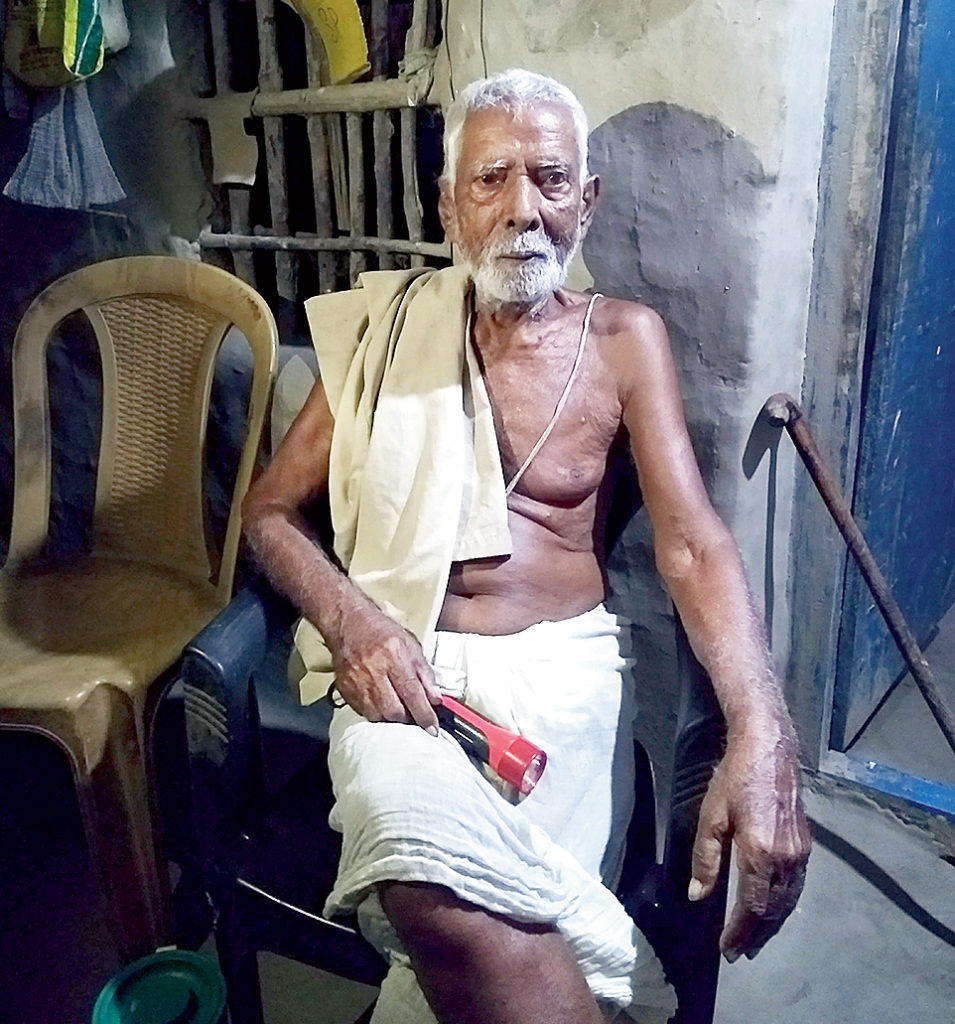
When we finally find Tripathi, the 108-year-old patriarch is sitting in the courtyard of his home surrounded by six grown-up great-grandsons and some relations from East Midnapore who have come to seek his advice regarding a land dispute. Tripathi stands up to greet us; a tall man, ramrod straight, wearing a dhoti and uttariya, his sacred thread wound around his bare torso.

“Our misery began with a crazy rainstorm,” begins Tripathi. “It was Ashtami day of 1942, the year of the Quit India movement.” Shortly before the Pujas, an agitating 33-year-old Tripathi had burnt down a police station in East Midnapore’s Bhagabanpur village. That night, he recalls, there was a terrible cyclone. It ravaged the farms and turned everything into a wasteland. The next morning, Tripathi says, he saw hundreds of human corpses floating around along with carcasses of cattle.

The widespread devastation was followed by an acute shortage of rice. Says Tripathi, “The price of rice that cost an anna a seer [16 annas make rupee; one seer equals 1.25 kilos] doubled immediately after the cyclone and tripled in a few weeks. There was starvation and then famine.”

Some people survived on bulga or soup made from discarded wheat served at community kitchens; most others died like flies. According to Tripathi, many sold their wives and daughters in exchange for sacks of rice. He says, “Women ran away with complete strangers for two square meals a day.”


There were hundreds of human corpses floating around along with carcasses of cattle, recalls Bijoykrishna Tripathi, 108 / Prasun Chaudhuri

Researcher and writer Madhushree Mukherjee, who interviewed many famine survivors of Bengal, toes the line that the catastrophe was engineered largely by the then British Prime Minister, Winston Churchill. For her 2010 book Churchill’s Secret War, she delved into oral accounts of survivors and official documents. She cites documents and exchanges to support the view that Churchill ordered the diversion of food from starving Indians to add to stockpiles of grains in Britain and Europe.

In a more recent research, historian and anthropologist Janam Mukherjee writes, “High colonial policy, of course, usually in the name of the war effort, played an important role, but responsibilities were widespread. Seeking colonial favor, or entrenched in ‘opposition’, the response to famine by Indian politicians in both Bengal and New Delhi, was also guided, often enough, by political interest rather than public welfare.”

By November of 1943, much of the Bengal countryside lay in ruins. Artist and active member of the Communist Party of India, Chittaprosad Bhattacharya, journeyed through the innards of the famine-struck Midnapore district. In page after page of ink drawings, he tried to capture the general predicament. The visuals came lined with annotations, observations. Eventually, all those sketches came to be his book, Hungry Bengal. The book, however, was banned by the British government and thousands of copies were destroyed.

Destruction, epidemic and mass death had people fleeing cityward. A lot many died on the way, those who made it starved on the streets of the city. But there were people like Tripathi who ventured beyond the city, to the marshes of the Sunderbans, in pursuit of food and new life.

Initially they landed up as raiyats or cultivators who farmed on lands held by absentee landlords. The chain of command ran thus: first came chakdars, who further sublet the land to raiyats.

One of the reasons Tripathi chose K-Plot was that he knew a chakdar who was looking for a raiyat to cultivate 50 bighas of land he had taken at lease. “Initially I farmed the land with some labourers and sent half of the harvest to the chakdar. But the chakdar was a kind man. He eventually gifted me a part of the land when I got married.”

Khoshain Sheikh is also a resident of K-Plot. When we arrive at his hut on the edge of the island, his younger brother, Qurbat, tells us that he is gone to sow paddy saplings. He takes us to the field and we find the 92-year-old crouched there in knee-deep water. “I have been sowing paddy since I was 12,” says the man with a goatee. Then, over a bowl of puffed rice, he tells us his story.

Sheikh was 16 when he arrived here. He says, “The famine actually started before 1943. While foodgrains were fast disappearing into hoarders’ godowns, the cyclone dealt a deadly blow to the belly. My father left our village in Bhagabanpur months before the cyclone.” The Sheikhs crossed the Hooghly and reached the island via Kakdwip. “It took over 12 hours to get here that day,” he reminisces.

All 12 brothers tilled the land, sowed paddy and harvested rich crop within a year. “When we first arrived, we had to deal with wild beasts and snakes. Many of my relatives succumbed to snakebite,” says Sheikh. Then adds, “We desalinated the water by boiling tamarind in it. In the initial period, we survived on gimey shaak and other wild herbs.” The landless are now land owners. Sheikh shows us around K-Plot. He points to the greenery, new embankments and plantations.

Next, Sarkar takes me to Maipith, a neighbouring island. “Maipith is one of those rare islands where tigers and humans co-exist. There is just an embankment that separates the tiger forest from the villages,” he says as we cross two wide rivers.

Pulin Samanta has been living on the edge of Maipith in Nagenabad village since early 1944. He has turned 100 this year. Tigers often enter his paddy fields but he feels these beasts are not as scary as the black-marketeers. “The day we left Jugiberi [Midnapore], the price of rice went up to eight annas per seer, an eight-fold increase in just a year. Only the very rich could buy from hoarders.”

The Samantas had to walk for four hours to reach Rasulpur on the banks of the Hooghly. “On the way, we saw starving people lying on the fields and vultures circling them.” They crossed the river to reach Kakdwip, where they met a chakdar. He had been looking for able farmers. “We rowed for two days to reach this place,” he says. “The first thing the family built was a ‘tonger bari’ or a tree house to survive the wild beasts at night.”

Samanta’s great grandson is trying to recharge his smartphone with a solar battery. Pump sets, parts of mechanised boats and a dish antenna on the roof of the double-storey house are obvious signs of prosperity.

Samanta’s neighbour, Abedan Bibi, is the last famine survivor we meet. The sun has set by then, LED lamps can be seen all around. Rural electrification has been patchy in the island because people here have always voted against the ruling party, says Asura Khatun, who shows us the way to Abedan’s home. The 103-year old woman used to cook her own food and roam the village on her own until she lost her eyesight a few years ago. That night, by the time we reach, she has already finished dinner.

When her granddaughter-in-law informs her that we’ve come to meet her for an interview about the famine, the frail woman crawls out of the mosquito net. She settles down on a wooden stool. In the faint rays of a solar light, we can barely discern her tiny figure in a white cotton printed sari with a blue border.

She begins, “I had got married a few years before the famine.” Her father-in-law, it seems, was an enterprising man who decided to switch his base to the island soon after the cyclone. “He had apprehended the famine as the problem of food shortage had been gradually deepening.”

She continues, “The first few weeks were difficult. We survived on boiled gira shaak and shapla — aquatic plants — fished out from ponds. Occasionally, we got some flour sent by the government in flood-relief boats.”

Sarkar and I leave the island the next day at the crack of dawn. As our motorised boat sputters across Thakuran river, I try to imagine how the scattered bits of land with its dense mangrove forests would have appeared to boatloads of people trying to escape starvation and death, 75 years ago. Like a green beckon perhaps, who can say.

source: http://www.telegraphindia.com / The Telegraph, online edition / Home> Culture / by Prasun Chaudhuri / December 09th, 2018

Matua community matriarch Binapani Thakur passes away

The chief adviser of All India Matua Mahasangha, Binapani Devi, popularly known as ‘Boro Ma’, passed away on Tuesday evening due to multi-organ failure.


The chief adviser of All India Matua Mahasangha, Binapani Devi, popularly known as ‘Boro Ma’, passed away on Tuesday. (File)

The chief adviser of All India Matua Mahasangha, Binapani Thakur, popularly known as ‘Boro Ma’, passed away on Tuesday evening due to multi-organ failure. Chief Minister Mamata Banerjee e and several state ministers rushed to SSKM Hospital and her death was announced by Banerjee in the evening. Thakur’s last rites will be held on Wednesday with full state honours. পরলোকে মতুয়াদের বড়মা বীণাপাণি দেবী

Binapani Thakur was brought to the SSKM Hospital in Kolkata from Jawaharlal Nehru Hospital in Kalyani due to a rapid decline in physical condition. She was bedridden for a long time and was suffering from respiratory problems. Prime Minister Narendra Modi i had met the 100-year-old matriarch of the Matua community on February 2 at Thakurnagar.

During her last visit to Thakurnagar, Banerjee had announced several projects and declared that Binapani Thakur would be honored with the honorary de -Litt title. Banerjee was seen to be close to Boro Ma.

Since 2009, the Matuas were mostly known to be Trinamool Congress supporters, and the party had fielded members of her family in elections. However, the family has been divided over its political leanings in recent years.

Matuas trace their ancestry to East Bengal, and many of them entered West Bengal after Partition and after the formation of Bangladesh. Matuas are Namasudras, a Scheduled Caste group with a presence in at least six parliamentary seats. While no official count is available, community leaders put their population at 3 crore.

source: http://www.indianexpress.com / The Indian Express / Home> Cities / by Express Web Desk / New Delhi / March 05th, 2019

When the love of nation and the love of science thrived together

The scientific genius of Bengal just before Independence deserves better storytelling


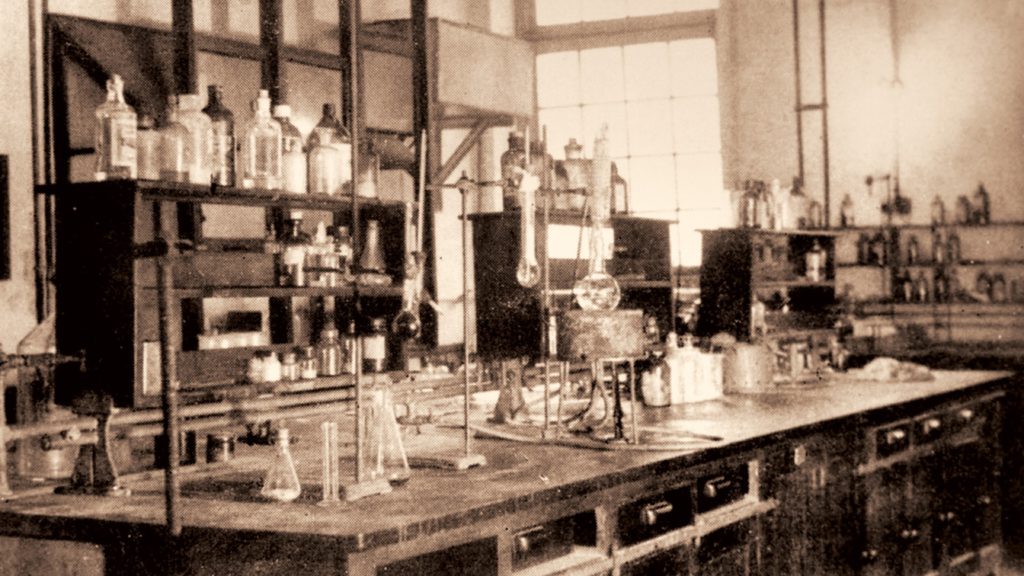
Acharya Prafulla Chandra Ray Laboratory, University College of Science and Technology, Calcutta / Telegraph file picture

One of the problems with history is not how it is written but how it is perceived. Time adds a certain sense of melodrama and stereotype to events. History then acquires a grandeur, a stark monumentality, but somehow the narrative lacks nuance, the sensitivity and vulnerability of genius. As a sociologist who has worked in Bengal for a decade, I always felt Bengal, nationalist Bengal, was more creative and nuanced than it is presented to be. One sees this particularly in the relation between science and nationalism. The debates that Bengal fought embodied a plurality of visions which the nation desperately needs today.

Our nationalism had a confidence, with powerful insights into oppression and liberation. I remember the first great nationalist institution in science, the Indian Association for the Cultivation of Science established by Mahendra Lal Sircar. Few remember its great goal, which was to rescue science from Western civilization. Our nationalism, thus, was not merely an attempt to liberate ourselves from the West but to evaluate it, to reinvent the defeated West. One sees it again and again as we look at science. We wanted to inject into science our own genius. J.C. Bose, for instance, borrowed from Shakta traditions to challenge the dualism of the mechanical and the living. Bose had an acute sense of being an Indian scientist. He realized that one had to take on the mainstream paradigms. He realized the danger was of the West reading you through orientalist eyes and reducing you to an occult or mystical figure. Bose realized that one had to make English science say things it had not said without being marginalized. Bose had that genius which people valued.

I remember a cousin of mine, a physicist, listening to a lecture at Princeton by William Shockley, the inventor of the transistor and a Nobel laureate. Shockley began his lecture by invoking Bose and claiming, “[T]here was Bose and the rest is toilet paper.” I wish some local publisher would republish Patrick Geddes’s biography of Bose to recapture his genius.

In fact, history has little to say about the relation between Bose, the poet, Tagore, and the biologist, Patrick Geddes. They shared a mutual reverence and a curiosity about nature which needs more discussion. The narratives of science and nationalism often become a failure of storytelling. Few know that Tagore wrote a textbook on science and even fewer know that Tagore, Bose and Geddes taught a summer school in science at Darjeeling.

The conversation between Geddes and Tagore also led to a vision of Santiniketan few talk about. The current Santiniketan embodies the aesthetic genius of Tagore. But the original Santiniketan embodied a vision of science that Tagore and Geddes discussed. One gets a whiff of this plan as one reads the Geddes-Tagore letters edited by Bashabi Fraser or Philip Boardman’s biography of Geddes. Geddes and Tagore dreamt not only of rural reconstruction but also of a return to an agricultural view of science. Tagore felt that the dialogue of civilizations would be a dialogue of universities. He argued that this exchange would be between the city science of the West, which sought to dominate nature, and the forest universities, which lived in harmony with nature. It is a pity we have not explored these dialogues or even captured the romance or the romanticism of science that this trio evoked. One forgets that Bose was an inventor par excellence also and one of the scientists who refused to patent his work, genuinely believing that ethically and creatively, science belonged to a commons of knowledge. I cannot resist but relate a story about Tagore’s first visit to Bose’s laboratory. The scientist was not there but Tagore left as his signature a bunch of oleander flowers. This relationship between the three makes C.P. Snow’s idea behind The Two Cultures an illiteracy. Nationalist science was interdisciplinary and cross-cultural in a way we cannot imagine today.

Tagore helped create an aesthetic of technology. His debates with Gandhi on khadi are critical. Gandhi saw khadi as transforming the village but Tagore warned that a mechanical use of khadi would create a uniform dullness. Tagore’s sense of the aesthetic went beyond function because he wanted to inject an aesthetic and an erotic into technology.

The debates between Prafulla Chandra Ray and Ananda Coomaraswamy, the geologist and the art critic, are also relevant. Ray warned about the impact of synthetic chemistry, claiming its power stemmed from the tapas of German scientists. Coomaraswamy warned that chemistry had no balancing ethic, that it would create an industrialization of colour: a standardized red for madder, replacing the infinite variety of red that was available in the villages.

Ray himself was a folklore figure. One can invoke a pantheon of stories about the chemist who was a great swadeshi scientist. In fact, Ray’s Life and Experiences of a Bengali Chemist is a literal embodiment of a life in science. The two volumes have nothing private or personal in them. The book is an attempt to show how science creates public knowledge. The whole narrative is written as a scientific experiment with Ray’s life as a test tube, creating a scientific method. Ray realized the importance of a swadeshi science and was among those most committed to a Gandhian way of life. His was an ascetic life and an ascetic style of science. I remember a leading scientist who had gone to visit the University College of Science and Technology. He landed up one evening, found it deserted except for an old man in a corner. Thinking he was the chowkidar, he asked about Ray, to discover that the old man was Ray himself. Ray brought to life and science a simplicity that was stunning.

A perfect contrast to the vision of Ray was Meghnad Saha. An astrophysicist, a brilliant scientist, Saha was tired of politicians who had no sense of the possibilities of science. It was Saha who was the greatest advocate of a Leninist style of planning and it was Saha who persuaded Subhas Bose to set up national planning committees. He also edited Science and Culture, one of the great science policy journals. Science and Culture comprised a wonderful network of intellectuals which included P.C. Mahalanobis, N.K. Bose and D.M. Bose, all of whom combined in their individualistic ways to create a society based on the scientific method. The prolific Saha worked on everything from dams to calendrical reform. He was quick to express his disappointment with Nehru and got elected to Parliament to challenge him. One can hardly dream of that kind of vision and commitment today.

One can retail story after story about this period, celebrating Satyendra Nath Bose or P.C. Mahalanobis, but what one wants to emphasize is the different styles of science and the varied dreams of it that the Bengal of that time possessed. There was a playfulness, a plurality, a sense of dream and ideals, an availability of eccentricity and creativity one misses today. The stories once popular are quietly fading. One wishes Bengal was better served by its historians of science. At least one would like to propose a museum of photography, stories, technologies as a tribute to this generation. We sadly have a regime that talks of ancient science idiotically but ignores the neighbourhoods of genius just before Independence. Surely this generation deserves the storyteller and his tales of a great and creative science.

The author is an academic associated with Compost Heap, a network pursuing alternative imaginations

source: http://www.telegraphindia.com / The Telegraph, online edition / Home> Opinion / by Shiv Visvanathan / November 28th, 2018

Au Revoir, Calcutta

On a Sunday with barely half a day left for him to bid adieu to the city he had called home for the past three years, French consul-general Fabrice Etienne criss-crossed north Calcutta with t2

Jorasanko Thakurbari: The house of Tagore made it to Etienne’s list of favourite spots as a mark of tribute to Rabindranath. “You have no idea of the influence that he has unless you reach Bengal. He is here on the streets, (our car had stopped at a traffic light and sure enough, there was Rabindrasangeet playing on the speaker), there is the university named after him, there is Santiniketan… there is so much respect. Everyone knows his work, not just the songs. This is unique. Of course, Calcutta is having trouble thinking beyond Tagore but that is a different issue. Only a small part of his work is available in French, like Andre Gide’s translation of Gitanjali and some novels like La Maison et Le Monde (Ghare Baire) and Charulata. But few in the West know that Tagore is more than a novelist. In French literature, we may compare him to Victor Hugo who was an educationist, a poet and a novelist. But his legacy is not as alive as Tagore’s is.”

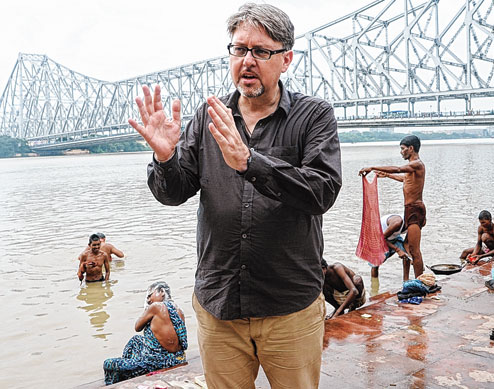
The riverside: Tip-toeing through the monsoon slush at the Mullickbazar flower market and pausing at a few stalls to negotiate prices for marigold strands, we reached Jagannath Ghat. “This is my favourite ghat as this is where you get the best view of the Howrah bridge and the rail station.” The gigantic warehouses on the Strand made him wistful. “How I wish I could live in a building like this, overlooking the river! Living in Calcutta you forget about the existence of the river which is largely hidden from view unlike in Paris which is split by the Seine. There, the city expanded on both sides of the river across which there are about 20 bridges connecting the northern and the southern sides. All the attractions are along the Seine — Eiffel Tower, the Louvre, Musee d’Orsay…. The Hooghly is much wider and the city has grown on its eastern side.”

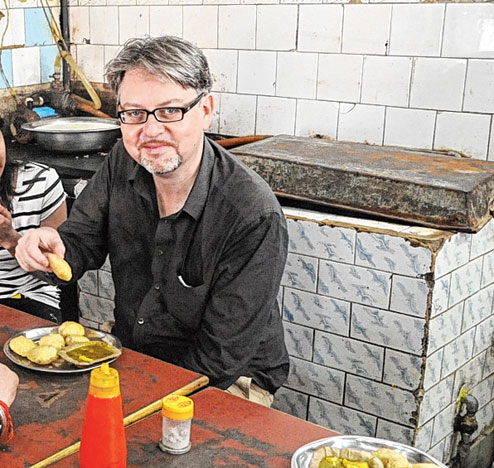
Street-side tea shop: “I have put on 10 kilos in these three years! A paunch is accepted in Calcutta but in Paris it is frowned upon. I have to start cycling and walking like a Parisian once I am back,” Etienne had confessed after getting off the weighing scale at Calcutta Club from where our trip had started. A couple of hours later, he was happily digging into club kachauri and alur torkari, followed by a handsome helping of rabri at Sharma Sweets on Kalikrishna Tagore Street, run by his friend Shyam Barua. “Nothing breathes the Orient more than the streets of north Calcutta. Wherever you look, there is something happening. These small tea shops remind me of our street-side cafes, which are integral to the French way of life. Here you can get away from the chaos on the street while keeping a watch on a slice of outdoor life. They are cheap and no one asks you to leave even if you spend hours with a cup of coffee.” 

College Street: Etienne could not find a single book in French on College Street but was startled to find some lesser-known titles of Alexandre Dumas in translation at several stalls. “This is the intellectual street of Calcutta with all the universities and bookstores. The Indian Coffee House here was a place for adda of Bengali intellectuals. It reminds me of the quartier Latin on the  left  bank of Paris which has bookstores of all sizes. This is for me one of the bridges between Paris and Calcutta…. For a kilometre on the promenade along the Seine, there are hundreds of small stores — some are just a box full of books. I used to go look for first editions of French or world literature titles as the area was close to our office.” On his last trip to College Street (“I used to come here often”), he picked up a Sunil Gangopadhyay translation. 

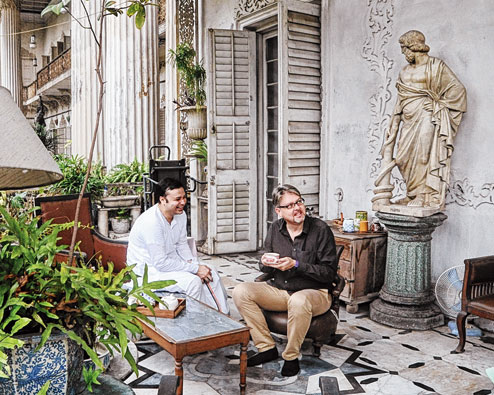
Marble Palace: A last-minute call to Sourendro Mullick secured an entry into Marble Palace, the palatial Mullick residence on Muktaram Babu Street. Photography being prohibited in the rest of the property, we settled down on the verandah adjoining Sourendro’s piano room, where a marble statue of Pluto, the lord of the Underworld, stood reclining against his staff around which a snake was coiled. “Calcutta is in many ways a baroque city and nowhere else does it express that trait more lavishly. This place is a Calcutta of one man’s fantasy. Rajendro Mullick had found so many things that caught his fancy from across the world. It reminds me of the Palace of Versailles where too the idea was to add chandeliers and marble works to express wealth. It is a unique mix of kitsch but it is kitsch with a soul. This place also has the first private zoo of India. The building has been extremely well-preserved,” Etienne remarked. 

source: http://www.telegraphindia.com / The Telegraph, online edition / Home> Entertainment / Text by: Sudeshna Banerjee , Pictures by: Sanytan Ghosh / September 17th, 2015