While passing through the tunnel, a visitor is sprayed with a disinfectant solution coming out of a high-pressure air compressor.
IIT Kharagpur. (Mint file)
The Indian Institute of Technology Kharagpur has set up a disinfection tunnel for sanitizing visitors to the campus during the ongoing lockdown triggered by the coronavirus outbreak, an official said on Saturday.
The tunnel has been installed at the sole entry point of the campus for essential services staff such those involved in cleaning operations and once the lockdown is lifted, it can be of use to screen visitors until the threat of COVID-19 is gone, he said.
While passing through the tunnel, a visitor is sprayed with a disinfectant solution coming out of a high-pressure air compressor.
The system to automate the process of disinfecting visitors was developed by Prof Mihir Sarangi, Associate Professor Mechanical Engineering, along with faculty and staff members from various departments.
“The output material is like mist and highly effective as it covers a larger surface area unlike liquid disinfectant.
Also, it does not need any drainage,” Sarangi said, This mechanism is, however, a supplement for hand washing or the need to wear face masks in public. Hand wash stations have been placed just outside the disinfection tunnel, he said.
The product prototype has been built indigenously at the IIT Kharagpur in less than a week while the campus is under lockdown.
The prototype is now fully operational at IIT Kharagpur and is used for all people entering the campus.
The commercial model for the product has been estimated to be available for Rs 4 Lakh.
IIT KGP Director Prof Virendra K Tewari said such technologies can be quickly built and employed at any location which has a daily influx of essential service providers.
“Our campus is like a mini township which, in the current situation, requires automation of hygiene and safety protocols for essential service providers who are coming out of their homes every day to serve at the campus and also the campus community who are interacting with these visitors,” he said.
Tewari said more such innovations to assist Indias fight against COVID-19 are underway. PTI SUS NN NN
source: http://www.hindustantimes.com / Hindustan Times / Home> Education / by Press Trust of India, Kolkata / April 18th, 2020
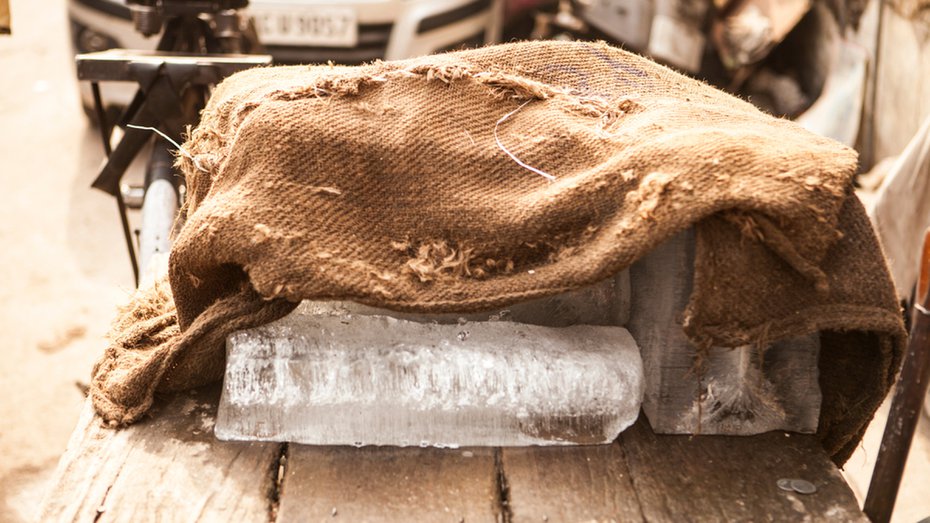
Two hundred years ago, after 20 failed attempts, the first consignment of ice arrived in Calcutta from Massachusetts
Blocks of ice for sale in a market in India. / Shutterstock
This was not very long ago, but a period that may well now be time stamped as BC or Before Corona. The exhibits at the Jadunath Bhavan Museum and Resource Centre in south Calcutta were arranged in a certain way to present the history of ice in the city — yes, it wasn’t such a taken-for-granted item as it came to be.
The photographs on display were pickings from Fulbright-Nehru Scholar Christine Rogers’s research. Exhibit 1, a black-and-white-photo of a young man driving a rickshaw laden with blocks of ice through the streets of Calcutta. “The boy is carrying the ice to the fish market. It is a photo from present-day Calcutta,” said Rogers. The second exhibit, a photograph of commercial projects of snow parks that are now being created for entertainment. The third, people sitting on the banks of the Hooghly where the ice used to be downloaded after it arrived all the way from the US.
Once upon a time, ice was a rare commodity, procured all the way from America. The exhibition, in consonance with Rogers’ talk, is a detailed history of ice trade in India. The now, followed by the then.
In the 19th century, the British army in India and people in the administration found it difficult to cope with the intense tropical summer. In a letter dated May 1833, Daniel Wilson, the fifth Bishop of Calcutta and the man who built St. Paul’s Church, writes to his family in England: “The weather is perfectly suffocating. None can pity us but those who know our suffering.”
Wilson’s immediate predecessor had not been able to endure the extreme temperatures and had died in office. Thus, to ease things for their own, the East India Company set about arranging for a regular supply of ice for all seasons.
Those days, what was available in the market was “Hooghly ice”. It used to come from Chinsurah in the winter months and was so named because it was made from the river’s waters. Said Rogers, “This ice was filthy and more like slush. It was made by freezing water in shallow pits and was dirty and unfit for drinking. This was not the kind of ice that the British were looking for.”
In 1833, a businessman in Boston, Frederic Tudor, arrived in Calcutta in a large vessel stacked with ice. Bringing ice to India was no easy task, not even for as enterprising a fellow as Tudor. According to Rogers, he failed 20 times before he met with any success. The challenge was to keep the ice from melting the entire length of the two-month journey to Calcutta and thereafter.
Tudor was not in this project alone; he partnered with Nathaniel J. Wyeth, a supplier of ice and a businessman. Together, the two cracked issues such as the technology of cutting ice, thereby making large-scale ice exports from Massachusetts possible. The two evolved the technique of harnessing horses to a two-blade ice cutter to cut more ice in less time.
David G. Dickason writes in his book, The Nineteenth-Century Indo-American Ice Trade, how Tudor took up this project only because he was in dire need of money after failing to dominate the global coffee market. Dickason writes: “He inaugurated his India venture only after experiencing a desperate need for adequate cash flows and profits in order to repay enormous debts incurred through his misadventures in coffee.”
With ice, Tudor got lucky. He was based in Massachusetts that had the requisite climate for producing natural ice in excess. Ice was cut from the Walden Pond, a lake there, where pure ice was easily found. Also, the Boston port was close by.
In 1847, when American essayist, poet and philosopher, Henry David Thoreau, was staying near the Walden Pond, he witnessed the cutting of ice. In one of his essays titled “The Pond In Winter”, he writes: “Thus it appears that the sweltering inhabitants of Charleston and New Orleans, of Madras and Bombay and Calcutta, drink at my well.”
The route was a long one. The ice, according to records, would be covered with fly ash and salt and then packed in jute to keep it from melting. Tudor earned such grand profits from Calcutta the next two decades that he came to be known as the Ice King.
The trade continued for almost 50 years. The price of the ice was only 4 annas per pound (one pound equals half a kilo), much cheaper than Chinsurah ice. It later came down to 2 annas per pound.
Records show that the ice was hugely in demand during that period and it had to be rationed at times as the ships were delayed and there would be a crunch. In fact, people had to produce a doctor’s certificate to get the ice. The British living in Calcutta even raised funds to set up an icehouse to preserve the cargo. Around this time, many Bengali businessman also got involved in the trade.
Rajinder Dutta was one of the pioneers of ice trade in Calcutta. His progeny, living in central Calcutta today, however, has no related documentation. Sanat Kumar Ghosh, who is one of the eighth generation Duttas, rattles off names of some others who eventually joined the trade — the Debs of DarjiPara in north Calcutta, Chhatu Babu and Latu Babu, and the Mitters.
“Rajinder Dutta was more famous as a homeopath. He had treated Ishwarchandra Vidyasagar, the Maharaja of Jaipur and also Raja Naba Krishna Deb of Calcutta,” says Ghosh as he hands over a book titled History of Homeopathy in India in the 19th Century. The book has a few lines on ice trade too. It reads: “In 1836, 12,000 tonnes of ice was shipped to Calcutta and 10 years later, the figure spiralled to 65,000 tonnes.”
That day at the Jadunath Bhavan Museum, Rogers spoke at length about how ice was transported to Madras and Bombay from Calcutta. Dickason also notes how eventually ice came to be used by Indians too. It was used to preserve food, for refrigeration, in drinks. Rounding up he wrote: “Even Hindoos, otherwise so scrupulous, do not hesitate to mix the frozen waters of America with the sacred stream of Gunga, whilst the stricktest Mohummudans use it with unlimited freedom (sic).”
source: http://www.telegraphindia.com / The Telegraph, online edition / Home> Heritage / by Moumita Chaudhari / March 29th, 2020
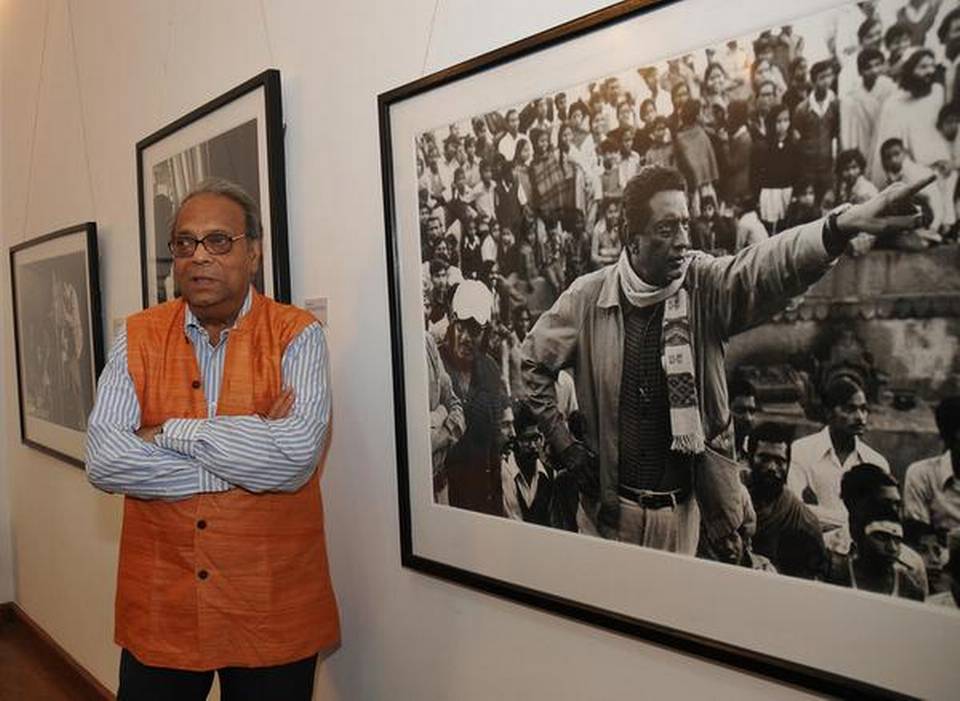
‘Goopi Gyne Bagha Byne’ (1969) onwards, he was the still photographer for all of Satyajit Ray’s works till his last film ‘Agantuk’ (1991)
For someone best remembered as the visual biographer of legendary filmmaker Satyajit Ray and a documentarian of the making of his astounding body of work, an interesting aspect about Nemai Ghosh was that he started off as an actor with actor-director Utpal Dutt’s Little Theatre Group in Kolkata.
Arts critic and publisher-editor Samik Bandopadhyay remembers one such play that he acted in: the landmark Angar (1959) about the exploitation of coal miners. It had music by Ravi Shankar and complex sets (Nirmal Guha Ray) and lighting design (Tapas Sen) with an entire sequence of a mine getting submerged under water. “He was an impressive and formidable figure on stage but was never so interested in photography then,” recalls Mr. Bandopadhyay.
Nemai Ghosh passed away in Kolkata on Wednesday. He was 85.
Ghosh’s interest in photography was kindled entirely by chance in 1966 when he found an abandoned camera and started tinkering and playing around with it. Being a great lover of cinema himself, he wanted to shoot the process of filmmaking which is when his path crossed with that of Ray. Initially just “tolerant” of his presence, as he once recalled, Ray discovered Ghosh’s talent by and by to have him become a part of his unit. Goopi Gyne Bagha Byne (1969) onwards, he was the still photographer for all of Ray’s works till his last film Agantuk (1991). “The only other parallel I can draw is Raghu Rai’s photographs of Indira Gandhi,” says photographer Chirodeep Chaudhuri of an imagemaker’s consistent collaboration and engagement with a personality.
Ray’s son and filmmaker Sandip Ray remembers meeting him on the sets of Goopi… “He was a part of the family. He was always there, not just on the shoot, but our home as well,” he says.
Black and white
The magic of his black and white images lay in the specific fleeting instants that they managed to capture, that too without flash, in natural light. “He never missed a moment, captured the right moment,” says Sandip Ray. “His work in theatre gave him a sense of the moment,” says Mr. Bandopadhyay.
Filmmaker Sujoy Ghosh compares his frames to videography. “Each of his photos tells a story to me. Like Jaya Bachchan in Kalighat, teeka on the forehead, prasad in hand, happy… I see many things in the process. It’s instructive and informative about the process of filmmaking itself,” he says.
Mr. Chaudhuri points out the candidness in his frames unlike the “manufactured PR images and ‘behind the scenes’, ‘making of’ balderdash” where the stars are perennially performing or posing.
“There was an endearing quality about his photos. You could see his love for theatre and cinema [reflected in them],” says Mr. Chaudhuri.
Apart from Ray, Ghosh also chronicled some of Mrinal Sen’s films and he was the still photographer on Mira Nair’s The Namesake. “His portraits of my father were absolutely brilliant,” says Mr. Ray. Sujoy Ghosh remembers him shooting on the sets of his own film Kahaani. “I fell at his feet. It was such an honour that he considered our film,” he says.
On theatre
Beyond Ray and films, a major part of his work was on the theatre in Bengal and about Kolkata itself. His work was a reference point for Sujoy Ghosh when he went shooting in Kolkata for Kahaani. “It was an amazing inspiration. Every photographer and painter has a [unique] way of looking at places, objects, people which is different from ours,” he says.
Mr. Chaudhuri remembers him showing rare colour photos of Ray when he visited Ghosh at his home couple of years back. “He was so excited going through the folders and files of his work on the computer,” he says. One of Ghosh’s disappointments, according to Mr. Chaudhuri, was not being given space by the State government to archive his work. Later, he gave away most of it to the Delhi Art Gallery.
In the latter half, he was passionately documenting painters at work and musicians in performance. According to Mr. Bandopadhyay, Ghosh had clicked some exclusive pictures of the ailing Italian maestro Michelangelo Antonioni, some of them in his hotel room, when the latter had come to Kolkata for the retrospective of his work at the International Film Festival of India in 1994. Impressed with his images, Mr Antonioni, who had taken to painting in his later years, had invited him for his exhibition to Italy. Ghosh took pictures of Antonioni moving around in the exhibition on a wheelchair. Having been witness to and documented the maestro’s painting phase, Ghosh wanted to preserve them in the form of a book. Sadly there were no takers for it in the commercial publishing world.
source: http://www.thehindu.com / The Hindu / Home> Entertainment / by Namrata Joshi / Mumbai – March 26th, 2020
In 2001, India, under Ganguly’s leadership, became only the third team in the history of Test cricket to win the match after being forced to follow-on.
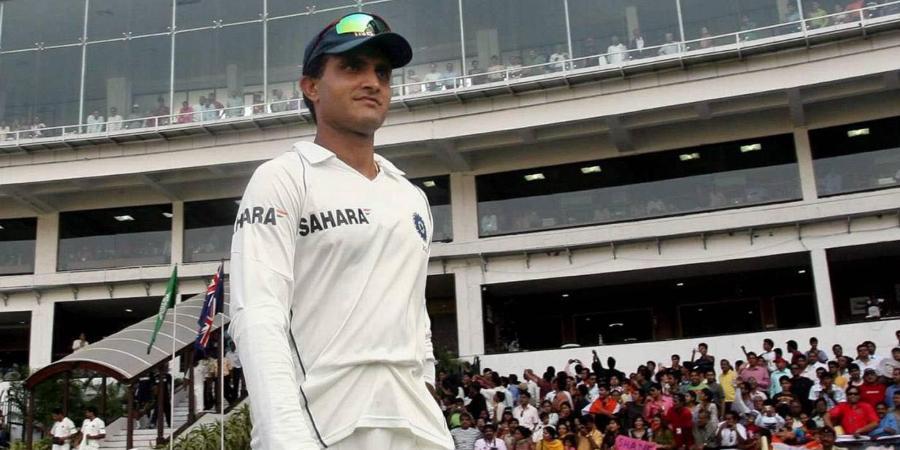
BCCI President and former India captain Sourav Ganguly (Photo | PTI)
New Delhi :
Board of Control for Cricket in India president and former India captain Sourav Ganguly on Wednesday reminisced the famous win over Australia in the 2001 Kolkata Test. Ganguly retweeted a video of the Indian team at the time celebrating in the dressing room.
“What a win…” Ganguly said in his tweet.
In 2001, India, under Ganguly’s leadership, became only the third team in the history of Test cricket to win the match after being forced to follow-on.
India were all out for 171 in reply to Australia’s first innings score of 445 at the Eden Gardens. Steve Waugh enforced the follow-on and India ended up declaring on 657/7 in their second innings, largely thanks to an extraordinary 372-run stand between Rahul Dravid and VVS Laxman.
Harbhajan Singh, who had become the first Indian to take a hat-trick in Test cricket in the first innings, led the way once again with the ball. He took six wickets as Australia were all out for 212 and India ended up winning the Test by 171 runs.
The match is regarded as one of the greatest Test matches ever and one of the most significant in the recent history of Indian cricket. The Australian team of the time was regarded as one of the greatest teams of all time and Waugh had termed winning a Test series in India as the “final frontier”. While they were unsuccessful in doing it that year, they went on to finally break the 35-year jinx when they came to India in 2004.
source: http://www.newindianexpress.com / The New Indian Express / Home> Sport> Cricket / by IANS / April 15th, 2020
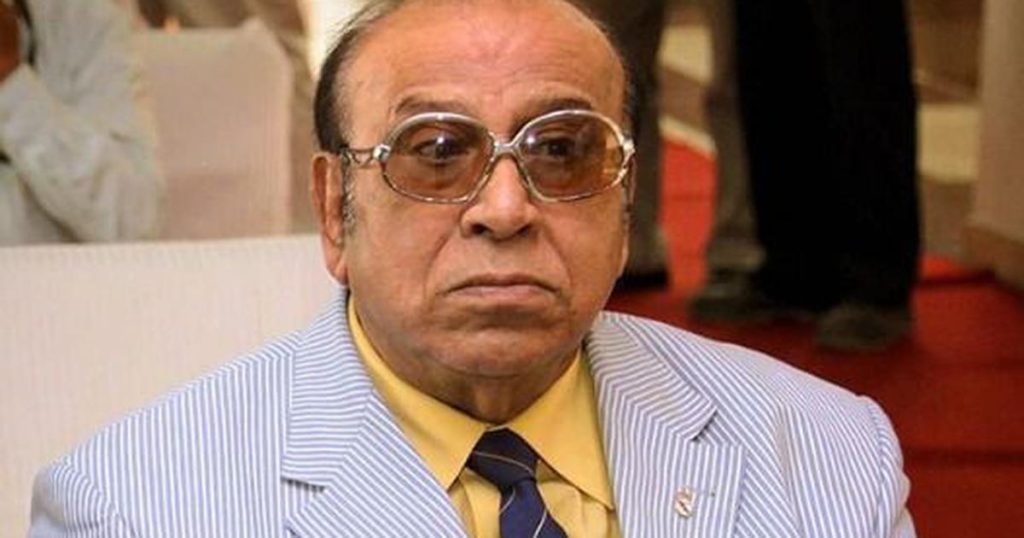
Subhash Bhowmick, Gautam Sarkar, Subrata Bhattacharya and Shyam Thapa, some of the best players in the 1970s were coached by the legendary Banerjee.
File image of PK Banerjee | Indian Football/ Twitter
Subhash Bhowmick, a robust and lethal forward in Indian football in the 1970s, was down in the dumps with no visible light at the end of the tunnel until Pradip Kumar Banerjee gave his career a new lease of life, something he is grateful to this date.
Bhowmick, who later became an accomplished coach, owes his stardom to Banerjee’s skills as a coach that brought out the best in him. Similarly, Gautam Sarkar, an absolute feisty character who would send those pin-point passes to Bhowmick playing for Mohun Bagan also benefited from Banerjee’s astute coaching.
Thus, as the 83-year-old veteran lost his battle against prolonged illness, his students, who were stars of Kolkata maidan in the 1970s, an era that was a witness to some of the best matches in Kolkata football, celebrated the accomplished life by narrating several anecdotes from their time with their beloved “Pradip Da”.
“I was kicked out of Mohun Bagan after we lost the Durand Cup final to East Bengal (in 1972),” Bhowmick said, as he went down the memory lane in an interaction with PTI.
“He was the person who picked me up from ‘gutter’ and told me ‘you’re the best player in India, come and play for ‘East Bengal’,” he added.
Bhowmick was one of the key figures in East Bengal’s famous 5-0 demolition of Mohun Bagan on that fateful IFA Shield final on September 29, 1975.
The ‘vocal tonic’
Known for his vocal tonic, Banerjee spurred Bhowmick on by recalling the insults hurled towards him by Mohun Bagan officials. The rest, as they say, is history as Bhowmick played like a tiger on the prowl handing Bagan supporters a day that they have lived on to regret even after 45 years.
Bhowmick did not find his name on the score sheet in that great win but was instrumental in setting up the first two goals scored by Surajit Sengupta and Shyam Thapa.
“Death is always sad. His demise has left all of us sad,” Bhowmick said.
“But the way he was suffering, he did not deserve this pain. For me, Pradip da was dead since the day he left talking about football with me,” he added.
Ahead of his times
Banerjee also fashioned memorable treble for Mohun Bagan two years later in 1977 and this time it was Subrata Bhattacharya, who was the star of the show after three quiet years.
The Mohun Bagan captain was a big let-down in the 1977 Calcutta Football League derby, that the team 0-2 in front of a packed Eden Gardens and was a reason for unhappiness among the fans.
“The fans would not let us enter the field in protest… Such was the atmosphere,” Bhattacharya said.
“The practice would begin at 7.30 am at the Eden Gardens but he (Banerjee) would come one hour before and pay extra attention to me, he made him do some different pieces of training.” he added.
“We went on to defeat East Bengal thrice that season and won the Shield, Rovers and Durand. Nobody dreamt of such a turnaround. Only Pradip Da could do it. He was ahead of his time and crystal clear in his thinking.” Bhattacharya said.
A great motivator
Banerjee’s rivalry with another great coach Amal Datta was well known in Maidan circles but Bhattacharya reckoned that the former knew how to deal with stars and adapt to situations.
“Amal da may have been a great coach and hugely respected for his tactical and aggressive football, But Pradip da had the horses-for-courses policy. He was sharp and was quick to adapt. It showed in his results. I won 37 of my 58 titles under him,” he said.
Former midfielder Sarkar recalled yet another famous win for Mohun Bagan under Banerjee in the 1978 Calcutta Football League.
In his prime, Sarkar was dropped for three-four matches, a decision that caused quite a lot of chatter. He was suffering from giardia, an acute stomach bug that was prevalent in the 70s in Kolkata especially among the lower middle class that didn’t have access to clean drinking water.
“I panicked, everyone was asking why Gautam Sarkar was not playing. I was indispensable then. But he kept quiet,” Sarkar said.
It was just on the eve, Banerjee met Sarkar at the entrance of the club tent.
“He told me that he had kept me for next day’s match as I was a big-match player. He called the kind of the big games,” Sarkar said.
“I again felt that spark, the fire inside me, despite lying low due to my stomach illness. It was as if I was transmitted some supernatural power,” he said recalling how his crucial saves played a huge role in their 1-0 win where Shyam Thapa scored the winner.
Thapa also remembered how Banerjee played a key role in Mohun Bagan’s famous 2-2 draw against Pele’s New York Cosmos team.
“I was given an extra responsibility to stop Pele. The whole team put up a vibrant show. He would sit and plan with us with a board. He was way ahead of his time,” he said.
With Banerjee’s passing, a huge void has been left on the Kolkata maidan, but his legacy in the form of the impact he made on the football there lives on.
source: http://www.scroll.in / Scroll.in / Home> Indian Football / by Press Trust of India / March 20th, 2020
The book aptly presents the socio-economic background of Haldane, particularly his father role in shaping his young, curious and socially sensitive mind
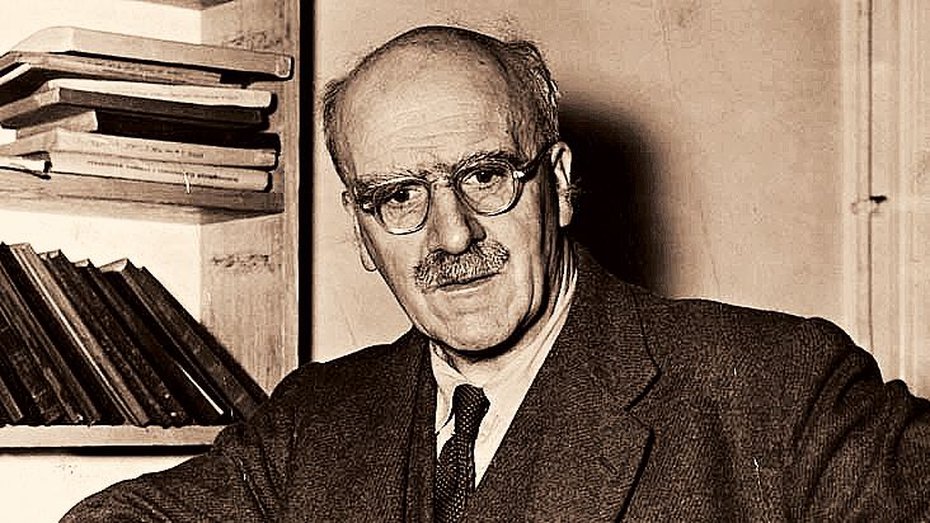
J.B.S. Haldane / [Wikimedia Commons]
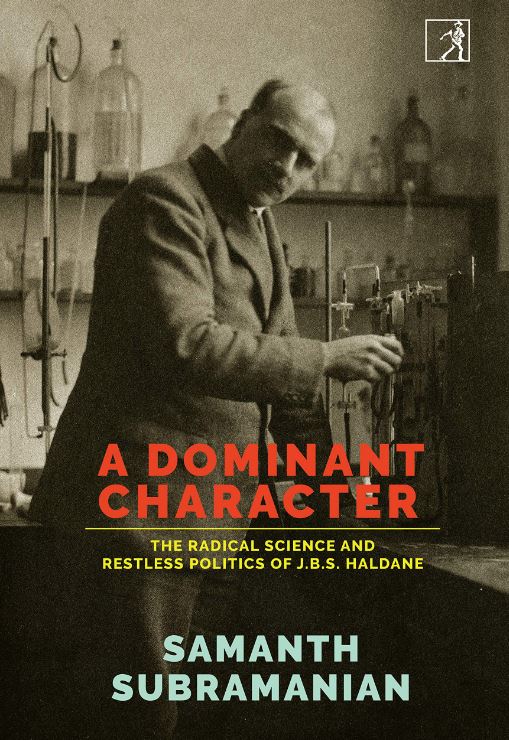
Samanth Subramanian’s book reveals a lot about the man who is its subject. It succeeds in conveying the multifaceted character of the protagonist, his dislike for conventional wisdom, his participation in World War I and the Spanish Civil War as well as his involvement in the British war effort during World War II and, of course, his pioneering contributions to the formative works of evolutionary genetics. Subramanian correctly points out that J.B.S. Haldane was a creative man full of new ideas who wrote many papers in reputed scientific journals. When he was not doing active science, he was busy writing about science for common people. The author also gives a lot of emphasis on the political work of Haldane which makes the book fascinating to read. It is rare to find such a vocal and politically active communist scientist in the history of science.
The book aptly presents the socio-economic background of Haldane, particularly the role played by his father in shaping the mind of the young, curious and socially sensitive Haldane.
Subramanian also succeeds in conveying the scientific nature of Haldane’s work which makes this book not only relevant to the general reader but also valuable for those interested in understanding the history of evolutionary genetics and biological sciences. This book is a good example of popular science writing and can be appreciated truly if the reader has an interest in the biological sciences.
To convey Haldane’s iconoclastic disposition, the author, at times, becomes a bit too harsh in his portrayal of the scientist’s idiosyncrasies and apparent lack of diplomatic skills. Creative minds often have their own set of idiosyncrasies and find social interactions difficult which reflects their complex thought processes.
A Dominant Character: The Radical Science and Restless Politics of J.B.S. Haldane by Samanth Subramanian, Simon & Schuster, Rs 799Amazon
Haldane had a special relationship with India. At sixty-four, he preferred to leave England and settle down in India, a fact that is difficult to believe as sixty-four years is rarely perceived to be an age when someone chooses to start afresh in a different country with a completely different set of languages. He spent the last part of his life (1956-1964) with his wife in India. He became an Indian citizen and worked in the Indian Statistical Institute in Calcutta and later settled in Bhubaneswar. He left England at the height of the Suez crisis in 1956 because he thought his country was on the wrong side of history. For Haldane, India was a new dream, a dream of Nehruvian socialist nation-building, where he could chip in with his scientific knowledge to help the country produce good biologists. This part of Haldane’s life is well-documented in the book.
Subramanian has tried his best to convey the main scientific beliefs of Haldane by pointing out that he was one of the pioneers who tried to implement the ideas of heredity as propounded by Gregor Mendel in the study of natural evolution. The relationship between genetics and evolution became clearer in the works of Haldane and his contemporaries.
In describing the character of Haldane, Subramanian also conveys his feelings about the Soviet Union. The Soviet Union is a recurring theme in this book as the protagonist was associated with the Communist Party of Great Britain for a long time and had played a role in the Lysenko affair. Subramanian describes the communist Haldane elegantly but fails to find anything positive in the Soviet Union. This is a bit strange. In this otherwise splendid book, Subramanian perhaps missed out the fact that if revolutionary Soviet Union, with all its faults, had not existed, then iconoclastic and adventurous scientists of the nature of Haldane, who fought for science and the liberation of the proletariat, may not even have existed on earth.
source: http://www.telegraphindia.com / The Telegraph, online edition / by Kaushik Bhattacharya / April 10th, 2020
VISUAL ARTS: Ghare Baire is a grand exposition of Bengal art being held in Currency Building in BBD Bag
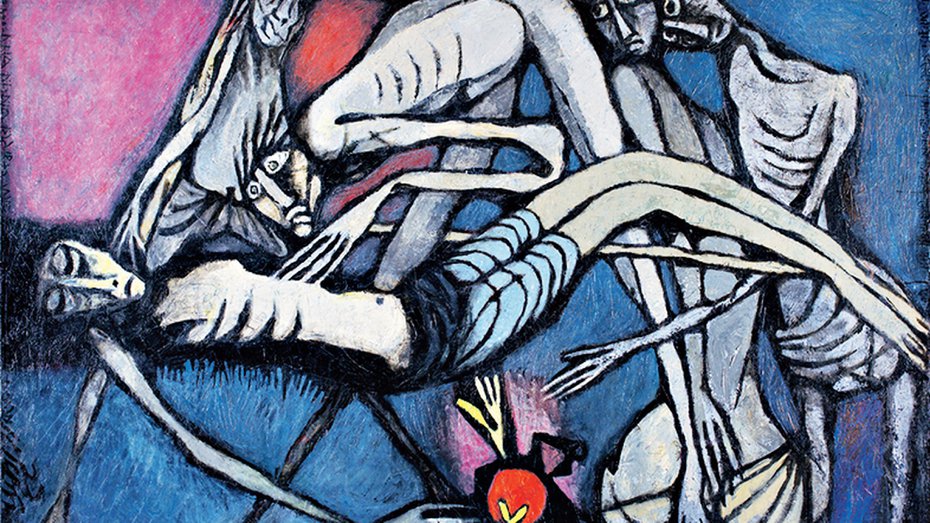
Assassinated, a painting by Prokash Karmakar / Delhi Art Gallery
Ghare Baire is a grand exposition of Bengal art being held in Currency Building in BBD Bag. It celebrates the glorious history of visual arts in this region of eastern India. It gently unfolds before one’s eyes as one perambulates through the galleries on the three floors where over 800 works are displayed. One can even go so far as to say that this is one of the best things that has happened in years in Calcutta’s stultified cultural space if one can forget the prime minister’s self-appointment as the head honcho of Bengal’s culture in his inaugural speech on January 11, and the mangled Bengali text accompanying the exhibits, that has since been rectified.
The massive project has been handled and financed by the Delhi Art Gallery. The National Gallery of Modern Art collaborated with it. Most of the art work came from DAG’s collection. The magnificent Currency Building constructed in 1868 has been restored by the Archaeological Survey of India. Ghare Baire is closed now, but according to a DAG statement, “As per our ongoing plans and talks with the Ministry of Culture, Ghare-Baire… is planned to be extended by a year, and that will be confirmed once we emerge from the current lockdown, by mid-April.” The introduction of the catalogue by Ashish Anand, CEO and managing director, DAG, drops a clanger. Rabindranath is referred to as thakurda. Hope that will be taken care of.
The exhibition begins with Frans Balthazar Solvyns’ prints of life in 18th century Calcutta hung along the staircase that leads to the first floor galleries with views of Calcutta by the Daniells, Henry Salt, and of Chittagong by James George. This is supplemented by other relevant material like maps and contemporary books. It is obvious that this is backed by solid research. This is the kind of museum that Calcutta needs to showcase Bengal as the crucible of Indian modernism.
This is the first — European Artists in Calcutta — of the 11 sections, the other 10 being: Early Indigenous Art, Realism and Academic Art in Bengal, Bengal School, Santiniketan: Charting Untrodden Courses, and Visualising Bengal Man-made famine, The Liminal Language of Bengal’s Modernists, India’s National Art Treasure Artists, Devi: Intrinsic to the City, Printmaking: Democratising Art, and lastly,
Modern Sculpture in Bengal on the ground floor. Another ground floor room is dedicated to Nemai Ghosh’s adulatory photographs of Satyajit Ray. This gives one some idea of the treat in store.
There are some splendid Early Bengal oil paintings of deities, but the Kalighat pats are of uneven quality. The Santiniketan section had a huge lacuna: no K.G. Subramanyan. Of late, 32 new works have been added, two by Subramanyan. The most moving is the section on the Bengal famine with Chittaprosad, Zainul Abedin, Paritosh Sen, Somnath Hore, Quamrul Hassan and Gobardhan Ash, and a large Ramkinkar oil.
The exhibition allows almost forgotten Calcutta Modernists like Prokash Karmakar (picture: Assassinated, 1966), Nikhil Biswas, Dharmanarayan Dasgupta, Bijan Choudhury, Rabin Mondal and Paritosh Sen to reclaim their rightful place in art history by revealing them in their full glory. Yet, women artists are given short shrift. Sunayani Debi, Meera Mukherjee and Mrinalini Mukherjee are there, but where are Arpita Singh, Anjolie Ela Menon and Jayashree Charavarty? Didn’t they deserve to be here?
source: http://www.telegraphindia.com / The Telegraph, online edition / Home> Arts / by Soumitra Das / April 04th, 2020
Basha Mukherjee is self-isolating for one to two weeks until she can return to work as a doctor to help in coronavirus pandemic. “There’s no better time for me to be Miss England and helping England at a time of need,” she told CNN.
Bhasha Mukherjee, who shifted from Kolkata at the age of 8, specializes in respiratory medicine. (Source: Instagram/Bhasha Mukherjee)
Indian-origin doctor Bhasha Mukherjee, who was crowned Miss England in 2019, has returned to the United Kingdom to help out on the frontlines in the ongoing coronavirus (COVID-19) crisis.
The beauty queen, who took a break from the medical profession to focus on charity work abroad after competing in the Miss World competition last year, told CNN on Monday that she has returned to the United Kingdom to aid the medical professionals. She told that it felt wrong to be wearing her Miss England crown, even for humanitarian work, while people around the world were dying from coronavirus and her colleagues were working so hard.
As the COVID-19 situation worsened in the UK, Mukherjee was getting messages from former colleagues telling her how hard the situation was for them. “When you are doing all this humanitarian work abroad, you’re still expected to put the crown on, get ready… look pretty.” But, she added: “I wanted to come back home. I wanted to come and go straight to work.”
She is now back and is self-isolating for one to two weeks until she can return to work as a doctor at the Pilgrim Hospital. “There’s no better time for me to be Miss England and helping England at a time of need,” she told CNN.
Mukherjee, who shifted from Kolkata at the age of 8, specializes in respiratory medicine. Invited to be an ambassador for several charities, she had taken a break from her medical career briefly. She was in India at the beginning of March for a community charity. She also visited Africa, Turkey, Pakistan, and other Asian countries.
source: http://www.indianexpress.com / The Indian Express / Home> Coronavirus Outbreak / by Express Web Desk / New Delhi / April 07th, 2020
Anandibai Joshi, who was the first female physician in India, was the first Indian women to complete her studies in western medicine from United States.
Anandibai Joshi was the first female physician in India
Anandibai Gopalrao Joshi was the first female Indian physician. She was also the first woman in India to complete her studies in western medicine from the United States. Anandibai has a rich legacy and inspired many women to pursue the field of of medicine in India and in the United States.
Anandibai also became the first woman from Bombay presidency of India to study and graduate with a two-year degree in western medicine from a foreign country.
Anandibai’s inspiration to pursue medicine
Anandibai was born with the name ‘Yamuna’ but was later given the name anandi by her husband Gopalrao Joshi. She was born in a family of landlords and due to parental pressure, she got married at the young age of nine.
Anandibai bore her first child at the age of 14 but due to lack of medical care, the child passed away after ten days. This incident was a turning point in Anandibai’s life and she chose to pursue medicine, with the support of her husband.
Gopalrao, who was a progressive thinker and supported education for women, enrolled her in a missionary school, and later moved to Calcutta with her, where she learnt how to speak Sanskrit and English.
Gopalrao’s support for Anandibai’s education
In the 1800’s, it was very unusual for husbands to focus on their wives’ education. Gopalrao was obsessed with the idea of Anandibai’s education and wanted her to learn medicine and create her own identity in the world.
One day, Gopalrao walked into the kitchen and threw a fit of rage when he saw Anandibai cooking instead of studying. This made her even more focussed on her education.
Gopalrao took the decision of sending Anandibai to America to study medicine in utmost detail with a missionary from Philadelphia named Mrs. Carpenter.
(Source: Wikipedia)
I volunteer myself a women doctor: Anandibai Joshi
Before she went to United States, Anandibai addressed a public hall in 1883, where she expressed her dissapointment for the lack of women doctors in India. She said,”I volunteer myself as one”, in the gathering.
She had also expressed her views on how midwifery was not sufficient in any case of medical emergency and how the instructors who taught women had conservative views.
Anandibai’s journey in America
After her motivating speech in the public gathering, she expressed her views on studying medicine in America. She also stressed the need of female doctors in India and stated that Hindu women can be better doctors for other Hindu women.
Anandibai’s health had started to decline but Gopalrao had urged her to go to America so that she can set an example for other women in the country.
Anandibai was urged to apply to the Women’s Medical College of Pennsylvania but learning about her plan to pursue higher education, the Hindu society of India decided to censure her very strongly.
Anandibai was enrolled in the Women’s Medical College of Pennsylvania and completed her two-year course in medicine at the age of 19. She graduated with an MD in 1886 with the topic of her thesis being ‘Obstetrics among the Aryan Hindoos’.
In her thesis, she covered information form Ayurvedic texts and American textbooks. On her graduation, Queen Victoria sent her a message, expressing her delight.
Confusion between Anandibai Joshi and Kadambini Ganguly
There is a major confusion between Anandibai Joshi and Kadambini Ganguly, with regards to who was the first female doctor of India. Anandibai got her degree in western medicine from Women’s Medical College of Pennsylvania while Kadambini completed her education in India.
Kadambini Ganguly
Tragically, Anandibai passed away due to tubercolosis at the age of 22, before she got a chance to practice medicine.
Thus, Kadambini Ganguly was the first female doctor to practice medicine while Anandibai Joshi was the first female doctor who got her degree in western medicine from the United States.
Anandibai Joshi’s legacy in the world of medicine
Anandibai passed away due to tubercolosis at the age of 21, on February 26, 1887. Even after her death, several writers and researchers continued to write about her to raise awareness about the importance of educating women in India.
Doordarshan also based a television series on her life and American feminist writer Caroline Wells Healey Dall penned down her biography in 1888.
The Institute of Research and Documentation in Social Sciences (IRDS), Lucknow has been awarding the Anandibai Joshi Award in Medicine in honour of her contributions towards the advancements of medical sciences in India.
Anandibai Gopalrao Joshi has been an inspiration to millions of Indian women who found the motivation of stepping into the field of medicine. She created history by making huge strides so ealry in her life, in a field which required precision and extensive education.
source: http://www.indiatoday.in / India Today / Home> News> Education Today> GK & Current Affairs> Personalities / by India Today Web Desk / New Delhi / March 04th, 2020
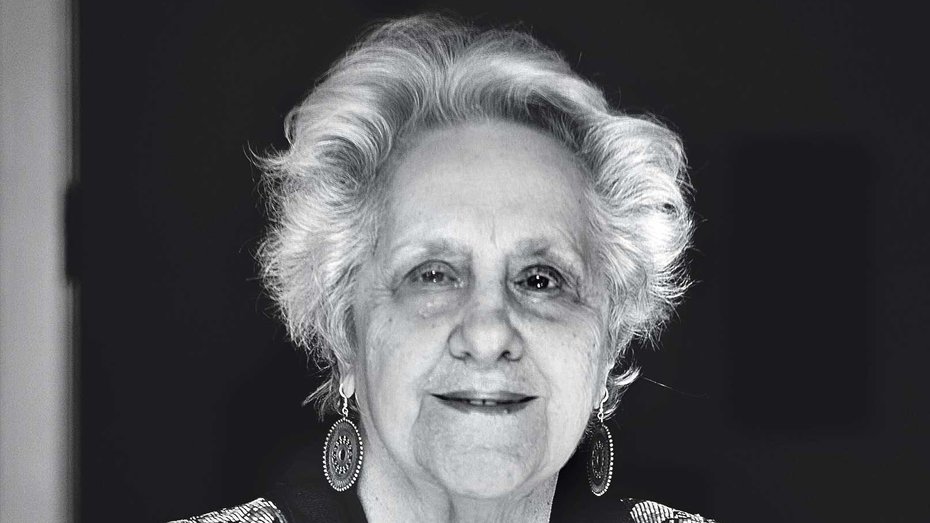
As one of a handful of Baghdadi Jews living in Calcutta and perhaps the oldest of the lot, her story is not her story alone
Flower Silliman / Courtesy: Jael Silliman
She is called Flower but there is nothing seemingly fragile about the 90-year-old woman. She is tall with broad shoulders. Her skin is smooth and barely lined. “I have seen a lot of history — 70 years of that century and 20 years of this,” smiles Flower Silliman, one of the 30 Baghdadi Jews still living in Calcutta.
We are at Flower’s residence on Moira Street and though it is just her and me in the room, the many Frida Kahlo portraits on the walls, on the sideboard, form our greater audience. She is in an easy chair, resplendent in a green floral nightgown. The sun is peeping through the netted windows of her living room and lighting up the red-oxide floor. Her green-gold eyes twinkle with memories and she adds in clipped English, “I have five children, 13 grandchildren and 12 great-grandchildren.”
Flower’s parents were born in Calcutta; it was her grandparents — both sets — who came from different parts of Iraq.
The paternal grandparents arrived in Calcutta from Basra. Her grandfather, a petty trader, would bring fezzes — short cylindrical peakless caps, sometimes with a tassel attached — from Baghdad and sell them all over the Far East and return home with spices. Says Flower, “All Muslims would wear fez caps then. In India, my grandfather would stop in Bombay and Calcutta. Otherwise he went to Penang, Jakarta, Singapore.”
Flower’s grandfather got married when he was 50. Flower dwells awhile on his fabled good looks — six-foot tall, blue eyes and so on — but it is his 16-year-old wife, Flower’s grandmother, who seems to have made a more enduring impression on her. In fact, Flower refracts her own story and the story of her entire family as it were, through the personas of her two grandmothers. The descriptions, the attention to detail, the emotions attached are so overwhelming that by the time the interview is over and I have taken my leave of her, I realise that I don’t even know the names of the two grandfathers.
Flower says, “My grandmother’s name was Farah. Farah is joy in Arabic. My name is Farah too. But I was born in the heydays of the Raj, which is why everything had to be anglicised. I became Flower. My two brothers had Arabic names but they were called Charles and Eric.”
Flower cannot stop talking about Farah. Farah lived a colourful life. Farah travelled to the Far East. In the Far East, Farah moved from one Jewish home to another with her husband. Farah had a beautiful Chinese shawl embroidered with red roses. Farah and her husband smoked the hookah. Flower is so into the Farah-tales that it would be rude to turn focus back on her own life. Says Flower, “My father was born in Singapore in 1899 and my aunt in Penang. This is all in a diary and I have it with me. It is written in Hebrew…”
As the story goes, Farah and her husband decided to settle down once the children reached school-going age and the city of their choice was Calcutta, where Baghdadi Jews were very many in number and mostly into indigo or opium trade.
Flower’s maternal side had their roots in Al Uzair. On that side of her family, until a couple of generations ago, most of the men were trained to be mohels, or priests. “Mohels are people who perform circumcision and other special religious duties. They were trained and sent out to places where the clergy was needed to read the prayers or maintain the synagogues,” says Flower.
Her maternal grandmother’s name is Simha. Most of Simha’s brothers went to Shanghai and one of them went to Poona [now Pune] to work as a steward in the home of Jewish businesswoman, scholar and philanthropist, Flora Sassoon. When Flora fell ill and someone was needed to nurse her, Simha was asked over. Says Flower, “When she died, she left some money for Simha to get married and that is how she and her brother arrived in Calcutta, where she got married soon after.”
Flower recollects how Simha would sew clothes and women’s garments. She says, “My mother experienced poverty. But Jews never had to beg. We looked after our poor.” The Jewish Girls’ School in Calcutta was set up by the Jews and everything from education to clothes to food was provided free of cost. Flower’s mother, Miriam Shooker, was among the first batch of students and she eventually went on to become a nursery school teacher.
In the early 20th century, there were around 5,000 Jews in the city. Everyone lived in close proximity to each other with the majority settled near Maghen David Synagogue in Burrabazar. The Jewish para extended to Bentinck Street, Grants Lane, Bowbazar, Phears Lane, Chaatawali Galli, Marquis Street, Kyd Street, Sudder Street and Middleton Row.
Everyone in the community knew each other, and frequented the same synagogues and clubs. The Judean Club in central Calcutta was a world unto itself. In her time, Flower and her friends would play badminton and housie here, dance and listen to music. Flower mixes her reminiscing with footnotes — Yom Kippur is the day of atonement; Hanukkah is the festival of lights, much like Diwali; traditionally Jews never mix meat and milk; Bar Mitzvah is like the thread ceremony and so on and so forth.
Flower’s parents, Miriam and Elias Abraham, married in 1920. Elias worked at the Calcutta port as a measurer of jute and gunny. Flower was born on April 20, 1930, at the Eden hospital — now part of the Calcutta Medical College. She says, “It was a British hospital and in those days it was the hospital of choice for Jews, Christians and Anglo-Indians.” By that time, both her grandfathers had passed away.
And then World War II broke out. Says Flower, “Jewish refugees came into our lives because they were relatives of someone or the other. When the Japanese entered Burma [now Myanmar], the Jews there had to leave. Some came here by ship. Some trekked via Chittagong and Assam to Calcutta. And many of them died on the way. A lot of these displaced people came to live with us. They had nothing. They slept on the sofas, on the floors, and they remained with us till they got a job.”
Flower looks out of the window, possibly remembering what her nine-year-old self had witnessed. As the Japanese came closer, they bombed the docks and Kidderpore. There was no casualty but it did scare the life out of people. Flower, along with her brother and mother, was sent away. The little girl found herself in Delhi for a few months, far from the comforts of home and fond things such as baklavas and Turkish Delights and cheese samosas.
At 13, Flower was sent away again — this time as a boarder to a school in Nagpur. This was where she first got a taste of a non-Jewish environment. She says, “From having only Jewish friends, now I had no Jewish friends, only Anglo-Indian and Christian ones. I was the only Jewish girl. I started to eat non-kosher food. I started going to church with my Christian friends.”
Her next stop was Delhi, where she joined Lady Irwin College — the director, Hannah Sen, was a Jew from Calcutta. Almost everyone around her now was a Hindu or a Muslim. Soon Flower found herself celebrating Guru Nanak Jayanti, Holi, Diwali. She says, “It felt like I had lived in a cocoon and now suddenly I was a butterfly. I loved Frank Sinatra and I had taken records with me. I told my friend Sheila to play them. She made a deal with me. If I listened to Pankaj Mullick, she would listen to Sinatra.”
After graduation, Flower returned to Calcutta and started teaching at St. Thomas’ School, Kidderpore. At 21, she married a Jewish man whom she had met at the Judean Club. He came from a family of foreign exchange brokers and was also the direct descendant of Shalom Aharon Obadiah Cohen — the first recorded Jewish immigrant who arrived in Calcutta in 1798. Says Flower, “Calcutta had changed completely. Suddenly the streets were full of people in khaki. We had never seen planes before and now there were planes on Red Road. Calcutta was a big war base. In 1939, the British army arrived and by 1942, there were American soldiers too. Many of them came to our houses for festivals and Friday night dinners. They got to know the families and started dating their daughters. Many fell in love with these soldiers — some of whom were Jews — and once the war was over most left. The exodus started.”
And then came a time when entire families started migrating. In May 1948, Israel was officially declared an independent state and many Jews shifted from Bombay and Calcutta. The Israeli government even airlifted people. In the meantime, a newly independent India was rife with a variety of rumours. Flower says, “There were rumours that Hindi would become the national language, everything would become Indianised. Jews felt they would not do so well in an independent India and were frightened. Jewish business firms such as the National Tobacco Company and the jute mills at Agarpara were sold out. People left. By 1955, we lost half the Jewish community.”
Flower too left the city but later, in 1975. She moved to Israel, where she set up a restaurant of kosher Indian food which she called The Maharaja. “Every evening, I would wear a sari and go to the restaurant. People would call me Maharani,” she recalls with a laugh. She eventually moved to the US for a couple of years before returning to India for good in 2008.
Mid-conversation, one of Flower’s neighbours enters the room. Flower asks her to check her computer’s Internet connection. The neighbour, a Mrs Ghosh, corrects Flower. She says, “It is not a computer, it is an iPad.” The nonagenarian replies, “Everything these days is a computer; even your phone is a computer. One of these days, we will be asked to swallow a tablet and we will all be computerised.”
And I thought to myself — not you, Flower. Never you.
source: http://www.telegraphindia.com / The Telegraph, Calcutta / Home> People / by Manasi Shah / April 05th, 2020