Category Archives: World Opinion

Feast of Jesuit founder today

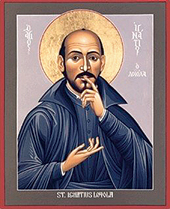
The 20,000 Jesuits and their institutions all over the world celebrate the feast of their founder, St. Ignatius of Loyola, on July 31.

FatherIgnatiusKOLKATA31jul2014

Ignatius was an unusual character of the 16th century, a brave knight and soldier under King Ferdinand of Spain. In 1521, he was wounded in the battle between France and Spain. His life was transformed during his long convalescence and he founded the Jesuit Order, the Society of Jesus, along with Francis Xavier at the University of Paris in 1537, which was approved by the Pope in 1540.

Perhaps Jesuits impart the best-known education in India and elsewhere. They have come to be known in the public mind for their educational work and have acquired the reputation of being among the world’s best educators and educationists.The Jesuit educational network is the largest in the world today.

The Jesuits conduct no less than 50 university colleges, 17 institutes of business administration and 210 high schools across the country; almost all of them are among the most reputable ones. More than 500,000 students belonging to every religious, linguistic and socio-economic group, receive their education at these institutions.

The situation is the same wherever the Society of Jesus has established itself for the greater glory of God. There are 28 Jesuit universities in the US.

As Malachi Martin has said in his book, The Jesuits, “Jesuits always aimed to be the best. And they were. They had a part to play in every major political alliance in Europe and America, in Asia and Africa. They became shapers not only of religious history, but also of world history. Even Nazi generals (incl. Hitler) dreamed of such a cadre of men; and even Lenin envied them.”

Historian Romila Thapar has stated that if India has a written history; the credit goes to the Jesuits.

St. Xavier’s college and school will remain closed on July 31 in honour of their founder. Here’s wishing all Xaverians, present and past, a very happy feast of St. Ignatius of Loyola.

The writer is the principal of St. Xavier’s College, Calcuta
source: http://www.telegraphindia.com / The Telegraph, Calcutta / Front Page> Calcutta> Story / by Fr. Felix Raj / Thursday, July 31st, 2014

Kolkata couple’s ‘Labour of Love’ on way to Venice Film Festival

Kolkata :

A film made by a couple from Salt Lake is on its way to the prestigious Venice Film Festival in the next couple of months.

The film, ‘Asha Jaoar Majhe’ (Labour of Love), is devoid of dialogues, though thoughts are communicated through expressions and music. “It’s a positive, simple, easy-going film on love. We’ve shown communication without words. I want people to come to see how love can be expressed by two people without having to speak at all,” said director Aditya Vikram Sengupta.

“In the film, the love is expressed through the most mundane things. In life, I have received love in several forms, from my mother, family members… It wasn’t like they pointed out and exhibited every day how much they loved me. But little actions showed me how much thought and care went behind each,” said Sengupta.

The film features actors Ritwick Chakraborty and Basabdutta Chatterjee. It’s in the race for not one but three awards at Venice – Luigi De Laurentiis Award (Lion of the Future (best debut)), Venice Days Jury Award and Venice Days Public Award.

“We haven’t been able to run it in Kolkata yet as films can’t be screened before the festival in order to be eligible. It’s a non- dialogue film as we felt there was no reason for dialogue just to fill up a silent moment,” said his wife Jonaki, who is executive producer and art director.

The couple, currently settled in Mumbai, produce and make ad-films for a living. “Half of the film was shot by Mahindra J Shetty, who was the cinematographer for ‘Udaan’ and ‘Lootera’. The other half was shot by me. The movie was made with a very small production crew of around 10, and on a very low budget,” added Sengupta.

On the cast, he said: “I took many auditions, but couldn’t find the right face for the role. Basabdatta fit in perfectly. She has a very classic look. Ritwik didn’t complain even if I kept calling for retakes. Some shots were taken 20-30 times. I’m grateful to the actors for their patience. Just because it’s a non-dialogue film doesn’t mean it’s a silent film or an art-house film. I think even 15-year-olds, who have some concept of love, will appreciate and enjoy it.”

The film, primarily set in the city, was extensively shot in north Kolkata. “That’s because my characters live in north Kolkata,” Sengupta explained.

source: http://www.timesofindia.indiatimes.com / The Times of India / Home> City> Kolkata / TNN / July 28th, 2014

Film set in Kolkata brothel bags UK honour

Kolkata :

Set in Sonagachi, ‘Sold’ — that follows the tale of a child trafficked from Nepal to the city, is directed and produced by Oscar winners and features ‘X-Files’ star Gillian Anderson, David Arquette, Tillotama Shome and Parambrata Chatterjee among others, has won the audience award at a London film festival recently.

This is the first feature film of Jeffrey Dean Brown, whose first short with dialogue, adapted from the book ‘Molly’s Pilgrim’, won the Oscar in 1986. This film is adapted from a book by Patricia McCormick that has been translated into 32 languages. The executive producer of ‘Sold’, Emma Thompson, is a two-time Academy Award winner. Joint Overdose, the film firm headed by Kolkata filmmaker Qaushiq aka Q, was the line producer. “We had met and the producers were well-versed with our earlier works. Our job was to ensure everything went smoothly during the production and shoot. The film will definitely hit the screens in India by next year,” said Q.

In the film, lead character Lakshmi’s stepfather accepts an advance for her to work as a domestic servant in Kolkata, and she becomes obliged to work off the debt. Lakshmi goes willingly, believing she will work and earn enough money to buy her mother a tin roof. But when Lakshmi arrives in Kolkata, she is handed over to Mumtaz, a ‘madam’ who presides over a brothel called Happiness House. Brown pointed out that ‘Shawshank Redemption’ is structurally similar to ‘Sold’. “Mumtaz exploits her prisoners like the warden did in ‘Shawshank’. In both the films, you know the hero is planning an escape, but you’re not sure how and this keeps you watching,” he said.

Asked about if he had any reservations about the content and depiction of Kolkata’s dark underbelly, Q said: “It’s not a negative set-up at all. It’s time for us to face the facts. And we were anyway interested in the film for the social message and its outreach.” His colleague in Overdose, Tanaji Dasgupta, not only has a role in the film but is also credited as a line producer.

“I remember visiting Sonagachi for the first time, seeing hundreds of young girls and women selling themselves on the streets. It was overwhelming. When I saw a girl who had just been rescued from a brothel, I truly understood the suffering these kids go through. She couldn’t look anyone in the eye; she looked shell-shocked, like someone taken from a battlefield who had lost her entire family. Girls like her are put on suicide watch for three months after being rescued. They don’t trust anyone; they’re like frightened animals. They try to escape, they cut themselves and have been known to hang themselves if not watched. The other survivors gradually make them feel at home and teach them to trust again. It was seeing these things with our own eyes that motivated us to make the film even more, so we could show the world what is happening,” said Brown.

source: http://www.timesofindia.indiatimes.com / The Times of India / Home> City> Kolkata / TNN / by Shounak Ghosal / July 19th, 2014

A cool musical ‘movement’ takes birth

Kolkata :

Who said classical music was boring? It could be cool, too. Say hello to supergroup ‘Classicool’, a conglomeration of second- or third-generation musical talents including sitarist Purbayan Chatterjee, drummer Gino Banks, son of Louiz Banks, tabla player Anubrata Chatterjee, son of Pt Anindo Chatterjee, flautist Rakesh Chaurasia, nephew of Hariprasad Chaurasia, and Amaan Ali Khan, son of Ustad Amjad Ali Khan, among others. Their mantra: Classical is cool.

It is to be noted that all of these collaborators have direct or indirect links with Kolkata. Louiz was ‘discovered’ by R D Burman during a concert at Park Street, Hariprasad Chaurasia speaks Bengali as fluently as anyone in the city. The supergroup, debuting in Mumbai on July 31, is aching to put up a show in Kolkata, the ‘Mecca of music’.

The musicians, though, loathe to call it a ‘band’ and prefer to call it a “movement”. The supergroup also has vocalist Suchismita Das, who has collaborated with A R Rahman, and city guitarist Sanjay Das. The idea to push classical music to GenY came to life with Purbayan tying up with music portal Qyuki.com, which is headed by A R Rahman, filmmaker Shekhar Kapoor and Samir Bangara, who is the co-founder and MD of the portal.

“The movement aims to make classical music more relevant to the youth. It’s only appropriate that so many musicians with a Bengal connect are on board. We are waiting eagerly to be able to stage a show in the city,” said Bangara.

“In an initiative like this, it’s only natural that everyone would have a Bengal connection. This project is distinctly Kolkata-driven, as you can’t avoid the city when it comes to classical music,” said Anubrata. “Classical music must be regenerated for the youth and they must be mobilized. Classicool retains original ragas and presents them in a modern soundscape using the bass and drums as accompaniment. In 3- to 5-minute capsules, we have presented original content in a new context. People, especially youngsters, have a lower attention span these days. Therefore, classical music needs to be fed in shorter doses of a few minutes in a song-like format. Also, these youngsters are used to a certain kind of bass-drum soundscape which they think is cool. They can also identify with certain visuals. Classicool presents classical music in a user-friendly format so that the sanctity of the raga is preserved without distancing or intimidating the listener,” said Purbayan.

With all the musicians established in their classical worlds and Gino being the only ‘non-classical’ player, does it make him feel the odd one out? “Not at all. Just because I play the drums doesn’t mean the character of the music has changed. The sound, a little. I have knowledge about classical music and that helps me, definitely,” said Gino.

“I’m very happy with the Classicool project. In my time, I was classic as well as cool,” Louiz laughed out loud. “But this movement is a welcome boost to the evolution of music. The purist may not agree. But I realized it 30 years ago when I ventured into classical and merged it with jazz,” said the veteran pianist.

“This is the best of both worlds. This is the future of music. And during my Kolkata days, I never found a more knowledgeable, appreciative audience. I’m very happy that Gino has teamed up with a bunch of extremely talented musicians with distinct Kolkata connections,” he added.

source: http://www.timesofindia.indiatimes.com / The Times of India / Home> City> Kolkata / TNN / July 22nd, 2014

Couple on clue chase track photo sites

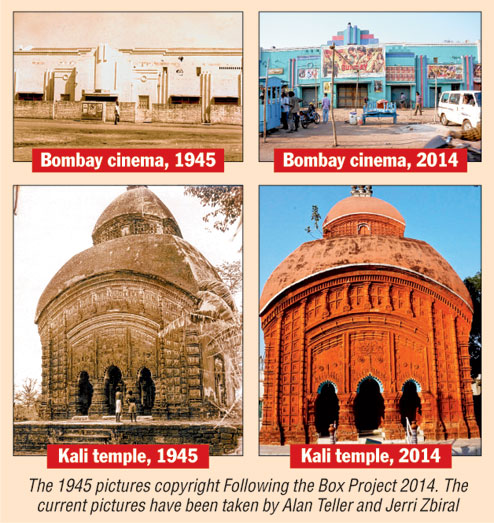
PhotosBengalKOLKATA21jul2014

The photographer and artist couple Alan Teller and Jerri Zbiral have unearthed a wealth of stories while chasing clues to identify the places in photographs of Bengal taken by an unknown American in 1945.

“Astonishing” was how the American couple described their weeklong sleuthing across Kharagpur, Salua and Pingla in West Midnapore, helped by two IIT Kharagpur students, Subhajyoti Ghosh and Siddharth Agarwal.

Metro had on February 26 reported on Alan and Jerri’s research — funded by Alan’s 2013 Fulbright-Nehru senior scholarship — into the background of a bunch of black-and-white photographs found in a box they had picked up for $20 at an estate sale in Chicago.

In the box were photographs of six temples, three of which the couple have located in Kharagpur — Balaji, Kali and Nandeswar. One they had traced three years ago. “The Nandeswar temple has a new portico which destroys the façade’s splendour,” said Jerri.

The couple have identified the man standing beside the Balaji temple in one of the photographs. “He was A. Narayan Swamy Naidu, the priest of the Balaji temple. He had founded the temple in 1935. We met his great-grandson Raju Naidu and daughter-in-law Padmavati, who is over 80 now. She became emotional when presented with a copy of our 1945 photograph,” said Jerri.

A movie theatre in one of the photographs has been identified as Bombay cinema in the railway town. Residents who were shown two photographs of markets suggested that one is the sprawling Golbazar in the heart of the town and other is located in Salboni, around 50km from Kharagpur.

Alan and Jerri have learned that the photographer was attached to a regiment of American soldiers stationed in Salua — around 5km from Kharagpur — which functioned as an airbase during World War II. Since 1949, Salua has been the headquarters of the Eastern Frontier Rifles (EFR). Gorkha personnel of the EFR helped the couple identify a laundry, a wall and a pond seen in some of the pictures.

“We have come to know that at the Salua base African-American soldiers were housed outside the main camp, segregated from the whites. That is not surprising as the US army wasn’t integrated till the 1950s. What is surprising was that the black soldiers were housed next to the munition storage areas. So if the Japanese bombed the area, wouldn’t they be the first to suffer a direct hit?” asked Alan.

“The whole issue of American presence in Kharagpur is shrouded in mystery,” he said. The couple have come across brief mention of their presence in documents at the Nehru Museum of Science and Technology, housed in a sprawling Raj-era building where the country’s oldest Indian Institute of Technology was inaugurated in 1951.

Under the British rule, the building had served as a jail for political prisoners — Hijli Detention Camp — and later as the command post of the American airbases in the region.

“We know that the Americans were doing reconnaissance work anticipating a Japanese land invasion but are uncertain about some details relevant to our search, such as why our photographer left his base and wandered around clicking all those photos of village life and temples and people with what was then a cumbersome camera. India’s role in World War II is still foggy and our search will perhaps clear up some areas. We’re seeking permission to gain access to the interior of the Salua base,” said Alan.

The couple will submit an application to the American authorities under the Freedom of Information Act for the release of documents related to the Hijli Detention Camp/Command Post and the Salua base, so they could draw a clearer picture of the photographer.

The couple’s last stop in their search was Naya village in Pingla (50km from Kharagpur), where they commissioned two jorano pats (narrative story scrolls unfurled to the accompaniment of songs) by patua Swarna Chitrakar, based on the 1945 pictures. “She has constructed a personal narrative based on a dozen or so photographs,”said Jerri.

The couple will deliver a lecture on the photographs and their search for the locations at the Victoria Memorial Hall at 5.30pm on Monday.

source: http://www.telegraphindia.com / The Telegraph, Calcutta / Front Page> Calcutta> Story / by Sebanti Sarkar / Monday – March 03rd, 2014

University of Calcutta to confer a posthumous doctorate on Lithuanian traveller anthropologist Antanas Poska

Vilnius (Lithuania):

In a rare honour, the University of Calcutta has decided to confer a posthumous doctorate on one of the world’s greatest explorers – Lithuanian traveller anthropologist AntanasPoska.

In an exclusive interview to TOI, Lithuanian foreign minister Linas Linkevicius said that Poska – the man who undertook an incredible journey to India on a motor bike all the way from Vilnius in 1929 will be conferred the doctorate during the University’s next convocation ceremony around September.

Confirming this to TOI from Kolkata, the University vice chancellor Suranjan Das said Poska “symbolised an eastern European’s inquisitiveness about India” and was being conferred the doctorate “for his contribution in making India known to the outside world through his extensive writings”.

Das told TOI “Poska’s feat is unparalleled when it comes to popularising India in Europe. Poska also studied in the University of Calcutta. Developing a close relationship with Lithuania is a priority for the new Indian government and conferring the doctorate will help seal the friendship”.

Das said “We have formally confirmed the University’s plans to confer the doctorate on Poska. However, it has to be given by the governor of West Bengal who presides over our convocation. Since the earlier governor resigned recently and we are waiting for the chair to be filled, the date of the convocation is yet to be finalised. It could take place around September-October”.

Lithuania’s ambassador to India Laimonas Talat Kelpsa has plans to bring Poska’s daughter Laimute Kiseliene to Kolkata to receive the doctorate.

It was TOI who had unveiled the extraordinary tale of Poska and a never before known facet of his work – the first ever translations of Rabindranath Tagore’s works into the Lithuanian language.

TOI had dug out Laimute who is now professor of choreography and dance methodology at Lithuanian University of Education. She for the first time ever unveiled to TOI a set of three binded books with “Tagore” written on them and a small palm sized journal made from birch tree barks.

She had received it from a frail old woman who had showed up at her door one day with these manuscripts.

The handwriting on them was familiar – it was that of her father who had written them during his exile.

Post 1929, when Poska returned to Lithuania from an eight year long journey across the world, the Soviet government packed him off on an 18-year-long exile to Siberia “without any formal reason”.

The frail lady then told Laimute that her father had returned from India as one of the biggest admirers of Rabindranath Tagore.

He then translated some of the poet’s works into Lithuanian – the first ever for any Indian literature to be done in that country.

Lack of paper during the exile forced him to use birch tree barks to write on. He also wrote poetry during his exiled years, copying Tagore’s style.

He had then given the documents to the lady in confidence who then worked in a Soviet controlled publishing house.

He wanted them published but the government destroyed most of his works.

Poska also gave her a note that read “These translations are a small bit of light for all those in despair”.

The lady instantly realised that they were “great cultural heritage” and hence hid them from the Soviets.

After knowing Poska is now survived by a daughter, the old lady had landed up at Laimute’s door many years later to hand over the manuscripts.

In an exclusive interview to TOI, Laimute had said “I was amazed when I received these manuscripts. He was a great fan of India and I grew up listening to stories of Tagore and Gandhi. My father never told anyone about these translations. Tagore’s works made a great impact on my father and hence took great pains to translate them thinking it would help those under Soviet oppression to see hope. These are real treasures of cultural heritage”.

“I would gladly give them to any publisher who would publish the translations now. There is nobody in Lithuania to validate the translation,” Laimute who has never shown these manuscripts to anyone before, said.

She added “The dream of his life was to translate the Vedas to Lithuanian”.

One of the translated works “dated 1932 at Shantiniketan” that TOI saw read in the introduction “While being a guest of a great Indian poet. With his personal help, I have prepared a small present for Lithuanians. This is a pearl of Tagore’s work called Fruit Gathering”.

Laimute revealed that Poska and Tagore met twice during his stay in Kolkata.

Laimute said “While in Shantiniketan, he waited for three days to meet Tagore. My father later revealed that the first meeting between him and Tagore wasn’t warm. Only when Tagore learnt of his interest in India, his travels, he became interested in Poska. Poska had expressed interest to Tagore of translating his works – an offer Tagore didn’t like. Tagore supposedly told him he looked down upon foreign translators who he felt ‘made it a business to make money from his works'”.

Poska in his journals also had nice things to say about the people of Bengal.

“During his next visit to Bengal. Poska found the people to be as warm, kind and creative as Tagore’s stories,” Laimute said.

Poska met Laimute’s mother Maria while on exile.

Laimute was born in Petro Pavlovsk in Kazakystan in 1950. She was nine years old when the family finally returned to Lithuania from their exile.

“Poska was never told why he was being exiled by the Soviets. So when he was ever asked the question, he would jokingly say it is because he stole Stalin’s pipe. One of Poska’s close friends and linguists from Bengal professor Suniti Kumar Chatterji gifted him a photo of Tagore which he always carried with him,” Laimute who took to being a professor of dance after hearing her father’s stories on Indian dances, said.

Poska and his co-traveller Matas Šalcius set out for an incredible journey to India on a motorbike in 1929. Their ways parted in Iran and each of them reached India separately in

1930. While Šalcius traversed India and continued his journey east up to the Philippines, Poska stayed on in India for five years, studying at Bombay University, later at Calcutta University and working at the Anthropology Laboratory of the Indian Museum in Kolkata.

He devoted these years to the study of commonalities between Lithuanian language and Sanskrit, Indian Vedas and Lithuanian folklore, making friends among Indian intelligentsia and expressing his passionate support for Indian independence.

He was a passionate advocate of the Esperanto language – international language of peace that was created by Ludwik Zamenhoff of Lithuanian Jewish origin in the end of the 19th Colonial India.

During the Soviet occupation, Poska was arrested for being well travelled and knowledgeable about the world beyond the Iron Wall.

He was first sentenced to hard labour in Siberian gulags, later transferred to Central Asia.

In Osh (Kyrgyzstan), he discovered and described an unknown Palaeolithic settlement and rare fossils.

Laimute finally revealed “Matas Salcius didn’t know how to ride a book. So it was father who drove all the way through so many years of travel”.

source: http://www.timesofindia.indiatimes.com / The Times of India / Home> City> Kolkata / by Kounteya Sinha, TNN / July 18th, 2014
Go-getter Bumbaiyya nurtures rugby dreams

Kolkata :

It’s probably apt that he has adopted the name Azad. Bumbaiyya, as he was known on the Howrah station platforms, has certainly broken free, thanks to a few well-wishers. Azad is now a strapping 20-year-old-youth, working in a glass factory in Odisha and looking after his widowed mother and sister. But things were not always this way for him. There was always the possibility of Bumbaiyya losing his way and ending up dead in some dirty gutter close to one of the busiest railway stations in the world.

Nobody seems to know what Bumbaiyya’s real name is. In 2004, when award-winning filmmaker Gerry Troyna was shooting at Howrah station for his BBC Four project ‘Monsoon Railway’, he came across the 10-year-old child and featured him in the documentary that won international acclaim.

“Bumbaiyya had apparently run away from home and turned up at the Howrah station. There, he collected used plastic bottles from the tracks and platforms. He also travelled a lot on trains, particularly those moving towards Mumbai. That is how he seems to have got the name ‘Bumbaiyya’. Gerry did not stop at featuring him in the film alone. He insisted that the boy start life afresh and seek shelter with an NGO in Kolkata. Bumbaiyya also came in touch with Mahindra Shinde, who is a former street child and part of Gerry’s crew now. He seems to have been inspired and actually adopted to the discipline involved in staying at the hostel run by the NGO. I would monitor his progress and Gerry would also keep in touch from wherever he was,” said Pallavi Biswas, a member of Troyna’s team.

It was at the hostel that Bumbaiyya adopted the name Azad. He took up studies and rugby. He was so good at the sport that Azad got selected to the national under-19 rugby team. “I played for the national side in several parts of the country. I also travelled abroad to countries like England and Thailand. By then, I had got in touch with my family in Odisha. Before I could sit for my Class X examinations, my father passed away and there was nobody to look after my mother and sister. I love rugby and would have loved to continue but had to start looking for a job to take care of them,” Azad said.

He believes that there is similar potential in other children who grow up on railway platforms. “They simply require a platform (not the railway kind) and some helping hands. They will certainly realize their potentials and grow up to be responsible adults,” Azad added.

Troyna doesn’t feel that he did anything out of the ordinary for the youngster. “I just opened a door for him. It was for him to take the opportunity. Today, when I watch this strapping young lad, I am proud. I am full of admiration. The films I make are not just entertainment. I believe that they must leave a positive effect. The people who agree to let us enter their lives must benefit in some way. I try to maintain a positive contribution and have never betrayed the trust of people, whether a beggar or a senior official. Azad loves rugby and is actually very good at it. I just hope he gets a job where he can continue to play the sport,” the 65-year-old filmmaker said.

source: http://www.timesofindia.indiatimes.com / The Times of India / Home> City> Kolkata / by Jayanta Gupta, TNN / July 12th, 2014

“India should invest more in green sector”

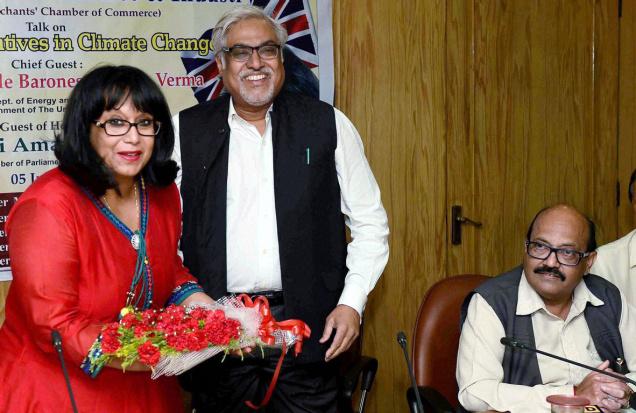
Vice president of MCC Chamber of Commerce and Industry Arun Kumar Saraf welcomes Baroness Sandip Verma, U.K. Minister, at an interactive session in Kolkata on Saturday. Rajya Sabha MP Amar Singh looks on. / The Hindu

It has a great potential for using its renewable energy resources: U.K. Minister

Stating that India has a huge potential in tapping its renewable energy, U.K. Minister of Department of Energy and Climate Change Baroness Sandip Verma said that India should invest more in green sector.

“Unlike in the U.K., India has a great potential for using its renewable energy resources. While in the U.K., we are still relying on nuclear and coal for our power resources, we are trying to do away with coal. India and the U.K. share a lot of similarities and I think India should consider options of investing in green sector,” Ms. Verma said.

She was participating in an interactive session on ‘India-UK initiatives on climate change’. Vice president of MCC Chamber of Commerce and Industry Arun Kumar Saraf was present.

Observing that India should learn from Bhutan in using clean energy, Amar Singh, Rajya Sabha MP, said there are a lot of untapped clean energy sources in Arunachal Pradesh.

Stressing on the need to uniform rule in banning constructions near river banks, Mr. Singh said after the flash floods in Uttarakhand [June 2013], there was a sweeping ban on constructions along river banks in the State so that future disasters could be avoided. “Why wasn’t there a similar ban in States like Himanchal Pradesh?” Mr. Singh asked.

“There is a huge scope in India and the U.K. to use low-carbon approaches not only to fight climate change but to deliver energy security, economic growth, and inclusive development. Although on a per capita basis, India’s carbon emissions remain a small fraction of those of developed countries, the country’s rapid economic growth has brought with it higher emissions,” Mr. Saraf said.

source: http://www.thehindu.com / The Hindu / Home> News> Cities> Kolkata / by Staff Reporter / Kolkata – July 06th, 2014

Bitten by travel bug, rickshawpuller on solo expedition from Kolkata to Ladakh

SUMMARY
Das way back in 2008 had gone all the way to Rohtang Pass in a rickshaw with his wife and daughter.
_____________________________________________________________

A rickshawpuller has set out on a daring 3,000-km expedition from Kolkata to the famous Khardung La pass in Ladakh, which has one of the world’s highest motorable road.

Forty-year-old Satyen Das, who ferries commuters at Naktala in south Kolkata, marshalled his personal savings and generous donations from local people, packed his luggage under the passenger’s seat of his refurbished rickshaw and started on his one-of-a-kind journey last month.

“I make a living on my rickshaw and spend my whole day with this, so I could not leave it behind when I started to dream about my trip to Ladakh,” Das said.

He has already reached Uttar Pradesh from where he will go to Srinagar and reach Ladakh after crossing Kargil next month. “I want to spread the message of world peace with this journey and also I want to promote rickshaw as a cheap and eco-friendly mode of transport,” he said.

Expecting to complete the expedition within five months, he is also eyeing an entry into the Guinness Book of World Records for his feat.

Bitten by travel bug, Das way back in 2008 had gone all the way to Rohtang Pass in Himachal Pradesh in a rickshaw with his wife and daughter. But this time the target is higher and he is travelling alone.

“He has this addiction of travelling in the Himalayas and going to far-off places,” said Partho Dey, secretary of Naktala Agrani Club, who helped him with funds.

Das modified his rickety old rickshaw with additional brakes and new body made of light steel at a total cost of Rs 15,000. In a day, he pedals to cover around 40-50 km and for makes night halts at religious places where he can stay for free.

Having only elementary education, the rickshawpuller said the unique road trip is also a great learning experience as he gets to understand the culture and diversity of India by criss-crossing different states, cities, towns and villages.

“My first task in the morning is to go to the local police station and take permission to move ahead. So far I have been getting it easily,” Das said. He is armed with maps to find his way to his next stop and a digital camera to document his special journey.

The club members are taking care of his wife and daughter, whom he left back home.

“We estimate that the trip would cost around Rs 80,000, which we have raised it amongst ourselves after we saw his passion and determination to travel,” Dey said adding that they have have given him an ATM card to withdraw cash as and when required.

source: http://www.indianexpress.com / The Indian Express / Home> Cities> Kolkata / by Press Trust of India / Kolkata – July 04th, 2014