Swachchhasila Basu visits Michael Madhusudan Dutt’s Bengali debut stage on the poet-playwright’s 145th death anniversary
DUTT ADDRESS: Belgachia Rajbari
A two-storey structure off north Calcutta’s Belgachia Road nudges curiosity. The portico cuts though the building like a tunnel. Trees grow on the walls, their aerial roots weaving a veil over it. The pink ground floor walls are peeling like scabs, the upper floor is unpainted. The bricks that seal the arched spaces to the right of the portico talk of secrets buried. The red doors to the left are not welcoming either. And yet, once, the doors of this very house had been thrown open to Bengal’s cultural elite.
The Belgachia Rajbari hosted, among other things, the first performance of Michael Madhusudan Dutt’s Sarmistha, the first original play in Bengali.
According to the Mahabharata, Sarmistha is the second consort of prince Yayati. Says 83-year-old Nityapriya Ghosh, “It was 1859. While translating Ramnarayan Tarakanath’s Sanskrit play Ratnavali into English, Dutt realised there were no original plays in Bengali. Encouraged by friends and patrons, among them the rajas of Paikpara and Jyotindramohan Tagore, he wrote this five-act play.”
This was supposed to be the most productive phase of Dutt’s literary life. In a letter from 1859, written to a friend whom he refers to “as one of the best dogs in creation” he writes, ” Sermista [the English translation by Dutt himself is spelt thus] has turned out to be a most delightful girl… Jyotindra says it is the best drama in the language.”
Ghosh, who used to live in Belgachia Villa – a government housing that came up in a portion of the Rajbari estate – says that around 1836, Prince Dwarkanath, entrepreneur and grandfather of Rabindranath Tagore, bought the estate and a single-storey house and converted it into this palace. In Bonedi Kolkatar Gharbari, Debasish Bandyopadhyay writes that Dwar-kanath had spent over Rs 2 lakh on the estate makeover.
“The who’s who of society would look forward to an invitation to the innumerable parties he threw here,” says 88-year-old Deboprosad Majumdar, who has done much research on the region.
Later, Dwarkanath’s son, Debendranath, auctioned the property. Its new owners, the Singhas of Kandi in Murshidabad, who were the rajas of Paikpara, got it for Rs 54,000.
Paikpara is adjacent to Belgachia.
In Calcutta – The Living City, writer Tapati Guha Thakurta talks about the drawing room of the palace being full of European style furniture, art and sculptures.
Ghosh’s daughter, Sahana, recalls playing with her friends in the palace gardens till the early 1970s, while attending mothers would sit around on marble chairs fixed to the ground, around a marble table, chatting, knitting and soaking up the winter sun.
At that time, the then owners lived in a second house further down, across a large water body known as the Motijheel. Sahana says, “It extended quite a bit across the estate even in the 1970s. An uncle used to take us bird-watching there.” The jheel has vanished in places today and what remains of it are unrelated ponds and garbage dumps.
Theatre artiste Ditipriya Bandopadhyay, who got a chance to enter the palace building recently – she was shooting for a TV serial – says, “I saw some black-and-white photographs. They were captioned but the writing was so blurred that there was no telling what was what.”
Sarmistha opens in the Himalayas. Dutt writes in yet another letter: “Everyone says it is superior to that [Ratnavali] book; as for the Bengali original, the only fault found with it is that the language is a little too high… This I need scarcely tell you, is nothing; for if the book is destined to occupy a permanent place in the literature of the country, it will not be condemned on this head.”
source: http://www.telegraphindia.com / The Telegraph,Calcutta,India / Home> Calcutta / by Swachchhasila Basu / July 01st, 2018
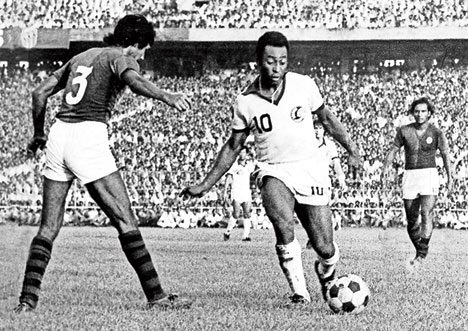
Compton Dutta tries to defend against Pele at Eden Gardens in 1977. A Telegraph file picture
September 24, 1977. New York Cosmos was to face Mohun Bagan. But the ground at Eden Gardens was slippery after a shower. Pele was in two minds about taking the field. But the galleries were roaring his name in chorus. That warmed his heart. He decided to play. “And he played the entire match,” recalls Compton Dutta, who was a part of the Bagan XI.
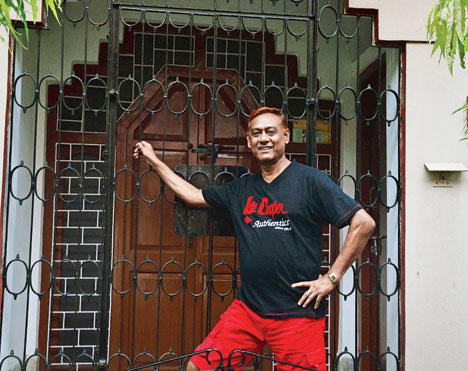
Seated in the drawing room on the first floor of his FD Block house, Dutta proudly revisits the match. “They went ahead by a goal scored by Alberto, who was Brazil’s captain in the 1970 World Cup. Then (Mohd) Habib and Shyam (Thapa) scored for us and we were up 2-1. But the referee gave a penalty in the dying moments amid an uproar. We asked Pele if it was a penalty. When he nodded in negation, we requested him to tell so to the referee. In broken English, he said the referee was the supreme authority. Thus the match ended in a draw.”
But what he saw of Pele later left a lasting impression. “There was a party in the evening at Grand Hotel where many had gatecrashed. When Pele got on the dais Dhiren-da (Dey, the Mohun Bagan secretary) placed a silver crown on his head.” In a short speech, Pele said to be a good player one has to be good human being first. So unruly was the crowd that when he went to have dinner, he was being pushed around from all sides and sweating, yet never did the smile waver from his lips. That showed that he really walked the talk.” That is why, in Dutta’s eyes, Pele will always be greater than Maradona.
The Cosmos match motivated the Mariners so much that they won the triple crown that year — ILA Shield, Rovers Cup and Durand Cup. “Ours was a star-studded team then — with Prasun (Banerjee), Gautam Sarkar, Ulaganathan, Habib, Akbar, Shyam and (Subhas) Bhowmik.”
It was time for Mohun Bagan to turn around after a period of humiliation. The club had lost almost every time to arch-rivals East Bengal between 1970 and 1975. Dutta rose up the ranks at Southern Sports Association and then Kalighat Club, marking his entry in first division football. He also debuted for Bengal in Santosh Trophy in 1974. He joined Mohun Bagan in 1975.
“Dhiren-da and (Sailen) Manna-da reared me with parental care. Subrata (Bhattacharya) and Prasun had joined the year before. Ulganathan was also there.” But it was East Bengal that had all the reigning stars. In 1975, in the IFA Shield final, the red-and-gold brigade rubbed it in with a crushing 5-0 scoreline on Mohun Bagan’s own turf. “I was fielded in the second half of that match,” Dutta says.
The turnaround started the next year with a 1-0 victory over East Bengal in the league. By then, the club had managed to wean away P.K. Banerjee as coach and then, Bhowmik and Samaresh Chowdhury from the red-and-gold ranks. Club transfers in those days were the stuff of thrillers. Footballers were sometimes made to sign on the dotted line at gunpoint.
Compton Dutta at the entrance of his FD Block house. (Saradindu Chaudhury)
Transfer tales
Dutta recalls Shyam Thapa’s entry to Mohun Bagan. “Shyam was playing the nationals in Patna. The final was over and the team was staying at a guest house with East Bengal musclemen on guard outside the gate. Late at night, they fell in a stupor after a few drinks. Mohun Bagan recruiters flashed burning match sticks at a distance in the dark as signal to Shyam. He collected his kit and climbed down through the window of the bathroom. A car was waiting for him and he was whisked away to Dehradun and then Delhi. News spread like wildfire that Shyam had escaped. But when his flight was landing at Dum Dum, Manna-da was ready on the tarmac with a police contingent. So there was no way East Bengal could snatch him back.”
A loyal Mariner all his life, Dutta faced the strong arm of the club only once. “Hemen Mondol and Omar worked for Mohun Bagan and Mohammedan Sporting respectively while Jiban and Paltu were the musclemen for East Bengal.” Once he came home to hear a fair and well-built man wanted to see him. “I realised who he was when he gave his name. He said word was doing the rounds that Bidesh (Bose) and I were considering a shift to East Bengal and Dhirenda wanted to meet us. Despite protests, he made us get into his car and reach the tent. Dhirenda was surprised to see us and told him not to worry about our loyalty.”
Football passion in those days ran high. Waiting in queue for a ticket overnight was common. “I have known people to sleep in the open for two nights also,” he says. “When we won, there were celebrations in Mohun Bagan localities. Sweets would be distributed, flags would be hung and songs would be played on the loudspeaker.” But if the team lost crunch matches or even drew against small teams, there would be hell to pay. “Irate supporters badmouthed us and torched vehicles on Red Road.”
Dutta had the misfortune of staying in an East Bengal para — Jadavpur. “Sometimes I would be called names as I would pass by on my bike. I always stopped and protested. Once I returned home after a derby win to find the ambience tense. A local boy had come up to our second floor place and abused my mother. Ignoring her plea, I stormed out to see who it was. The boy was not home but I told his mother that his behaviour was unacceptable and I wanted to meet him. Of course, he never came but others dragged him to our house to seek an apology. Years later, the same boy would be among neighbours coming to me for tickets.”
Tragedy strikes
He became Mohun Bagan captain in 1980. The same year on July 16, Indian football witnessed a black day with 16 spectators dying during a derby at Eden Gardens. “The common belief is the violence was sparked by the on-field altercation between Bidesh and Dilip Palit.”
But Dutta offers a different account. “The violence erupted before the match started. We saw people being carried out by the police as we walked out of the dressing room. We did not realise they were dead.” He blames the thoughtless distribution of tickets that allowed supporters of both teams to sit together. “And when police appeared at the top of the tier to lathicharge the crowd in D1 — the only block in the stadium then to have an upper tier — spectators tried to jump down 20 feet to the lower tier or were already crushed in the stampede.”
His senior international career took off with the 1978 trip to Bangkok for Asian Games. He would go on to play two Nehru Gold Cups, two Merdeka Tournaments, President’s Cup, King’s Cup and pre-Olympics. But it is the 1982 Asiad in Delhi that is at the top of his mind. “A preparatory camp was held for two years at the site where Salt Lake stadium was being built. We were put up in under-construction flats in Karunamoyee,” recalls the right-back who would move into Salt Lake much later, in 1995.
But the sore point was the payment on national duty — a paltry Rs 2000 per month for two years — in place of the club pay cheques ranging from Rs 70,000 to a lakh a year. Sensing the discontent, an option was given and 21 players opted out. “Ours was a valid point. But the media portrayed us as traitors to the country. We started getting heckled everywhere. Finally Priyada (Priyaranjan Dasmunshi) called a meeting and mediated a truce. The AIFF agreed to take back six players, including me.”
Fighting with fever
During the trials, Dutta was down with malaria yet he was kept in the team. “We drew against China and won against Malaysia and Bangladesh. After every match, I would need saline injection at the medical unit. In the quarter-final, Pradip-da (P.K. Banerjee, coach) asked if I was up for it. I said yes. He promised to substitute me whenever I would raise my hand as signal of exhaustion. I fell frothing at the mouth after half time but there was no substitution despite my repeated signals. After I was finally taken off, I was just changing into a track suit when Sudeep Chatterjee, my substitute, blundered at the top of the box resulting in a last minute goal. Pradipda was weeping bitterly.” Only then did he realise that there were just two minutes left. “Had I known, I would have carried on.”
He did get to play at Salt Lake Stadium at the fag end of his career. “It was such an improvement from the sticky mud of the Eden surface which stuck to our studs in the monsoon.”
Another count on which he considers the present generation lucky is the live telecast of matches. Communication was nil when they went abroad. “Once on Puja-eve, we were returning from a match in Pyongyang, North Korea via Moscow. We had to take a roundabout route as India were denied access to China airspace in those days. But word spread that our flight had crashed. It was only after we reached that we found the reason for the grim atmosphere at the local Puja pandals.”
Watching the Asian teams assert themselves at the on-going Fifa World Cup, he laments the decline of India’s standard. “We don’t even play the top teams in the continent now. The Indian Super League (ISL) may be a well-marketed event but will it help Indian football?” he wonders.
source: http://www.telegraphindia.com / The Telegraph,Calcutta,India / Home> Calcutta / by Sudeshna Banerjee / June 29th, 2018
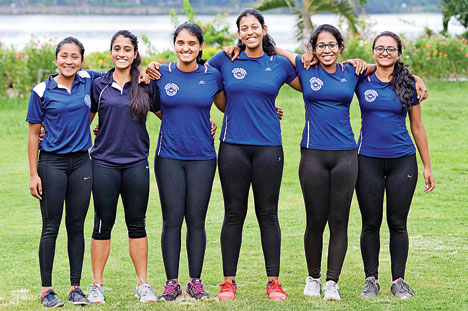
(From left to right) Aishwarya, Shreya, Shramana, Shweta, Shreyaa and Semanti at the Bengal Rowing Club. Pictures by Bishwarup Dutta
Calcutta:
Six girls from Calcutta will be part of the 10-member Indian women’s team for the World University Rowing Championship to be held in Shanghai from August 10 to 13.
Some 500 participants from 25 countries, including the US, the UK, Germany and Australia, will compete at the Shanghai Water Sports Centre in Qingpu district.
The finalists were selected at a trial camp in Chandigarh on June 18.
The top rowers from Indian universities attended the camp. The Calcutta contingent comprised four girls from Jadavpur University and two from Calcutta University.
Team JU
Semanti Choudhury, Shramana Saha and sisters Shreyaa and Shweta Brahmachari had won gold in the 2000m women’s fours in the national university championships at Chandigarh earlier this month.
The win was special because the team edged out Punjab University, the hot favourites, by 1.5 seconds.
“It is going to be a huge challenge in China,” Semanti, who has just completed her MSc in economics at Jadavpur University, said.
The senior-most in the group, she’s been rowing for more than a decade. Painting is her other passion.
Shreyaa, the older of the Brahmachari sisters, is doing her MSc in Chemistry from JU. “For me, it is labs and lakes,” Shreyaa, who lives in Southern Avenue, said. She got introduced to the lakes while taking swimming lessons at Anderson Club.
She shifted to rowing in 2009 at the Lake Club. Early morning trainings made her leave the bed at 5am. The two sisters slept together and it was their mother who prodded the younger daughter, Shweta, to follow suit.
“You, too, should get up early. Why don’t you join her for rowing,” Shweta remembered her mother telling her.
Shreyaa won her first medal (bronze) in 2010, the first time she took part in the sub-junior nationals in Roorkee. Shweta started rowing in the winter of 2010 and within six months, won gold in the sub-junior nationals in Calcutta.
Shramana, a first-year English honours student at JU, loves playing the double bass guitar. “I hardly have a social life. For me, the strings and the oars complement each other,” she said.
Team CU
Aishwarya Krishnan and Shreya Iyer, childhood buddies turned rowing partners, together won Bengal’s lone gold medal in the Senior National Championships in Pune last December.
The duo defeated Chandigarh and Odisha in the 500m women’s double sculls.
Shreya has just completed her graduation in psychology from Loreto College. Aishwarya studies commerce in St Xavier’s College. Both started rowing when they were in school, one after the other. The turning point in their careers came in 2015 when they became partners in double sculls. The two have since won several medals.
“We are super excited. Our strength is our chemistry,” Shreya said.
Rowing apart, Aishwarya is a trained Bharatanatyam dancer. Shreya’s other passion is violin.
The training
Shweta and Shramana are members of the Bengal Rowing Club. The rest are Lake Club members.
All six will leave for the training camp in Chandigarh in a few days.
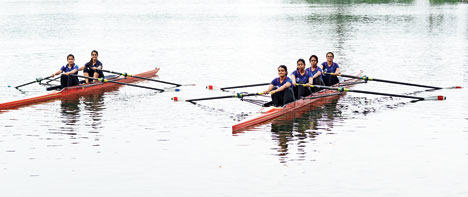
But they are already into full throttle practice mode at the Rabindra Sarobar lake.
Shreya and Aishwarya are focusing on double sculls while the four from Jadavpur are training for women’s fours.
They are training in two shifts at the moment – early morning and evening.
Apart from boat sessions, long-distance running, ergometers and gymmimg are part of their schedule.
All four are on a junk-free and high-protein diet.
“We have not competed with so many formidable teams on an international level earlier. But we will give everything we have got,” Aishwarya said.
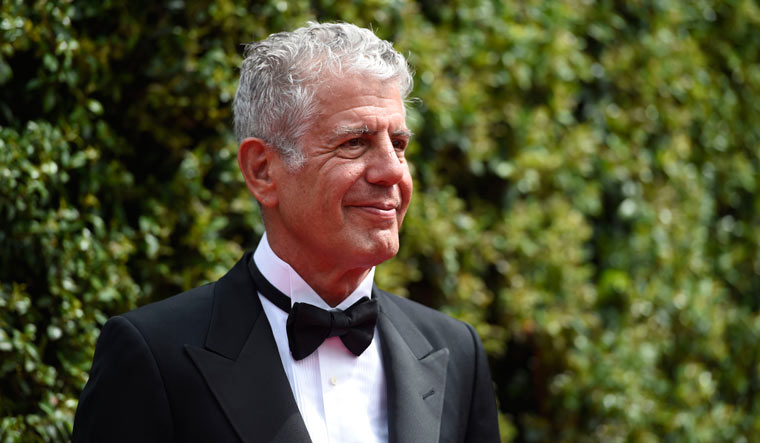
The news of US celebrity chef Anthony Bourdain’s death has sent shock waves across the food world and beyond. Bourdain, who will be remembered as a renowned chef, author and TV personality, was also an intrepid journalist. He pioneered a kind of a cultural field reporting which offered an unpretentious window into the lives of people who toil and sweat to earn their bread, who are the hidden cogs of a food chain whose most ostentatious and snobbish aspects are held up as aspirational. He travelled the world in search of stories connected to food and eating and living. He patiently listened, and allowed himself to be carried away. When he came to India in 2006 to shoot an episode of his TV series No Reservations, he characteristically observed: “To be in India, anywhere in India, is to risk being endlessly enchanted and repelled, until your senses wanna to shut down.”
A major part of that episode was devoted to his time spent in Kolkata, although the same episode also featured the high-energy Maximum City Mumbai. Bourdain pointed out how these two were the only cities in India, with their tightly-packed interweaving of class and cultures, which reminded him of home, that is New York. Bourdain took a second class train to reach Kolkata and immersed himself in its sounds, smells, shapes and colours, traversing a journey which has charmed countless other dreamers, authors, filmmakers.
After intently watching a cock-fighting match in rural Bengal, digging into a two-rupee plate of poori-aloo bhaji in a flower market under the Howrah Bridge and attending local wrestling matches and temple rituals, you could only trust Bourdain to cleverly remark, “Incidentally if you are going to be reincarnated in India , I highly recommend being a cow. The service is excellent.”
He even waded into the sets of a TV serial shoot, where he dined on a simple, wholesome thali with the cast and crew. Mamata Shankar, Bengali actress and daughter of famous Indian dancer Uday Shankar, was in the middle of a shoot, but happily entertained her curious guest who derived a great sense of reassurance from the fact that soap operas the world over are the same, like good old comfort food. In a Mid-Day article, Mamata fondly reminisced: “He was a happy Frenchman, consumed by food. We ate together that afternoon and he surprised me with his knowledge of Bengali food. He was a khaddo rashik (gourmand). I told him about my father and uncle (Pandit Ravi Shankar). He was familiar with their work. I was surprised how much he knew about my family.”
Accompanied by a popular food columnist Nondon Bagchi, Bourdain played a hectic round of cricket at Kolkata’s Maidan and followed it up with a round of jhaal muri and a similar version of the savoury snack served with crackers from vendors on the fringes of the park. This wasn’t very dissimilar to eating nachos after a game of baseball, the dapper chef thoughtfully pointed out.
When onboard a ferry in the Sundarbans to escape the hectic flurry of the city, Bourdain was your green hero worried about submerged islands and sustaining biodiversity. But every global issue for Bourdain had an entry-point from food. Who would have thought that prawns and bhetki fish in extra virgin diesel oil could be so tasty, Bourdain observed as any real journalist would, always curious, open-minded and unafraid of the unknown.
source: http:theweek.in / The Week / Home> Leisure> Lifestyle / by Sneha Bhura / June 09th, 2018
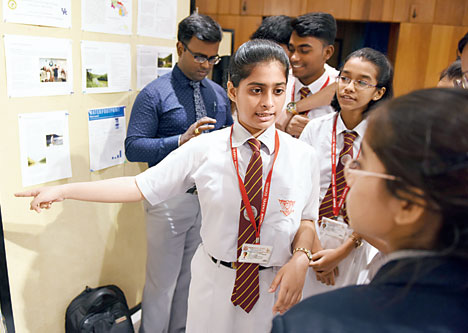
A study on quality of water brought together schoolchildren from Calcutta and Kentucky.
Students of 10 schools from Calcutta, Durgapur, Kharagpur, Ranchi and Guwahati studied the quality of water from various sources and the Kentucky students assessed the impact of coal mines on water. They presented their projects at American Center on Friday. Students of Union Chapel School at American Center on Friday. Pictures by Ankit Datta
The students of DAV Model School, Durgapur, were declared winner for their study on the water of Barakar river flowing through Jharkhand and Bengal. They shared the prize with the students of Belfry High School, Kentucky, who based their project on wells in East Kentucky.
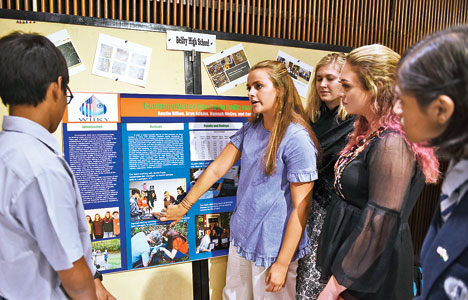
Students of Belfry High School, Kentucky – Pictures by Ankit Datta
Ten schools from eastern India and 12 from Kentucky tested samples from 121 water bodies, including rivers, wetlands, ditches, canals, wells and ponds in their own areas. The findings were shared with the community to discourage contamination of water.
The project titled Exploring Water Quality in Eastern India and Kentucky was launched by the US consulate general in Calcutta, in collaboration with University of Kentucky and Association of Social and Environmental Development,
“We hope the participants will take the lead in championing positive social change regarding water quality and conservation,” said Jamie Dragon, director, American Center.
The students of Belfry High School investigated water in 10 wells near coal mines.
“We will present a proposal to the Environmental Protection Agency in the US because well water is not regulated,” said Haridas Chandran, physics teacher at Belfry.
The students of DAV Model School, Durgapur, checked the pH level of Barakar river water and its residual chlorine content. One of the findings was that storing the water for long is not recommended because the absence of residual chlorine can trigger a significant growth of microbes.
“We carried out some tests in the school laboratory and the rest on river banks,” said Soumit Das, Class XII.
Garden High School worked on wetlands and Sri Sri Academy on water quality of Hooghly.
Carol Hanley, who guided the students in India and Kentucky, said they had to choose a waterbody that had both cultural and scientific significance.
“We call this community- based science so that science becomes real,” said Hanley, the director, College of Architecture, Food and Environment, University of Kentucky.
source: http://www.telegraphindia.com / The Telegraph,Calcutta,India / Home> Calcutta / by A Staff Reporter / June 23rd, 2018
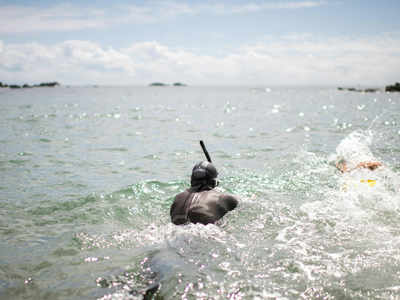
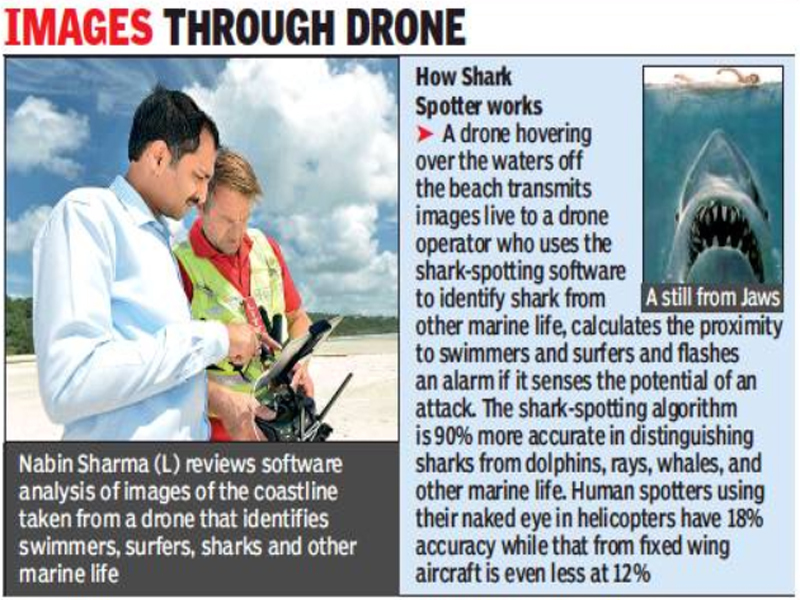
Shark Spotter has been deployed in 11 beaches in north New South Wales such as Byron Bay, Ballina (picture for representation only)
Jalpaiguri :
Remember Jaws, the 1975 Hollywood thriller on a giant man-eating great white shark that struck terror on fictional resort town Amity Island? In beaches across Australia, the Steven Spielberg reel horror is real with the country recording the largest number of unprovoked shark encounters with humans after the United States.
Now several Australian beaches have deployed a technology co-developed by a technologist from north Bengal that uses artificial intelligence to seek out sharks based on aerial footage from drones and warn swimmers to get out of the water quickly.
Dubbed as Shark Spotter, the software uses an algorithm capable of using video footage streamed from drones to detect sharks and alert swimmers. “The Shark Spotter is the world’s first, non-destructive technology able to detect sharks and other potential threats using real-time aerial video imagery. The new algorithm is 90% accurate in distinguishing sharks from other marine life. Human spotters from fixedwing aircraft or helicopter have accuracy of 12%-18%,” said Nabin Sharma, a lecturer at the University of Technology Sydney, who along with Michael Blumenstein developed the software that is making waves Down Under.
Shark Spotter has been deployed in 11 beaches in north New South Wales such as Byron Bay, Ballina, where shark attack was a major problem. And they have already saved lives. Shark attack reports from these beaches have declined significantly, prompting authorities in beach towns in the US and Europe to also consider the technology.
The Shark Spotter technology has won in three major categories (Research & Development Project of the year, Artificial Intelligence or Machine Learning Innovation of the year and Community Service Markets) in the Australia Information Industry Association, iAward 2018, New South Wales.
Sharma did his schooling in Holy Child School, Jalpaiguri, before graduating from Ananda Chandra College in the town. He then did Master of Computer Application (MCA) and Bachelor of Science from Siliguri Institute of Technology, before doing his PhD from the School of ICT, Griffith University. He is currently a lecturer with the School of Software, University of Technology Sydney (UTS).
Of more than 500 known shark species, 26 have been involved in unprovoked attacks on humans. Of these, Australia has 22 shark species. Australia records an average 1.5 deaths per year from shark .
source: http://www.timesofindia.indiatimes.com / The Times of India / Home> City News> Kolkata News / by Pinak Priya Bhattacharya / TNN / June 24th, 2018
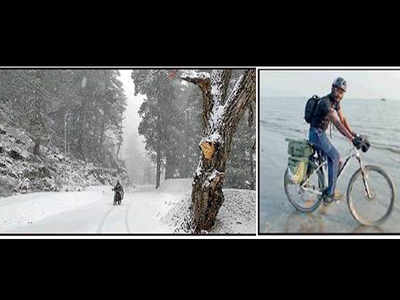
City mountaineer and trekker Samrat Moulik recently cycled 3,000km from Gangotri in Uttarakhand to Kuakata in Bangladesh
Kolkata :
A mountaineer and trekker from Kolkata, who quit a corporate job to pursue his passion, is preparing for a mega cycling expedition of 5,500km – from Nubra Valley near Ladakh to Kanyakumari and onward to Sri Lanka.
Three months ago, he completed a 3,000km solo cycling journey from Gangotri in Uttarakhand to Kuakata in Bangladesh, traversing the entire length of the Ganga as it meandered through five states before entering Bangladesh.
“The condition of the Ganga – that we consider sacred and yet pollute – prompted me to undertake the ‘Save Ganga’ campaign in February-March. I wanted to know what was polluting the river and its impact on the population living along its length,” said Samrat Moulik. He began the journey on February 8 this year and finished on March 21.
While the condition of the river is good in Uttarakhand, its deterioration was visible after Haridwar. “Pollution actually began at Nagina – a town in Uttar Pradesh. In Moradabad, there is cremation ground at the ghat, a picture that one sees all along the river thereafter. From there on, the river water gets murkier as it flows. The effects of Ganga Action Plan, about which I had heard for years, were not visible. The pollution load of the Ganga increases as polluted tributaries flow into it,” said Moulik.
As the river flows downstream, industrial waste becomes the major pollutant. The situation improved in Jharkhand. But when the river bifurcates into the Hooghly and the Padma near Rajmahal, its condition again deteriorates. “The situation is better in Bangladesh because of people’s dependence on the river,” he said.
Moulik plans to start his journey in September. He will cover several rivers in central, west and south India before travelling to Sri Lanka and cycle along the rivers there.
source: http://www.timesofindia.indiatimes.com / The Times of India / Home> News> City News> Kolkata News / TNN / June 14th, 2018
Shib Shankar Patra is one among thousands of die-hard Argentina fans in Kolkata and there’s nothing unusual about it.
But then die-hard fans at times can be weird too and the 53-year-old Patra has that weird streak in him.
Trying to garner enough savings from his modest earnings through a tea stall, Patra harboured a dream — to watch ‘The Albiceleste’ live from the stands in Russia.
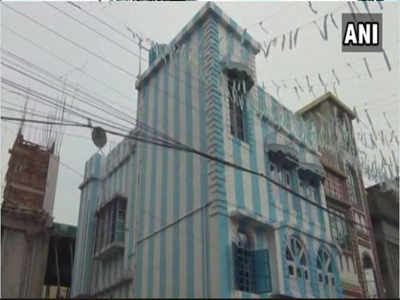
But when a Kolkata-based travel agent informed him that his savings — a princely amount of Rs 60,000 (USD 900) is not enough to fund his World Cup trip (travel agent gave him a budget of Rs 1.5 lakh), he decided the next best thing –paint his entire three-storied building in Argentina colours.
“I don’t smoke or drink. I have only one addiction and that is Lionel Messi and Argentina. I don’t earn much but ensure that bulk of my earnings is kept aside for these indulgences when World Cup comes calling,” Patra, owner of a tea and snack stall in North 24 Parganas’ Nawabganj township, told PTI.
You don’t need a GPS to track Patra’s house once you get down to Ichhapore Railway Station. Ask any cocky teenager or elderly uncle about “Argentina Chaayer Dokan” (Argentina Tea Stall), they will be more than happy to oblige.
The street leading up to his tea stall cum house is dotted with Argentina flags while a giant one flutters high making its presence felt.
Every four years coinciding with the World Cup, Patra, who runs his tea stall from the ground floor of his three-storied building, gives his building a fresh coat of light blue and white shade.
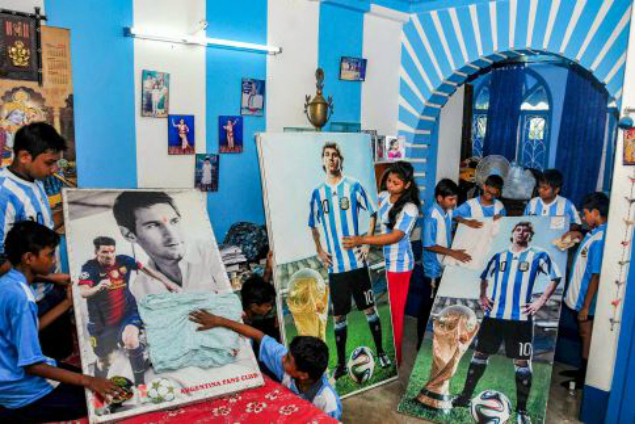
Enter his three-room apartment and the craziness hits you instantly. All the walls are painted in Argentina colour, even the small ‘puja sthal’ (where the idols of Gods and Goddesses are placed). The walls of each room adorns a life-size vinyl flex print poster of Messi.
Addiction can be contagious but if its ‘Messi mania’, Patra doesn’t mind that his wife Swapna along with his children — 20 year-old daughter Neha and 10-year -old son Shubham are equally mad about the fleet footed genius.
“My kids know everything about Messi. The food he likes, the car he drives, everything,” Patra says with a glint of pride in his eyes.
“They don’t miss a single match of Messi. If there’s a late night match during the exams, they will pretend to sleep early but will watch live streaming on their cell phones,” wife Sapna said.
There is one common thread of all Argentina fans in Bengal. The 1986 World Cup, which was aired live on Doordarshan turned Kolkatans into ‘Maradona devotees’. Messi is an extension of Maradona.
“I have watched the Argnetina friendly at the Salt Lake Stadium. I lived a dream that day,” Patra recollected.
It was the first time, he painted his house in Argentina colours, something he repeated in the 2014 edition of the World Cup as well.
Since 2012, the Patra family celebrates every Messi birthday with fanfare like cutting cake to organsing blood donation camp.
And it goes without saying that tea and samosas (staple diet for Bongs during their football adda sessions) is complimentary on all Argentina match days.
With Messi’s birthday coinciding with the World Cup, they have cancelled the blood donation camp, which is held every year.
Instead a 30-pound cake will be cut and 100 Argentina jerseys will be distributed amonmg local kids with Messi’s photograph embossed.
In attendance would be the local MLA and India U-17 World Cupper Rahim Ali.
By his own admission, he has never taken any loans for his personal indulgences.
“I’ve never sought money from anyone but we never fell short, and somehow everything falls in place in time,” Patra said.
“People here also happily come forward. Someone sponsors the food, someone gets the cake and we make it a mini-Argentina here,” Patra says.
Even there will be prayers for Messi with the priest of the local Hanuman temple — his regular client — offering special prayers for the Argentine wizard.
“He gets me the ‘sindoor’ from Hanuman’s left leg (the connection is Messi being a left-footed player) and the vermilion is applied on Messi’s poster during every match. We hope he lift the Cup this time,” Patra signed off.
source: http://www.timesofindia.indiatimes.com / The Times of India / Home> News> City News> Kolkata News / PTI / June 13th, 2018
The announcement regarding the coal mine allocation was made by CM Mamata Banerjee on Facebook.
Kolkata :
West Bengal has finally received allocation of the Deocha Pachami Harinsingha Dewanganj coal mines in Birbhum district. Deocha Pachami Harinsingha Dewanganj is the world’s second largest coal mine. The project is likely to bring investment worth Rs 12,000 for the state.
Making the announcement on Facebook, chief minister Mamata Banerjee wrote, “I am very happy to share with all of you that after a long wait of 3 years, West Bengal has got the allocation of the Deocha Pachami Harinsingha Dewanganj Coal Mines in Birbhum district.”
The chief minister added, “With an estimated reserve of 2102 million tonnes, it is the 2nd largest coal mine in the world. The mining project has huge potential of generating nearly a lakh of direct and indirect employment opportunities in Birbhum and neighbouring districts.”
Referring to the coal mine, Mamata added, “It will also involve investments worth Rs 12000 crores in the intermediate run. There will be huge socio economic development of Birbhum, the neighbouring districts and the entire state.”
Necessary administrative infrastructure has already been set up to start the project immediately.
source: http://www.timesofindia.indiatimes.com / The Times of India / Home> News> City News> Kolkata News / by Ajanta Chakraborty / TNN / June 09th, 2018
Proud moment: Indian rallyist team comprising Ashwin Naik from Mangaluru and Amitrrajit Ghosh from Kolkata won the European Rally Championship, ERC 3 category, at Athens, organised by the Federation of Internationale de lautomobile; (right) the team during the race.
This is the first time the duo has won the coveted championship
The Indian rallyist team, comprising Amitrrajit Ghosh of Kolkata and Ashwin Naik from Mangaluru, on Sunday won the European Rally Championship, ERC 3 category, at Athens in Greece organised by the Federation of Internationale de l’automobile (FIA).
A release here said it was the first time that the Indian rally duo has won the coveted European Rally Championship. The debutantes Ghosh-Naik drove a Ford Fiesta R2.
The event for the Indian duo was sponsored by Ramakrishna Race Performance Management of Kolkata and Pana, a Mangaluru-based Educational conglomerate.
Quoting Mr. Ghosh and Mr. Naik, the release said it was the first time that any Indian team has made it to the top slot. The European rallyists and the FIA were awed by the victory. The international rally scenario for Indian drivers would not be the same any more as Amit-Ashwin duo have just raised the benchmark, the release said.
Congratulating the duo, Chairman of Pana educational group Prasad Hegde said the Amit-Ashwin team have brought laurels to the country and Pana group is extremely happy with the results.
This was also the first international event that any Mangaluru-based organisation has sponsored.
The Indian duo, who scripted début victory, were leading in their class right from the day one of the three-day rally that passed through some torturous terrain.
Mr. Ghosh, an ace driver was ably co-driven by Mr. Naik and his immense experience left no ambiguity about this victory when they started for the last leg on Sunday.
The release quoted them as saying, “We both drove with safety on top of our mind which gave us confidence right from the word go. We just had to bring the car to the ramp in one piece which we did with great aplomb.”
It quoted Mr. Ghosh as saying, “I and Ashwin knew that we were racing with an older generation of Ford Fiesta R2. Our goal was always to finish the rally with honourable points but we did it by winning the ERC 3 on the top slot which is so fulfilling.”
source: http://www.thehindu.com / The Hindu / Home> News> Cities> Mangaluru / by Special Correspondent / Mangaluru – June 07th, 2018