Category Archives: World Opinion

Badminton: How Subhankar Dey overcame India snub and loneliness in Europe to win SaarLorLux Open

Dey, who ran away from home to keep playing badminton and travels without a coach, defeated England’s Rajiv Ouseph in straight games in the final.
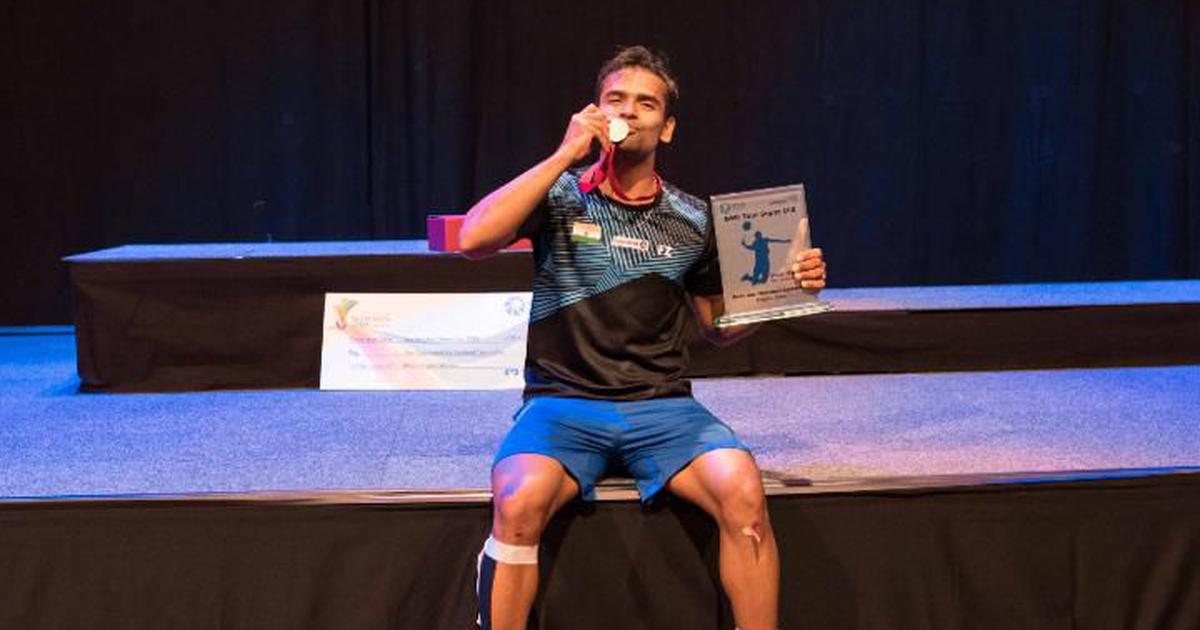
Sven Heise/Badminton Photo via Subhankar Dey

On the eve of the biggest final of his career, Subhankar Dey went out with his roommate to walk through a local fair in Saarbrucken, Germany, and kept telling himself that winning the SaarLorLux Open title was the last thing he has to worry about.

After all, the 25-year-old had never imagined playing in a Super 100 final, leave aside winning a title, when he ran away from his home in Kolkata eight years ago because he wanted to pursue the sport while his mother wanted him to take up the Food Corporation of India job offered to him.

But on Sunday, the world number 64 showed the temperament of a champion and the guile of a battle-hardened journeyman to upset fifth seed Rajiv Ouseph 21-11, 21-14 and clinch the biggest title of his career.

It had been a phenomenal week for Dey as he overcame former World and Olympic champion Lin Dan in the second round and saved two match points in the semi-finals against China’s Ren Pengbo before booking his spot in the final.

“My only dream was to become a professional badminton player and I had to struggle even for that,” said Dey, while trying to control his emotions. “But I am thankful to my parents and especially my elder sister who stood by me and this title is dedicated to them.”

He added, “Even after beating Lin Dan, all I told myself was that I am playing well and should make the most of it. So I prepared similarly for the next-round match and thankfully I played very well [against Toby Penty].”

Career struggles
To say that Dey’s journey from the cement courts of Kolkata to the podium in Saarbrucken was difficult would be an understatement.

After leaving home, the youngster trained for couple of years with Shrikant Vad at the Syed Modi Academy in Thane before hopping through various training centres in India, as some coaches had problems with his approach while others couldn’t accommodate him for long.

With his career going nowhere, a break to play in the Danish League for Greve Strands Club provided Dey with an opportunity to hone his skills further and also play more international tournaments thanks to his base in Europe.

“Yes, playing for a club in Europe helped me play more tournaments,” Dey said. “But it was difficult to live all by myself. There used to be no one to talk to and once after winning the Portugal Open title in 2017 I spent two days at the airport because I wanted to see people and interact with them.”

Dey, who lived with a family in Denmark that did not charge him money as their child also played in the same club, would spend all his prize money, his Railways salary and the funds given by his elder sister to play tournaments and record his own matches as he never had anyone to coach him there.

He also began following the European system of studying his opponent’s videos and planning his match strategy in the absence of a coach.

The changes brought the desired results as he won the Iceland International and Portugal International in 2017 and also reached the semi-finals of the Senior Nationals in Nagpur last year after beating 2017 Singapore Superseries champion B Sai Praneeth.

He was, however, still overlooked for the national camp probably because he had left it midway back in 2014 when he was sent to Bengaluru to train with Saina Nehwal, while the rest of the men’s shuttlers were practising at Hyderabad.

Opening an academy
Instead of getting demotivated by the snub, Dey worked towards starting his own academy in Kolkata to provide local players and even those in India who are overlooked by the big centres an opportunity to train with quality coaches.

While he was clear that he had many years of badminton left in him, he hired Indonesian coach Nur Mustaqim Chayo to work with the trainees. Dey himself has been training at the same centre for the past few months.

“I never got an opportunity to train at the national camps or the big centres like Gopichand Academy or Padukone Academy,” said the shuttler, who is supported by the Lakshya NGO. “I was even asked to leave a few academies, while I couldn’t settle in some. So I decided to start an academy of my own and I am happy to finally work with the coach on my game.”

The academy, managed by his elder cousin Somnath Kar, has allowed Dey to focus solely on his training and preparations. In the SaarLorLux Open final, he showcased his ability to read the game and make a solid game plan as he did not allow Ouseph to attack and use his height advantage. “I did a lot of homework and it paid off. I watched his games. I was patient and knew I had nothing to lose,” he said.

The title would have definitely helped him gain confidence that his chosen way of putting in the hard yards do deliver the goods.

source: http://www.scroll.in / Scroll.in / Home> Badminton / by Abhijeet Kulkarni / November 05th, 2018
Here lies Hindoo Stuart: Inside the 250-year-old Park Street cemetery

The Park Street cemetery, which is now 250 years old, is home to stories of Kolkata’s past and present.

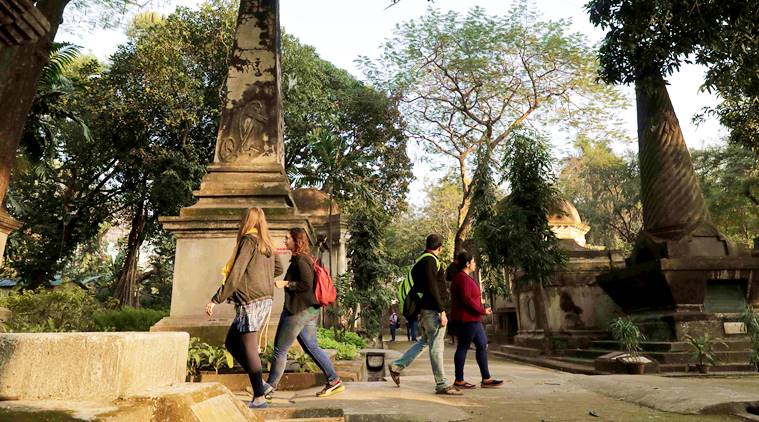
South Park Street Cemetery , one of the oldest Christian cemeteries celebrates 250th birthday on Saturday, January 06, 2018.It is a consecrated Christian Cemetery with mortal remains underneath each of the 1600 plus vaults with remarkable Tombs . Locals , tourist ,as well as embassy people seen in the cemetery during the programme Express photo by Partha Paul.

In the 250 years of its existence, the Park Street cemetery in Kolkata has seen its share of stolen kisses and frantic lovers, both gay and straight. In Vikram Seth’s 1993 novel, Suitable Boy, Lata takes a leisurely through the Park Street cemetery along with a friend, Amit. They visit the tomb of Rose Aylmer, a Welsh girl who sailed to India with an aunt in 1798, and died of cholera two years later. Famous British poet Walter Savage Landor, a suitor of Rose, immortalised her in a poem Rose Aylmer. Amit and Lata recite the poem together at the spot.

Not far from the bustle of one of Kolkata’s busiest streets, is the South Park Street Cemetery, with two functional old iron gates at the entrance. Inside, rows of obelisks and gazebos spread out on both sides in no particular order. A marble plaque on the left pillar declares that the cemetery opened in 1769 and closed in 1790, but historians will tell you that burials continued into the 1830s.

The cemetery is the final resting place of many like Rose Aylmer. As Souvik Mukherjee, assistant professor of English, Presidency University points out, most Europeans who would land in the muggy, mosquito-ridden city, would last only “two monsoons”. “They would almost always fall prey to malaria,” says Mukherjee, who specialises in the cemeteries of Bengal. The truncated pillars that dot the cemetery signify lives lost too soon. “You will find graves of many, many children here,” says Mukherjee.

According to Susan Hosking’s book, The Great Burial Ground at Chowringhee: Reflections on the South Park Street Cemetery in Kolkata, this is one of the oldest non-church cemeteries in the world. Hosking says that by the mid-18th century, the old Christian burial grounds in the ruins of the first Fort William, established in 1665, had become inadequate. Eight acres of relatively high ground in an uneven and swampy area were marked out for a new cemetery on what was then the southern outskirt of the town.

The oldest tomb in the cemetery, according to Mukherjee, is that of Mrs Sarah Pearson, who died on September 8, 1768. Very little is known of the oldest resident of the place but tomes have been written on the one who has the most prominent tomb of the cemetery — a blindingly white structure in a maze of greys. The tomb of Sir William Jones, renowned philologist and founder of Asiatic Society of Bengal, finds pride of place bang in the middle of the cemetery.

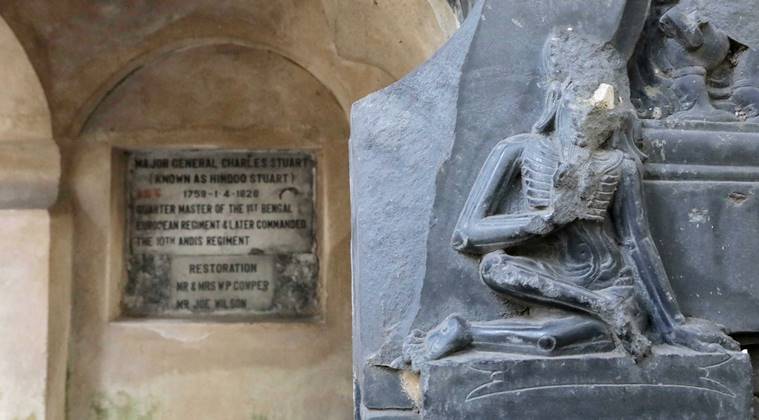
Major General Charles Stuart, known as Hindoo Stuart tomb at South Park Street Cemetery , one of the oldest Christian cemeteries celebrates 250th birthday on Saturday, January 06, 2018.It is a consecrated Christian Cemetery with mortal remains underneath each of the 1600 plus vaults with remarkable Tombs . Locals along as well as embassy people seen in the cemetery during the programme Express photo by Partha Paul.

It is definitely not the most beautiful structure in the premises. That distinction belongs to the tomb of Charles Stuart (1758- 1828) or as the officer of the East India Company was popularly known, Hindoo Stuart. A beautiful synthesis of Hindu, European and Islamic styles, the tomb looks like an exotic guest in a genteel gathering. “He was one of the few British officers to embrace Indian culture,” says Mukherjee. CP Hodson’s biography of Stuart mentions that he “had studied the language, manners and customs of the natives of this country with much enthusiasm, his intimacy with them … obtained for him the name of Hindoo Stuart.”

However, in 1984, this very tomb almost fell prey to the greed of realtors. “The cemetery continues to exist thanks to a legal intervention by the Calcutta High Court. An order was issued stopping a well known family business from turning the cemetery into an arts centre. The demolition work had already begun and the damage can still be seen. Innumerable graves have been lost, replaced by strewn rubble and a multi-storey car park. The tomb of Charles Stuart was demolished, later restored, and the demolition of DeRozio’s grave had begun. Justice Bagbati Banerjee saved the South Park Street Cemetery,” says Anthony Khatchaturian writer, guide and Kolkata Heritage activist.

Deepanjan Ghosh, who runs an exhaustive blog on forgotten chapters of the city’s history, says one of the most interesting personalities to be buried in the cemetery is Elizabeth Jane Barwell, popularly known as Miss Sanderson. The “celebrated Miss Sanderson”, daughter of a colonel in East India Company’s army, was widely known as the most beautiful girl in Calcutta when she arrived. She was also notoriously mischievous. “A popular story about her is that she told 16 of her suitors that she would be going to a ball in a Parisian dress and it would be marvellous if they wore a similar costume of pea-green, with pink silk trimmings. All of the men turned up in the exact same ridiculous outfit!” says Ghosh.

Not very far away from her tomb is the modest one of Henry Louis Vivian Derozio (died 1831), the revolutionary thinker and poet who, in many ways, shaped the then Bengali intelligentsia. At the age of 18, he got the post of a lecturer in English literature and history at the Hindu College. He was considered to be a rabble-rouser by the orthodox, Hindu-dominated management of the college as he encouraged his students to question social evils. Eventually, he was expelled. His untimely death soon followed. But his legacy lived on. “His grave is the most visited one in the cemetery,” says Ghosh.

Not surprisingly, the cemetery has inspired its share of ghost stories. There were rumours of a priest in white cassock haunting the premises. Mukherjee dismisses it with a simple, irrefutable logic. “Priests in India wear black cassocks,” he says.

source:http://www.indianexpress.com / The Indian Express / Home> Eye / by Premankur Biswas / January 28th, 2018

The Downton Abbeys of Dhanyakuria

Wandering in the Bengal countryside could bring you to these accidental Indo-English castles

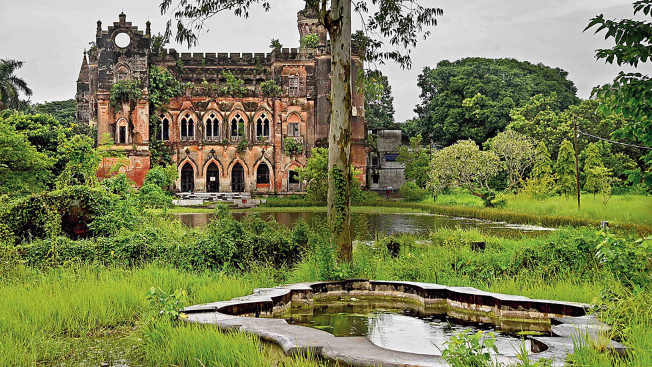
Gaine Garden on the Barasat-Taki highway looks every bit the English castle
Image: Ankit Datta

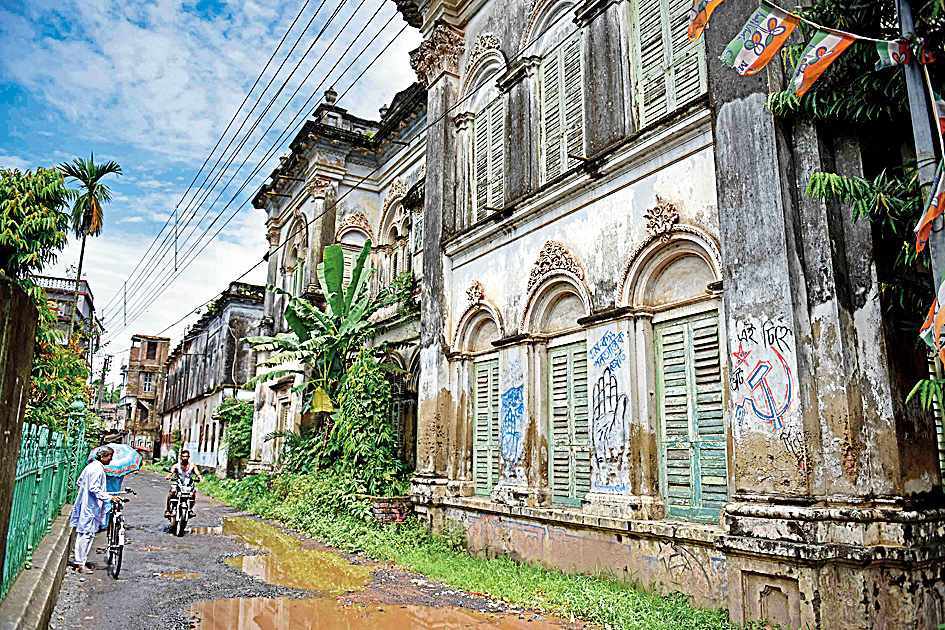
Anyone who has travelled along the Barasat-Taki road — northwards from Calcutta, towards Basirhat — would have noticed the picture-postcard castle. Visitors are not allowed inside the gated compound, but you can stop and admire the turrets, spires, the uneven roofline broken by stepped gables.

But that afternoon, when we reach the place, the gates are wide open. A truck is downloading bricks — we learn they are for the construction of a government office building. It is a 30-acre campus and we are eager to explore it. We sneak in and manage some quick clicks, when some security guards spring into action. We are chased out with a stern — “You need permission from the [social welfare] department.”

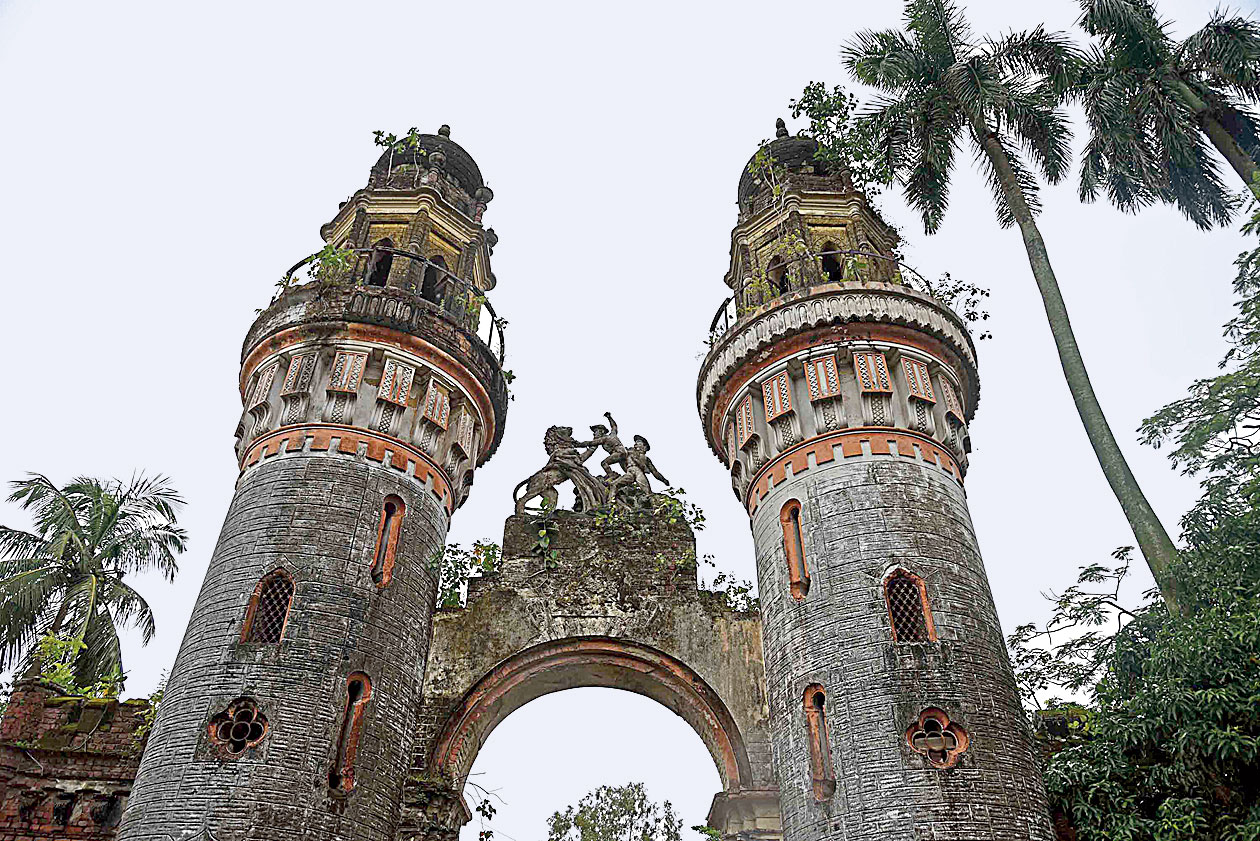
Atop the Gaine Garden gateway is some colonial baggage in stone — figures of two Englishmen overpowering a lion with bare hands
Image: Ankit Datta

Out on the road, we ask a passerby what this grand structure is called and what it’s meant to be. “This used to be called Gaine Garden, property of the Gaines,” he informs us, and for details redirects us to the Gaine progeny living in Dhanyakuria village in North 24-Parganas.

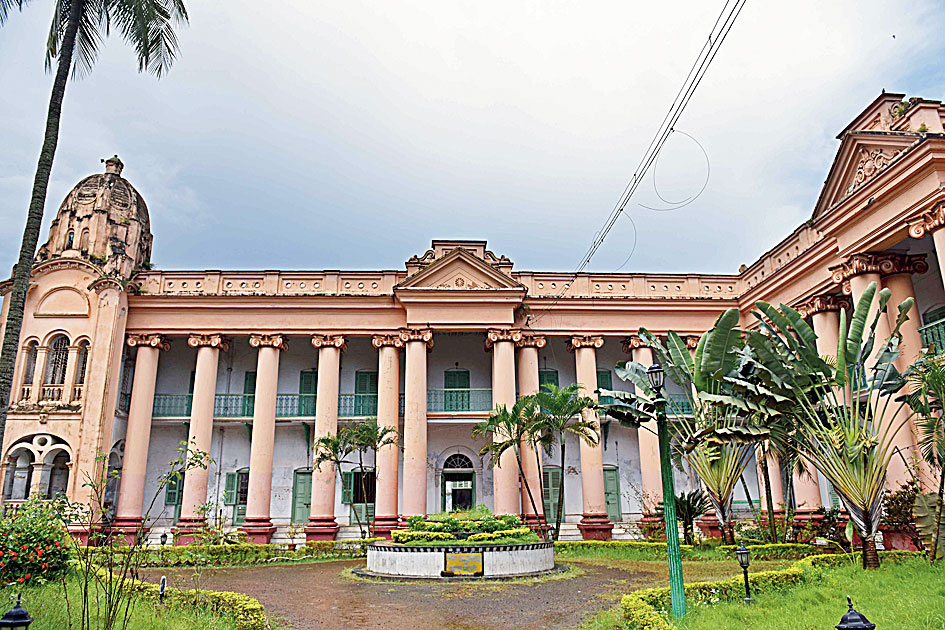
Teacher and writer Monjit Gaine lives with his elderly father, Kanchan Gaine, and his family in a portion of yet another grand structure of long, open corridors and many wings called the Gaine Rajbari. Monjit ushers us into the majestic thakurdalan or collonaded altar for Durga worship. He says, “Every other month some tele-serial or movie is shot here. Villagers call this ‘shooting bari’.” According to him, it is the rent from film production companies that aids the upkeep and maintenance of the huge mansion.

Unlike Gaine Garden, Gaine Rajbari was meant to serve as residential quarters and is located inside Dhanyakuria village
Image: Ankit Datta

The Gaines made a fortune trading in jute, jaggery and other agricultural products. They worked in partnership with two other families of Dhanyakuria — the Sawoos and the Ballavs. All of them enjoyed the patronage of the British. “Huge tracts of agricultural fields and land ownership turned them into zamindars,” says Monjit. “Family lore goes that our ancestral properties extended to Satkhira in present-day Bangladesh, and in north, central and south Calcutta,” he adds.

Gaine Mansion was built in parts, primarily by Gobinda Chandra Gaine and his son, Mahendranath Gaine, mid-19th century onwards. Mahendranath was a prominent member of the Bengal Chamber of Commerce and owned quite a few jute mills too. He was the one who built Gaine Garden by the main road. Post Independence, the state government acquired the property. Says Monjit, “A few years ago we heard it had acquired the heritage tag. [Once a property gets this tag, it cannot be defaced, its basic structure cannot be changed either.]” He has no clue about the ongoing construction.

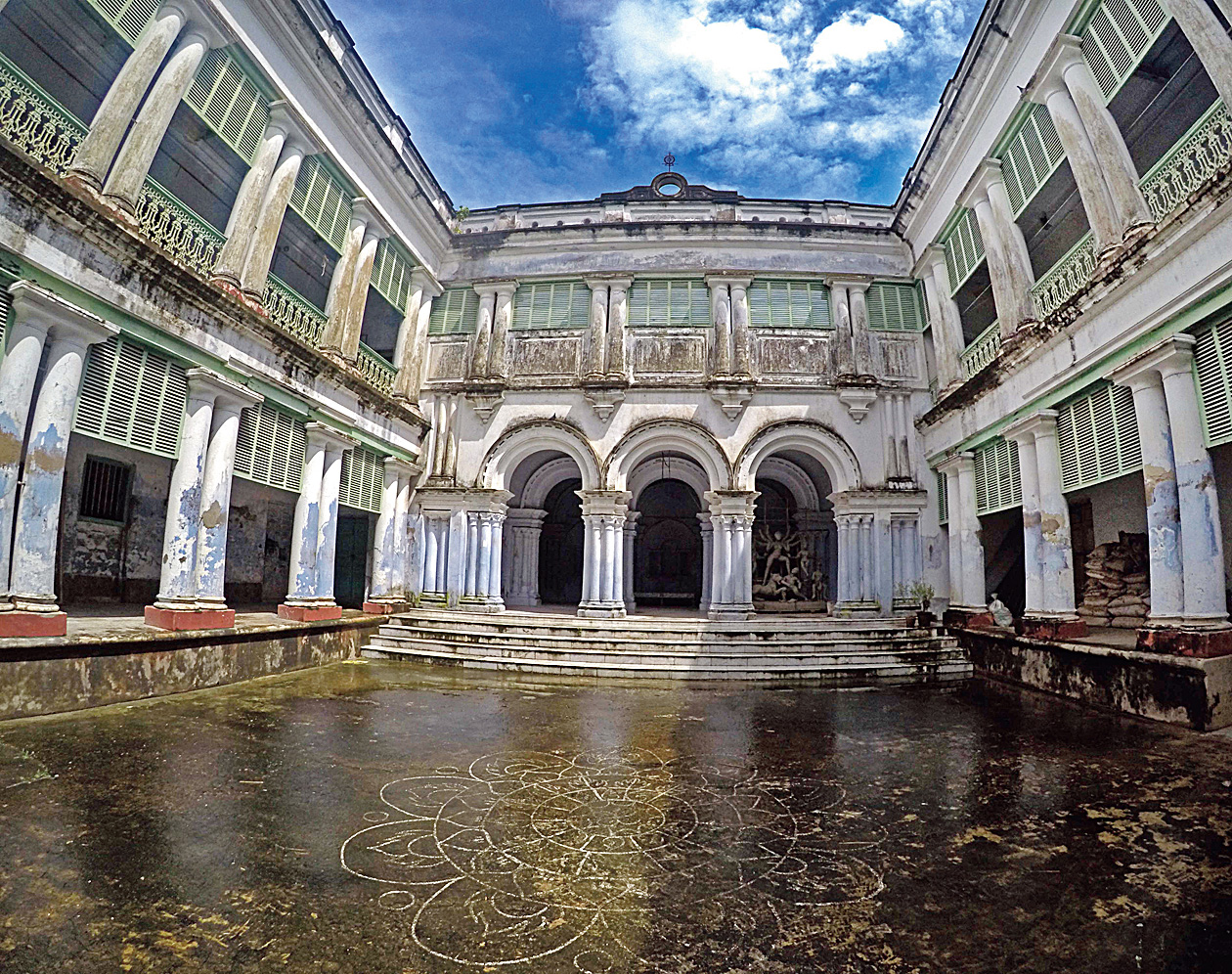
Its thakurdalan has featured in films such as Guru Dutt’s Sahib Bibi Ghulam, the Indo-French production La Nuit Bengali and the Uttam Kumar-starrer Suryatapa. You can spy a Durga idol in one corner of the thakurdalan of the Gaine Rajbari. The Gaines have been commissioning the idols to the same family of artisans for nearly 200 years
Image: Ankit Datta

According to Monjit, the three leading families worked for the development of the area. They built hospitals, roads and schools. We cross the Sanskrit primary school-turned-private English medium prep-school founded by the Gaines. Beyond it, a little ahead of the trisection is the mansion of the Sawoos. The gate is locked, a neighbour says the caretaker has gone to the market and the owners don’t live here.

We peep through the collapsible gate and spy a thakurdalan almost as majestic as the Gaines’. Here too, there is a solitary and stark frame of an under-construction Durga idol. Later, we call Ashok Sawoo, who lives in north Calcutta. The house was built by his forefather, Patit Chandra Sawoo, 200 years ago.

The Sawoo Mansion usually remains closed; most of the family lives in Calcutta now. The house was founded by Patit Chandra Sawoo 200 years ago and extended by his son Rai Bahadur Upendra Nath Sawoo
Image: Ankit Datta

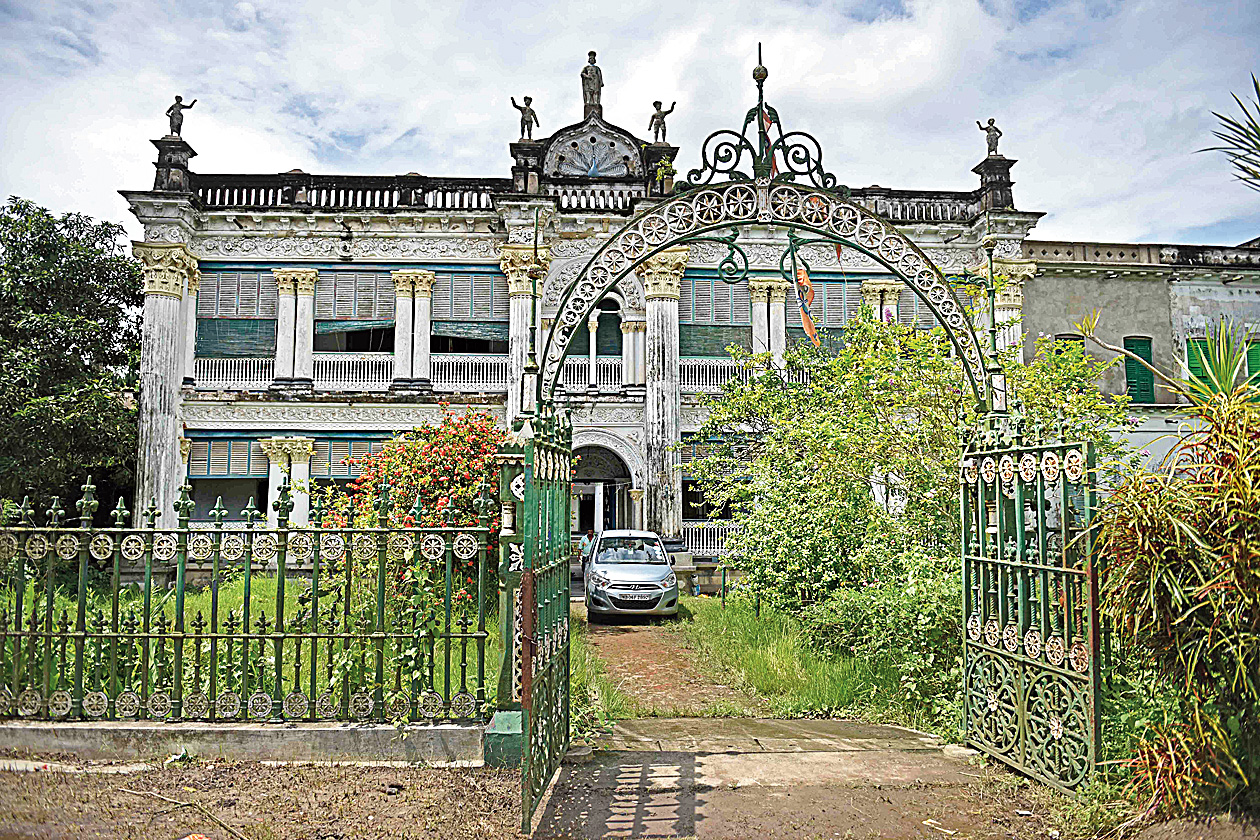
We walk down to Ballav Mansion next. Painted in green and white, the mansion has ornate cast iron gates and fencing. The Corinthian pillars, stucco work in the verandah and the grand thakurdalan reflect the wealth of the family. There is a well-kept garden too. Says family member Uma Ballav Biswas, “The house was built by my great-grandfather, Shyamacharan Ballav, 150 years ago. He made his fortune mainly in jute trade.”

At the time of filing this piece, Uma is looking forward to the annual family reunion on the occasion of Durga Puja. It seems the same artisans make the Durga idols for the Gaines, the Sawoos and the Ballavs. The same family of priests presides over the festivities. Says Monjit, “If anyone wishes to see our houses in full grandeur, this is the time. There’s no restriction on entries at this time. Just like our ancestors, we welcome villagers and visitors.”

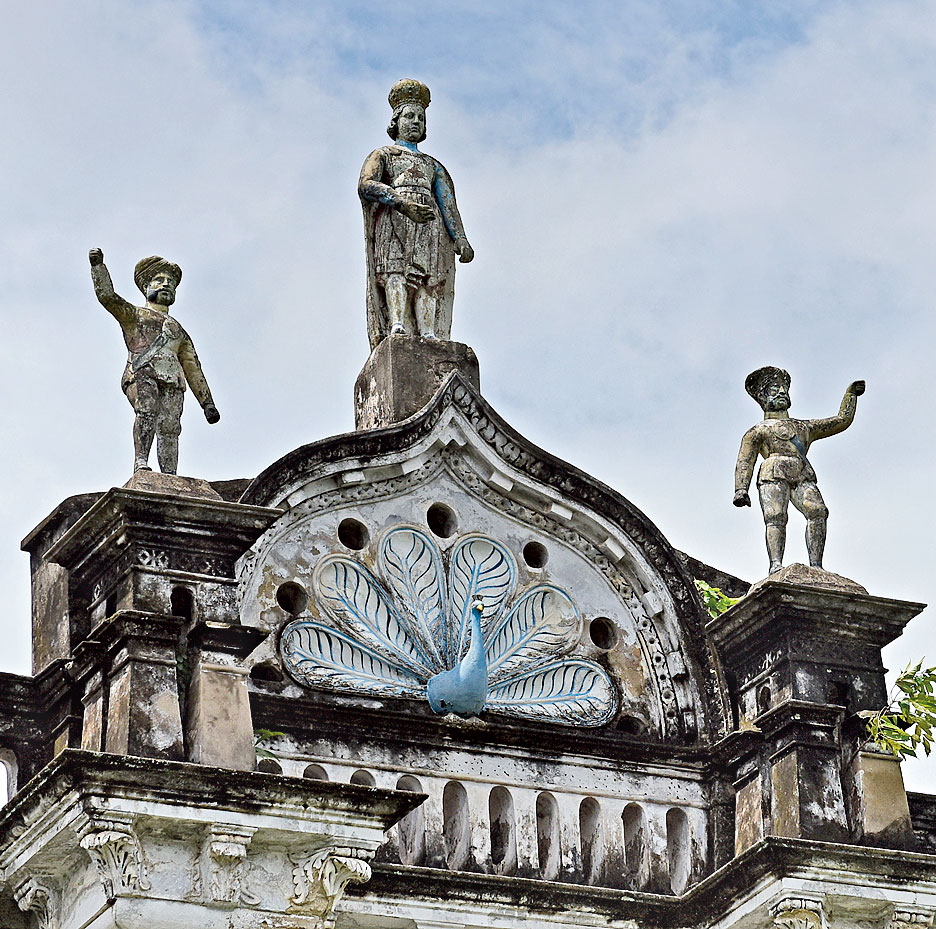
Ballav Mansion is referred to as ‘putul bari’ or dolls’ house by locals — after the figurines on the central arch and those on either end of the roof
Image: Ankit Datta
The centrepiece is a princely figure wearing a cape and fancy headgear; the rest of the figurines include moustachioed Indian sentries and a lone peacock
Ankit Datta

source: http://www.telegraphindia.com / The Telegraph,Calcutta,India – Online edition / Home> Heritage / by Prasun Chaudhuri / October 21st, 2018

Kolkata girl crosses English Channel

Kolkata, (PTI):

Twenty-two-year-old city girl Amrita Das crossed the English Channel, completing the 34-km challenge in 13 hours and 42 minutes.

An understudy of Masudur Rahman Baidya, the first double amputee below the knee to cross the channel, Amrita began at 6.19 am (GMT) from the Shakespeare beach in Dover, England and swam across the channel, reaching France at 8.01 pm (GMT) on September 4.

She could have bettered the timing if Amrita did not veer off course due to strong currents, Baidya said.

“There were high tidal waves that blew her off-course and she had to remain static for about an hour before resuming swimming,” Baidya, who has conquered the English Channel (1997) and the Strait of Gibraltar (2001), told PTI.

Baidya said Amrita had started started her preparation long ago.

source: http://www.telegraphindia.com / The Telegraph,Calcutta,India – Online Edition / September 06th, 2010

Kolkata Gets $100 Million Asian Development Bank Loan For Drainage

The $100 million loan is the third and final tranche under the $400 million Kolkata Environmental Improvement

Investment Program and is aimed at expanding sewerage and drainage coverage and providing sewage treatment in Kolkata.

New Delhi :

India and Asian Development Bank (ADB) on Wednesday signed $100 million loan agreement to strengthen capacity of Kolkata Municipal Corporation (KMC) for resilient urban services, an official statement said.

The $100 million loan is the third and final tranche under the $400 million Kolkata Environmental Improvement Investment Program and is aimed at expanding sewerage and drainage coverage and providing sewage treatment in Kolkata.

It will target expansion of sewerage and drainage services in selected peripheral areas of KMC to at least 3,000 additional households and provide sewage treatment for at least 1,00,000 households, the Ministry of Finance said in the statement.

The agreement was signed by Ministry of Finance Additional Secretary Sameer Kumar Khare for the Indian government and ADB’s India Resident Mission Country Director Kenichi Yokoyama for the multilateral lending agency.

Mr Khare said it will supplement the efforts made in previous phases that aim to provide affordable access to water supply, sewerage and drainage services in Kolkata.

Kenichi Yokoyama said that the current financing will be used to construct 43 km of additional sewer drain pipes, four pumping stations, 13 km of pumping mains and three sewage treatment plants to improve sanitation service and climate resilience.

The overall goal of the programme, approved in 2014, is to restore water production capacity to 1,478 million liters per day and ensure leaks on 700 kilometers of water pipes are repaired by 2023, the statement said.

It aims to install 40,000 water meters in pilot areas, 170 kilometers of sewer-drain pipes and provide new sewerage connections to 27,000 homes, it said.

source: http://www.ndtv.com / NDTV.com / Home> Sections> Kolkata / by Indo-Asian News Service / October 04th, 2018

Telugu Bible turns 200

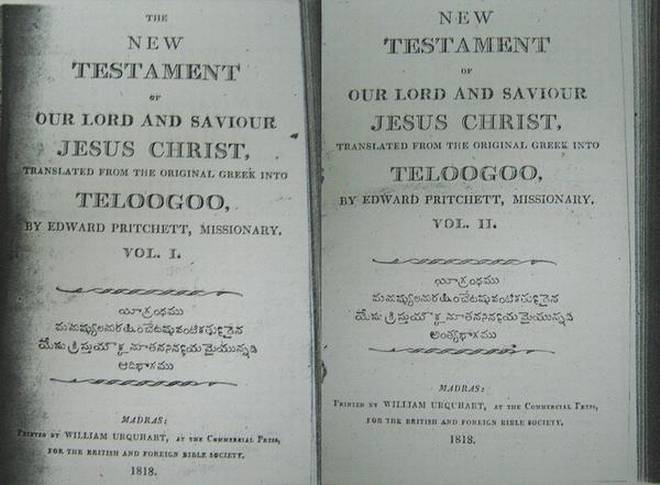
The cover page of the New Testament that was first translated and printed in Telugu in 1818. | Photo Credit: Special Arangment

It was translated in Vizag and West Bengal

On September 30, based on a resolution adopted by the United Nations, the world celebrates the International Translation Day (ITD). It is observed in honour of fifth century St. Jerome, a priest from northeastern Italy, who was the first to translate the Bible (New Testament) into Latin from Greek manuscripts. He also translated parts of the Hebrew Gospel into Greek.

The ITD has a unique connection with Visakhapatnam. The churches in the city will be celebrating this year the 200th year of the translation of Bible from original Greek to Telugu.

First attempt
The first attempt to translate the Bible (New Testament) was made by one Rev. Benjamin Schulz (1689-1760) some time in the mid-1760s, and the manuscripts were sent to Germany for printing, but it was not printed and the manuscripts were lost.

The second serious attempt was made simultaneously at Vizagapatam (as Visakhapatnam was then called) and Serampore, then unified Bengal, some time around 1805-1806.

Telugu Pandit’s role
In Serampore, the project of translation was led by Rev. William Carey of the Baptist Missionary Society. In Visakhapatnam, young Christian missionaries of London Missionary Society Rev. Augustus De Granges and Rev. George Cran took up the work of translating the Bible from original Greek to Telugu. The missionaries in Vizagapatnam were assisted by a local Telugu Pandit Anandarayar.

The untimely death of both Granges (1809) and Cran (1810), however, did not deter Anandarayar from pursuing the work of translation under the guidance of Rev. John Gordon and Rev. Edward Pritchett, said V. Edward Paul of INTACH.

“The first three gospels out of four translated in Vizagapatam were sent to Rev. Carey in Serampore and the translation work continued simultaneously at Serampore and Visakhapatnam. The full extent of translation was completed with the fourth gospel, letter and acts and sent to then Madras Presidency for expert opinion of Rev. Thompson and Mr. Campbell, a reputed Telugu scholar in the Presidency. It was certified and then printed in 1818, and that makes the translation 200 years old, as of today,” said Mr. Edward Paul. The Bible that was printed in 1818 in Madras Presidency is today considered the authentic Bible and has undergone several revisions.

source: http://www.thehindu.com / The Hindu / Home> News> States> Andhra Pradesh / by Sumit Bhattacharjee / Visakhapatnam – September 28th, 2018

Edit

Nasscom to host first SME conclave in Kolkata

Kolkata :

The National Association of Software and Services Companies (Nasscom) on Thursday said it will host its first international SME conclave here on January 10-11, 2019, to provide entities an opportunity to establish a business connect.

The two-day conclave will be attended by over 2,500 delegates, 100 chief information officers, while over 200 companies will showcase their products and solutions, the association’s SME Council Chairman Kamal Agarwala said.

Small and medium enterprises constitute about 80 per cent of the association’s membership and they contribute about 20 per cent of the total software exports of the country, according to industry sources.

source: http://www.outlookindia.com / Outlook / Home> The News Scroll / September 27th, 2018

Paintings that pioneered modern art in India to get a permanent gallery in Kolkata

Victoria Memorial Hall is all set to unlock a set of 5,000 paintings from the Bengal School that paved the path of modernism in Indian art.

Victoria Memorial Hall (VMH), one of the museums with the highest footfalls in the country, is all set to unlock a a set of 5,000 paintings from the Bengal School that paved the path of modernism in Indian art.

“This winter we will open a permanent gallery dedicated to this collection. It includes the largest and most important collections of the works of Abanindranath Tagore and Gaganendranath Tagore, two of the pioneering figures of modern Indian art,” said Jayanta Sengupta, curator and secretary of VMH.

Notable among this collection are the works by cousins Abanindranath and Gaganendranath, as well as Nandalal Bose. The three are among India’s nine artists of national importance whose works cannot be taken outside the country.

“This collection is one of the most important in the context of Indian modern art because modern art movement in India centred on Kolkata, and this collection comprises works of the formative days,” said Sushobhan Adhikary, art critique and former curator of the museum at Kala Bhavana of Visva Bharati.

The Bengal School art movement that started in the late 19th century led to the development of modern Indian art during the early 20th century.

The 300-odd works of Abanindranath is the most exhaustive collection of his works and include the iconic series on Arabian Nights, Mughal Empire, Mangalkabya and the mask series. Among most famous paintings are ‘Bharat Mata’ (1905) and ‘Passing of Shah Jahan’ (1902), Krishna Lila series and the 12 original illustrations for Omar Khayyam’s Rubaiyat (1909-1911).

Gaganendranath’s 200-odd works include those of cubist style and his signature-style of satiric works and caricature.

Besides, there are pencil sketches of Jyotirindranath Tagore, Rabindranath’s elder brother whose art influenced the poet’s drawings in his early days.

“The permanent gallery will be a treat for art lovers,” Adhikary added.

“Jyotirindranath had the unique habit of sketching people sitting in front of him and then to get the sketch signed by the person. The collection comprises several dozen of such signed portraits,” said Subhashis Mukherjee, treasurer, Rabindra Bharati Society (RBS).

The collection of about 5,100 paintings, sketches and doodles was in the strong-room of RBS from 1945 to 2011, when it was handed over to VMH on enduring loan.

The authentication and cataloguing was going on over the past six years and is now complete. The framing and mounting has been done afresh in most cases.

The gallery, which is almost ready, will be able to display about 250-300 paintings. The works from the collection will be put on display in turns.

“We already had an exhaustive collection of the Company school of art. Now, we have a great collection of modern Indian art. At present we are equipped to provide one of the best visual documentations in India of late-medieval and modern South Asian history from the late 17th century to the middle of the 20th century,” Sengupta said.

Among other important artists in this treasure trove are Mukul Dey, Radha Charan Bagchi and Sunayani Devi, Asit Haldar, Sudhir Khastagir and Sarada Ukil – all important personalities of Bengal art.

There is also a set of about 100 paintings of ‘unknown artists’, belonging to the Bengal school and the Rajput school.

source: http://www.hindustantimes.com / Hindustan Times / Home> Kolkata / by Snigdhendu Bhattacharya, Hindustan Times / September 19th, 2018

Platform for chip designing

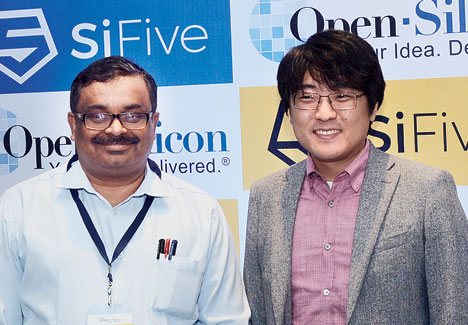
IIT Kharagpur director Partha Pratim Chakrabarti with Yunsup Lee, co-founder and chief technology officer, SiFive. Picture by Bishwarup Dutta

Calcutta:

IIT Kharagpur is exploring the possibility of using a platform developed by a group of researchers at the University of California, Berkeley, that can be freely used for designing semiconductor chips.

In the foreseeable future, Digital India will need application-specific chips in every conceivable domain but today only a handful of companies have the ability to design integrated circuits (IC).

Inspired by the success of open source software, SiFive, a US-based company, aims to change the ecosystem of chip design by promoting OpenSilicon – a platform where pre-designed open source components can be stitched together to design customised ICs.

The OpenSilicon platform already provides the open source RISC-V processor developed by the researchers at UC Berkeley.

Recently, SiFive hosted an academic symposium at a city hotel, where cost-effective ways to design and fabricate semiconductor chips were discussed threadbare. The symposium was attended by professors from IIT Kharagpur.

Later, the academics explained the significance of the conclave.
Designing semiconductor chips require sophisticated and expensive software tools or CAD tools and years of experience. Chip fabrication costs are astronomical. For any start-up that wants to get into custom chip designing, the costs and skill requirements are difficult to overcome.

“It is a promising initiative. Offering open source pre-designed components through a cloud-based design framework has the potential to bring down the design cost. Also, bundling multiple custom ICs in a single fabrication cycle can help in sharing the fabrication costs among the partners,” said Pallab Dasgupta, dean, Sponsored Research and Industrial Consultancy, IIT Khargpur.

Dasgupta is also a professor in the department of computer science and engineering with years of experience in electronic design automation.

The IIT has an advanced chip design laboratory since 2000, which has successfully designed and tested more than 100 chips with its fabrication partners. It carries out research for top global semiconductor and EDA companies.

SiFive is aiming to let more start-ups use its platform to minimise the cost of developing semiconductor chips and rid the chip design industry of the proprietary regime of a handful of wealthy companies, said Yunsup Lee, co-founder and chief technology officer (CTO) of SiFive.

“India is home to some of best research and educational institutions in the world. We are honoured to host presentations from the academic luminaries who are on the frontlines of innovation and research in the areas of machine learning, hardware verification, circuit design and more,” said Yunsup, who delivered a lecture at the symposium.

When Metro asked him to explain what prompted the company to hit upon the concept of looking beyond the proprietary regime, Yunsup, who has done his PhD from UC Berkeley, where he co-designed the RISC-V ISA and the first RISC-V microprocessors with Andrew Waterman, said: “At the University of California, Berkeley, we believe in taking the technology to a larger pool of users so the technology can do greater good. This was developed during our student days. With this motto in mind, we are touring 20 cities across the globe to popularise the concept.”

IIT Kharagpur director Partha Pratim Chakrabarti, who attended the session, said: “The concept they have floated is innovative. We are holding talks about a tie-up that the company has proposed.”

source: http://www.telegraphindia.com / The Telegraph,Calcutta,India / Home> Calcutta / by Subhankar Chowdhury / September 14th, 2018

Squash wins back its star, India gets medal

Calcutta boy’s sport-or-job battle

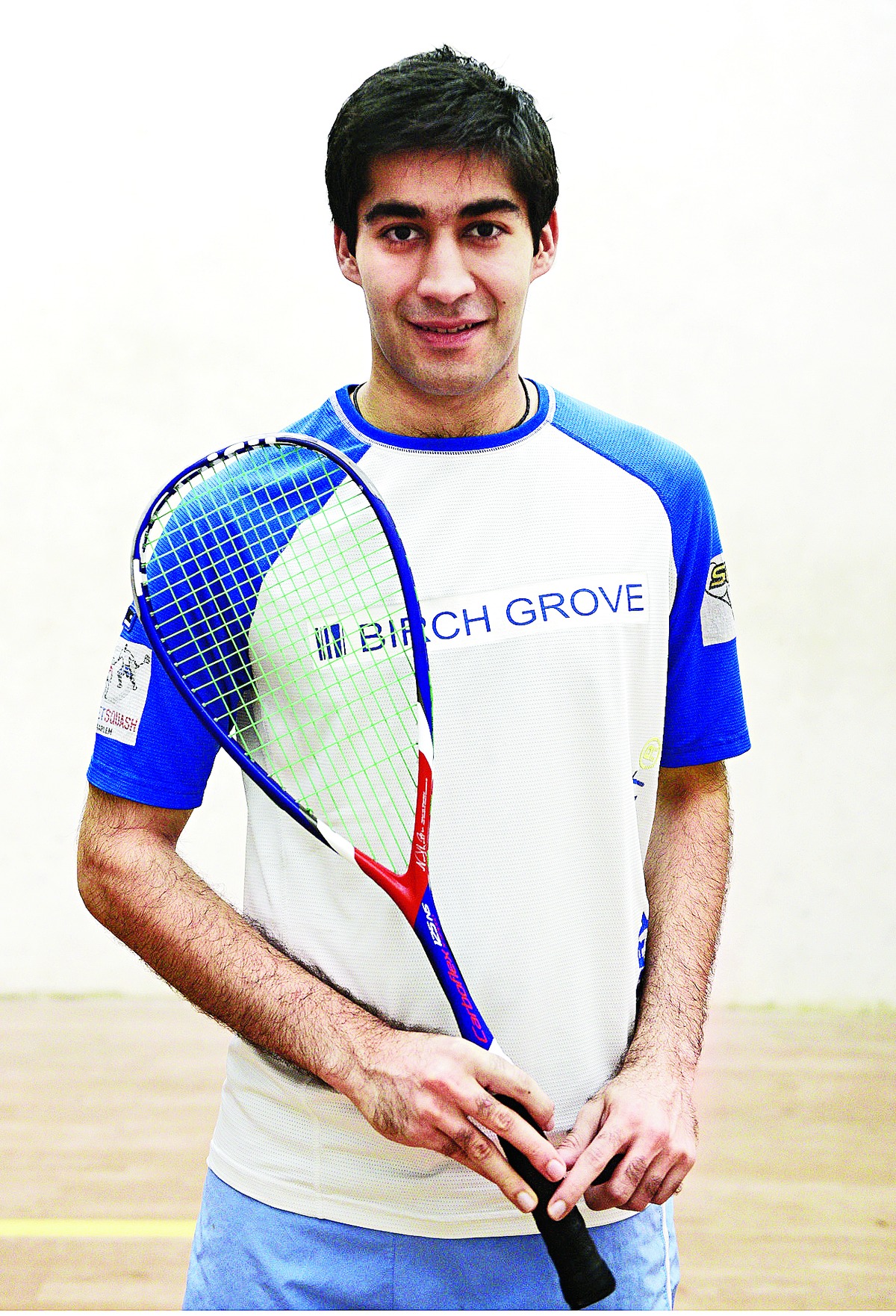
Ramit Tandon at Saturday Club on Monday.
Picture by Gautam Bose

Calcutta:

Ramit Tandon’s journey from La Martiniere for Boys in Calcutta to the winners’ podium at the 2018 Asian Games hasn’t followed the usual curve of sporting success achieved through sweat and the sacrifice of myriad other ambitions.

The 26-year-old, who also studied at Columbia University, was till a year ago analysing equity and debt markets sitting in the New York office of a hedge fund. Squash remained his passion, but primarily as a leisure activity.

Last Friday, Ramit won an Asian Games bronze in Jakarta along with teammates Saurav Ghosal, Harinder Pal Singh Sandhu and Mahesh Mangaonkar, all three of them regulars in the competition circuit.

Ramit had quit his job in New York to turn pro only last November. His Professional Squash Association (PSA) ranking then was above 600. Over the next few months, he won two PSA titles to break into the top 60, good enough to earn him a spot in the Indian team for the Asian Games.

“I used to badly miss being in competitive squash. The travelling, the pressure (to perform), the adrenaline rush and, of course, the honour of representing the country,” Ramit told Metro at the Saturday Club, where he hits a ball or two whenever he is in town.

At the Asian Games, Ramit won all but one of his matches. He counts his performance against Qatar in a crunch match in the group stage as his personal favourite. He did not play a match in the semifinal against Hong Kong because the two players before him had lost theirs, making the rest of the contest inconsequential.

While the gold medal eluded India, Ramit sees the bronze as a vindication of his decision to become a squash pro.

So, what made him finally choose squash over a shirt-and-tie career? “Hedge funds require balancing risk and return. I thought it was time I did it for myself instead of clients,” he said. “I was earning well. I had to factor in so many things, including the possibility of a comeback to my earlier career if I failed in squash.”

As a student, Ramit had been regarded as a promising player in the junior circuit. Between 2001 and 2011, Ramit had won a string of national championships in successive age groups. He was the captain of the India Under-19 team that won a gold medal in the Asian Junior Championships in Sri Lanka in 2011.

But studies won the competition when it came to choosing a career. “I had had a decent schooling. When I got a chance to study at Columbia University, I did not want to let go of it. After my graduation in statistics, I got an analyst’s job with Birch Grove,” he recalled.

Now that squash has won back what it lost, Ramit intends to be loyal to the sport. And nobody’s complaining.

source: http://www.telegraphindia.com / The Telegraph,Calcutta,India / Home> Calcutta / by Debraj Mitra / September 04th, 2018