Category Archives: Travel

The Danes are back: How a Bengal town is restoring its European legacy

Serampore, near Kolkata, was an important 18th century Danish colony. A grand heritage restoration programme is underway in the town to restore its major landmarks to their former glory.

Serampore, near Kolkata, was a Danish outpost for 90 years (1755-1845). The 210-year-old Lutheran St Olav Church’s restoration was completed in 2015. The project won the Unesco Heritage Award of Distinction in 2016. (Burhaan Kinu / HT Photo)

From the white colonnaded verandah of the Denmark Tavern in Serampore, a sub-divisional town 35 km from Kolkata, the panorama is serene: a placid river Hooghly flows next to the late 18th century building, towards its final resting place, the Bay of Bengal. Even on a busy suburban weekday, the waterfront is usually quiet. These days, however, the peaceful atmosphere is often punctured by sounds of hammers, saws and drills, thanks to the restoration work going on in the building. The tavern’s renovation is not a stand-alone project; it is a part of a heritage restoration programme underway in the town, which was a Danish outpost for 90 years (1755-1845). The Danes had two other colonies in India: Tranquebar (now Tharangambadi in Tamil Nadu) and the Nicobar Islands.

Other than the tavern, several other Danish-era structures are being restored: The 12,000-square feet Danish Government House (DGH) and its two gates; Red Building (a British-era structure located inside the DGH campus), and the cast iron gate, fence and staircase of the Serampore College, which completes 200 years in 2018. The 210-year-old Lutheran St Olav’s Church’s restoration was completed in 2015.

“Tranquebar and Serampore were different kinds of outposts. The former was a port town; the sea gave it a carefree atmosphere. Serampore was a commercial and educational-missionary hub, and more urban. So its heritage has had to grapple with the challenges of an expanding town and burgeoning population,” says conservation architect Manish Chakraborti.

The DGH is located at one end of its 6.7-acre compound. The former residence of the Danish governors is an imposing colonial-style building, but not ornate. The middle part of the yellow and white house, which has an extended porch and six Iconic columns, juts out. A flight of steps will take you into the rooms. Under the Danes, DGH was the administrative headquarters. It continued to be so under the British and till 1990, the Bengal government too had its offices in the building. It was abandoned in 1990 after a fire. Today, the DGH campus, which houses the sub-divisional magistrate’s office, looks rundown. The compound is more or less barren, and doubles up as a parking lot. The town outside is dense, heavily built up, teeming with people and small businesses.

However, even today, the structure and pattern of the main street of the town centre remains as it was constructed by the Danes. The St Olav’s Church is just a few steps away from DGH. It has a portico of twin columns and has the royal monogram of Christian VII, who was the King of Denmark when the church was consecrated. It is flat roofed and reflects the designs of contemporary churches in British India.

Heritage town

“The church is special not just to Christians but all communities… It is a critical component of the town’s life,” says Mohit Ranadip of the Shrirampur Heritage Restoration Initiative, a local citizen-led body. “The town’s heritage, however, is not just about the Danish heritage …. one must not miss the elegant houses of the rich Indian trading class of the 18th century and the ghats they built on the river…we must restore them too.” Some residents, however, allege that the local municipality is not doing enough to save the town’s heritage. “For example, they shouldn’t allow high-rises around the historic centre and concretise roads,” says a resident, who did not wish to named.

While the Church was restored with funds from Denmark’s ministry of culture, DGH’s restoration is being funded by the Centre, the West Bengal Heritage Commission (WBHC), and the Serampore Municipality is in charge. The renovation of DGH will be completed early next year. The National Museum of Denmark (NMD) is overseeing the restoration of the tavern, the Serampore College, and the Red Building. Realdania, a philanthropic organisation, has provided Rs 10 crore (2012-18) funding for the project, which is called the Serampore Initiative.

“Initially, I was sceptical about restoring heritage buildings outside Denmark, but after we began researching for the project, we realised that locals also have a great appreciation for these old buildings and want them to be restored,” says Dr Bente Wolff, project leader, Serampore Initiative, NMD. “Our historian, Simon Rasten, accessed 20,000 pages of Danish documents from the West Bengal State Archives and found information about the town and the architectural plans of the building.” Rasten also traced the only existing map of the Danish areas and the buildings in The Queens Reference Library, Copenhagen.

Bengal’s Little Europe

The Europeans began trading with this region from the 16th century, an era that coincided with the birth of the large trading companies in the continent. But it was only in the last decades of the 17th century that Europe-Bengal trade in textiles, raw cotton, silk, sugar, saltpeter and opium flourished and their outposts came up along the river. Starting with the British in Calcutta, there were the Danes in Serampore, the French in Chandernagore, the Portuguese in Bandel and the Dutch in Chinsurah.

The Danish history in Bengal, however, was not one of smooth progress: In 1698, they acquired a trading settlement called Dannemarksnagore. But it was closed down in 1714. In 1755, the Nawab of Bengal, Ali Vardi Khan, granted the Danes the right to settle down in Bengal as well as free trading rights. Along with the parwana, the Danes bought land and established Fredricksnagore, in the honour of King Fredrick V. In the next few years, three more villages were added to Fredricksnagore: Serampore, Ackna and Pereapore. Since then the Danish territory has been colloquially called Serampore, only officially it was Fredricksnagore.

It was under the administration of Governor Colonel Ole Bie (1776-1805), that Serampore flourished. His abilities and cunning entrepreneurship brought prosperity to the town and the present historical town centre, which is being restored, is his legacy. Contemporary travellers also wrote eloquently about Serampore’s glory days. In 1803, George Annesley wrote that the buildings of Serampore were “picturesque being white, with expensive porticoes to the south and the windows closed by Venetian blinds painted green.”

Though Serampore was managed by the Danes, it also attracted other Europeans and Indians. “The manufacturing of cotton and silk textiles as well as salt petre and sugar led to the rise of a local class of Indian traders, middlemen and agents, and the gradual urbanisation of the settlement… Some Indians eventually became powerful, economically and politically,” Rasten told HT. The turning point in the history of Serampore was the British occupation of Denmark (1807 to 1814). The British monopolised trade in India, and in 1845 Denmark sold Serampore and Tranquebar to the British East India Company.

The challenges of heritage restoration

“When the West Bengal Heritage Commission handed over DGH in 2008 to me, it was in ruins: The floor was broken, the roof had collapsed and tree roots were coming out of the walls,” says conservation architect Gopa Sen. “There were false partitions, destroying the internal plan of the house…. It was a terrible and heartbreaking sight. And a challenge for us.”

The same was the case for the Denmark Tavern, whose front verandah, which overlooks the river, had collapsed. “The campus had been converted into quarters for policemen and additional structures had come up in its precincts. The police line is now being shifted,” says Manish Chakraborti, who is restoring the tavern and parts of the Serampore College. He is also the man behind the restoration of the church, which won the Unesco Heritage Award of Distinction in 2016. “We started with the St Olav’s Church because it had a defined boundary and a single ownership. It is also has immense historical importance because missionary, educationist and botanist William Carey was the first preacher here,” explains Chakraborti. “These buildings could have been saved much earlier but there was not much political support, nor funds. Restoration was seen as a bourgeoisie exercise. The state never looked at public spaces as vibrant community spaces.”

The architects and historians involved in the projects accessed old paintings, maps and documents to get a flavour of the core heritage zone of the town and the how the buildings looked during the Danish period to help them draw up a restoration plan. “The challenges in projects such as these are always unknown. Despite hours of planning, there can be surprises when you start work in an old building, which means reworking the original plan… while keeping to the strict norms,” says Sen.

Both Sen and Chakraborti are ensuring that all the work that is being done follows the heritage norms. This means that the building materials have to be same as those the Danes used: Lime, surki, molasses and khayer. Masons from Murshidabad, who know this old construction technique, have been employed for the project. The architects are also reusing old materials, especially the Burma-teak doors and windows.

For a restoration project to be successful and sustainable, it is important that people have a stake in the project. On that score, Serampore has not done badly: Citizens participated wholeheartedly in a competition to design a new bus stand, which will be shifted from the historic core area. Ranadip’s organisation is also pushing schools to teach their students the town’s Danish lineage.

Future plans

For heritage buildings to survive and ensure their long-term maintenance, which can be expensive, it is important to have an “adaptable re-use plan”. By early 2018, the 200-year-old Danish Tavern will be back in business: It will have a coffee shop, a Danish bakery and six well-appointed rooms for guest accommodation.

“The DGH will have a museum of the town’s Danish past and an exhibition hall,” says Dr Basudeb Malik, officer on special duty, WBHC. “Once the restoration is over, we are expecting tourists interested in Bengal’s colonial-trade history to come not just to Serampore but other outposts in Bengal as well. The government is working on a project to ensure this”.

“I see the restoration work in Serampore as a triggering process; It will hopefully lead to greater investments in urban restoration and push for developing safe, clean and secure community spaces, which Bengal –– for that matter, India –– is woefully short of,” says Chakraborti. “There are no green spaces here…the quality of open environment will improve for the people,” says Flemming Auland, architect, NMD.

The tourism sector is also upbeat about the opportunities such restoration programmes could bring. “Our Little Europe Tour will take tourists to the colonial settlements along the river,” says Navpreet Arora of FunOnStreets, a Kolkata-based tourism company.

Serampore, more than just commerce
The 18th century ushered in an era of Lutheran missionary activities in Serampore, thanks to the patronage of Danish rulers. Though they came to preach Christianity, they also dedicated themselves to education and social reforms. The protagonists were William Carey, Joshua Marshman and William Ward. They established the Serampore Mission, the Serampore Mission Press and the Serampore College. The press printed the Bible in 45 languages including Assamese, Awadhi, Telegu, Bengali, Mooltani, Persian and Pushtu. Journalism in Bengal can be said to have begun with the Serampore missionaries who were the first to expose the lapses of the British government. The Serampore College was designed by a Danish architect and the front gate and two beautiful staircases were gifts from the king of Denmark.

For Denmark, it is a restoration of a link that was lost in time. “But this is just not Danish heritage… this is a part of the world’s shared heritage, which had never been studied. It deserves to be showcased,” says Dr Wolff.

“When [foreign] governments undertake these kind of projects, there is, of course always an objective of image building and visibility,” says Gulshan Sachdeva, director, Europe Area Studies Programme, School of International Studies, Jawaharlal Nehru University. This, however, Dr Sachdeva adds, is not necessarily a negative assessment. Some of these projects genuinely improve awareness and contribute to the local economy through increase in tourism etc. “Ultimately, it is a win-win for both the partners,” he adds.

The rise of the Indian trading class
Approximately at the same time as the Danes came to Serampore, the founder of the Goswami family, Ramgovinda, settled in the western part of the town. His two sons – Harinarayan and Ramnarayan – built a large fortune thanks to their positions as middlemen and their good relations with the Danes. Harinarayan functioned as the diwan of customs (collector) under the Danish East India Company, while his brother Ramnarayan became the official moneylender to the factory. They established an aristocratic colony on the western side of town and became influential people in Serampore. “Unlike other colonial rulers, the power equation between the Danes and Indians were different… locals such as the Goswami family called the shots because they were very rich,” says Simon Rasten, historian, National Museum of Denmark.

@kumkumdasgupta

source: http://www.hindustantimes.com / Hindustan Times / Home> India / by KumKum Dasgupta, Hindustan Times / December 10th, 2017
City secrets: Art Deco architecture spread across Kolkata, thanks to a state law – and jugaad

Preserving Art Deco architecture in the city is uniquely challenging because it is so commonplace, residents take it for granted.

Photo : Deepanjan Ghosh

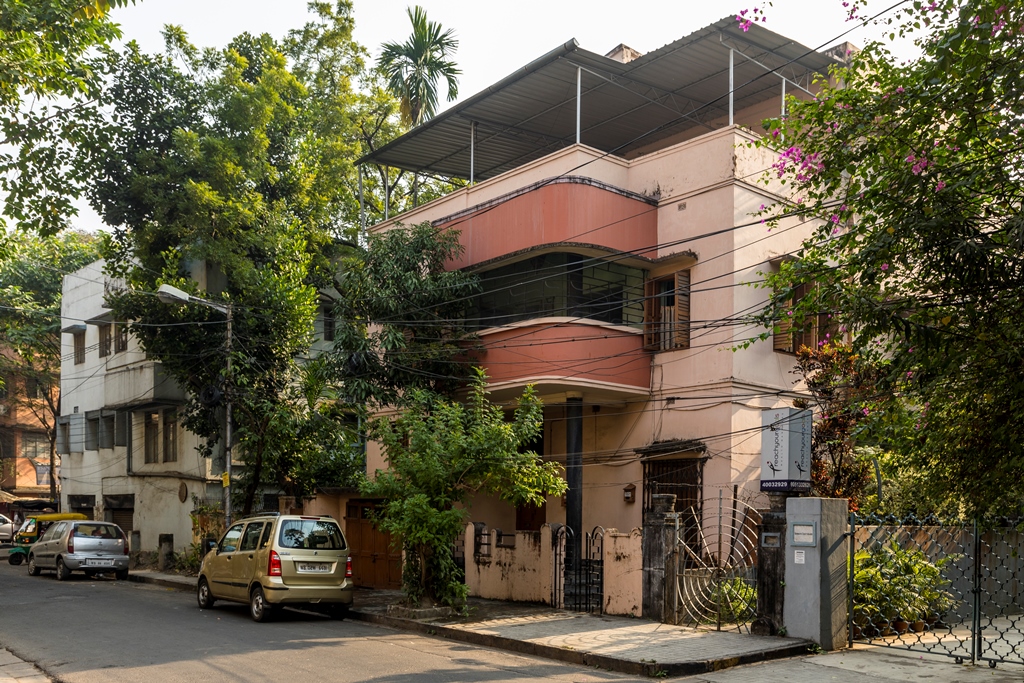
In 2015, author Amit Chaudhuri started a movement to preserve ordinary Bengali homes in South Kolkata. The architecture of these homes, Chaudhuri said, was unique and its destruction would be a disaster. His movement and the pressure group that he created, Calcutta Architectural Legacies, has helped to shine a light on the kind of buildings that ordinary Kolkatans do not think of as constituting heritage.

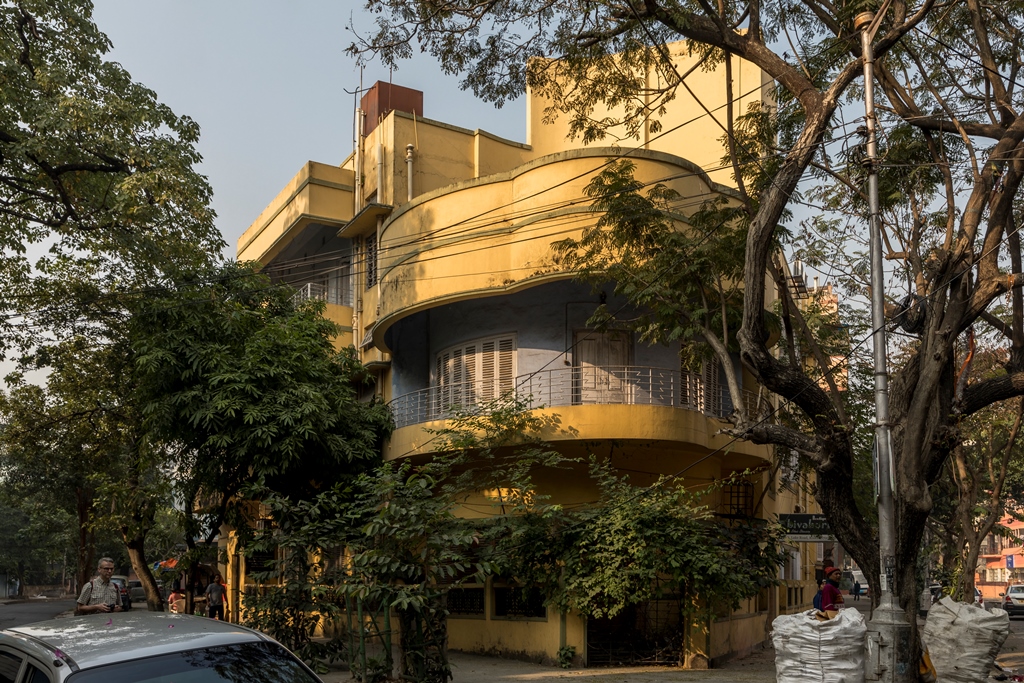
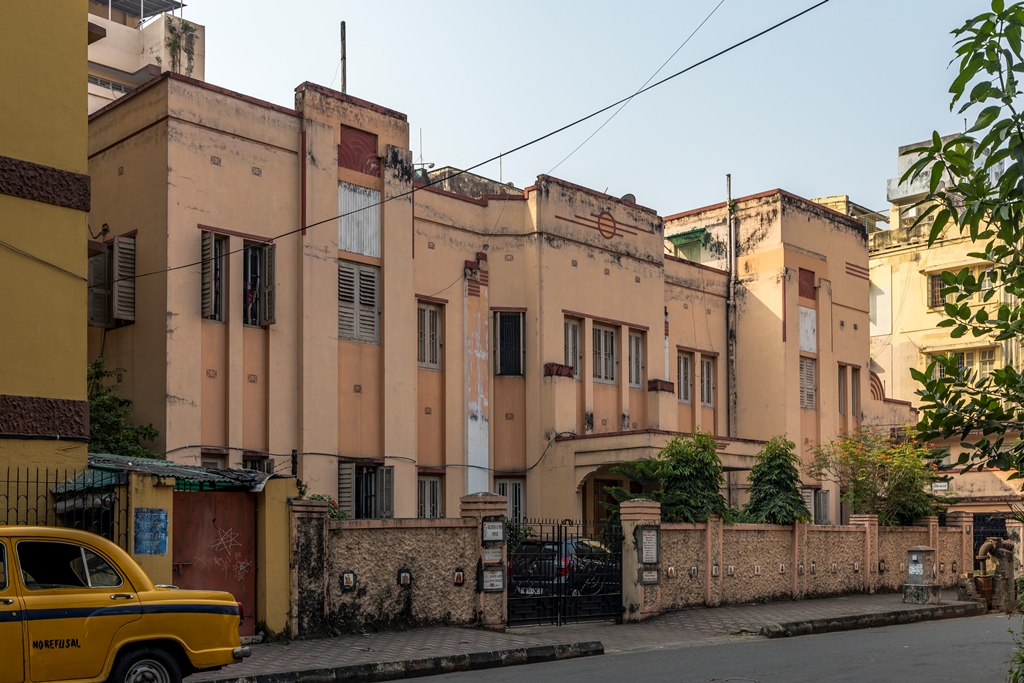
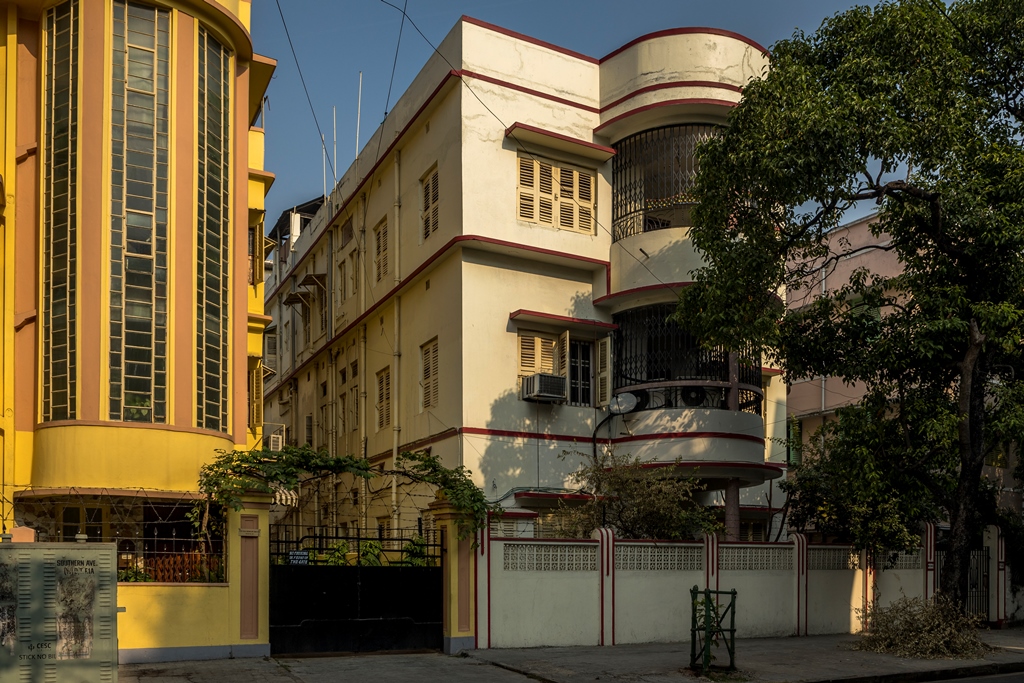
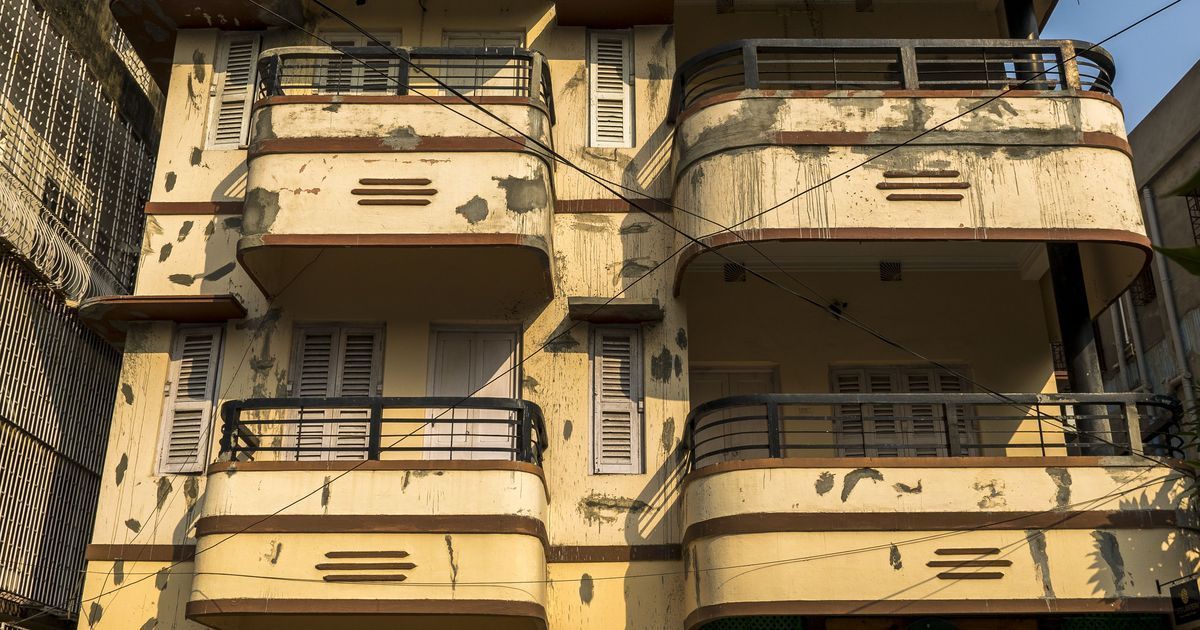
“When we speak of Calcutta’s architecture, we usually mean the colonial institutions that the British erected,” wrote Chaudhuri. “Or the aristocratic mansions of North Calcutta built by Bengali landowners. But the houses I’m speaking of were built by anonymous builders for middle-class Bengali professionals: lawyers, doctors, civil servants and professors.” Chaudhuri also notes that a lot of these houses have in common, the presence of Art Deco elements such as “semi-circular balconies; a long, vertical strip comprising glass panes for the stairwell; porthole-shaped windows; and the famous sunrise motif on grilles and gates”.

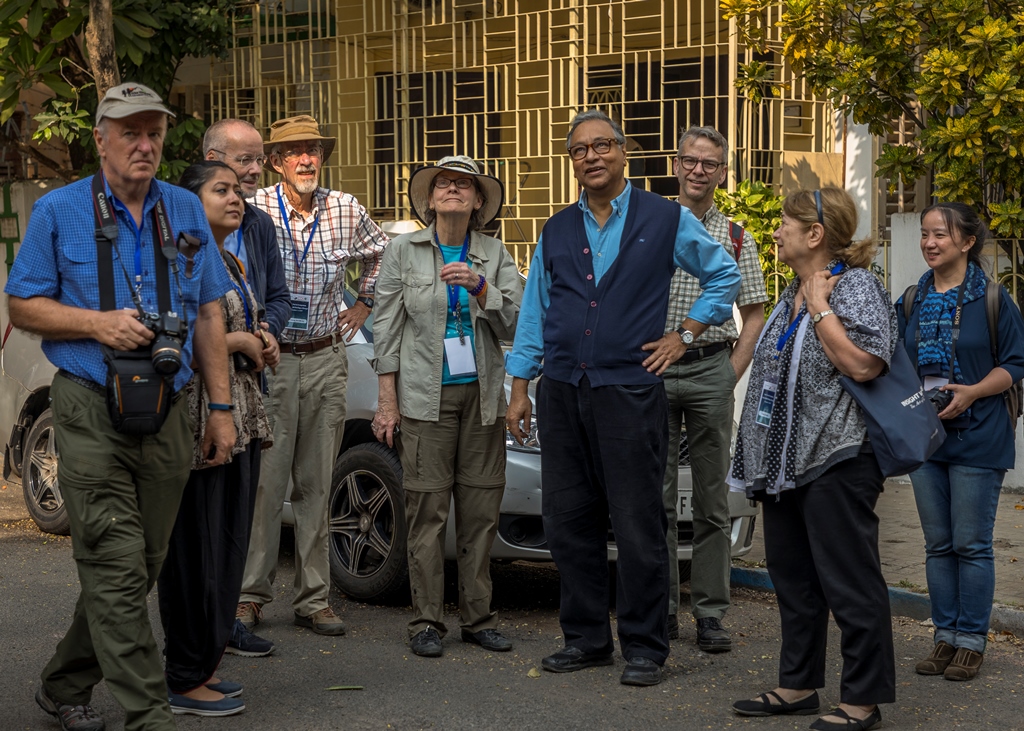
Art Deco is so common in South Kolkata that most people are intimately familiar with it without even realising it. These neighbourhoods were the focus of a walk on December 5, led by Jawhar Sircar, the former CEO of Prasar Bharati. The walk was organised by the International Council on Monuments and Sites, an interdisciplinary, global network of architectural and archaeological heritage experts. “Jawhar Sircar has had a deep engagement with South Kolkata’s Art Deco style and advocated for it on various public forums,” said Kamalika Bose, urban conservationist and co-ordinator of the ICOMOS programme. But the focus on these architectural curiosities also raises a question – why did a 1920s European architectural style find so many takers in 1950s and 1960s Kolkata?

Photo credit : Deepanjan Ghosh


A modern style

Styles rarely evolve in a day, but the definitive moment for Art Deco that experts point to is the International Exhibition of Modern Decorative and Industrial Arts, held in Paris in 1925. Fifteen thousand exhibitors from 20 countries presented to 16 million people a highly decorative “style modern”, using fine craftsmanship and expensive materials. Even the name “Art Deco” is an abbreviation of the title of the exposition. This style would spread rapidly around the world, from skyscrapers in New York to ocean liners that crossed the Atlantic. It can still be seen today, in structures such as the Chrysler Building, the General Electric Building and the American Radiator Building of New York. But while American skyscrapers were the largest and most visible examples of the style, Art Deco encompassed almost all forms of the visual arts, architecture and design, including painting, sculpture and even typography.

In Kolkata, the sole example of the Art Nouveau style, which preceded Art Deco, is the Esplanade Mansions opposite the Raj Bhavan, built in 1910. But there is little evidence to suggest that the Art Deco buildings seen in the city today evolved from here. In an age without internet, trends caught on through magazines, which meant that Asia lagged a decade behind Europe. Art Deco’s dominance in the West ended with the beginning of World War II, but here in India, the earliest Art Deco structures were built in the 1930s and the style would continue well into the 1960s in Kolkata. Mumbai is known to have the world’s second-largest collection of Art Deco buildings but what makes South Kolkata’s Art Deco homes unique is the fact that they are more a result of jugaad than formal architectural decisions.

Photo credit : Deepanjan Ghosh

Metro-style ‘baadi’

Among the earliest examples of Art Deco in Kolkata are Victoria House, now the headquarters of the Calcutta Electric Supply Corporation, built in the 1930s and Reid House on Red Cross Place, built in 1941. But the icon of the city was the Metro Cinema Hall. Designed by Thomas White Lamb and built by Metro Goldwyn Mayer, Metro Cinema stood on Dharmatalla crossing, one of the city’s nodal points. With its waterfall-style columns and grand staircase, Metro became the building that a new class of up-and-coming Bengalis wanted to ape.

The building boom in South Kolkata began around the same time with large numbers of people moving out of the North, or later moving to West Bengal post-Partition. While these people were affluent, they had nowhere near the astronomical sums of money needed to construct the lavish mansions of North Kolkata. Buildings in the north followed the pattern of rooms arranged around a central courtyard. This placed an emphasis on communal space. But with changing sensibilities putting a greater stress on personal space, this style was thought of as both wasteful and outdated.

Photo credit : Deepanjan Ghosh

Scenographer and artist Swarup Dutta has taught design for a decade and closely studied the evolution of Kolkata’s architecture. He points to a peculiarity in the law in Bengal, which allows civil engineers and draftsmen to file the plans for a building, as opposed to architects, who would be required in other states. This was good news for homeowners, since architects would charge between 2% and 5% of construction cost, says former civil servant Jawhar Sircar. The demand that Bengalis made from their civil engineers, aka “contractors”, Sircar says, was, “amake Metro style baadi baniye dao” – build me a house in the Metro style. Because civil engineers were concerned with the technical side of construction, instead of the aesthetic, their response was to present their clients with a collection of templates. These would then be tweaked according to each client’s needs. Since the buildings in areas like Hindustan Park and Lake Temple Road all came up around the same time, and used the same technique, entire neighbourhoods ended up looking like variations on a theme.

Why is it important to save these buildings? Chaudhuri says in an interview, “In a city like Kolkata, what we embrace, what we celebrate it for, is its modernity. It’s a form of existence that teaches us to look and experience life in a certain way…as exemplified by these non-heritage residential buildings which form these astonishing residential neighbourhoods that have art deco features as well as traditional features and European provenances.”

But saving them is proving to be a challenge for a number of reasons. With economic stagnation in the east, the younger generation have had to move out in search of work and many homeowners now no longer have the means to maintain the houses they are living in. With the buildings being worth much less than the land they stand on, a developer’s offer is difficult to refuse.

Photo credit : Deepanjan Ghosh

But the greatest challenge is to get ordinary Kolkatans to think of these buildings as special. “You don’t notice them,” said restoration architect James Simpson who was also a part of the ICOMOS walk, “because for you, they are commonplace. But once you know what to look for, these buildings keep popping out at you.” If anything, Chaudhuri’s initiative has at least managed to put these buildings in the spotlight. Three friends, Manish Golder, Sidhartha Hajra and Sayan Dutta have begun a project to document these buildings on Instagram. Their handle, @calcuttahouses, now has more than 2,000 followers. Chaudhuri hopes his campaign will make people “look at these buildings again – something we’ve stopped doing for a number of reasons”. Whether that will be enough, remains to be seen.

Jawhar Sircar. Photo credit: Deepanjan Ghosh.

source: http://www.scroll.in / Scroll.in / Home> Magazine> Archtecture/ by Deepanjan Ghosh / December 12th, 2017

River heritage walk

The heritage walk on Saturday. ( Pranab Debnath)

Krishnagar:

In a bid to rediscover and rebuild the cultural relationship between Bengal and the UK that developed over centuries along the banks of the Hooghly and the Thames, a group of contemporary artistes, authors and historians from Calcutta and London on Saturday participated in a walk in Nadia’s Krishnagar.

The walk, a part of the 10-day initiative titled “Silver River India Walk”, began from Azimganj in Murshidabad on Thursday. It will conclude at Calcutta’s Victoria Memorial Hall on December 16, with stops at 10 important heritage sites like Barrackpore, Chandernagore and Batanagar – all located along the banks of the Hooghly.

The walk has been organised by the British Council in India in association with UK-based art organisation Kinetika and India-based Think Arts, with the support of the Union ministry of culture, the state tourism department and several other organisations to mark the 70th year of India’s Independence.

On Saturday, around 40 artistes from Bengal and the UK paid a visit to the clay model hub in Krishnagar’s Ghurni and learnt about the craftsmanship of the artisans.

“It is a great experience to see the artisans working with delicate artefacts with such fineness. Stories of these artisans need to be known by people that live on the banks of the Thames too,” said Kevin Rushby, a travel journalist with The Guardian.

source: http://www.telegraphindia.com / The Telegraph, Calcutta,India / Home> West Bengal / by Subhasish Chaudhuri / December 10th, 2017

Kolkata Chinese makes it big with Tangra-style food in London

Kolkata :

Kolkata-born Chinese who took Tangra-style cuisine to London is planning to leverage the popularity of the Indo-Chinese food that he serves at his restaurant in Harrow to start a chain across UK.

Steven Lee, whose father had migrated to India in the 1940s from Guangdong province in China, was born in Kolkata in 1971 and grew up in Tangra, the Chinatown that once housed tanneries that have now been converted to restaurants.

Like most Chinese living in Kolkata, Lee had bland Chinese food at home. But it was the spicy Indian-Chinese served in Chinese restaurants that he loved.

“Indo-Chinese food is a Tangra creation that is now a worldwide sensation. This fusion is unique on its own and loved by foodies all over. It is different because this fusion is prepared by using Indian ingredients while still accepting the Chinese cooking technique,” explained Lee, who started Indo-Chinese kitchen bar Hakkaland named after the Tangra’s Hakka community.

While Lee left Kolkata to work in at China Garden — a popular Chinese restaurant by Nelson Wang in Mumbai — nearly 20 years ago, he still visits his relatives in Kolkata annually during the Chinese New Year.

Around 17 years ago, celebrity chef Udit Sakhel invited him to London to work at his restaurant Dalchini. There, Lee used his experience and knowledge of Tangra-type Chinese to introduced Indo-Chinese food. “I infused many new dishes to this fusion and Asian taste which was widely accepted in the UK and the restaurant was a huge success in early 2000s. “Keeping the multi-cultural diversity of UK in mind, I introduced Hakka Chicken, Ginger Chicken, Fish Pepper Salt, Tai Pai Paneer, Soya Chilli and a lot more,” Lee recounted.

After working for Dalchini at Wimbledon, Spice n Ice at Croydon and Bombay Wok at Hounslow, Lee teamed up with partners to launch Hakkaland a year ago. During Durga Puja, Lee’s restaurant served to Bengali patrons at the Ealing Town Hall.

Encouraged by the customer response, Lee now plans to make Hakkaland UK’s first Indo-Chinese restaurant chain with joints in Manchester, East London, Leeds, Lecister and Birmingham. Lee isn’t sure yet but if things go his way, he even has eyes on bringing his brand home to where it all started, Tangra.

source: http://www.timesofindia.indiatimes.com / The Times of India / News> City News> Kolkata News / by Subhro Niyogi / TNN / November 20th, 2017

Danish tavern decked up to start second innings in Serampore

Kolkata :

The double-storey Denmark Tavern, which was in a shambles till a couple of years ago, will soon turn into a lifestyle stay. The edifice on the banks of the Hooghly in Serampore will be Bengal’s second government-backed live-and-conserve endeavour after the St Olav’s Church project, which was restored last year and is in back in use for prayers and religious ceremonies.

Come February and CM Mamata Banerjee will open the doors of Denmark Tavern that has risen out of debris after being painstakingly restored by the National Museum of Denmark (NMD) in tandem with the West Bengal Heritage Commission. The NMD has funded the Rs 3.5-crore restoration and the state tourism department is paying another Rs 1.2 crore for the finishing. It will be running the cafe-by-the-river, which will have six overnight-stay rooms.

The Serampore riverfront, which looked picture perfect during the Danish rule, fell on bad times and the majestic structures were left to rot for decades. In 2012, things started changing with Serampore Initiative, the grand revival of the former Danish colony. The Denmark Tavern restoration is part of the big plans to bring back the old glory of the former Danish colony.

“We are extremely excited about the completion of the Denmark Tavern, which was the most challenging of the restoration work we have done in Serampore,” Bente Wolff, curator, National Museum of Denmark, told TOI from Copenhagen. Over last several months, Wolff has been flying in and out of Serampore to supervise the restoration work.

“This is the first public-private partnership in the heritage sector at this scale. This will give a fillip to the CM’s pet project of river cruise linking all the heritage towns along the Hooghly,” said Manish Chakraborti, the project’s conservation architect
Clearing the morass and rescuing the tavern was the most formidable task ever, said Suvaprasanna, chairman of the commission. “The challenge was in connecting history with architecture. For instance, the exact location of the tavern was not known. Finally, we found documents showing it was next to the SDO’s residence. It took one-and-a-half months to clear the debris,” he said.

“Denmark’s interest in reviving the remnants of the buildings first started in 2008 at the ethnographic department of the National Museum of Denmark,” added commission member Partha Ranjan Das. Archival and field studies were carried out between November 2008 and April 2009 by restoration architect Flemming Aalund and historian Simon Ranten, who produced an elaborate, report.

source: http://www.timesofindia.indiatimes.com / The Times of India / News> City News> Kolkata News / by Ajanta Chakraborty / TNN / November 21st, 2017

How World War II cramped Kolkata airport runway

HIGHLIGHTS

Kolkata airport currently has a runway capacity of only 30 flights per hour

Airports Authority of India is considering a second airport for Kolkata.
________________________________________________________________________

Kolkata :

A decision taken during World War II has now come to haunt Kolkata airport’s growth prospects. The airport which currently has a runway capacity of only 30 flights per hour, could have handled twice the number of flights had there been a proper second runway at its disposal. But the plan to create a second cross runway in the east-west direction was junked and instead a parallel runway was built that cannot be used for simultaneous operations now because they do not meet safety parameters.

It is this runway constraint, coupled with lack of space for additional parking bays that is forcing Airports Authority of India to consider a second airport for Kolkata.

It was the Allied Forces’ fear of the airport at Dum Dum being bombed by Axis powers during World War II that led to the British opting for parallel runways instead of ones that cross each other. With Japanese bombers a constant threat, the Allied Forces felt that if a bomb was dropped at the point where the runways intersect, it would take out both runways. Instead, having them parallel would give them an opportunity to use the alternative runway if one was destroyed.

“Kolkata airport’s first landing strip dates back to the 1920s. It was later strengthened for use as taxiway and is still in use to taxi aircraft. Around 1932-33, a proper runway was constructed in the north-south direction. This is now the secondary runway at Kolkata airport. To cater to the increased requirement during WW II, it was decided to construct another runway around 1942-43. That is when the cross runway proposal was mooted and then dropped in favour of the parallel runway,” the source said.

While airports around the world have parallel runways in which flights take off and land simultaneously, it is not possible at Kolkata airport because the two runways are too close to each other. “When they were built, there were Dakota and Fokker planes with small wing span. The separation between the two runways at Kolkata airport at 213 metres was sufficient then. But as aircraft dimension changed, the minimum distance criteria was revised. Today’s Boeing and Airbus with large wing spans require a minimum distance of 760 metre between parallel runways. There is no space at Kolkata airport to create that separation as the terminal building is located to the west and boundary wall to the east,” an official said.

At present, the primary runway is used for flight operations with the secondary runway coming into play when the primary runway is shut down for maintenance or other exigencies.

source: http://www.timesofindia.indiatimes.com / The Times of India / News> City News> Kolkata News / by Subhro Niyogi / TNN / November 14th, 2017

Phulia creates 3km-long alpana in 10 hours

– Hundreds wield brush and paint to draw on road with four colours

Anit Thapa addresses the meeting in Kurseong on Sunday. Picture by Passang Yolmo

Phulia:

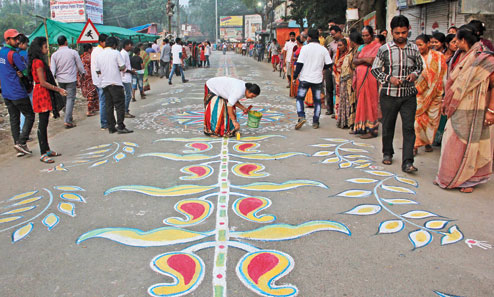
Over 800 people wielded brushes and paints of four hues and drew for around 10 hours to create a 3km-long alpana, which the organisers claim is the longest in the world.

The residents of Nadia’s Phulia woke up on Sunday morning to a splendid view of the alpana, which is a traditional motif drawn on the floor in Bengal and elsewhere in the country.

From 9pm on Saturday, 25 groups with 35 members each started drawing the alpana from Phulia bus stand and completed the entire 3km stretch of a road at Sabujpally around 7am on Sunday. To draw the alpana, 2,800 litres of acrylic paints of four different hues were used.

The artists were responding to a request by Junior 100 Foundation, a social organisation.

“Phulia’s 3km alpana is the longest in the world so far and we are planning to approach the Guinness Book of World Record for its inclusion on the list of extraordinary achievements,” said Abhinaba Basak, the cultural secretary of Junior 100 Foundation.

Debabrata Pal, 28, a graduate in fine arts from a government art college, who took part in the alpana drawing, said: “With such an initiative, people will experience the pleasant look of traditional motifs synonymous with our culture”.

In September, Before Durga Puja, Samaj Sebi Sangha Sarbojanin Durgotsav Committee in south Calcutta drew a 1.2km alpana. Over 320 government art college students took less than 24 hours to draw it.

Basak said: “Our aim is not to go for any competition rather to revive a passion to learn Bengal’s traditional art among the young generation. With this objective, we tried to make it as long as possible, which eventually became the longest one.”

Enthusiasts like Mousumi Biswas, 22, an MA second-year student and Arijit Debnath, 11, of Class V also took up the brush to draw the alpana. The initiative received cooperation from police who diverted traffic to facilitate the drawing.

source: http://www.telegraphindia.com / The Telegraph, Calcutta,India / Home> West Bengal / by Subhasish Chaudhuri / October 29th, 2017

Kolkata to Chandannagar: The French life

In Chandannagar, time flows as languorously as the Ganga beside it

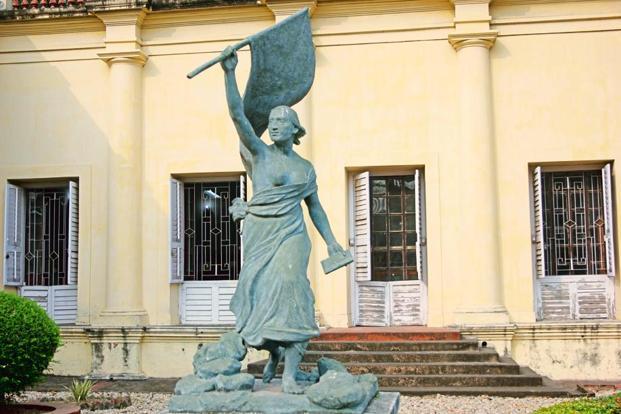
The statue of Marianne, a national symbol of France, outside the Dupleix mansion. Photos: Ganesh Vancheeswaran

The rains had left the fields lush green, a vivid contrast to the dark brown soil at the base. This dual-colour canvas kept a tight grip on the sides of the road through most of the trip. Bustling villages and near skirmishes with traffic ensured there was never a dull moment on the drive from Kolkata to Chandannagar.

My decision to go to Chandannagar for the weekend had been an impromptu one, taken the night before. The fact that it was the only French colony in Bengal in the 17th century, at a time when the British were making determined inroads into the region, made me curious. And so, late one Saturday morning, I hopped into a taxi for the 53km ride. It was a swift and mildly disorienting transition from the crush of humanity in Kolkata. As we entered Chandannagar, my driver pointed to two pillars topped with urns. He said these were all that remained of the grand gate built by the French in 1937.

I asked him to take me to the Dupleix Museum, located in a large yellow mansion. It is one of the few in India that houses a collection of artefacts from French rule, which lasted more than 250 years. Chandannagar was a major trading and military hub for the French during the 18th and 19th centuries. And this mansion used to be the official residence of French governor generals. Apart from French memorabilia, the museum houses rare collections of statues, letters exchanged between freedom fighters, and news clips on the freedom movement in Bengal. With its colonnaded courtyard, broad slatted windows and high ceilings, it is a throwback to period architecture. Even today, French is taught at an institute that operates from the same premises.

Leaving the museum, I headed to a stall nearby for a leisurely mutka (earthen cup) of tea. I was in no mood to rush from place to place. Already, I could feel my heartbeat settling into a slower rhythm. Chandannagar has that effect on you.

The interior of the Sacred Heart Church.

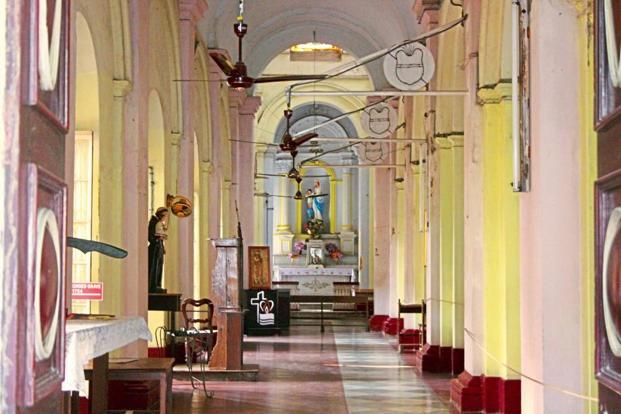
Continuing my journey into the past, I walked up to the lovely Sacred Heart Church, close to the Dupleix Museum. This church, designed by French architect Jacques Duchatz, was inaugurated in 1884. Stepping into its cool portals, I was transported back to the 19th century. The stained glass, old furniture and colourful murals along the nave are largely intact. Later, I walked through the restored graves and tombstones in the cemetery adjoining the church. Buried here along with other nobles is the long-forgotten French commander Duplessis, one of the town’s founding fathers.

Exploring the streets that evening, I saw a number of rambling bungalows from the French period. The structures, still intact, exuded an air of genteel neglect. There was an abundance of greenery. Traffic was sparse and slow-moving. Passing through the local market, I was struck by the absence of the hoarse cries one normally finds in Indian markets. Even the haggling was absent. It seemed as if the entire town loathed anything loud or frenetic.

Wending my way to the strand, I sat on a bench. A few others had colonized benches to read the newspaper or chat. In front of me, the Ganga, known in these parts as the Hooghly, flowed gently, with barely a murmur. Boats ferrying locals were the only traffic. And quiet descended as soon as the day’s activity wound up with the setting sun.

Fortified by some luchi-aloo dum the next morning, I sallied forth again. This time, to the stunning Nanda Dulal temple with its cream-and-vermillion exterior. This temple is built in the do chala (double sloping roof) style native to Bengal, but is, surprisingly, devoid of the terracotta work that is typical of buildings in this district. I learnt from the priest that this temple, which houses a deity of Lord Krishna as a child, was first built in 1740, destroyed and then rebuilt.

I was tempted to join the boys playing volleyball in front of the temple. In keeping with the mood, however, I decided to return to my room to curl up and read.

Weekend Vacations offers suggestions on getaways that allow for short breaks from metros. The author tweets from @theholehog.

source: http://www.livemint.com / Live Mint / Home> Leisure / Ganesh Vancheeswaran / November 09th, 2017

Centuries-old temples unearthed in West Bengal A parish anticipating relic tourism

ASI members inspecting the temples in Bhuri, a village near Burdwan

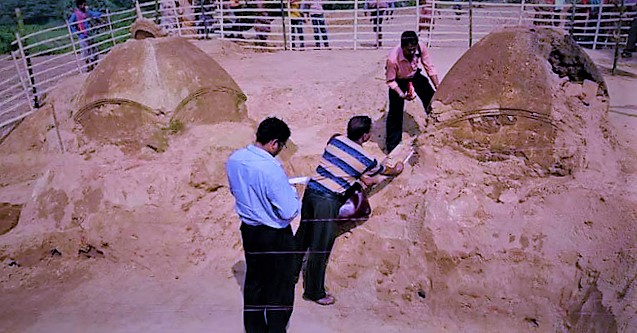
Less than 130 kilometres from Kolkata, in an area at East Burdwan’s Bhuri village, two temples emerged while local workers were digging. The initial inspection and predictions tell that the temples could be centuries old.

Unprecedented and to the dismay of the local workers were digging a section of the land as a part of the Village Panchayat’s cleaning programme aiming to set up a park, two masts of 1.4 metres each came out. The masts resemble the architecture of temples and the primary observation reveals that the temples could be centuries old. Some of the locals also believe that these are Lord Shiva temples that were built during the early British empire.

The land lies beside a canal that connects the River Damodar that was dug years ago to divert water from the village and prevent flood during the monsoons. Whether it was flood or earthquake that led to the demolition and the extinction of these two temples is still a mystery.

Growing anticipation
A team of three from the Archaeological Survey of India (ASI) visited the site where the temples were discovered. According to one of the members of the team who requested a privacy of identity said, “We can’t say anything as of now, it’s very strange that this part of the country had temples like these. We have to dig another 20 odd feet to unearth the reality and the exact identity of these temples. I would my team to prepare the report as soon as possible.”

The ASI team met the local authorities and explained their expectations regarding the security of the place how to neutralise the local excitement. The village head and local police station were instructed to cover the area and stop any kind of further digging. The temples have already got few dents due to the unprofessional digging and the ASI officials stressed on putting a barricade to stop further damage.

While it was just a park that was on the cards, the local authorities are now expecting a tourism spot revolving on the historical aspects of these two temples. For the time being, they are keeping a close watch on the area and have also managed to set up lights during the night to make sure that there is no unnecessary loss of information.

Relic tourism
The eastern region of India especially West Bengal, Bihar, Odisha, and Jharkhand have seen a plethora of religious as well as ethnic diversity since centuries. From the Buddhist settlement in Bodh Gaya and their gradual spread in and around eastern India to the likes of Vaishnavas and various sects of Hinduism practised their culture here. The likes of Moghalmari in West Midnapore district of West Bengal where almost three decades of excavation revealed a Buddhist settlement also adds another hue to this mysterious finding.

History lovers and story seekers have always found their way to dig the reality out of these unique discoveries. While the eastern state is aiming to promote itself as a one-stop destination for all kind of tourists, the unearthing of these two temples near Burdwan definitely has a positive prospect for West Bengal’s tourism industry.
Keep an eye on this space to follow the updates from the unique hamlet nearby the railway station Galsi that recently witnessed the emergence of these two shaman relics.

source: http://www.mediaindia.eu / Media India Group / Home> Tourism / by Sudipto Roy / Kolkata / October 27th, 2017

The Calcutta Chromosome

An empathetic look at a heartbreaking city

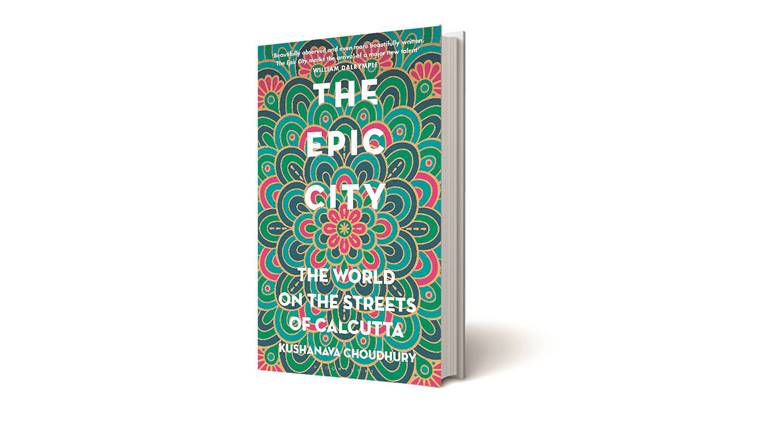
The Epic City: The World on the Streets of Calcutta Kushanava Choudhury (Bloomsbury Circus 241 pages; Rs 499)

Calcutta is personal. And the front flap blurb contains all the trigger words: immigrant, Princeton, British Raj, mosquitoes, hawkers, fish-sellers. Would this be another book balancing nostalgia with wide-eyed wonder? Or would it hit the road running in one more case of parachute authoring? Or, worse, would it be a supercilious outsider’s take on a city that is easy to love, easy to hate, but hard to know?

Calcutta, that most storied of cities, has been subjected to all kinds, right from Geoffrey Moorhouse’s 1971 work to Amit Chaudhuri’s Two Years in the City (2013). In recent years, it has been best served by Strangely Beloved: Writings on Calcutta (2014), a compilation of essays and excerpts that, by virtue of its format, held up special-interest mirrors to facets of the city, from the Eastern Calcutta wetlands to the soundscape that birthed India’s first rock band. The flipside is the academic undertone that robs the city of some of its joy, and the nostalgia shoehorn that depletes some immediacy.

Superficially, The Epic City has none of those problems: Kushanava Choudhury spent some of his childhood years in Calcutta and then comes back to work in the city as a reporter at The Statesman (peeve: the article is part of the masthead, so why lose it?) at the turn of the millennium as a fresh Ivy League graduate. “Like the revolutionaries of my parents’ generation, I wanted to change things…My best hope for making a difference was to work at a newspaper.” To translate those efforts to “make a difference” into a book would be a straight card into disaster zone. Where Choudhury scores emphatically is in twinning his heart, mind and soul — his own story — with the city’s to forge a work that is as gritty as the Beleghata canals, as wondrous as Kumortuli, as determinative as the Partition.

Groomed in the shoe-leather reporting The Statesman was once renowned for (the newspaper’s decline is an obvious parallel for the city), Choudhury lends depth to his observations with lightly worn erudition to produce one of the most readable accounts of a world city. Casual chats with relations, friends, colleagues merge seamlessly with purposeful conversations with trade unionists, little magazine archivists, impoverished scions of Calcutta’s oldest families, descendents of refugees, small publishers, idol sculptors. Underlying it all is an understanding of cultural crosscurrents — Satyajit Ray, of course, but more (and more powerfully) Ritwik Ghatak, Michael Madhusudan Dutt but also Mujtaba Ali — and an instinctive sense of history that burrows into unarticulated spaces, uncomfortable silences.

Cleverly constructed and utterly relevant as each of the 14 chapters of the book is in conveying Choudhury’s clear-eyed vision of the city, two, in my mind stand out. In ‘College Street’, the essay that opens the core section, the author uses a favourite trope for all city chroniclers to eviscerate one of its most fondly held myths: Of Calcutta as a centre of learning. Traipsing through the portals of little magazines and past “rainwater and dog shit” of university avenue, Choudhury trains his guns on the “notes business”, which finesses the education system to ensure intellectual stagnation more effectively than the much-reviled brain drain ever could.

The mood of The Epic City grows darker as it investigates the methodical de-industrialisation of Calcutta — the old factories in the southern reaches memorialised only as bus-stops such as Bengal Lamp and Usha — the rarely acknowledged Hindu-Muslim divide (including at The Statesman, as cosmopolitan as the city likes to think itself to be) and, in ‘Russian Dolls’, it culminates in a familial account of the run-up to Partition and its aftermath.

Weaving together the devastating sequence of the World War II in Europe, the Churchill-directed Bengal famine, the consequences of Direct Action Day with his own grandparents’ displacement from East Pakistan and pitching forward to the rise of the Communists and the Naxal rebellion to his father’s decision to migrate, Choudhury creates a stunning, tight fabric of continuum. Always empathetic, mostly sharp and frequently insightful, this is a heart-full work on a heartbreaking city, notwithstanding the gaping hole of the post-2011 Mamata Banerjee years. While it might even impress the resident Calcuttan, it is definitely recommended for anyone else ever touched by the city.

Sumana Mukherjee is a writer in Bengaluru

source: http://www.indianexpress.com / The Indian Express / Home> Lifestyle> Books / by Sumana Mukherjee / October 07th, 2017