Category Archives: Travel

Hidden collections

Did you know that the City of Joy is also a city of museums? We’re not talking about the most obvious ones, but several that are tucked in forgotten corners, waiting for the elusive visitor to drop in. In fact, many of these museums provide a wealth of material for those who are interested, but lose out because few people know they exist. Utsav Basu does the rounds of a few of Kolkata’s lesser-known museums

Sabarna Sangrahashala

Located in Barisha, Sabarna Sangrahashala is a museum on the Sabarna Roy Choudhury family and the city of Kolkata. Developed by the Sabarna Roy Choudhury Paribar Parishad in 2005, the museum mainly caters to young students and researchers who wish to learn more about the history of the City of Joy. The museum – or rather a collection by the family trust – possesses rare documents and articles, including ‘kabilatipatras’ dating back to the 18th and 19th centuries. Among them is an important artefact which bears the signature of Kavi Rama Prasad Sen dated 1794. The highlight of the museum is the historic judgment of the Calcutta High Court in the Kolkata birthday case and the expert committee report on the matter, which states that Job Charnock was not the founder of Calcutta (Kolkata), nor is August 24 the city’s birthday.

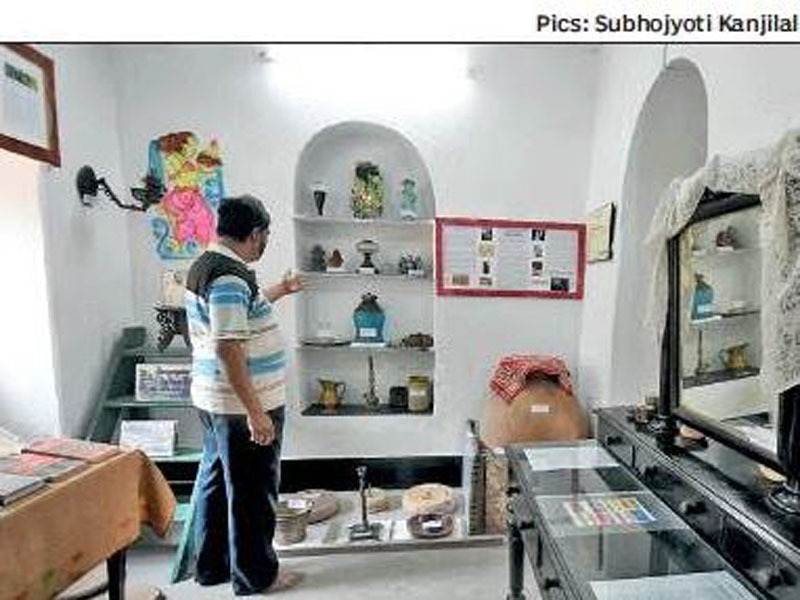
Other articles include a huge earthen rice pot dating to 1840 with can carry 240kg of grain, a metal hookah from 1878, a metal candelabra from 1795, grinding wheels from 1845 and a wooden table used by Antony Firingee’s grandfather, John Firingee, from 1680.

Timings 10am-12pm and 5pm-7pm every day except Thursday
Entry free

Gurusaday Museum

Tucked away in a corner of Joka, Gurusaday Museum, run by Bengal Bratachari Society, is a house of folk art forms conceptualised by civil servant, folklorist, and writer Gurusaday Dutt. A deep interest in Bengal’s folk art led Dutt to collect around 2,325 specimens of various art forms of Bengal. These artefacts were later housed in a museum, which was thrown open to the public in 1963 by Humayun Kabir, the then Union minister of education. The museum now reels under financial crunch, after the Centre, in a notification, asked it to run on its own. The museum authorities claim this is a breach of agreement between the President of India and the Bengal Bratachari Society of May 23, 1984. Before the recent turn of events, it was funded by the Ministry of Textiles.
From specimens of Bengal’s ‘kanthas’ to ‘patachitras’, the museum is a paradise of eclectic artefacts that range from clay dolls to sandesh chhach (sweet moulds) and Dutt’s personal belongings. A few interesting things include ornaments made of paddy, archaeological specimens from the 1st and 2nd centuries BC, dokra crafts and manuscripts of undivided Bengal.

Timings 11am to 5pm (Tuesday-Sunday) Entry 10; IRs 2 (students); 50 (foreigners)

Raja Rammohun Roy Memorial Museum

Located on Raja Rammohun Roy Sarani near the Amherst Street crossing, the nearly 200-year-old house owned by Raja Rammohun’s family houses a history that talks about his life and work. Through various documentations, the museum talks about his ideological battles with his father, compatriots and with a few British officials.

Though the museum does not have any of the real documents or objects used by Roy, a beautiful recreation of the period talks about his life. There are, however, a few original documents such as the original cover of the ‘Tuhfatu’l-Muwahhidin’ (A Gift to Deists), which was a frontal attack launched by Roy against idolatry and superstition plaguing Hinduism in the 18th and 19th centuries, the cover page of the first sermon of the Brahmo Samaj, and photocopies of a few letters written by Roy to various luminaries of the day.

Started in 2000 as a permanent exhibition, the museum slowly took shape through donations from many quarters and the tireless efforts of teachers and professors of Raja Rammohun Roy College. The museum, like any other lesser-known museums of the city, reels under a financial crunch and is thus not being able to expand and house many other artefacts related to the reformer.

Timings: 11am to 4.30pm, all days except Mondays Entry 10;50 for photography

State Archaeological Museum

Located near the Behala tram depot, the State Archaeological Museum, under the state government, is divided into six departments – Site and Sights, Early Historic Period, Sculptures of Bengal, Paintings of Bengal, Metal Sculptures gallery and the Nandadirghi Vihara: Jagjivanpur.

Inaugurated in 1980 by then chief minister Jyoti Basu, the museum has a collection of rare tools of the Early, Middle and Late Stone Ages from Susunia (Bankura) and other sites, proto-historic antiquities from Pandu Rajar Dhibi (Burdwan), sculptures, stone and stucco from the Gupta, Maurya, Shunga, Kushana, Pala and Medieval times.
The painting section of the museum boasts Mughal miniatures, paintings on wooden planks, Kalighat patachitras and watercolours. Primarily painted by court painters of different rulers, the section also has paintings that tell stories.

The main attraction of the museum, however, is the Nandadirghi Vihara: Jagjivanpur section, which documents the 1992 excavation activities at the site in Malda. The section doesn’t have all the real artefacts found in the excavation, but has flawless replicas, apart from a few real exhibits. It also has a model of the excavation site in Malda.

Timings 11am-4.30pm (Wednesday to Sunday) Entry Rs 5

Cultural Research Institute

Barely a two-minute walk from the Kankurgachi crossing, beside the Bureau of Indian Standards building is the Ambedkar Bhawan Cultural Research Institute, which houses a museum divided into four sections. Run by the state government, the museum was earlier at the New Secretariat building. In 1980, it was shifted to Ambedkar Bhawan.
The cultural institute, through the four sections – Ethnographic, Puppet, Kantha and Boat – has an interesting collection that talks about Bengal and its varied cultural background.

The ethnographic section displays baskets of several tribes, tribal musical instruments, Birbhum paintings, masks and other artefacts that talk about Bengal’s ethnic milieu at length. The puppet section breaks the popular belief that Rajasthan is the only land from where puppetry originated. This section has a collection of puppets that were used to tell stories of Dakshin Rai and Bon Bibi and that of other kings who ruled Bengal and their valour. The Kantha section is also quite interesting. This section displays some of the finest examples of kantha.

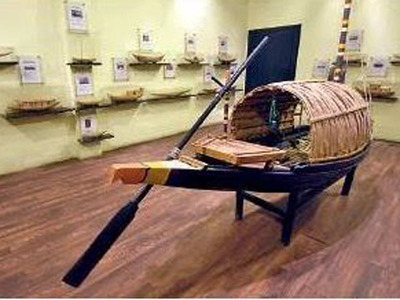
The main attraction is the boat museum, which boasts a collection of around 40 models of several boats of Bengal, used for various purposes. This section is a virtual boat-ride through a wave of stories. Through detailed descriptions about the type of boats used for specific reasons, the narratives also throw light on the areas of Bengal where the boats were used or made.

Timings 10am-5.30pm (Monday to Friday)

Entry Free

Acharya Bhawan

The museum on Acharya Jagadish Chandra Bose at his house built in 1902, beside the Bose Institute on APC Road, houses furniture used by Bose and his wife, the original instruments used by him for his various scientific experiments and his personal belongings. A request to the trustees can also take you to the attic room where Bose used to carry out his experiments.

Restored by INTACH and looked after by the Sir J C Bose Trust, Acharya Bhawan has not been changed a bit from its original glory. The trust has arduously taken the task of keeping intact the feel of the house as it was more than 100 years ago.

A section of the museum has the original chairs and the table which Bose exclusively used while interacting with his friend, Rabindranath Tagore. The museum also has the dark room and the observatory used by Bose for his experiments.

Timings 2pm-4pm (Wednesday and Friday) Entry | Free

source: http://www.timesofindia.indiatimes.com / The Times of India / Home> City News> Kolkata News / Utsav Basu / TNN / April 28th, 2018
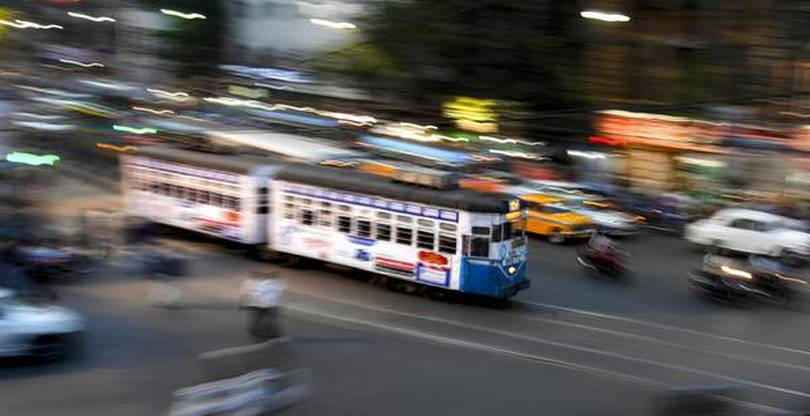
A streetcar named Calcutta: trams are part of the city’s charm

The city’s trams may have been sidetracked by taxis and buses, but they soldier on carrying passengers and a proud legacy

As he drives a tram through the busy streets of Kolkata, Dinesh Singh keeps a watchful eye for yellow taxis. When he started work 35 years ago, Mr. Singh, who is from Uttar Pradesh, did not have to worry so much. The electric cars ran smoothly on dedicated lines with nothing coming in their way. But now, vehicles running on fossil fuels have gained the upper hand.

The trams may not have kept pace with the city’s fast life, but they refuse to roll down into the sunset. Making slow progress through busy streets without leaving a smoky trail, the trams offer a ride down history. Running continuously since March 27, 1902, the Kolkata trams make up one of the oldest transport systems in Asia. “Earlier, tram lines used to be separate from the regular traffic. But as the city grew, those lines were merged with the main traffic routes. Hence, tram services run even more slowly now. Youngsters no longer prefer it, and it is only the elderly passengers and women who still use it,” says Uma Shankar Sharma, who has a history with trams. The 59-year-old took up driving trams after his father completed 40 years of service piloting them through the city’s streets.

Bombay, Madras, Delhi and Karachi have no trams now, though the British introduced them in these cities also. Exuding an old-world charm and nostalgia, the slow-moving, eco-friendly transport system is part of Kolkata’s charm. The Calcutta Tramways Company was registered in London in 1880. The British managed it even after Independence. In 1967, the West Bengal government took over the operations. But as time passed, taxis, private buses and India’s first metro simply outpaced the trams. The tram tracks became a casualty of rapid urbanisation. Many tracks were removed. The slow speed, infrequent timings and failure to change network patterns worked against trams. The tramway corporation even introduced bus services to increase its revenues.

Indrajit Singh, a timekeeper at the Esplanade tram depot, says only 10% of the tram lines in existence in 1995, when he joined service, are functioning now. He cites the expansion of the metro and other means of transport as the reason for the decline. The depot, from where the first electric tram car in Asia was run, today houses a tram museum and a cafe, serving history buffs and tourists. A 2011 study by the University of Calcutta said improving Kolkata’s tramways would have greater economic and environmental benefits than replacing it with other means of transport such as buses.

source: http://www.thehindu.com / The Hindu / Home> News> Cities> Kolkata / by K.R. Deepak / April 21st, 2018

GPS tracking for Nepal cargo from city

Calcutta:

Cargo shipped from other countries to Calcutta and then sent by road to Nepal is now being tracked by the customs authorities with GPS to ensure the containers do not go missing on the way.

As part of a pilot project which started on Wednesday, the customs authorities are using the GPS-enabled electronic cargo tracking system to lock Nepal-bound containers at the Calcutta ports.

“Cargo containers from India cross over to Nepal from Raxaul, Jogbani and Sanauli. While Raxaul and Jogbani are in Bihar, Sanauli is in Uttar Pradesh. Now, we can track a container’s journey to any of the three border points from a port. The tracker will help us know whether a container has deviated from the route or stopped midway and for how long,” a customs official said on Friday.

At the border points, Indian customs officials remove the device. A report is immediately generated containing all details of the trip.

“Importers and exporters can track the movement, too, with this system. This will increase transparency as well as make documentation less complicated,” the official said.

Three containers bound for Nepal were sealed with the new tracking system at Kidderpore and Garden Reach ports on Wednesday.

India and Nepal had signed a memorandum of intent in 2017 to introduce the tracking system.

Surrounded by land on all sides, Nepal’s import cargo from across the world are shipped to Calcutta, Haldia or Visakhapatnam.

However, because of its proximity to Nepal, bulk of Nepal’s cargo is shipped to the ports in Bengal.

Nepal imports items from pulses to helicopters, most of which are shipped to Kidderpore, Garden Reach and Haldia. Other items it imports include electronic goods, plastic granules, machineries, coal, urea and food products such as black pepper and noodles.

Customs officials said around 1,500 containers carried cargo from Kidderpore and Garden Reach on an average every week.

Officials said there had been a few occasions when the containers went missing on the way to the border.

source: http://www.telegraphindia.com / The Telegraph,Calcutta,India / Home> Calcutta / by Special Correspondent / April 21st, 2018

Nurturing little Armenia in the heart of Kolkata

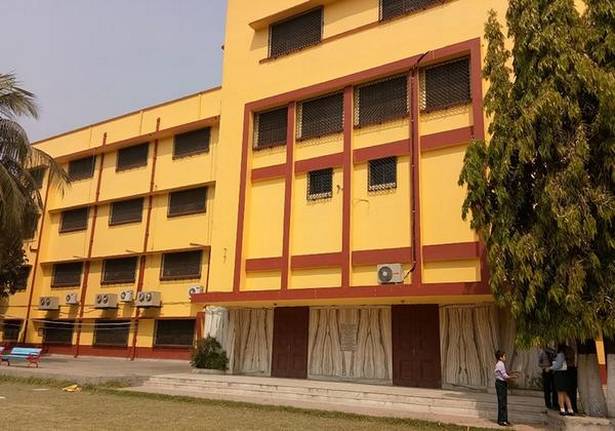
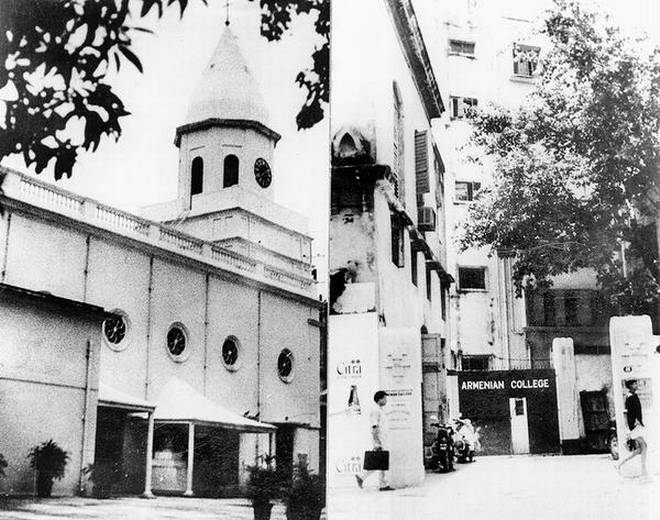
The Armenian Church of Nazareth, the oldest church in Kolkata; and (right) The Armenian College. | Photo Credit: PTI

For 197 years, the Armenian College and Philanthropic Academy has offered not just education but a sanctuary for children torn by conflict.

It was a birthday party of a different kind.

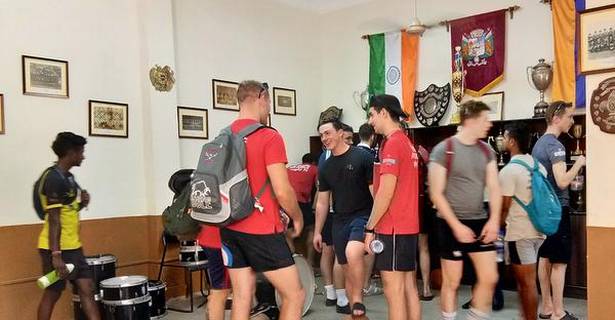
Brought together often by conflict and exile and nurtured in a regime of tough love, the dozen alumni and 70 present students of the Armenian College and Philanthropic Academy (ACPA) of Kolkata were celebrating 197 years of the institution on April 2.

Amid the animated discussions on the crisis in West Asia, Razmik Hakobyan, a 24-year-old Iraqi, an alumnus of the school, said he was dispatched to the ACPA in 2007 for “safety and education,” after a bomb exploded close to his house in Baghdad’s upmarket Kembel Gilani area. Mr. Hakobyan’s father, a retired soldier, decided distant Kolkata was safer.

“A friend who studied in Kolkata told us about the school and my parents got interested,” said Mr. Hakobyan, who left Baghdad when he was just 13. He would like to visit Baghdad, he said, but only on vacations.

“Baghdad is not getting better and nor is its education,” said the young man, whose family has since shifted to Kurdistan. Close to completing his graduation at the city’s St. Xavier’s college, Mr. Hakobyan says he is indebted to the Armenian College and its teachers.

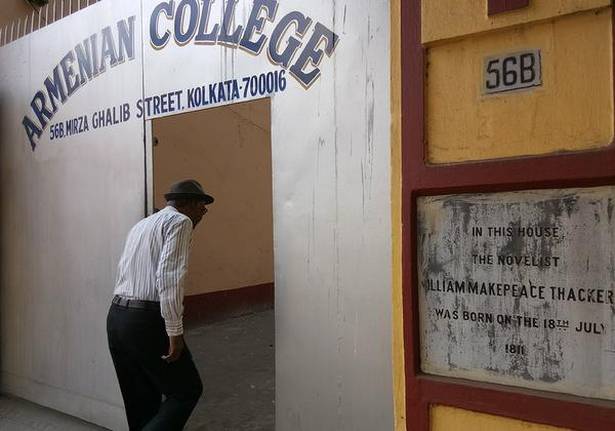
Set about 500 metres north of Park Street in the heart of the city, a plaque at the entrance of the imposing yellow building announces that “the novelist William Makepeace Thackeray was born on the 18th July, 1811” in the premises. Since 1821, it has housed the Armenian College and Philanthropic Academy — a school for Armenian students from all over the world up to Class X.

India as home

The Armenians adopted Christianity in 301 AD and were invited “to come and settle in his dominions” by emperor Akbar in the 17th century.

They arrived in Bengal in 1645 and settled along the Hooghly’s fertile western bank like most traders of the time. Anne Basil in her seminal book Armenian settlements in India writes that the community grew in size and influence and felt the need to have its own school. An informal school was set up in 1798, which was replaced by the present Armenian College and Philanthropic Academy on April 2, 1821, at 358, Old China Bazar Street near the Armenian Holy Church of Nazareth, Calcutta.

Following the genocide of more than a million Armenians in eastern Anatolia by Turkish forces in 1915, “hundreds of children of uprooted families…found shelter and a roof and received sufficient education…” at the Kolkata school, notes Basil.

Open to all Armenians

Armen Makarian, a former student and school’s coordinator, said the institution is the only Armenian school of its kind in the world.

According to Very Reverend Father Movses Sargsyan, head of the Davidian Girls’ School (DGS) — the girls’ wing — and Armenian College, the school is globally known among Armenians. “Internet, website and social pages informed the guardians,” Father Sargsyan said. While a majority of the students are from Armenia, the rest are from the Armenian disapora in Iran, Iraq and Russia and a handful of Indian-Armenians.

“We would like to have Armenian students from across the world — from Germany, Italy or France and even Syria,” Father Sargsyan said.

Like most boarding schools, the Armenian College has an intensely packed, exacting schedule. Mobile phones and laptops are a strict no-no, with the students allowed two hours out of the premises for shopping.

“But we like it,” said Vladimir Grigoryan, a ninth standard student, who was born in Russia but now stays in the Armenian capital, Yerevan.

“My parents were paying $2,500 annually for my education in Armenia. But the teachers never cared if we were learning — unlike here where teachers are constantly demanding,” said Vladimir, whose father runs a chain of hotels in Russia.

For Sevak Azarian Namagardi from Iran, who just appeared for his ICSE examinations, life is a “little boring” at times. Being a trained singer and a regular at choirs, he looks forward to weekly chats with his family over Skype.

“As the summer vacation approaches, I’m making arrangements to leave for Tehran,” he said. He has more reasons to cheer. “This time the family and I will visit Armenia, our motherland,” said Sevak. He, however, is equally keen to get back to friends at the school.

Academic challenge

Imparting education to students from such diverse backgrounds, however, is not easy. Soumitra Mallik, Principal at the Academy said the key problem was to match various levels of education.

“We do not know if the student who has studied up to Class V in her or his country is on par with what is taught here under the ICSE syllabus. So, this content mapping and matching is a problem,” he explained.

The other problem is communication as the students usually come from non-English speaking backgrounds. While Armenian teachers teach Armenian language, history, and culture, most of the around 25 faculty members at the Academy are Indian.

“So, we have six-month preparatory courses where we intensely teach English, some Mathematics and a bit of the Sciences to provide an outline of what the student will study and to hone their English language skills,” Mr. Mallik said. So far, it has worked well as many of the students are quickly able to leapfrog to reading Shakespeare’s Merchant of Venice within a few years!

Arindrajit Saha, the English teacher, said, “Studying Shakespeare within a brief period of time can be considered an important marker.”

Though the students indeed are grateful for the free and quality education they receive, there are regrets of a lost childhood back home.

“Saddam Hussein may have been a dictator but Iraq was not doing too badly and there was peace. With his departure, the country permanently collapsed and I had to leave my incomplete childhood behind,” said Mr. Hakobyan.

The different countries that the students hail from may not share friendly diplomatic ties, but the bond that Mr. Hakobyan or Sevak develop at the Kolkata school go beyond political compulsions or geographical boundaries.

“We are from the same tree, with same roots. The branches move in different directions, but the root remains,” says Arian Makarian of Iran, an alumnus.

source: http://www.thehindu.com / The Hindu / Home> News> Cities> Kolkata / by Suvojit Bagchi / Kolkata – April 14th, 2018

Film on rickshawala’s Ladakh feat feted

Kolkata :

Satyen Das was busy picking up passengers on his rickshaw at Geetanjali Metro station in Naktala when he got to know a documentary film—‘Ladakh Chale Rickshawala’ — on his rickshaw journey from Kolkata to Ladakh had won the Best Exploration/Adventure Film at the 65th National Film Awards announced in New Delhi on Friday.

By afternoon, when he got the news, the 44-year-old had already earned Rs 150, but he was more excited about the award. It’s his love for adventure that gave him the courage to fight all odds to complete the treacherous journey, says Das.

It turned out to be a life-changing moment for Das, when Indrani Chakraborty, a television producer from Naktala, hailed his rickshaw in 2014. During the short journey, she learnt that Das was planning to leave for Ladakh soon. He fished out old pictures of him visiting Puri and some places in north India on his rickshaw and showed it to her. At that moment, Indrani decided to shoot his journey to Ladakh and turn it into a film.

“I didn’t have the money to follow Satyen Das on his entire journey to Ladakh, so taught him to shoot on a handycam. It was tough when the handycam stopped working after he crossed Benaras and someone from my team had to rush to where he was and get it repaired. Two of my associates and I met him on the final leg of his trip in Ladakh,” says Indrani.

Das credits Indrani for helping him in completing the journey and doesn’t forget to thank some of his regular passengers and members of Naktala Agrani Sangha, a club in his neighbourhood.

“I drove my wife and daughter to Puri and north India and was inspired to take my rickshaw to Khardung La mountain pass, the world’s highest motorable road, 39 km Leh. I got help from Indranidi, a few of my passengers and members of Naktala Agrani Sangha. There were many challenges; every day, someone or the other would ask me to return to Kolkata. ‘You can go till Srinagar, not beyond,’ they told me. But I didn’t budge,” recalls Das.

For Das, food was as big an issue as the lack of oxygen and the inclement weather. “I carried basic ingredients like rice and potatoes. I would either have aloo chokha-bhaat or instant noodles; it was more of a fight for survival,” he says.

But the toughest part of his journey came when he reached Zoji La pass. “The roads were rough and there was no way that I could carry my belongings on the rickshaw and cover the 8-km stretch. I would offload everything on the road drive the rickshaw for a few metres and return to carry the things on my shoulder. It took an entire day to cross that stretch, but I didn’t stop. I wanted to create a record of sorts by reaching Khardung La.”

Das, who shot his journey on a handycam, was joined by a three-member camera team in Ladakh. “From thereon, there was no looking back. I returned to Ladakh again in 2017, this time with the message of fighting global warming. I sprinkled 5,000 date seeds along the way.”

His rickshaw has been put on display at the university campus set up by Sonam Wangchuk in Ladakh. Indrani, who helmed the documentary film, said even though the journey took two-and-a-half years to complete, it took her three years to finish this 64-minute film. She approached Films Division, which has taken the project under its wing.

source: http://www.timesofindia.indiatimes.com / The Times of India / Home> News> City News> Kolkata News / by Zinia Sen / April 04th, 2018

Calcutta boy’s haveli hotel in Bikaner

Forefather’s legacy reinvented with honesty of heritage

Golpark:

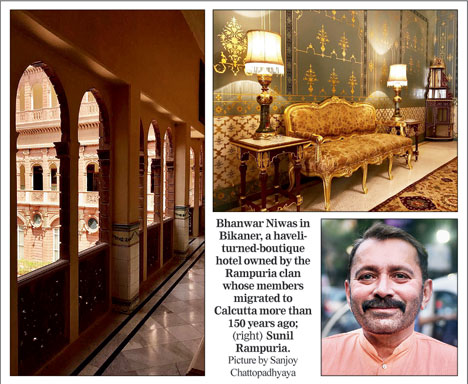
A Calcuttan whose forefathers had migrated to the city from Rajasthan more than 150 years ago has returned to his roots to turn an ancestral haveli into a boutique hotel.

Bhanwar Niwas, one of the famous mansions owned by the Rampuria clan, stands in the old walled city of Bikaner. The haveli had been built in the late 1920s by Seth Bhanwarlal Rampuria, heir to a textile and real estate fortune in Calcutta. It became a boutique hotel in 1993 at the initiative of Bhanwarlal’s grandson, 61-year-old Sunil Rampuria.

Sunil, an alumnus of La Martiniere for Boys and St Xavier’s College, is now based in Bikaner but keeps visiting Calcutta, which he calls “home” and where his parents and in-laws remain.

“The Calcutta I grew up in has made me the person I am. The city is steeped in tradition but that has not stopped it from being liberal. Calcutta moulds you,” Sunil said.

He remembers going to a kindergarten school on Royd Street that used to be run by a Spanish woman and an Iraqi man. “I always wondered why their surnames were different. Back then, living in was not a common thing,” he quipped.

Sunil had sold a house in Vizag, where he had worked in a construction company for several years, to fund the facelift of Bhanwar Niwas.

Although the property is more than 90 years old, it did not need much renovation. The architecture of the three-storey mansion is a mix of Indian and European styles with a majestic facade and a sprawling courtyard in the middle. Multiple staircases and large rooms complete the heritage look.

“People from my native place came to work in Calcutta and eventually settled down. But there were relatives back home. They built large houses because they were a status symbol,” Sunil told Metro before returning to Bikaner last weekend.

Several bhujia makers in the city trace their roots to Bikaner. The Rampurias are one of the oldest among these clans with several havelis spread among Sunil’s distant relatives.

His great grandmother lived there until 1988. Sunil left Calcutta in 1992 when he was 27 and started the project the same year. He was married with three children and his parents were apprehensive about the decision because of the risks.
In Bikaner, people were surprised that Sunil was reversing a trend. While his forefathers had migrated from a provincial town to a booming business centre, he was returning from Calcutta.

Before the hotel opened, Sunil made changes like carving attached bathrooms out of the large rooms. He did the stencil-painted wallpapers himself.

The hotel has done well over the years. “I don’t have go to Delhi to solicit business,” Sunil said.

Bhanwar Niwas offers a wholesome period experience in its own way. It is located in the middle of a locality and guests can see people celebrate local festivals. There are no TVs in the rooms because Sunil wanted to be “faithful to the period when the mansion was built”.

It is hard to miss the connection with the Best Exotic Marigold Hotel, the 2012 film about a young Sonny Kapoor (played by Dev Patel) who wants to realise his father’s dream of restoring a grand hotel in Jaipur.

Sunil downplays the comparison, but is proud that his eldest son Prashant now looks after Bhanwar Niwas.

Calcutta is dotted with centuries-old buildings that are caught in the conservation conundrum.

A little over a month ago, the Calcutta Municipal Corporation allowed the building that housed the old Kenilworth Hotel to be demolished by its present owners after downgrading its heritage status. Heritage conservationists alleged a builder-official nexus.

Metro reported last week that Tripura House, the stately Ballygunge Circular Road mansion, will have a residential highrise share a portion of its 100-cottah compound after the West Bengal Heritage Commission gave its nod to a project rejected by the civic body.

Heritage has to be relevant to make conservation viable, Aishwarya Tipnis, an architect working on French heritage structures in Chandernagore, said in a lecture at the Indian Museum last Wednesday. “Conservation is no rocket science. It is far from a NASA code that can’t be cracked,” she said.

Sunil seems to have cracked the code.

source: http://www.telegraphindia.com / The Telegraph,Calcutta,India / Home> Calcutta / by Debraj Mitra / April 12th, 2018

Architect helps crack conservation code

Calcutta:

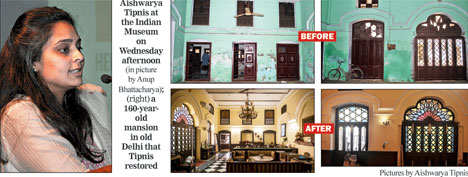
A young architect working on heritage structures in Chandernagore busted several myths about conservation of old buildings at a lecture at the Indian Museum on Wednesday afternoon.

“Conservation is no rocket science. It is far from a Nasa code that can’t be cracked,” said Aishwarya Tipnis.

An alumnus of the School of Planning and Architecture in New Delhi, Tipnis won the Chevalier des Artes et des Lettres, France’s top cultural award, this January for her “outstanding commitment” to the preservation of French heritage in Chandernagore, where she has been working for eight years.

The 37-year-old debunked the common perception that conservation is opposed to development, stressing that it is in fact a part of it.

The lecture, titled Why Does Heritage Conservation Even Matter To Anyone, took the audience through a presentation that told the story of Tipnis’s first big project – the restoration of a 160-year-old mansion in old Delhi, which started in 2010.

The current owner of Seth Ram Lal Khemka Haveli at Kashmere Gate in Shahjahanabad, Deoki Nandan Bagla, wanted to spruce up the house before his sons’ marriage. The three-storeyed house had been home to Bagla’s grandparents since 1920. Lack of renovation had created large cracks on floors and walls and several doors and windows were missing.

It was one of the first private conservation projects in the capital and went on to become a torchbearer for conservation of several old mansions. But the journey wasn’t smooth. The first challenge came from the client himself. Bagla wanted to turn it into a contemporary home. “What is restoration? Make the haveli modern,” he told Tipnis.

But Tipnis managed to convince him that compromising on the house’s principle architectural and aesthetic values was not a smart choice. “I told him everybody had a fancy home. But a palatial mansion was rare. He could show it off as a status symbol to the families of prospective brides.”

The finer details of the conservation were not as important to Bagla as his family’s pride. The point Tipnis drove home was that “architects have to get off their high horses” and connect with people.

One of the key aspects of traditional architecture was lime mortar plastering instead of cement. It led to setting up a lime mortar chukki in the courtyard of the mansion. After several failed experiments – with everything from urad dal and gur to methi seeds – a traditional lime plaster was ready to be caked on the walls.

The project also proved that conservation did not need to be an extremely expensive affair and jugaad could go a long way in bringing down the costs. Instead of using imported beams, Tipnis and her team used stainless steel beams made in Bagla’s factory.

The main lesson of the project was that heritage must continue to be relevant for conservation. “The day it loses relevance, no amount of legislation can preserve it,” said Tipnis.

source: http://www.telegraphindia.com / The Telegraph,Calcutta,India / Home> Calcutta / by Debraj Mitra / April 05th, 2018

Glass-top gallery at Currency Building

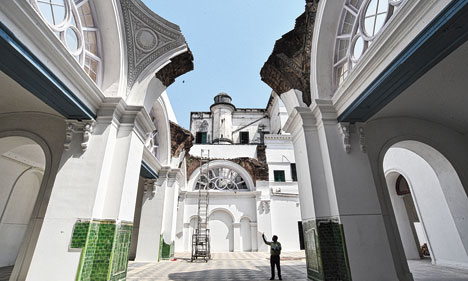
The courtyard of the 185-year-old Currency Building
Dalhousie is being restored by the Archaeological Survey of India. The remnant of the dome to the left was in a state similar to the one on the right and has now been restored.
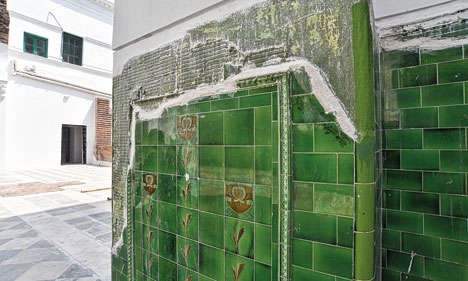
The green tiles (above) with nettle patterns have developed cracks in some places and a few have broken edges. A technique called lime punning, which involves application of a mixture of lime and sand, is being used to prevent water from seeping into the inner side of the tiles and conserve them. / Pictures for all above by Sanjoy Chattopadhyaya

Calcutta:

The large courtyard of the more than 150-year-old Currency Building, designed in Italian style, will soon be turned into an exhibition hall for the National Gallery of Modern Art with a glass roof over the remnants of demolished domes overhead.

The flat toughened glass ceiling will allow sunlight to stream in and keep the view of the domes unhindered.

Conservation and restoration work is underway at the protected monument, which is under the custody of the Archaeological Survey of India (ASI). The first and second floors of the building’s west wing, facing Dalhousie Square, will also be handed over to the National Gallery of Modern Art (NGMA).

The building was “founded” in 1833, according to the ASI website. “It initially housed Agra Bank and was named Currency Building when the government took over a large portion for its currency department,” the website states.

The building had been in use till 1994. The Central Public Works Department (CPWD), which was in charge of the building, started demolishing the structure in 1996.

In the book White and Black, Soumitra Das writes that the destruction was stopped after the Calcutta Municipal Corporation (CMC) and Intach (Indian National Trust for Art and Cultural Heritage) intervened. The ASI was given custody of the building in 2005. But the three massive central domes had been pulled down by then.

Architects and engineers are now conserving the tiles on the walls of the courtyard and restoring the hollow walls on the first and second floors.

Some tiles with nettle designs have developed cracks while a few others are damaged along the edges. Instead of restoring the tiles, which would involve filling the gaps with similar tiles, the ASI has decided to conserve them using a technique called lime punning (see caption).

“Lime punning will prevent water from seeping into the inner side of the tiles and restrict further decay,” said Sudipta Sen, a junior conservation architect in the project.

Post restoration, only the west wing of the building will be handed over to NGMA, which plans to use the space for an exhibition hall and a full branch office.

“An office in Calcutta would help researchers as they would be able to approach the city office for help instead of going to Delhi,” said Adwaita Charan Gadanayak, the director general of NGMA.

“We expect to get the space within three months. The ASI is working very fast. Once we get the space, we will use some of it for permanent display of paintings and artefacts and the rest for exhibitions,” Gadanayak said.

“A memorandum of understanding was signed in 2015 and work was carried out in phases. Recently, we have quickened our pace and hope to hand over the space to NGMA soon,” said G. Maheshwari, the superintending archaeologist of ASI’s Calcutta circle.

The first and second floors of the west wing are also being done up. Each of the floors has three rooms and a 40-metre-long hall. Together, the two floors hold 12,055 sq ft of space.

The east wing has offices of the ASI and National Monuments Authority.

source: http://www.telegraphindia.com / The Telegraph,Calcutta,India / Home> Calcutta / by Subhajoy Roy / April 01st, 2018

India’s only Greek cemetery lies in utter neglect in Kolkata

Kolkata :

The Greek community has long vanished from Kolkata. Besides the Greek Orthodox Church at 2A Library Road, the Panioty Fountain (named after Demetrius Panioty) at Curzon Park that is featured in Satyajit Ray’s ‘Paras Pathar’ still stands testimony to Kolkata’s Greek connection. Tucked behind the Metro construction at Phoolbagan rests the only cemetery meant for this community in India.

Locals vouch for its historic relevance and claim that the Greek President had also visited it in 1998. All the above addresses are Grade 1 Heritage Buildings in KMC records.

Yet, today the cemetery lies in neglect. Father Raphael, priest of the Greek Church which also takes care of it, is keen that the either the state government or any private organisation takes up the initiative of renovating this dilapidated cemetery that is a Grade 1 heritage building by KMC records.

In 1777, this cemetery had started functional at 105 Abul Kalam Azad Sarani. Curiously enough, the first tombstone belongs to that a Greek businessman named Alexander! In 1771, Alexander Argeery was sent to Cairo by Warren Hastings on a diplomatic mission to obtain permission for British merchants to trade with Egypt. Once he managed to do that, he was rewarded by Hastings with a permission to build a Greek church in Amratollah Street. Eventually, he shifted his business to Dhaka, where he died on August 5, 1777. Later, his body was buried at this Phoolbagan cemetery on August 7, 1777.

A blue tarpaulin sheet almost hides the entrance. Passers-by can easily overlook the inscription mentioning ‘Greek Cemetery’ beside the gate. Even those staying in the residential apartments, which literally surround the cemetery, wouldn’t think that this can be an attraction for tourists and students of world history.

But in reality, it deserves all their attention and more.

Built on 26 cottah of land, this cemetery is now home to some 300 odd graves. Caretaker Basanta Das, whose grandfather and father also worked here, says this includes even those that don’t have a tombstone.

Unfortunately, most of the tombstones are broken. They are either nameless or have illegible inscriptions. Some have inscriptions written in Greek as well. “Not all the graves have bodies buried underneath. Even when some Greeks died in other India cities and were buried there, their tombstones were erected here. That has been done so that memorial services for all Greeks in India can be collectively held here,” says Raphael.

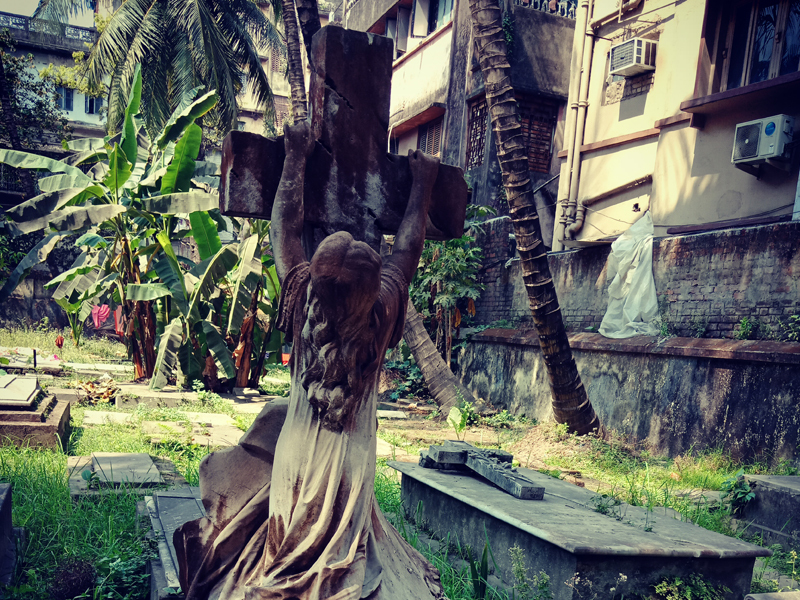
A small chapel – Prophet Elias – stands inside the cemetery. Few sculptures still remain. Among the first one to draw the attention is the sculpture on the grave of Sir Gregory Charles Paul who was the advocate general of Bengal. Next to this grave rests his widow Lady Aglaia Elizabeth Paul. At the far end of the cemetery rests another grave with inscriptions written in Greek. A striking sculpture of a lady kneeling and holding on to a cross looks arresting.

The once-beautiful garden has now been reduced to just mini bushes. A well has been dug right inside the premises. That’s where Das and his family take a bath and wash utensils. Sometimes when guests come visiting, the graves serve as dining tables for their sumptuous lunches. Ask them if they are scared of spirits on rainy nights and Das and his family break into a peal of laughter. “Never have spirits bothered us here,” Das insists.

The fund crunch in renovating this cemetery is obvious. “The Greek community abroad has been financially supporting our church as well as the upkeep of the cemetery. But in recent times, Greece has been reeling under economic crisis. The community is still trying to help us but currently, we have had to cut down 50% of our projects because of the financial crisis,” says Raphael, adding that any initiative for the upkeep of the cemetery is welcome.

The only Greek representative in Kolkata is 66-year-old old Sister Nectaria Paradesi who is responsible for looking after two orphanages. In the absence of Greek families in Kolkata, the church allows people of other faith who now belong to the Greek Orthodox Community to get buried here. “It is difficult to get burial space in this city. Since this cemetery still has space to accommodate tombs, we allow those who have converted to our congregation to get buried here,” Raphael says.

That’s why one spots the tombstone of Philoythei Tina Khatoon. “The last burial – that of a lady in her 40s – happened some six months ago,” says Das, who gets a meagre salary of Rs 4,500. He is now pinning hopes on the Metro rail authorities to help with the renovation. He had heard that once the Metro Rail station gets built, the authorities might be interested in renovating this place. Das is now hoping these words will not just rumours.

source: http://www.timesofindia.indiatimes.com / The Times of India / News> City News> Kolkata News> India / by Priyanka Dasgupta / TNN / March 25th, 2018

Promise to preserve DHR heritage tag

Rail board chief inspects toy train route and stations

Lohani seated on a toy train near Sukna on Tuesday. Picture by Passang Yolmo

Siliguri:

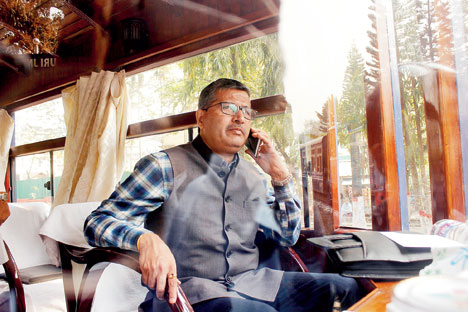
Ashwani Lohani, the chairman of Indian Railway Board, on Tuesday promised that all necessary restoration works would be taken up for preservation of the world heritage status of the Darjeeling Himalayan Railway (DHR).

The chairman said he would look into possibilities of reducing toy train fares and said more second class coaches would be introduced in toy train services so that tourists as well as locals could afford the travel.

The railway official arrived at New Jalpaiguri on Tuesday morning and took a special toy train – two coaches hauled by a steam loco – to the hills.

He visited a number of stations, the DHR workshop at Tindharia, the printing press at Kurseong and also interacted with railway employees, local people and passengers of other toy train services.

“We are aware of the world heritage value of the DHR and will do all necessary work for the conservation and restoration of the DHR,” said Lohani at Sukna, from where he started his inspection.

During the statehood agitation in the hills last year, the toy train services had come to a halt in June. Also, a section of agitators had torched two stations -Tindharia and Gayabari-and damaged a portion of Elysia Building, the DHR headquarters in Kurseong.

source: http://www.telegraphindia.com / The Telegraph,Calcutta,India / Home> West Bengal / by Bireswar Banerjee / March 21st, 2018