Category Archives: Travel

Kolkata revives the romance of the Raj

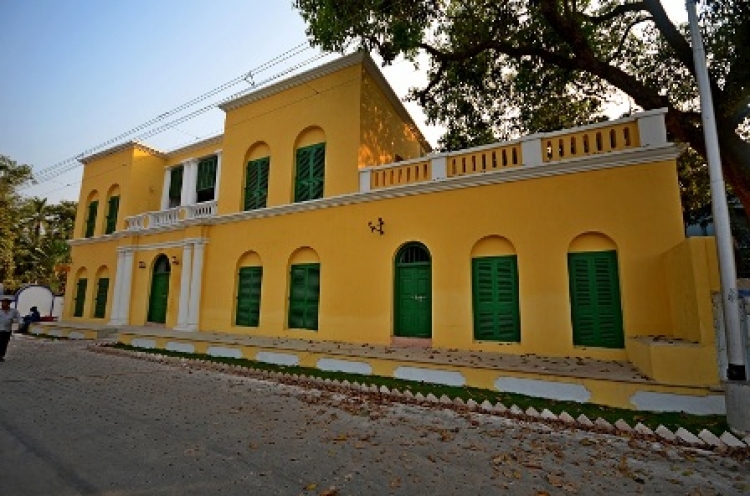
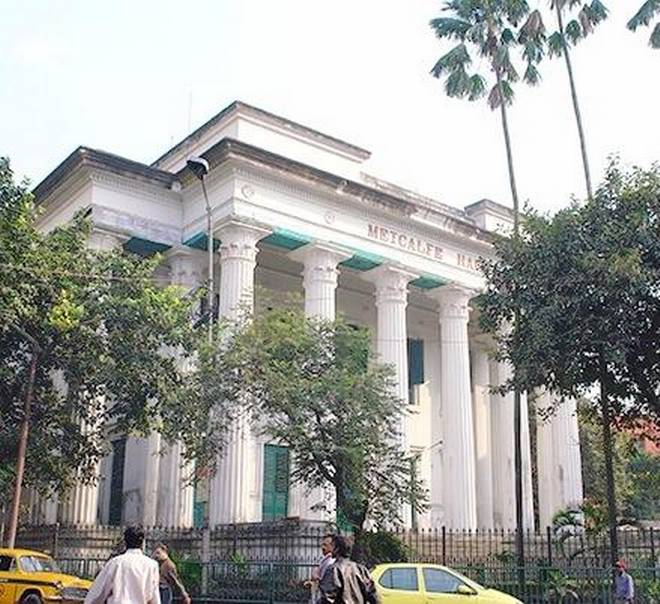
From another time: Metcalfe Hall, at left, and Currency Building are set to host exhibitions. | Photo Credit: The Hindu

Two colonial-era buildings to get a new lease of life as hubs of art and culture

Two of Kolkata’s oldest colonial buildings, Currency Building and Metcalfe Hall, both built in the 19th century, will soon become museums and galleries showcasing art and urban history.

The three-storied Currency Building in Dalhousie Square was built in 1833. Designed in the Italian style with Venetian windows and cast iron gates, its vaults and strong room once housed some of India’s oldest banks, including Agra Bank and the Reserve Bank of India.

But now the western wing is all set to become the office of the National Gallery of Modern Art (NGMA). Once the NGMA moves in, the Currency Building will host an exhibition of sketches and sculptures by Ramkinkar Baij, a pioneer of modern Indian sculpture.

“We are expecting that a portion of the Currency Building will be handed over to us by September. There are plans to have a large exhibition on Ramkinkar Baij,” said Adwaita Gadanayak, director general of NGMA.

Archaeologists say the Currency Building was not a mint but a place where currency was kept. Till 1937, it was occupied by the RBI, after which it fell into neglect. Its central dome collapsed later. The Archaeological Survey of India (ASI) took over its upkeep in 2005.

Barely 200 m away is Metcalfe Hall, with 30 Corinthian pillars built between 1840-1844. Located at the junction of Strand Road and Hare Street, it draws its name from Lord Metcalfe, the Governor General of India in 1835-36. It is in this structure that the city’s history will come alive as the ‘Calcutta to Kolkata’ exhibition.

Renovation dilemma

The ASI grappled with the question whether to rebuild the Currency Building’s dome, but decided to keep the existing structure.

In Metcalfe Hall, it shifted one lakh books for repair work. “The exhibitions will bring them back to life,” said G. Maheswari, Superintend- ing Archaeologist, ASI, Kolkata circle.

source: http://www.thehindu.com / The Hindu / Home> News> States> Other States / by Shiv Sahay Singh / Kolkata – September 02nd, 2018
London goes the Kolkata way!

For decades now jhalmuri, spicy puffed rice, has ruled the streets of Kolkata.

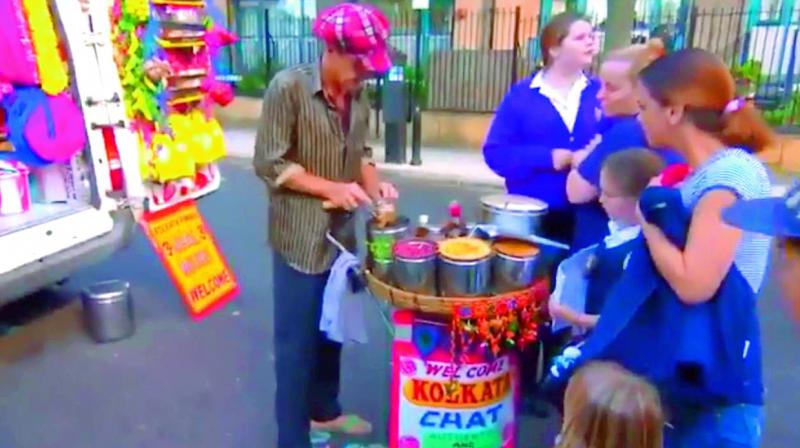
Chef Angus Denoon serving jhalmuri in London.

For decades now jhalmuri, spicy puffed rice, has ruled the streets of Kolkata. Having been a part of 10 Foods Around the World to Try Before You Die (published by Huffington in 2012), jhalmuri has now found many new admirers on the streets of London.

Well-known industrialist Harsh Goenka recently put up a video on his Twitter account of an English chef selling jhalmuri in London. “Jhalmuri is my all time favourite snack. Jhalmuriwalas dot the streets and lanes of Kolkata, and each neighbourhood proudly boasts of their ‘guy’ being the best. Funny that a mix of simple ingredients can demand such finesse. Now delighted to see it available in London (sic),” he tweeted. What’s interesting is that many foreigners can be seen enjoying the Indian street food in the video.

The chef, who is seen making jhalmuri in the video, is a British chef Angus Denoon, and has been selling jhalmuri on the streets of London for almost a decade since he first tasted it on the streets of Kolkata.

Jhalmuri makes for a perfect rainy season snack. Try this easy-breezy recipe and enjoy it with a cup of adrak ki chai.

Jhalmuri
Ingredients
(serves 4)
250 gm murmura
1 spicy mixture (farsaan) with peanuts
¼ cup onion, finely chopped
2 green chillies, finely chopped
1 potato, boiled and diced into small pieces
¼ cucumber, finely chopped
1 tomato, finely chopped
Juice of one lemon
2 tsp coriander leaves, finely chopped
½ tsp mustard oil, to drizzle for jhalmuri masala
¼ tsp amchoor powder
½ inch roasted cinnamon
1 roasted green cardomom
2 roasted cloves
½ tsp salt
1 roasted dried red chilli
¼ tsp roasted coriander seeds
¼ tsp roasted jeera
(Grind them together. Quantity needed — 1 tablespoon)

Method
Mix all the ingredients of jhalmuri, except the lemon juice and coriander leaves. Sprinkle the jhalmuri masala and then mix some lemon juice. Garnish with coriander leaves and serve.

Purabi Sarkar, home chef

source: http://www.deccanchronicle.com / Deccan Chronicle / Home> Lifestyle> Food and Recipes / Deccan Chronicle / July 05th, 2018

When Bourdain visited Kolkata and indulged in a plate of poori-bhaji

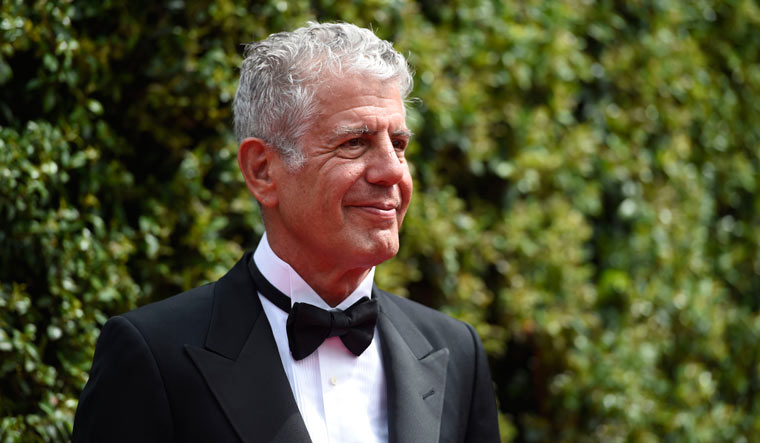
Anthony Bourdain | AP

The news of US celebrity chef Anthony Bourdain’s death has sent shock waves across the food world and beyond. Bourdain, who will be remembered as a renowned chef, author and TV personality, was also an intrepid journalist. He pioneered a kind of a cultural field reporting which offered an unpretentious window into the lives of people who toil and sweat to earn their bread, who are the hidden cogs of a food chain whose most ostentatious and snobbish aspects are held up as aspirational. He travelled the world in search of stories connected to food and eating and living. He patiently listened, and allowed himself to be carried away. When he came to India in 2006 to shoot an episode of his TV series No Reservations, he characteristically observed: “To be in India, anywhere in India, is to risk being endlessly enchanted and repelled, until your senses wanna to shut down.”

A major part of that episode was devoted to his time spent in Kolkata, although the same episode also featured the high-energy Maximum City Mumbai. Bourdain pointed out how these two were the only cities in India, with their tightly-packed interweaving of class and cultures, which reminded him of home, that is New York. Bourdain took a second class train to reach Kolkata and immersed himself in its sounds, smells, shapes and colours, traversing a journey which has charmed countless other dreamers, authors, filmmakers.

After intently watching a cock-fighting match in rural Bengal, digging into a two-rupee plate of poori-aloo bhaji in a flower market under the Howrah Bridge and attending local wrestling matches and temple rituals, you could only trust Bourdain to cleverly remark, “Incidentally if you are going to be reincarnated in India , I highly recommend being a cow. The service is excellent.”

He even waded into the sets of a TV serial shoot, where he dined on a simple, wholesome thali with the cast and crew. Mamata Shankar, Bengali actress and daughter of famous Indian dancer Uday Shankar, was in the middle of a shoot, but happily entertained her curious guest who derived a great sense of reassurance from the fact that soap operas the world over are the same, like good old comfort food. In a Mid-Day article, Mamata fondly reminisced: “He was a happy Frenchman, consumed by food. We ate together that afternoon and he surprised me with his knowledge of Bengali food. He was a khaddo rashik (gourmand). I told him about my father and uncle (Pandit Ravi Shankar). He was familiar with their work. I was surprised how much he knew about my family.”

Accompanied by a popular food columnist Nondon Bagchi, Bourdain played a hectic round of cricket at Kolkata’s Maidan and followed it up with a round of jhaal muri and a similar version of the savoury snack served with crackers from vendors on the fringes of the park. This wasn’t very dissimilar to eating nachos after a game of baseball, the dapper chef thoughtfully pointed out.

When onboard a ferry in the Sundarbans to escape the hectic flurry of the city, Bourdain was your green hero worried about submerged islands and sustaining biodiversity. But every global issue for Bourdain had an entry-point from food. Who would have thought that prawns and bhetki fish in extra virgin diesel oil could be so tasty, Bourdain observed as any real journalist would, always curious, open-minded and unafraid of the unknown.

source: http:theweek.in / The Week / Home> Leisure> Lifestyle / by Sneha Bhura / June 09th, 2018

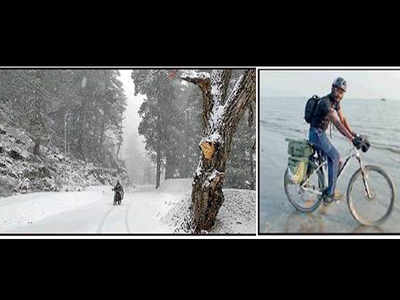
Kolkata cyclist to pedal from Ladakh to Sri Lanka

City mountaineer and trekker Samrat Moulik recently cycled 3,000km from Gangotri in Uttarakhand to Kuakata in Bangladesh

Kolkata :

A mountaineer and trekker from Kolkata, who quit a corporate job to pursue his passion, is preparing for a mega cycling expedition of 5,500km – from Nubra Valley near Ladakh to Kanyakumari and onward to Sri Lanka.

Three months ago, he completed a 3,000km solo cycling journey from Gangotri in Uttarakhand to Kuakata in Bangladesh, traversing the entire length of the Ganga as it meandered through five states before entering Bangladesh.

“The condition of the Ganga – that we consider sacred and yet pollute – prompted me to undertake the ‘Save Ganga’ campaign in February-March. I wanted to know what was polluting the river and its impact on the population living along its length,” said Samrat Moulik. He began the journey on February 8 this year and finished on March 21.

While the condition of the river is good in Uttarakhand, its deterioration was visible after Haridwar. “Pollution actually began at Nagina – a town in Uttar Pradesh. In Moradabad, there is cremation ground at the ghat, a picture that one sees all along the river thereafter. From there on, the river water gets murkier as it flows. The effects of Ganga Action Plan, about which I had heard for years, were not visible. The pollution load of the Ganga increases as polluted tributaries flow into it,” said Moulik.

As the river flows downstream, industrial waste becomes the major pollutant. The situation improved in Jharkhand. But when the river bifurcates into the Hooghly and the Padma near Rajmahal, its condition again deteriorates. “The situation is better in Bangladesh because of people’s dependence on the river,” he said.

Moulik plans to start his journey in September. He will cover several rivers in central, west and south India before travelling to Sri Lanka and cycle along the rivers there.

source: http://www.timesofindia.indiatimes.com / The Times of India / Home> News> City News> Kolkata News / TNN / June 14th, 2018

Id gift for buddy trio’s business idea

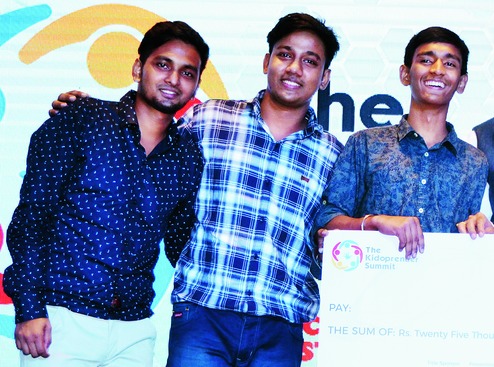
(From left) Md Wasim Ali Ansari, Azhar Rabbani and Ayush Singh at The Kidopreneur Summit at Novotel on Saturday. Picture by Biswajit Kundu

Calcutta:

They gave Id celebrations at home a miss to pitch their business module before a roomful of entrepreneurs. Azhar Rabbani and Mohammad Wasim Ali Ansari, along with Ayush Singh, have devised a plan to provide easy accommodation to outstation students through an app.

The three friends beat six other teams to bag the first prize at The Kidoprenuer Summit, in association with The Telegraph, at Novotel on Saturday. Co-hosted by Sonali’s Cubo, Merchants’ Chamber of Commerce and Srei Infrastructure Finance, the one-of-its-kind conclave gave young entrepreneurs a chance to showcase their innovative business ideas.

The OFY (Only For You) Homes project hopes to address the accommodation problems that students of other cities face when they come to Calcutta to study. “More than 60 colleges in and around the city don’t offer hostel facilities and at any time around 30,000 students are looking for a place to stay,” said Ayush, 17, a student of Shree Jain Vidyalaya.

The boys plan to offer standardised paying guest accommodation and flats on rent through an app. “Students can rent a home for any period of time and also share it with a maximum of four roommates. We will offer packages. They can get food, Internet, electricity and other amenities at Rs 6,000 to Rs 12,000 a month,” said Azhar, 18, of Seth Anandram Jaipuria College.

College mate Wasim, 18, said the trio have been working out the logistics for the past three months. “We hope to launch the app by the year end. We are tying up with people who rent out rooms,” he said.

Yubasana Kapas, 14, of Gokhale Memorial Girls’ School won the third prize for her plan to showcase Bengal’s art and culture before foreign patrons.

Three students – Kaushik Sardar, Shane Romel Kujur and Gaurav Bordoloi – from National Institute of Technology, Durgapur, bagged the second prize for Pedals Go, an app-based rental plan for bicycles.

“The event has brought three generations of entrepreneurs on one platform,” said Vayjayanti Pugalia, who curated the event.

The summit saw young entrepreneurs from across the country exchange notes with business stalwarts from the city and share their stories and challenges.

source: http://www.telegraphindia.com / The Telegraph,Calcutta,India / Home> Calcutta / by Chandreyee Ghose (additional reporting by Samabrita Sen) / June 17th, 2018

Kolkata’s first Durga Puja-themed restaurant encapsulates city’s most celebrated event

Dashabhuja, the new restaurant, connects Bengal’s most delightful celebration with its inhabitants’ most delightful indulgence—Durga Puja and the festive Bengali cuisine.

With food stalls lining the streets, devotees queuing up outside eateries and plates full of food passed among families and friends, the whole of Kolkata turns into a giant food court during Durga Puja.

While the five-day festivities get over in the wink of an eye, the city now has its maiden Durga Puja-themed restaurant ready to serve gastronomes round the year.

Dashabhuja, near the city police headquarters at Lalbazar, connects Bengal’s most delightful celebration with its inhabitants’ most delightful indulgence—Durga Puja and the festive Bengali cuisine.

The elegantly-lit eatery, decorated with colourful overhead canopies and various forms of the goddess Durga, simulates the feeling of sitting in a marquee while pampering the taste buds. The sound track of rhythmic dhak beats, an inseparable part of the Puja rituals, and several Puja-themed hangings and artefacts add to the festive ambience.

The menu, comprising authentic Bengali platters, gives prominence to Puja dishes starting from bhog (community feast of food items offered to the Goddess first) of khichdi, bhuni khichdi and labda (mixed vegetables) to the lavish spread of mutton curry, luchis (a type of puri), chanar paturi, rice, and payesh or the Bengali version of kheer.Along with the Puja-specific main course, the mouth watering variety of “Pujor Misti” or the sweets offered to the goddess Durga, such as chandrapuli, narkel naru, balushai, etc., are also served in the eatery round the year.

According to the restaurant owner, an artist associated with designing prominent community puja pandals or marquees for the last three years, the eatery is a perfect amalgamation of his dream and the family business.

“My dream is to design the themes for Durga Pujas while we have been running restaurants as part of our family business.

So in my new project, I thought of connecting the two. This is the first of its kind project that would let you soak in the carnival spirit of the puja in Bengal—throughout the year,” said Sayak Raj, the owner, who also designed three prominent community pujas last year.

Raj also revealed he was in conversation with a number of city artisans and sculptors, who would be making the Durga idols for some of the most popular pujas this year, and plans to install artefacts designed by them in his eatery.

“I wish this restaurant to be an archive of the Durga Puja celebrations in Bengal so that visitors from other states and countries can get a glimpse of our heritage and culture surrounding this festival. We are planning to decorate the interior with the miniatures of Durga idols to be installed in some of the prominent pujas in the city this year,” he said.

The restaurant, inaugurated by veteran Bengali actor Barun Chanda and legendary Indian classical dancer Uday Shankar’s daughter and actress Mamata Shankar barely a month ago, has created a buzz among food enthusiasts in the city and received significant celebrity presence.

“We have also requested some popular committees to provide us with their Puja theme songs so that we can play them in our restaurant all year long — along with our signature theme music,” the owner added.

source:http://www.nationalheraldindia.com / National Herald / Home> Food / IANS / June 12th, 2018

Apeejay Surrendra Park Hotels To Manage Oldest Hotel In India

Apeejay Surrendra Park Hotels has entered into an agreement with the Government of West Bengal to manage the historic The Denmark Tavern, the 232-year-oldest hotel in India, in Serampore, Kolkata.

“We are delighted to manage The Denmark Tavern on behalf of the West Bengal Government. THE Park Hotels will build on the rich legacy of the Tavern and bring it and the area back to life. The hotel will soon be buzzing with guests enjoying a quiet break on the banks of Hooghly and the sights and sounds of old-world Serampore and beyond,” Priya Paul, Chairperson, Apeejay Surrendra Park Hotels.

The Tavern was established in 1786 in what was then Fredricksnagore. The two-storeyed structure by the Hooghly is the place where the Danes had kept their flagstaff and cannons. The Tavern was a place to meet and stay for traders, clergy and travellers exploring Bengal.

In 2010 – 11, more than 200 years after the tavern’s heyday, a group of restoration experts studied the building that stood in complete ruins surrounded by debris. It took around two years to restore the Tavern to its former glory as part of the Serampore Initiative, a restoration programme for several Danish heritage structures led by the National Museum of Denmark and funded by Realdania, a private trust in Denmark, in collaboration with West Bengal State Heritage Commission, and Indian National Trust for Art and Cultural Heritage (INTACH).The refurnished building has a cafe, inspired by the double height central atrium of the Indian Coffee House in Kolkata and six high-ceilinged spacious rooms.

The restored Denmark Tavern will fall under THE Park Collection brand of THE Park Hotels. The Park Collection is intimate, personalized, and tailored to transmit inimitable guest experiences. The Denmark Tavern will have THE Park Hotel’s design aesthetics, its impeccable services and will reverberate with Anything But Ordinary experiences. The hotel will open by September 2018.

source: http://www.traveltrendstoday.in / Travel Trends Today / Home> Hot News / by T3 News Network / May 24th, 2018

Magic memoirs: A son pens his tribute

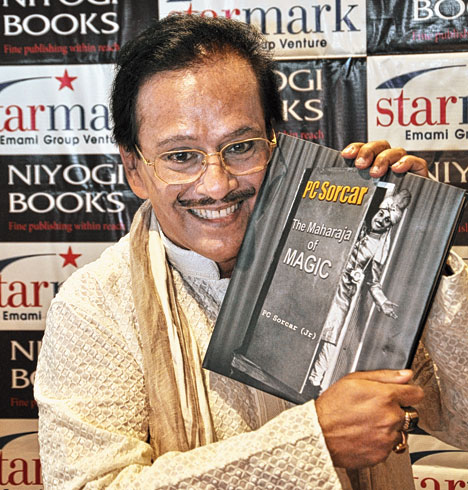
P.C. Sorcar (Jr) at the launch of a memoir of his father on Friday. (Anup Bhattacharya)

Calcutta:

On April 9, 1956, a live telecast of a magic show in London seemed to have gone awfully wrong. The scheduled 15-minute slot on BBC was almost over but the assistant cut in half by the turbaned Indian magician was not coming back to life.

As the channel switched to the news bulletin, viewers jammed the studio lines with calls, convinced that the woman had been murdered. Such was the furore that the event made the next day’s headlines, with interviews of the assistant, alive and well.

“It had all been part of a grand plan. He had deliberately instructed the lady assistant to lie unresponsive… at the critical moment… This man was Protul Chandra Sorcar. He was also my father,” the writer of a book titled PC Sorcar: The Maharaja of Magic describes the incident.

A memoir of the illustrious father Protul Chandra Sorcar penned by his torch-bearer and son Prodip Chandra Sorcar or P.C. Sorcar (Jr) was launched on Friday at Starmark. It is replete with anecdotes that demonstrate how the senior Sorcar single-handedly revived a dying Indian art and went on to be hailed by the International Brotherhood of Magicians in 1948 as “The World’s Greatest Magician”.

The book is also a storehouse of photographs, publicity material, newspaper clippings and cartoons on the phenomenon that was P.C. Sorcar. His reception in the 35 nations where he performed is nothing short of spectacular. If The Sunday Times carried a photo of him reading the newspaper blindfolded, one of Japan’s top newspapers The Yomiuri Shimbun ran the headline on an article on him “Invaluable Living Asset From India Brings Black Art” while The Australian Women’s Weekly did a full page feature on him when he was touring the continent in 1958.

“The book was five years in the making,” said Bikash D. Niyogi, the managing director of the publisher Niyogi Books.

At the launch of the book on Friday, Sorcar (Jr) revealed that his grandfather was bitterly against his son taking up magic as a profession. “‘Do not do public shows. Society is not ready. You will be taken as a dabbler in hocus pocus,’ he kept telling his son. He wanted him to become an engineer instead,” said Sorcar (Jr).

In a way, he was right. “Even after my father’s body was flown in from Japan where he suddenly passed away in January 1971, people gathered outside our house at night expecting him to return, much like he would at the end of his disappearing tricks, appearing from a distant corner with the shout ‘I am here’. People were so gullible that they could not distinguish between his stage persona and the person he was in real life.”

Sorcar, as a child, had an opposite problem. He took the sombre man keeping a strict eye over his son and the smiling magician on stage as different people. The book is a testimony as to how the two avatars of PC Sorcar come together in the eyes of a fellow magician who is also his son.

source: http://www.telegraphindia.com / The Telegraph,Calcutta,India / Home> Calcutta / by Sudeshna Banerjee / May 12th, 2018

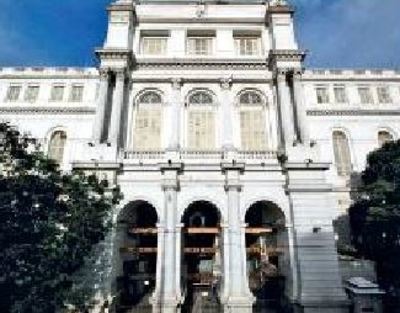
1.5-million-year-old tools found in Museum vault

Indian Museum is pushing back the history it has been narrating thus far. It has ‘excavated’ Paleolithic stone age tools, some of which are up to 1.5 million year old, from its own sub-terranian store and will put them on display at a new pre-historic gallery that will open next month

Kolkata :

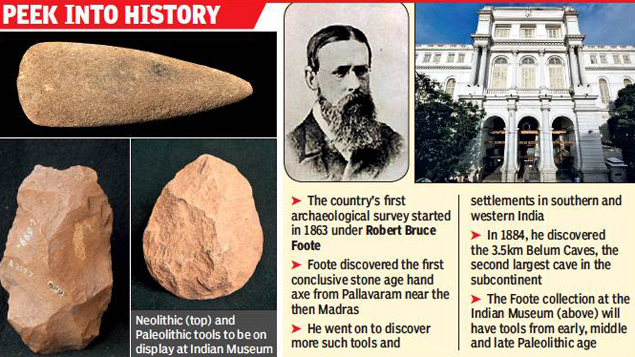
Indian Museum is pushing back the history it has been narrating thus far. It has ‘excavated’ Paleolithic stone age tools, some of which are up to 1.5-million year old, from its own sub-terranian store and will put them on display at a new pre-historic gallery that will open next month.

The collection, handed over to the museum in the 19th century by geologist-cum-archeologist Robert Bruce Foote, had been gathering dust in the underground store till they was re-discovered recently. Foote is considered the father of Indian pre-history and was the director general of Geological Survey of India.

Museum officials stumbled upon the collection of 100-plus tools that were discovered by Foote in south India. The oldest among them were unearthed in Atiram Pakkam, an area in Pallavaram, Chennai. These finds were named Atiram Pakkam tools.

“The Bruce Foote Collection is indeed the oldest collection of human tools anywhere in India. This treasure trove has never been viewed since it was brought to the museum. The inventory has swelled for 200 years without proper cataloguing. We are now sorting and classifying the collections scientifically,” said Indian Museum director Rajesh Purohit.

About 40 stone tools comprising of hand axes, scrappers, cleavers and arrow heads, mostly made of quartzite, will be brought out from that collection and displayed in the new gallery that will replace the Harappa gallery which had been till now the starting point of history at Indian Museum. The Harappa gallery has remained shut to public for nearly 15 years. Handpicked items from the Indus Valley Civilisation will also be exhibited at the new gallery.

The focus though will no longer be on Harappa and Mohenjo Daro, because these are both in Pakistan today and a large number of excavations on the Indian side around a circumference of 1.22 lakh sq km have revealed footprints of contemporary civilisations. “We can build our own history around these sites that have been unearthed in Haryana, Gujarat and Rajasthan. While in the earlier case, the civilisation developed along the Indus, on the Indian side the civilisations sprung up along Ravi, Chenab, Beas, Sutlej, Jhelum, Saraswati, Hakra and Ghaggar,” Purohit explained.

While Lothal (Gujarat) and Kalibangan (Rajasthan) excavations are well-known, other explorations in Rakhigarhi, Krunal, Birhana, Banawali and Firmana that have happened later and have led to discovery of thousands of archaeological remains like pottery, figurines and seals will now be part of the new gallery.

source: http://www.timesofindia.indiatimes.com / The Times of India / Home> News> City News> Kolkata News / by Jhimli Mukherjee Pandey / TNN / April 15th, 2018

Gate-way to a new Calcutta

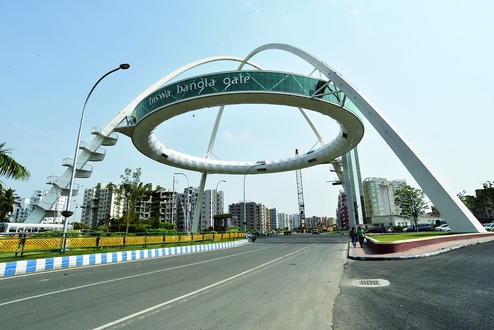
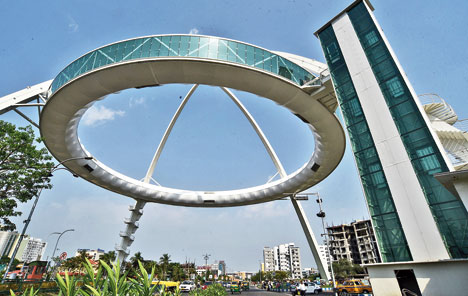
Kolkata Gate, a steel-and-glass structure with giant arches at the Rabindra Tirtha crossing of New Town, is almost ready. The two steel arches that criss-cross each other 55m above the ground can be spotted from several kilometres away.

A circular viewing gallery made of steel and toughened glass has been set up at 25m above the ground level. The 10ft-wide and 60m-long gallery has been constructed by interlinking four prefabricated structures that resemble aerobridges. These structures in turn are welded and attached to the steel arches at designated points. The facade is made of toughened glass with laminated silicone sheets that can withstand gale-force winds, hailstorms and extreme heat.

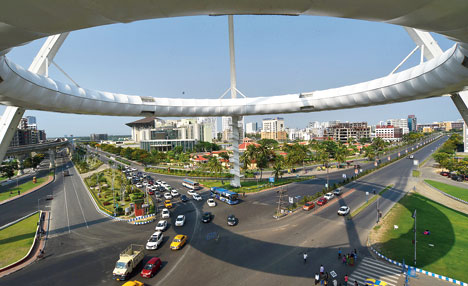
A bird’s-eye view of New Town clicked from a landing a few feet below the viewing gallery of the Kolkata Gate. The view from the gallery will be unhindered as nothing taller than the gate will come up in the area, New Town being a planned city and with pre-determined floor levels for every plot.

Programmable LED lights and flashers have been placed along the length of the steel arches to give it a snazzy look at night. The viewing gallery will have a snacks counter during the day and a fine-dining restaurant after 7pm. At night, only diners will be allowed inside the gallery that will offer a panoramic view of the township. The walls of the gallery have been painted with murals with an entire wall dedicated to the schemes and achievements of the state government.

“The restaurant will offer a one-of-a-kind experience. It will be unlike any other in the city and will offer cuisines from across the world,” said Debashis Sen, the chairman of Hidco. It is likely to open doors in June, officials said.

Two lifts with a glass facade made of toughened glass similar to that used in the viewing gallery will take visitors up to the gallery. The lifts are equipped with telephones at every level so that the operators can get in touch with visitors in case of an emergency. Hidco is mulling a Rs 30 fee per person for a visit to the gallery. Diners at the restaurant won’t need to pay the fee.

source: http://www.telegraphindia.com / The Telegraph,Calcutta,India / Home> Calcutta / by Snehal Sengupta / Photos by Sanjoy Chattopadhyaya / April 30th, 2018