Category Archives: Travel

The big fat biryani battle

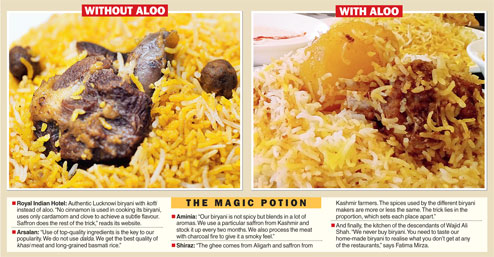
AlooBiriyaniMPOs23nov2014

The A in the B

Shahanshah Mirza cannot imagine his biryani without the aloo. Fatima Mirza could not imagine her biryani with the aloo. Till the girl from Lucknow was married into the Mirza family of Park Circus. “I remember finding the aloo in the biryani quite funny at first,” says Fatima, who friends insist serves up some of the best biryani in town. And yes, with the aloo.

Why are we so bothered about the biryani being cooked in the Mirza kitchen? Simple, that’s where the great “to aloo or not to aloo” debate was born for the Calcutta biryani.

Yes, Shahanshah Mirza is the great-great-grandson of Wajid Ali Shah, the last nawab of Awadh. Foodlore has it that the nawab came to Calcutta after losing his throne and to cut costs, his cooks replaced the meat with the potato. And, foodlore number two: Wajid Ali Shah’s cooks added the aloo but only after falling on hard times following the death of the nawab. Either way, thus was born the Calcutta biryani the city now gorges on.

The nawab’s family line dismisses all this as, well, lore. “The nawab was a connoisseur of food and had given a free hand to his chefs to experiment with dishes. Once his chefs played around with the biryani and put potatoes in it. The nawab liked it so much that he ordered that the aloo be a constant in the biryani henceforth,” says Shahanshah.

And that is how it is cooked to this day in the Mirza kitchen — and in the kitchens of almost every biryani-serving restaurant around town.

With the royal exception of… Royal Indian Hotel.

What started as a humble rented shop in Chitpur to sell culinary creations by Ahmed Hussain, a migrant from Lucknow, is now a two-storeyed restaurant that seats 65 in its AC hall, 75 in the non-AC hall and 40 in the ground-floor dining hall and “remains full at meal times”.

But don’t dare mention the A (aloo) word here. “We only make authentic Lucknowi biryani and our patrons love that. Our biryani does not have aloo, it has kofti (meat balls),” declares Md Irfan, one of the directors of Royal Indian Hotel, stirring up biryani since 1905, the year Lord Curzon divided Bengal.

More than a century on, Calcutta still stands divided. Along the thick potato line when it comes to the biryani.

How tough it is to serve biryani without the potato in a city weaned on that is evident from what Luknow, an Awadhi food restaurant that opened in Park Circus and Ballygunge this year, had to face. With diners insisting that “aloo chhara biryani hoy na (there can be no biryani without aloo)”, Shalini and Vinay Arora, the couple behind Luknow, were in a pickle. The cooks from Lucknow at the helm said: “Awadhi biryani cannot be cooked with potatoes.” But on popular demand aloo was introduced in one of the 11 biryanis on the menu.

No wonder the most popular biryani places in Calcutta just pile on the potato. Arsalan, Shiraz, Aminia, New Aliah — you name it and all of them have it. Aminia of New Market that has been running since August 15, 1947, has three more outlets in Calcutta — at Gol Park, Jessore Road (Nagerbazar) and Rajarhat (Chinar Park). They have been serving aloo with their biryani since inception.

Arsalan, a relatively recent dot on the biryani map of Calcutta (2002), has zoomed to the top of the bestseller chart and now runs five outlets — two in Park Circus, including the landmark one at 191 Park Street, and one each in Ripon Street, Taratala and Hatibagan. For them, there truly is no B (biryani) without A (aloo). “Some customers even look for a second piece of aloo on the plate!” says Arsalan director Akhtar Parwez.

The aloo is also an essential part of the biryani at Shiraz Golden Restaurant, which dates back to 1956. It has 10 outlets in the city stretching from Garia to Dum Dum.

A new kid on the biryani block, Oudh 1590, has tried to create a destination for Awadhi cuisine with the decor and menu at its Deshapriya Park address. But with one concession for the Calcutta palate: the option of the biryani with aloo. “Yes, the Awadhi Handi Biryani without aloo is less popular. People come and specifically ask for the aloo-wala biryani,” admits Debaditya Chaudhury, a partner of Oudh 1590.

Among foodies batting for the aloo in the biryani is musician-food writer Nondon Bagchi. “It is a part of our tradition. The aloo should not be taken out of the Calcutta biryani,” he says.

And slightly further away from home, we asked economist Abhijit Vinayak Banerjee, the celebrated co-author of Poor Economics and a fabled cook in his friends’ circle, where he stood on potatoes in biryani. “Potatoes can be very nice, especially if the biryani is sharp, like a Sindhi biryani,” said the man from MIT in the US. [Sindhi biryani is known to have mint, coriander and prunes in addition to the meat and rice. Originating from Sindh province in Pakistan, some of its variations have potatoes in it.]
BiriyaniFamilyMPOs23nov2014

The biryani boom

Enough of the potato, let’s get to the meat of the matter now.

To what lengths Calcutta can go for its fill of biryani is evident from the thousands who throng The Telegraph Biryani and Kebab festivals every year at City Centre (Salt Lake and New Town).

And it’s this passion for the rice-and-meat platter that has finally nudged Royal Indian Hotel to join the branching-out biryani brigade. Yes, Royal will have its first branch — “to be opened opposite Quest mall very soon”.

It took four generations and more than a century for this traditional biryani bastion to get a move on. So what prompted them to go south? “Our loyal customers from across Calcutta travel all the way to 147 Rabindra Sarani and often rue that we don’t have an outlet in their part of the city. We believe we are now ready to reach out and take our brand to all corners of Calcutta — north, south, east and west. We begin with south because it is a strategic location, where we can attract a wide clientele from the Ballygunge and Park Circus areas,” says Royal’s Irfan.

The restaurant that enjoys iconic status among loyalists says the popularity of the biryani here picked up after Independence. “Satyajit Ray to Uttam Kumar, Gunter Grass to Khushwant Singh, they all loved our biryani. Yesteryear actress Tabassum would get it packed and take it for Dilip Kumar. And now, Sourav Ganguly loves our Chicken Biryani,” smiles Irfan.

Royal may finally be stepping out of its crease, like Dada used to in his prime, but no one understands the biryani boom better than bestseller Arsalan. “If everything goes right, we intend to open three branches by June 2015,” says Arsalan director Akhtar Parwez. The locations on the radar are Barrackpore, Rajarhat and Jessore Road.

Simmering in the Arsalan handi is a target for “at least 50 outlets across Bengal” in the next 10 years. “If a Bengali loves and craves for Arsalan biryani, he should be able to get it near his home. That’s where we want to take our brand to,” says Parwez, reluctant to divulge the number of plates served per day in their blockbuster outlet at the Park Circus roundabout.

Multiplicity is the name of the game for Shiraz and Aminia as well. Aminia aims to open a branch in Behala, next to Ajanta cinema, and another near the Shyambazar tram depot. Shiraz has launched a chain of quick-service restaurants named Lazeez Express, which “does good business in Kasba”. For Zeeshan, which already has two outlets in the south (Deshapriya Park and Garia), another one near Lake Market is being planned. And then one in Kidderpore maybe.

Two new biryani players — Oudh 1590 and Luknow — are attracting a steady clientele in south Calcutta, enough for Oudh 1590 to eye a second serve near City Centre Salt Lake in January.

Multiplicity is married to makeover in the new-age biryani game, with words like decor and ambience coming into the dictionary. Take Oudh 1590. This Awadhi cuisine restaurant has created a “period dining experience” at its Deshapriya Park address.

The older players, too, are paying attention to the look and feel of their dining rooms. Aminia Rajarhat that opened earlier this year has been built on a Sufi theme.

“Today’s customers are hygiene-conscious and look for places that have a feel-good ambience. So we had to put in a lot of effort to make our Hatibagan address look chic and vibrant,” says Arsalan man Akhtar Parwez.

With the “need to reach out” becoming the mantra — from Royal to Lazeez — the biryani is taking the pizza route. Takeaways and home delivery are playing an important part. “You need to take special care as food items like biryani are best enjoyed fresh from the handi,” says Parwez.

“We depend largely on home-delivery orders, from domestic as well as corporate clients,” says Ishtiaque Ahmed of Shiraz’s Lazeez chain.

And then there’s Facebook, Zomato and Foodpanda for the smart(phone) set to book biryani on the go.

A foodnote: The great biryani debate doesn’t begin or end with the aloo. There’s a greater debate cooking, which questions the very standing of the biryani. But as with most things Calcutta, there is no place for the finer nuances or larger debates of life.

We turn the culinary pages to Abdul Halim Sharar (1860-1926), a courtier in nawab Wajid Ali Shah’s Lucknow durbar, who wrote in Lucknow: The Last Phase of an Oriental Culture that the real raeez of Lucknow preferred mutton pulao to biryani, which was bit of an aam aadmi food.

The last word is left, once again, to economist Abhijit Vinayak Banerjee from MIT. When asked to define the difference between pulao and biryani, he said: “Pulao is rice cooked in broth. Biryani is made with pre-cooked rice. Kachchi biryani is with marinated but not cooked meat. Normal biryani is with cooked meat. In both cases the meat cooks more and the vapours from that are used to flavour the rice.”

That, sadly, is too fine a flavour for the Calcuttan busy with a mouthful of biryani, aloo and all.

Do you like your biryani with or without the aloo? Tell ttmetro@abpmail.com

source: http://www.telegraphindia.com / The Telegraph, Calcutta / Front Page> Calcutta> Story / by Sibendu Das / Sunday – November 23rd, 2014
Expo on lost Kalamkari textile in city

Kolkata :

They had originated and proliferated in India, possibly in Tanjore, in the late 16th or early 17th century under the patronage of the Mughal emperors. But, with the passage of time, Kalamkari paintings on textiles faded into oblivion.

Thousands of miles away, a museum in France on the Swiss border has preserved some of the oldest specimens of Kalamkari paintings on textiles. These are very rare to find even in museums within the country.

For a fortnight starting on Wednesday, the textile gallery of the Indian Museum will showcase the world famous ‘Tapis Moghol’ — some of the most elaborate designs replete with mysterious animals, birds, foliage and flowers — that hold the key to many stories of the times. The ‘Tapis Moghol’, that dates back to the late 16th or early 17th century, has been preserved for the world at the En Musea De L’Impression Sur Etoffes De Mulhouse or the Museum of Printed Textiles at Mulhouse, France.

Kalamkari paintings in its earliest form were motifs painted on large wall hangings that were used to decorate the altar behind the deity. Kalamkari, though, is not a lost art form in the sense that it is still practised in both the painted and block printed versions. But, we have lost most of the original designs that were popular when it was used as an altar backdrop in South Indian temples.

“A gentleman called Funffrock, who was an employee of the French East India Company, was posted in Tanjore. The Frenchman was immensely interested in the traditional art form and got a cotton cloth, measuring eight feet by eight feet, done up with rich intricate designs that showcased the best motifs of that time. With time, this became the focal exhibit, around which the other collections of the period grew. The exhibition will give the city a glimpse of the Funffrock collection,” explained Ruby Palchowdhury, spokesperson of the Crafts Council of West Bengal, which is a wing of the Crafts Council of India and is funded by the Centre.

Textile and culture ministries and the Alliance Francaise have funded the expo that will have 25 panels to show off design details and the stories underneath. The exhibition has been curated by ethnic historian Lotika Varadarajan.

source: http://www.timesofindia.indiatimes.com / The Times of India / Home> City> Kolkata / by Jhumli Mukherjee Pandey, TNN / November 16th, 2014

Spotlight on heritage assets

The Kathgola Palace, where the then chief of the British East India Company had met Mir Jafar after the Battle of Plassey in 1757, has regained some of its lost glory. The house of the Jagat Seth family, pre-eminent for its powerful moneylenders and bankers in the first half of the 18th century, has been restored, too.

Decrepit and prey to vandals till a couple of years back, both buildings are now popular tourist spots in Murshidabad, which was the capital of undivided Bengal during the Mughal era.

“They are now sustainable heritage properties and generate Rs 10 crore in tourism revenue,” said Pradip Chopra of the PS Group, who is also president of Murshidabad Heritage Development Society.

The Murshidabad model of conservation will be showcased along with other successful conservation projects in a seminar titled “Get the best out of your Heritage Property/Assets” at Palladian Lounge on November 22 and 23. The seminar will be part of “Resurgence — 3rd Murshidabad Heritage Festival 2014” to be held at Hazarduari palace and Kathgola palace in Murshidabad.

The Murshidabad Heritage Development Society is organising the festival, along with CREDAI Bengal, The Palladian-Asian Hotels North Limited, Hotels and Restaurants Association of Eastern India, The Calcutta Gastronomes, Intach and ASI.

“It will bring together stakeholders like property owners, developers, tour operators, hoteliers, restaurateurs and conservationists to develop a sustainable conservation effort,” said Anjan Mitra, architect and seminar coordinator.

The seminar will have an eclectic mix of speakers, including Debasish Nayak, the director of the Centre for Heritage Management, Ahmedabad University, civil engineer R.K. Anil, Aman Nath of Neemrana Fort Palace Hotel, Raj Basu of Help Tourism, Kasturi Gupta Menon, the chairperson of Crafts Council of India, and Sunil Rampuria, a heritage property owner in Bikaner.

Heritage is not just the building but also history, memories, lifestyles, craft, cuisine and a host of other things that need to be conserved holistically, said Mitra. So the inclusion of stakeholders like The Calcutta Gastronomes represented by chef Shaun Kenworthy.

The teaser launch of the seminar at Palladian Lounge on Tuesday showcased the royal vegetarian cuisine of Murshidabad, called Sheherwali cuisine.

source: http://www.telegraphindia.com / The Telegraph, Calcutta / Front Page> Calcutta> Story / Thursday – November 13th, 2014

Murshidabad to get heritage hotels

Kolkata :

Murshidabad, 250 kilometres north of Kolkata and the erstwhile capital of undivided Bengal, offers an unparalleled treasure-trove of heritage to tourists, both domestic and international. But, thanks to years of neglect and indifference, the majestic buildings are falling apart and the art, crafts and cuisines of the past are fading into oblivion.

The Murshidabad Heritage Development Society (MHDS), which has launched the revival project for Murshidabad through conservation of buildings, running of museums of family heirlooms, exhibitions of lost arts and crafts, cuisines, handloom and textile, have now planned to initiate the next level of heritage campaigns — converting some of the palatial buildings into heritage hotels to attract tourists and generate a tourism-centric industry.

MHDS, along with the Archaeological Survey of India (ASI), on the occasion of World Heritage Week will hold a seminar at Palladian in Kolkata on November 22 to create awareness about the rich and vibrant heritage of Bengal encompassing architecture, arts and history and build a learning bridge between our past, present and future.

But, if you think that Murshidabad is only a hub of the Nawabi heritage, you should look beyond. Along with Nawabi culture, a powerful stream of rich traders and bankers, mostly from Rajasthan, had made its mark here. More than 400 years ago, they came, settled, prospered, built mansions, places of worships and even schools and colleges. They were known as ‘Sheherwali’. “We have identified 97 such heritage buildings with fascinating architecture and historical importance,” said Sandip Nowlakha, founder secretary of MHDS.

Murshidabad cuisine in general, or ‘Sheherwali’ cuisine in particular, is one such fascinating aspect of the heritage. “The love for food, especially all things sweet, is an apt description of any ‘Sheherwali’ cuisine. Food features prominently in the community, having evolved passionately through centuries of their existence in Bengal. ‘Sheherwali’ cuisine is possibly the finest vegetarian spread one can find, even in modern times,” said Siddharth Dudhoria, the founder president of MHDS.

The symposium aims at fine-tuning the heritage-tourism model being developed by the MHDS. It would put together experts across the country and bring forth some successful models. “Heritage can be a great revenue earner. Unless we drive this point home, we cannot make younger generation understand the value of our heritage. Several heritage buildings at places like Azimgunj, Ziagunj, Lalgola, Kathgola can be heritage hotels offering finest heritage experiences. Once heritage generates revenue and employment, the care for it would reach the zenith,” said Pradeep Chopra, president of MHDS.

source: http://www.timesofindia.indiatimes.com / The Times of India / Home> City> Kolkata / TNN / November 12th, 2014

Bengal’s Dutch link on Presi site

Kolkata :

Dutch history in India has been ‘e-mortalized’ by Presidency University and Netherlands Embassy, with the launch of a web portal documenting and geo-tagging the total area of the Dutch cemetery in Chinsurah. At the same time, ‘The Dutch East India Company in India’, a book by anthropologist Bauke van der Pol was released on Friday.

“This book looks at the larger picture of the Dutch in India, and Dutch trade relations with India have existed for far longer than those with say, America or Australia,” said van der Pol, who presented a comprehensive compendium of the Dutch East India Company heritage in India by guiding the reader through country houses, settlements, trading posts and cemeteries.

The website and the book was launched by Presidency University vice-chancellor Anuradha Lohia and the Honorary Consul of the Netherlands, Namit Shah. “The ‘Dutch Cemetery in Chinsurah’ database, that’s available online at www.dutchcemeterybengal.com, tells the story of a centuries-old colonial settlement that produced some of the key figures involved in the shaping of trade, polity and culture in the Indian subcontinent. Less well-known than its British namesake, the Dutch East India Company, Vereenigde Oostindische Compagnie (VOC), once managed the vast inter-continental trade from 17th to 19th century through its settlements in coastal India. As a hub between the western trade capital Amsterdam and its Eastern counterpart in Batavia, Chinsurah occupied a key position in VOC and indeed, in Dutch history as well,” said Souvik Mukherjee of the English department, who headed the digital humanities project.

Mukherjee outlined the objectives of the project. “We photographed the gravestones and tombs in detail, accessed and digitized the research matter from offline sources. We also transcribed headstone inscriptions and inserted architectural, biographical, geographical, demographic, literary and historical metadata,” he said.

The Dutch anthropologist also gave a sneak peek into his next book, ‘Dutch on the Ganges’, scheduled to be released next year.

While explaining how the Dutch settled at Baranagar, van der Pol said, “It was a small settlement where big ships would anchor before heading out. It was also known to have a widely-known brothel, with beautiful ladies from Malaysia.”

He also gave a brief description of Prince Hendrik van Oranje’s three-month stay in Bengal back in 1837.

source: http://www.timesofindia.indiatimes.com / The Times of India / Home> City> Kolkata / TNN / November 07th, 2014

Curry King brings 14 new marinations

Kolkata :

Marination, that familiar method of flavouring and tenderizing food by coating them in a seasoned, and often acidic, liquid prior to cooking, lies at the core of a cuisine, lending character to the dish even as it provides a signature of the region. When Barbeque Nation, the casual dining chain which has an outlet at Sector V, decided to broaden the menu on their live on-the-table grill, not many could have fitted the bill better than Pat Chapman.

The Englishman, a chef, food writer, broadcaster and author, has a strong Indian connection and, perhaps more importantly, a passion for her cuisines. The Curry Club, which the London-born chef founded back home, has not just helped many a Brit take that bold leap from the bland to the spicy but has had them delve deeper into Indian cuisines.

“I’m not here to teach Indian marination to the chefs here; they know that better than me. But I do know the Indian palate,” said Chapman, who has brought 14 different marinations from round the world to add to what was being put on the table in the DIY (do-it-yourself) menu before the main buffet. “Putting the grill on the table is a fantastic concept and we don’t have it as yet in Britain,” added the 73-year-old, who had seven generations of his family living in India since 1715.

“My mother was born in Mhow and she was a terrific cook. She taught me and I have been cooking Indian food since I was eight,” said Chapman, who has earned sobriquets like ‘Ambassador of Indian food’ and ‘Curry King’ from British food reviewers. The man who has authored 36 recipe books with cumulative sales of over 1.5 million copies reminded that he has had no formal training as a chef. “But I’ve worked hard and learnt from so many of them. These chefs are my gurus,”
he added.

Giving a ‘demo’ of three of the marinations he has brought here — a Lebanese-Arabian coating of broccoli, a Thai preparation of Basa fish and Jamaican Jerk chicken — Chapman pointed out that the essence of marination is tenderizing for penetration of the flavours and that acid helps do that.

“Marination works particularly well for starters. Indian and Middle-East starters use it very cleverly,” he said. “In my view, Indian is the best food in the world. The curry is a wonderful thing, the food of a nation,” he added, and pointed to the phenomenal spread of Indian cuisine in the UK.

“I came to India for the first time in 1965 and have been here some 43-44 times since then; my wife Dominique has been here about 20 times. The visits have been more frequent since the 1980s, when I started The Curry Club. I bring groups and have them meet chefs here. Most members are British but we have Americans and people from other regions on board too,” he said. “Indian food is addictive. When I was a kid, garlic had to be bought from the chemist in the UK. Now you get it everywhere. Every region of India is represented in London through its restaurant and they are all doing well.”

Yorkshire Lamb, Spanish Valencia Prawns, English Mushrooms, Persian Veg Patties, New Orleans Corn, Mexican Veg Shashlik… As the skewers were laid on the table grills for the gastronomes to baste them in Vinegar Chili, Lemon Butter or Oriental Garlic to add that sheen of personal preferences, Chapman went around for the interactions. As the items disappeared quickly from the plates in the company of barbeque, tartar and mild mustard sauces, the beaming Englishman would have known he had connected well with the Indian palate.

source: http://www.timesofindia.indiatimes.com / The Times of India / Home> City> Kolkata / by Arup Chatterjee, TNN / October 18th, 2014

Darjeeling harbours a trove of springtails

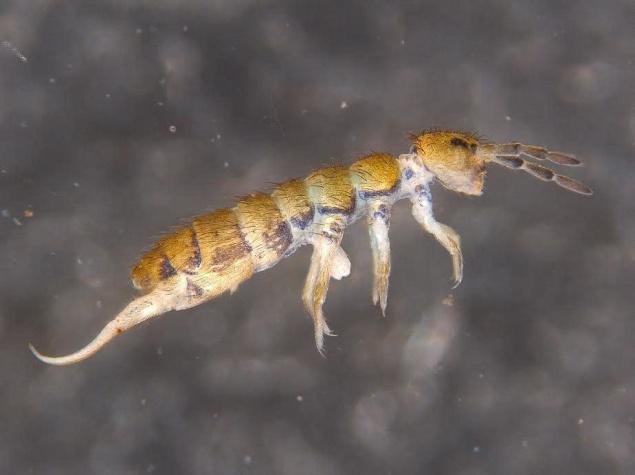
A species of springtails, Isotomurus balbeatus, commonly found in the soil in Darjeeling. PHOTO: SPECIAL ARRANGEMENT

In the forested foothills of Sukna in the Kurseong subdivision alone, 21 species of springtails are found. The number falls with altitude.

Darjeeling is home to the highest number of species of springtails, a wingless insect that helps in soil formation, in the country.

A recent study by Zoological Survey of India scientists says 32 species of springtails (Collembola), more than 10 per cent of the total found in India, is present in the hill district of north West Bengal.

“Springtails play a very important role in soil fertility. Springtails are the only insects that are as important as bacteria and fungi in the breakdown of leaf litter and organic soil formation,” Gurupada Mandal, a scientist who took part in the three-year study, told The Hindu.

In the forested foothills of Sukna in the Kurseong subdivision alone, 21 species of springtails are found. The number falls with altitude.

“We have conducted surveys in different part of the country, including the Northeast, and have found springtails there as well, but never such a high concentration of so many species as in Darjeeling,” Mr. Mandal says.

The soil too becomes rich, providing enormous scope for cultivation of various crops. It is an indication of rich biodiversity, the scientists say.

ZSI Director K. Venkataraman said springtails were a unique kind of insect, which, by using binoculars, could be seen to jump on the soil surface.

They were tiny with sizes varying from 0.25 mm to 6 mm, barely seen with naked eyes.

“While we have considerable information on winged insects, not much is known about non-winged insects such as springtails,” he said.

Beneficial
Usually, people perceive insects as harmful; however, there are insects such as springtails which, are in fact, beneficial for human beings as they circulate nutrients in the soil, Mr. Venkatraman said adding that the country required more such studies.

source: http://www.thehindu.com / The Hindu / Home> News> National> Other States / by Shiv Sahay Singh / Kolkata – October 12th, 2014

Victoria Memorial Hall collections to find place in Google’s digital storehouse of art

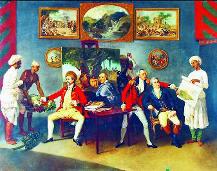
The painting titled 'General Claude Martin and his Friends' or 'Colonel Polier with his Friends' depicts Colonel Antoine Polier, Claude Martin, and John Wombwell with the painter himself, Johann Zoffany (1733-1810), in the background, being waited on by Indian servants, probably in Lucknow around 1786-87.
The painting titled ‘General Claude Martin and his Friends’ or ‘Colonel Polier with his Friends’ depicts Colonel Antoine Polier, Claude Martin, and John Wombwell with the painter himself, Johann Zoffany (1733-1810), in the background, being waited on by Indian servants, probably in Lucknow around 1786-87.

Kolkata :

The Victoria Memorial Hall’s collections will find a place in the largest-ever digital repository of exhibits and collections on a global platform created by Google. Apart from Victoria, some others on the list are Metropolitan Museum of Art and Museum of Modern Art in New York, British Museum, National Gallery and Tate Gallery in London, Musee d’Orsay in Paris, Acropolis Museum in Athens and Hiroshima Peace Memorial Museum.

Victoria Memorial curator Jayanta Sengupta told TOI that the museum and its finest collection of art and artifacts are expected to join the Google Cultural Institute, a cyber platform created by Google Art that enables users to view high resolution images from various museums and even compile their own digital collection. It is fast emerging as an invaluable resource for researchers as they can have access to objects from museums across the world and learn about art objects, their history and artists at the click of a mouse.

“A team from Google will reach Kolkata with sophisticated video and still cameras to film the museum and photograph the 120-odd highlights. Of these, they will select one item and photograph it with high-definition gigapixel camera so that it can be magnified online without distortion. Once the exercise is over in a couple of months, a virtual tour of the galleries at Victoria Memorial will be created and the images uploaded on Google Cultural Institute,” said Sengupta.

Victoria Memorial signed a memorandum of understanding with Google Art in February 2013 and has been communicating with the team since. The museum has sent the list of 120 items it considers the best among its collection of 33,000+ objects of art apart from the 10,000+ small objects like stamps.

Though the Google team is at liberty to select any one of the 120 objects listed by Sengupta’s team as the museum’s highlight for the gigapixel photography, the curator has suggested a painting titled ‘General Claude Martin & his Friends’. The painting that has an alternative title ‘Colonel Polier with his Friends’ depicts Colonel Antoine Polier, Claude Martin, and John Wombwell with the painter himself, Johann Zoffany (1733-1810), in the background, being waited on by Indian servants, probably in Lucknow around 1786-87.

“We have suggested the painting by 18th century German neoclassical painter because it is intricate. There are six paintings within the painting that can be enlarged and viewed in detail when photographed in a gigapixel image,” explained Sengupta. Other paintings that make the cut are ‘Bharat Mata’ and ‘Passing of Shah Jahan’.

Among the other objects in the highlights shortlist are oil paintings by Thomas and William Daniel, Abanindranath Tagore and Gaganendranath Tagore, a 1964 copy of the Ain-e-Akbari manuscript, Persian translation of Aristotle’s treatise Six Principles of Ethical Life and commentary by Dara Shukoh as well as his Persian translations of Gita and Upanishad, Aurungzeb’s personal Quran, Tipu Sultan’s dagger, Maharaja Ranjit Singh’s sword and Queen Victoria’s piano.

“Once Victoria Memorial Hall joins the others on the Google Cultural Institute website, all objects that comprise the museum highlights will be there for the world to see and experience online. We have been working on documenting each object, detailing the history, the artist and its relevance. We are currently in the final lap of that exercise and expect to be on the website by this yearend or early next year,” said Sengupta.

source: http://www.timesofindia.indiatimes.com / The Times of India / Home> City> Kolkata / by Subhro Niyogi, TNN / September 07th, 2014

In a first, transgender opens Durga Puja pandal

transgenderKOLKATA04oct2014

In a marked departure from the practice of inauguration of Durga Puja by celebrities, cine stars and sportsperson, a transgender had the rare opportunity of inaugurating a community Puja in the city.

Sobuj Sangha, a club located at Haridevpur in the southern fringes of the city, urged the representatives of the Association of Transgender/ Hijras in Bengal to inaugurate a Puja pandal on Tuesday.

Overwhelmed by the invitation, Ranjita Sinha, secretary of the organisation told The Hindu on Wednesday that the efforts of the club in recognising transgenders and eunuchs should be lauded.

“When Durga Pujas are presenting plethora of themes on socially important issues, we are happy that at least one Puja Pandal committee thought about us,” Ms Sinha said, adding that she asked two members of her organisation to go and inaugurate the Puja. There are over 1,700 community Puja pandals in the area under Kolkata police alone.

This is for the first time that Durga Puja organisers have invited members of the transgender community for the inauguration of a pandal, she said, adding that it is the recent landmark Supreme Court judgment that has brought awareness and recognition for the community to some extent.

Ms Sinha also pointed out that transgenders particularly eunuchs were considered important in religious and social occasions but slowly discrimination led to the community being excluded from such events.

“For the Hindus there are references in the mythology about the significance of eunuchs; the Muslims also consider their presence and blessings of considerable importance,” she said.

Despite the encouragement they may have received from this event, the members of the transgender community feel that a lot more concerning the community and its rights need to be addressed.

“A few months ago the West Bengal Government had proposed to set up a Transgender Welfare Board but there has been practically no follow-up on this,” Ms Sinha added.

source: http://www.thehindu.com / The Hindu / Home> News> Cities> Kolkata / by Shiv Sahay Singh / Kolkata – October 02nd, 2014

Synagogues on Makeover Mode as Govt Charms Israel

The Thekkumbhagam Synagogue in Kochi

New Delhi :

The synagogues in Israel may be caught in cross-firing, but those in India are going to be spruced up soon, courtesy the Modi-led BJP government. The files started moving with speed within the Culture Ministry when the Palestine issue got worse — signifying the BJP government’s political stance in the Israel-Palestine conflict.

Though the move to protect the synagogues was initiated during the UPA rule, the Manmohan Singh government developed cold feet later as Israel and Palestine has always been a volatile subject in our country. “Our team had visited the synagogues in Kolkata and had even finalised the sketches way back in 2010. But the project did not go beyond that, as there was some terse communication to go slow,” said an ASI source.

The Archaeological Survey of India is busy moving the files and renovation is expected to start soon. Sources admit that the renovation of synagogues is a political decision. “Home Minister Rajnath Singh and Minister of External Affairs Sushma Swaraj are planning to visit Israel towards the year end and there are enough reasons to believe the renovation is closely connected to the visits,’’ said a government source.

There are around 35 synagogues in India—most of them in Kochi, Kolkata, Mumbai and Ahmedabad. “The synagogues in our country represent a rich cultural and religious tradition. The ASI is actively thinking of renovating the synagogues across the country. Most of them have been encroached upon by private parties and some, even by governments,’’ said a source in the Ministry of Culture.

The source added that the renovation work will start initially in Kochi’s Thekkumbhagam Synagogue and the Beth El Synagogue and the Maghen David Synagogue in Kolkata. The government is also planning to start a “Jewish tourism circuit” connecting all synagogues in the country, the source added. Though the government gave in following pressure and even vouched its support to the ‘‘Palestinian cause’’, it is an open secret that many BJP leaders, including PM Modi, have a close affiliation with Israel. Modi visited Tel Aviv as the CM of Gujarat, a state which has old diamond trade ties with Israel.

Transport and rural development minister Nitin Gadkari, too, visited Israel three years ago when he was the BJP chief while Sushma Swaraj is a self-declared “fan” of Israel. She, as the chief of India-Israeli Parliamentary Friendship Forum in the past, visited Israel last year.

“Both countries are victims of the growing religious fundamentalism and it is natural that they grow closer. It also helps that both share unique ethnic and religious aspects,’’ said a Culture Ministry official, who is part of the renovation project.

source: http://www.newindianexpress.com / The New Indian Express / Home> The Sunday Standard / September 28th, 2014