Category Archives: Travel

Kolkata’s wooden trams chug into stardom

The streetcars lend authenticity to the city’s 1942 avatar in “Detective Byomkesh Bakshy!”

An unexpected but delightful outcome of the making of Dibakar Banerjee’s film Detective Byomkesh Bakshy! that released on Friday was the rescue from obscurity of two tramcars that were used to recreate the city’s 1942 avatar.
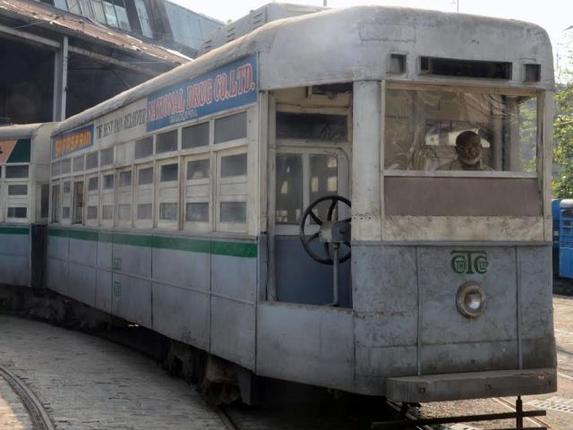
Tram No. 567, used in the film “Detective Byomkesh Bakshy!”, at the Nonapukur Tram Depot in Kolkata. Photo: Sushanta Patronobish / The Hindu

Using brands that have faded from public memory and antiquated ad campaigns, the project has revived interest in trams ‘No. 563’ and ‘No. 567’, now renamed ‘Byomkesh Bakshi’ Tramcars. The film, however, spells the detective’s last name as Bakshy.

The film used two wooden tramcars built in the 1930s and a watering car used to water the tram tracks of the city.

“The tramcar was renovated at their [the filmmakers] cost by us. They collected samples from old photographs and, accordingly, old-style branding was done on the top panel of the trams,” Nilanjan Sandilya, managing director of The Calcutta Tramways Company (CTC) Ltd. told The Hindu.

Mr. Sandilya said that trams were the main public mode of transport in the 1940s and were crucial to depict that period of the city.
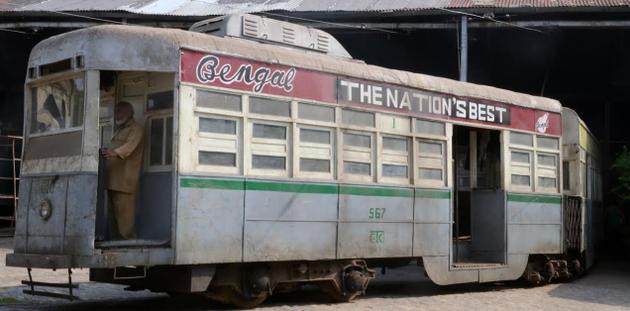
Tram No. 567, used in the film “Detective Byomkesh Bakshy!”, at the Nonapukur Tram Depot in Kolkata. Photo: Sushanta Patronobish / The Hindu

The two tramcars used in the film are wooden ones that have seldom been taken out on the streets after the shooting of the film, said S.S. Ghosh, the Works Manager of the CTC. Tram No. 567 displayed advertisements of brands such as Bengal Lamp, Lux Toilet Soap and Dulaler Tal Mishri during the shooting. An old brand of palm candy was also advertised at Nonapukur tram depot. Tram No. 563, which was changed to No. 469 for the film, carried similar advertisements in English, Bengali and Hindi. Shooting was held at the Park Circus Tram Depot. The watering car used in the film predates the trams. According to Mr. Ghosh, watering cars were built between 1915 and 1920 and only two of them are now left with the tram company. Such is the enthusiasm surrounding the tram cars that a prototype called “Byomkesh Bakshi Tramcar” is on display at a tram museum-on-wheels called Smaranika.

source: http://www.thehindu.com / The Hindu / Home> News> Cities> Kolkata / by Shiv Sahay Singh / Kolkata – April 04th, 2015
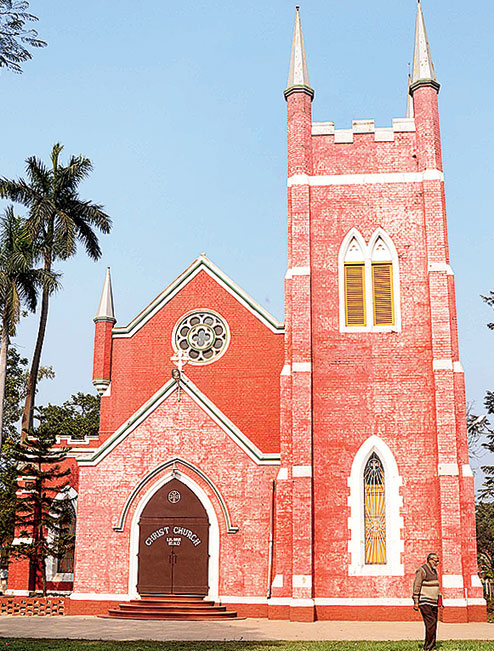
A railway church in Liluah

Christ Church in Liluah. Picture by Gopal Senapati

The old red Gothic structure on the eastern banks of a large pond looks huge from outside. The pond and the church stand on land that belongs to the Eastern Railway in Liluah. Despite the massive structure, inside, the church cannot seat more than 100 people on its pews. If there is a big congregation, authorities have to arrange for extra chairs for the parishioners.

Christ Church, under the Church of North India (CNI), has 160 parishioners on its list. Most of them are local residents, but there are some who come from other parts of Howrah and Hooghly as well.

The interiors of the church got a fresh lick of pink paint in December, before Christmas. Reverend Sailen Das, a senior member of the church committee, is expecting a good turnout for Good Friday on April 3. The service will start at 12 noon and will continue till 3pm. “Many people attend the church service on Good Friday because it is a significant day. The week before Good Friday is the Holy Week and every evening we have a mass for the Lent period that has started 40 days before Good Friday,” said Das.

Christ Church was built in 1915 for the European and Anglo-Indian employees of the then East Indian Railway. A plaque on the wall of the church reads, ‘This stone was laid on December 22, 1915 by Robert Swan Hichet Esq, Agent East Indian Railway.’ Since the inception of the Liluah workshop in 1900, the Christian employees wanted a
place of worship. “The church runs on donations from members,” said Das.

Inside the church, there are no other decorations, apart from the altar. An antique object inside the church has been removed some 20 years back. “A huge brass eagle with wings spread out, perched on a brass stand was placed in the front of the altar where the priest would keep the Bible during church service. There was an attempt to steal the eagle stand about 15 years back, but it was so heavy that the thieves could not carry it out of the church. After this, we were forced to give the eagle away to St Paul’s Cathedral,” said Das.

Christ Church will turn 100 at the end of this year and the committee members are planning to do some social work.

“We run a Sunday school for Biblical teachings. We are thinking of starting a dispensary at the local club where we could distribute free medicines,” said Das.

source: http://www.telegraphindia.com / The Telegraph, Calcutta / Front Page> Howrah> Story / Friday – April 03rd, 2015

All-Women Police Station Opened in Howrah

An all-women police station was today opened in Howrah (rural) district.

The police station was inaugurated by state correctional home minister Hyder Azid Safi at the Uluberia police station.

Parliamentry secretaries and MLAs Nirmal Majhi and Pulok Roy alongwith DIS Subroto Mitra was present on the occasion.

source: http://www.outlookindia.com / Outlook / Home> Howrah / March 16th, 2015

Treasures of Bengal Renaissance on display till Jan 28

Kolkata :

An exhibition of rare colour etchings, manuscripts, letters and documents at the Sadharan Brahmo Samaj Library at Bidhan Sarani has brought alive the Bengal Renaissance — the days of Raja Ram Mohan Roy and Rabindranath Tagore, the two doyens of Bengal’s socio-cultural resurgence.

The exhibition, which will continue till January 28, is part of the 185th Maghotsava celebration, an annual event of Sadharan Brahmo Samaj. Some of the artifacts being exhibited are rare etchings that capture early-19th century life and rituals in Kolkata. None of these etchings, done by European artists, were formerly available in India. Art restorer and archivist Ganesh Pratap Singh painstakingly bought these back from different international auctions.

“These are our treasures of our country, lying with personal collections mostly of Europeans and Americans. Once they are up for sale, I don’t lose a moment in buying them back,” said Singh, who for the first time is showcasing his treasure trove, which includes Tagore’s rare photographs. An original deed of a loan agreement of Tagore during the 1900s is also part of the exhibition. “Tagore probably took the loan for his family business,” Singh said.

The colour etchings are the most remarkable portrayals of socio-religious life of Kolkata and Bengal in the early-19th century. There are scenes of Charak Utsav, from markets and a series on the custom of ‘sati’, where a widow would be burnt alive on her husband’s pyre. Father of Bengal Renaissance, Ram Mohan Roy, took the lead in abolishing this custom. Several letters written by Ram Mohan and Keshav Chandra Sen are also on display.

“We have also brought some of the pieces from our own collection at Ram Mohan Library,” said Subrata Dutta, joint secretary of the Samaj. The Brahmo Samaj Library in itself is a historic place visited by the who’s who of Bengal Renaissance for intellectual exchanges.

“The formative years of people like Sukumar Ray were shaped here,” said Bijon Chanda, another joint secretary and key custodian of the 25,000 rare books, manuscripts and photographs. But January 26 is a special day when Brahmos from different corners of the country would meet at the majestic prayer hall to pray for peace.

Sudin Chattopadhyay, a former professor of history at the then Presidency College, was delighted to see the etchings and pointed out that their depiction of ‘sati’ was still relevant for the current generation. “The word ‘sati’ now does not bring the horrible picture of the custom to one’s mind. The current generation that only has textual knowledge of the custom will get a glimpse of how horrible the practice was after seeing these paintings,” he said.

source: http://www.timesofindia.indiatimes.com / The Times of India / Home> City> Kolkata / TNN /January 25th, 2015

A festival adds to the woes of Sagar

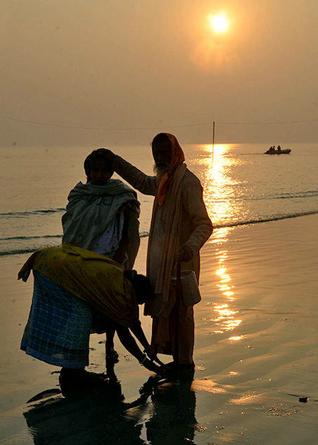
A sadhu blesses two women at Sagar island on Monday. Photo: Sushanta Patronobish

Devotees gathering for Makar Sankranti almost thrice the island’s population

In the next few days, lakhs of devotees will descend on the Sagar Island in the Sunderbans archipelago of West Bengal to take a holy dip, where the Hooghly river enters the Bay of Bengal, on the occasion of Makar Sankranti. They are unaware of the festival’s environmental impact on the island.

Sagar is the largest island in the Indian Sunderbans system, boasting an area of 251 square km and a population of 2.10 lakh as per the 2011 census. Despite its size, the erosion of certain parts owing to the rising sea level is causing its residents concern.

In July 2014, at least 10 villages were submerged in high tide, and this exposed the vulnerability of the island, like the other smaller islands of the unique ecosystem.

While State government officials admit that no detailed environmental assessment has been done in the recent past, some recent studies show that on the one hand, the issue of pollution has not been addressed and on the other, the island’s tourism potential has not been tapped.

Experts say the number of devotees gathering on a particular beach during the Mela is five to six lakhs, almost three times the island’s population.

At least two recent papers, produced by researchers of the School of Oceanographic Studies (SOS), Jadavpur University, have looked at the issue of sustainability of the Mela and the island’s tourism potential.

‘Impact of Gangasagar Mela on Sustainability of Sagar Island,’ published in 2012 in the International Journal of Research in Chemistry and Environment, pointed to an increase in fecal coliform bacteria in the surface water of the beach used by the pilgrims. The paper said the inhabitants of the island living near the Mela ground complained of obnoxious smell and communicable diseases.

“The authority needs to limit the gathering according to the… capacity of the Gangasagar Mela ground which depends on infrastructure such as housing, latrine, toilet and bathing ghat [so as] to minimise pollution,” said the paper authored by Tuhin Ghosh of the SOS and Rituparna Hazra and Rajarshi Mitra.

Another paper published by Prof. Ghosh and others at International Journal of Innovative Research & Development in 2014 looks at the tourism potential of the island under the Global Sustainable Tourism Criteria.

source: http://www.thehindu.com / The Hindu / Home> News> Cities> Kolkata / by Shiv Sahay Singh / Sagar (South 24 Parganas) / January 13th, 2015

Hazarduari gets ‘Adarsh’ tag from ASI

Kolkata :

Hazarduari Palace in Murshidabad has been declared an Adarsh Monument by the Archaeological Survey of India (ASI) along with three others in eastern India.

The other three monuments are Vaishali-Kolhua in Bihar, Rang Ghar in Assam’s Sibsagar and the Konark Sun Temple in Odisha. These
will be in the focus of international tourism promotion plan developed by the central government.

ASI has selected only 25 out of 3,680 protected monuments under the Adarsh Samarak Yojona. The list was made on the basis of the number of tourists these monuments attract annually. The list includes some of the biggest crowd-pullers like Taj Mahal, Khajuraho, Qutab complex and Red Fort.

All of them can be of great interest to international tourists, believes the ministry of culture. “Keeping that in mind, we are developing amenities of international standards, including washrooms, drinking water, signs, cafeterias, audio-visual centres, Wi-Fi connectivity, interpretation centres and encroachment-free areas,” said ASI regional director (eastern region) P K Mishra.

But more than anything else, security will be enhanced. The Centre is thinking of introducing the ‘tourism police’ force that is quite common across the world.

Hazarduari Palace, earlier known as Bara Kothi, is located on the campus of Kila Nizamat in Murshidabad, on the banks of the Bhagirathi. It was built in the early 19th century by Duncan MacLeod under the reign of Nawab Nazim Humayun Jah of Bengal, Bihar and Orissa (1824-1838). In 1985, the palace was handed over to ASI. Kila Nizamat or Nizamat Kila was the old fort of Murshidabad which was demolished to build this grand palace.

Built in the 13th century, the Konark Sun Temple is shaped like a chariot of the Sun God with 12 pairs of ornamented wheels dragged by seven horses.

Rong Ghor, meaning ‘House of Entertainment’, is a two-storied building that used to serve as the royal sports pavilion. Ahom kings and nobles used to watch buffalo fights and other sports at Rupahi Pathar in Rangpur, particularly during the Rangali Bihu. Said to be one of the oldest surviving amphitheaters in Asia, the building was constructed during the reign of Swargadeo Pramatta Singha in 1744-1750.

Kolhua in Vaishali is where the Buddha is said to have preached his last sermon. To commemorate the event, emperor Ashoka erected one of his famous lion pillars here in the third century BC. A hundred years after the Buddha’s death, Vaishali hosted the second great Buddhist council. Two stupas were erected to commemorate it.

Jainism, too, has its origins in Vaishali. In 527 BC, Lord Mahavir was born on the outskirts of the city and lived in Vaishali till he was 22. Vaishali remains an important pilgrimage centre for both Buddhists and Jains.

source: http://www.timesofindia.indiatimes.com / The Times of India / Home> City> Kolkata / by Krishnendu Bandyopadhyay, TNN / January 11th, 2015

Sky’s the limit for these girls

BirlaGirlsKOLKATA30dec2014

Lying on blankets at a height of 9,200ft, they gazed up at the sky and couldn’t believe what they saw. Khushi Goenka and two of her schoolmates from Modern High School for Girls were staring up at the Milky Way. With the naked eye.

In Hawaii to attend the second edition of the Pacific Astronomy & Engineering Summit at Imiloa Astronomy Center, the girls had seen the constellation through a telescope just the day before. “It was unbelievable because the previous day at the astronomy centre we had seen the constellation and other stars and there we were, seeing it again, this time with the naked eye,” said Khushi, a Class XII student.

Khushi, along with Class XI students Adwitiya Dawn and Shruti Keoliya, made up the only team from India invited to the five-day conference. Accompanied by their physics teacher Pamela Dutta, the girls worked in collaboration with Puragra (Raja) Guha Thakurta of the department of astronomy and astrophysics at University of California, Santa Cruz, and PhD student Emily Cunningham on the Halo 7D project.

The conference included presentations by scientists and astronomers from China, Japan, Canada and the US but the high point for the city girls was a meeting with five scientists who had spent four months in isolation in simulated Mars-like conditions.

“We met the HI-SEAS crew, a group of five scientists who had spent four months in isolation on a Mars-like surface on top of a mountain. We got hold of an aeronautical engineer and kept asking him absurd questions to satiate our curiosity and not letting him eat his plate of chicken that he hadn’t in the past months,” recalled Shruti.

After the girls returned to the city, Guha Thakurta visited their school and shared with Metro the importance of research and how the trip not only opened new avenues for the girls but also opened their minds to new ideas.

“It opens the eyes of students, especially those who are used to finding exact answers even to difficult problems, to the fact that there are problems that do not have a right answer. In research you have some idea of the question you are trying to answer but there is no guarantee you will find the answer,” explained Guha Thakurta, an astronomer for 30 years. “In most high schools, students are taught there is a correct answer and there is an incorrect answer. To know that there are many shades of grey in between is an eye-opener. The girls, on several occasions, were looking for answers but we would tell them we don’t know the answers or the answer is not known.”

Guha Thakurta said the girls understood the need for research and saw “some laws of physics, some of which they put in their presentation. Some of it they had learnt in class but what they had probably not seen is how someone who making a career as a researcher still uses the formula that they are learning in high schools”.

“In the initial document sent to us, the astronomy terms seemed alien and too technical. But as we started researching, the concepts became clear and we tried to make our presentation (calculating the mass and structure of Milky Way) as comprehensible as possible for the layman,” Adwitiya said.

The five-day trip included sessions by scientists and astronomers, visits to museums, trekking and cultural presentations and some bhangra and dandiya to get everyone at the conference on their feet.

“As far as education is concerned, travelling contributes hugely as does mixing with people and working together as a team on research. The girls had to Skype with California early in the morning before school and be there in time to attend school,” said Devi Kar, the director of Modern High School for Girls.

source: http://www.telegraphindia.com / The Telegraph, Calcutta / Front Page> Calcutta> Story / by Jhinuk Mazumdar / Tuesday – December 30th, 2014

Researchers trace 57 addresses of Tagore

Kolkata :

“All our dwelling places contain varied partnerships of love…” Tagore wrote in 1935. What about is own spaces? Have they withstood the onslaught of time?

Not quite. One of the revered addresses that have been deleted forever is 49 Park Street where ‘Gitabitan’ and ‘Mayar Khela’ were composed. Researchers have recently recorded 57 places where the bard lived. Sixteen of them were in Kolkata, 14 in the Hills and 27 in south Bengal.

In a prelude to an ambitious heritage-tourism project of the government titled Tagore Circuit, history professors Shouvik Mukhopadhyay, Partha Sankha Majumdar and Ramanuj Mukherjee, at the behest of the West Bengal Heritage Commission (WBHRC), have come up with dates, anecdotes, addresses and several startling revelations about the poet.

Take Birjitalao where ‘Raja O Rani’ was staged and Tagore played Bikram in the 19th century. Wife Mrinalini played Narayani — her only stage appearance. The poet would frequent this house, rented by brother Satyendranath, next to the St Paul’s Cathedral.

“Indira Devi in her memoirs attests that the present day Calcutta Club was located on this land,” reads the study in its avatar as a coffee-table book. Chief minister Mamata Banerjee has a foreword: “Tagore has stayed in many different places which have earned for themselves the distinction of being temples of creativity, knowledge, literature, beyond any parallel.”

WBHRC chairman Shuvaprasanna writes: “The history of these abodes… testifies to the insight of a complete artist… throw light on the mental upheaval of a creative person who was never confided to a single place.”

Tagore would keep visiting the Hills; some of these structures continue to exist. The house that Scottish shipping magnate Daniel Hamilton built for the poet at Gosaba is one of the best maintained structures. But 16 such dwellings in Kolkata don’t exist any longer. The list includes 52/2 Park Street, 50 Park Street, 14 Lower Circular Road (now AJC Bose Road) and 237 Lower Circular Road. Soon after his marriage, the poet started living here and Mrinalini was admitted to Loreto House. Tagore wrote ‘Chhobi O Gaan’ here. Businessman Naliniranjan Sarkar later erected a building here. It’s now the Kolkata Police’s Foreigners Regional Registration Office.

“In a country like ours, it’s not possible to protect such buildings unless they are enlisted. The research on Tagoreean abodes is a significant beginning for such initiatives,” said Partha Ranjan Das, member, WBHR.

Places like 10 Sudder Street where Tagore lived with Jyotirindranath and his wife Kadambari Devi continue to exist. But the only trace of Tagore here is a plaque that reads that ‘Nirjharer Swapnobhango’ was composed here. After changing hands, the building is now Hotel Plaza.

The grand exception is the Art College, an enlisted heritage building. From 1928, the poet frequented the residential quarters of then principal Mukul Dey here and exhibited his paintings in February, 1932.

“His journey was external, physical as well as internal. The constraint of space often made him impatient and he continuously changed his locations, not only by moving outside but also relentlessly changing his dwelling places. Fluidity was integral to his creative genius,” write the researchers.

“The research is our labour of love, but there’s no stopping here. We are working on how the constant change of residences played a crucial role in Tagore’s creative genius,” said Mukhopadhyay. Both he and Majumdar have studied in Santiniketan.

source: http://www.timesofindia.indiatimes.com / The Times of India / Home> City> Kolkata / by Ajanta Chakraborty, TNN / December 28th, 2014

Sarat library without a librarian

Sarat01KOLKATA14dec2014

Factfile

Name:Sarat Smriti Granthagar
Estd: 1956
Address: Village and PO – Panitras, PS – Bagnan
No. of members: 1,029
Membership fees: Rs 2 per month for general members, free for children
Rare books: Collection of old volumes from Sarat Chandra Chattopadhyay’s personal library

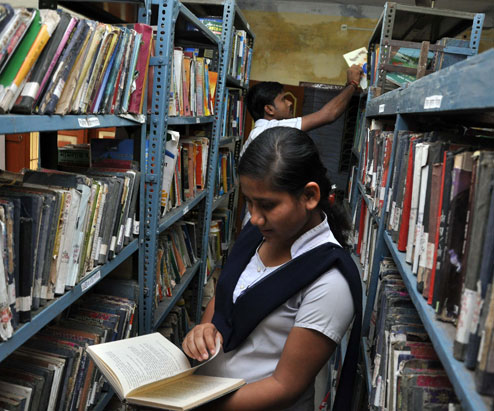
Panitras in Bagnan is popularly known as Sarat Chandra Chattopadhyay’s home. Not only did Sarat Chandra live here, but his sister’s house was also in Gobindapur, in Bagnan. Sarat Chandra’s house in Panitras is now a tourist attraction and a heritage property. However, there are many other things in this village that are associated with the novelist. The local library is dedicated to him. It was named Sarat Smriti Granthagar by the local people, who started it in 1956. Sarat Mela is held on the ground adjoining the library.

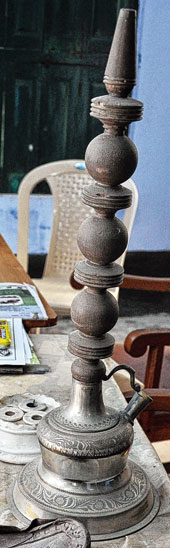
Some of Sarat Chandra’s belongings are also displayed at the library. An inkpot, a porcelain pen holder, an old pair of slippers, a torch, a hukkah and also a small wooden writing table. Although these have heritage value, the library authorities can only afford to keep these things stacked on top of an old cupboard. Interested people can take a look by bringing them down.

Sarat02KOLKATA14dec2014

Sarat Smriti Granthagar was started by the local people who wanted to promote education in this area. Sarat Chandra being a popular figure at that time, they decided to name the library after him. It started functioning from a mud house in the locality. Some years later, in 1960, a permanent structure came up where the library now stands. In the same year, it became a government-sponsored library and in 1987 it was given the status of a town library. The total membership of the library now stands at 1,029 out of which only 235 are active members. The children’s section has 371 members, most of whom are students of the nearby schools, Panitras Boys’ School and Samta Sarat Chandra Uchha Balika Vidyalaya.

“Almost all students from the two schools come to this library for membership. Since we have a huge collection of reference books, they find it easier to study here,” said Gaurav Guria, a staff at the library. Students find this library useful since many old textbooks that have gone out of print, are available here. “Students studying in college or doing their post graduation in Bengali, often tell us that many of the texts here cannot be found in the market anymore,” said Guria. The library also has a career guidance section, which is useful to those studying for competitive exams.

Sarat03KOLKATA14dec2014

Although it is a popular library in this part of Howrah, Sarat Smriti Granthagar is operating without a librarian for more than two years. “The librarian and the assistant librarian retired some years back and both positions are lying vacant. A librarian was appointed for a year here in 2011, but after he left, no one has been appointed. The district library authorities are aware of the fact that there is no librarian at our library. However, they have not managed to appoint anyone in this position so far. So it is up to us to run the library on our own,” said Guria. The retired assistant librarian was asked to look into the running of the library, however, he could not continue due to illness.

The library has 11,245 titles. A collection of 133 encyclopaedias, gazettes and other books used by Sarat Chandra has been kept in this library. Copies of the Indian Quarterly Register and Indian Annual Register of 1920, 1925, 1929 and other years, are part of the novelist’s collection. Volumes of Nelson’s Encyclopaedia used by the author are also here. The books have been bound and preserved well. “The Howrah Municipal Corporation has taken initiative in 1999 to preserve these books,” said Guria.

Grants come regularly to the town library. It receives Rs 48,000 as annual grant. In 2010-11, the library received a computer from Raja Rammohun Roy Library Foundation (RRRLF).

source: http://www.telegraphindia.com / The Telegraph, Calcutta / Front Page> Howrah> Story / by Dalia Mukherjee / Friday – December 12th, 2014

‘Kolkata deserves Unesco tag’

Kolkata :

The word “Bengali” is most used in Penang, Malaysia, to refer to anyone of North Indian origin because the headquarters of Penang Presidency were located in Kolkata during the British Raj.

Such unknown facts about the heritage of Kolkata was up for discussion at the Indian Museum where the two-day annual conference of the Indian National Trust for Art and Cultural Heritage (Intach) ended on Saturday to discuss the impact of urbanization on heritage.

Many heritage conservationists and art historians converged at the Indian Museum to attend the event on Friday. Experts felt that Kolkata should find a place among the Unesco sites but unfortunately the fact that Kolkata was the centre from where the British Empire proliferated, hasn’t quite been marketed well.

“The city should make a consistent effort in getting its pivotal place in history registered in the world’s mindscape,” said historian and conservation architect from Delhi AGK Menon.

“There is a renewed interest in Malaysia in the contributions of this once capital of the British empire to the realm of art and architecture,” said Khoo Salma, a conservationist with the Penang Heritage Trust.

“Coming here almost feels like being where it all began, at least when it comes to colonial art and culture,” said Gwynn Jenkins, a cultural anthropologist working in Malaysia. Among others present were historian PT Nair, art historian Bhau Daji Lad Museum director Tasneem Mehta and art historian Saryu Doshi.

“There are heritage laws in place but they have no teeth. We are yet to see destroyers of heritage getting arrested. Promothesh Barua’s house got razed, the arch at the gateway of Bishop’s House was pulled down and nothing happened to the builder. This needs to be stopped,” said GM Kapur, Intach state convenor.

source: http://www.timesofindia.indiatimes.com / The Times of India / Home> City> Kolkata / TNN / November 23rd, 2014