Category Archives: Travel

WRITER’S BLOCK – Of love, lust, and death in Calcutta

Every time I visit Calcutta — I prefer to use the old name when I look back fondly at a recent visit — there is something I do without fail. I take a taxi to Kumartuli, where idol-makers are at work round the year, stroll through its lanes before walking along the river up to Baghbazar, where I get into a ferry bound for Howrah station. The boat, carrying anywhere between 100 to 200 passengers at any given time, goes under the iconic bridge to get to the station, where I walk around aimlessly for a while before taking the next boat back.

This is my way of paying tribute to Calcutta, my most favourite city in India, because it owes its existence to the river: it was near Baghbazar that Job Charnock dropped anchor in 1690, and soon Calcutta, the British city, came into being. The best part is it costs next to nothing: one-way fare, until recently, was five rupees, now it is six. The trip invariably takes place at dusk, and most of the time I have company.

So last week, before the roads could get clogged up by Durga Puja festivities, a friend and I arrived at Kumartuli in a yellow taxi to watch the Durga idols being carried away by parties of able-bodied men representing different neighbourhoods of the city. My friend watched the spectacle awestruck: she has lived in Calcutta for 20 years, but this was her first visit to Kumartuli, whereas I started exploring the city as recently as in 2011, and knew much of old Calcutta like the back of my hand.

Before she could take enough pictures her phone died, so I led her through the narrow lanes to the riverbank. We watched the sun — now a gentle orange ball — slowly lower itself behind the buildings on the opposite bank. Once it was no longer a circle but just an orange smudge, we sat on a concrete bench by the river. Conversation is meaningless at such an hour, in such a place — when the day slowly melts into night, and when the river that gave birth to Calcutta changes colours — all you can do is sit in silence and watch the spectacle unfold. But silence was impossible at the moment. We happened to share the long concrete bench with four other people — two men and two women. Since they had identical ID cards hanging from their necks, it was clear that they all worked for the same company. What was equally clear was that they had come on this outing as couples, but it was difficult to decide who was whose girlfriend. One moment it appeared that Ms. C was Mr. A’s partner, but the very next moment it seemed Ms. D was Mr. A’s girlfriend. And then suddenly Mr. B put his arm around Ms. D.

What aggravated my confusion was the conversation (it is so easy to eavesdrop on Bengalis) I could overhear: they were talking about hotels that asked no questions when a man checked in along with a woman — or a woman checked in along with a man.

“Next time you are in Pune, check into such-and-such hotel,” one of the men advised the rest of the gang.

“That hotel?” one of the women retorted, “but they asked me for my entire family history before I could check in.” “How silly of you,” the man rebuked her, “You could have just shown your ID card.”

Precisely at that moment, something came floating down the Hooghly and everybody’s attention turned to it. All along, things had been floating on the river: the ferries, the hyacinths, nobody gave a second glance. But right now, all eyes were fixed on that something — a human body, bloated and skinless — floating down the river.

Crows sat on the body as it glided downstream, pecking on whatever they thought was still edible. Suddenly, I found the silence I was looking for, as the men and women who flirted with lust now contemplated death.

source: http://www.thehindu.com / The Hindu / Home> Features> Metroplus> Society / by Bishwanath Ghosh / Chennai – October 14th, 2016
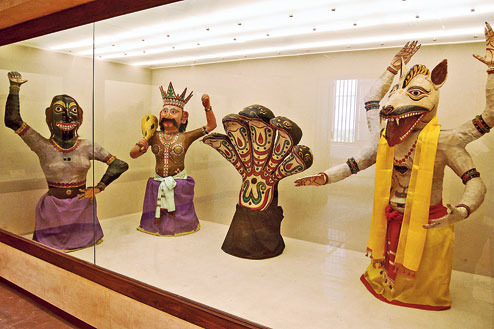
Mask gallery doors set to open

The number of masks in Indian Museum runs into hundreds and acquisitions date from the colonial period to 2000.

The collection has masks from not only India but also Australia, New Zealand, Central America, Africa, Bhutan and Nepal.

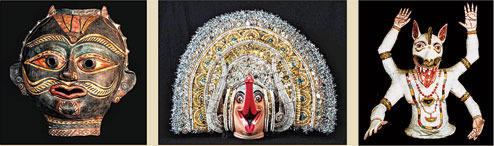
Most are dance masks of ancient folk traditions. Like the torso-covering Satriya mask of Narasimha used in Assam’s indigenous theatre, the Bhaona, or the brass mask of guardian spirit Bhuta of Karnataka or the golden deer from Bengal’s Gamira Dance ‘Ram Banbas Yatra’. There are masks of the Maoris and native Americans as well.

The mask gallery on the museum’s top floor was thrown open to the public in 2010. But it had to be shut in 2014 when some masks got drenched in rainwater because of a leaking roof.

MUSEUM TREASURE TROVE

The revamped mask gallery at Indian Museum will reopen on Tuesday
(From left) terracotta mask of Bakasura from Bihar; chhau mask of Lord Ganesha; Narasimha Satriya mask of Assam. Pictures by Bibhash Lodh

The gallery, revamped and redesigned by curator Mita Chakraborty, will reopen on Tuesday. Eight-five items will be on display.

“Many major museums have masks but few museums have a gallery dedicated solely to masks,” director Jayanta Sengupta said. “We have a significant collection. The Indian Council for Cultural Relations has decided to make Indian Museum the nodal agency for a large comprehensive exposition on Masks of India, which will be showcased in the next edition of The Festival of India. We will select items from museums across the country.”

The museum has arranged for a school workshop on Chhou and Gamira mask-making to mark the reopening.

Birinchi Medhi, professor of Gauhati University’s anthropology department, will give a special lecture on ‘Satriya Mask’ from 2pm. Sarit K. Chaudhuri, director, Indira Gandhi Rashtriya Manav Sangrahalaya, will inaugurate the gallery at 3pm. A mask dance is on the cards.

source: http://www.telegraphindia.com / The Telegraph,Calcutta,India / Front Page> Calcutta> Story / by Sebanti Sarkar / September 27th, 2016

Horse carts get life… and a burden

Kulti :

A 50-year-old tanga (horse-drawn carriage) operator in Burdwan’s Kulti had been planning to sell his two horses and look for some other source of income as the business, in which his family has been involved for four generations, had fallen on hard times.

The same was the fate of around 30-odd tanga operators in Kulti town on the Bengal-Jharkhand border.

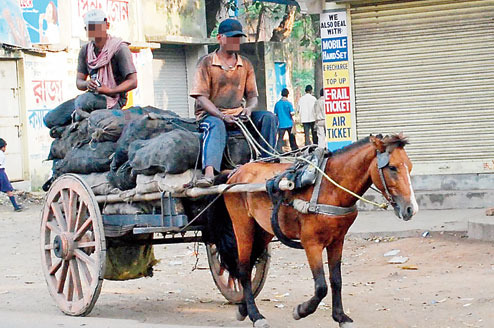
Pilfered coal being ferried in a tanga in Kulti. The faces of the operators have been blurred. /  Picture by Santosh Kumar Mandal
Pilfered coal being ferried in a tanga in Kulti. The faces of the operators have been blurred. / Picture by Santosh Kumar Mandal

However, the tangas have now got a new lease of life and the horses are back on their feet, ironically though, because they are being used to carry the burden of an illegal trade. Local coal pilferers have chosen the nearly forgotten mode of transport to ferry their booty to brick kilns and depots as tangas are much faster than bullock carts.

The horse-drawn carriage was introduced in Kulti by the British after James Erskine founded Bengal Iron Works.

The journey of the tanga since then has been chequered. From a symbol of glory during British rule, it became a popular mode of public transport. However, with the advent of modern means of transport such as buses, autorickshaws and totos, the tanga lost out.

Earlier, pilferers used to transport coal in trucks. However, because of a crackdown by police, they had chosen bullock carts and bicycles. However, bullock carts are slow and ferrying huge amounts of coal on cycles is a labourious and time-consuming task, prompting the pilferers to choose the tangas.

The owners of at least 30 horse-drawn carts in Kulti town have modified the vehicles so that they can be used to ferry coal. The hoods and seats have been removed to make space for coal sacks. Sources said the tanga owners charge between Rs 200 and Rs 250 for each trip.

Some residents alleged a section of policemen took bribes from tanga owners and pilferers.

Asansol-Durgapur police commissioner L.N. Meena said he did not know that tangas were being used to ferry pilfered coal and dismissed as “baseless” the allegation of bribe.

source: http://www.telegraphindia.com / The Telegraph,Calcutta,India / Front Page> Bengal> Story / by Abhijeet Chatterjee / Wednesday – August 17th, 2016

Afghan tribe star of Museum show

Kolkata :

On International Day of World Indigenous People, observed on August 9, Indian Museum brought to the fore an anthropological treasure it has had in its store since 1929. Physical anthropologist Biraja Shankar Guha, former director of Anthropological Survey of India, had brought in a model of the Khalash community of Afghanistan after his study on them. Khalash community. It’s accession no is 11813.

In Afghanistan, at the extremities of Hindukush are some isolated mountain valleys of Khyber-Pakhtunkhwa, known to rest of Afghanistan and Pakistan as Kafiristan.

The word ‘Kafiristan’ underlines that the Khalash community follows its own religion. They have liberal customs, rituals and beliefs – for instance, elopement is as common as married women choosing their new husbands, said Indian Museum education officer Sayan Bhattacharyya.

The Khalash religion is similar to the religion that was practised by Rigvedic Aryans and the community has retained most of the Indo-Iranian traits as well.

A wooden statue put on display shows the pagan origin of the community. Some of the Khalash people claimed to be descendants of Alexander the Great and a recent genetic analysis has substantiated this belief.

During the 1970s, local Muslims and militants tormented the Khalash because of the difference in their religions and multiple Taliban attacks on the tribe lead to its numbers shrinking to just 2,000.

However, protection from the government has ensured decrease in violence by locals and Taliban. It has also brought about a great reduction in the child mortality rate. The last two decades has seen a rise in their numbers.

source: http://www.timesofindia.indiatimes.com / The Times of India / News Home> City> Kolkata / TNN / August 11th, 2016

Our celebs are charging a bomb for Khuti Pujos

CelebsKOLKATA25jul2016

The lucrative business of celebs’ public appearances is known to one and all. In a state where people celebrate baro mashe tero parbon, festivities are aplenty all year round.

From mega stars to fringe celebrities — routine appearances during festivals like Durga Puja are great opportunities to earn those extra bucks, sometimes running into lakhs. But cutting the ceremonial satin ribbon to throw a Puja open is so last century.

With Durga Puja becoming bigger by the day, celebrations now begin from Ratha Yatra — which marks the making of the kathamo or the wooden frame on which the Durga idol is built.

Khuti Pujo, as it’s famously called, is now a rage with Puja committees going all out to make their paras bask in the reflected glory of stardom.

For celebs too, it’s the new Puja inauguration. The remuneration has been worked out, the list of dos and don’ts drawn up and a schedule added to their busy planners.

For some, however, the handsome paycheck is not the key factor — good PR is. Ever since Soham joined the political fray, he has not been charging a penny for showing up at Khuti Pujos. It’s the same with Rituparna Sengupta and Paoli, who attend the ceremony only on request. Rituparna has been to Khuti Pujos organised by ministers and bureaucrats whereas Paoli has done the same for those close to her. The latter charged approximately a lakh last year for attending a Khuti Pujo, but this year things are different. Then, there are those who are squeezing out an extra hour from their choc-a-bloc diaries as the reward is alluring.

Rachna Banerjee, we hear, takes anywhere between Rs 50 – Rs 70K to attend a Khuti Pujo. If she is familiar with the Puja committee, she travels by the car sent to her by the organisers; else, she travels by her own and gets the petrol bill reimbursed. Being choosy, she has turned down several offers to attend such a ceremony. On the other hand, she has attended many for free just for the rapport she shares with the organisers.

Sreelekha Mitra, who has already attended one this year, charged Rs 50K for it. Her remuneration goes up depending on the distance and she takes up an offer only if it is to her liking. Koneenica Banerjee, who attended the Khuti Pujo of Tridhara and Hindustan Park ‘out of love’, has several offers from Hazra, Baranagore, Barrackpore and Dum Dum lined up in the next few days. The actress charges Rs 50 – Rs 60K depending on the place and the time she needs to spend there.

As per Puja committees, it costs a bit more if they wish to get Tonushree Chakraborty or Paayel Sarkar on board, who charge somewhere between Rs 70k – Rs 80k. Tonushree has already attended six such ceremonies this year, while Paayel has been to four. On the other hand, Monami Ghosh has always remained a favourite with many. The actress, who charges `30k, stays for around 30 minutes and travels by the committee’s car. If she is attending one on the outskirts of Kolkata, the remuneration goes up to Rs 35k. Another hot favourite with Puja organisers is Vikram Chatterjee, who shot to fame with a popular megaserial. He charges around Rs 25k – Rs30k per event and stays for around 15 minutes. Last year, he attended three Khuti Pujos and 18 inaugurations and the numbers are set to soar this year. All the payments are made in advance to rule out complications of a starry kind later.

*The figures mentioned in the article are approximate and have been shared by Pujo organisers.

source: http://www.timesofindia.indiatimes.com / The Times of India / News Home> City> Kolkata / Zinia Sen & Ruman Ganguly / July 25th, 2016

Eco-friendly transport in Kolkata’s Fort William

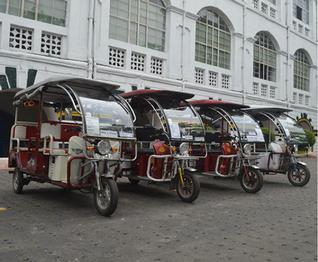
Battery-powered rickshaws wait for passengers in the Fort William campus in Kolkata.— Photo: Special Arrangement

Battery-operated rickshaws, locally called ‘totos,’ are now allowed to ply in Fort William, the headquarters of Eastern Command, for civilians to commute in the 177-acre campus. The initiative has benefited those who work in the Eastern Command — both former and current employees — as they routinely visit Fort William, located on the eastern banks of the river Hooghly.

“Electronic rickshaws are immensely helpful. We had to walk a kilometre or two to reach the canteen from one of the main gates,” said Shibnath Ganguly, a retired Air Force staff and added: “It was an arduous walk, especially in the summer.” The e-rickshaws charge a subsidised rate of two rupees from each passenger for each trip.

235th anniversary

The rickshaws ply from 8 am to 8 pm inside Fort William, which completes its 235th year in 2016.

Opened in 1781, the fort, with a formidable arsenal and personnel presence, was named after William III of England. Many civilians, a few thousands in number, stay inside, while scores of employees daily report to their offices offices.“This is primarily a welfare service, not only for the benefit of the public but also for the boys who operate the rickshaws,” explains Col. Richard Fernandes, the Commanding Officer of 12 Garhwal Rifles, who ensures smooth operation of the rickshaw service. The drivers are civilians, selected by the Army, to run four such rickshaws.

“The Army has provided the e-rickshaws. The drivers are not only paid Rs.3,000 every month [by the Army] but also make additional money by providing the service to people,” said Col. Fernandes. The rickshaws are not allowed to go outside the Fort’s campus. However, that is “not a major concern” for Mritunjay Kumar, one of the drivers who covers 50-60 km every day. “I am earning about Rs. 100-150 per day and making about Rs. 8000 each month,” said 19-year-old Mr. Kumar, whose father is a civilian employee of the Army.

The officials believe that the earning of the drivers from the e-rickshaw project, promoted as “an eco-friendly” venture, will go up from localised tourism, as the Vijay Smarak [War Memorial] at Fort William was recently opened to the public.

The e-rickshaws charge a subsidised rate of two rupees per passenger per trip

source: http://www.thehindu.com / The Hindu / Home> National / by Special Correspondent / Kolkata – July 14th, 2016

City wins teen chef crown – Calcutta Girls student tops it

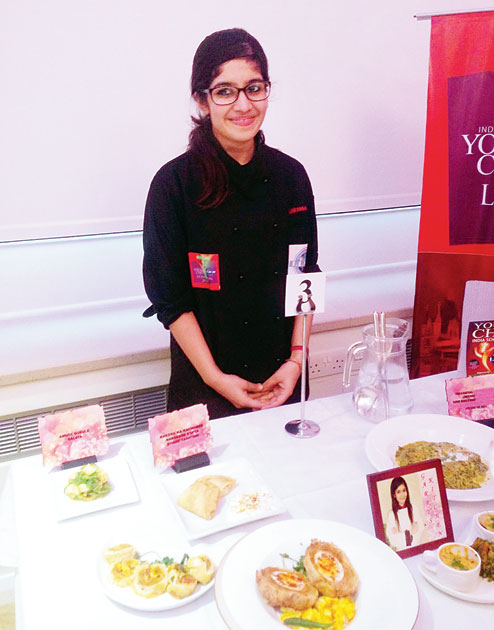
Garima Poddar plates her dishes at IIHM Young Chef India Schools 2014 at the University of West London

Garima Poddar likes her friends calling her Garry after Gary Mehigan, her favourite judge on Masterchef Australia.

And true to the Masterchef nickname, the Calcutta Girls High School Class XII student won the IIHM Young Chef India Schools 2014 contest at the University of West London on Saturday and retained the crown that Simran Kapur had won for Calcutta last year.

The finals of the inter-school cooking competition — held by the International Institute of Hotel Management (IIHM), in association with t2 — saw six finalists from six Indian cities (Calcutta, Delhi, Hyderabad, Bangalore, Pune and Ahmedabad) battle it out with their plates and pans to serve up meals to some of the best-known Indian chefs in London.

Wearing the judges’ hat at the London finale were Andy Verma, who owns restaurants Vama and Chakra in the UK, Dipna Anand whose family owns and runs Brilliant restaurant in London’s Southall area largely inhabited by Indians, Romy Gill of Romy’s Kitchen in South Gloucestershire, and closer home t2 columnist Shaun Kenworthy and Sector V IIHM’s chef Sanjay Kak.

How apt it was for the IIHM Young Chef India Schools contest to culminate in London was underlined by Virendra Sharma, MP, Ealing Southall, the chief guest at the evening prize distribution, who pegged the number of Indian restaurants in the UK at 60,000.

10dishesKOLKATA05jul2016

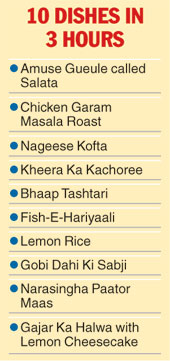
But what did Calcutta girl Garima do that the others didn’t? For one, she churned out 10 dishes in a three-hour-long cookout, a number unmatched by any other contestant. “Her biggest challenge was getting all her dishes right because she made so many,” agreed the judges, all of who gave Garima the highest score.

The Southern Avenue resident pinned her win down to two factors — confidence and practice. “I know it sounds cliched but practice does make perfect. I strived to make at least three dishes a day to prepare for the finals. One day, I did a 100 roti challenge just to get that perfect roti shape and all the rotis were given to the needy,” said Garima.

Like Garima, her other five competitors made it past 8,000 students who participated in the Young Chef competition over six months. Two got their visas in the nick of time and reached two hours before the contest kicked off while the Jaipur girl had to give it a miss, cutting down the number of finalists to six from seven.

In the two days they all spent in London before the finals, food was the only thing on Garima’s mind. Ask the Lebanese hairdresser at Eli’s Hair & Beauty on Kew Bridge Road who was unexpectedly pulled into a casual conversation on tahini, babaganoush and shawarma as she settled down for a wash-and-blow dry! Or the Kadai Chicken that was sampled at a local restaurant down the road from the hotel.

“In fact, it was for this competition that I started having non-veg,” said the spunky Marwari girl. “Non-veg is not cooked at home but we eat it outside. Initially, I would nibble on chicken; now I can eat a whole chicken meal!”

Which is why chicken featured on what the judges called her “buffet”. There was Chicken Garam Masala Roast, Nageese Kofta (egg wrapped in chicken keema) “learnt from my mom’s friend”, Kheera Ka Kachoree “learnt from dadi”, Bhaap Tashtari, Fish-E-Hariyaali, Lemon Rice, Gobi Dahi Ki Sabji and a fusion dessert Gajar Ka Halwa with Lemon Cheesecake. She also made an Amuse Gueule called Salata (frozen salad) and an Assamese dish called Narasingha Paator Maas “inspired by a YouTube video of Gordon Ramsay cooking Assamese food in Assam”.

The commerce student who loves economics also made all the right calculations and moves. Like when she used micro-greens to garnish her dishes, an idea picked up from Shaun’s cooking demonstration the previous day. Or when “I decided not to make rotis because they would have to be made last and would eat into my plating time”, she said.

Her future plans? “It’s either economics or cooking and after this contest, the scales are tilting more in favour of the latter,” she signed off, clutching in her hands the winning trophy, a cheque for Rs 5 lakh and a placard that read ‘Garry’s Kitchen’, which she had proudly displayed on her table.

What is your message for Garima? Tell ttmetro@abpmail.com

source: http://www.telegraphindia.com / The Telegraph,Calcutta,India / Front Page> Calcutta> Story / by Karo Christine Kumar in London / Monday – October 20th, 2014

WRITER’S BLOCK – Inside India’s oldest hotel

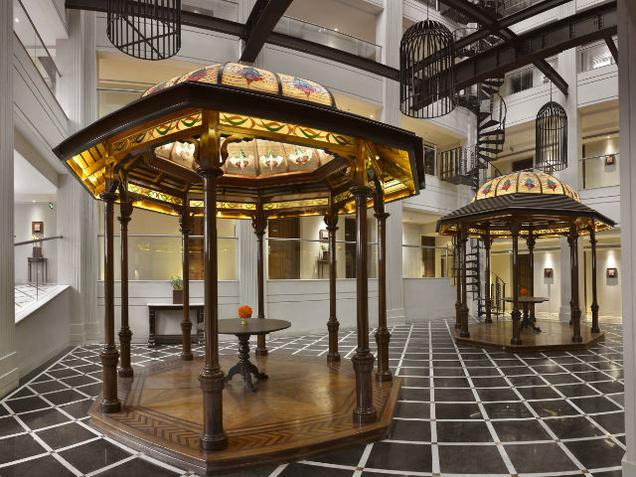
Past meets present: The atrium of the Lalit Great Eastern. /  by Special Arrangement
Past meets present: The atrium of the Lalit Great Eastern.
/ by Special Arrangement

In 1836 — when Bahadur Shah Zafar was yet to ascend the throne in Delhi to become the last Mughal — a man called David Wilson opened a bakery in Calcutta, which was fast growing into a second London. The bakery, a great source of comfort for homesick sahibs, did so well that Wilson soon acquired adjoining properties and in 1840 opened a hotel, cleverly naming it after Lord Auckland, the Governor-General of India who lived right across the road.

Until then, Calcutta boasted of only one hotel, Spence’s, also located a stone’s throw from Wilson’s bakery. Spence’s, which opened in 1830, had its share of admirers, who included Jules Verne. While scanning the archives of The New York Times, which I subscribe to online, I found only one mention of Spence’s, in an 1888 dispatch that was datelined ‘Spence’s Hotel, Calcutta’. Thereafter, for nearly a century, no Calcutta hotel merited mention in the paper other than Wilson’s, by then rechristened the Great Eastern Hotel. If you came to Calcutta, you had to stay at the Great Eastern, whether you were Mark Twain or Rudyard Kipling or Queen Elizabeth.

While no one seems to be sure when exactly Spence’s Hotel shut down, one knows for certain when exactly the Great Eastern was rescued from closure — in 2005, when the property, by now dilapidated and rat-infested, was bought over from the West Bengal Government by The Lalit group. Reopened to the public in 2013 as The Lalit Great Eastern, it is today the oldest existing hotel in India — a 176-year-old brassware restored and polished, its lifespan extended by another century or two.

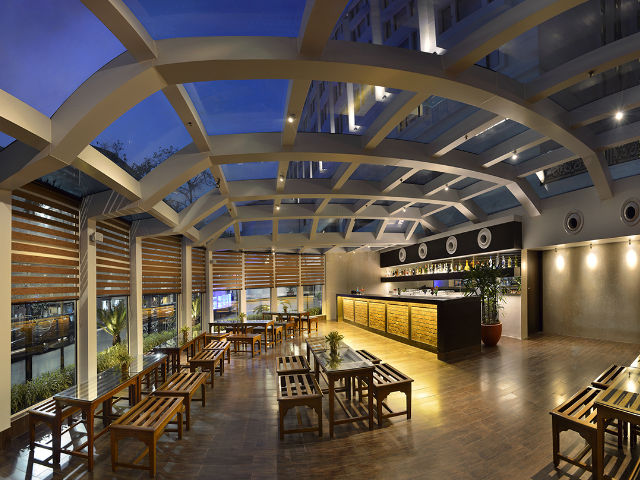
Resurrecting history: The Wilson, which serves as the pub and backery.

At the hotel, where I checked in last weekend, it is hard to miss the advertisement placed in the October 1840 issue of The Englishman and Military Chronicle: “D. Wilson and Co. beg respectfully to announce having taken those splendid and spacious Four-storied Premises, No. 1, Old Court House Street, formerly occupied by Messrs. Thacker and Co. and the Sans Souci Theatre, opposite Government House, and are sparing no expense in the alterations, and fitting it up in a manner that will render it one of the most comfortable family hotels in India.”

Nearly two centuries later, the new owners are doing precisely the same thing — sparing no expense in the alterations — as they blend the Victorian, Edwardian and modern eras to give something unique to Kolkata, which has been notorious for neglecting its handsome colonial-era buildings. The Victorian block, comprising 49 suites, is still under renovation, and will open in February next year.

The three nights I stayed there, I skipped dinner, simply because I overate during lunch, gorging on Bengali food that was prepared in its sanitised kitchens, but tasted very home-cooked. On the third day, lunch was actually home-cooked: I had happened to mention to the resident manager that I had never had litti-chokha, the quintessential Bihari dish, during my decade-long association with Kolkata, and so he had got me litti-chokha from home.

To burn calories, I walked — outside the hotel and inside. I walked around Dalhousie Square, Kolkata’s Westminster, where the hotel is located; I walked the streets of Kumartuli, watching Durga idols being made; I took a ferry across the Hooghly and walked on the Howrah Bridge. Walking in the corridors of the hotel was also as good as walking back in time. From time to time, one came across glass wine decanters, silver napkin-holders, silver water jugs, ancient teapots — all belonging to the time when the Great Eastern was known as the Jewel of the East.

It is one thing to recreate the past with the help of imagination, quite another to recreate it with actual pieces from the past — The Lalit Great Eastern has achieved the latter. When you hold an old wine decanter, you are forced to wonder whether it bears the fingerprints of Rudyard Kipling. It just might — who knows?

source: http://www.thehindu.com / The Hindu / Home> Features> Metroplus> Society / by Bishwanath Ghosh / Chennai – July 01st, 2016

Hill royal relic now rubble – GTA pulls down Bangla king’s centuries-old palace to set up hotel management school

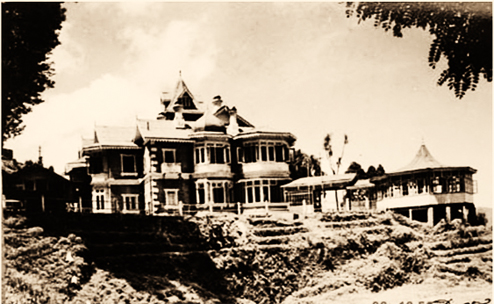
An undated photo of Sailabash: Courtesy Das Studio in Darjeeling

Darjeeling :

Darjeeling’s rare connection with present-day Bangladesh and a part of the hill town’s rich history has been reduced to rubble.

The GTA has pulled down Sailabash, the over-a-century-old summer retreat of the raja of Digapatia, to set up a modern hotel management institute and guesthouse in one of the last few available green spaces in Darjeeling.

Digapatia is now in Rajshahi, Bangladesh.

The palace under the tourism department of the GTA near Jalapahar and was brought down about two weeks ago. “The building was in a dilapidated state and recent earthquakes too had caused some damage,” said Kishore Ghimire, an executive engineer of the GTA.

In his book, A Concise History of The Darjeeling District Since 1835, which was published in 1922, E.C. Dozey, a writer and historian, said the building had been set up on land that was once owned by Capt J. Masson, the superintendent of Tukvar tea estate, by the “Digapatia Rajah”. The retreat was earlier called Girivilash and the name was changed to Sailabash after Independence.

The Late Nayan Subba’s soon-to-be-published book, Heritage buildings of Darjeeling, Kalimpong and Kurseong, says Raja Pramatha Nath Rai Bahadur had founded Girivilash whose garden was laid out by a German floriculturist and horticulturist, Morgenstern, and was looked after by 12 gardeners.

Nobody could say exactly in which year the building had been constructed. But its believed it was built in the last decade of the 19th century.

“Girivilash was a favourite place for the British governors of Bengal….The British army took over the palace in 1942. Later on, it was acquired by the government. It also served as a Tibetan school for a while. The palace has lost the historical grandeur of Girivilash,” writes Subba.

According to Subba, the colonial building had an attic with miniature gables and a small dome, and an all-weather glazed rotunda with small square windows in classical style. There was a tennis court as well.

“Raja Pramadanath Roy occupied the front suite on the ground floor, which included the library, with its precious screens of velvet and ornate wooden pelmets,” writes Subba.

The front suite of the upper storey with the snow view rooms was “for the rani”,

Subba writes. It was “beautifully furnished with a curtained brass cot and a chandelier. There was a huge grandfather clock, which indicated the days of the month and the full moon day (Ekadashi). On the ground floor were the drawing room, dinning room, tash khana (card room) and the billiards room,” Subba adds.

Despite being in a dilapidated state, Sailabash was still a landmark in Darjeeling and used to house a guesthouse after Independence. Once the building was taken over by the Darjeeling Gorkha Hill Council, the office of the hill body’s vice-chairman was housed there. For the past 20 years, the building had been lying vacant.

Bharat Prakash Rai, convener of the Indian National Trust for Art and Cultural Heritage (Darjeeling chapter), said: “How foolish can we be to dismantle such structures in the name of development. Could it not have been repaired? We have lost a piece of history and that is very sad.”

Dawa Lepcha, the GTA Sabha member in charge of tourism, said: “A big-scale hotel management institution will be coming up and the requirements were such that the building had to come down.”

GTA executive engineer Ghimire said the project cost had been pegged at Rs 55 crore. “Apart from the institution, there will also be a guesthouse with 24 rooms for in-house training. The infrastructure is being set up as per the parameters laid down by AICTE (All India Council for Technical Education)”

The five-acre plot in which the Sailabash was located has Annapurna and Kafal guesthouses, along with a pond built by the DGHC. “The Annapurna guesthouse will be used as an administrative building for the institution, while a part of Kafal will have to be dismantled. The pond will be smaller in size and we will have facilities for rainwater harvesting,” said Ghimire.

The engineer said restoration of the building would have cost much more.

source: http://www.telegraphindia.com / The Telegraph, Calcutta,India / Front Page> North Bengal> Story / by Vivek Chhetri / Wednesday – June 01st, 2016

Darjeeling girls scale Mount Everest

– College students from hills make up first all-girl team of NCC to conquer the highest peak

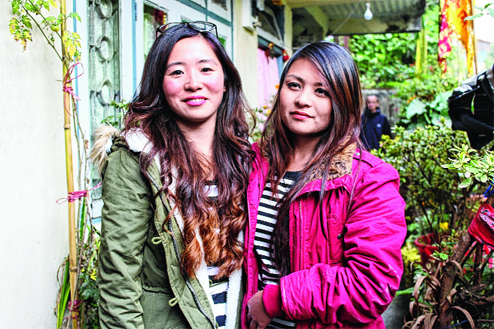
Trishala Gurung (left) and Sulaxchana Tamang. File picture

Darjeeling :

The first all-girl team of the National Cadet Corps to Mount Everest, which included two college students from Darjeeling, has successfully climbed the world’s tallest peak.

Trishala Gurung and Sulaxchana Tamang, who study at Southfield College and Ghoom Degree College in Darjeeling, respectively, were among the 10 girls to be selected from across the country to be part of the NCC team to scale the highest peak.

Speaking over the phone from Delhi, Lt. Col. Umang Kohli, additional director publicity, NCC (headquarters), said: “It is confirmed that the first all-girl team of the NCC has successfully climbed Mount Everest. They were part of a 19-member group which reached the summit. The NCC team has done us proud.”

The expedition team consisted of 10 NCC girls selected from across the country and 15 officers. Of the total 25 members, five, including the team doctor, were to stay at the base camp. “Of the 20 members, who were to climb the peak, 19, including 11 girls, have succeeded,” said Lt. Col. Kohli.

Only one NCC team member could not reach the top.

Om Prakash Tamang, father of Sulaxchana, 21, said: “My daughter called me around 7am today. She had just returned to the base camp. She said the team had successfully climbed Mount Everest. We are very happy.”

According to Om Prakash, Sulaxchana was part of the first batch to climb the summit.

Ganesh Gurung, father of Trishala, 22, said she had called him this evening to confirm the success of the team.

Lt. Col. Kohli said the team had climbed the peak in two batches on May 21 and 22.

Preparation for the expedition by the NCC team had started more than a year back. In November 2014, 100 girls from across the country had been selected for training at the Himalayan Mountaineering Institute in Darjeeling.

After completing a nearly one-month training, 40 girls were shortlisted in February 2015. “The 40 girls were then taken to climb Mount Deo Tibba (19,688ft) in Himachal Pradesh. After the 41-day expedition, 15 girls were selected for another expedition,” said Ganesh.

Between August and October 2015, the 15 girls were taken to an expedition to Mount Trishul (23,353ft) in Uttarakhand. After 50 days of that expedition, 10 girls were selected to scale Mount Everest.

The team led by Col. Gaurav Karki was flagged off in Delhi on March 9.

Mountaineer in Siliguri hospital

Chetna Sahu from Calcutta, who developed frostbites while descending from the summit of Mount Everest, has been admitted to a private nursing home in Siliguri. She climbed the peak, along with her husband Pradip.

source: http://www.telegraphindia.com / The Telegraph,Calcutta,India / Front Page> North Bengal> Story / Vivek Chhetri / Wednesday – May 25th, 2016