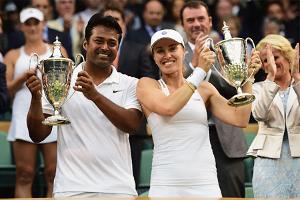
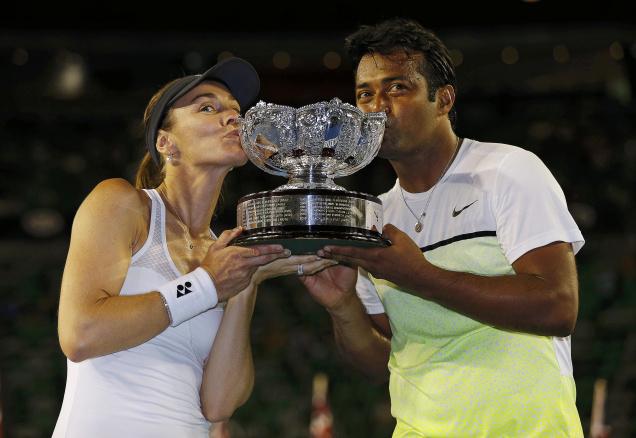
Leander Paes with his Swiss partner Martina Hingis won the mixed doubles title at Wimbledon. (Getty Image)
London :
A vintage Leander Paes clinched his 16th Grand Slam trophy, winning the mixed doubles event of the Wimbledon Championship with legendary Martina Hingis after a dominating win over Alexander Peya and Timea Babos, here today.
Seventh seed Indo-Swiss pair drubbed the fifth seed Austrian-Hungarian team 6-1 6-1 in the lop-sided summit clash which was over in just 40 minutes.
It was Paes’ eighth mixed doubles title and second with Hingis. They had won the Australian Open early this year.
42-year-old Paes has eight men’s doubles crowns in his Grand Slam collection.
Paes’ win capped an incredibly successful Wimbledon for India as the country took three titles this year. Sania Mirza won the women’s doubles and Saumit Nagal won the junior boys doubles trophy.
For Hingis, it was second title in as many days, having won the women’s doubles with Sania. Overall it was 18th Major title for the Swiss and third in mixed doubles.
Hingis was back on court less than 24 hours after that win with Sania but showed no sign of fatigue. She served well and was terrific at the net, complementing the Indian Pro.
Paes and Hingis literally toyed with Peya and Babos, who surprisingly failed to put any resistance.
In no time Paes and Hingis pocketed the first set as all they needed was 19 minutes to nose ahead. Two broke Babos in the fourth game and Peya in the sixth for a 5-1 cushion. Hingis served out the set when Paes smashed a volley winner.
Paes and Hingis kept the pressure on the Austrian- American combination right from the first game of the second set. Peya failed to negotiate a Paes return at deuce to hand the seventh seeds grabbed the opportunity to break them.
Babos’ could not handle a Hingis return and the Indo- Swiss pair got an early break. There was no stopping them from there as they raced to victory in less than one hour.
Babos failed to hold her serve even once and it was on her return that Paes hit a deft backhand volley winner to close the contest.
source: http://www.timesofindia.indiatimes.com / The Times of India / Home> Sports> Tennis> Wimbledon 2015 / by PTI / July 12th, 2015
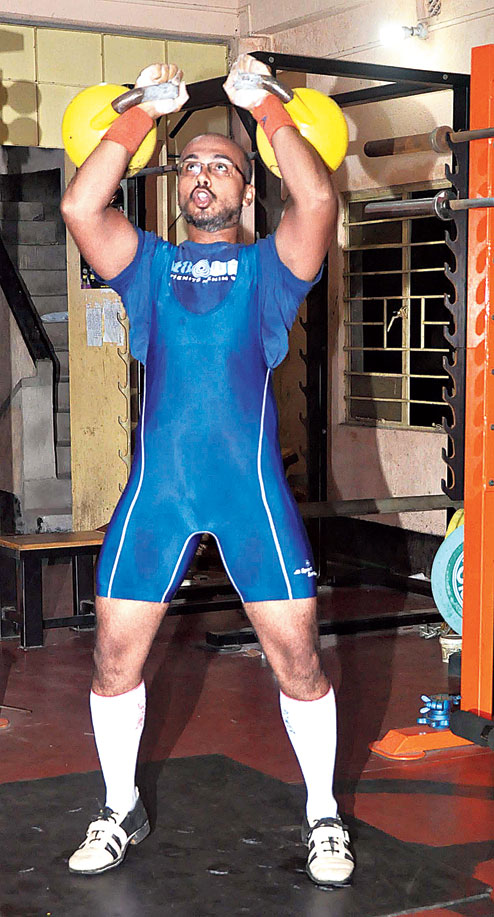
Kaushik Balial demonstrates kettlebell lifting at KB’s gym. Picture by Gopal Senapati
Kettlebell lifting has a long history in Russia and has been a competitive sport since the 1960s. Kettlebell sports, also known as Girevoy Sport, is a popular sport in Russia and Europe. It has started becoming popular in other countries around the world recently. A variation of weightlifting, the sport involves the same snatch and jerk techniques that are demonstrated in the former.
Along with the world, kettlebell sports have also made an entry into India and Calcutta. Health clubs and gyms where members are involved in regular kettlebell training, have introduced the sport as well. Kaushik Balial of KB’s Gym, introduced kettlebell training in his gym some months back and on July 4 and 5, he conducted a workshop on Level 2 kettlebell training. “In most gyms in Calcutta, kettlebells, which were treated as a fitness training equipment, have become a sports equipment. More people are trying this sport,” said Kaushik.
“Level 2 training includes training in the sport. Level 1 is all about strength and endurance and is usually done with one kettlebell. In Level 2, the trainees have to learn to lift two kettlebells together and gradually try to increase the weight limit,” he added.
Four members of KB’s Gym participated in the workshop. At this workshop, Kaushik demonstrated kettlebell lifting with two 4kg bells. “There are generally two events in competitive kettlebell events. One is the biathlon and the other is the long cycle. The biathlon is a classical event where the lifter has to perform a set of jerks followed by a set of snatches. In a long cycle, the lifter has to perform a set of long jerks,” said Kaushik.
At the workshop, Kaushik stressed on techniques – how to do the moves and how to develop a body for the sport. “Strength and endurance are the two most important things in kettlebell sports. This form of fitness training has become popular among the young generation because kettlebells are small equipment which require less space and also because training takes less time. The maximum time one should give to kettlebell training is 20 minutes,” said Kaushik. After this workshop, Kaushik hopes to be able to build a team of kettlebell lifters. “There is a kettlebell lifting competition next year in Calcutta and I hope to send a team there,” said Kaushik.
source: http://www.telegraphindia.com / The Telegraph, Calcutta,India / Front Page> Howrah> Story / by Dalia Mukherjee / Friday – July 10th, 2015
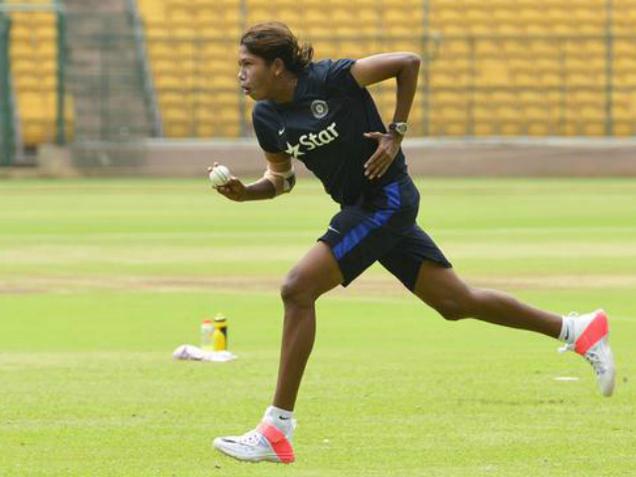
Jhulan Goswami in the nets. — Photo: K. Murali Kumar / The Hindu
The lanky all-rounder lifted India to 142 from a dismal 87/8, while the White Ferns’ chase gave out at 125.
Indian eves recovered brilliantly to snatch a well-deserved 17-run win over visiting New Zealand in the first of their five-match One-Day International (ODI) series here on Sunday and picked up two crucial points in their bid to qualify for the 2017 Women’s World Cup.
The Indians found their heroine in the six-footer Jhulan Goswami whose 67-ball 57 (6×4, 1×6) lifted the hosts to 142 all-out after being 87 for eight at one stage. In reply, the White Ferns faltered under pressure and were dismissed for 125.
Opting to bat first after winning the toss, the Indians had struggled against some accurate bowling and lost wickets at regular intervals before former captain Goswami blasted a timely half-century that virtually took the game away from the White Ferns, for whom pacer Lea Tahuhu, off-spinner Leigh Kasperek and left-arm spinner Morna Nielsen took three wickets apiece.
The White Fern innings never really took off and the early wickets took the momentum off their chase. Despite some resolute batting by opener and skipper Suzie Bates (28), Sophie Devine (24) and Kasperek (21), the visitors could not stop the marauding Indian bowlers who were well supported through smart catching and agile fielding.
For the hosts, off-spinner Sneh Rana came away with three wickets, while left-arm spinner Ekta Bisht, who opened the bowling, and seamer Harmanpreet Kaur took two apiece to complete a fine win.
The teams meet again at the same venue on Wednesday. The first three matches of the series count towards qualification to the 2017 World Cup.
Brief scores:
India 142 all out in 44.3 overs (Jhulan Goswami 57, Lea Thuhu 3 for 25; Morna Nielsen 3 for 24) beat New Zealand 125 all out in 45.3 overs (Suzie Bates 28, Sophie Devine 24; Sneh Rana 3 for 26, Ekta Bisht 2 for 18, Harmanpreet Kaur 2 for 16) by 17 runs.
Points: India 2, New Zealand 0.
source: http://www.thehindu.com / The Hindu / Home> Sport> Cricket / IANS / Bengaluru – June 28th, 2015
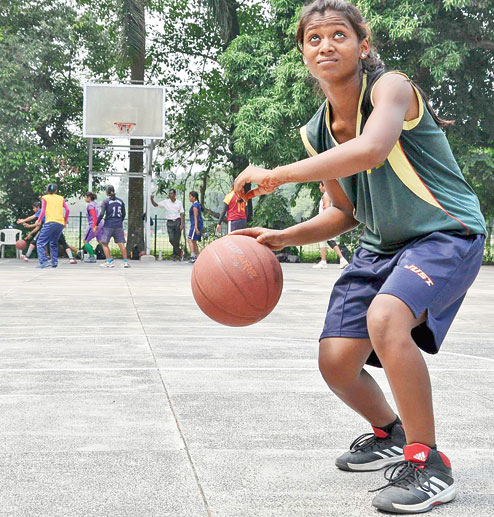
Survival has been a struggle for Sushila Ekka who has had to fight poverty and follow her passion of slam-dunking basketball to make a living. The young girl was a regular player in the Howrah district basketball team from where she has been selected to play national level tournaments. She started playing for the district when she was only 11 years old, a year after she started training under coach Alok Banerjee at Dumurjala Stadium.
“Sir (Alok Banerjee) had come to our school, Batore Adivasi Samaj School, and had told us that if anyone was interested in playing basketball, he or she should go to him. At that time, I was young and I had no idea about basketball. I went to play at Dumurjala and there I saw that this was a new kind of game that I had never seen before,” said Sushila. Prior to this, Sushila had no idea about any kind of sports and games. Living in poverty where her father, Lorenthis Ekka, is a labourer in a rolling mill and mother, Serophina Ekka, is a domestic help, Sushila’s prime interest was to get a job through sports quota. “I started to like the game and would practise as much as possible. My coach sent me to the district sub-junior tournament after a year from where I was selected for the state and national tournaments,” said Sushila.
She played her first national game in the West Bengal team in 2004. The team had won eighth position and Sushila was noticed for her performance as the playmaker in the five-member team. This year, the state team did not fare
well in the national tournament, but Sushila had still performed well. Sushila’s dream of landing a job came true two years back when she got a job in the electrical division of Eastern Railways. She joined the Railways basketball team and her coach, Satya Pattanaik, has always encouraged her to play well.
“Sir (Pattanaik) inspires me to play and has helped me in many ways. Before joining the Railways team, I would train under him and he ensured that I got all facilities, like jersey, ball and other accessories,” said Sushila. Before joining Eastern Railways, Sushila had also worked as games teacher in a private school. “I needed to earn a living to run the family expenses as well as my own. My parents would not be able to afford my expenses for playing basketball,” said Sushila. Although, she likes the game a lot, Sushila does not like to watch the big international teams playing on TV. “I have heard of the National Basketball Association in USA, but I have never watched them on TV. Also, I prefer watching games live than on television,” said Sushila.
Sushila has travelled across the country to play in various tournaments and invitation matches. Earlier this year, she went to Tuticorin in Tamil Nadu to play for an invitation match. There too, Sushila bagged the best playmaker award. “I have won several best playmaker awards in the past few years within West Bengal. The awards always inspire me to play better,” said Sushila.
She practises every morning at the basketball court in Calcutta Maidan, before going to work. However, her goals are more oriented towards her job than making it big in the game. “I have to practise a lot because I want to perform well. Only then will I get a promotion,” she said. Sushila also plans to study further. “I did not study after Class X because I wanted to play basketball. But now I think it would be better to complete higher studies so that I can get better job prospects,” she said.
MORE ABOUT SUSHILA
DoB: September 2, 1992
Born in: Howrah
Education: Class X
Family: Parents, two brothers
Loves: Singing
Hates: Backbiting
source: http://www.telegraphindia.com / The Telegraph, Calcutta, India / Front Page> Howrah> Story / Friday – June 19th, 2015
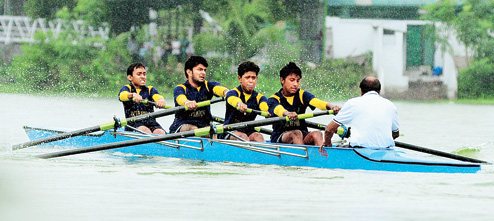
Junior boys of South Point High School in action at the Bengal Rowing Club
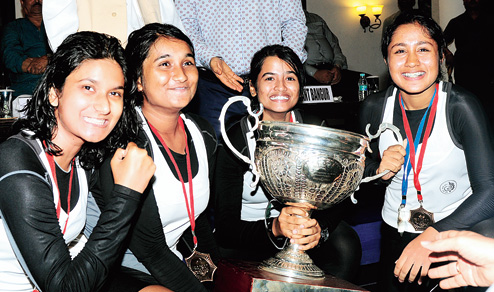
Aishwarya Krishnan couldn’t have asked for a better gift on her 17th birthday. As the Class XII student of GD Birla Centre for Education picked up the trophy with her three teammates, the smile on her face said it all. The real winner, however, was the spirit of the game as Aishwarya took her closest competitors for a celebratory dinner after the final race.
The 14th Bengal Rowing Club Student Rowing Championship, in association with The Telegraph, saw 43 teams from 25 schools rowing passionately to make their schools proud.
The competition was fierce but the bonhomie among participants outshone all rivalry. “I will never forget the moment when we stepped out of our boats after winning the race and one my best friends, who was my opponent, came running and hugged me tight. This is the sort of bond we share here. It’s true that when we are rowing we don’t think of anything else but finishing the race. But I have made the best of my friends here,” said Aishwarya, who has been participating in this event for four years. “This was the second time my team won the gold. It was the best gift I could have asked for.” The GD Birla team defeated defending champion Modern High School for Girls to lift the senior girls’ trophy.
In the senior boys’ race, St. Lawrence High School retained the trophy. The boys beat Future Hope in a close finish.
Aishwarya Krishnan (extreme right) and her teammates after winning the senior girls’ race at the 14th Bengal Rowing Club Student Rowing Championship. Pictures by Arnab Mondal
“Future Hope was leading even when we had travelled half the distance but then we just had to fly it out to the finishing point,” said Shubham Singh of the winning team.
Yash Juthani of MP Birla Foundation Higher Secondary School was disappointed on finishing fourth but happy that his school took home the award for best dressed school for their white jerseys with a special logo of two crossed oars and emblem showing the students rowing. “Participating in the competition is in itself a wonderful experience. Every year we make new friends and have great fun,” said the Class XII student. “But we will definitely do much better next time.”
Hemant Bangur, the president of Bengal Rowing Club, was all praise for the students. “Now that our flagship event is coming to an end, I will miss the bubbling energy of the students at the club. I would like to thank the school for their co-operation and active participation,” he said.
Governor Keshari Nath Tripathi, who graced the prize distribution ceremony, had words of encouragement for the young rowers. “I congratulate all the winners…. They have earned it by their devotion, concentration and hard work. Those who couldn’t win need not despair. Defeat many a times is the inspiration for better performance and ultimate success. I expect them to achieve this role in the next championship.”
Like every year, the club promoted other sports too, archery and chess being the highlights this year. There was also an indoor rowing competition.
Rowing glory
Junior Girls
Gold: Modern High School for Girls
Silver: Ashok Hall Girls’ Higher Secondary School
Bronze: La Martiniere for Girls
Junior Boys
Gold: South Point High School
Silver: La Martiniere for Boys
Bronze: St. Xavier’s Collegiate School
Senior Girls
Gold: GD Birla Centre for Education
Silver: Modern High School for Girls
Bronze: Sushila Birla Girls’ School
Senior Boys
Gold: St. Lawrence High School
Silver: Future Hope
Bronze: Seventh Day Adventist
source: http://www.telegraphindia.com / The Telegraph, Calcutta, India / Front Page> Calcutta > Story / by Samabrita Sen / Monday – June 15th, 2015
For someone like Surajit Ghosh, who has won 12 gold medals in international swimming competitions, it is disheartening to lead a life without any recognition or acknowledgement. Ghosh had won the first gold medal for India in 1984 at the Asian Swimming Championships in Hong Kong. Since then, he was a winner for the next 10 years, in Asian and South East Asian Swimming Championships. Of the 19 medals that he has won, 12 have been gold medals and seven silver.
From 1985-89, Surajit was number one in South East Asia and number 2 in Asia. Apart from this feat, Surajit has over 100 medals that he has won at national swimming championships. He was champion for 10 consecutive years in the senior national championships for 200m butterfly and 400m individual medley. Despite his achievements and talent, Surajit laments that he has never been recognised by either the state or the central government. “My achievements have remained unrecognised. I have never received any kind of recognition from the state or central governments,” he said.
Surajit was a swimmer since childhood, when he started swimming in the neighbourhood pond. His elder brothers Abhijit and Biswajit were also swimmers. However, Surajit went a long way in this sport. His first guru was Jnanaranjan Das, who trained him and encouraged him to go to competitions. “My strength was 200m butterfly in which I had made a record time of 31 seconds in 1979, at my first junior national championship. Later, to perform better, I never stuck to one coach. I would go to other places around India, where I would practise with other good swimmers and practise under different coaches,” said Surajit.
A swimmer can only improve if he has a good competitor. “When I went to competitions, I would watch other swimmers and would contact them later so that I could go and practise with them to improve my speed. I have been to Madras, Kerala and other parts of India, with the aim of increasing speed,” said Surajit. Many swimmers in Bengal would want to practise with Surajit for the same reason.
“Bula Chowdhury has practised with me for a long time because she wanted to increase her speed,” said Surajit. He had also trained for many years under Australian coach, Eric Arnold, in Delhi. “I had stayed for a long time in Delhi, just to train under Arnold who was also training national champion Khajan Singh at that time,” said Surajit.
Although he has been a rank-holder in Asia and South East Asia, he regrets that he could never get a rank in world championship. “I had gone to the World Swimming Championship in 1990, but there I could not go beyond Rank 8. The competition was tougher because there were so many more swimmers from across the world who were better than me,” said Surajit.
Having a job with the Eastern Railway through the sports quota, Ghosh now coaches young swimmers in Bally and other swimming clubs. “I started Bally Swimming Centre but I also train students in other clubs in Hooghly and other places,” he said. He encourages young swimmers and is always on the lookout for new talent.
MORE ABOUT SURAJIT
DoB: January 15, 1968
Born in: Howrah
Education: HS
Family: Wife, two daughters
Loves: Long drives
Hates: Deceit
source: http://www.telegraphindia.com / The Telegraph, Calcutta / Front Page> Howrah> Story / Friday – April 03rd, 2015
WITH the retirement of Madhumita Bisht, a long and illustrious chapter in the history of Indian badminton has come to a close. In a career spanning nearly three decades, Madhumita grew from a small-town girl to a big-hearted champion. By stringing together will, courage and determination to succeed, Madhumita set an example for all those who followed.
Madhumita Bisht announcing her retirement in New Delhi. The queen of Indian badminton is an eight-time National singles champion, nine-time doubles winner and a 12-time mixed doubles winner
V.V. Krishnan
“If you believe you can do it, you will do it. After all, we human beings are blessed with amazing abilities. It is for us to make the most of these abilities.” These words from the 38-year-old Madhumita reflect the tremendous self-belief she developed over the years.
No wonder, Madhumita, who became the National sub-junior champion in 1977, went on to collect National titles at will. An eight-time National singles champion, nine-time doubles winner and a 12-time mixed doubles winner! That, in short, tells the tale of Madhumita’s all-round success at home.
Madhumita broke Meena Shah’s record of six successive National singles titles by winning seven between 1985 and 1991. She also had the unique distinction of emerging winner in all her eight appearances in the singles final of the National championship.
A fitness fanatic, fiercely competitive and a firm disciplinarian, Madhumita was greatly inspired by Ami Ghia, who won the Nationals seven times. She acknowledges the contribution made by Ami and says, “till date, we are best friends.”
Even before Madhumita arrived on the National scene, Ami was already a four-time National singles champion. “I remember watching her play for the first time. I thought she was just too good,” recalls Madhumita, now a Sports Officer with Northern Railway.
It was at Panjim in 1978 that Madhumita first saw Ami play and went on to lose to her. “I used to be very scared of the senior players like Ami and Kanwal Thakur Singh. Then I joined Railways and Ami was with me. I remember, we had a camp in Delhi’s Karnail Singh Stadium. We were roommates. Dipu Ghosh was our coach and he was of the opinion that I stood to gain a lot from Ami. He was right.”
Madhumita recalled a tournament in Bangalore, before joining the Railways, in 1978. “I was to play Ami in the final. But when I watched her warm-up, I forgot all about the fact that even I had to warm-up. Believe me, I did not warm up at all. Needless to say, I lost. But after watching her before the match, I realised the importance of warming up before every match. Perhaps, her meticulous ways rubbed off on me.”
It was not until 1980 that Madhumita began to believe that she could actually beat Ami. “I had beaten Kanwal Thakur Singh (who won two National titles by beating Ami in the finals) in the Lucknow International. So my confidence was growing.”
One Saturday afternoon, in the Uber Cup camp at Patiala, Madhumita lost 11-12 to Ami in the deciding game. “After the match I was wondering if I could run her so close, it was possible to beat her, too. Sunday was a day of rest. On Monday, the trials to select the team were to start. When the lots where drawn, I faced Ami in the first match of the round-robin trials. I beat her 11-7, 11-8,” recalls Madhumita with a glint of pride in her eyes.
“I beat her in August 1980 and again in January 1981. But around a fortnight later, in the Vijayawada Nationals, I lost to her in the semifinals. But thereafter, things became a little more comfortable for me. I beat her six times in the National finals. I’ve enjoyed playing with Ami. I played with her and many more opponents since then, but I can tell you, that in my opinion, Ami was the most difficult player to beat,” declares Madhumita, whose game revolved around her speed, fine anticipation, power and deception.
Hailing from Jalpaiguri and getting her early lessons in badminton from her father at Siliguri, young Madhumita worked hard to overcome the constraints. From playing on an outdoor mud-court to a make-shift indoor hall with the roof only 15 feet high, Madhumita progressed. “One could neither serve deep, nor go back since there was a danger of banging your racquet against the back-wall. But this helped my speed as I had to get adjusted to the shuttle travelling at such a quick pace,” says Madhumita on those challenging days.
An appearance in the National junior final and a sub-junior title kept her on the course. “In 1978, my dad (an artist with the Information and Cultural Affairs Department) shifted to Calcutta. This helped my badminton a lot. I must tell you that my dad was my biggest support. When I was 10, he accompanied me everywhere. He forgot everything else as he helped me pursue my dreams. He would give me an oil massage, tie my shoe-laces and even hand over the racquet to me before my match. Would you believe that? He would never scold me even when I lost. He would say, ‘unless you lose, you’ll not know what it takes to win.’ Till date, he is equally concerned,” says Madhumita about her “baba,” who used to personally repair the cemented floor of the badminton court at Siliguri to ensure that there was no break in his daughter’s practice-session.
Employed with the South Eastern Railways at the tender age of 13 years and seven months and married at 18 to Delhi-based shuttler Vikram Singh, Madhumita benefited a great deal from the environment which encouraged her to go on.
Madhumita went on to bag a bronze in the Asian Games in 1982 and received the Arjuna award in the same year. In 1992, Madhumita became the first lady to represent the country in the Olympic Games, in Barcelona. In fact, right through the 1980s and the 1990s, Madhumita was a regular feature of the Indian teams for the World Cup and Uber Cup competitions. Again in the 1998 Asian Games in Kuala Lumpur, Madhumita was part of the bronze-winning team.
Looking back on Madhumita career, success in the major international championships is absent. She won a triple-crown at Toulouse and finished runner-up in the USSR International in Moscow. But to see things in perspective, it must be remembered that during her best years as a singles player, lack of international exposure was the biggest hindrance facing the Indian players. Barring Prakash Padukone, no other player in the country could break these home-grown shackles. But surely, Madhumita deserved more in the international arena.
Among her big victories, the one against World number two Kusuma Sarwanta in 1992 stands out. Kusuma had won the Malaysian Open and the following week, Madhumita beat her in the second round in Indonesia.
Madhumita wanted to take a break from the game soon after the Nationals in 1991. “But Vikram and my in-laws asked me to concentrate on making it to the Olympic Games the following year. They said, ‘since you are playing well, you should give it a shot,'” recalls Madhumita.
Madhumita was ranked 29th in the world in 1992. For three months she looked for a sponsor to play abroad but in vain. Non-participation brought down her ranking to the 60s. “Since only the top-40 get a direct seeding in the Olympic Games, I had no option but to play and do well enough to raise my ranking. I reached the quarterfinals of the Korean Open and the ABC Championships before making the pre-quarterfinals of the All-England Championships that year,” says Madhumita.
On her return from Barcelona, Madhumita chose to stay off the game. She returned when her son was three months old but was firm on playing only in the country. “I was very happy to have a son after 10 years of marriage. I knew that I had played enough and my time was now for him. So I made up my mind not to travel overseas,” says Madhumita.
Later, Madhumita became Sindhu Gulati’s doubles partner after Nancy Keith gave up the sport following her marriage. Madhumita and Sindhu not only won their inter-Railways matches but also went on to win all three selection tournaments leading to the selection of the Indian team for the World championship in Switzerland. “Though Sindhu was aware of my priorities, all others waited for me to report for the World Cup camp at Patiala. At that time, I was away in Kolkata to attend my brother’s wedding. Citing domestic reasons, I stayed away from the camp.”
The turning point in Madhumita’s career came when she lost the doubles match with Sindhu in the 1996 Nationals at Bharauch. “I had put on a lot of weight due to thyroid problems. But I told myself that I had to become completely fit before the next Nationals. Thereafter, I began training very hard.”
A string of consistent showings, up to the Pune Nationals in 1997, saw Madhumita make the National team for the SAARC Cup at Colombo. “I was not very keen but Dipu Ghosh and Ami Ghia persuaded me to travel with the team.” She made all the three finals and won the doubles in the company of P. V. V. Laxmi.
Thereafter, in a major tournament in Chennai, where Aparna Popat and Manjusha Kanwar did not play, Madhumita beat Neelima Choudhary in the semifinals and Laxmi in the final. This was also Madhumita’s last singles title.
Her amazing success-rate in the doubles is something that has not received the kind of accolades it deserves. Madhumita’s first doubles title came in the company of Ami in 1981. She regained the crown in 1986 with Mallika Barua and went on to retain the title for the next three years with Ami. After Ami left the scene, Madhumita partnered Sudha Padmanabhan and won twice in succession till 1991. In 1998, Madhumita was back on top with Sindhu and regained the title for the last time in 2000 alongside P. V. V. Laxmi.
In mixed doubles, Madhumita’s consistency will be hard to match. She has played the National mixed doubles finals a whopping 20 times!
Madhumita first won the mixed event in 1982 in the company of Sanat Mishra. The duo came together in 1987 and recreated the magic over the next three years. For the following two years, it was with Harjeet Singh. After her comeback, beginning in 1995, Madhumita won four times in succession with Vinod Kumar. Last year, Vincent Lobo was Madhumita’s partner in prosperity, just as it was Markose Bristow this year. Interestingly, the only time Madhumita partnered Vikram, the duo ended as runner-up in 1986.
“I understand that doubles competition does not get its due. But that has not discouraged me from enjoying the doubles. I hope, with changing times, we’ll pay more attention to doubles. After all, in the World Team championship, you have three doubles. I’m glad the Badminton Association of India is working in this direction. Getting a specialist doubles coach like Rashid Sidek to India was a wonderful idea. We have talented doubles players and youngsters like Sanave Thomas and V. Diju are promising a lot. I am sure, it is a matter of time before we start getting results in doubles, too.”
Being involved in competitive badminton for 27 years, the only time an injury threatened to put an end to her career was in 1999. A leg-injury suffered in a camp in Bangalore necessitated an operation. And for once, Madhumita thought that it was not possible for her to resume playing. But help was at hand.
“Dr. Ashok Rajagopal told me that he’ll see to it that I’m back. He even told me that he cited my example to encourage others to fight their injuries and return to their respective discipline. It took eight months for me to get back. I again trained and found a place in the Uber Cup team in 2000,” recalls Madhumita.
Thereafter, she began contemplating retirement. Though there was no dearth of motivation, Madhumita thought it was time for her to spend more time with her growing son, Harshvardhan, besides fulfilling other family commitments.
“After the Cochin Nationals (in 2000), I decided to announce my retirement. But people around me prompted me to play on. The same happened even after the Jaipur Nationals, last year. But this time, before the Lucknow Nationals I had made up my mind that this would be it,” she says.
In fact, Madhumita all but made a formal announcement at Lucknow before changing her mind to do so on her return to Delhi. The mixed doubles title in the company of Markose Bristow was an indication of her form and this led to her selection in the Uber Cup team in Eindhoven.
And when Madhumita finally called it a day in New Delhi, it was in the presence of her employers, former Asian champion Dinesh Khanna and several badminton players.
“I am not feeling too sad since I had prepared myself mentally for this day long time back. May be, I’ll be attached to badminton and do everything that I can for the youngsters. Whatever I’ve learnt, I will try to give to the younger players,” said Madhumita who is also the chief coach for Railways.
“Whatever I am today, my job, name and fame, it is all due to badminton. There are several successful people in various professions and vocations but how many of them are well-known? So I’ll remain eternally grateful to the game and all those people who believed in me.”
Looking ahead, Madhumita is happy that a lot of foreign exposure is being given to today’s players. “It is good but not everyone is making the most of it. Since, they are getting it far more easily, they do not value it as much. I feel, there is not much accountability. The players should be made to feel that if they are being given the opportunity to represent the country, they should give their very best. I am not saying you win every time you go out and play, but try your best. I see that they lack dedication and discipline. This is where the role of parents comes in. Certain values need to be inculcated at home.”
Citing examples of her idol Prakash Padukone for his discipline and P. Gopi Chand for his commitment, Madhumita says, “I’ve watched Prakash work very hard. His discipline was simply amazing. Take a look at Gopi. He is so dedicated. Even after three knee operations, he is so committed on the court. If you don’t have the commitment, you cannot succeed,” says Madhumita. For years, Madhumita has carried on successfully mainly due her form and fitness. Her passion for the game and the appetite for success have kept her on the court. When looking at Madhumita’s glorious career, it is difficult to find a parallel. She is one of a kind.
“If you believe you can do it, you will do it. After all, we human beings are blessed with amazing abilities. It is for us to make the most of these abilities.” These words from the 38-year-old Madhumita reflect the tremendous self-belief she developed over the years.
No wonder, Madhumita, who became the National sub-junior champion in 1977, went on to collect National titles at will. An eight-time National singles champion, nine-time doubles winner and a 12-time mixed doubles winner! That, in short, tells the tale of Madhumita’s all-round success at home.
Madhumita broke Meena Shah’s record of six successive National singles titles by winning seven between 1985 and 1991. She also had the unique distinction of emerging winner in all her eight appearances in the singles final of the National championship.
A fitness fanatic, fiercely competitive and a firm disciplinarian, Madhumita was greatly inspired by Ami Ghia, who won the Nationals seven times. She acknowledges the contribution made by Ami and says, “till date, we are best friends.”
Even before Madhumita arrived on the National scene, Ami was already a four-time National singles champion. “I remember watching her play for the first time. I thought she was just too good,” recalls Madhumita, now a Sports Officer with Northern Railway.
It was at Panjim in 1978 that Madhumita first saw Ami play and went on to lose to her. “I used to be very scared of the senior players like Ami and Kanwal Thakur Singh. Then I joined Railways and Ami was with me. I remember, we had a camp in Delhi’s Karnail Singh Stadium. We were roommates. Dipu Ghosh was our coach and he was of the opinion that I stood to gain a lot from Ami. He was right.”
Madhumita recalled a tournament in Bangalore, before joining the Railways, in 1978. “I was to play Ami in the final. But when I watched her warm-up, I forgot all about the fact that even I had to warm-up. Believe me, I did not warm up at all. Needless to say, I lost. But after watching her before the match, I realised the importance of warming up before every match. Perhaps, her meticulous ways rubbed off on me.”
It was not until 1980 that Madhumita began to believe that she could actually beat Ami. “I had beaten Kanwal Thakur Singh (who won two National titles by beating Ami in the finals) in the Lucknow International. So my confidence was growing.”
One Saturday afternoon, in the Uber Cup camp at Patiala, Madhumita lost 11-12 to Ami in the deciding game. “After the match I was wondering if I could run her so close, it was possible to beat her, too. Sunday was a day of rest. On Monday, the trials to select the team were to start. When the lots where drawn, I faced Ami in the first match of the round-robin trials. I beat her 11-7, 11-8,” recalls Madhumita with a glint of pride in her eyes.
“I beat her in August 1980 and again in January 1981. But around a fortnight later, in the Vijayawada Nationals, I lost to her in the semifinals. But thereafter, things became a little more comfortable for me. I beat her six times in the National finals. I’ve enjoyed playing with Ami. I played with her and many more opponents since then, but I can tell you, that in my opinion, Ami was the most difficult player to beat,” declares Madhumita, whose game revolved around her speed, fine anticipation, power and deception.
Hailing from Jalpaiguri and getting her early lessons in badminton from her father at Siliguri, young Madhumita worked hard to overcome the constraints. From playing on an outdoor mud-court to a make-shift indoor hall with the roof only 15 feet high, Madhumita progressed. “One could neither serve deep, nor go back since there was a danger of banging your racquet against the back-wall. But this helped my speed as I had to get adjusted to the shuttle travelling at such a quick pace,” says Madhumita on those challenging days.
An appearance in the National junior final and a sub-junior title kept her on the course. “In 1978, my dad (an artist with the Information and Cultural Affairs Department) shifted to Calcutta. This helped my badminton a lot. I must tell you that my dad was my biggest support. When I was 10, he accompanied me everywhere. He forgot everything else as he helped me pursue my dreams. He would give me an oil massage, tie my shoe-laces and even hand over the racquet to me before my match. Would you believe that? He would never scold me even when I lost. He would say, ‘unless you lose, you’ll not know what it takes to win.’ Till date, he is equally concerned,” says Madhumita about her “baba,” who used to personally repair the cemented floor of the badminton court at Siliguri to ensure that there was no break in his daughter’s practice-session.
Employed with the South Eastern Railways at the tender age of 13 years and seven months and married at 18 to Delhi-based shuttler Vikram Singh, Madhumita benefited a great deal from the environment which encouraged her to go on.
Madhumita went on to bag a bronze in the Asian Games in 1982 and received the Arjuna award in the same year. In 1992, Madhumita became the first lady to represent the country in the Olympic Games, in Barcelona. In fact, right through the 1980s and the 1990s, Madhumita was a regular feature of the Indian teams for the World Cup and Uber Cup competitions. Again in the 1998 Asian Games in Kuala Lumpur, Madhumita was part of the bronze-winning team.
Looking back on Madhumita career, success in the major international championships is absent. She won a triple-crown at Toulouse and finished runner-up in the USSR International in Moscow. But to see things in perspective, it must be remembered that during her best years as a singles player, lack of international exposure was the biggest hindrance facing the Indian players. Barring Prakash Padukone, no other player in the country could break these home-grown shackles. But surely, Madhumita deserved more in the international arena.
Among her big victories, the one against World number two Kusuma Sarwanta in 1992 stands out. Kusuma had won the Malaysian Open and the following week, Madhumita beat her in the second round in Indonesia.
Madhumita wanted to take a break from the game soon after the Nationals in 1991. “But Vikram and my in-laws asked me to concentrate on making it to the Olympic Games the following year. They said, ‘since you are playing well, you should give it a shot,'” recalls Madhumita.
Madhumita was ranked 29th in the world in 1992. For three months she looked for a sponsor to play abroad but in vain. Non-participation brought down her ranking to the 60s. “Since only the top-40 get a direct seeding in the Olympic Games, I had no option but to play and do well enough to raise my ranking. I reached the quarterfinals of the Korean Open and the ABC Championships before making the pre-quarterfinals of the All-England Championships that year,” says Madhumita.
On her return from Barcelona, Madhumita chose to stay off the game. She returned when her son was three months old but was firm on playing only in the country. “I was very happy to have a son after 10 years of marriage. I knew that I had played enough and my time was now for him. So I made up my mind not to travel overseas,” says Madhumita.
Later, Madhumita became Sindhu Gulati’s doubles partner after Nancy Keith gave up the sport following her marriage. Madhumita and Sindhu not only won their inter-Railways matches but also went on to win all three selection tournaments leading to the selection of the Indian team for the World championship in Switzerland. “Though Sindhu was aware of my priorities, all others waited for me to report for the World Cup camp at Patiala. At that time, I was away in Kolkata to attend my brother’s wedding. Citing domestic reasons, I stayed away from the camp.”
The turning point in Madhumita’s career came when she lost the doubles match with Sindhu in the 1996 Nationals at Bharauch. “I had put on a lot of weight due to thyroid problems. But I told myself that I had to become completely fit before the next Nationals. Thereafter, I began training very hard.”
A string of consistent showings, up to the Pune Nationals in 1997, saw Madhumita make the National team for the SAARC Cup at Colombo. “I was not very keen but Dipu Ghosh and Ami Ghia persuaded me to travel with the team.” She made all the three finals and won the doubles in the company of P. V. V. Laxmi.
Thereafter, in a major tournament in Chennai, where Aparna Popat and Manjusha Kanwar did not play, Madhumita beat Neelima Choudhary in the semifinals and Laxmi in the final. This was also Madhumita’s last singles title.
Her amazing success-rate in the doubles is something that has not received the kind of accolades it deserves. Madhumita’s first doubles title came in the company of Ami in 1981. She regained the crown in 1986 with Mallika Barua and went on to retain the title for the next three years with Ami. After Ami left the scene, Madhumita partnered Sudha Padmanabhan and won twice in succession till 1991. In 1998, Madhumita was back on top with Sindhu and regained the title for the last time in 2000 alongside P. V. V. Laxmi.
In mixed doubles, Madhumita’s consistency will be hard to match. She has played the National mixed doubles finals a whopping 20 times!
Madhumita first won the mixed event in 1982 in the company of Sanat Mishra. The duo came together in 1987 and recreated the magic over the next three years. For the following two years, it was with Harjeet Singh. After her comeback, beginning in 1995, Madhumita won four times in succession with Vinod Kumar. Last year, Vincent Lobo was Madhumita’s partner in prosperity, just as it was Markose Bristow this year. Interestingly, the only time Madhumita partnered Vikram, the duo ended as runner-up in 1986.
“I understand that doubles competition does not get its due. But that has not discouraged me from enjoying the doubles. I hope, with changing times, we’ll pay more attention to doubles. After all, in the World Team championship, you have three doubles. I’m glad the Badminton Association of India is working in this direction. Getting a specialist doubles coach like Rashid Sidek to India was a wonderful idea. We have talented doubles players and youngsters like Sanave Thomas and V. Diju are promising a lot. I am sure, it is a matter of time before we start getting results in doubles, too.”
Being involved in competitive badminton for 27 years, the only time an injury threatened to put an end to her career was in 1999. A leg-injury suffered in a camp in Bangalore necessitated an operation. And for once, Madhumita thought that it was not possible for her to resume playing. But help was at hand.
“Dr. Ashok Rajagopal told me that he’ll see to it that I’m back. He even told me that he cited my example to encourage others to fight their injuries and return to their respective discipline. It took eight months for me to get back. I again trained and found a place in the Uber Cup team in 2000,” recalls Madhumita.
Thereafter, she began contemplating retirement. Though there was no dearth of motivation, Madhumita thought it was time for her to spend more time with her growing son, Harshvardhan, besides fulfilling other family commitments.
“After the Cochin Nationals (in 2000), I decided to announce my retirement. But people around me prompted me to play on. The same happened even after the Jaipur Nationals, last year. But this time, before the Lucknow Nationals I had made up my mind that this would be it,” she says.
In fact, Madhumita all but made a formal announcement at Lucknow before changing her mind to do so on her return to Delhi. The mixed doubles title in the company of Markose Bristow was an indication of her form and this led to her selection in the Uber Cup team in Eindhoven.
And when Madhumita finally called it a day in New Delhi, it was in the presence of her employers, former Asian champion Dinesh Khanna and several badminton players.
“I am not feeling too sad since I had prepared myself mentally for this day long time back. May be, I’ll be attached to badminton and do everything that I can for the youngsters. Whatever I’ve learnt, I will try to give to the younger players,” said Madhumita who is also the chief coach for Railways.
“Whatever I am today, my job, name and fame, it is all due to badminton. There are several successful people in various professions and vocations but how many of them are well-known? So I’ll remain eternally grateful to the game and all those people who believed in me.”
Looking ahead, Madhumita is happy that a lot of foreign exposure is being given to today’s players. “It is good but not everyone is making the most of it. Since, they are getting it far more easily, they do not value it as much. I feel, there is not much accountability. The players should be made to feel that if they are being given the opportunity to represent the country, they should give their very best. I am not saying you win every time you go out and play, but try your best. I see that they lack dedication and discipline. This is where the role of parents comes in. Certain values need to be inculcated at home.”
Citing examples of her idol Prakash Padukone for his discipline and P. Gopi Chand for his commitment, Madhumita says, “I’ve watched Prakash work very hard. His discipline was simply amazing. Take a look at Gopi. He is so dedicated. Even after three knee operations, he is so committed on the court. If you don’t have the commitment, you cannot succeed,” says Madhumita. For years, Madhumita has carried on successfully mainly due her form and fitness. Her passion for the game and the appetite for success have kept her on the court. When looking at Madhumita’s glorious career, it is difficult to find a parallel. She is one of a kind.
Yudhajeet and (right) Deeptyajeet De at the Welfare Society for the Blind tournament. (Arnab Mondal)
At 18, twins Yudhajeet and Deeptyajeet De have already won more accolades than their years put together. The Class XII students have not only beaten players on the other side of the chess board but also their greatest opponent – visual impairment.
Yudhajeet was introduced to the game by his mother when he was just six, while Deeptyajeet started picking up the moves from his brother a few years later. Both are FIDE-rated players and Yudhajeet added another feather to his already crowded cap when he won the first edition of the Rapid Blind Chess Tournament organised by the Welfare Society for the Blind last week. Deeptyajeet finished third at the same event.
“We eat, drink and sleep chess. We just love the game. We keep thinking about our moves all day,” said Yudhajeet, whose FIDE (Federation Internationale des Echecs) rating is 1554. The rating provided by the World Chess Federation denotes a player’s individual skill level. Viswanathan Anand, for instance, enjoys a FIDE standard rating of 2797 at present.
Yudhajeet has had no vision in both eyes since birth but that hasn’t stopped him from taking on sighted opponents. “We have to visualise the board in our mind and remember all the positions constantly. It is tougher when we play rapid chess as there is little time to make the moves,” said Yudhajeet, who finished runner-up in an all-Bengal under-14 sighted tournament in 2010.
The duo have been in the top 20 at the east zone chess meet quite a few times and qualified for Category B of the national championship for the visually impaired. Though Deeptyajeet, FIDE rating 1443, is yet to qualify for Category A of the national meet, Yudhajeet has played it twice.
“Both brothers are keen learners. Yudhajeet is quick to grasp the openings and remembers the moves I teach him. They have improved a lot in the past year. They have to compete more with sighted players now at the national level to gain confidence,” said chess player Laltu Chatterjee, who has been training the boys for more than a year.
The Uttarpara boys met their present coach at an all-Bengal open chess tournament in Rishra and requested him to train them. Before that it was their tutor, Madan Jana, who had taught Yudhajeet the basics of the game and got him interested.
When their mother, Ruma De, wanted Yudhajeet to engage in an indoor sport, she decided chess was the best option. “I thought he could excel in it as it’s more of a brain game and he has always been a good student in school,” Ruma said.
Yudhajeet’s first competitive event was an all-Bengal tournament for the visually impaired in 2008.
“It was held at St. Xavier’s College and I won the runner-up trophy. The taste of success in the very first tournament gave me a huge boost and made me dream,” he said. In 2012, he came third in the junior open national chess meet for visually impaired and in 2014, he found a place among the top 10 in the national A championship.
Last year was also good for Deeptyajeet, who started playing the game at age 10 and played his first tournament in 2011. In 2014, he won three all-Bengal tournaments.
A late entrant in the game, chess is now Deeptyajeet’s sole passion. It is brother Yudhajeet’s first love, too, but he also plays the sitar and is a big fan of Virat Kohli.
A dream they share is to become international masters, but their immediate goal is to make a mark in the ongoing open national chess meet in Nagercoil, Tamil Nadu.
What is your message for Yudhajeet and Deeptyajeet De? Tell ttmetro@abpmail.com
source: http://www.telegraphindia.com / The Telegraph, Calcutta / Front Page> Calcutta> Story / by Ayuan Paul / Saturday – February 28th, 2015
This nondescript automobile repair workshop on a narrow lane off the Hazra Bridge over the Adi Ganga wouldn’t be hard to miss… had it not been for a few unusual cars parked in and outside it.
Cars with scraped bumpers and dented bodies, but with many extra gadgets, special seats, reinforced interiors and, once you open the hood and look carefully, even modified and fortified engines.
Calcutta Motors, this 52-year-old workshop, is where car rallyists from all over Bengal send their automobiles for renovations, repairs, reinforcements and all other works.
And on most days, this is also where they drop in for a chat with the amiable and helpful Joydeb Ghosh, whose father Soumen had started this business in 1963.
Joydeb, 39, is an avid rallyist himself and winner of many awards in this adventure sport. And Calcutta Motors happens to be the most well-known name in Eastern India for converting ordinary vehicles into ones fit for all sorts of rallies across the country.
Converting an ordinary automobile into a “rally-worthy” vehicle is no easy or inexpensive task (see box).
“The first step is to fit a ‘sump guard’ (chamber guard) in the undercarriage of the vehicle and a fuel tank guard for added protection,” oydeb says. Special suspensions need to be installed and the suspensions’ lower arms and apron need to be strengthened. The entire body of the vehicle has to be reinforced through ‘tik’ (cold) welding. “‘Tik’ welding is a special and time-consuming process where all the joints need to be re-welded,” he adds.
Then comes the major task of ‘blue-printing’ the vehicle’s engine. “Engine components of a vehicle of the same make differ, and that affects their performance. We get the manufacturer’s blueprint with the exact specifications of all engine components and replace all the components that do not meet the specifications.
The purpose is to ensure optimum performance of the engine. We make all these new components ourselves,” Joydeb explains. Joydeb, who has participated in over 250 car rallies over the past 10 years, says that in order to save costs for rallyists, he does a lot of “jugaad”. “I and my mechanics go all over the country and observe how rally cars elsewhere are retrofitted and apply the same techniques at much lower costs here,” he says. This is because many automobile enthusiasts from Kolkata and Bengal are good rallyists, but hail from middle-class families and don’t have the very deep pockets required for upgrading their cars to the ‘rally-worthy’ category.
Special seats and seatbelts need to be installed, as well as probes for odometers, trip meters and sophisticated GPS equipment. And finally, a ‘roll cage’ needs to be installed inside the vehicle for protecting the driver and navigator. Joydeb, his team of mechanics and the drivers and navigators of the 20-odd automobiles — Maruti Gypsies, Esteems, Cedias, SX-4, and Maruti 800 — that have been retrofitted and undergo regular overhaul and servicing at Calcutta Motors, all form a large and happy family. Their passion for automobiles and participating in rallies is the bond that binds them together in a strong brotherhood. They call themselves the ‘CM Rally’ team.
Calcutta Motors also sends its service team, comprising its best mechanics, to rallies the ‘CM Rally’ team members participate in. “We go wherever our customers go as rallyists and give the best services to them,” said Sarbeshwar Dolui, a senior mechanic at the workshop.
Calcutta Motors’ service team has been awarded many trophies in various rallies across the country. Joydeb’s dream is to ensure that the ‘CM Rally’ team members win in every rally they participate in. And he’ll do all he can to make that happen.
source: http://www.timesofindia.indiatimes.com / The Times of India / Home> City> Kolkata / by Jaideep Mazumdar, TNN / February 21st, 2015
Leander Paes in his long and illustrious career has played with nearly 100 different partners in doubles and recently with Martina Hingis
There seems to be no expiry date on Leander Paes career. At 41, he is going as strong as ever, picking Grand Slam titles almost at will stunning the game’s pundits, few whom were willing to write him off as a potent force in the doubles. The Indian ace enthralled, legion of his supporters and proved his detractors wrong when he won his record 15th Grand Slam doubles title at the recent Australian Open, partnering game’s another great, Martina Hingis in the mixed doubles event.
It took all the persuasive charm of Leander to get the Swiss ace and former Women’s World No.1 Martina Hingis, who came out of retirement in 2013, to team up with him and as he says, “it took almost two years.” And when it happened, it was sheer magic. The two champions produced vintage tennis to win the mixed doubles crown.
Incidentally, Hingis had won a mixed doubles title at the Australian Open in 2006 pairing with Mahesh Bhupathi, Leander’s former men’s doubles partner. But winning with Leander Paes indeed has been a special moment for Martina Hingis, who had won three singles (from 1997 to 99), four doubles and two mixed doubles titles at the Melbourne Park. It was Leander Paes’ third Australian Open mixed doubles title and he had earlier won it in 2003 with Martina Navratilova of the United States and with Cara Black in 2010. In a career tally of seven mixed doubles titles, he has won three with Cara Black of Zimbabwe, two with Martina Navratilova one with Lisa Raymond of the US and now with Martina Hingis. In men’s doubles, he has won Grand Slam titles and maximum of three with Mahesh Bhupathi.
A delighted Martina Hingis, called him as a ‘perfect patner’ while Leander, acknowledged her role saying “we had a great chemistry and understanding”.
Leander Paes in his long and illustrious career has played with nearly 100 different partners in doubles, ranging from legend like Martina Navratilova (in mixed doubles) to a relatively unsung Vishnu Vardhan (men’s doubles). With whomsoever he plays, Leander has the ability to transfer his kinetic energy and positive attitude to his partner and that’s one of the main ingredient of his success in doubles. Leander also makes sure that his weakness, such as lack of a very powerful serve, is compensated by a strong partner, who serves strongly and a great hitter, such as Mahesh Bhupathi and Radek Stepanek
There is lot more to it in doubles, than finding a good partner. The well-known tennis coach, M. Krishna Kumar of Kinesis, who is a USPTR certified Professional and an avid admirer of Leander’s game, lists Leander’s lightning fast reflexes and good court craft as his big asset. Krishna Kumar also picks up Leander’s uncanny court craft as big plus point. “He has an exquisite court craft and Leander has the ability to pick the ball and find the right gap and angle to put it away for a winner. For that you need speed and timing and he has that ability to do that with an amazing ease,” says the coach.
Leander is a great team man, adds Krishna Kumar. “In doubles you need to complement each other well and communication is very important and Leander does that very effectively with all his partners.” Tennis fans in Bengaluru had a great time during the Davis Cup match against Serbia few months ago, watching Leander turn a losing doubles tie into a winning one with Rohan Bopanna. Two sets down, the Indians came back from cold to win that tie, with Leander taking charge of the show from the third set. Though Leander and Rohan won the doubles tie, India lost the rubber 2-3. But Leander made that doubles contest a memorable one. That never-say-die and taking charge in crunch situations makes Leander arguably the best doubles player in the World.
As years roll by, Leander’s magical show goes on and on.
source: http://www.thehindu.com / The Hindu / Home> Features> MetroPlus / by Kalyan Ashok / February 08th, 2015