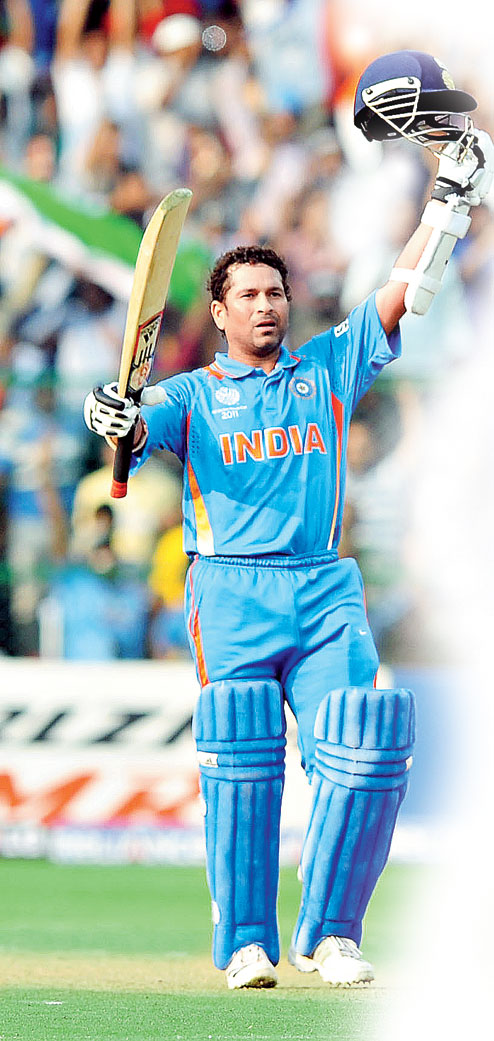
More than Vedanta, cricket is a religion in India. It unites the country and Sachin Tendulkar is god,” began L. Ramaswamy, of the Vedanta Academy, as the audience broke into titters.
Ramaswamy was addressing a gathering at Bharatiya Vidya Bhavan and the audience comprised members of IIT Kharagpur Alumni Association, Salt Lake Chapter. The association was hosting the meet in collaboration with Bharatiya Vidya Bhavan and the topic for discussion was “Vedanta and cricket”.
Life, he said, is a lot like a game of cricket. “Cricket is a batsman-centric game. The batsman wants to score but every ball coming at him tries to get him out. The ball symbolises the weaknesses of the mind. The way the ball can be slow, fast, spin or swing the mind can be overcome by emotions like lust, anger, greed, jealousy etc and they can get us ‘out’,” Ramaswamy explained.
The batsman only has one weapon — the bat — which symbolises a person’s intellect. “The mind is like a river trying to overflow with emotions but if the banks (intellect) are strong the river will reach its destination as well as nourish the land it passes. But if the banks are weak the river will flow off course, flood and destroy wherever it flows.”
The cricket ground is like our life, he explained. For instance, the crease is our spiritual discipline and the fielders are the sense objects trying to get us “out”. This happens if we fall prey to the temptations of our sight, taste, touch etc. The runner is our only friend and this symbolises “satsang” or getting together for spiritual development. It is with the help of the runner that the batsman at first starts scoring singles. It is later, after he is set that he aims for fours and sixes to increase his run rate.
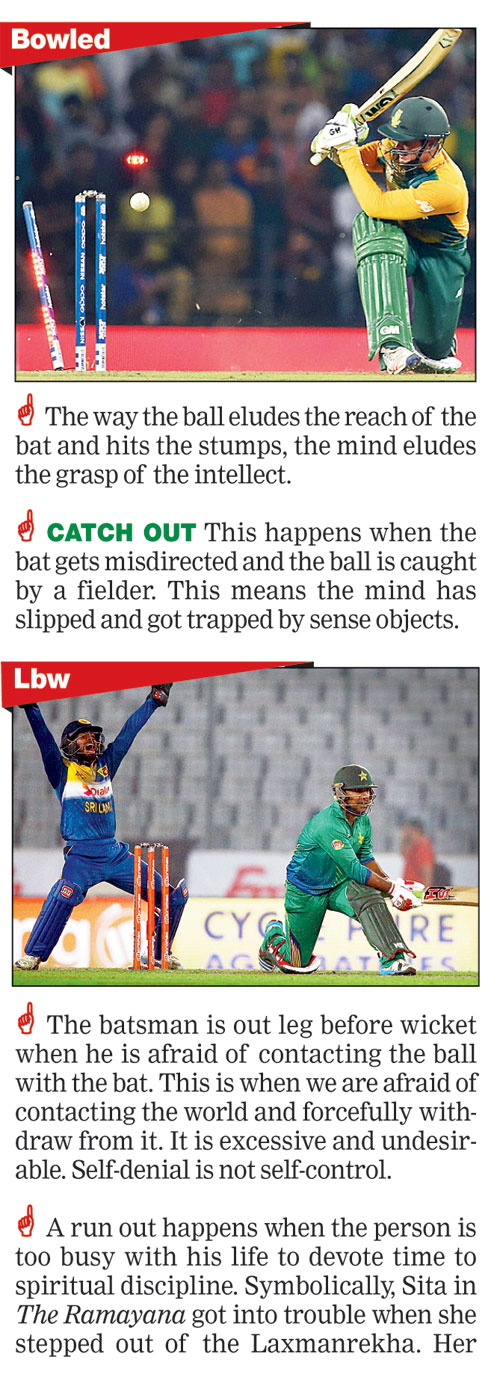
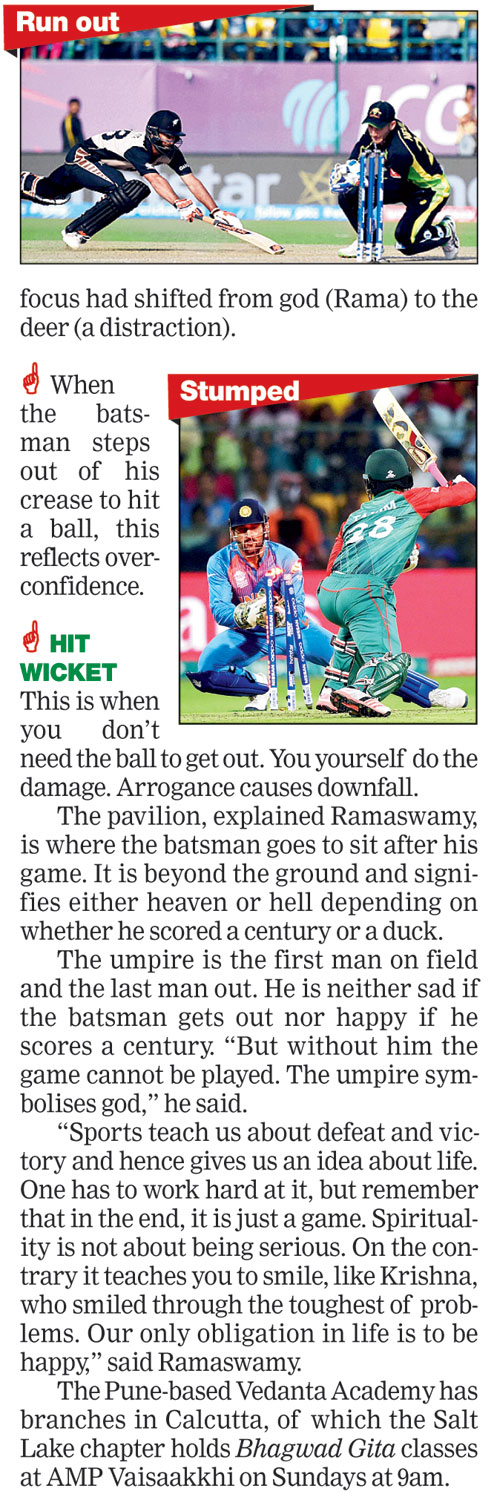
Ramaswamy then picked up every form of dismissal in cricket and found parallels with life —
source: http://www.telegraphindia.com / The Telegraph,Calcutta,India / Front Page> Salt Lake> Story / by Brinda Sarkar / Friday – April 01st, 2016
Shah Rukh Khan, Sourav Ganguly and Abhishek Bachchan may have set the ball rolling by becoming owners of professional sporting teams in India. But they surely didn’t know that they would kickstart a whole new trend of owning professional football teams comprising children of Bengal’s sex workers. Citizens of Kolkata have come forward to sponsor 16 such football teams that are part of the Padatik Football League. Each of the teams has been sold for Rs 7,000. The prize money is a modest and encouraging Rs 10,000 for the winning team and 7,000 and 5,000 for the runners-up.
Twelve teams have been named after the respective red light areas in Basirhat, Sonagachhi, Rambagan-Sethbagan, Jorabagan, Dum Dum, Domjur, Khidirpur, Kalighat, Boubazar, Titagarh, Seoraphuli, Baruipur and Durgapur. Three teams have mixed membership. While tribal children belonging Amlasole have one team, kids of prisoners, street children and druggies have been grouped together to form the Dosti 1 and Dosti 2 teams. Then, there is a team that belongs to Durbar Sports Academy. “It’s been five years since we organized such football tournaments. But this is the first time we introduced the concept of owning teams. Of course, SRK buying an IPL team has been an inspiration,” said Bharati Dey, secretary of Durbar Mahila Sammanwaya Committee that has organised the tournament.
But what prompted people to become team owners? Retired banker Ashoke Dutta, who owns the Dum Dum team, said paying Rs 7,000 is a ‘social responsibility’. “These are marginalised sections of society. It feels good to be able to do something that brings them to the mainstream,” Dutta said, adding that he has named his team after his deceased wife. “Since it is a seven a side team, I call it Suchitra 7 after my wife,” the widower said.
Artist Subrata Gangopadhyay is the proud owner of the Sonagachhi team. Being involved with NGOs working in red light districts, Gangopadhyay has always supported the cause of such children by donating his paintings. “If my contribution helps these talented children go forward, it will make me happy,” he said. Since Gangopadhyay has recently undergone an angioplasty, he hasn’t been able to personally make it to the stadium. “But I am keeping a tab on my boys. Before every match, I send out messages to boost their spirit and say ‘Fight Sonagachhi Fight’,” he said.
When TOI met with some players of the Rambagan-Sethbagan football team on a lazy Thursday afternoon, they were busy decorating the pandal for their para Saraswati Puja in between their practice session. Twenty one-year Subhas Kumar Shaw, a die-hard Maradona fan, said this effort makes him feel inclusive. “Citizens buying the teams is an index of our acceptance into mainstream society,” he said. Shaw’s Jorabagan team had played against the Sonagachhi team at a stadium in Basirhat. “Unfortunately, our team lost to Sonagachhi,” Shaw said.
But Rabi Das was luckier. His 56-year-old mother has retired as a sex worker but Das has no qualms about introducing himself as a sex worker’s son. “My mother, who now lives in a village in Burdwan, is extremely happy. We have already played four games and looking at lifting the cup,” smiled the player of the Rambagan-Sethbagan team who dreams of a day when news of this tournament will reach the ears of his idol Messi.
The audience turnout hasn’t been bad either. At the inaugural match between Amlasole and Dosti II at Shyambazar’s Deshbandhu Park, some 250 people turned up. “Already 17 matches have been played. Teams have been divided into three zones – Basirhat, Domjur and Baruipur. Eight teams will qualify in the quarter finals. The semi finals will have four teams. We are hoping to host the finals at Ladies’ Park on March 3,” said coach Biswajit Mazumdar.
Sex worker Dulu Sarkar (name changed), whose brother Milan is playing in the Rambagan team is happy. “After my mother expired, I looked after my brother. I’m happy that he is playing,” she said, before preparing herself for her clients. Her only regret is that she herself hasn’t yet been able to make it to the stadium. If her brother’s team reaches the finals, she is hoping to excuse herself from her babu to play cheerleader for her sibling.
source: http://www.timesofindia.indiatimes.com / The Times of India / News Home> City> Kolkata / by Priyanka Dasgupta / TNN / February 13th, 2016
Legendary Japan Warriors’ Leander Paes in action during the men’s doubles match against Obi UAE Royals at International Premier Tennis League (IPTL). (PTI Photo)
Legendary Indian tennis player Leander Paes was appointed as the global brand ambassador of the Legendari Group, that owns the IPTL’s Japan Franchise, for a period of three years starting 2016 on Sunday.
Legendari Group’s association with Paes will commence from Chennai Open and as part of his role as brand ambassador, Paes will be part of #TeamLEGENDARIAthlete.
“The Legendari Group aims to utilise the power of brand Leander as a springboard to promote tennis and other growing sports across India and Asia. The Legendari Group will support Paes in every step towards achieving Olympic glory as he prepares to participate in the prestigious quadrennial event for a 7th consecutive time,” a press release said.
“I am thrilled to grow my partnership with the Legendari Group. I am excited to associate with them to promote sports, especially tennis. It is an honour to be the first #LegendariAthlete, and I look forward to utilizing my abilities to drive the growth of sports as a way of life,” Paes said.
Executive Chairman & Managing Director, Shanthan Reddy said, “Leander has inspired many generations of tennis players and sportsmen in our country, and across the world with his game. We are absolutely delighted with this opportunity, and wish him success at Rio 2016 and through the year.”
source: http://www.hindustantimes.com / Hindustan Times / Home / PTI, New Delhi / January 03rd, 2016
Remember Farhan Qureshi of Three Idiots who left his engineering to become a wildlife photographer. Here is the story of another engineer who left his well settled life to chase his dreams. Saptarshi Roy is a production engineer from Jadavpur University and worked in some of the biggest companies like CTS, Cognizant and Wipro but his passion for the mountains overpowered his sense of security. Farhan had ‘Rancho’ alias Phunshuk Wangdu to motivate him but this self-motivated engineer left his well settled job and started a trekking company to make people become a part of the pristine beauty.
“I completed my production engineering in 2001 and then like any other engineer joined a company through campus interview. In the next ten years I worked with numerous companies. I was never comfortable and went on switching jobs. Finally I felt that engineering is not my cup of tea and started doing something which I liked,” this 38 year old trekker told TOI.
Roy always had a passion for the snow-capped hills and used to run to the peaks whenever he could manage time out of his busy schedule. In 2010 Roy left his job and started a company Himalaya Trekkers – a company responsible to designing customize trekking trips for the people- even for those who don’t have any idea about the ridges and the rifts of the Himalayas.
According to Roy – a trek in The Himalayas is not just a trek; it is an experience that involves all your senses, the sight of snow-clad peaks, the clean smell of mist in the air, smoking hot Momos which melts in your mouth, sound of rugged nature, and the cold touch of the icy wind. “Camping on grassy meadows, beneath the Milky Way sipping on hot coffee in cozy tents with the nature beckoning you with her clarion call to explore is indeed an experience which no hotel room with its walled comfort can offer. Those who live this life will never trade anything for it,” Roy added.
In the last five years Saptarshi has taken more than 500 people to different trekking routes including difficult trekking zones like Roopkund (16000 feet), Pin Parvati Pass (17400 feet), Satopanth Tal (15100 feet), Dzongri & Goecha La (16000 feet) and Sahastra Tal (16400 feet). “We try to provide the real feel of the mountains. As I love the mountains I want the people who travel with us to love the mountains as well,” Roy added.
Going to the mountains has helped Roy to go beyond the corridors of religion, caste and creed. “I have a guide in Kashmir – Altaf. He stays in a small village near Sonmarg. His father Gulam Mohammed has peculiar fascination for the Bengalis particularly for the Kolkatans. Whenever we go to their home they offer us a particular handmade roti along with namkeen chai which I like very much,” Roy added. When asked whether they had faced any hardship, Roy said, “This year in Garwal region we had wait for one hour because there were lots of snow ground bear. They are not dangerous to find them at such an altitude is something great”.
source: http://www.timesofindia.indiatimes.com / The Times of India / News Home> City> Kolkata / by Saibal Gupta, TNN / December 14th, 2015
Manoj Verma, the commissioner of Siliguri metropolitan police, flagged off the Queen on Wheels 2015, the women’s car rally organised by Rotary Club of Siliguri Green in association with The Telegraph, at Siliguri Institute of Technology on Sunday.
According to the organisers, 71 cars, all driven by women, participated in the rally. However, most of the cars had men as navigators. The event was held with the help of the Federation of Motor Sports Clubs of India.
The cars travelled for around 60km covering different terrains and reached finally at Uttarayon Township in Matigara. Suman Agarwal finished first in the rally that was held in Time-Speed-Distance (TSD) Format, while Shyamashree Mitra and Venus Baid came second and third, respectively. The top three were presented with trophies and prizes.
source: http://www.telegraphindia.com / The Telegraph, Calcutta,India / Front Page> North Bengal> Story / Monday- November 30th, 2015
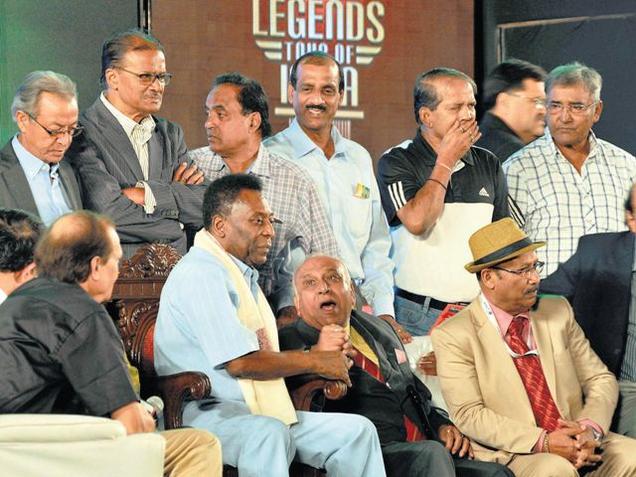
DOWN MEMORY LANE: Players from the Mohun Bagan team that hosted Pele way back in 1977 had a great time getting reacquainted with the Brazilian legend in Kolkata on Monday. Photo: Ashoke Chakrabarty / The Hindu
Felicitates the 1977 Mohun Bagan team, shares special moment with Rahman
Football legend Pele had an evening to remember as he renewed his acquaintance with the players of the Mohun Bagan team which hosted him in 1977.
Pele feted all the 13 players and coach P.K. Banerjee who were present to receive the honour from the greatest footballer on earth at the Netaji Indoor Stadium on Monday evening. Subrata Bhattacharya, the captain of the Bagan side then, called in his players to be felicitated by the owner of three World Cup crowns. The others players included the likes of Shibaji Banerjee, Prasoon Banerjee, Gautam Sarkar, Bidesh Bose, Shyam Thapa, and Pradip Choudhury.
Prasoon, the younger brother of P.K. Banerjee, asked Pele who he thought was better: Diego Maradona or Lionel Messi? “Both have the same style and are great players, but Maradona was a more complete player than Messi. For the last 10 years, Messi is the best player the world has seen,” said Pele.
Machine closed!
Asked whether the world would see another Pele, the legend quipped, “My mother and father have closed the machine.”
Pele also had a special moment with internationally-acclaimed music composer A.R. Rahman, who has scored the music for a biopic on the Brazilian great which is yet to be released.
“I am zero on sport, and know only names like Kapil Dev and Sachin Tendulkar. I have composed the music for Pele’s biopic without even knowing him. But, when I saw the ‘rushes’ of the movie, I cried thrice,” said Rahman, after meeting the legend.
“I wanted to see the real Pele. He is such an amazing personality, a great inspiration. All my musician friends were envious when they came to know that I was doing the music for Pele’s biopic,” said Rahman.
Rahman sang ‘happy birthday’ for Pele, who turns 75 on October 23. The Brazilian also cut a cake, shaped like the Jules Rimet Trophy, which he helped Brazil retain forever after becoming the world champion for the third time in 1970.
West Bengal Chief Minister Mamata Banerjee and former India cricket captain Sourav Ganguly were present on the occasion.
source: http://www.thehindu.com / The Hindu / Home> Sport> Football / by Amitabha Das Sharma / Kolkata – October 13th, 2015
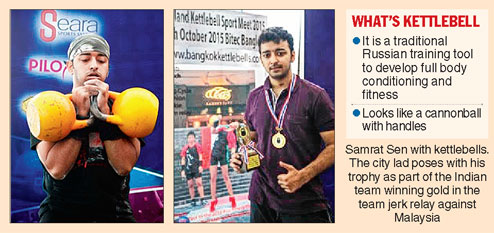
He is an expert in the long cycle category and he had 10 minutes to prove his strength. Beside him was a man ready to snatch. But the Calcutta boy came back with top billing and international prestige.
No, he is not a cyclist or a rugby player, nor was someone trying to grab something from him.
Meet 29-year-old MNC employee Samrat Sen who got the top ranking at the Thailand Kettlebell Meet (long cycle category) on October 10.
The annual event was held as part of Asia Fitness Convention at the Bangkok International Trade and Exhibition Centre.
Participants from nine countries tested their strength at the self-sponsored event, sanctioned by the International Kettlebell and Fitness Federation (IKFF).
The Indian contingent of six did the country proud by winning the team jerk relay against Malaysia. Sen was part of it.
“This is the first time India won a gold in kettlebell relay abroad. In a relay, the four best lifters of each country lift double kettlebells (2 x16kg) for three minutes each for a total of 12 minutes,” he said.
“India and Malaysia were head-to-head but towards the end we edged past them in a thrilling victory.”
A resident of east Calcutta, off the EM Bypass, Sen is happy to have gained international recognition for a sport that very few know of in the city, except those who are into fitness and weight training.
Kettlebell is a weight-training programme where you have to lift cannonball-like equipment as many times (repetitions) as possible in a minimum of 10 minutes.
Sen clocked 85 reps with double 16kg kettlebells. The feat secured him the top seed in the IKFF rankings.
“In Thailand, one could compete under the long cycle (clean and jerk), snatch (one bell), jerk (two bells) and biathlon (a combination of jerk and snatch) categories,” Sen told Metro over the phone from Bangkok.
“Lifters, of every category, stood side by side and put their strength and endurance to test for 10 minutes. But there is a catch – for those 10 minutes you cannot keep the kettlebells on the ground. You have to hold on to them and keep doing the reps. It is also a test of mental strength and focus.”
The Calcutta lifter, who has never compromised with his weight training despite work pressure, said the competition was not just about appearing on stage and lifting the kettlebells. “It is also about how you lift them. One needs to follow the right technique and pacing and have tremendous cardiovascular fitness to succeed in this sport,” he said.
What started as a fitness regimen in 2012 soon turned into a passion for Sen. “I took up kettlebell training to improve my fitness levels, not to compete. I found it difficult to lift them even a few times, leave alone holding on to them for 10 minutes,” he said.
“But I would keep surfing online about the discipline… I came across international lifters who would lift the heaviest of kettlebells with absolute ease and clocked ridiculous number of reps in 10 minutes, hardly breaking into a sweat. That motivated me… with my coach Arnav Sarkar egging me on, I soon took up the sport seriously.”
What followed was one gruelling session of practice after another to make Sen “competition ready” – a disciplined life and a strict diet with little leisure or fun time.
“I do not go to a gym, but I train every day after returning from work. It’s extremely challenging after a stressful day… but once I get started, I know I will complete the whole routine.”
Sen allows himself to cheat once a week with some ice cream, cold drinks, a plate of tandoori chicken or a Chinese meal.
A kettlebell is a traditional Russian training tool that is used to develop full body conditioning and fitness. The first-ever Kettlebell meet in India was held in Calcutta at the Calcutta Rowing Club in 2013. It had only 15 participants. By February 2015, the Calcutta meet saw a surge in lifters with 30 putting their strength to test.
“The kettlebell sport community is a small but extremely tight-knit one… with lot of support and encouragement for new lifters,” Sen said.
My message for Samrat Sen is…. Tellttmetro@abpmail.com
source: http://www.telegraphindia.com / The Telegraph, Calcutta,India / Front Page> Calcutta> Story / by Chandreyee Ghose / Monday – October 12th, 2015
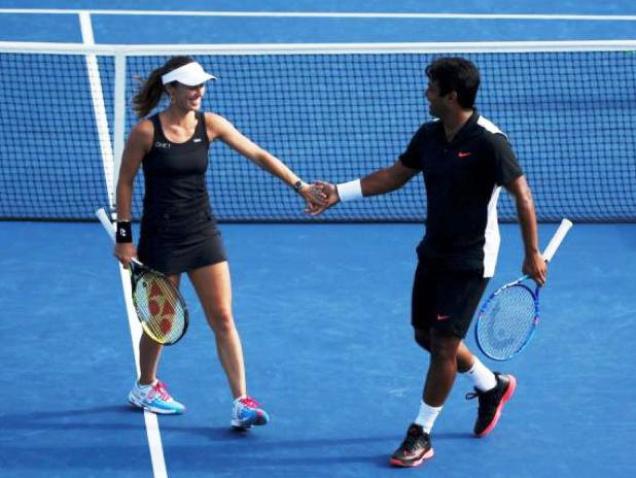
Martina Hingis celebrates a point with mixed doubles partner Leander Paes during their finals match against Bethanie Mattek-Sands and Sam Querrey at the U.S. Open tennis tournament in New York on Friday / Reuters / The Hindu
Paes now has nine Grand Slam mixed doubles titles, surpassing compatriot and former partner Mahesh Bhupathi’s record of eight.
Leander Paes created history by winning the U.S. Open mixed doubles title with Swiss partner Martina Hingis and surpassed compatriot and former partner Mahesh Bhupathi’s record.
The 42-year-old Paes now has won nine Grand Slam mixed doubles titles, against Bhupathi’s eight.
The fourth seeded India-Swiss pair, edged past unseeded Americans Bethanie Mattek-Sands and Sam Querrey 6-4 3-6 10-7 in a tricky final to win their third Major title together this season.
Paes is now only behind legendary Martina Navratilova, who won 10 mixed doubles trophies. Of those 10, two came with Paes, when they won Australian Open and Wimbledon in 2003.
With this win, Paes and Hingis, who also won Australian Open and Wimbledon titles early this season, have become the first mixed doubles team since 1969 to win three Grand Slam mixed doubles titles in the same year.
It was Paes’ 17th Grand Slam title overall and Hingis’ 19th. Hingis has won four Grand Slam titles and all of them have come with Indians. She won her first mixed doubles trophy with Bhupathi when they won 2006 Australian Open.
Hingis is also in the contention in the Women’s Doubles with Sania Mirza with whom she won the Wimbledon this year. They are up against Yaroslava Shvedova of Kazakhstan and Casey Dellacqua of Australia.
Paes and Hingis broke Mattek-Sands at love to take a 2-1 lead in the opening set as the Swiss miss hit a forehand passing shot to secure the break. That bit of momentum was all they needed, as Paes easily closed the set out at 5-4 when Hingis hit a volley winner.
A lone break of serve also decided the second set, as Mattek-Sands hit two straight winners to break Hingis’ serve as the Americans led 3-1. Hingis saved three set points on her serve at 2-5, but Querrey easily held in the next game to send the contest into a deciding super tiebreak.
The unseeded Americans were cruising as they created a 4-1 cushion when they won both points on Hingis’ serve to grab the first mini-break. But Hingis and Paes took the mini-break back on Mattek-Sands’ serve at the next opportunity.
The crucial point of the match came at 7-7, when Paes blocked Querrey’s serve for a clean passing-shot winner. He then won both points on his serve to close out the match, hitting an overhead winner on their first match point and then lifting Hingis in celebration.
source: http://www.thehindu.com / The Hindu / Home> Sport> Tennis / PTI / New York – September 12th, 2015
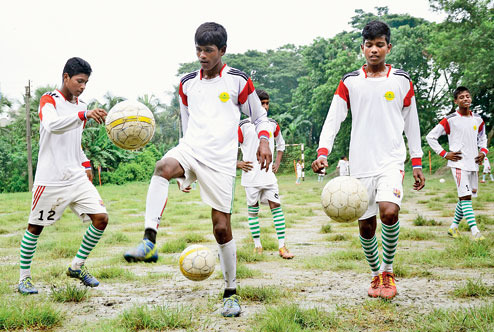
Tapas Khan is his team’s star striker but often sleeps hungry. Sanu Manna is greased lightning in the midfield but the struggles of life sometimes sap his spirit. Bijay Mondal’s long-range shooting would do a pro proud but the one goal he is eyeing is a livelihood.
The three 14-year-olds turning out for Deeksha Education Trust scored a stunning goal each in the final of the Calcutta leg of the STAR Sports Young Heroes tournament last month against a stellar school team that was expected to dominate them.
Those who watched the Young Heroes final say St. Lawrence High School didn’t lose the match, the Deeksha boys won it with their natural brilliance.
“We have been playing football together for just the past two years and this was our first inter-school tournament. Before the campaign started, we couldn’t have imagined winning the Calcutta leg over so many top schools,” Dipankar Pramanik, the captain of the winning team, told Metro.
Dipankar, a student of Class VIII at the NGO-run school in Dihi village of Sonarpur, South 24-Parganas, was one of the stars of the tournament with four goals.
Like Tapas, Sanu and Bijay, his is a story of fighting poverty to play football. Dipankar’s family is so poor that he often stays in his coach Jhoton Manna’s house to ease the burden on his elder brother, who is the breadwinner.
“We are six, including my parents, elder brother, sister-in-law and niece. We live in a mud hut. My father is ailing and unable to work. My brother earns around Rs 4,000 a month working in a local hospital. I dream of ending my family’s misery by playing for a big club,” Dipankar said.
The Deeksha captain takes pride in the fact that his team’s success in the STAR Sports Young Heroes tournament came against the top school teams of Calcutta, including La Martiniere for Boys, St. James’ School and St. Xavier’s Collegiate School.
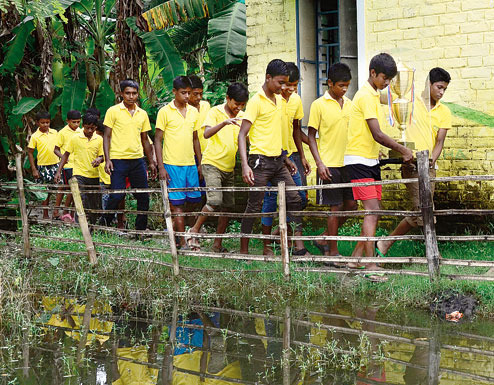
The team carries the STAR Sports Young Heroes trophy to their school building. Pictures by B. Halder
STAR Sports Young Heroes is an under-15 national inter-school football tournament-cum-talent scouting programme that involves over 650 schools. As many as 64 school teams from across Bengal had competed in the Calcutta leg, culminating in Deeksha’s 3-0 victory over St. Lawrence at the Howrah Municipal Corporation Stadium.
For Class VIII student Tapas, the second highest scorer for his team in the tournament with three goals, football is the lone bright spot in a life beset with problems. His father has been battling tuberculosis for seven years and his elder brother, a masonry apprentice, doesn’t earn enough to feed the five-member family.
Sanu, a student of Class IX and the midfield general of the Deeksha squad, isn’t sure he will be able to continue playing football. His father, a barber, struggles to support the family of five and Sanu is bracing for the day he will have to give up playing to earn a living.
Classmate Bijay, who too comes from a poverty-stricken family, lost his mother to snakebite a few months ago and he wakes up every morning worrying about where the next meal will come from. “My coach tells me that I am doing well but I wonder whether football will earn me a living,” he said.
Debdas Munda, a student of Class IX who defended so well that Deeksha didn’t concede a single goal in the tournament, is the son of a vegetable vendor. His next challenge is to prove he is good enough to be a professional footballer before his father asks him to work for a living.
Debdas has at least one reason to be optimistic. Former Iran footballer and Maidan hero Jamshid Nassiri, who is the head mentor of the talent scouting programme, picked him among the three most talented footballers in the Calcutta leg of the tournament.
The other two boys who made the cut are Kiyan Nassiri, a Class VIII student at St. James’ School, and Saaron Bhattacharya, a Class IX boy from Julien Day School, Kalyani.
“I will pick the 45 most talented under-15 players from 15 cities to undergo training under professional Spanish coaches, who would then choose the top 16 players. These 16 players would be flown to Spain for an international exposure trip. After they return, we will help them compete for selection to the under-17 squads of big clubs and academies, provided their parents agree to cooperate,” Nassiri said.
Debasish Sarkar of Deeksha, who along with his wife and three friends had started the school in 2012, said the STAR Sports Young Heroes campaign was much more than a tournament for his institute. “The football team has changed the culture and atmosphere of the village. They have shown what they can do and everyone is proud of them.”
Sarkar first took note of the Deeksha boys’ potential when his son Dion, an alumnus of South Point, visited the village with his school football team to play a friendly. The visitors conceded seven goals. “I was amazed by their game and requested (coach) Jhoton to take special care of them and build the team,” he recounted.
Jhoton, 20, used to be the best football player in Dihi until a spinal cord injury two years ago dashed his dream of turning professional. “I will be happy if I can help some of these boys grow as players. But I feel we also need a professional coach to groom them properly,” Jhoton said.
Sarkar has approached some Calcutta-based coaches to help take the team to the next level but nobody has agreed yet. “The distance from Calcutta to Dihi village (around 35km) is a huge constraint,” he said.
Under Jhoton’s tutelage, Dipankar and his teammates are preparing for their next challenge: the national final of the Young Heroes tournament, where they will be up against 14 champion teams from as many cities.
Besides concentrating on bettering their game, the boys are eager to hone their conversational English. “Since returning victorious from the Calcutta leg, they have been requesting me to teach them how to communicate in English with teammates on the field. They heard the city boys doing that during the tournament!” smiled Sarkar, who teaches science and English at the school.
If learning to converse in English is a skill the boys aim to acquire over time, the national leg of the Young Heroes tournament is a mission. They believe a better future is just a goal away.
source: http://www.telegraphindia.com / The Telegraph, Calcutta,India / Front Page> Calcutta> Story / by Ayan Paul / Thursday – September 10th, 2015
The three-day Tollygunge Club Invitational Bridge Tournament 2015, presented by The Times of India, came to a close on Sunday with team Bangur Cement winning the title.
More than 125 people aged between 19 and 90, many of whom were national champions, took part in the competition. The participants included players from Secunderabad, Bangalore, Nagpur, Ahmedabad and Delhi.
Uma Puri, the chairperson of Tollygunge Club bridge sub-committee, said, “A lot of tournaments are being played on. But the unique thing about this one is that it is also a charity drive and we donate a part of the proceedings from the registration fees to an NGO working with cerebral palsy patients.”
Colonel VSM Sharma (90), a native of Hyderabad who is currently settled in the US, was the non-playing captain at the historic 1988 Venice Bridge Olympiad in which India ended as the semi-finalist.
“This is my first time at the Tollygunge Club competition. During 1967-68, I had formed a six-member Army engineers’ team which made quite a ripple at that time.”
“This is a very competitive tournament in a friendly atmosphere,” he told TOI on the Tollygunge Club tourney.
When the final bell rang, the contestants were frowning in concentration. Of 21 teams, the competitors were boiled down to eight. Then it was an open-to-all contest — every team played every team. Bangur Cement, that was leading on Day-II, made good of their form and clinched the title on the final day.
The champion team had champions of their own accord. Sunit Chokshi from Gujarat, whose team Formidables won the last three nationals as well as winter nationals, and also the last summer national, has come back for a second time at the Tollygunge Club competition.
“I shifted to bridge after I figured out I wasn’t cut out for billiards. My seniors used to play bridge and one day they fell short of one player. They included me even though I had no clue about the game. That’s how it began,” Chokshi told TOI. He praised Bengal’s bridge players, saying that the state has produced some international-level players.
Debasish Ray, who has been part of the national champion team four times, had become the youngest bridge champion at 24.
“I was part of the 1988 Olympiad team, and our achievement was the high point of India’s bridge history. This tournament, into its third year, has been incredible,” he said. Ray and Chokshi were part of Bangur Cement that sweeped the finals.
source: http://www.timesofindia.indiatimes.com / The Times of India / News Home> City> Kolkata / TNN / August 31st, 2015