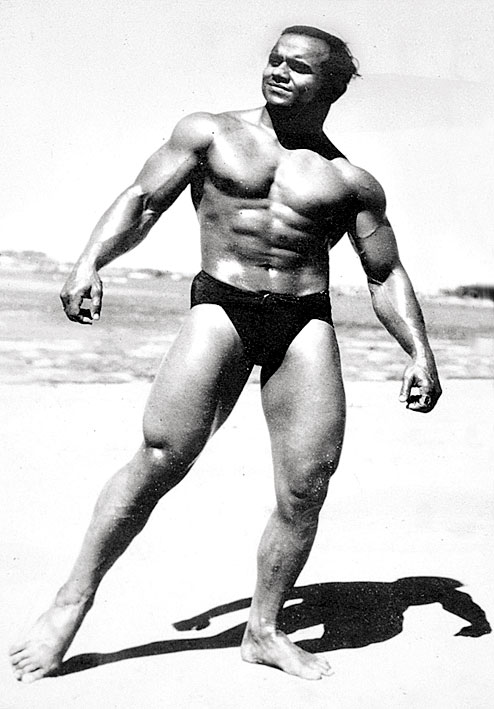
♦ Born March 17, 1912 in Putia village of Comilla district in present-day Bangladesh.
♦ At 12, he survived a near-fatal attack of leishmaniasis, a disease caused by the bite of a sandflies but it left him fragile and sickly.
♦ The teenaged Aich got into bodybuilding. His father had ill health and so to support his family he started performing at fairs and other public events in his native village as well as those in the neighbourhood.
♦ Aich met magician P.C. Sorcar at Jubilee School in Dhaka. Sorcar instantly recognised Aich’s capabilities and asked him to join him. While the magician’s feats drew applause from the crowd Aich silenced them by bending steel rods, balancing on his stomach on the tip of a sword, tearing 1,500-page books and doing squats with very heavy loads. But a trick with a spear went wrong and resulted in a life-long scar on his neck.
♦ In the 1940s, Aich joined the Royal Air Force (RAF) as airman and met an officer, Reub Martin, who introduced him to proper weight training equipment.
♦ In 1942, at the peak of the Quit India movement, Aich slapped a British officer for making an offensive comment about India. He was court martialled and jailed.
♦ In jail, he would practise bending the steel rods in his cell. He would also practise daily for up to 12 hours with the little equipment he could find in jail. Aich was released from jail in 1947 after India gained Independence.
♦ In 1950, at the age of 38, Aich won the Mr Hercules contest. In 1951 he stood second in the Mr Universe contest in London. The first position went to fellow Bengali bodybuilder Monotosh Roy, who became the first Asian to be crowned Mr Universe.
♦ Aich trained in London for a year, funding his stay by working with British Railways and bagged the Mr Universe title on March 17, 1952, which was coincidentally his 40th birthday. At that time, his measurements were— biceps 46cm, chest 1.2m, forearm 36cm and wrist 16.5cm. His height was 4ft 11” and he won in the Pro-Short division.
♦ He got a hero’s welcome upon his return to India with both Prime Minister Jawaharlal Nehru and President Rajendra Prasad congratulating him personally.
♦ Aich tried to repeat his feat thereafter but could only secure the third position in 1955 and the fourth position in 1960. He also won gold medals for body building in the Asian Games of 1951 (New Delhi), 1954 (Manila) and 1958 (Tokyo).
♦ Aich performed in a circus, entertaining the spectators with his amazing muscle dancing in the 1960s.
♦ Aich time and again said that the secret for his strength was that he was a teetotaller. He never smoked, ate a simple diet of fish, fruit, lentils, milk, rice and vegetables.
♦ He was a fan of Hollywood actor and multiple Mr Universe title-winner Arnold Schwarzenegger and had watched all his films. He regretted having never met him in person.
♦ Aich passed away on June 5, 2016 at the age of 104 years.
Had you met Manohar Aich? Write to The Telegraph Salt Lake, 6, Prafulla Sarkar Street, Calcutta – 700001 or e-mail to saltlake@abpmail.com
source: http://www.telegraphindia.com / The Telegraph,Calcutta,India / Front Page> Salt Lake> Story / Friday – June 17th, 2016
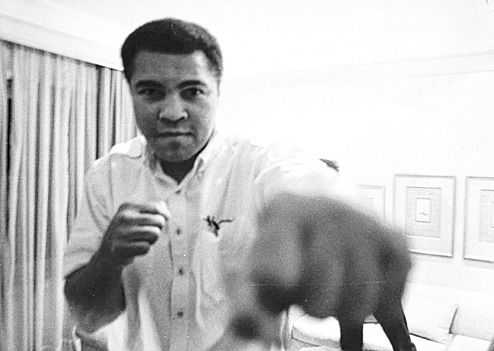
Muhammad Ali in his Taj Bengal room in December, 1990
I chased 100m drug cheat Ben Johnson from the 1988 Seoul Olympics and caught him… for an interview at his home in Toronto. I bit my nails during the football World Cup final in Rome in 1990 when Germany’s Andreas Brehme scored against Maradona’s Argentina in a penalty shootout to win the trophy. I joined Carnivale-style Brazilian fans in downtown Los Angeles after they won the World Cup of football in 1994. I was with Sunil Gavaskar when he presented Kapil Dev with a bottle of champagne at the WACA in Perth in 1992 after the Indian all-round legend got his 300th wicket. I saw Kapil dance on the bed of his Ahmedabad hotel room after becoming the highest wicket taker in the world in 1994. I had goosebumps when the Indian national anthem played to announce P.T. Usha as the sprint queen of Asia in South Korea in 1986. I’ve seen Boris Becker ‘boom boom’ his way to a Wimbledon title.
You could say that I’ve been there and done numerous international sporting events as a sports journalist in the 1980s and 1990s. But whenever I am asked about the highlight of my life, my answer is always the same: my encounter with Muhammad Ali at Taj Bengal, Calcutta, in 1990.
It went down like this. Word got around that The Greatest was visiting Calcutta for a community event, unrelated to sport. We at Sportsworld magazine (from the ABP Group of publications) were desperate to get an interview, and needed to identify the organisers of the community event. Having done so, we sought to find a ‘connection’ to the organisers. The link was a man named Dada Osman, a leading figure in Calcutta’s rugby scene and an old family friend of my parents.
Osman organised for me to meet Ali in his hotel room for 15 minutes! The arrangements included permission for us to take a photographer and one other person. This made for plenty of problems because everyone I knew wanted to be my chaperone. You would expect enthusiasm from a bunch of young journalist colleagues. But the demand to accompany me to meet Ali went far beyond my colleagues and friends. My father, Neil O’Brien, known to be an avid boxing fan, put in a request as well. How could I turn him down, when it was part of folklore that the quiz legend Neil O’Brien could rattle off every world heavyweight boxing champion in chronological order since the titles began!
So off we went, father, son and another legend, Calcutta’s best-know sports photographer, Nikhil Bhattacharya, to see the ultimate Legend. To set the scene, it must be pointed out that by this time Ali’s Parkinson’s was well publicised, and we were warned that it would not be a smooth-sailing question-and-answer session.
I knocked on the hotel room door a couple of times and after a little while, it opened. I stood there looking at this big white bath robe right in front of my face. My eyes travelled upwards, and there IT was: the Louisville Lip. From the photographs I had seen, Ali didn’t seem as big a man in comparison to some other boxers of his generation. But I was astounded to see this large frame standing in front of me. It was later that I realised it was not only his physical stature; it was also his awesome presence and aura which made him look bigger than he actually was. There is only one word which comes to mind every time I tell this story.
MAJESTIC! That’s what he was. And mind you this was way past his glory days. He still floated gently like the butterfly he claimed to be. The raving and ranting had been replaced by slow and soft speech. But there was no denying that there was something special about this man. He radiated greatness by his mere presence. I honestly don’t remember what questions I asked, but I recall he wasn’t able to provide long answers. Just a simple ‘yes’ or ‘no’. As an interview it wasn’t very informative.
All I remember is that he sat back on the large sofa, white bathrobe wrapped around as if he had just come out of the boxing ring. I sat at the other end of the sofa… on the edge of it really. My dad sat on the single sofa at the side. Nikhil da went about his business, click, click, click.
There are two other things which are etched in my memory. At the end of our 15 minutes, my dad, unannounced to me, pulled out an enlarged black-and-white print of a photograph of Ali in the famous pose after he had knocked out Sonny Liston to win his first of three world titles. I recall feeling a bit embarrassed, because as a journalist I always refrained from asking sportspersons for autographs, and posing for photos with them. I remember thinking; I had never witnessed my father pay such reverence to any other person. Such was dad’s passion for this legend that he stooped to break my unwritten rule of no autograph/photograph.
Dad’s request gave me courage to ask my last question; and I couldn’t help but ask it. “Ali sir, may I take a photo with you?”
He stood up very slowly, I jumped to my feet. Nikhil da set himself up to take the shot. Just when Nikhilda said “ready?” something got into me. I raised my right fist and placed it on Ali’s jaw to pose for the photo. Perhaps at the back of my mind I was aware that his Parkinson’s would not allow him to ‘sting like a bee’ in reaction to this bold step of mine. I was right. He merely looked at me, leaned forward and the man, known for his classic one-liners, whispered in my ear, “BE COOL, FOOL!”
The champion, his body ravaged by something beyond his control, had not lost his wit, his class and his dignity.
Over many years, when I came across media reports that he was ill, I always told myself that one day I would write again about our meeting to relive the Legend of Ali to the current generation. Sadly, that day has arrived today, when my teenage son, born 20 years after Ali retired, burst into the room to announce, “Dad, sad news: Muhammad Ali has died.” My son knew it would be sad news for his dad, because he has heard on numerous occasions his dad tell the story of the encounter with Muhammad Ali. The time had come for me to write the story, as a eulogy and tribute to the great man. I’m glad I passed on the Ali legacy to my children. I had to, because I have never been so in awe of a person ever in my life as I was with Muhammad Ali that day in the hotel room in Calcutta.
Truly the Greatest! RIP.
Andy O’Brien, always a sports fan and always a Calcuttan, worked for 13 years with Sportsworld magazine. He migrated to Australia in 1996.
source: http://www.telegraphindia.com / The Telegraph,Calcutta,India / Front Page> Caclutta> Story / by Andy O’Brien / Sunday – June 05th, 2016
Former chief curator of the Cricket Association of Bengal (CAB) Prabir Mukherjee, who was known for his no-nonsense steadfast approach, died at a city hospital late last night after a prolonged illness.
Mukherjee, 86, was suffering from a liver condition and depression and was being treated at the BNR Hospital since April 11, his grandson Pranay Mukherjee said.
His body, however, was not taken to Eden Gardens in a departure of the tradition followed in the city’s cricket fraternity to honour his last wish, Pranay said.
“He was severely depressed and would tell me the way he was ‘ill-treated’ despite serving 28 years at the Eden. ‘Please never take me there’,” Pranay told .
The veteran curator, who was involved with the Eden Gardens pitch for more than two decades including preparing the wicket for the 1987 World Cup final, had vowed not to return to the stadium after being blamed for the India-South Africa T20 International washout fiasco on October 8, 2015.
Even more than six hours after it had rained in the afternoon, the CAB groundsmen led by Mukherjee could not get the field ready and the third and final T20 was also called off as South Africa had swept the series 2-0.
During that time, Sourav Ganguly was the president-designate of CAB, who had squarely blamed the veteran curator for not covering the entire ground during the afternoon’s showers that left the field soggy.
“I never worked for money. I have told them (CAB officials) that I’m not coming back to the Eden again,” the snubbed Mukherjee had said and since then the CAB grounds including that of the Eden was managed by Sujan Mukherjee.
However, the CAB officials including joint secretary Subir Ganguly and treasurer Biswarup Dey visited his residence on Prankrishna Mukherjee road near Tala Bridge and paid their last tributes
.
In his condolence message, CAB joint secretary Avishek Dalmiya, the BCCI chairman of New Area Development Committee who’s away in Guwahati, said, “Prabirda’s contribution to Bengal cricket has been immense. He was not only involved with the Eden but various grounds across the state.” MORE TAP SSC SSC
source: http://www.timesofindia.indiatimes.com / The Times of India / News Home> City> Kolkata / PTI / June 02nd, 2016
A West Bengal police wireless operator scaled the Mount Everest, bringing cheers to the mountaineering enthusiasts who were distraught by the news of recent deaths while attempting to reach the world’s highest summit.
According to a statement released by the West Bengal Police Directorate, Rudra Prasad Haldar (39) reached the summit last Saturday at around 5.24 am. Halder had set out on his mission “Mount Everest” on April 7. He reached the top on May 21 and returned to the base camp two days later, the statement said.- PTI
source: http://www.thehindu.com / The Hindu / Home> News> Cities> Kolkata / PTI / Kolkata – May 27th, 2016
Mr. De has dedicated his PhD thesis to cricketing legend Sachin Tendulkar and his alma mater, Kolkata’s Presidency University.
An Indian-American scientist has received the prestigious Springer Theses Award in recognition for his outstanding research in which he developed transgenic mice to study a critical tumour-suppressor called A20.
Arnab De’s thesis was nominated by New York’s Columbia University. Before this, Mr. De, who has also developed peptide-based prodrugs as therapeutics for diabetes, had received the Young Investigator Award at the American Peptide Symposium.
The thesis prize is awarded by Springer, a leading global publisher of renowned scientific journals and books, to recognise outstanding PhD research.
Internationally top-ranked research institutes select their best thesis annually for publication in the book series: “Springer Theses: Recognising Outstanding PhD research”.
Additionally, winners also get a cash prize of 500 euros.
The research work was highlighted by the European Molecular Biology Organization (EMBO) Reports.
Only research considered to be of ‘fundamental relevance to a general readership’ is chosen to be highlighted by EMBO.
Mr. De has dedicated his PhD thesis to cricketing legend Sachin Tendulkar and his alma mater, Kolkata’s Presidency University.
Mr. De said: “Two things that have influenced me the most is sports and education. This thesis is dedicated to Sachin Tendulkar not only for the cricketing joy he provided me, but also for being a constant source of inspiration to all Indian youth.”
Ole John Nielsen (University of Copenhagen), who shared the 2007 Nobel peace Prize as a member of the Intergovernmental Panel on Climate Change along with US vice president Al Gore, had in 2012 described the Springer award as an “insanely great honour”.
source: http://www.thehindu.com / The Hindu / Home> International / PTI / Singapore – May 28th, 2016
– College students from hills make up first all-girl team of NCC to conquer the highest peak
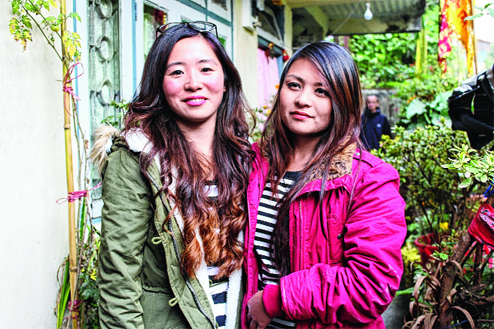
Trishala Gurung (left) and Sulaxchana Tamang. File picture
Darjeeling :
The first all-girl team of the National Cadet Corps to Mount Everest, which included two college students from Darjeeling, has successfully climbed the world’s tallest peak.
Trishala Gurung and Sulaxchana Tamang, who study at Southfield College and Ghoom Degree College in Darjeeling, respectively, were among the 10 girls to be selected from across the country to be part of the NCC team to scale the highest peak.
Speaking over the phone from Delhi, Lt. Col. Umang Kohli, additional director publicity, NCC (headquarters), said: “It is confirmed that the first all-girl team of the NCC has successfully climbed Mount Everest. They were part of a 19-member group which reached the summit. The NCC team has done us proud.”
The expedition team consisted of 10 NCC girls selected from across the country and 15 officers. Of the total 25 members, five, including the team doctor, were to stay at the base camp. “Of the 20 members, who were to climb the peak, 19, including 11 girls, have succeeded,” said Lt. Col. Kohli.
Only one NCC team member could not reach the top.
Om Prakash Tamang, father of Sulaxchana, 21, said: “My daughter called me around 7am today. She had just returned to the base camp. She said the team had successfully climbed Mount Everest. We are very happy.”
According to Om Prakash, Sulaxchana was part of the first batch to climb the summit.
Ganesh Gurung, father of Trishala, 22, said she had called him this evening to confirm the success of the team.
Lt. Col. Kohli said the team had climbed the peak in two batches on May 21 and 22.
Preparation for the expedition by the NCC team had started more than a year back. In November 2014, 100 girls from across the country had been selected for training at the Himalayan Mountaineering Institute in Darjeeling.
After completing a nearly one-month training, 40 girls were shortlisted in February 2015. “The 40 girls were then taken to climb Mount Deo Tibba (19,688ft) in Himachal Pradesh. After the 41-day expedition, 15 girls were selected for another expedition,” said Ganesh.
Between August and October 2015, the 15 girls were taken to an expedition to Mount Trishul (23,353ft) in Uttarakhand. After 50 days of that expedition, 10 girls were selected to scale Mount Everest.
The team led by Col. Gaurav Karki was flagged off in Delhi on March 9.
Mountaineer in Siliguri hospital
Chetna Sahu from Calcutta, who developed frostbites while descending from the summit of Mount Everest, has been admitted to a private nursing home in Siliguri. She climbed the peak, along with her husband Pradip.
source: http://www.telegraphindia.com / The Telegraph,Calcutta,India / Front Page> North Bengal> Story / Vivek Chhetri / Wednesday – May 25th, 2016
Bengal’s Lili Das claimed the women’s 1500m gold medal with a new junior national record of 4 minutes, 20.31 seconds on the opening day of the Federation Cup National Junior Athletics Championships here on Tuesday. Das’ feat helped her qualify for the World Junior Athletics Championships.
Das set the track ablaze, shaving nearly seven seconds off the earlier record created by Haryana’s Pinki Kumari in 2014. Such was her dominance that the 17-year-old Das almost lapped one of her rivals.
“It is a fantastic performance by Lili as she managed a record in this city which is situated at an altitude of 920m,” her coach Kalyan Chaudhary told reporters.
For the daughter of jute farmers hailing from Triveni in Hooghly district, Tuesday’s show was a personal best. “Her mom always used to wonder about her career. But now she would be happy as her daughter will get her share of the limelight and more importantly a job,” Chaudhary said.
The qualification mark for the world meet to be held in Bydgoszcz, Poland from July 19-24 is 4 minutes, 28.20 seconds. Harmilan Kaur of Punjab, who won silver, also booked her ticket with a time of 4:28.05s.
Priyanka wins gold Another impressive performer from rural India was Priyanka Kerketa of Jharkhand who took the gold in women’s long jump with a leap of 5.99m, which came in her fourth attempt.
There was no coach at hand to help the Ranchi girl and she was guided by teammate Ramdev Tigga after each jump. “I wanted to do a 6.20,” said Priyanka who is from Tanghar Baishali village near Ranchi. Soma Karmakar of Bengal took the silver with 5.76 and Aishwarya B of Karnataka took the bronze with an effort of 5.60m.
In women’s 5000m race, Heena of Himachal Pradesh was disqualified after being found overage and second- placed Jothi of Tamil Nadu was awarded the gold.
Just as people can barely recall which Bengali year we stepped into yesterday, sports of our soil are getting wiped off people’s collective memories.
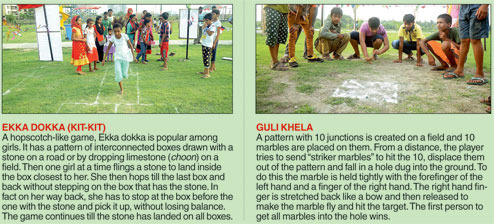
At a traditional sports meet organised at New Town’s Eco Urban Village recently, the show was stolen by children from the urban fringes while those living in swanky apartments stared in awe at the games being played and lamely asked how they were played and what they were called.
The sports were part of Lok Tirtha, a three-day festival presented by Housing and Infrastructure Development Corporation (Hidco) and implemented by the NGO Art Illuminates Mankind (AIM).
For a generation that is constantly told off for not going outdoors to play anymore, the kids who turned up were spoilt for choice. The ground had been divided into zones for five different games and over 80 names had been registered till the time the event started. Plenty more joined thereafter and every child spoken to said they would be playing every game.
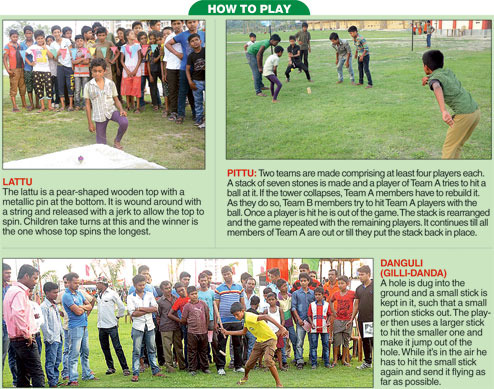
The girls hopped across the ekka-dokka boxes and the boys threw balls at one another to stop the rival team from rebuilding the stack in pittu (see box for rules). “Pittu is not a game for the faint-hearted. I know many kids who’ve broken their arms playing it,” said Md Imtiaz Molla, a Class VII student who lives in a nearby village called Pakapol. “And it’s definitely not suitable for the kids who live in the apartments. They can’t play these rough games.”
Sneha Bhattacharya, a Masters’ student, had driven down from her Moulali home with her nine-year-old brother Debopriya, and the boy was wonderstruck at the new world of sports. “I mostly play games on the computer or the mobile,” said the boy, without looking away from a lattu (top) that a village boy, Sain Ali, had set spinning for 56 seconds. “I’ve never even seen a lattu before, let alone spin one. These boys are such experts that I’m felling shy to try and spin it today.”
His sister Sneha recalled how she would play kumir-danga and kit-kit (ekka-dokka) as a child. “And that wasn’t too long ago. But computers and mobiles have very quickly replaced all outdoor games for kids,” she said.
Surjaprobha Das, a student of a girls’ school in Lake Town, was too shy to play these “new” games but watched intently how other kids aimed their marbles to hit those of others in guli khela. “My daughter is only in Class II but her afternoons are already chock-a-block doing homework, attending tuitions and studying for tests. She doesn’t have the time to play anything and even if she goes out no other kids would come,” said her mother Sabita, who hoped her daughter would play pittu and ekka dokka, her own childhood favourites.
In fact, many adults joined the kids’ queue too. Hidco officials, the manager and security guard of Eco Urban Village, all played danguli. “There are many attempts to keep alive traditional food, music and dances but sports get overlooked. We wanted urban children to come and get a feel of these games so they at least know what other options they have,” said Debashis Sen, chairman cum managing director of Hidco, after trying a hand at danguli. “In fact, the winners of these games would be given medals, certificates and game kits consisting marbles, lattoos etc to propagate the games further.”
Sonali Chakraborty, secretary of AIM, said she was delighted to see such huge participation in the festival. “We would’ve been happier if more urban children had turned up but we shall try and make this an annual event now and I’m sure they’ll come next time around,” she smiled.
Pictures by Shubham Paul
Do you have memories of playing these games?
Write to The Telegraph Salt Lake, 6, Prafulla Sarkar Street, Calcutta 700001. Email: saltlake@abpmail.com
source: http://www.telegraphindia.com / The Telegraph,Calcutta,India / Front Page> Salt Lake> Story / Friday – April 15th, 2016
Former Bengal batswoman Chandravati Pal died in a road accident today, according to Cricket Association of Bengal.
Chandravati, 40, was on her way to Calcutta Parsi Club where she was coaching when the accident took place near Red Road this morning, a CAB official said.
“She was riding pillion on a two-wheeler when she was hit by a bus from behind near the Red Road. She was taken to hospital in a critical condition and passed away around 9 am,” the CAB official said.
“It’s really unfortunate, I had met her at the CAB a couple of days ago. She was always smiling and never got into an argument,” he added.
A top-order right hand batswoman, Chandravati represented Bengal for 15 years and also played for East Zone several times.
She coached Combined District Team for two years and currently was coaching Howrah District under the ageis of CAB.
“We convey our solace to the bereaved family and pray for eternal peace to her departed soul,” CAB stated in a condolence message.
source: http://www.newindianexpress.com / The New Indian Express / Home> Cricket> News / by PTI / April 16th, 2016
N. Ramanna, a former Karnataka and Bengal footballer, passed away in Kolkata on Tuesday.
He was 77 and came from a family of footballers: one brother, N. Papanna was an India international while another, N. Rajanna, also played for Karnataka.
Originally from Mysore, Ramanna represented Karnataka in the 1962 Santhosh Trophy.
He moved to Kolkata soon after, where he played for East Bengal and Mohammedan Sporting. He also represented Bengal in the Santhosh Trophy. Ramanna settled down in Kolkata after retirement.
His death was condoled by the KSFA and the BDFA.
source: http://www.thehindu.com / The Hindu / Home> Sport / Bengaluru – April 06th, 2016