Category Archives: Sports

Game-o-Thon off to a flying start

Kolkata :

Rohit Sarkar toggles between virtual football and the real thing, and gets a kick out of both. “I play for my college team,” said the 22-year-old, adding: “I’m good with the ‘FIFA’ games too,” he added.

‘FIFA’ is a popular video games series, and the youngster is hoping to score in ‘FIFA ’11’ or ‘FIFA ’14’, the two versions of the simulated football games that feature in Game-o-Thon, the two-day PC gaming tournament that began on Friday. Rohit had just won the first round in the ‘Counter Strike’, a team game of shootouts between cops and terrorists. “We’ve came together as a team just two days ago,” he smiled, pointing to his four teammates in a cramped basement full of terminals.

Though they were expecting a high turnout for the two-day tournament, which is only in its second year, the rush had caught the organisers by surprise in the morning. “We have had to stop registration and told many to come tomorrow,” said Umang Lalani, whose idea it was to start a gaming meet in eastern India that could match those in cities like Delhi and Mumbai. “Over 900 could register today and we think we’ll be able to accommodate a total of 1200 for the two days of the meet. It’s way above the 500-odd we had last season. We definitely have to move to a much bigger place from next year,” smiled the 35-year-old.

The early face-offs were shortened to save time. “I’ve left out a very popular team game called ‘Call of Duty’ to ensure lesser stations are occupied and more participants are accommodated.

Among the participants were eight-year-old Asmita Banerjee, who lost her ‘FIFA ’11’ face-off with an older opponent but was all excited with the experience. Also fighting it out with an older opponent was Adarsh Shah, but the 11-year-old created quite a flutter when he did a Yuvraj Singh by ‘hitting’ every ball in the one-over-per-side match for a six. The 36 was easily the best score of the day in ‘Cricket 07’. “I am gaming for two years now but this was my first tournament,” Adarsh informed.

As the ‘amateurs’, most of them carrying personal kit, had fingers working overtime on keyboards or joysticks, one ‘pro’, national champion Santanu Basu, smiled at the enthusiasm. Prathamesh Patil, a technical marketing man rushed to the venue by a major gaming hardware manufacturer, was around to spell out the difference in figures.

“Headphones, mice, keyboards, mouse pads and, for some, joysticks, make up a kit and the options are huge. Someone who has just begun may be using a keyboard that costs Rs 2,500 while for a professional it may go up to 9,000,” he said between technical sessions with gamers. “It’s similar for the other gadgets.”

On a rain-drenched day, many said they hoped to be a pro some day.

source: http://www.timesofindia.indiatimes.com / The Times of India / Home> City> Kolkata / TNN / August 09th, 2014

This Lee is a game changer in kabaddi

Jang Kun Lee (left) and Seong Ryeol Kim.  / Photo: Special arrangement / The Hindu
Jang Kun Lee (left) and Seong Ryeol Kim. / Photo: Special arrangement / The Hindu

In a cluster of doughty Indian kabaddi players the presence of a South Korean creates an outlandish effect, true to his name, the Korean has been noted for his speed and agility.

In a cluster of doughty Indian kabaddi players the presence of a South Korean creates an outlandish effect.

Jang Kun Lee seems to have leapt out of a martial art move and landed straight on the kabaddi mat to salvage his Indian hosts from crisis. This is how the plot seems to be unfolding for the Bengal Warriors in the Pro Kabaddi League, where the 21-year-old South Korean, who calls himself a student of the sport, has already become a hero for the team.

Jang Kun Lee, who shares a part of his name with the celebrated martial art exponent Bruce Lee, has raised the expectations of his Indian teammates, something akin to the exploits of the celluloid hero. Lee is the raider (attacker) every defence dreads and the South Korean showed he is a quick learner as he picked up successive ‘Best Raider’ awards in the back-to-back matches his team Bengal Warriors won when the second round of the recently-launched STAR Sports Pro Kabaddi tournament hit the city this weekend.

His speed and agility are already a talk of the tournament. The player says it comes from his experience of playing the martial art sports like judo and taekwondo. “The tournament is a big learning experience for me and it really feels nice to be apart of it,” Lee said, after picking up his second best raider award.

The Korean interest in Kabaddi does not stop with Lee. The secretary general of Korea Kabaddi Association Yoon Young-hak is closely monitoring the education process of his boys. The other Korean player with Bengal Warriors, Seong Ryeol Kim, is a defender and had already made his debut with the Warriors. Young-hak insists that Kim is also a player of great merit. There are two more Koreans – Dong Ju Hong and Tae Deok Eom who play for Dabang Delhi and Patna Pirates – but it is Lee who is currently hogging the limelight.

Lee went on to reveal the secret of his instant success. “We have a different training procedure in Korea where we focus more on weight training and other strength-building measures. That probably makes us quick and agile. Indians are the best in the world in technique, but I am not sure about the time they devote to weight training,” he said.

The South Korean player says the newly designed professional tournament like Pro Kabaddi will help the sport gain the attention of the world.

“Kabaddi is yet to pick up in our country. The good performance of players like Lee or Kim will definitely help the sport grow in our country,” said Young-hak appreciating the way Bengal Warriors is using his compatriots. “We are preparing for international tournaments like Asian Games and our experience here will form an important part of our training and understanding of the game,” Yoon Young-hak said, adding that his country also is taking the help of coaches from Sports Authority of India to train their players.

Commonwealth bronze sweetens life for Sakina Khatun

Sakina khatun with the bronze medal she won at the Commonwealth Games in Glasgow. / The Hindu

Her success is all down to her hard work: coach

Life has not been kind to Sakina Khatun, who won a bronze medal at the Commonwealth Games on Saturday.

In Glasgow’s Clyde Auditorium, the 25-year-old Bangalore-based para-athlete lifted a weight of 88.2 kg to finish third in the women’s powerlifting event (Lightweight Group A). It was a success that came after prolonged hardship.

“My parents cried when I broke the news to them on the phone,” she told The Hindu from Glasgow.

Her coach and mentor Farman Basha, who also competed at the Games, faltered in his event on account of an injury, but his delight was enormous. “She has been through a lot. So I’m very happy for her,” he said.

Sakina hails from Basirhat in West Bengal’s North 24 Parganas district. Her mother is a farm labourer while her father, ailing with a serious back condition, is unable to work. “He can’t even walk,” Sakina said. “We don’t have the money for his treatment.”

Afflicted with polio at a young age, she took up swimming on her doctor’s suggestion, learning in ponds in her village before a teacher in school noticed she had an aptitude for it. “Despite steady success at the national level, I was ignored for the 2010 Commonwealth Games team. It left me disheartened and I quit the sport,” she said.

Sakina switched over to powerlifting on the advice of one of her swimming coaches, and in 2010 was directed to Basha. “She wanted to come over to Bangalore to be trained by me,” he said. “She had no money and I couldn’t afford to spend a rupee on her.”

But Sakina found a benefactor in Dilip Majumdar, a businessman who volunteered to support her training. “I’m a girl and my parents were against my leaving home,” she recalled. “But my sponsor managed to convince them.”

“At first, she could only lift around 25 kg,” recalled Basha. “But gradually she improved. Her success is all down to her hard work.”

source: http://www.thehindu.com / The Hindu / Home> News> Citis> Bangalore / by Shreedutta Chidananda / Bangalore – August 04th, 2014

The Lede – Test of Metal : The Indian origins of a famous rugby trophy

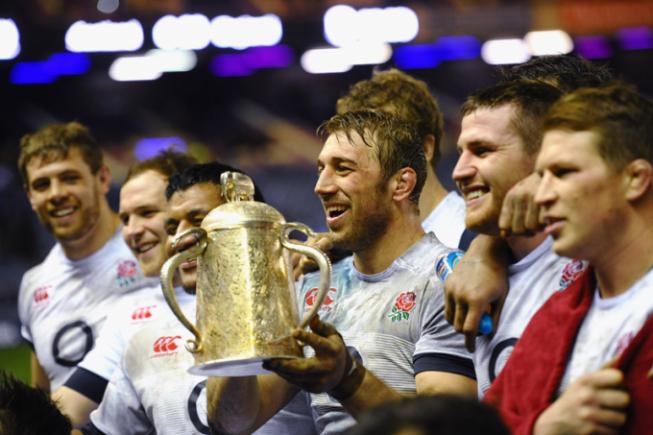
Chris Robshaw, the captain of the English rugby union team, holds the Calcutta Cup, which England retained in February - / Photo : Laurence Griffiths / Getty Images
Chris Robshaw, the captain of the English rugby union team, holds the Calcutta Cup, which England retained in February – /
Photo : Laurence Griffiths / Getty Images

On 8 FEBRUARY, before a crowd of 67,144 people, Scotland faced England at Murrayfield Stadium in Edinburgh as part of the 2014 Six Nations rugby championship. After 80 minutes of play on a muddy pitch, England secured an authoritative victory, with a score of 20–0. As disappointed home supporters filed out, up in the main stand Chris Robshaw, the jubilant English captain, held aloft an intricately engraved silver trophy, with three handles shaped like cobras and an elephant figure crowning its dome-shaped lid: the Calcutta Cup, the oldest trophy in international rugby.

The trophy Robshaw received was, in fact, a replica of the original cup, which is stored in the World Rugby Museum in Twickenham, near London. The museum’s curator, Michael Rowe, told me over the phone that although the cup’s significance has decreased in recent years, it was incredibly prestigious in its heyday, when it was “the Ashes in the sport of rugby.” What is most remarkable, Rowe said, was that the trophy’s origins can be traced back to the largely forgotten history of rugby in colonial India.

In the winter of 1872, a group of British émigrés having a hard time adjusting to life in Calcutta published letters in the Englishman, a prominent newspaper, asking that the administration organise rugby matches. A game was played on Christmas Day that year, with English players on one side and those representing Scotland, Ireland and Wales on the other. There is no record of who won, but the event was a success, and was repeated the following week. Those two matches led to the formation of the Calcutta Football Club in January 1873 (at the time, rugby was one of several related games called “football”). The club thrived—137 members joined in the first year alone—and it joined the Rugby Football Union, the sport’s governing body for all British territories, in 1874.

After a successful start, however, the club fell on hard times. A regiment of the British army left the city for a new posting, and new British arrivals were more interested in polo and tennis. According to Rowe, funds soon started running out, forcing the closure of the club’s free bar, which caused the membership to drop substantially. GA James Rothney, the club’s treasurer, secretary and team captain, considered several fundraising suggestions, but concluded that none of them would keep the club going.

Then, Rowe told me, in 1877, Rothney had an “ambitious” idea. He wrote to the Rugby Football Union suggesting that, to preserve the memory of the club, its remaining funds be used to make what he described as a trophy of “ornate Indian workmanship,” to be “devoted to the purpose of a Challenge Cup and presented to the Rugby Union to be competed for annually” in any way deemed “best for the encouragement of Rugby Football.” Both the Union and the club’s members agreed. Rothney withdrew the club’s remaining £60, a substantial sum at the time, in the form of 270 silver rupee coins. These were melted down in September 1878 by WE Jellicoe, a British silversmith and watchmaker on Calcutta’s Esplanade Row, to create the Calcutta Cup.

The cup was taken to Britain, and in March 1879 the Union organised the first Calcutta Cup match—a game in Edinburgh between England and Scotland, which ended in a draw. The contest was repeated in every following year, and the cup, Rowe said, quickly “became eponymous with the England–Scotland rugby game.” In 1883 it was incorporated into the Home Nations Championship, which eventually became the Six Nations—an annual rugby union competition involving France, Italy, Scotland, Wales, England and Ireland that is effectively the sport’s European championship. The cup has been contested every year since, except during the World Wars. England has won 68 of the 121 matches to date, with Scotland winning 39 and 14 matches ending drawn. England has retained the trophy since 2009.

Today, the original trophy is treated with special care. In 1988, on the night after England retained the cup, two drunk players, one English and the other Scottish, took it out onto the streets of Edinburgh, where they passed it between themselves and dropped it several times. The cobra handles were crushed, and the body and base badly dented. The Edinburgh jewellers Hamilton & Inches restored the cup to its original form, but, as Rowe told me, “silver is a soft metal,” and the restoration left the cup “in a fragile state.” The incident led to a decision to give both nations replica trophies, and store the original at the World Rugby Museum to avoid any further damage.

Rowe said that with the rise of other rugby-playing nations, the England–Scotland rivalry has mellowed in recent years, and so reduced the significance of the Calcutta Cup. But, he added, Rotheny’s idea to entwine the memory of the Calcutta Football Club into the history of rugby was a success. “It is quite remarkable that a short-lived club has such a place in the history of the sport,” he said.
_________________________________________________________________________

Atul Dev is a correspondent with The Sunday Guardian.
_________________________________________________________________________
source: http://www.caravanmagazine.in / The Caravan / Home> Reporting & Essays> The Lede / by Atul Dev / 2014

Mohun Bagan kicks off quasquicentennial celebrations

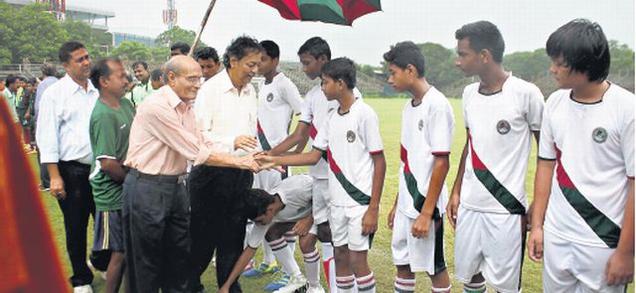
Samar (Badru) Banerjee, the Indian captain of the 1956 Melbourne Olympics football team and one of the oldest surviving football stars, meeting the Mohun Bagan junior players accompanied by the Mohun Bagan secretary Anjan Mitra. Photo: Special arrangement. / The Hindu

A group of senior members sitting on the redecorated galleries in the Mohun Bagan ground trained their gaze on the dark clouds gathering yonder signalling imminent rain.

A group of senior members sitting on the redecorated galleries in the Mohun Bagan ground trained their gaze on the dark clouds gathering yonder signalling imminent rain. Their faces lit up at the prospect, as rains have become synonymous with the successful celebration of one of the most notable victory in the annals of Indian sport – the IFA Shield triumph in 1911.

Mohun Bagan loves to associate itself with that epochal win against the British East York Regiment and celebrates the day (July 29) as its foundation day.

In keeping with that tradition, the club this year sought to begin its quasquicentennial celebrations from Tuesday as the exact date of its foundation remains uncertain.

“It was established in 1889 and in August, but it is not known exactly on which the date it was founded,” says Subhransu Roy, a noted sports researcher from the city. The day saw a big gathering of former players, members and the media, and the club sought to commemorate the occasion befittingly by organising a host of ‘friendlies’ on its ground.

The club management used the opportunity to announce a bigger function at an unannounced date to make the 125 years celebrations more memorable. “We are the oldest and one of the most popular football clubs in Asia. Mohun Bagan symbolises a way of life in Bengal and that has sustained our popularity for all these many years,” says Mohun Bagan general secretary Anjan Mitra. “We have planned big celebrations and hope to bring them around by September,” he added.

Mohun Bagan successfully completed the club licensing criterion this year and entered the threshold of professionalism. “The club ran on the patronage of Kings and Zamindars in the early years, but continued to receive popular support for its notable performances on field. What is remarkable here is the transcendence from an amateur set-up to a more corporatised arrangement,” says Mr. Roy.

Much like its later cousin and traditional rival, East Bengal Club (established 1920), Mohun Bagan has a big community support which is ever growing. “Mohun Bagan has been able to retain its identity as the champion club of India despite not always performing. In recent years, it has not done well in the national tournaments, but its popularity remains intact,” says Mr. Roy.

“We have thousands of people waiting to become members of the club. This is the image of the club, and the older it grows the more popular it will become,” says Mr. Mitra, the secretary of the club since 1995.

source: http://www.thehindu.com / The Hindu / Home> News> Cities> Kolkata / by Amitabha Das Sharma / Kolkata – July 30th, 2014

Bitten by travel bug, rickshawpuller on solo expedition from Kolkata to Ladakh

SUMMARY
Das way back in 2008 had gone all the way to Rohtang Pass in a rickshaw with his wife and daughter.
_____________________________________________________________

A rickshawpuller has set out on a daring 3,000-km expedition from Kolkata to the famous Khardung La pass in Ladakh, which has one of the world’s highest motorable road.

Forty-year-old Satyen Das, who ferries commuters at Naktala in south Kolkata, marshalled his personal savings and generous donations from local people, packed his luggage under the passenger’s seat of his refurbished rickshaw and started on his one-of-a-kind journey last month.

“I make a living on my rickshaw and spend my whole day with this, so I could not leave it behind when I started to dream about my trip to Ladakh,” Das said.

He has already reached Uttar Pradesh from where he will go to Srinagar and reach Ladakh after crossing Kargil next month. “I want to spread the message of world peace with this journey and also I want to promote rickshaw as a cheap and eco-friendly mode of transport,” he said.

Expecting to complete the expedition within five months, he is also eyeing an entry into the Guinness Book of World Records for his feat.

Bitten by travel bug, Das way back in 2008 had gone all the way to Rohtang Pass in Himachal Pradesh in a rickshaw with his wife and daughter. But this time the target is higher and he is travelling alone.

“He has this addiction of travelling in the Himalayas and going to far-off places,” said Partho Dey, secretary of Naktala Agrani Club, who helped him with funds.

Das modified his rickety old rickshaw with additional brakes and new body made of light steel at a total cost of Rs 15,000. In a day, he pedals to cover around 40-50 km and for makes night halts at religious places where he can stay for free.

Having only elementary education, the rickshawpuller said the unique road trip is also a great learning experience as he gets to understand the culture and diversity of India by criss-crossing different states, cities, towns and villages.

“My first task in the morning is to go to the local police station and take permission to move ahead. So far I have been getting it easily,” Das said. He is armed with maps to find his way to his next stop and a digital camera to document his special journey.

The club members are taking care of his wife and daughter, whom he left back home.

“We estimate that the trip would cost around Rs 80,000, which we have raised it amongst ourselves after we saw his passion and determination to travel,” Dey said adding that they have have given him an ATM card to withdraw cash as and when required.

source: http://www.indianexpress.com / The Indian Express / Home> Cities> Kolkata / by Press Trust of India / Kolkata – July 04th, 2014