Category Archives: Science & Technology

Kolkata shipyard develops new vessel for Coast Guard

ShipyardKOLKATA17aug2016

Kolkata :

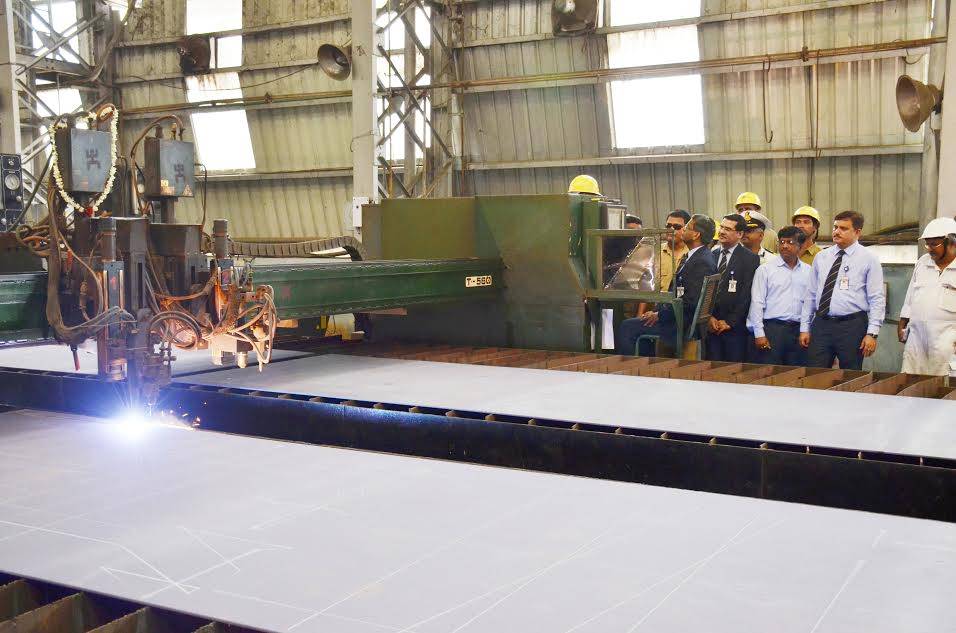
Garden Reach Shipbuilders and Engineers (GRSE), on Saturday, commenced work on the first in a series of Fast Patrol Vessels (FPVs) it has developed and will be building for the Coast Guard. Among those present during the ‘Plate Cutting Ceremony,’ the first step towards construction of a ship, were Rear Admiral (retd) AK Verma, chairman-cum-managing director, GRSE and other senior officials.

The order for the FBVs was placed in March, 2016 and the first ship will be delivered in February, 2018, Verma said. “The design of these ships is unique. They are cost-effective, fuel-efficient and ideally suited for patrolling, anti-smuggling, anti-poaching and rescue operations. They are an improved version of Inshore Patrol Vessel (IPVs) built earlier by GRSE for the Coast Guard. The FPVs are designed and developed by the in-house design centre of GRSE. Thanks to active support and participation of internal workforce and business partners in various shipbuilding activities, GRSE’s capabilities are constantly increasing. These ships will add punch to the Coast Guard’s capabilities in maintaining maritime security,” the CMD added.

The FPV is 48.9 metres long, 7.5 metres wide and has a displacement of nearly 300 tonnes. It is capable of attaining a maximum speed of 34 knots. At 12-16 knots, these ships have endurance of 1,500 nautical miles. They are fitted with three water jet propulsion systems powered by marine diesel engines, each developing 2720 KW of power and will be fitted with CRN-91 indigenous 30 mm gun. The ship has modern habitability conditions with accommodation for 35 personnel.

source: http://www.timesofindia.indiatimes.com / The Times of India / News Home> India / by Jayanta Gupta / TNN / August 14th, 2016

Tea tool for planters

Jalpaiguri :

The Tea Board of India today gave plucking machines to 150-odd small growers in the district.

Officials said the machines had been given away with a 50 per cent subsidy to be borne by the board. The remaining amount will be paid by the beneficiaries in three-four installments.

“Getting workers in the tea sector has become a major problem.The small tea sector here is also facing this shortage. That is why the tea board has decided to offer the machines to small growers,” Ramesh Kujur, deputy director of the tea board, said.

The tools that cost between Rs 40,000 and Rs 72,000 were given to planters from Rajganj, Sadar and Mainaguri who had applied for them.

“It can help growers in tackling manpower crisis and also increase the amount of leaves plucked,” Kujur said.

Jalpaiguri has 10,000-odd small planters.

ADDITIONAL REPORTING BY OUR SILIGURI CORRESPONDENT

source: http://www.telegraphindia.com / The Telegraph,Calcutta,Indai / Front Page> North Bengal> Story / Wednesday – August 10th, 2016

East India’s first cadaver liver transplant in Kolkata

Kolkata (IANS) :

Bolstering efforts to carry out cadaver organ transplants in West Bengal, a team of doctors at a private hospital here on Tuesday night performed what is possibly eastern India’s first such liver transplant in the city, the hospital said in a statement.

Family members of a 53-year-old male patient – Samar Chakraborty – who was declared brain dead on Monday assented to the procedure to transplant the liver that is expected to bequeath a new lease of life to a 46-year-old female recipient with liver damage.

The liver, the most important solid organ in the body, was transplanted to 46-year-old Madhuri Saha, a patient with a known case of autoimmune hepatitis, decompensated cirrhosis, ascites, hepatic encephalopathy and hypersplenism by a team of doctors at the Apollo Gleneagles Hospitals.

Following the necessary tests to validate an adequate match, gastroenterologist Mahesh Goenka and his team undertook a successful harvest and transplant of this vital organ.

Chakraborty had a history of diabetes and hypertension, and was suffering from chronic kidney disease. Admitted only recently at a hospital in north Kolkata with Intra Cerebral Haemorrhage, he had gone into a deep coma, suffering irreversible brain damage.

He was shifted to Apollo, where a panel comprising leading doctors from the hospital and the health department of the West Bengal government evaluated his condition and declared him brain dead.

The family consented to multi-organ retrieval, and following the completion of necessary formalities regarding blood type and stability of the organs, the process was undertaken.

Last month, a 70-year-old brain dead woman here bequeathed a new lease of life to four persons, with her kidneys and cornea successfully transplanted in the city’s first multi-organ cadaver donation operation.
–IANS / ssp/pgh/

source: http://www.timesofindia.indiatimes.com / The Times of India / News Home> City> Kolkata / IANS / July 27th, 2016

IIT-Kharagpur to confer Distinguished Alumnus Award at the 62nd convocation

Kolkata:

Indian Institute of Technology Kharagpur will confer the Distinguished Alumnus Award on the occasion of the 62nd convocation of the Institute which will be organized on July 30 and 31.

Seven eminent alumni have been selected for the award for their exceptional professional achievements in the industry, in the academia or as entrepreneur. The awardees are – Dr Anurag Acharya, Ajit Jain, Asoke Deyasarkar, professor Gautam Biswas, professor Indranil Manna, professor Supriyo Bandopadhyay and Professor Venkatesan Thirumalai.

Dr. Anurag Acharya (IIT KGP B.Tech./Computer Science and Engineering/1987 batch), Distinguished Engineer at Google USA. Dr. Acharya is key founder of Google Scholar which since its inception has become an indispensable service for the global academic and research community.

Ajit Jain (IIT KGP B.Tech./Mechanical Engineering/1972 batch), President of Reinsurance Division, Berkshire Hathaway Insurance Group, USA. Shri Jain is a visionary in the global investment sector, having led Berkshire Hathaway to great heights. He is a well-known philanthropist as well funding the Jain Foundation with the mission is to cure muscular dystrophies.

Dr. Asoke Deysarkar (IIT KGP B.Tech./Chemical Engineering/1971 batch), CEO and Chairman, PfP Industries, USA. Dr. Deysarkar has blended his research with entrepreneurship in Chemical Engineering forming a billion dollar conglomerate of companies. The Deysarkar Family has helped establish the Trans-disciplinary Program in Petroleum Engineering at IIT KGP. Dr. Deysarkar is also known for his philanthropy activities.

Professor Gautam Biswas (IIT KGP Ph.D./Mechanical Engineering / 1985 batch), Director, Indian Institute of Technology Guwahati. Prof. Biswas has an illustrious academic career of 25 years having taught at IIT Kharagpur, IIT Kanpur and in various international universities and known for his leadership at IIT Kanpur, Central Mechanical Engineering Research Institute, Durgapur and IIT Guwahati. His fundamental research on heat transfer phenomena is well recognised in the international academic community. He was the Founder Director of Academy of Scientific and Innovative Research (AcSIR), New Delhi.

Professor Indranil Manna (IIT KGP Ph.D./Metallurgical and Materials Engineering/ 1990 batch), Director, Indian Institute of Technology Kanpur. He has been an exceptional academician and researcher having a long-standing association with IIT Kharagpur as faculty and thereafter leading the Central Glass and Ceramic Research Institute, Kolkata and IIT Kanpur. His significant contributions in advanced material science and engineering have been well recognised by national and international bodies.

Professor Supriyo Bandopadhyay (IIT KGP B.Tech./Electronics and Electrical Communications Engineering/1980 batch), Commonwealth Professor, Department of Electrical and Computer Engineering, Virginia Commonwealth University, USA. Recently he was named Virginia’s Outstanding Scientist and is known globally for his interdisciplinary research. He directs the Quantum Device Laboratory in the Department of Electrical and Computer Engineering which has been frequently featured in national and international media for exemplary research in nanotechnology.

Professor Venkatesan Thirumalai (B.Sc./Physics /1969 batch), Director, NUSNNI-NanoCore, National University of Singapore. He is known for his pioneering research in laser technology. Prof. Venkatesan was Founder of the PhD/MBA program in NUS and the Surface Center at Rutgers University.

The Distinguished Alumnus Award is one of the highest recognition given of accomplishment and contribution of an alumnus/alumna from the Institute.

The awardees will be given a gold medal and a certificate.

source: http://www.timesofindia.indiatimes.com / The Times of India / News Home> City> Kolkata / Somdatta Basu / TNN / July 12tj, 2016
Where ideas turn into experiences

It’s a rare congregation where designers, techies, tinkerers, hobbyists and artists get together to toy with their ideas, exchange notes and give shape to them. MakersLoft, eastern India’s first makerspace, lets children give flight to their imagination with the help of tools and tips from professionals.

Purav Manot is passionate about robotics and has been following YouTube videos to build a bot. MakersLoft gave this student of Lakshmipat Singhania Academy a platform to develop professional skills and collaborate with fellow robotic enthusiasts. Manot now helps other kids create custom robots.

“I used to watch videos and design programmes with sensors and motors but never got a chance to showcase my models. Then MakersLoft happened. Now, I get to exchange and share interesting robotic experiences with professionals and hone my technical abilities,” Purav said.

Come with an idea and leave with a product is the invitation from Meghna Bhutoria, the founder and CEO of MakersLoft. “From 3-D painting, robotics, app development to photography, herbal painting, woodwork and fashion designing, MakersLoft is a one-stop shop for thinkers and innovators, no matter what their age,” she said.

The concept is widely prevalent in the US, France and Germany and has finally found a niche for itself in Calcutta. Stationed in a flat on Ballygunge Road, MakersLoft offers an enticing blend of lab-based learning, hands-on training and even offers chances of entrepreneurship.

“There are plenty of such never-seen-before experiences dished at MakersLoft. We have also introduced some unique and fun activities for tots and teens. Making ‘glow-in-the-dark’ objects, setting up structures and models using PVC pipes and phone film-making are some of the interesting options that can break the monotony of routine life at home or school,” Bhutoria said.

For Kushagra Kanoi, a student of Calcutta International School, the Lego classes on Saturdays are something he looks forward to all week. His Lego blocks were only lifeless pieces of plastic before he joined MakersLoft. Now, he knows how to get the blocks moving. “I used to make Lego cars but couldn’t do much to get them going. But with Lego technique set here, I know how to put lever and battery to use,” Kushagra said.

Namrata Manot, a Lego instructor at MakersLoft, said: “The kids’ imagination knows no boundaries. We give them an idea and watch them add their own creativity to it.”

source: http://www.telegraphindia.com / The Telegraph,Calcutta,India / Front Page> Calcutta> Story / by Rumela Sinha / Tuesday – July 05th, 2016

Indian-American scientist wins Springer Theses Award

Mr. De has dedicated his PhD thesis to cricketing legend Sachin Tendulkar and his alma mater, Kolkata’s Presidency University.

An Indian-American scientist has received the prestigious Springer Theses Award in recognition for his outstanding research in which he developed transgenic mice to study a critical tumour-suppressor called A20.

Arnab De’s thesis was nominated by New York’s Columbia University. Before this, Mr. De, who has also developed peptide-based prodrugs as therapeutics for diabetes, had received the Young Investigator Award at the American Peptide Symposium.

The thesis prize is awarded by Springer, a leading global publisher of renowned scientific journals and books, to recognise outstanding PhD research.

Internationally top-ranked research institutes select their best thesis annually for publication in the book series: “Springer Theses: Recognising Outstanding PhD research”.

Additionally, winners also get a cash prize of 500 euros.

The research work was highlighted by the European Molecular Biology Organization (EMBO) Reports.

Only research considered to be of ‘fundamental relevance to a general readership’ is chosen to be highlighted by EMBO.

Mr. De has dedicated his PhD thesis to cricketing legend Sachin Tendulkar and his alma mater, Kolkata’s Presidency University.

Mr. De said: “Two things that have influenced me the most is sports and education. This thesis is dedicated to Sachin Tendulkar not only for the cricketing joy he provided me, but also for being a constant source of inspiration to all Indian youth.”

Ole John Nielsen (University of Copenhagen), who shared the 2007 Nobel peace Prize as a member of the Intergovernmental Panel on Climate Change along with US vice president Al Gore, had in 2012 described the Springer award as an “insanely great honour”.

source: http://www.thehindu.com / The Hindu / Home> International / PTI / Singapore – May 28th, 2016

Nezone-Ok Play in pact to make indigenous e-rickshaws

Kolkata :

City based Nezone Group and leading moulded plastic maker Ok Play has forged a partnership to manufacture indigenous e-rickshaws.

“We have collaborated with Ok Play to manufacture eastern region’s first ICAT (International Centre for Automotive Technology) and Automotive Research Association of India (ARAI) approved e-rickshaw,” Nezone group managing director M L Beswal told .

As steel pipe producer it is forward integration for us as we will be providing the chasis of the e-vehicle, he added.

Calcutta High Court’s direction to the West Bengal government to form a high-power committee to take steps against unauthorized e-rickshaws comes as a boon for us, he said.

According to estimates, over a lakh e-rickshaws are plying across the state, most of which are either built with Chinese components and are unable to meet regulatory requirements.

PSU banks have also approved this product which will help buyers to get subsidised Mudra scheme loan to purchase the vehicle.

This is a complete green vehicle as even components used for body are all UV stable plastic body which is non-polluting, long lasting and edge free, Nezone officials said.

Feasibility is being carried out to make solar powered e-rickshaw as well, Benswal said.

He said if some direct fiscal benefit scheme is offered by the West Bengal government it would help in quick switchover to authorised e-rickshaw in the state.

The Delhi government has announced a subsidy of Rs 15,000 per e-rickshaw. The Maharashtra government has waived registration charges on such vehicles.

Several state governments have waived VAT on e-rickshaws. The union government has reduced central excise to 6 per cent on these battery operated vehicles.
BSM MD SOM

source: http://www.timesofindia.indiatimes.com / The Times of India / News Home> City> Kolkata / PTI / May 26th, 2016

Homeopath Parimal Banerji explains origin of life in new book

Kolkata :

Paving a new path in the field of the biosciences, eminent homeopath Parimal Banerji shared his discovery on the origin of life at the launch of his book, ‘Discovery Of The Source Of Life Force’ throwing light on the enigma of life called Life-Force. The book was launched on Monday by governor, Keshari Nath Tripathi.

Over the past few decades, Banerji has carried out extensive research on the subject: The Origin of Life or Source of Life – Force which scientists across the globe have been striving to discover since the beginning of civilization. Hypotheses and facts about how the organs and cells work are known but why they function and what the energy is or the force behind them could not be established.

This book will provide a breakthrough in medical world and an exploration in the human quest for the ultimate.

Banerji discovered a new molecular energy, ASA (Anubik Shakti Abarta) Supra molecular energy, which has revolutionized many concepts of physics.

Speaking on the occasion Banerji said, “Anubik Shakti Abarta is a special type of molecular energy which remains in very high dilutions and can exist for an indefinite period even in concentration much beyond 1 in decillion. Molecular composition in each cell in our human body varies widely, which creates the constitution of men so different from each other and are responsible for their individual behaviors, intellect, mental capabilities, memory, manifestation or resistance to diseases, immunity, genetic effects, physical structures, etc. Explanation to all these has taken the life science to a very advanced status with the creation of a new horizon.”

Banerji has been working in search of the source of life-force in the living organisms since the beginning of his medical education. It has remained undiscovered despite extensive researches being carried out by the biosicentists all over the world. He has been successful in discovering the source of life force and presented a paper on it at the Mihijam Institute of Homoeopathy in 1980. Its various aspects were being worked out and were presented at Cultivation of Science at Kolkata. The discovery now explains how consciousness is generated, what makes the cells to work and why a living unicellular animal has the ability to think and react unlike the dead.

Former Prime Minister of India Morarji Desai, Late Prime Minister Narshimaha Rao, Late Air Marshal Subrata Mukherjee were Banerji’s patients, to name a few. Apart from his proficiency in homoeopathy, he has also been working in the domain of physics, relating to life sciences.

source: http://www.timesofindia.indiatimes.com / The Times of India / News Home> City> Kolkata / by Jhilmil Pandey / TNN / May 16th, 2016

Meet Annie Roy, the only woman tunnel engineer of country

AnnieRoyKOLK29apr2016

Bengaluru:

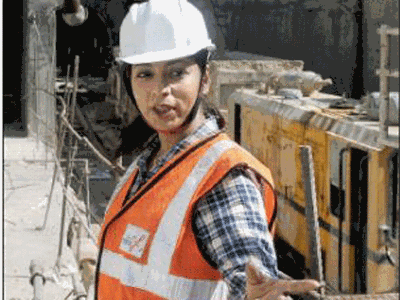
“She must be a visitor.” That’s the murmur she heard when Annie Sinha Roy walked into the construction site of Delhi Metro on the first day of her job. “There were about 100 men, most of them labourers and a few engineers. They thought I would not last long. There were no toilets, no place to sit and debris all around,” the country’s first and only woman tunnel engineer recalls.

“After a couple of hours, I was standing in front of a huge machine that had to break the ground but it was stuck. A German engineer and my boss asked me to get inside it and open a nut. Even before I realized what I was doing, my face was gushed by hydraulic oil. The colleague said my face would glow for the rest of my life. Today tunnelling is my life,” says Annie, 35, ahead of the inauguration of South India’s first underground Metro rail on Friday.

In Bengaluru, she alone steered Godavari, the tunnelboring machine that recently finished boring underground from Sampige Road to Majestic. She calls it her tunnel because the machine had got damaged just when she joined as assistant engineer in Bangalore Metro Rail Corporation (BMRC) in May 2015. After that, she used to spend eight hours in the tunnel every day. “Sometimes when people see me with the helmet and jacket and learn that I work for Namma Metro, they would only ask when the work will get over,” she says. Recalling her long journey, she said she wanted to pursue her masters after completing degree in mechanical engineering from Nagpur University.

“But I lost my father and I had to get a job to bail out my family from financial crisis. I got a job offer from Senbo, a contractor with Delhi Metro, and took it up in October 2007,” says Annie, who hails from a middle class family in north Kolkata.

In 2009, she joined Chennai Metro. And then went to Doha for six months in 2014. “My visa application was rejected thrice by Qatar because they do now allow unmarried women to go and work there. But the fourth time, I fought it out with them,” she laughs.

Annie is proud of her work in the tough male world around her, which has helped her “not bother about what is going to happen tomorrow”.

She wants women to break stereotypes and work in the male-dominated professions. “I want women to drive a tunnel boring machine. I want them to work in the tunnel,” said Annie who lives in HSR Layout with her husband, a techie.

source: http://www.timesofindia.indiatimes.com / The Times of India / News Home> City> Bangalore / by Aparjita Ray, TNN / April 29th, 2016

Power for 500 garden families

Siliguri :

Around 500 families of a Terai tea garden who had been living without electricity for the past 13 years got power supply in February following the State Legal Services Authority’s instruction to the West Bengal State Electricity Distribution Company Limited .

Amir Sarkar, the general secretary of the Darjeeling District Legal Aid Forum (DDLAF), a voluntary organisation, said the residents of Girja Line in Gayaganga Tea Estate, 20km from here, had been facing hardships for a long time.

“The information came to us from Dhumkuriya Legal Aid Clinic, Dagapur, which is a unit of the DDLAF, in 2011. We took up the matter with the Sub-Divisional Legal Services Committee here in Siliguri,” Sarkar said.

It was followed by a visit of a team from the committee and some representatives of the DDLAF.

“It was found that even though the WBSEDCL had installed meters in the houses, there was no electric supply,” the DDLAF secretary said.

After the visit, the residents submitted a mass petition demanding power supply to the DDLAF, which took it up with the State Legal Services Authority (SLSA) and the West Bengal Human Rights Commission in Calcutta.

Representatives of the DDLAF and local people appeared before the commission and the SLSA where the case was heard.

“We also pursued the case in a circuit bench of the state human rights commission in Siliguri. Around 100 residents of Girja Line were present at the hearing,” Sarkar said.

Both the bodies ordered the chairman of the WBSEDCL to extend electricity supply to the affected families.

“Although the direction was given back in 2011, the WBSEDCL took time in executing it. We had to take up the matter again. Finally, the residents of Girja Line got electricity in February this year,” Sarkar said.

On April 10, the residents organised a programme.

“They celebrated the occasion. They had invited members of the subdivisional judiciary and also the DDLAF. All those present were felicitated by the residents of the garden,” Sarkar said.

Ajay Kumar Das, the additional district and sessions judge (first court) of Siliguri and chairperson of the subdivisional legal services committee and Sridhan Su, civil judge (senior division), Siliguri, attended the programme with others.

The judges spoke on the free legal assistance process and justice accessibility programme and apprised the tea garden workers and their families as to how to get justice through the alternative dispute redressal mechanism, Sarkar said.

source: http://www.telegraphindia.com / The Telegraph,Calcutta,India / Front Page> North Bengal> Story / by The Telegraph Correspondent / Saturday – April 23rd, 2016