Category Archives: Science & Technology

Award

Calcutta :

West Bengal State Electricity Distribution Company Ltd was given the IPPAI Power Awards 2014 on August 2 at a programme in Goa.

The award was given by the Independent Power Producers’ Association of India (IPPAI) in association with Delloitte, a consultancy firm.

source: http://www.telegraphindia.com / The Telegraph, Calcutta / Front Page> Calcutta> Story / Wednesday – August 06th, 2014

Top Gear’s ‘best taxi in the world’ to cease production

AmbassadorKOLKATA03aug2014

Originally based on the Morris Oxford, the Ambassador has been manufactured by Hindustan Motors in India since 1948.

The car manufactuer has announced that it will suspend production at its plant in West Bengal. Few see it returning to Indian roads, as more efficient, modern cars have taken over the market.

This car ruled Indian roads for the first 40 years, becoming a symbol of power and influence. By the end of the 1970s, it had a market share of 75 percent.

The entry of Suzuki though a local joint venture with Maruti, changed all that and by 1992, Ambassador’s share dropped to 20 percent.

Lack of investment, a militant workforce, an ageing plant and lack of interest and vision by the owners are cited as resons for the demise of this car.

In teh 1990s, Hindustan Modors enterd into a joint venture withGeneral Motors to manufacture and sell Opel vehicles. There was also a collaboration with Mitsubishi Motors to manufacture the Lancer. But none of these ventures took hold.

In a statement, Hindustan Motors blamed the shutdown on “worsening conditions at its Uttarpara plant which include very low productivity, growing indiscipline, critical shortage of funds, lack of demand for its core product the Ambassador and large accumulation of liabilities”.

Only 2,200 Ambassadors were sold in 2013-14; a small fraction of the 1.8 million passenger cars sold in India.

In a show, which was aired on the BBC last year, Top Gear organized a world taxi shootout in which Ambassador emerged a winner, beating competitors from all over the globe.

The Top Gear team’s verdict? “If performance is getting to your destination at some point of time, yeah, this is quite a performer.”

As reported in The Economic Times, Nida Najar notes: “Drivers complain that pedals break off after a few thousand miles, that the air-conditioners malfunction. Some use turmeric to stop up holes in the radiator; anything to avoid servicing with expensive and increasingly rare parts. Many carry water bottles to cool off radiators that frequently overheat.”

source: http://www.ferret.com.au / Ferret / Home / by Kevin Gomez / July 03rd, 2014

3 Keralites for Mission Palliative Care in Rural West Bengal

Kozhikode :

Three Keralite Civil Service officers would soon add a new chapter in palliative care in rural West Bengal, inspired by similar initiative in their home state.

‘Sanjeevani’, an end-of-life care project to be launched in September in the Nadia district of WB, is the brain child of IAS officers P B Salim and Bijin Krishna and Amarnath, an IPS officer. The project has been conceptualised by the Kozhikode based Institute of Palliative Medicine (IPM), the training, research and outreach arm of Pain and Palliative Care Society, which pioneered community volunteering in end-of-life care.

Salim, hailing from Muvattupuzha, is currently working as the District Magistrate of Nadia while Amarnath, a native of Moozhikkal in Kozhikode, is the ASP of South 24 Parganas. Bijin from Meppayur in Kozhikode is the Assistant Collector of Murshidabad district. “Both Amarnath and Salim had associated with IPM years ago. Salim suggested starting a palliative care programme in West Bengal. He along with Amarnath then approached me. Later, Bijin also extended support to the initiative,” said Dr Suresh, director of IPM, which provides technical support for the project.

According to Salim, Sanjeevani is aimed at improving the quality of life of the terminally ill in Nadia.

“The project intends to introduce a new culture of providing care for the bed-ridden patients utilising a network of physicians, nurses and volunteers,” he said.

source: http://www.newindianexpress.com / The New Indian Express / Home> States> Kerala / by Shafeeq Alingal / July 25th, 2014

First beating heart surgery performed in Kolkata

In a first of its kind surgery in the city, a woman recently underwent a successful complex heart surgery while her heart was still beating.

According to a release, the 51-year-old woman was suffering from a severely stenotic rheumatic mitral valve disease, which required her mitral valve to be replaced. The mitral valve consists of two flaps and is responsible for controlling the flow of blood into the heart.

A team of two doctors at the Eastern Railway’s B.R. Singh Hospital conducted the surgery with the help of a heart-lung machine. The heart was continuously supplied with oxygenated blood and it remained in a state of slow beating to enable the mitral valve to be replaced with metallic valves. The surgery on heart valves is commonly performed on a motionless heart by using a special solution called cardioplegia . As the heart is stopped for surgery, the surgeon must restart it and reintroduce blood into the heart muscles.

This is known as reperfusion. Reperfusion can cause impairment of heart function known as reperfusion injury with complications such as irregular heart rhythms and pump dysfunction. Reperfusion injury is especially a concern in high risk patients, such as elderly, people who had previous heart operations, and those with complex health problems. Therefore, the beating heart surgery leads to better preservation of heart and better survival rate, especially among high-risk patients.

source: http://www.thehindu.com / The Hindu / Home> News> Cities> Kolkata / by Staff Reporter / Kolkata – July 23rd, 2014

Railway cardiac experts perform rare surgeries in Kolkata

Kolkata :

Doctors at the B R Singh Hospital in Kolkata have successfully replaced Mitral valves of two patients without stopping their hearts. Cardiologists at the hospital under Eastern Railway, have claimed that such surgeries have been performed in the eastern part of the country for the first time. According to them, keeping the heart beating during such a surgery reduces chances of post-operative complications.

“The first surgery was conducted a few days ago on a 51-year-old female patient suffering from severe Stenotic Rheumatic Mitral Heart Disease. After that a similar surgery was conducted on a 52-year-old male patient. Such surgeries are normally performed after the heart is stopped by using a special solution called Cardioplegia. After the surgery, the surgeon has to restart the heart and reintroduce blood into the heart muscles. This is known as Reperfusion and can cause impairment of heart function,” said cardiac specialist Alok Mazumdar who along with Himanshu K Dasmahapatra of the Advanced Cardiac Care Centre was part of the team that performed the surgery.

The Mitral valve is located in the left or more important half of the heart. This valve separates the upper and lower chambers on the left side and is very critical for proper functioning of the organ. “Reperfusion injury can cause complications such as irregular heart rhythms (Arrhythmias) and pump dysfunction. Reperfusion injury is especially a concern in high risk patients, such as elderly people who had previous heart operations and those with complex health problems. Reperfusion can be avoided if the heart is kept beating during surgery. Beating heart surgery leads to better preservation of heart function, better survival rate, especially in high risk patients. There is less chance for developing any heart rhythm, kidney or liver complications and most importantly, reduce the risk of neurological complications including stroke and memory problems. Hospital stay is also reduced due to quicker postoperative recovery,” Mazumdar added.

The surgeries at B R Singh Hospital were performed with the aid of Heart-Lung Machines. The hearts of the two patients were continuously perfused with Oxygenated blood and they remained in a state of slow and empty beating to allow the Mitral valves to be removed and replaced by metallic ones.

“No Cardioplegia was used and the risk of developing any major complications after valve surgery in this unique way is significantly lower than performing surgery in a stopped heart. There are no records of such a surgery being performed before this in the eastern part of the country. A handful of such surgeries may have been performed elsewhere in the country,” the doctor said.

According to noted heart surgeon Kunal Sarkar, this was a commendable effort. “Such surgeries are rare as a lot of precision and expertise is required. Doctors normally go in for such surgeries only if the patients suffer from certain complications. Normally, the heart is stopped during valve replacement as the risks involved during the surgery itself are less,” he said.

source: http://www.timesofindia.indiatimes.com / The Times of India / Home> City> Kolkata / by Jayanta Gupta, TNN / July 21st, 2014

Bengal to house hub for start-ups

StarupsKOLKATA19jul2014

Calcutta :

The Bengal government will allot 10,000 square feet of built-up space in Salt Lake’s Sector V to Nasscom for setting up its first incubation centre in the eastern region.

The announcement was made by state information technology minister Amit Mitra at the eastern edition of the Nasscom Product Conclave here today.

The prospective hub, which will be aimed at mentoring start-up companies and fuelling entrepreneurship for product development, is expected to take shape within 3-6 months. It will require a strong infrastructure back-up and is likely to draw venture capital funds, seed funds and top names of the industry as mentors into the state.

The development comes at a time Bengal is battling the scathing aftermath of Infosys’s decision to put their maiden campus project on hold here. Incidentally, software behemoth Microsoft India is in the final stages of setting up a research and innovation centre in Sector V to impart its expertise in IT skill training.

Nasscom already has such as facility in Karnataka, which is supported by the state government. It houses around 15 start-up companies. The proposed facility in Calcutta will have the requisite plug-and-play facilities. A board comprising Nasscom members and government representatives will initiate a selection process based on merit.

“As we move towards an era where the dividing line between products and services gets blurred, this is a particularly important area. This is a very different ecosystem from the traditional industry and need a different kind of support. At the heart lies the entrepreneur who is young, capable and talented but do not necessarily have deep pockets or experience of what is required to run a business,” Nasscom president R. Chandrashekhar said.

The turnover of the Indian IT industry is slated to grow to $300 billion by 2020 from about $118 billion now. Of this, as much as $100 billion is likely to come from the product start-up ecosystem. At present, the product sector is estimated at $2.2 billion.

“We are looking at entrepreneurial development. We accept the offer. We will give 10,000 square feet ready to start with. We are also building 13 IT parks. We would like to request Nasscom to help us bring IT companies into these IT parks. We want you to promote it for us,” Mitra said at the conclave.

source: http://www.telegraphindia.com / The Telegraph, Calcutta / Home> Front Page> Business> Story / by Staff Reporter / Calcutta, Saturday – July 19th, 2014

Clinic for arthritis patients

Kolkata :

Arthritis, traditionally believed to be the disease of the old, is striking the young at an alarming rate. Over 180 million patients in India are suffering from this disease that causes severe painful and restricts movement, severely affecting normal life.

According to recent trends, doctors have seen that with changing lifestyle, the severity of arthritis at young age, especially in women, is on the rise. Any patient showing the signs of varied levels of pain, swelling, joint stiffness, and a constant ache around the joint(s) or other symptoms like inability to use the hand or walk, weight loss, poor sleep and muscle aches and pains is recommended to visit an orthopaedic consultant.

With a large number of patients reporting symptoms of arthritis, the department of orthopaedics at Rabindranath Tagore International Institute of Cardiac Sciences has decided to conduct arthritis clinics periodically for people residing in and around Kolkata. The inaugural clinic will be held on Saturday, July 19, from 1pm onwards.

The clinic will offer free Bone Mineral Density (BMD) test screening along with consultation with a seasoned specialist Abhirup Maulik, consultant, rheumatologist, Rabindranath Tagore International Institute of Cardiac Sciences. The clinic will be functional on every second week of every month.

Commenting on the clinic, Maulik said, “Awareness about Arthritis is important as it can help one to act on time since early detection results in better treatment.” He further added,” Treatment options vary depending on the type of arthritis and include physical therapy, lifestyle changes (including exercise and weight control), orthopaedic bracing, and medications. Joint replacement surgery may be required in eroding forms of arthritis.”

source: http://www.timesofindia.indiatimes.com / The Times of India / Home> City> Kolkata / by Subhro Niyogi, TNN / July 16th, 2014

Solar power to light up 100 schools

The State pollution control board has taken an initiative to supply electricity to 100 schools across the State by setting up solar plants.

West Bengal Renewable Energy Development Agency (WBREDA) is taking up the work on installation of 10 kilo watt plants on the rooftops of school buildings.

“The Rs. 3-crore project will start with a few schools in every district. The maintenance of these plants will be carried out by the pollution control board,” an official of the WBPCB said.

Nodal agency
WBREDA has been the nodal agency to set up alternative and renewable energy units in the State.

“Now, other departments like pollution control board, public health engineering, and even the agriculture department have started work on installation of solar pumps,” the Trinamool Congress website that highlighted the initiative said.

“The step will not only ensure a pollution-free environment but also create awareness for the future generations,” the website said.

source: http://www.thehindu.com / The Hindu / Home> News> Cities> Kolkata / by Special Correspondent / Kolkata – July 08th, 2014

Students’ date with robots

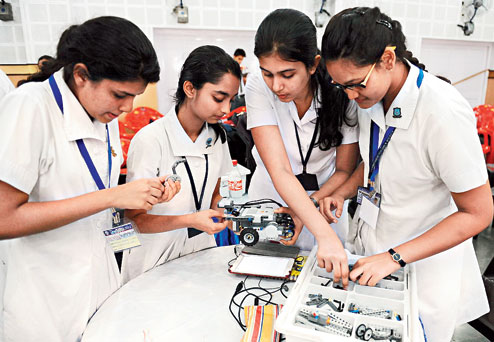
Students at the robotics workshop at La Martiniere for Girls. Picture by Sanjoy Chattopadhyaya

The first day of a robotics workshop at La Martiniere for Girls in May saw the girls struggling with motors, beams and light censors. But at the end of three days, they were adept at not just assembling a robot but also programming and navigating it through obstacles.

Five of the nine teams that participated in the workshop, including La Martiniere for Girls, qualified for the global round of International RoboCup Junior Competition presented by Indian RoboCup Junior Foundation. Tiro Nomura from Saitama University, Tokyo, judged the teams.

Lorraine Mirza, the principal of La Martiniere for Girls, met David Prakash, the chairman of the Indian RoboCup, in Bangalore. “Why not the east? I would like to host it in our school,” Mirza thought and soon enough she made arrangements to host the workshop and competition in Calcutta, in association with St. Augustine’s Day School, Barrackpore.

The students had to build autonomous robots and not remote-controlled ones, programme the robots and manoeuvre them through obstacles. “The robots have got sensors to sense the obstacles and avoid them,” Prakash said.

And then, as Mirza said, “it was time to test how much you (the students) have learnt and to pick out the teams that are going for the national competition”.

“On the first day, it was torturous for us and it took us three hours just to assemble. But over the next three days we learnt the programming as well,” said Nilakshi Padhi, a Class IX student of La Martiniere for Girls who was part of one of the teams that qualified for the national competition.

Four-member teams from South City International School, Mahadevi Birla World Academy, St. Augustine’s Day School, St. John’s Diocesan Higher Secondary School, La Martiniere for Girls and Boys and others took part in the workshop.

G.S. Rautela, the director general of National Council of Science Museums and the chief guest, urged the students to follow their passion. “Don’t be guided by peers or what your parents are pushing you to. If you like to build robots, build robots. If you want to write a poem, write poems. But follow your passion.”

source: http://www.telegraphindia.com / The Telegraph, Calcuta / Front Page> Calcutta> Story / by Jhinuk Mazumdar / Monday – July 07th, 2014

Home is where the care is

Knock knock: medical services are being delivered on the doorstep for senior citizens living by themselves, reports Sudeshna Banerjee
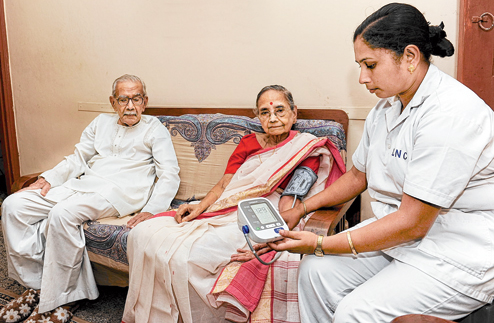
ChatterjeesKOLKATA06JUL2014

The Chatterjees of Jodhpur Park live on their own. The husband, a diabetic in his 70s, is recovering from a hip surgery. He has a nurse coming in every day to monitor his parameters and medicine intake, while a physiotherapist makes him do the mandatory exercises. A doctor drops by when the nurse flags for attention. His son, living away in the UK, does not have to depend on his weekly calls back home to find out how his father is doing. An emailed report reaches him every Saturday, with details of his medical status. It is not his mother who sends the mail but a homecare agency which he has engaged for his parents’ care. He can rest easy that they will take steps in case of a medical emergency as well.

With children flying the nest in search of career opportunities, the elderly in Calcutta are living alone at home in greater numbers. And to look after them, private agencies are coming up with far better management and accountability than the local nurse-ayah centres.

According to market analyst Frost & Sullivan, the Indian healthcare industry was valued at $79 billion in 2012 and is expected to reach $160 billion by 2017. The largest slice of the pie comprises healthcare delivery services.

“India has a 144 million geriatric population, second only to China. Fifty-one per cent of this number die of chronic diseases like cancer, diabetes and cardiac ailments. Because of advanced diagnostics, diseases are getting detected early and people are living longer. So there is a long period over which disease management is required,” said Ganesh Krishnan, co-founder and chairman of Portea Home Medical Care Services. In his estimate, the home healthcare market is worth about $2-4 billion and in the next 10 years the size of the industry would grow to over $15 billion in India.

The IIM Calcutta graduate, based in Bangalore, who calls himself a “serial entrepreneur”, detected this demand after selling off his last online venture, Tutorvista, in 2013 for $213million in what he says is the largest ever exit in the education sector in India.

Portea is already present in 18 cities, including Calcutta. “Seventy per cent hospital visits can be treated at home,” he said.

An NRI trio of Elina Dutta, Prateep Sen and Tamojit Dutta, along with a couple of friends, started Tribeca Care, a healthcare-at-home platform. They launched the facility in Calcutta last year with Prateep relocating to the city from the US. “We want to make it viable here before expanding to other cities,” said Elina, a former advertising professional who shuttles between Dubai and Calcutta.

Mission Arogya, an NGO which has set up the Kolkata Medical Emergency System website (www.kmes.in) with a Rockefeller Foundation centennial grant it won last year providing people with real-time data on ICCU bed availability in hospitals, is also venturing into this sector with Arogya Homecare Services, which will see a formal launch on August 1.

“We have started providing continuity of care for patients returning from hospitals. This way, patients need not overstay at hospitals, thereby raising their bills. Hospitals too can admit new patients if beds get vacated sooner,” said Mission Arogya co-founder Rajib Sengupta. Their second service in the pipeline is emergency retrieval. “We are tying up with institutions with advanced life support ambulances, which have ICU monitor and resuscitation kits, other than the usual oxygen and stretcher. We are training paramedical staff so that they can rush with an ambulance if a situation arises.”

Nurse with GPS-enabled device

And Calcuttans are ready to pay for such a service. “When we wanted to come here, everyone warned us that Calcutta is price-sensitive and price realisation would be lower. If you look at e-commerce figures for instance, the city lags behind even Chandigarh and Pune. But we have got the biggest response from here,” said Krishnan of Portea.

“It proves Calcuttans are ready to spend for what they perceive is important. Since it is usually the children who engage such services on behalf of parents, it shows family values and attachment are higher here than in other metros,” he added.

Perhaps the number of children having left home in search of jobs too.

What is novel about these companies is the professional approach they bring to a traditionally unorganised sector. “For every patient getting discharged from hospitals to our care, we appoint a care transition manager. He is responsible for setting up the infrastructure at the patient’s home — the bed, devices, oxygen cylinder… whatever his needs be,” said Tamojit Dutta.

Tribeca has divided the city into sectors and created a panel of 15 general physicians. “These days it is tough to make doctors come on call. Our empanelled doctors will do home visits for emergencies in their area,” Elina said.

Each of Portea’s health workers carries a GPS-enabled smartphone. “Thus we know how far he is from the patient’s home. We have developed an app by which the readings get recorded in our centralised database. If a patient’s blood sugar level, for example, is found to be high, the system issues an alert and the doctor in our headquarters has a discussion with the on-site health worker about remedial measures. The patient’s son sitting in the US gets to know that his mother’s sugar has been checked and the findings are sent via email and SMS,” said the Portea chairman.

Mission Arogya, which has a no-profit no-loss revenue model, wants to ensure that the service stays within the reach of the middle class as well. “Ours is a pay-for service model, not a subscription-based one. If a client wants us to scale up in any way, like use webcam and video conference to provide regular health updates to near and dear ones, we will do so,” says Sengupta, a Jadavpur University software engineer who is also pursuing research in bio-medical informatics at the University of Nebraska, Omaha.

Hospitals are largely welcoming of the development. “All these years we had no such service in Calcutta. People are at last thinking about it. With the number of patients with chronic illnesses on the rise, this is the answer,” said Arindam Kar, director, critical care, Medica Superspeciality Hospital, who has voluntarily trained a team of advanced nurse practitioners of the hospital to look after released patients at home for over two years now.

“This is a pay-for service and the patients are taken to the hospital if needed,” Kar added.

Each nurse is in charge of about five-six patients and is the one-point contact for all their medical needs. They instruct the ayahs engaged by the patients on duties like changing of oxygen cylinders, taking a call on whether a doctor needs to be called and facilitating appointments and blood sample collections.

Explaining why domiciliary disease management is beneficial to hospitals, he says the average realisation per occupied bed is far less for patients with chronic illness like Parkinson’s disease or bed sore than for those with acute illness requiring operation or investigations.

“After two days of stay in a hospital, if a patient with urinary tract infection is prescribed an antibiotic which has to be infused over an hour, he would find it taxing to stay back just for that. In such a case, it would suit both him and the hospital to have him treated at home,” Kar said.

Quality of caregivers

One problem area seems to be the lack of quality and accountability of the primary caregivers. At Tribeca, the senior-most nurses are direct employees of the company but the rest are sourced from nurse-ayah centres. “In the first batch of ayahs that we trained, a lot either left soon after or did not deliver,” Tamojit recalled. Tribeca Care tried out about 40-45 agencies from which the number of supply points has now been filtered down to 15. “We can’t handle a 300-strong ayah workforce. We’d rather have 30 nurses in our employ and work with agencies that we trust.”

But Portea does not believe in outsourcing. “We give the health workers a three-month training at a centralised location spending a lot of money. We can’t control quality unless they are our own people,” Krishnan said. The company has a 700-strong workforce across the country.

This lack of accountability has kept Mission Arogya from including ayahs in its portfolio of services. “Our nurse will teach the ayah engaged by patients how to take care of them, like changing the catheter,” said Sengupta.

Service bouquet

Elderly patients are asking for more. Mission Arogya will soon start delivering laboratory services and medicines to the doorstep. They will also take orders for medical equipment like medical mattress, Nimbus bed, bipap ventilation and insulin.

“We are trying to do dialysis at home but that will depend on logistics and location of the client,” said Sengupta. Portea also offers equipment on hire and pharmacy deliveries.

Tribeca Care is even devising a package that will include services of lawyers and accountants. “For the elderly, tax returns to groceries, everything is a problem. They are requesting for these services. We help with technology, too, like setting up Skype for clients to talk to relatives abroad,” Elina said.

“We even dabbled in property management as some clients needed help in disposing of property. We are also thinking of starting packaged tours for the elderly who are fit to travel,” said Prateep.
_________________________________________________________

HELP AT HAND

Portea Medical
3355 4554
E-mail: care@portea.com
Website: www.porteamedical.com

Tribeca Care
4027 7777
E-mail: enquiry@tribecacare.com
Website: www.tribecacare.com

Arogya Homecare
2436 1080, 8334880900
E-mail: contactus@missionarogya.org
Website: www.missionarogya.org

What other services do senior citizens require at home? Tell ttmetro@abpmail.com
___________________________________________________________
source: http://www.telegraphindia.com / The Telegraph, Calcutta / Home> Front Page> Calcultta> Story / by Sudeshna Banerjee / Sunday – July 06th, 2014