Category Archives: Science & Technology

Three-day astronomy exhibition

Siliguri :

The Sky Watchers’ Association of North Bengal (SWAN) will hold a three-day astronomy exhibition and a Live Lunar show here from October 31.

“This year, we are hosting our annual exhibition in association with the state department of information and cultural affairs. Lot of activities involving school students and youths would be organised at the Ramkinkar Exhibition hall in Dinabandhu Mancha during the three-day exhibition which will commence at 11am and conclude at 8pm everyday,” Debasis Sarkar, the SWAN secretary, said at a news conference here today.

Astronomical equipment like telescopes and imager and images of the space, planets and stars would be displayed at the exhibition. A video show on celestial events like eclipses and transit of Venus and an on-screen presentation on Mangalyaan would also be organised.

“We will also organise a quiz contest for students on astronomy and space science, discussion on science and astrophotography. We are expecting footfall of a considerable number of students, youths and senior citizens from Siliguri and the surrounding areas who are interested in learning more about astronomy. It is an open-to-all exhibition and the entry is free. We will distribute software and study material among enthusiasts,” Sarkar said. “As far as we know, it is the only integrated exhibition on astronomy in eastern India.”

By an integrated exhibition Sarkar meant a display of pictures, videos, equipment and holding of competition and discussions.

On the evening of November 2, the final day of the event, a live moon viewing through telescope would be organised on Siliguri Boys’ High School ground (next to Dinabandhu Mancha). “The basic idea is to popularise astronomy and inculcate interest in the subject and allied sciences in the common people and students. We appreciate SWAN’s initiative and we feel good to be associated with the event,” said Miten Chhetri, the subdivisional information and cultural officer of Siliguri, who was present at the news conference.

source: http://www.telegraphindia.com / The Telegraph, Calcutta / Front Page> Story> North Bengal / by The Telegraph, Correspondent / Thursday – October 30th, 2014

India’s First Fish Hospital to Come up in Kolkata

Kolkata :

The country’s first hospital to treat abnormalities and diseases in fish is set to come up in Kolkata by mid-2015, a senior scientist said.

Senior scientist T J Abraham, who is spearheading the project told PTI that the work has already started on the project.

He said that nearly 60-65 kinds of disease and abnormality were found in fishes in India and the one reason why West Bengal slipped from the number one position in fish production was due to the fact that 10-20 per cent of them died of diseases.

“Such hospitals are quite common in foreign countries,” Abraham, a senior fish microbiologist with the West Bengal University of Animal and Fishery Sciences, said.

The institute will not only help fish farmers increase yield by reducing the number of fish deaths, but will also ensure that people will consume healthy fish, he points out.

According to Abraham, the hospital will have 50 glass aquariums, 25 circular water tanks, each with a capacity of 500 litres, to admit and treat diseased fish.

The hospital will also have a separate well-equipped pathological lab to diagnose various fish diseases.

Asked when fish growers should approach the hospital, he said, “In such cases as abnormality, sudden death, change in colour or drastic reduction of weight, they may either contact the hospital or visit it with fish and water samples.”

He said that the diseased fish would be kept in aquariums for observation and after ascertaining the disease/ abnormality, medicines and tips would be provided to the growers.

The fish hospital, which is funded by the Indian Council of Agricultural Research, under the Union Ministry of Agriculture, has a budget of Rs five crore.

“Nearly Rs 1.70 crore will be spent on hospital construction and the rest on creating infrastructure and lab facilities,” said Abraham.

Apart from Abraham, who is heading the project, there will be another scientist and the team of the two will be assisted by 4-6 research scholars initially.

Abraham said that the hospital would document diseases affecting fish in Bengal to be forwarded to the World Animal Health Organisation, Paris of which India is a member.

source: http://www.newindianexpress.com / The New Indian Express / Home> Nation / by PTI / October 24th, 2014

A Doctor’s Quest

Since when did you want to become a doctor? Since I was a child in Chittagong. My father wanted my elder brother, whose schooling was being taken care of by a well-to-do family, to be a doctor but I too dreamed of becoming one.

But you weren’t even going to school… Yes, while my friends attended school, I used to sell fruit in the market but I made sure I progressed too. When they were back, I’d take their class notes and copy them. This went on till I was 13 or 14, when I became a tutor to some four- and five-year-olds and could pay the fees. So, I managed to go to school in classes IX and X and did well in matriculation. It got me a scholarship and took care of my Class XI and XII fees. I continued to be a tutor, and that was the time I began to believe that I could become a doctor. Though I had good results in the intermediate exams too and was eligible, I was told it wasn’t possible to get into medical studies in Chittagong, in what used to be East Pakistan.

And you decided to come to Kolkata… That the standard of education was much higher in India was motivation too. I arrived in 1955, all but penniless and armed with a letter from Mrs Nellie Sengupta and permission to stay at the zamindar’s Kolkata home for a few days. I discovered that Mrs Sengupta’s contact had fallen on bad times and was saddled with graver problems than mine. That’s when my struggles began. I went from one medical college to another but without any success. One day, overwhelmed by a sense of hopelessness, I was at College Square, when a man sitting on the same bench pulled me into a conversation. He literally dragged me to the famous Sarbadhikari house on Amherst Street and told me to seek an audience with Dr Kanak Chandra Sarbadhikari the next morning. I managed to meet the influential orthopaedic surgeon but he told me that I couldn’t get into a government college because I had no papers. He arranged for me to face the board at National Medical, which was then a private college. The interview went off well and I was in.

But you still had no money… I couldn’t afford hostel fees but managed somehow. Among things I did was carry the stretcher up and down buildings for St John’s Ambulance Brigade. It was hard work but it allowed me to stay at Netaji Bhavan. Later, when I started receiving refugee stipend, I moved to the hostel.

How did you end up in Newcastle? My life has been like a ship with a captain, dragging me from one place to another with the sole aim of making me a good surgeon. I had no resource to get into postgraduate education in Calcutta and the refugee stipend was also stopped. While I was contemplating all this, I fell in love and got married in secret. That was the best thing I did in my life. Leaving her behind at her parents’ place, I went to England in 1961 with very little money and without doing internship. After a month of going from one place to another, I finally landed a job at the Berry General Hospital in Manchester. The one year there got me the registration number, and after drifting from one speciality to another, circumstances had me landing up in the neurosurgery department. Gradually, I grew fascinated by what the neurosurgeons were doing — their fight between life and death, working on the pulsating brain to cure patients. I told myself I should be a surgeon for the most precious part of the body.

So, the struggle continued in England? Yes, it was hard. I had no holidays, working even on weekends to make ends meet for the growing family (son was born in 1963 and daughter in 1965).

How did you stay focused and pursue a high ambition despite poverty and other problems? Struggle has always spurred me to strive harder. I am sure it is largely because of my childhood moorings. In Chittagong, even as my mother somehow kept us alive, my father filled us with teachings of the great souls. They sounded hollow initially but became a source of great strength later. Swami Vivekananda’s words in particular provided the answer whenever I was confronted by doubt and dilemma. Soon, I knew nothing could stop me from achieving my goal.

When did you consider settling in India? The moment I passed FRCS from Edinburgh and England, my wife was keen to come back to India. I too wanted to serve here. It was 1971 by the time I could save enough for plane tickets. However, I couldn’t find a job here and we went back. A second attempt, in 1973, got me a job in Safdarjung Hospital in Delhi but they were only into head injuries. I was doing a much higher level of work. I failed to get a suitable placement and realized a job in India was not for me. I went back and worked harder to try to get a career in England. It was difficult for an Indian doctor to get a consultant’s job there at that time. During this period of despair, I got a call from Dr William Sweet, the famous neurosurgeon of Harvard University. I worked with him at the Mess General Hospital but I did not quite enjoy it and went back to the National Health Service in Newcastle.

You became a world famous surgeon… At that time, the success of aneurysm surgeries was very poor and I decided to take it as a challenge by making it my area of work. I travelled the world at my own expense to get better at it, meeting doctors, writing in publications.

You treated several VIPs. Can you tell us about it? On one occasion, in the mid-80s, I received a call from the PMO and later came to know it was Gopalkrishna Gandhi (who would later serve as governor of Bengal) at the other end. I had to rush to Delhi to attend to President Venkataraman’s wife, who had a brain haemorrhage. She insisted she be treated in Newcastle. After she had recovered sufficiently, she didn’t want stay in the hospital or move to a hotel. So, she came to stay at our house, and it became a fortress. They were charming people and strict vegetarians, so my wife and I became vegetarian chefs for a while! Soon, VIPs from different parts of the world wanted their loved ones to be treated by me. When I reached retiring age (65) in 2002, the Newcastle hospital named the OT ‘Robin Sengupta Theatre’ in a rare gesture. They wanted me to continue and I finally stopped in December 2012. I am now an emeritus consultant there.

You’ve had other honours as well… In 2003, the BBC did a programme ‘A Day in the Life of Dr Robin Sengupta’, which was a part of their ‘What is best in NHS’ series. Then, because I have trained so many Indian neurosurgeons in England, the Neurosurgery Society of India named me ‘Neurosurgeon of the Millennium’ in 2000. The National Academy of Science made me an honorary fellow. I was really moved when former President APJ Abdul Kalam gave me the Vivekananda Samman at the ‘World Confluence of Humanity, Power & Spirituality’ organized by SREI.

Why did you choose Kolkata for the Institute of Neurosciences Kolkata (I-NK)? Apart from an emotional connect with the city that made me a doctor, I also saw the urgent need for neurological services in eastern India. I had attained a great deal but I asked myself, ‘Should I now slip into a comfortable life in England, enjoying the fruits of my struggle and hard work, while people continued to suffer?’ Friends and relatives tried to dissuade me from such a task but Vivekananda’s words reminded me that it was better to wear out than rust away. My wife and I donated all our resources and so many others helped raise the funds, but I built I-NK with the support of the Kolkata Municipal Corporation and the government of West Bengal. I am looking for a bigger campus to set up facilities for top-level education and research and extend world-class services to more people. I-NK already has an association with the Newcastle hospital and more doctors from around the world will want to work here. There is no dearth of cases here. I am hoping the state government will join in this effort and we’ll do wonders.

What have you learnt and unlearnt in these 15 years of I-NK? I learnt that handling patients and their relatives here is a different art. In the West, they want to know the truth. Patients too want it, even if means asking ‘Doc, how long do I have?’ Here, not only will relatives insist that you not tell the patient, they often don’t want the truth themselves. All they want are false assurances.

What do you see when you look back? I see my struggle but also the sacrifices of people around me, particularly those of my family. The struggle may have been tasteless and painful at that time, but it’s like vintage wine now. That’s what time does. When I lost my only son, who too was studying medicine, in an accident in 1983, I was overcome by a sense of guilt at not having spent enough time with my family as I chased my goal. I still do surgery; it seems I’ll never be able to rest. There’s still so much left to do.

source: http://www.timesofindia.indiatimes.com / The Times of India / Home> City> Kolkata / by Arup Chatterjee & Debasish Konar, TNN / October 17th, 2014
Kolkata dock system creates record in monthly container handling

Kolkata :

Bharat Kolkata Container Terminals Pvt Ltd, a wholly-owned unit of PSA International is due to commence container handling operation at the Kolkata Dock System (KDS) of Kolkata Port Trust (KoPT) Terminal from December, 2014 and has already started mobilizing equipment. This was announced by KoPT chairman RPS Kahlon.

Officials believe that this will boost KDS’ performance which has already created a record in September. According to Kahlon, KDS handled 50,092 Twenty Feet Equivalent Units (TEUs) containers in September, creating an all time record. The previous highest was monthly handling by this port facility was in August, 2014, when it handled 44,873 TEUs.

“During the first six months of the current financial year, KDS recorded a growth of 7.93% in container handling as compared to the same period of the last fiscal and continued to hold third position among the major ports. Between, April and September, 2014, KDS and Haldia Dock Complex (HDC) combined handled 3,14,440 TEUs as against 2,97,970 TEUs in the corresponding period in the last fiscal. This was a growth of 5.52%,” Kahlon said.

According to officials, this was possible due to the sustained encouragement, faith and support of customers.

source: http://www.timesofindia.indiatimes.com / The Times of India / Home> City> Kolkata / by Jayanta Gupta, TNN / October 14th, 2014

Surgical cure for ‘silent fracture’

Kolkata :

An alarming 45 to 50% Kolkatans in the age group of 55 to 70 suffer from osteoporosis or some form of bone disorder, mentions a survey done by orthopaedics.

For about half of them, the disorder results from loss of bone density and it cripples them within two years.

“Silent fracture” of the vertebral column induced by osteoporosis is a common manifestation of bone disorder that now affects thousands in the city and 25 million across the country.

However, there is some ray of hope as a new form of treatment has emerged over the last few years to treat bone compression fractures effectively, say experts.

Balloon kyphoplasty is a technique that involves repairing a fractured and compressed bone with a balloon that’s inserted into the vertebral fracture.

It helps to restore the bone in its original position, thereby curing the resultant stoop caused by a curved spine.

The effect, according to doctors, is a long-lasting one and has helped patients improve their quality of life.

“Bone degeneration starts from the age of 45 and it gets very acute in some people. Loss of bone density leads to osteoporosis, often resulting in fracture of the spine. Once that happens, the spine gets curved, leading to a stoop that restricts movement. Balloon kyphoplasty is the only way of repairing a fracture-induced curve. But, it is used only in those who are in intense pain and have a severe stoop,” said Abrar Ahmed, orthopaedic su-rgeon at Apollo Gleneagles Hospital.

The surgical procedure is a simple one and the recovery time is just about two hours.

A small hole is drilled on the skin near the position of the vertebral fracture. A needle with the balloon is inserted into the fracture to lift up the bone to its normal height, thereby restoring the curve.

The balloon is then taken out with the needle and the gap is filled up with a fluid. The patient can walk within two hours of the surgery. Balloon kyphoplasty is also effective in trauma-induced spinal fractures.

“It works well for trauma patients with spinal fractures,” said Sisir Mandal, another rorthopaedic surgeon.

Experts said a simple bone mass density (BMD) test could help prevent bone compression and spinal fractures. “Those above 50 years of age, people who have been taking steroids for a long time and those with a history of bone injury or illness should undergo the test. BMD helps assess bone health and works as an alert for making pharmacological and lifestyle interventions to restore it timely. It could help to curb at least half of the spinal disorders including fractures. But, very few undergo the test on time,” said Ahmed.

The surgery is expensive, though. It costs Rs 2 lakh and is recommended only when all other forms of treatment are ruled out.

A healthy diet and a regular, active lifestyle help to slow down bone degeneration, said experts.

“Over the last decade, we have seen a major shift in lifestyle and food habits that has affected bone health. Sadly, awareness about bone diseases is among the lowest. This is probably why we have seen a spurt in the number of osteoporosis patients,” said Debashish Basu, preventive medicine expert.

Ahmed said balloon kyphoplasty was among the “safest and most advanced surgeries” of modern times.

source: http://www.timesofindia.indiatimes.com / The Times of India / Home> City> Kolkata / TNN / October 13th, 2014

IITians create solar-powered cold storage with no running cost

Kolkata:

Young IIT engineers have come up with an affordable solution to the wastage of agricultural produce by developing a unique solar-powered cold storage system which works at almost zero running cost.

Developed at the Science and Technology entrepreneurship Park (STEP) of IIT-Kharagpur by mechanical engineering student Vivek Pandey and his team, the micro cold storage system has been successfully tested in a Karnataka farmland.

“It is a first of its kind product developed anywhere in the world as there are no running costs for the farmer and works on clean and sustainable technology for all 12 months. We have even applied for four patents for technologies used in the product,” Pandey said.

Under the banner of Ecofrost Technologies, the young graduates are now ready to move out of the campus and start a manufacturing and assembly unit in Pune next month.

Using a uniquely designed thermal storage methodology that controls compartment cooling in tandem with regular cooling, micro cold storage helps increase the shelf life of agricultural produce using solar panels of 2.5 KW-3.5 KW.

“The power generated is sent directly on to the compressor which can run at various speeds to adjust itself to the cooling demand. Instead of batteries, the system has a thermal storage unit which can store power for more than 36 hours to provide power in case there is no sun during cloudy or rainy weather,” the young innovator said.

Existing solar-powered units run on batteries which need to be replaced after 2-3 years making the running cost very high for farmers. It is estimated that every year India loses around 30 per cent of food production due to wastage and contamination.

“We want to provide farm-level solar cold storages in areas that lack access to grid connected electricity. By increasing the shelf life of agriculture produce, it will improve farmers’ livelihood by reducing losses and allowing better price realisation,” Pandey said.

Meant for horticulture produce, the micro cold storage system has a capacity of 5 metric tonnes and a price varying between Rs 5 to 6 lakh.

“We have started getting orders and will start a manufacturing and assembly unit in Pune next month. We have a target to manufacture 20,000 such cold storage units in the next five years,” the IITian said, adding that they are looking to raise around Rs 5 crore from venture capitalists.

Their promising innovation has won the first prize of Rs 10 lakh in the national university competition ‘DuPont: The Power of Shunya’.

Besides selling directly to farmers, they are also trying to create village-level entrepreneurs who will act as nodal points for cold storage in mandis where any farmer can store his produce at a fixed cost.

source: http://www.ibnlive.in.com / IBN Live / Home> India / by Press Trust of India / Kolkata – September 18th, 2014

300 Rare Gramophone Recordings Digitised

Kolkata :

A rich collection of over 300 rare recordings, including speeches by Mahatma Gandhi, Jawaharlal Nehru and Netaji Subhas Chandra Bose and old classical music have been given a new lease of life through digitisation.

They can now be heard at a new digital sound archive centre at Weavers Studio here, which was thrown open to the public today.

Weavers Studio founder Darshan Shah said “Our primary objective is to preserve these voices of our ancestors and make them easily and electronically available for researchers, musicians, students of music and the public at large. It is unfortunate that many of our rare records are on the verge of destruction and without timely action, these would be lost forever.”

The oeuvre include Nehru’s speech after the Mahatma’s assassination and the original version of the national anthem sung by Gurudev and his students at Shantiniketan.

Other gems which have been digitised include the songs by Gauhar Jan, the country’s first classical singer to record in 1902, besides Hindustani and Carnatic classical music, music by Bengal artists and folk music.

There are also many versions of ‘Vande Mataram’, ‘Ram Dhun’ by Bismillah Khan and voices of Bal Gangadhar Tilak, Tagore, Rajendra Prasad, Vijayalakshmi Pandit, Aga Khan and Sarojini Naidu, among others.

Anyone visiting the studio can listen to the gems of the bygone era through kiosks and guided listening sessions and acquaint themselves through thematic exhibitions.

Shah said the collection would be taken to the youth in schools and colleges, museums and libraries to provide them a new perspective of looking at Indian history through sound and visuals.

Interested visitors to Weavers Studio are given android phones to listen to the records at the click of a button.

Also on display are the original gramophone records and gramophone players.

Some of the old and rare records collected and restored by the studio, which was set up in 1993, include Nicole and Pathe records dating back to 1900-1910 and the arare Beka grand records.

“We sourced the records from collectors and flea markets. This is an ongoing project and so we are still looking for old records,” Shah said.

In the second phase of the project, Weavers Studio would create an online archive where all these recordings would be uploaded on the web.

During 1902 to 1985, over 300,000 records were issued in India and were released under more than 75 different labels and in various formats, said Suresh Chandvankar of the Society of Indian Record Collectors in Mumbai.

They too are working for the preservation, documentation and dissemination of India’s rich cultural heritage in the field of audio and video recordings.

source: http://www.newindianexpress.com / The New Indian Express / Home> Nation / by PTI / September 05th, 2014

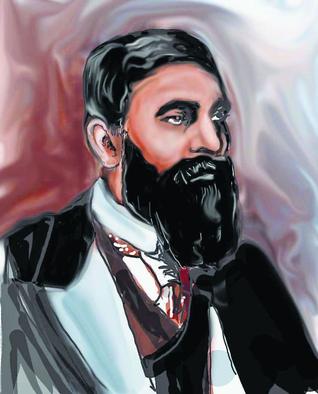
DOWN MEMORY LANE – A legendary doc

Dr. Hem Chandra Sen
Dr. Hem Chandra Sen

From curing ailments common and uncommon to initiating Durga Puja in Delhi, Dr. Hem Chandra Sen left behind an unforgettable legacy

Doc Holliday may have been a favourite with youngsters watching Western cowboy films over five decades ago, but long before that Delhi had its own bearded Doc whom few remember now. There were no motorised vehicles in 1879 when Dr. Hem Chandra Sen came here in a bullock cart all the way from Agra. Rich people travelled in palanquins, buggies or four-wheeled landaus and the poor in ekkas and carts. Women hardly showed their faces in public, they either wore burqas or ghoonghats and there was no electricity and piped water supply. In this milieu Dr. Sen became the first Indian allopathic doctor of Delhi.

From dispensing medicines to those building the E.I. Railways’ Agra-Delhi line, he started treating the local populace; women did not mind uncovering their heads and faces before him. Dr Sen was credited with “miraculous healing powers”, his day beginning at 4 a.m. and ending late at night. Rich and poor alike were treated by him. Those who couldn’t come to his chambers were visited by him, for which he used two sets of horse carriages — one for the morning and the other for the evening. He charged Rs. 2 (for the full treatment) from those whom he visited at home and nothing from patients who came to his clinic. He set up a pharmacy also, as getting medicines from Calcutta took a lot of time. Later it became a separate unit known as H.C. Sen and Company.

In 1883 Dr. Sen, founder of the Imperial Medical Hall, set up the Imperial Medical Press and type-setting moulding unit adjacent to his clinic. It was afterwards run by his nephew A.T. Roy, and the latter’s sons and grandsons, as one of the leading presses of Delhi. Member of the first management committee of Hindu College, Dr. Sen played a leading role in youth education along with Lala Shri Krishna Dass Gurwala (one of the founders of the college), M. M. Malaviya and many others of note.

Lala Krishan Dass Gurwala was among the seths who persuaded Dr. Sen to settle down in Delhi. It is interesting to note that the name Gurwala was appended to the family as it used to provide gur and gram to pilgrims, says the centenary brochure on Dr. Sen brought out in 1980. Gurwala’s grandfather was hanged by the British for supporting Bahadur Shah Zafar. The family traces its history to 1560 and Lala Nodhamal of Akbar’s reign. After Gurwala helped establish the Delhi Cloth and General Mills, it meant an extended practice for Dr. Sen. However when the good doctor fell seriously ill due to his exertions (“grace under pressure”, to quote Hemingway), the British Chief Commissioner of Delhi ensured that there was complete silence in the Fountain area of Chandni Chowk so that he was not disturbed. It’s worth mentioning that when Unani medicines were ineffective even the famous Ballimaran hakims did not hesitate in referring patients to Dr. Sen for a speedier cure.

Europeans also came to Dr. Sen, a Freemason, for treatment and for advice even on personal matters. Born in Calcutta before the 1857 Revolt, he died in 1906 and the Delhi markets were closed for a week as a mark of respect. He was succeeded by his sons, Dr B. C. Sen and Dr R.B. Sen (Adu Babu). From 1880 till his death Dr. Sen had stayed on in Delhi and among his guests were Rabindranath Tagore, Swami Vivekananda, novelist Sarat Chandra, Sir Surendranath Banerjee, Subhas Chandra Bose, Madan Mohan Malaviya, Hakim Ajmal Khan and the Maharajas of Jaipur and Jodhpur.

Interestingly, Vivekananda used to walk to the Yamuna every day through Chandni Chowk so long as he stayed in Delhi. The road from the Fountain leading to Old Delhi station is named after Dr. Sen and on Ansari Road in Daryaganj his descendants continue to maintain their 100-year-old pharmacy. Now a book on the legendary doctor, an initiator of Durga Puja in Delhi, is being written (at the behest of Anees Enterprises) by Shipra Sen to commemorate her ancestor whose medicines for curing diseases like jaundice, other liver infections and malaria are still popular. May be Doc Holliday too would have got rid of his bottle-induced problems had he cared to saunter (shoulder-strapped gun and all) into Dr. Sen’s celebrated 19th Century “Maktab” at the Fuwarra!

source: http://www.thehindu.com / The Hindu / Home> Features> FridayReview> History & Culture / by R. V. Smith / August 31st, 2014

Spunk and sacrifice – Awarded for excellence, courage and more

SnehaKOLKATA29aug2014

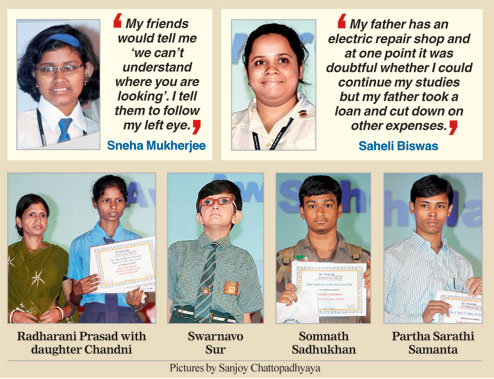
Sneha Mukherjee has a plastic sphere where her right would have been and minus power in her left eye but the only “favour” the 12-year-old takes in class is to sit in the front row.

Sneha underwent an eye surgery for removal of tumour when she was just 11 months old and had since had no vision in her right eye.

That has not impaired her spirit and Sneha, who has a ready response for any insensitive remark about her eye implant. “My friends would tell me ‘we can’t understand where you are looking’. I tell them to follow my left eye,” said the Class VII student of St. Joseph’s Convent in Chandernagore and winner of The Surrendra Paul Memorial Award for Courage at Peerless presents The Telegraph School Awards for Excellence 2014, in association with Parle-G and powered by Adamas University.

If Sneha has always been encouraged by mother Lopamudra not to take any favours, other parents have made sacrifices — big and small — for their children’s education.

Radharani Prasad has to work as a domestic help as her husband is confined to bed by paralysis but that didn’t stop her for admitting daughter Chandni to Gurukul Vidyamandir Higher Secondary School after she scored 75 per cent in ICSE. Chandni received The Telegraph Education Foundation Scholarship.

“The school did give us concession but despite that I had to pay about Rs 15,000 for her admission after taking loan. I haven’t been able to pay her monthly fee so far,” said Radharani, who shared The Abhirup Bhadra Memorial “Thank You Baba-Ma” Award with Balaka and Swarup Sur, parents of Swarnavo, a kindergarten student at Assembly of Angels Secondary School, Barrackpore.

Swarnavo had a hernia surgery when he was 10 months old and an eye surgery when he was three. “He is extremely regular in school and I do not have to give him any special attention,” said the proud mother.

It was for Subir and Swarnali Biswas (who received The Abhirup Bhadra Memorial “Thank You Baba-Ma” Award) that their daughter Saheli (who received The Telegraph Education Foundation Scholarship) could continue her studies.

“My father has an electric repair shop and at one point it was doubtful whether I could continue my studies but my father took a loan and cut down on other expenses,” said the student of Class XI.

The spunky Somnath Sadhukhan, who received The Faith in Astha Scholarship, studies geography honours at Surendranath College while his mother sells pens and stationery in and around Shyambazar.

Rudrangshu Mukherjee, the managing trustee of The Telegraph Education Foundation, had one thought on Saturday for the students. “When you become somebody eminent, somebody successful… just turn back and reflect on those who need to be educated, those who need your support… “Please grow with The Telegraph Education Foundation, the best is yet to be because the best is in your hands.”

Barry O’ Brien, the convener of The Telegraph School Awards for Excellence, shared how students and teachers have often told him how moved they are by the stories of courage and resilience.

“Don’t just be moved. Don’t just take a handkerchief out of your pocket and wipe your tears. Do something small, very small, it could be anything. Try to reach out to somebody,” was O’Brien’s advice,

Delhi Public School Megacity and Sunita Sen, the principal of Ballygunge Shiksha Sadan, did just that, responding on the spot to a request to fund a laptop for Partha Sarathi Samanta, the son of a guard who is studying MTech at the Indian Institute of Engineering Science and Technology. They chipped in with Rs 40,000 for the recipient of The Club Friday Scholarship.

source: http://www.telegraphindia.com / The Telegraph, Calcutta / Front Page> Calcutta> Story / by Jhinuk Mazumdar / Tuesday – August 26th, 2014

IIT-Kharagpur working on national digital library

Seeking to create a national online educational asset for students interested in research and innovation, the IIT Kharagpur, recently put forth a proposal to form a NDL to the Ministry of Human Resource Development.

Seeking to create a national online educational asset for students interested in research and innovation, the Indian Institute of Technology (IIT) Kharagpur, recently put forth a proposal to form a National Digital Library (NDL) to the Ministry of Human Resource Development.

The MHRD not only approved of the project, but also granted Rs. 100 crore for the project to be kick-started by the IIT Kharagpur, one of the premier tech institutes in the country. This was announced by institute’s director Partha Pratim Chakrabari at the 60th convocation ceremony in July-end.

Talking to The Hindu over phone, one of the core team members who ideated the NDL Partha Pratim Das said the project’s main aim was to create a knowledge base for students of all ages, especially for those interested in research.

“Every university has its own digital archive of its intellectual output and syllabus, known as the Institutional Digital Repository (IDR), whose access is limited to the university’s own staff and students. The NDL is modelled on the IDR, but will consist of IDRs of several universities and any student will be free to access it. For instance, a student of IIT Madras will be able to access study material of a specialisation taught exclusively at IIT Kharagpur. The NDL aims to streamline IDRs and other study material into one common online,” Prof. Das, also a professor of the computer and engineering department, said.

Except for copyrighted content, the data will mostly be available for free.

While the NDL is a relatively new concept in India, it has already made its appearance in most universities in the west. The content for the NDL will be derived from institutes of all types of specialisations and will include school-level study material as well.

The multi-faceted project would start by incorporating digital content of about 50 institutions at the primary level, keeping the next target at about 100 institutions.

Another focus of the project is to create e-content, comprising video lectures, interactive questions and answers and books, in multiple languages.

Stating that ‘a lot of activity is planned in vernaculars’, Prof. Das said: “Initially, the knowledge base will be created in English. We will gradually include vernaculars and create a multi-lingual interface so that students from across India can freely access it without facing a language barrier,” Prof. Das said.

The brainchild of a four-member team will be launched in 18-21 months and a prototype will soon be launched to test the project’s feasibility. About 100 courses will be launched at a preliminary level.

Headed by Prof. Chakrabarti, the proposal was worked on by professor in charge of the institute’s central library Subrata Chattopadhyay, professor of the computer and engineering department Sudeshna Sarkar and librarian of the central library B. Sutradhar along with Prof. Das.

Keeping in mind the evolving technology, plans are on to make the interface available across all platforms — cell phones, tablets and laptops. Content will also be developed keeping in mind the needs of differently-abled students.

source: http://www.thehindu.com / The Hindu / Home> News> Cities> Kolkata / Kathakal Nandi / Kolkata – August 04th, 2014