Category Archives: Science & Technology

Sky’s the limit for these girls

BirlaGirlsKOLKATA30dec2014

Lying on blankets at a height of 9,200ft, they gazed up at the sky and couldn’t believe what they saw. Khushi Goenka and two of her schoolmates from Modern High School for Girls were staring up at the Milky Way. With the naked eye.

In Hawaii to attend the second edition of the Pacific Astronomy & Engineering Summit at Imiloa Astronomy Center, the girls had seen the constellation through a telescope just the day before. “It was unbelievable because the previous day at the astronomy centre we had seen the constellation and other stars and there we were, seeing it again, this time with the naked eye,” said Khushi, a Class XII student.

Khushi, along with Class XI students Adwitiya Dawn and Shruti Keoliya, made up the only team from India invited to the five-day conference. Accompanied by their physics teacher Pamela Dutta, the girls worked in collaboration with Puragra (Raja) Guha Thakurta of the department of astronomy and astrophysics at University of California, Santa Cruz, and PhD student Emily Cunningham on the Halo 7D project.

The conference included presentations by scientists and astronomers from China, Japan, Canada and the US but the high point for the city girls was a meeting with five scientists who had spent four months in isolation in simulated Mars-like conditions.

“We met the HI-SEAS crew, a group of five scientists who had spent four months in isolation on a Mars-like surface on top of a mountain. We got hold of an aeronautical engineer and kept asking him absurd questions to satiate our curiosity and not letting him eat his plate of chicken that he hadn’t in the past months,” recalled Shruti.

After the girls returned to the city, Guha Thakurta visited their school and shared with Metro the importance of research and how the trip not only opened new avenues for the girls but also opened their minds to new ideas.

“It opens the eyes of students, especially those who are used to finding exact answers even to difficult problems, to the fact that there are problems that do not have a right answer. In research you have some idea of the question you are trying to answer but there is no guarantee you will find the answer,” explained Guha Thakurta, an astronomer for 30 years. “In most high schools, students are taught there is a correct answer and there is an incorrect answer. To know that there are many shades of grey in between is an eye-opener. The girls, on several occasions, were looking for answers but we would tell them we don’t know the answers or the answer is not known.”

Guha Thakurta said the girls understood the need for research and saw “some laws of physics, some of which they put in their presentation. Some of it they had learnt in class but what they had probably not seen is how someone who making a career as a researcher still uses the formula that they are learning in high schools”.

“In the initial document sent to us, the astronomy terms seemed alien and too technical. But as we started researching, the concepts became clear and we tried to make our presentation (calculating the mass and structure of Milky Way) as comprehensible as possible for the layman,” Adwitiya said.

The five-day trip included sessions by scientists and astronomers, visits to museums, trekking and cultural presentations and some bhangra and dandiya to get everyone at the conference on their feet.

“As far as education is concerned, travelling contributes hugely as does mixing with people and working together as a team on research. The girls had to Skype with California early in the morning before school and be there in time to attend school,” said Devi Kar, the director of Modern High School for Girls.

source: http://www.telegraphindia.com / The Telegraph, Calcutta / Front Page> Calcutta> Story / by Jhinuk Mazumdar / Tuesday – December 30th, 2014

New Town to get country’s first floating solar plant on Jan 5

Kolkata :

The country will get its first floating solar power plant on January 5.

The unit, which will generate 10KW solar power every day, will be inaugurated at Rajarhat New Town. State power minister Manish Gupta will inaugurate the floating solar power plant installed on a waterbody near Eco Park in New Town.

The floating solar power plant has been jointly set up by the Arka-Ignou Community College of Renewable Energy, headed by solar power expert S P Gon Chaudhuri, and the New Town Kolkata Development Authority (NKDA).

The power that will be put into the grid through marine cables will light up several areas in Eco Park and its surroundings.

Gon Chaudhuri, who is a former managing director of West Bengal Renewable Energy Development Agency (WBREDA) and West Bengal Green Energy Development Corporation (WBGEDC), said the ministry of new and renewable energy (MNRE) had earlier sanctioned a grant of Rs 20 lakh to the authorities as a research component and another Rs 15 lakh for developing and installing the solar panels. The panels have already been installed and are now ready to generate power.

“Already, engineers from different parts of the country are coming to have a look. A team of experts is coming from Lakshadweep soon to take a look at the project as a similar project will be taken up there,” Gon Chaudhuri, who was also the former adviser to the state power department, said.

Gon Chaudhuri also said that that it was around one and a half years ago that he first thought about developing a floating solar panel.

“Land is required for setting up any power plant, but a floating solar panel doesn’t require any land, since it is set up on a waterbody. Only Japan and Australia have developed floating solar power plants so far,” he added. “I gave a proposal to the Centre that developing such floating solar panels has its own benefits since it will not only generate pollution-free solar power, but also help emit less carbon dioxide. Once this floating solar panel is inaugurated and starts generation, we will conduct further research on this,” Gon Chaudhuri said.

source: http://www.timesofindia.indiatimes.com / The Times of India / Home> City> Kolkata / by Suman Chakraborti, TNN / December 22nd, 2014

IIT-Kharagpur conclave a stepping stone for budding entrepreneurs

Kolkata :

Students of IIT-Kharagpur will get the opportunity of rubbing shoulders with renowned academics, new-age entrepreneurs, eminent business personalities and successful venture capitalists over three days in January when the premier B-school organizes the sixth edition of the Global Entrepreneurship Summit (GES 2015).

Companies like Microsoft, IBM, Intel, Flipkart, Amazon Web Services, BSE, Deloitte and other corporate giants will hold workshops between January 16 and 18, focusing on the entrepreneurial acumen of participants. IIT-Kharagpur’s entrepreneurship cell, which is organizing the event, has already undertaken various activities on the same lines, including the pan-India entrepreneurship awareness drive. Following the successful culmination of the drive, which saw close to 25,000 applicants participating from 24 cities last year, the e-cell is now moving on to the flagship event.

The previous edition of GES has seen people like India TV founder Rajat Sharma, Aakash tablet founder Suneet Singh, serial entrepreneur Dominique Trempont, Forbes columnist and Silicon Valley entrepreneur Srimana Mitra, renowned social entrepreneur Harish Hande, former ICICI Bank deputy manager Nachiket Mor and naukri.com founder Sanjeev Bhickchandani participating. Even this year, the organizers are trying to rope in a star-studded panel.

GES is the only such conference of entrepreneurship that will serve as a conclave for discussion of opportunities and programmes aimed towards promoting entrepreneurship in various universities across the world. It will host a global business model competition, Empresario, powered by Viligro, which saw entries from around the country at the preliminary round in October. The finals of the competition will be part of GES where the winners will get a direct entry into the semi-finals of the International Business Model Competition.

The other important event is the start-up camp that will involve interaction of entrepreneurs and students where start-ups will recruit the finest talent for internships or jobs while giving them an opportunity to meet to meet the CEOs in campus.

Unlike previous years, GES 2015 will be an invite-only summit where only specific colleges will be able to send their delegations.

“IIT’s entrepreneurship cell aims at supporting budding entrepreneurs. GES will prove to be the ultimate stage for propagating the cause,” said Deepak Kumar Jha, a member of the e-cell, IIT.

GES 2015 has Flipkart as its title sponsor along with sponsors like IBM, Villgro, VMware, Fedena, Haier, Air India and the WBIDC.

source: http://www.timesofindia.indiatimes.com / The Times of India / Home> City> Kolkata / TNN / December 12th, 2014

One stop, three starts

ApolloKOLKATA04dec2014

The Apollo Hospitals group will set up a medical college in the city with 150 MBBS and 50 postgraduate seats and a 1,000-bed hospital.

The state government has given a 14-acre plot at Calcutta Riverside in Maheshtala, on the southern fringe, to the group for setting up the medical college. The institution will be the fourth private medical college in Bengal.

The township is coming up on 262 acres on the banks of the Hooghly, about 20km from the city. Apart from residential apartments, Calcutta Riverside includes a medical college, a film city and a sports academy.

“With the Apollo Institute of Medical Sciences and Research, Calcutta will become one of the health hubs. We’ll bring faculties and new technology,” Prathap C. Reddy, the chairman of the Apollo Hospitals group, said at a programme where chief minister Mamata Banerjee laid the foundation stone for three facilities at Calcutta Riverside.

He said the medical college would be part of a bigger project by the Apollo group, which will have 17 other colleges, including ones related to paramedics, nursing and allied health services.

Mamata said she had formed a group of ministers to get the project cleared. “In the coming days a lot of doctors will be produced from here,” the chief minister said in her speech at the programme.

Apollo officials said the Rs 300-crore project would be completed in five years and in two phases. In the first phase, there will be 100 MBBS seats and a 500-bed hospital.

“We are planning to bring faculty from abroad,” said Rupali Basu, the chief executive officer of Apollo Gleneagles Hospitals, Calcutta. Once the building that will house the medical college is ready, the group will apply for a no-objection certificate from the health department. After getting the certificate, the group can apply for an inspection by the Medical Council of India.

Bengal has 2,450 MBBS seats, nearly half of which were scrapped by the medical council earlier this year because of lack of adequate infrastructure at the colleges.

The council later restored the seats after the colleges promised to set up the required facilities.

Along with the medical project, the chief minister laid the foundation stone for Kolkata Studios and Sourav Ganguly’s school and sports academy. The former Team India skipper was present on the occasion.

source: http://www.telegraphindia.com / The Telegraph, Calcutta / Front Page> Calcutta> Story / by The Telegraph Special Correspondent / Tuesday – December 02nd, 2014

French scientist wows students with ‘do-it-yourself’ science

Kolkata :

It’s a rare lecture that makes teachers feel like the taught and forces guardians to pull out chits of paper from their wallets to take down notes in a hurry. When renowned French scientist and author Nicole Ostrowsky speaks, the laws of magnetism take on a whole new meaning.

The acclaimed physicist was in Kolkata last week as the star attraction of the third edition of Apprentice Scientist competition at The Future Foundation School (TFFS). The contest, held in collaboration with its partner school Lycee Francais de Pondicherry, encourages some of the best young brains in the city to get out of their textbooks and test their scientific aptitude in creative ways.

The participating school teams get the same equipment — and questions that force them to think out of the box. This time, for instance, each team got two plastic glasses, a football, three bottles and other items that look like odds and ends. One of the questions was: can you transfer air using two cups and a container full of water?

The teams of Class VII students had to complete four experiments, at the end of which they came to realize, hands-on, that all sciences — physics, chemistry, biology — are linked.

The correlation between sciences was a key feature of Ostrowsky’s lecture. She added psychology to the group and pointed out how it would dominate research in the days to come.

Ostrowsky, author of ‘The Agenda of the Apprentice Scientist’, is on a worldwide mission to make science fun for children. A professor emeritus at University of Nice in France, she has taught at Harvard and founded the ‘Exploratoire’ in Paris, a hugely popular collection of interactive scientific experiments. This is her first visit to Kolkata. “I am fascinated by the colours here,” she said.

The packed hall at TFFS was completely under her spell as Ostrowsky put up one scientific riddle after another: If you put a pea and a banana in a bowl of water, which will sink? If all the icebergs in the world melted, would the sea level rise? She showed how the answer to these questions can be found in simple experiments at home. “Be curious. Ask questions. That is what a scientist does,” she advised students. Handing over her pointer stick to students, she asked if anyone could find its centre of gravity. One boy did, drawing applause.

The same spirit was seen in the contest where Cedric Le-Bescont, head of science teachers at Lycee Francais, was urging the competitors to “forget your books and write your own science”. “Forget what you learnt. Analyze what you see,” he kept telling students.

He wanted them to stop etting confined to any one branch of science and to allow them to look for down-the-lane answers. The winners were Heritage School, followed by South City International and Modern High for Girls.

source: http://www.timesofindia.indiatimes.com / The Times of India / Home> City> Kolkata / TNN / November 25th, 2014

NBU to host science meet

Siliguri :

The North Bengal University has been chosen by the state department of science and technology to host the Bengali Science Congress for two days in February-end next year.

According to varsity sources, the authorities were informed by officials of the state science and technology department about hosting the two-day event from February 28.

“The trend of hosting the Bengali Science Congress was started by the erstwhile Left Front government. The main aim of holding such a meet is to encourage young students to take up science in their higher studies, pursue research or start careers in the field. Even research scholars benefit from the congress as they get to know about the recent findings in the field, new technologies and new areas which can be subject of future research,” a varsity source said.

The two-day event will be conducted mostly in Bengali and thus, it has been titled Bengali Science Congress.

“Most of the lectures, exhibitions and posters will be in Bengali. Students may not understand certain scientific terms in English and that is why Bengali has been kept as the medium of instruction. Such events will help clear their doubts and also give them direction as to which field of science they want to take up in future,” a source said.

The last time NBU had hosted the congress was in 1998. Topics in different fields of science like botany, zoology, chemistry, physics and environmental science will be dealt with at the event. Around 25 resource people like faculties of different varsities and scientists will be invited to the event.

“We are hosting the event after around 16 years. The host varsity as well as the state department will choose the resource persons for the event,” said the source.

source: http://www.telegraphindia.com / The Telegraph, Calcutta / Front Page> North Bengal & Sikkim> Story / by The Telegraph, Correspondent / November 20th, 2014

Innovation showcased at science meet

Kolkata :

Innovation and creativity were the hallmarks of the third Times NIE Science Project Competition held on Saturday at NSHM Knowledge Campus, Kolkata. Presented by NSHM Knowledge Campus, the event saw students from over 50 schools impressing the distinguished panel of judges with their projects on Physical Science, Life Science or Social Science. The projects were evaluated on three primary parameters: innovation, application and presentation.

The projects made by the students ranged from nanotechnology, hydraulics, cardiology, hovercraft, Everest climber, USB fan to smart stick for the blind, virtual reality, solar car, windmill, gastro-entro system, bottle tornado, robotics, gyro boat, Kepler space telescope and solar sound radio receiver.

The judges were Dr. Abhijit Chakraborty, professor and head, Crystallography and Molecular Biology Division, Saha Institute of Nuclear Physics; Dr. Rajendra Nath Basu, chief scientist and head, Fuel Cell and Battery Division, CSIR-Central Glass & Ceramic Research Institute, Kolkata and Dr Manish C Bagchi, CSIR Emeritus Scientist, School of Bioscience & Engineering, Jadavpur University.

The first prize was won by La Martiniere School for Boys for their project ‘Auto control street light’ which showed how street lights can glow for one or two km only on detecting vehicular movement. In second place was Calcutta Girls High School for their project, ‘Flix’, a hydraulic robotic arm which was based on Pascal’s Law. The Heritage School came third for their project on the advantages of automatic irrigation system. Special Appreciation Awards were given to 10 schools.

“At NSHM, we believe in learning by doing. In fact, we give emphasis on experiential learning. The kind of curriculum we offer are not typical academic courses. We call them professional degree courses which are different from the run-of-the-mill or traditional academic courses,” said Cecil Antony, managing trustee, NSHM Knowledge Campus.

source: http://www.timesofindia.indiatimes.com / The Times of India / Home> City> Kolkata / by Althea Phillips & Monalisa Chakraborty, TNN / November 17th, 2014

Raman memorial lies forgotten

Kolkata :

Few in Kolkata seem to remember Sir C V Raman on his 226th birth anniversary or the fact that he discovered the Nobel-winning Raman Effect at a small laboratory in this city.

The memorial on the campus of Goenka College of Commerce at BB Ganguly Street stood forlorn and deserted on Friday. A bust of the scientist had been garlanded and a bunch of agarbattis lay nearby. Nobody had bothered to relight them after they went out soon after being lit the first time.

“We haven’t seen any programme organized here. The college administration takes care of garlanding the bust and keeping the place clean. We sometimes use it as a shelter when it rain,” a student said.

When the ‘Hall of Scientific Fame’ was inaugurated in January 2013, it was announced that scientific discourse would be held there routinely. Replicas of Raman’s instruments were to be displayed. An enclosure exists but it is empty.

The original building of IACS, the first science research unit of India, was established during Bengal Renaissance where Goenka College now stands. It was here that Raman carried out his research between 1907 and 1933 that won him the Nobel Prize in 1930.

When Bidhan Chandra Roy was chief minister, he offered land to IACS at Jadavpur as the BB Ganguly Street plot had to be returned to the government so that Goenka College, which was in Presidency College, could become an independent institution. Raman was extremely unhappy on coming to know that the original campus of IACS hadn’t been preserved and resigned his membership.

In 2012, scientists from Kolkata appealed to then Prime Minister Manmohan Singh to build a memorial on the original site. This was inaugurated in 2013. “It’s just a memorial where no other activities are held. Little effort is made to preserve heritage in our country. We can’t carry out any activity at BB Ganguly Street as we are located quite far now. We can’t keep replicas there as the space is open,” said Prof Deb Shankar Ray, acting director, IACS.

source: http://www.timesofindia.indiatimes.com / The Times of India / Home> City> Kolkata / by Jayanta Gupta, TNN / November 08th, 2014

Rs 16cr bounty for IIT-Kharagpur innovators

Kolkata :

Freedom to experiment has always been a strong point for IIT-Kharagpur. And now, this freedom will take budding innovators across the globe to realize their dreams. On Wednesday, two alumni of the institute, Arjun Malhotra and Srigopal Rajgarhia, came up with a generous ‘gift’ of Rs 16 crore for their alma mater.

While Malhotra, with his Rs 6 crore plus grant, is setting up the innovation centre inside the campus, Rajgarhia has donated Rs 10 crore to connect the Kharagpur campus with best-known institutes abroad. This is not just an “exchange” link in the form that we know it otherwise. Under this international programme, 30 best students of IIT-Kharagpur will be sent abroad to complete portions of their projects/credits there. This will be added to their degrees and the entire cost for their travel, stay and tuition will be borne by the institute from the endowment.

A part of Rajagarhia’s grant will be used to bring top-notch faculty from abroad for specific teaching hours.

For Malhotra, donating to IIT has become routine now. “I am aware of the talent in the boys here, which sometimes don’t come to the fore for lack of funds. The innovation-centre is a no-holds barred place where any one within the campus can soil his hands to bring alive any bright idea,” promised Malhotra.

“We need to build the confidence among students so that they inculcate the ability to start experimentations from the very beginning. The institute wants them to get exposure from the very first year. Innovation should not be limited only for a handful of students,” said alumni affairs and external relations dean Siddhartha Mukhopadhyay.

PP Chakraborty, director of the institute, was happy that finally IIT-Kharagpur has shed its conservatism in teaching-learning process and moving towards globalisation. “It is not enough to be just a premier tech school of the country. Our students do need foreign exposure. Each selected student’s curriculum will be framed in such a way that they are able to do a lot of reference work in the libraries and laboratories, attend lecture hours and also visit industrial houses abroad.”

source: http://www.timesofindia.indiatimes.com / The Times of India / Home> City> Kolkata / TNN / November 06th, 2014

Chaos to School in the Cloud

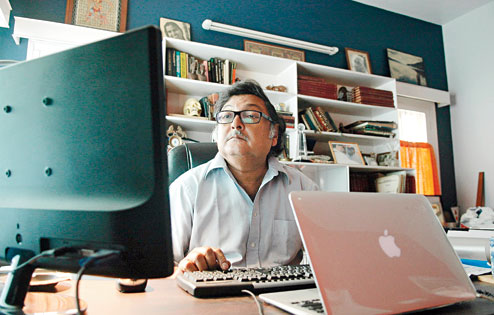
SugathaKOLKATA02nov2014

Calcutta-born education scientist Sugata Mitra grew up in a strict Jesuit-school environment in Delhi where life was all about discipline and order.

Little did he know that one day his life would be all about “theories of chaos”, the key to a series of self-organised learning environments that are transforming the way education is imparted.

Mitra, a physicist by training and a polymath by choice, is the winner of the 2013 TED prize that fetched one million dollars for his radical educational project School in the Cloud. Seven such experimental facilities have since been launched in the UK and India, three of them in Bengal.

Apart from giving shape to his vision, the 62-year-old scientist is making the most of his stay in Calcutta with “a daily visit to the bazaar to shop for fish and duck eggs”.

For Mitra, professor of educational technology at Newcastle University in the UK since 2006, each day is about implementing what he calls SOLE, or unsupervised self-organised learning environment. This theory forms the basis of his School in the Cloud concept, a term that he first used in a riveting speech after winning the TED award last year.

Mitra was the first recipient of the one-million-dollar purse since it was raised from $100,000. Past winners of the prize, awarded by the non-profit Sapling Foundation to foster the spread of “great ideas”, include Bill Clinton and Bono.

The journey to worldwide recognition of Mitra’s great ideas started with a winning experiment in 1999 called Hole in the Wall. The then Delhi-based scientist and educator embedded a computer within a wall in a Kalkaji slum and children were allowed to use it freely. The experiment proved that kids could quickly learn computers on their own without any formal training.

Mitra called it Minimally Invasive Education and the experiment caught on, even inspiring the novel Q&A by Vikas Swarup that Danny Boyle adapted into the Oscar-winning Slumdog Millionaire.

The unintended connection with Slumdog Millionaire is not something he is excited about. “I was quite startled at first because I couldn’t see the connection,” Mitra said of the film. “The fact that you can learn by yourself was put into a very different, rather sad context. I wish that one wouldn’t have to learn under the circumstances as we see in the movie.”

So would he have approved if the story didn’t feed on the rags-to-riches formula?

“I found Vikas Swarup on the Web after the film released in England and wrote to him. We were in correspondence and I still feel it would have been better if it were about a slumdog professor who did not win a million-dollar game show but went on to become a professor!” Mitra said.

School in the Cloud, which has brought Mitra back to Calcutta, started in the UK three months ago. “It’s a three-year research project and according to the budget, a maximum of seven locations is what I could afford (with the prize money). The challenge was to find those seven places,” Mitra said.

In England, he picked George Stephenson High School, “where the steam engine man George Stephenson lived”, and another in the rural hamlet of Durham. In India, he found a school each in Delhi and a town called Phaltan, near Pune, besides the three in Bengal. The first three are already operational.

“I am here because the most remote of all the sites is a village called Korakati in the Sunderbans, where the facility will hopefully be operational from March 9, followed by one in the village of Chandrakona in West Midnapore on March 13. Third in line is a semi-urban school at Gocharan in Barasat,” said Mitra, working out of a well-appointed study in his Salt Lake home.

Since the project was launched here this February, help has come from “unexpected quarters”.

“People had read about my TED wish in the papers and I was getting calls. Then, one morning in February 2013 somebody landed up at my house early morning. He was a schoolteacher from Korakati who wanted to do something for his village and from the description, it was the kind of place I was looking for — no electricity, no health care, no primary education,” the education scientist recounted.

Midnapore appeared on his radar through an NGO and Gocharan was suggested by a doctor friend who works there.

Mitra’s confidence in his experiment with unsupervised self-organised learning challenges the basics, including the concept of a school.

If his Hole in the Wall experiments with slum children in India from 1999 to 2004 showed there is no limit to learning capacity “as long as children are left unsupervised and allowed to work in groups”, carrying the project to the UK entailed turning it “upside down”.

In the third phase, he chose south India for an experiment that made him realise how children stop being adventurous if there’s a teacher breathing down their necks. “Therefore, the process of unsupervised learning had to be done purposefully or replaced with a different kind of adult, maybe a grandparent.”

He found out that a grandmother’s presence helped step up a child’s academic performance. “That’s how I got the third piece of my puzzle. I realised I had to have children in unsupervised groups, along with the Internet and an admiring adult.”

In his pursuit of the “admiring adult”, Mitra put out a request for “British grannies”.

“We were looking for retired teachers who may not be grandmothers but were willing to come on Skype and talk to children for one hour every week for free. I got hundreds of calls,” Mitra recalled.

And when the TED prize happened, he thought: “Now is the opportunity to put these pieces together and see what we get.”

“It was TED that coined the term School in the Cloud, where cloud is the other word for the Internet and that is where grannies and children connect,” he explained.

Mitra today has 300 grannies on board, mostly from the UK and also the US, Canada, Australia and India. “At any point in time, we get 30 active grannies,” he said.

And what does a School in the Cloud look like? “Essentially like cyber cafes for children with a few important differences. The computers are big, publicly-visible screens within a glass-walled room, which is an effective control on what they are doing on the computers,” Mitra said.

The group size is determined by the number of computers he can afford. “So we have clusters of four or five children per computer. It has low-level seating and there’s a 52-inch screen on the wall where the granny comes on live over Skype, almost lifesize. It’s like being present there,” smiled Mitra, who keeps an eye on the proceedings through a surveillance camera along with his research team.

English is the most important part of the agenda, Mitra said, for the Indian leg of the School in the Cloud project. “While they want their children to learn many things, what the parents are most interested in is English because they feel that will change their lives more than anything else, which I feel is true. I hope native English-speaking grannies will be more easily able to transfer language skills to these children.”

A typical SOLE session, 40 to 60 minutes long, is open to topics that children might ask for or those initiated by the grannies.

A research team will soon be travelling to Korakati and Chandrakona for a baseline measurement of where the kids stand. “I am focusing on ages six to 14. They follow a very old-fashioned disciplined structure but I have managed to remove the adults,” said Mitra, who has arranged for a waiting room next to the schools for mothers to watch on a large screen what their children are up to.

Schools in the Cloud in Bengal will be kept shut during regular school hours so that children continue with their regular education and their teachers don’t feel threatened. “I am not replacing schools. I am supplementing them,” Mitra said.

Just as fish and duck eggs supplement the Bengali in him

What message do you have for Sugata Mitra? Tell ttmetro@abpmail.com

source: http://www.telegraphindia.com / The Telegraph, Calcutta / Full Page> Calcutta> Story / by Mohua Das / March 04th, 2014