Recently, a Santhal village in Birbhum killed the post of majhi haram or morol. We visit the headman of a nearby village
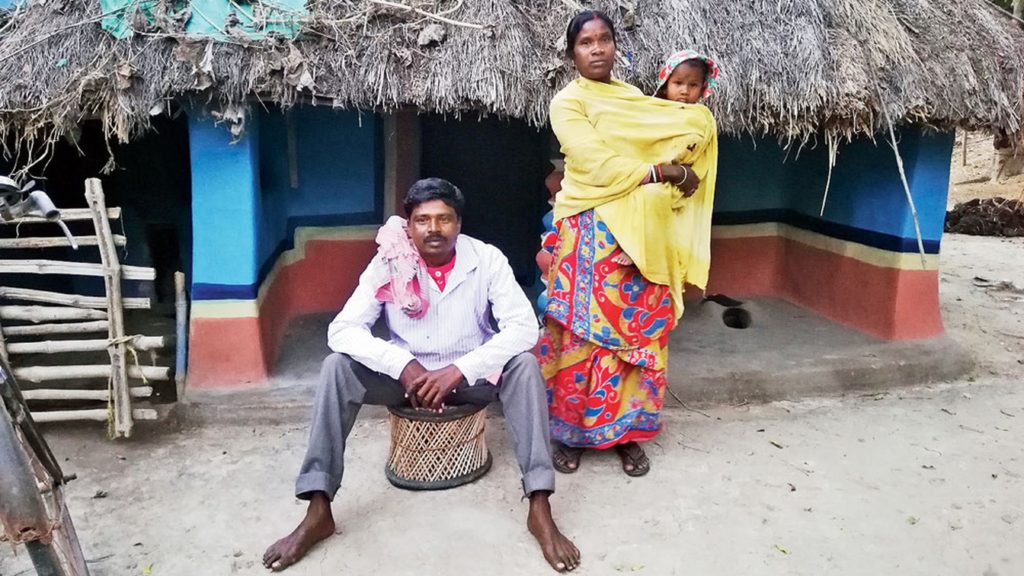
Majhi haram Nilu Mardi with a neighbour / Image: Moumita Chaudhuri
Gopal Nagar Dakshin Palli in Bengal’s Birbhum district is a tribal village. The drive from Bolpur town to the house of Nilu Mardi, the village headman, takes all of half an hour. The reason behind the trip — a recent report about another tribal village in this very district doing away with the concept of morol or village headman. Reports attributed the move by Chatormath village in Suri town to political interference. It also said that other villages were planning to follow suit. Nilu Mardi is a majhi haram, a term used to describe the headman of a Santhal village.
A majhi haram performs the role of a morol, but all morols are not majhi harams. Mardi hurries out of his mud hut, his hands folded in greeting. The 40-something moustachioed headman is of shy demeanour; he offers his visitors a charpoy and fetches a low cane stool for himself. Over steaming cups of milky tea, he starts to talk.
He says, “My father was a majhi haram and I have inherited the title from him.” According to him, the headman in every Santhal village is actually the religious head, selected quite literally by the higher powers. Mardi describes how a jaan or seer performs rites, which involves among other things blessing a magic stick.
The stick hops out on its own and stops at a house of its choice and the male head of that household is anointed majhi haram. Says Mardi, “One cannot assume or give up the title at whim. It remains in the family as long as it has to be there.” In case there are no male successors, the stick and the title are passed on to the son-in-law.
At this point in the conversation, Balu Tulu, a man of average build, not more than 60 years old, enters the courtyard. There is another mud hut facing Mardi’s home; the courtyard is common to both.
Tulu lives in the second hut; he is also a relation of Mardi. A concrete structure is coming up on another end of the courtyard — an uncommon sight in a village where there is no pucca house — which houses a common kitchen with two clay ovens. A little away from it, there is a generous stack of straw.
Tulu expresses shock and surprise at the fact that a tribal village has decided to do away the headman’s post. “Chatormath will actually lose the status of being a Santhal village in that case,” he announces to no one in particular. As it turns out, to date, in a Santhal village, money and social hierarchy is no great divider. Tulu speaks freely in front of the headman.
Mardi too does not seem to mind. “I am the majhi haram but he is an elderly person and in a Santhal village we always consult the elders and respect their knowledge,” he says humbly. The women of the family are sitting out too, witnessing the conversation unfold; from time to time there is giggling, oftentimes someone makes a point without any inhibition. “I have to preside over cases where one has stolen a morog (rooster) or a handi (utensil),” says Mardi and there is tittering all around. He also settles household feuds, big and small, and skirmishes.
The main issue these days, however, is inter-caste marriage. There is an unwritten rule among the Santhal tribes that if two adults marry without the consent of their families, then the families have to bear the consequences. Tulu says, “If two adults marry within the community, they are allowed to stay together but then both the bride and the groom’s families have to do the ritual goat sacrifice — the boy’s family has to sacrifice two goats, while the girl’s family has to sacrifice one.” But when the marriage happens outside the caste, there is a problem. “We generally call off the marriage and order them to stay apart. And if they refuse to listen to the village head, they are asked to leave the village,” says Tulu. But matters don’t end here. “Nowadays, aggrieved parties approach courts of law and even the panchayat. They also take the help of the police and are eventually allowed to stay on,” he adds.
The older man repeats what Mardi has already explained — that the majhi haram of a Santhal village is not a political post. “That is why political parties do not interfere in the works of a majhi haram,” says Tulu. So when a village in Birbhum has turned hostile towards an age-old Santhal ritual, we have to understand there are other reasons, he adds knowingly. Mardi agrees: “Let alone the police, the panchayat won’t even entertain a case from our village if anyone tries to bypass the majhi haram.”
source: http://www.telegraphindia.com / The Telegraph, online edition / Home> Heritage / by Moumita Chaudhuri / March 17th, 2019
In the 75th anniversary year of the Bengal Famine, Prasun Chaudhuri travels to K-Plot in the Sunderbans to meet survivors .
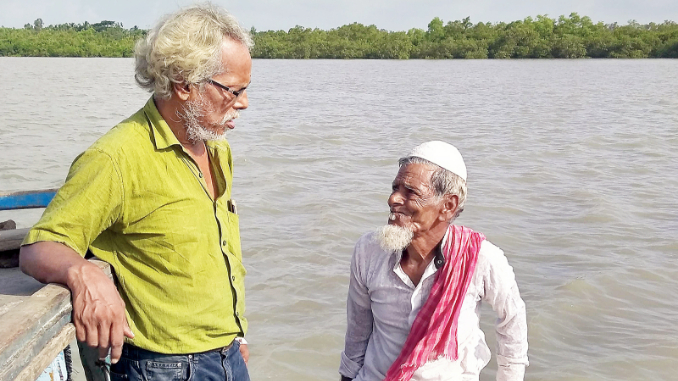
Memory Bank: Writer Sailen Sarkar hears out Khoshain Sheikh, who was 16 when he came to K-Plot / Prasun Chaudhuri
The island is called K-Plot. It might be only 130 kilometres south of Calcutta, but it is not easy to access. First, you have to take the Lakshmikantapur-bound local train from Sealdah. Get off at Mathurapur. Pack yourself into a crowded mini-van to reach Raidighi. Get off it and into another shared vehicle that will drop you to the Raidighi ferry ghat. Then board a motorised country boat to Bamunghat in K-Plot. In all, you need about six hours to touch this southern tip of the Sunderbans surrounded by Thakuran river on the east and west, Shibua river on the north and the Bay of Bengal on the south.
The name K-Plot is a British legacy. Successive officials of the East India Company had unimaginatively named these islands after the English alphabet sometime in the late 18th century. These settlements had been conceived by Collector General Claude Russell in 1771, soon after the company got Diwani rights or the permission to collect taxes on behalf of the Mughal emperor. Russell had initiated extensive reclamation of mangrove forests and offered pieces of land ranging from five to 10,000 bighas to businessmen, landlords and government employees based in Calcutta. (In Bengal, the bigha was standardised under colonial rule at 1/3 acre.)
Years later, post the notorious Bengal famine of 1943, which killed an estimated 35 million, many people sought a home in the Sunderbans in general and K-Plot in particular. Most of them were from Midnapore district, which was the worst affected. Turns out many of these famine survivors managed to give both tide and time a slip and are still around to tell their olden tale.
It is late afternoon by the time we reach K-Plot. We meaning, myself and writer Sailen Sarkar. A retired schoolteacher, Sarkar travelled extensively across southern Bengal before he wrote his Bengali book, Durbhikkher Sakkhi or Witness of the Famine.
It is one long walk to famine survivor Bijoykrishna Tripathi’s house. On the way Sarkar tells me, “I discovered these survivors by chance during my travels. While chatting with the elders of the islands, it emerged that many farmers have roots in Midnapore and clear recollections of panchasher manwantar (the famine happened in the Bengali calendar year 1350). These conversations opened up for me bits and pieces of oral history of one of the biggest tragedies of modern Indian history.”
Sarkar’s first interviewee, Sripaticharan Samanta, didn’t open up to him at first. Instead, he wept and asked, “Why did you come so late?” Soon after the interview, Samanta died. Says the writer, “That’s when I realised the urgency of documenting the oral narratives of famine survivors. I knew we were about to lose pieces of history, the legacy and tales of the indomitable spirit of ordinary human beings.”
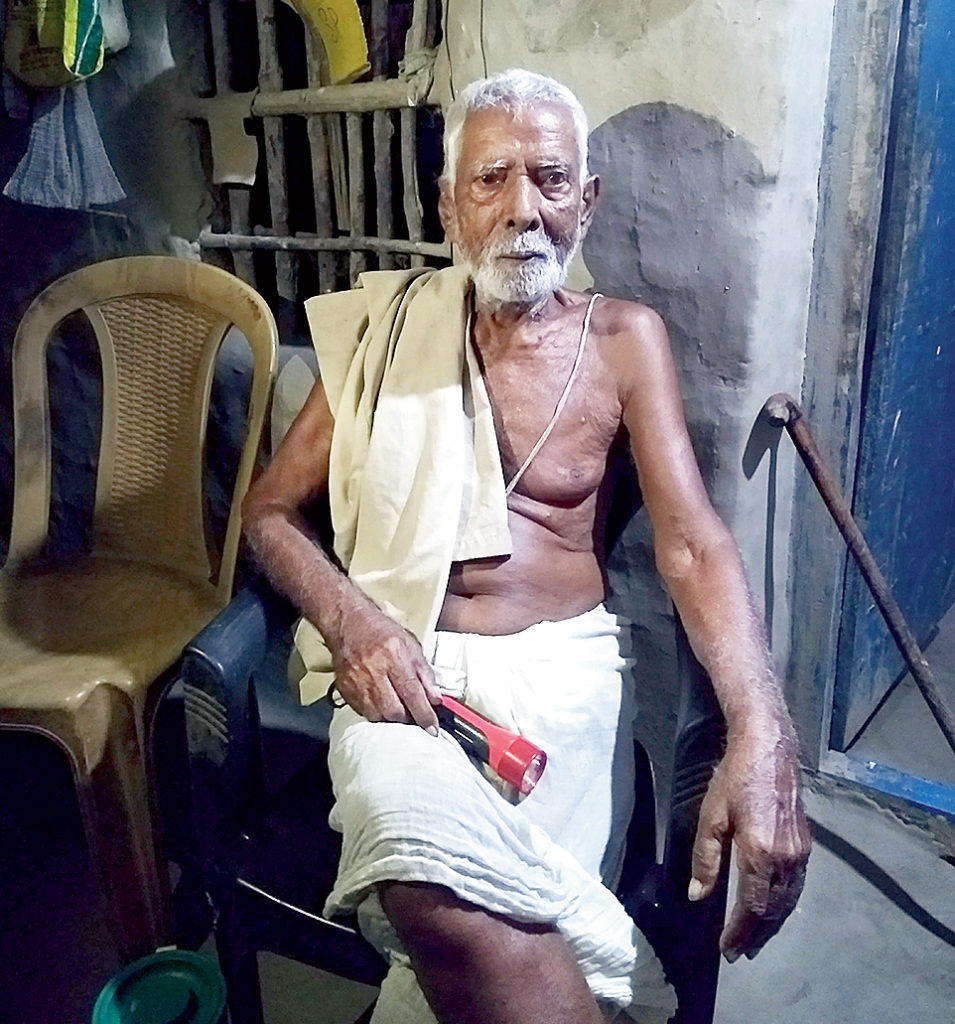
When we finally find Tripathi, the 108-year-old patriarch is sitting in the courtyard of his home surrounded by six grown-up great-grandsons and some relations from East Midnapore who have come to seek his advice regarding a land dispute. Tripathi stands up to greet us; a tall man, ramrod straight, wearing a dhoti and uttariya, his sacred thread wound around his bare torso.
“Our misery began with a crazy rainstorm,” begins Tripathi. “It was Ashtami day of 1942, the year of the Quit India movement.” Shortly before the Pujas, an agitating 33-year-old Tripathi had burnt down a police station in East Midnapore’s Bhagabanpur village. That night, he recalls, there was a terrible cyclone. It ravaged the farms and turned everything into a wasteland. The next morning, Tripathi says, he saw hundreds of human corpses floating around along with carcasses of cattle.
The widespread devastation was followed by an acute shortage of rice. Says Tripathi, “The price of rice that cost an anna a seer [16 annas make rupee; one seer equals 1.25 kilos] doubled immediately after the cyclone and tripled in a few weeks. There was starvation and then famine.”
Some people survived on bulga or soup made from discarded wheat served at community kitchens; most others died like flies. According to Tripathi, many sold their wives and daughters in exchange for sacks of rice. He says, “Women ran away with complete strangers for two square meals a day.”
There were hundreds of human corpses floating around along with carcasses of cattle, recalls Bijoykrishna Tripathi, 108 / Prasun Chaudhuri
Researcher and writer Madhushree Mukherjee, who interviewed many famine survivors of Bengal, toes the line that the catastrophe was engineered largely by the then British Prime Minister, Winston Churchill. For her 2010 book Churchill’s Secret War, she delved into oral accounts of survivors and official documents. She cites documents and exchanges to support the view that Churchill ordered the diversion of food from starving Indians to add to stockpiles of grains in Britain and Europe.
In a more recent research, historian and anthropologist Janam Mukherjee writes, “High colonial policy, of course, usually in the name of the war effort, played an important role, but responsibilities were widespread. Seeking colonial favor, or entrenched in ‘opposition’, the response to famine by Indian politicians in both Bengal and New Delhi, was also guided, often enough, by political interest rather than public welfare.”
By November of 1943, much of the Bengal countryside lay in ruins. Artist and active member of the Communist Party of India, Chittaprosad Bhattacharya, journeyed through the innards of the famine-struck Midnapore district. In page after page of ink drawings, he tried to capture the general predicament. The visuals came lined with annotations, observations. Eventually, all those sketches came to be his book, Hungry Bengal. The book, however, was banned by the British government and thousands of copies were destroyed.
Destruction, epidemic and mass death had people fleeing cityward. A lot many died on the way, those who made it starved on the streets of the city. But there were people like Tripathi who ventured beyond the city, to the marshes of the Sunderbans, in pursuit of food and new life.
Initially they landed up as raiyats or cultivators who farmed on lands held by absentee landlords. The chain of command ran thus: first came chakdars, who further sublet the land to raiyats.
One of the reasons Tripathi chose K-Plot was that he knew a chakdar who was looking for a raiyat to cultivate 50 bighas of land he had taken at lease. “Initially I farmed the land with some labourers and sent half of the harvest to the chakdar. But the chakdar was a kind man. He eventually gifted me a part of the land when I got married.”
Khoshain Sheikh is also a resident of K-Plot. When we arrive at his hut on the edge of the island, his younger brother, Qurbat, tells us that he is gone to sow paddy saplings. He takes us to the field and we find the 92-year-old crouched there in knee-deep water. “I have been sowing paddy since I was 12,” says the man with a goatee. Then, over a bowl of puffed rice, he tells us his story.
Sheikh was 16 when he arrived here. He says, “The famine actually started before 1943. While foodgrains were fast disappearing into hoarders’ godowns, the cyclone dealt a deadly blow to the belly. My father left our village in Bhagabanpur months before the cyclone.” The Sheikhs crossed the Hooghly and reached the island via Kakdwip. “It took over 12 hours to get here that day,” he reminisces.
All 12 brothers tilled the land, sowed paddy and harvested rich crop within a year. “When we first arrived, we had to deal with wild beasts and snakes. Many of my relatives succumbed to snakebite,” says Sheikh. Then adds, “We desalinated the water by boiling tamarind in it. In the initial period, we survived on gimey shaak and other wild herbs.” The landless are now land owners. Sheikh shows us around K-Plot. He points to the greenery, new embankments and plantations.
Next, Sarkar takes me to Maipith, a neighbouring island. “Maipith is one of those rare islands where tigers and humans co-exist. There is just an embankment that separates the tiger forest from the villages,” he says as we cross two wide rivers.
Pulin Samanta has been living on the edge of Maipith in Nagenabad village since early 1944. He has turned 100 this year. Tigers often enter his paddy fields but he feels these beasts are not as scary as the black-marketeers. “The day we left Jugiberi [Midnapore], the price of rice went up to eight annas per seer, an eight-fold increase in just a year. Only the very rich could buy from hoarders.”
The Samantas had to walk for four hours to reach Rasulpur on the banks of the Hooghly. “On the way, we saw starving people lying on the fields and vultures circling them.” They crossed the river to reach Kakdwip, where they met a chakdar. He had been looking for able farmers. “We rowed for two days to reach this place,” he says. “The first thing the family built was a ‘tonger bari’ or a tree house to survive the wild beasts at night.”
Samanta’s great grandson is trying to recharge his smartphone with a solar battery. Pump sets, parts of mechanised boats and a dish antenna on the roof of the double-storey house are obvious signs of prosperity.
Samanta’s neighbour, Abedan Bibi, is the last famine survivor we meet. The sun has set by then, LED lamps can be seen all around. Rural electrification has been patchy in the island because people here have always voted against the ruling party, says Asura Khatun, who shows us the way to Abedan’s home. The 103-year old woman used to cook her own food and roam the village on her own until she lost her eyesight a few years ago. That night, by the time we reach, she has already finished dinner.
When her granddaughter-in-law informs her that we’ve come to meet her for an interview about the famine, the frail woman crawls out of the mosquito net. She settles down on a wooden stool. In the faint rays of a solar light, we can barely discern her tiny figure in a white cotton printed sari with a blue border.
She begins, “I had got married a few years before the famine.” Her father-in-law, it seems, was an enterprising man who decided to switch his base to the island soon after the cyclone. “He had apprehended the famine as the problem of food shortage had been gradually deepening.”
She continues, “The first few weeks were difficult. We survived on boiled gira shaak and shapla — aquatic plants — fished out from ponds. Occasionally, we got some flour sent by the government in flood-relief boats.”
Sarkar and I leave the island the next day at the crack of dawn. As our motorised boat sputters across Thakuran river, I try to imagine how the scattered bits of land with its dense mangrove forests would have appeared to boatloads of people trying to escape starvation and death, 75 years ago. Like a green beckon perhaps, who can say.
source: http://www.telegraphindia.com / The Telegraph, online edition / Home> Culture / by Prasun Chaudhuri / December 09th, 2018
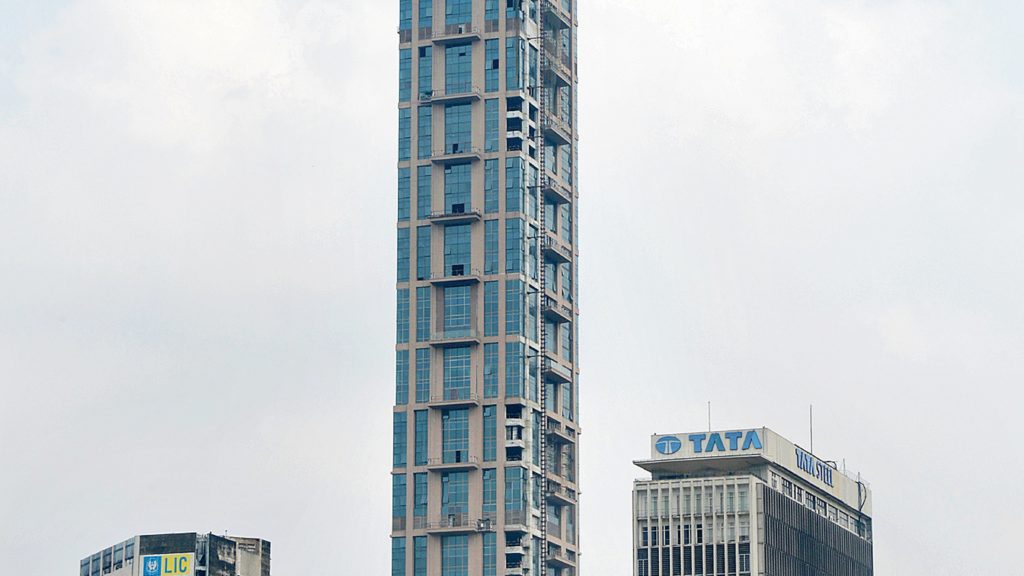
The 42, the 61-storeyed residential building on Jawaharlal Nehru Road will now have 65 storeys
The 42 / The Telegraph picture
The 42, the tallest building coming up in Calcutta, is getting taller with the civic body sanctioning the construction of four more floors following a change in a rule related to buildings within a kilometre of the Metro Railway corridor.
The 61-storeyed residential building on Jawaharlal Nehru Road will now have 65 storeys. The tower will be 249m tall, 12m more than the height in the original plan.
The Calcutta Municipal Corporation approved the proposal for the extra floors last year.
“We have started constructing the additional four floors,” said Subir Basu, one of the architects of the project, being developed by a consortium named Chowringhee Residency Pvt Ltd.
Mumbai-based Hafeez Contractor is the other architect.
The civic body could allow the construction of the additional floors because of an amendment to its building rules last year, which allows extra floor-area ratio (FAR) for buildings within 1km of the Metro Railway corridor.
“Fifteen per cent extra FAR is allowed if the road in front of a building is 15m to 24m wide and 20 per cent extra FAR is allowed if the road is more than 24m wide,” a CMC official said.
The 42, the city’s tallest structure, is just a building away from Maidan Metro station and the road in front — Jawaharlal Nehru Road or Chowringhee Road — is nearly 30m wide.
FAR denotes the ratio of a building’s gross floor area to the size of the plot on which it stands. More FAR means opportunity to build more floor space in a building.
“Following the amendment, we have got 20 per cent more FAR,” architect Basu said.
The building plan for The 42 had been approved in 2014. Subsequently, the CMC building rules had been amended twice. The first amendment, in 2017, allowed extra FAR to properties within 500m of the Metro corridor. In 2018, buildings within 1km of the corridor were brought within the ambit of the revised FAR rule.
For the CMC, the additional floor space would result in more revenue.
The work at The 42 site was stalled for some time in 2017 after the Airports Authority of India had imposed a height restriction of 198m on structures within a certain radius of the airport. The order would have resulted in demolition of the top 12 floors of the tower.
The AAI later revised the height limit to 260m and sent a no-objection letter to the developers of The 42 in January 2018.
source: http://www.telegraphindia.com / The Telegraph, online edition / Home> West Bengal / by Subhajoy Roy in Calcutta / March 11th, 2019
Sadhanamala is being translated from Sanskrit to a regional language – Bengali – for the first time
Shadakshari Lokeshvara – Circa 11th Century CEImage: Wikimedia Commons
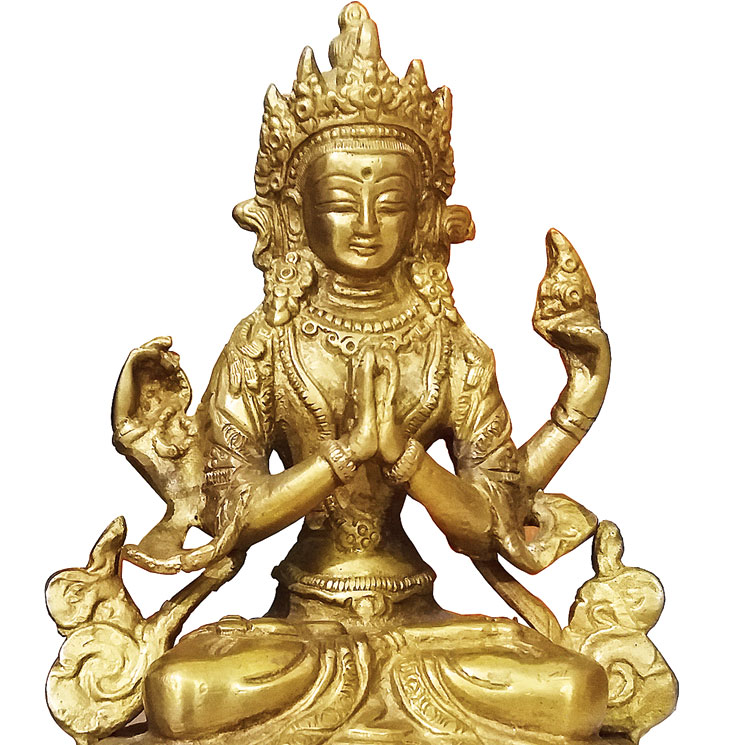
Priyanku Chakraborty is engrossed. He is examining a four-inch figurine. When he looks up from it, the research fellow in Buddhist Studies from Calcutta’s Asiatic Society says, “This is the idol of Sadaksari-Lokesvara and embodies the compassion of all the avatars of Buddha.” He points out how the four-armed deity is seated on a double-whorled lotus. How one pair of hands is folded in greeting, and the other two hold a string of prayer beads and a lotus, respectively.
“That this idol does not represent Vajrasattva, Maitreya or Manjusri or any other Buddhist deity is defined in the Sadhanamala, the text that deals with Buddhist tantric or meditative practices,” he continues. “If it was a figure of Maitreya, the deity would have been holding a Nagkesar flower; likewise, it would have had a sword had it represented Manjusri,” he adds.
Chakraborty knows. After all, he is working on the translation of the Sanskrit text, Sadhanamala, into Bengali — the first such attempt in any Indian regional language, according to him. Collaborating with him is Anindya Bandhu Guha, a Comparative Literature scholar.
An idol of Sadaksari-Lokesvara Image: The Telegraph
According to modern historians, the text was originally compiled by the great Buddhist scholar Abhyakaragupta between the 11th and 12th centuries. Abhyakaragupta was associated with the Vikramasila-mahavihar of present-day Bhagalpur district in Bihar. Says Guha, “The Caryapadavalis or Charyapad is accepted as the earliest example of Bengali literature. Its commentary begins with a salutation to Goddess Vajrayogini. Now, who is Vajrayogini? To know about her we must refer to the Sadhanamala. Therefore, it is necessary to translate the text into Bengali to know the Buddhist tantric tradition of early Bengal, which may also help render the socio-cultural scenario of that time.”
Chakraborty talks about the countless metal and stone figures and paintings of Buddhist deities belonging to the early-medieval era that have been discovered from the Indian subcontinent — Gangarampur and Mogalmari in Bengal, Vikrampur of Dhaka, Dinajpur in Bangladesh, Jolaibari in Tripura, Telhara (near Nalanda) in Bihar and Suryapahar in Assam are some such places.
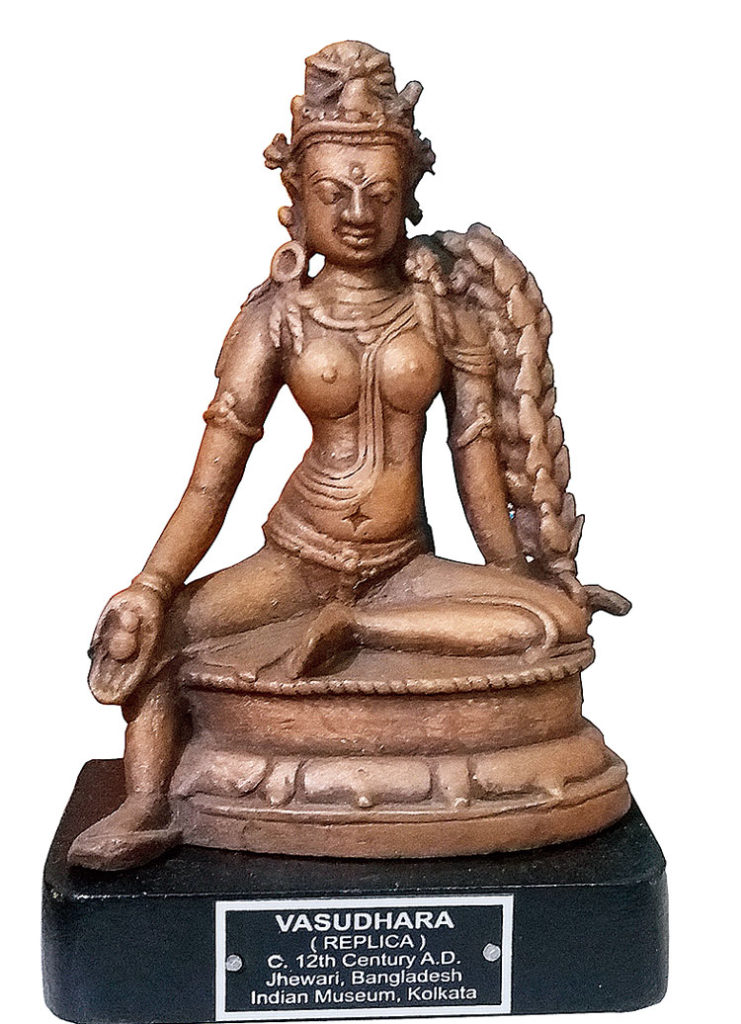
An idol of Vasudhara Image: The Telegraph
Is Sadhanamala then a manual to help us identify Buddhist deities? “No,” Chakraborty is emphatic. “The descriptions are meant to aid meditation and enable one to visualise a deity,” he adds. There are 312 sadhanas or meditation practices outlined in the Sanskrit version of Sadhanamala.
But, till such time as there is no comprehensive translation of this text in any modern Indian language or English, there is no unveiling the munificence of the world of tantric Buddhism, which is an integral part of Buddhism. “And that’s the point of our effort,” says Chakraborty. He and Guha seem to think that the project will take another five years before it can be completed.
Sanskrit scholar and Buddhologist Ratna Basu tells The Telegraph, “The translation of an ancient text makes it more universal and accessible. This secularisation of the text is always a laudable attempt if the translation is sincere, to the point and accurate.” Basu herself is engaged in the English translation of the Sadhanamala.
However, Aiswarya Biswas, professor of Buddhist Studies at Calcutta University, throws in a word of caution. She says, “The Sadhanamala is a highly specialised Buddhist tantric text. Since translation is an academic initiative, we cannot discourage it, but I am sure a person well aware about the subject matter will not translate the whole text, especially the portions about secret practices.” Biswas is aware, though, that an incomplete translation may raise further questions. She says, “For all these reasons, a pioneer translator has a great responsibility.”
Basu does not share this cautionary stance. Her take is this: many ancient scriptures — originally written in Sanskrit or Pali or Prakrit — have been translated in the whole. There are iconographical descriptions of Brahmanical deities in the Puranas. Most of them have been translated into Bengali, Hindi, English and so on. We have Bengali and English translations of Brahmanical tantric texts such as the Saradatilaka-tantra, Hayasirsa-pancharatra and some others. “So why not the Buddhist tantric text?” she asks.
The Sanskrit used in Sadhanamala is non-Paniniyan — it does not follow the grammar of Panini — making it difficult to decode. Moreover, the Pali and apabhramsha languages are often used in the portion of the mantras and dharanis or chants.
Says Chakraborty, “Such language is a common feature of tantric Buddhist texts written or compiled in Sanskrit. Since Buddhist mysticism has already slipped into oblivion in India, a proper understanding of the text’s terminologies is quite difficult. Therefore, it is a sort of challenge for us.”
source: http://www.telegraphindia.com / The Telegraph, online edition / Home> Heritage / by Bitan Sikdar / March 10th, 2019
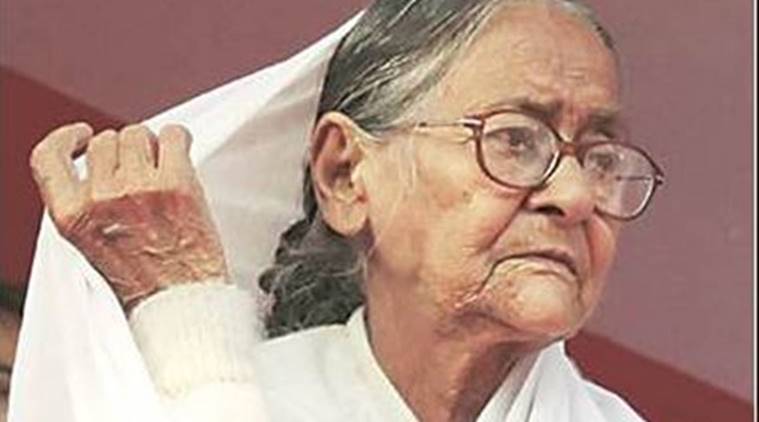
The chief adviser of All India Matua Mahasangha, Binapani Devi, popularly known as ‘Boro Ma’, passed away on Tuesday evening due to multi-organ failure.
The chief adviser of All India Matua Mahasangha, Binapani Devi, popularly known as ‘Boro Ma’, passed away on Tuesday. (File)
The chief adviser of All India Matua Mahasangha, Binapani Thakur, popularly known as ‘Boro Ma’, passed away on Tuesday evening due to multi-organ failure. Chief Minister Mamata Banerjee e and several state ministers rushed to SSKM Hospital and her death was announced by Banerjee in the evening. Thakur’s last rites will be held on Wednesday with full state honours. পরলোকে মতুয়াদের বড়মা বীণাপাণি দেবী
Binapani Thakur was brought to the SSKM Hospital in Kolkata from Jawaharlal Nehru Hospital in Kalyani due to a rapid decline in physical condition. She was bedridden for a long time and was suffering from respiratory problems. Prime Minister Narendra Modi i had met the 100-year-old matriarch of the Matua community on February 2 at Thakurnagar.
During her last visit to Thakurnagar, Banerjee had announced several projects and declared that Binapani Thakur would be honored with the honorary de -Litt title. Banerjee was seen to be close to Boro Ma.
Since 2009, the Matuas were mostly known to be Trinamool Congress supporters, and the party had fielded members of her family in elections. However, the family has been divided over its political leanings in recent years.
Matuas trace their ancestry to East Bengal, and many of them entered West Bengal after Partition and after the formation of Bangladesh. Matuas are Namasudras, a Scheduled Caste group with a presence in at least six parliamentary seats. While no official count is available, community leaders put their population at 3 crore.
source: http://www.indianexpress.com / The Indian Express / Home> Cities / by Express Web Desk / New Delhi / March 05th, 2019
The Winners, an all-women patrolling team by the Kolkata Police, was launched in July 2018, with an aim to check crimes against women and make public places safer for them.
“Oye, akeli hai kya? Chalegi park me? 300 dunga. Arey bol na, jyada chahiye? (Hey, will you come with me to Park, I will pay you 300 bucks. If you want more, tell me,” said a man in his twenties to a woman near Mohor Kunja Park under Hastings police station area around four months ago. The offender had no clue that he was messing with the wrong person. Arpita Mallik, a constable with the Kolkata Police and a member of the team The Winners, made her first arrest that day.
The Winners, an all-women patrolling team by the Kolkata Police, was launched in July 2018, with an aim to check crimes against women and make public places safer for them. The team with personnel trained in self-defence has so far apprehended more than 200 “Road Romeos”.
“I was on duty in civil dress. When the man teased me, I asked him to wait and grabbed him by the collar. He put up stiff resistance but was soon surrounded by a group of policewomen and he started apologising. We arrested him and I felt good,” Arpita said with a wide smile. She stays alone and meets her husband in Malda on holidays.
EXPLAINED
Step towards better gender equation in Kolkata Police
The Kolkata Police has always been keen on increasing the presence of women in their force. The State Home Department has set up eight women-only police stations in Kolkata to investigate crimes against women. A rape or molestation survivor will be comfortable with a woman police officer, they feel. More women in the force means more women reaching out to report incidents that bother them. Several crimes, including eve-teasing, often go unreported. An all-women battalion is a step towards betterment of city police’s gender equation — 800 women in the 26,000-strong police force.
“He wasn’t very keen on me joining police but I managed,” she said. The Winners has 28 women personnel, including three senior officers. All the 25 constables are in their mid-twenties. In white uniform, they conduct patrol on scooty.
“They have been rigorously trained in self-defence and have revolver licence. Our objective is to make the city safe for women,” said Sampa Guha one of the senior officers of the team. “I am happy to see such young, smart women cops in our city. Once a man in lungi started following me on the street and retreated as soon as he spotted a group of policewomen. Cheers to these ladies,” said Anindita Ray Choudhuri, a management student.
However, the team has to fight odds while on duty. Once a constable in the team was bitten on her hand while another was heckled while on patrol inside the Millennium Park. Six persons, including two women were arrested for allegedly harassing personnel on duty.
“We face a lot of challenge and even get teased but when we are in uniform, people respect us also. There have been instances when during midnight patrolling, women came and thanked us for making them feel safe. It gives us immense satisfaction,” said Zinnatara Khatun, another member of the team.
Team Winner is headed by three sub-inspectors, including Sampa Guha, Mita Kansabanik and Zinnatara Khatun. Sampa has various accolades to her credit in power lifting in international, Asian and national events. Zinnatara Khatun is an athlete who has won the Indian Police Medal. Mita is also a power lifting champion.
“We love catching Road Romeos,” laughs Zinnatara. Mita is married and has a 16-year-old daughter, while Zinnatara and Sampa are single.
“Earlier marriage used to give a woman financial security and an identity, but nowadays it has nothing exceptional to offer a woman,” said Zinnatara and Sampa.
Madhumita Mahapatra, another member of the team, says, “My husband is very proud to see me in uniform. I have a tight schedule but he is always there to pick me up when I finish work.” Another member, Debolina Das Rai, feels they stand for themselves to bring the change. “My husband mostly takes care of our son as I have a tight schedule. We manage well and he never complains,” she said.
Their message on Women’s Day
“People talk about women empowerment but hardly practice it. We are educated and present ourselves well but our mentality remains the same. Real change has to come from within. All women should be financially independent and should speak up. Once a woman starts sharing financial responsibility of her family and her parents, people will stop craving for male child. To bring a change, it is important for women to learn self-defence. Girls are mentally much stronger than men and we must celebrate womanhood.”
source: http://www.indianexpress.com / The Indian Express / Home> Cities / by Sweety Kumar / Kolkata / March 08th, 2019
The scientific genius of Bengal just before Independence deserves better storytelling
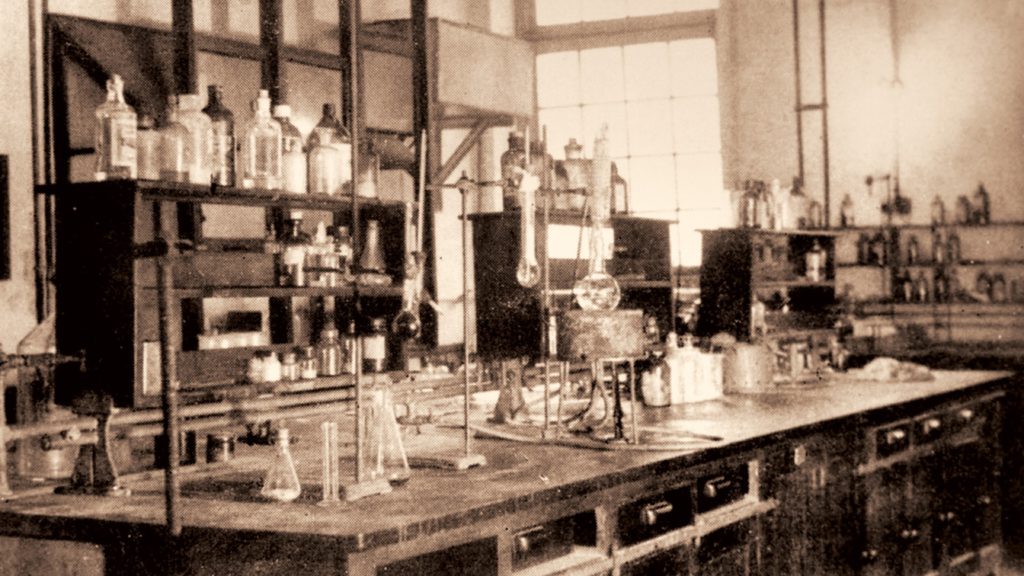
Acharya Prafulla Chandra Ray Laboratory, University College of Science and Technology, Calcutta / Telegraph file picture
One of the problems with history is not how it is written but how it is perceived. Time adds a certain sense of melodrama and stereotype to events. History then acquires a grandeur, a stark monumentality, but somehow the narrative lacks nuance, the sensitivity and vulnerability of genius. As a sociologist who has worked in Bengal for a decade, I always felt Bengal, nationalist Bengal, was more creative and nuanced than it is presented to be. One sees this particularly in the relation between science and nationalism. The debates that Bengal fought embodied a plurality of visions which the nation desperately needs today.
Our nationalism had a confidence, with powerful insights into oppression and liberation. I remember the first great nationalist institution in science, the Indian Association for the Cultivation of Science established by Mahendra Lal Sircar. Few remember its great goal, which was to rescue science from Western civilization. Our nationalism, thus, was not merely an attempt to liberate ourselves from the West but to evaluate it, to reinvent the defeated West. One sees it again and again as we look at science. We wanted to inject into science our own genius. J.C. Bose, for instance, borrowed from Shakta traditions to challenge the dualism of the mechanical and the living. Bose had an acute sense of being an Indian scientist. He realized that one had to take on the mainstream paradigms. He realized the danger was of the West reading you through orientalist eyes and reducing you to an occult or mystical figure. Bose realized that one had to make English science say things it had not said without being marginalized. Bose had that genius which people valued.
I remember a cousin of mine, a physicist, listening to a lecture at Princeton by William Shockley, the inventor of the transistor and a Nobel laureate. Shockley began his lecture by invoking Bose and claiming, “[T]here was Bose and the rest is toilet paper.” I wish some local publisher would republish Patrick Geddes’s biography of Bose to recapture his genius.
In fact, history has little to say about the relation between Bose, the poet, Tagore, and the biologist, Patrick Geddes. They shared a mutual reverence and a curiosity about nature which needs more discussion. The narratives of science and nationalism often become a failure of storytelling. Few know that Tagore wrote a textbook on science and even fewer know that Tagore, Bose and Geddes taught a summer school in science at Darjeeling.
The conversation between Geddes and Tagore also led to a vision of Santiniketan few talk about. The current Santiniketan embodies the aesthetic genius of Tagore. But the original Santiniketan embodied a vision of science that Tagore and Geddes discussed. One gets a whiff of this plan as one reads the Geddes-Tagore letters edited by Bashabi Fraser or Philip Boardman’s biography of Geddes. Geddes and Tagore dreamt not only of rural reconstruction but also of a return to an agricultural view of science. Tagore felt that the dialogue of civilizations would be a dialogue of universities. He argued that this exchange would be between the city science of the West, which sought to dominate nature, and the forest universities, which lived in harmony with nature. It is a pity we have not explored these dialogues or even captured the romance or the romanticism of science that this trio evoked. One forgets that Bose was an inventor par excellence also and one of the scientists who refused to patent his work, genuinely believing that ethically and creatively, science belonged to a commons of knowledge. I cannot resist but relate a story about Tagore’s first visit to Bose’s laboratory. The scientist was not there but Tagore left as his signature a bunch of oleander flowers. This relationship between the three makes C.P. Snow’s idea behind The Two Cultures an illiteracy. Nationalist science was interdisciplinary and cross-cultural in a way we cannot imagine today.
Tagore helped create an aesthetic of technology. His debates with Gandhi on khadi are critical. Gandhi saw khadi as transforming the village but Tagore warned that a mechanical use of khadi would create a uniform dullness. Tagore’s sense of the aesthetic went beyond function because he wanted to inject an aesthetic and an erotic into technology.
The debates between Prafulla Chandra Ray and Ananda Coomaraswamy, the geologist and the art critic, are also relevant. Ray warned about the impact of synthetic chemistry, claiming its power stemmed from the tapas of German scientists. Coomaraswamy warned that chemistry had no balancing ethic, that it would create an industrialization of colour: a standardized red for madder, replacing the infinite variety of red that was available in the villages.
Ray himself was a folklore figure. One can invoke a pantheon of stories about the chemist who was a great swadeshi scientist. In fact, Ray’s Life and Experiences of a Bengali Chemist is a literal embodiment of a life in science. The two volumes have nothing private or personal in them. The book is an attempt to show how science creates public knowledge. The whole narrative is written as a scientific experiment with Ray’s life as a test tube, creating a scientific method. Ray realized the importance of a swadeshi science and was among those most committed to a Gandhian way of life. His was an ascetic life and an ascetic style of science. I remember a leading scientist who had gone to visit the University College of Science and Technology. He landed up one evening, found it deserted except for an old man in a corner. Thinking he was the chowkidar, he asked about Ray, to discover that the old man was Ray himself. Ray brought to life and science a simplicity that was stunning.
A perfect contrast to the vision of Ray was Meghnad Saha. An astrophysicist, a brilliant scientist, Saha was tired of politicians who had no sense of the possibilities of science. It was Saha who was the greatest advocate of a Leninist style of planning and it was Saha who persuaded Subhas Bose to set up national planning committees. He also edited Science and Culture, one of the great science policy journals. Science and Culture comprised a wonderful network of intellectuals which included P.C. Mahalanobis, N.K. Bose and D.M. Bose, all of whom combined in their individualistic ways to create a society based on the scientific method. The prolific Saha worked on everything from dams to calendrical reform. He was quick to express his disappointment with Nehru and got elected to Parliament to challenge him. One can hardly dream of that kind of vision and commitment today.
One can retail story after story about this period, celebrating Satyendra Nath Bose or P.C. Mahalanobis, but what one wants to emphasize is the different styles of science and the varied dreams of it that the Bengal of that time possessed. There was a playfulness, a plurality, a sense of dream and ideals, an availability of eccentricity and creativity one misses today. The stories once popular are quietly fading. One wishes Bengal was better served by its historians of science. At least one would like to propose a museum of photography, stories, technologies as a tribute to this generation. We sadly have a regime that talks of ancient science idiotically but ignores the neighbourhoods of genius just before Independence. Surely this generation deserves the storyteller and his tales of a great and creative science.
The author is an academic associated with Compost Heap, a network pursuing alternative imaginations
source: http://www.telegraphindia.com / The Telegraph, online edition / Home> Opinion / by Shiv Visvanathan / November 28th, 2018
On a Sunday with barely half a day left for him to bid adieu to the city he had called home for the past three years, French consul-general Fabrice Etienne criss-crossed north Calcutta with t2
Jorasanko Thakurbari: The house of Tagore made it to Etienne’s list of favourite spots as a mark of tribute to Rabindranath. “You have no idea of the influence that he has unless you reach Bengal. He is here on the streets, (our car had stopped at a traffic light and sure enough, there was Rabindrasangeet playing on the speaker), there is the university named after him, there is Santiniketan… there is so much respect. Everyone knows his work, not just the songs. This is unique. Of course, Calcutta is having trouble thinking beyond Tagore but that is a different issue. Only a small part of his work is available in French, like Andre Gide’s translation of Gitanjali and some novels like La Maison et Le Monde (Ghare Baire) and Charulata. But few in the West know that Tagore is more than a novelist. In French literature, we may compare him to Victor Hugo who was an educationist, a poet and a novelist. But his legacy is not as alive as Tagore’s is.”
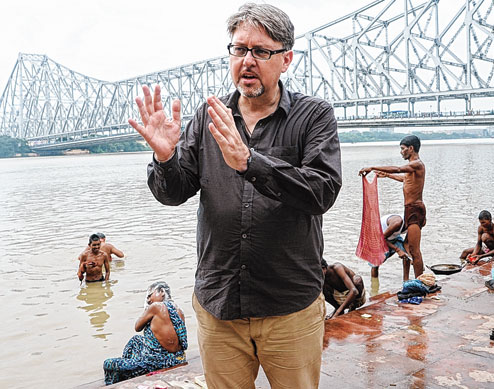
The riverside: Tip-toeing through the monsoon slush at the Mullickbazar flower market and pausing at a few stalls to negotiate prices for marigold strands, we reached Jagannath Ghat. “This is my favourite ghat as this is where you get the best view of the Howrah bridge and the rail station.” The gigantic warehouses on the Strand made him wistful. “How I wish I could live in a building like this, overlooking the river! Living in Calcutta you forget about the existence of the river which is largely hidden from view unlike in Paris which is split by the Seine. There, the city expanded on both sides of the river across which there are about 20 bridges connecting the northern and the southern sides. All the attractions are along the Seine — Eiffel Tower, the Louvre, Musee d’Orsay…. The Hooghly is much wider and the city has grown on its eastern side.”
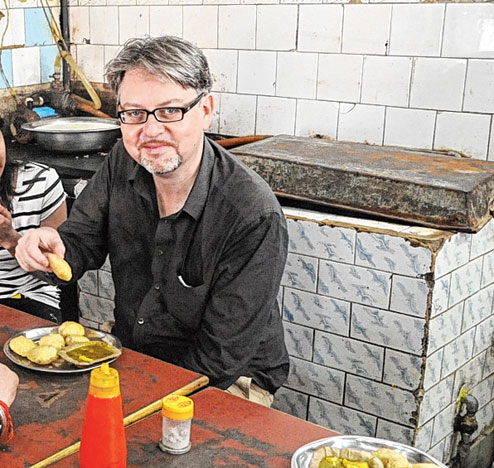
Street-side tea shop: “I have put on 10 kilos in these three years! A paunch is accepted in Calcutta but in Paris it is frowned upon. I have to start cycling and walking like a Parisian once I am back,” Etienne had confessed after getting off the weighing scale at Calcutta Club from where our trip had started. A couple of hours later, he was happily digging into club kachauri and alur torkari, followed by a handsome helping of rabri at Sharma Sweets on Kalikrishna Tagore Street, run by his friend Shyam Barua. “Nothing breathes the Orient more than the streets of north Calcutta. Wherever you look, there is something happening. These small tea shops remind me of our street-side cafes, which are integral to the French way of life. Here you can get away from the chaos on the street while keeping a watch on a slice of outdoor life. They are cheap and no one asks you to leave even if you spend hours with a cup of coffee.”
College Street: Etienne could not find a single book in French on College Street but was startled to find some lesser-known titles of Alexandre Dumas in translation at several stalls. “This is the intellectual street of Calcutta with all the universities and bookstores. The Indian Coffee House here was a place for adda of Bengali intellectuals. It reminds me of the quartier Latin on the left bank of Paris which has bookstores of all sizes. This is for me one of the bridges between Paris and Calcutta…. For a kilometre on the promenade along the Seine, there are hundreds of small stores — some are just a box full of books. I used to go look for first editions of French or world literature titles as the area was close to our office.” On his last trip to College Street (“I used to come here often”), he picked up a Sunil Gangopadhyay translation.
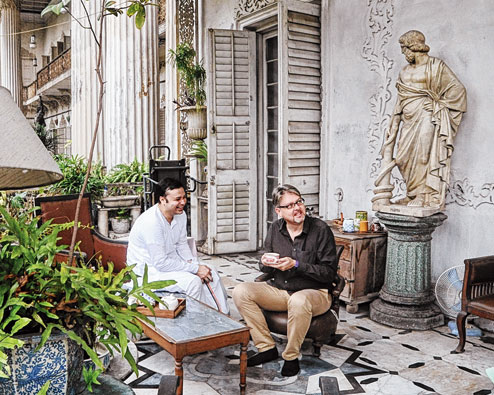
Marble Palace: A last-minute call to Sourendro Mullick secured an entry into Marble Palace, the palatial Mullick residence on Muktaram Babu Street. Photography being prohibited in the rest of the property, we settled down on the verandah adjoining Sourendro’s piano room, where a marble statue of Pluto, the lord of the Underworld, stood reclining against his staff around which a snake was coiled. “Calcutta is in many ways a baroque city and nowhere else does it express that trait more lavishly. This place is a Calcutta of one man’s fantasy. Rajendro Mullick had found so many things that caught his fancy from across the world. It reminds me of the Palace of Versailles where too the idea was to add chandeliers and marble works to express wealth. It is a unique mix of kitsch but it is kitsch with a soul. This place also has the first private zoo of India. The building has been extremely well-preserved,” Etienne remarked.
source: http://www.telegraphindia.com / The Telegraph, online edition / Home> Entertainment / Text by: Sudeshna Banerjee , Pictures by: Sanytan Ghosh / September 17th, 2015
The train manufactured by CNR Dalian Locomotive & Rolling Stock Co. is the first of 14 rakes to be shipped to Calcutta
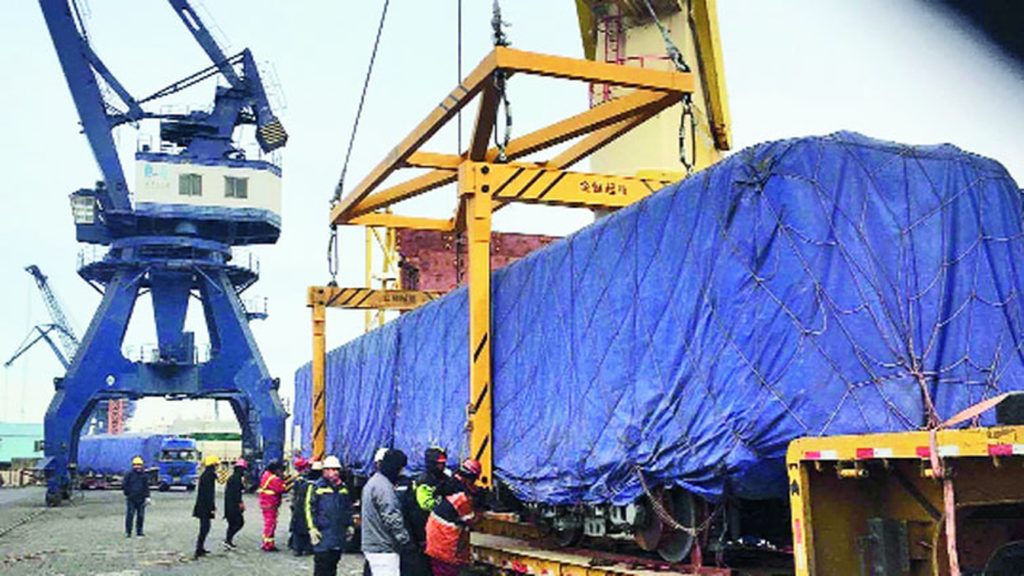
The China-made coaches being loaded on a vessel at the Dalian port / Sourced by the Correspondent
Consignment: Calcutta Metro’s first foreign-made rake
Origin: Dalian, China
Status: In transit
Calcutta Metro’s first foreign-made rake is sailing towards Chittagong on its way to the city from China.
The rake is scheduled to arrive at the Calcutta port on March 1. From there, it will be taken to Metro Railway’s Noapara maintenance base for trial runs, Metro officials said on Thursday.
The train manufactured by CNR Dalian Locomotive & Rolling Stock Co. of China is the first of 14 rakes to be shipped to Calcutta.
The prototype rake was loaded onto cargo vessel Han Zhang at Dalian port.
The vessel, which had set sail from Dalian on February 1, is now sailing towards Chittagong in Bangladesh after touching Singapore. It is scheduled to reach the Sandheads on February 28 and wait for the high tides.
At noon on March 1, when the high tide sets in and the water level rises, the vessel will enter Netaji Subhas Dock at Garden Reach.
The rake, like the existing Metro rail fleet, will have eight coaches.
“The train is being carried in two tiers of the vessel’s deck. Each tier has four coaches,” Metro spokesperson Indrani Banerjee said.
Once the cargo ship anchors at Calcutta port, special cranes will be used to lift the coaches and load them on to a container. “The coaches will be assembled in the port area to form the rake before a diesel engine pulls it to Noapara,” Banerjee said.
Metro will use Eastern Railway’s tracks to roll the new rake into its Noapara facility. The rake will be taken to Majerhat and from there to Chitpore, Belghoria and Dum Dum, before entering Noapara.
Calcutta Metro’s rakes, unlike other Metro trains, run on broad gauge tracks used by passenger and long-distance trains. “So, it’s easier to bring the rake into Noapara from the port using Eastern Railway’s tracks,” a Metro official said.
Engineers from China and Japan would be present when the coaches are unpacked and assembled into a train. Although CNS Dalian has manufactured the train, the components have been made by Toshiba of Japan.
“Once inside the maintenance base, the trials will begin,” Banerjee said.
Metro officials could not say when the first train would start commercial runs.
The 14 Chinese rakes will replace the snag-prone old non-AC Metro rakes and reduce the burden on the existing AC rakes.
The new rakes will also be used in the expanded network of Metro. The Noapara-Airport and Noapara-Baranagar-Dakshineswar lines are scheduled to be commissioned by next year.
The Chinese company is manufacturing 14 low-maintenance rakes for Calcutta Metro, breaking the monopoly of the Integral Coach Factory in Perambur, near Chennai, where the current snag-prone AC trains were built.
The trains will run at an average speed of 65kmph, 10kmph faster than the rakes in use. The aerodynamic design of the rakes will help them hit peak speed faster than the existing ones and reduce energy consumption too, the Metro spokesperson said. The doors will be 20cm wider than that of the existing AC rakes.
source: http://www.telegraphindia.com / The Telegraph, online edition / Home> West Bengal / by Sanjay Mandal in Calcutta / February 22nd, 2019
The year 1942 was a landmark year in terms of political and military changes, especially in East Asia.
Calcutta in post-World War II days
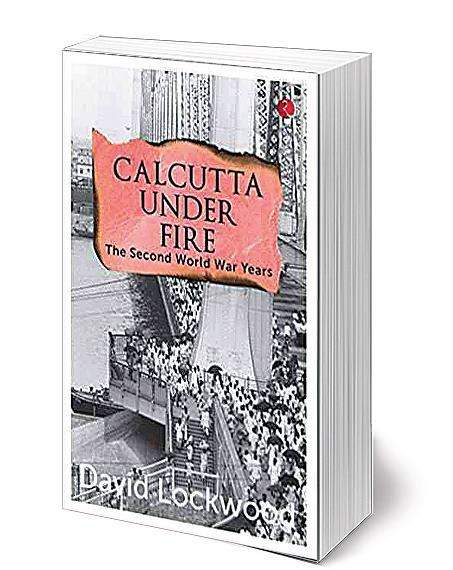
Calcutta Under Fire: The Second World War Years By: David Lockwood Publisher: Rupa Pages: 294 Price: `295
The year 1942 was a landmark year in terms of political and military changes, especially in East Asia. Japan, which had entered World War II spectacularly by bombing Pearl Harbour in December 1941, had—within less than a year—successfully invaded Malaya, Hong Kong, Singapore and Burma. In each of these territories, the defending (and now defeated) forces had been the British.
With the Japanese occupying Burma, sitting literally on the doorstep of India, it was unsurprising that by late 1942, fears of a Japanese invasion of India, or at least of its eastern and coastal stretches, should be widespread.
Yet, there were other factors to be considered. Political, social, and military factors, and factors regarding less tangible ideas, such as the need to save face, or to put up a brave front. There was the Indian national movement, there was the growing doubt among many Britishers themselves regarding the future of India as part of the Empire. There was the (natural, given what had happened in Burma and elsewhere) fear among Indians that the British would be incapable of defending India against the Japanese.
David Lockwood examines all of these and more in an attempt to explain the circumstances and events that shaped India during World War II, especially around the tumultuous year of 1942, when the Japanese bombed Calcutta and sent thousands fleeing the city in panic.
But merely looking at the Japanese bombing of Calcutta in isolation would not make a complete book, so Lockwood instead spreads his net wide to encompass events, ideologies, movements, policies and more. He examines the theory of hegemony as an intrinsic part of British imperialism, and from there goes on to discuss how the Congress’s policies were tailored towards a counter-hegemony.
There is a detailed discussion of how the Congress’s policies underwent changes; of the work the Congress did to mobilise the general populace in what was essentially a counter-hegemonistic movement; of the role played by radio (including the Congress’s illegal, underground radio broadcasts as well as Subhas Chandra Bose’s broadcasts from Berlin); and of rising discontent and nationalism among the Indians in the British Indian military and civil services.
The final picture is a complex but intriguing one of the different forces that not only shaped India in 1942, but which eventually led to independence. Lockwood manages to present interesting insights into the considerations that made the British, the Congress, and the general Indian public (both urban as well as rural) act as they did.
Lockwood’s research is extensive (he even manages to present the Japanese side of it: did they really intend to invade India and make it part of a Japanese Empire?). There are some delightful bits of trivia, too (the thought of an impending Japanese invasion seems to have encouraged some Indians, who looked on the approaching Japanese armies more as liberators than conquerors, to take some very surprising steps, such as learning Japanese). While Lockwood’s style of writing may at times seem more geared towards an academic audience than a layperson, the book is an invaluable resource for understanding India during World War II.
source: http://www.newindianexpress.com / The New Indian Express / Home> Lifestyle> Books / by Madhulika Liddle / Express News Service / February 24th, 2019