Category Archives: Inspiration / Positive News and Features

Child Crusader’s Story to Inspire the World

Kolkata :

Her defiance against an age-old custom developed into a campaign that caught the imagination of the nation. And now anti-child marriage crusader Rekha Kalindi will rub shoulders with Malala Yousafzai and Anne Frank in a book that tells the tales of how they changed the world.

The story of this braveheart from West Bengal’s Purulia district, conferred the National Bravery Award for refusing to be a child bride and inspiring many of her ilk, features in the “Kinderen Die De Wereled Hebben Veranderd” (Children Who Changed the World), a Dutch book to be released Nov 20 to mark the 25th anniversary of the UN Declaration of the Rights of the Child.

Written by renowned Dutch journalists and historians, the book portrays the heroics of 20 children who stood up against injustice or became a symbol of injustice done to them and includes the likes of Pakistani education activist Malala Yousafzai and holocaust diarist Anne Frank.

Talking about Rekha’s story – the only one from India – Aletta Andre who has penned the chapter on her, elaborated about the 16-year-old’s efforts to inspire nearly 10,000 girls in the district to pursue their studies and not to concede to their families’ demand of an early marriage.

“It’s not only about her own defiance but also about how she counselled and inspired a lot of other girls to do the same. At least 10,000 in Purulia district have resisted child marriage and her story has been also mentioned in a Class V textbook,” Andre, a Delhi-based Dutch journalist, told IANS on the phone.

Considered a liability, her parents had planned to marry Rekha off at 11 to get rid of “their burden”. But having seen her elder sister suffer as she became a mother at 12, the idea of marriage terrified Rekha and eventually led her to revolt that created history.

Conferring the Bravery award in 2009, the then president Pratibha Patil had described Rekha as a “messenger of social change”.

At the age of four Rekha started working, rolling beedis along with her mother. Now a class 10 student of Jhalda Satyabhama Vidyapith, she actively campaigns against child labour and child marriage.

Ecstatic about being part of the book, Rekha at the same time is distraught for she can read only Bengali and not Dutch.

“I heard the book is in some other language which I cannot read. I am sad at that, but I am also very happy that my story will be read by foreigners,” Rekha told IANS.

Aspiring to be a teacher and preparing hard for her board exams, Rekha insists her job has just begun.

“There is so much poverty; many girls have to work because of which they don’t get time to study. I wish a day comes when all of us will go to school without having to worry about work,” added Rekha.

Unicef, which has been working to curb the menace of child marriage, expressed happiness at Rekha’s contribution getting international recognition and hoped this would inspire and create many a crusader like her.

“This is surely a proud moment for all of us and I hope it creates many a Rekhas to fight out the menace of child marriage and child labour,” Asadur Rahman, head of Unicef’s field office said.

Others featuring in the book include Pakistani child labour hero Iqbal Masih who helped over 3,000 minor bonded labourers to escape before he was murdered in 1995 and South African Nkosi Johnson, who made a powerful impact on public perceptions of HIV/AIDS and its effects before his eventual death at the age of 12 from the pandemic.

source: http://www.newindianexpress.com / The New Indian Express / Home> Nation / IANS / August 31st, 2014

Spunk and sacrifice – Awarded for excellence, courage and more

SnehaKOLKATA29aug2014

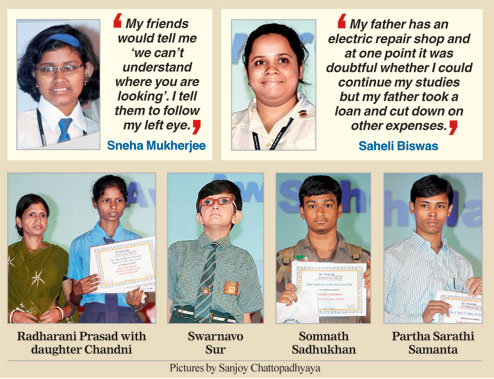
Sneha Mukherjee has a plastic sphere where her right would have been and minus power in her left eye but the only “favour” the 12-year-old takes in class is to sit in the front row.

Sneha underwent an eye surgery for removal of tumour when she was just 11 months old and had since had no vision in her right eye.

That has not impaired her spirit and Sneha, who has a ready response for any insensitive remark about her eye implant. “My friends would tell me ‘we can’t understand where you are looking’. I tell them to follow my left eye,” said the Class VII student of St. Joseph’s Convent in Chandernagore and winner of The Surrendra Paul Memorial Award for Courage at Peerless presents The Telegraph School Awards for Excellence 2014, in association with Parle-G and powered by Adamas University.

If Sneha has always been encouraged by mother Lopamudra not to take any favours, other parents have made sacrifices — big and small — for their children’s education.

Radharani Prasad has to work as a domestic help as her husband is confined to bed by paralysis but that didn’t stop her for admitting daughter Chandni to Gurukul Vidyamandir Higher Secondary School after she scored 75 per cent in ICSE. Chandni received The Telegraph Education Foundation Scholarship.

“The school did give us concession but despite that I had to pay about Rs 15,000 for her admission after taking loan. I haven’t been able to pay her monthly fee so far,” said Radharani, who shared The Abhirup Bhadra Memorial “Thank You Baba-Ma” Award with Balaka and Swarup Sur, parents of Swarnavo, a kindergarten student at Assembly of Angels Secondary School, Barrackpore.

Swarnavo had a hernia surgery when he was 10 months old and an eye surgery when he was three. “He is extremely regular in school and I do not have to give him any special attention,” said the proud mother.

It was for Subir and Swarnali Biswas (who received The Abhirup Bhadra Memorial “Thank You Baba-Ma” Award) that their daughter Saheli (who received The Telegraph Education Foundation Scholarship) could continue her studies.

“My father has an electric repair shop and at one point it was doubtful whether I could continue my studies but my father took a loan and cut down on other expenses,” said the student of Class XI.

The spunky Somnath Sadhukhan, who received The Faith in Astha Scholarship, studies geography honours at Surendranath College while his mother sells pens and stationery in and around Shyambazar.

Rudrangshu Mukherjee, the managing trustee of The Telegraph Education Foundation, had one thought on Saturday for the students. “When you become somebody eminent, somebody successful… just turn back and reflect on those who need to be educated, those who need your support… “Please grow with The Telegraph Education Foundation, the best is yet to be because the best is in your hands.”

Barry O’ Brien, the convener of The Telegraph School Awards for Excellence, shared how students and teachers have often told him how moved they are by the stories of courage and resilience.

“Don’t just be moved. Don’t just take a handkerchief out of your pocket and wipe your tears. Do something small, very small, it could be anything. Try to reach out to somebody,” was O’Brien’s advice,

Delhi Public School Megacity and Sunita Sen, the principal of Ballygunge Shiksha Sadan, did just that, responding on the spot to a request to fund a laptop for Partha Sarathi Samanta, the son of a guard who is studying MTech at the Indian Institute of Engineering Science and Technology. They chipped in with Rs 40,000 for the recipient of The Club Friday Scholarship.

source: http://www.telegraphindia.com / The Telegraph, Calcutta / Front Page> Calcutta> Story / by Jhinuk Mazumdar / Tuesday – August 26th, 2014

45 years on, an inspiration returns to her inspiration – The fairy godmother, The La Martiniere girl

Shabnam Ramaswamy, who started life afresh from the streets to become the force behind Jagriti Public School and Stree Shakti women’s co-operative in Katna village of Murshidabad, returned to her alma mater, La Martiniere for Girls, on Friday morning for the first time in 45 years.

The 60-year-old fairy godmother to hundreds of women and children took a walk down her La Martiniere memory lane…

ShabnamKOLKATA11aug2014

Whenever I’d go over the AJC Bose flyover I’d point at my school and show my driver or some staff member travelling with me in the car: “See, that’s my school!” After I went out of school in 1969 and all these years of struggle, I had never set foot in my school.

As I was addressing students of the school, I was thinking I would have loved my father to be alive today. In those days, picking me from a village, bringing me to the city and admitting me to this school, what a chance it was for me.

I went through all the stereotypes of marriage and conventions but it was the school that really made me what I am in terms of my lateral thinking, turning of views, never to give up against all odds. These are things in the books you read but the teachers put it across in a manner that really changed the way I think.

Shabnam2KOLKATA11aug2014

One book that I loved reading during my school days was Tom Sawyer. He was such a big influence on me. Him painting the wall, the mundane routine of doing that job when everyone else was having fun. At 22 (Shabnam was married off at 16) when I’d see other girls around me having fun and I would think, like Tom I’m going to make everybody come and paint my wall too while I sit on the stool with all my treasures. And today it seems like it’s really happened!

Look at the background I came from. My mother was illiterate, so was my grandmother. My father was in the army. So it was really the school that taught me how to handle life and the education gave me the ability to juxtapose both worlds, not to hate that or look down on it but do something about it. In fact, today I’ll be visiting one such teacher’s house who has baked a cake and waiting for me. I’m just looking forward to meeting her after all these years.

College I did because I desperately needed the graduate degree but it’s the school that made me. Looking at the school after all these years, no matter how much the buildings have changed and new ones have come up, these pillars will remain. The pillars are like pillars of strength for me. Today, with pride I can say that I come from here.

Shabnam3KOLKATA11aug2014

My favourite corner was always the field because I loved sports. I used to throw javelin, discus and do high jumps, long jumps. I used to participate in inter-school sporting events. I wasn’t a hugely academic person.

When I was starting Jagriti (Shabnam’s CBSE-affiliated English-medium co-educational public school for the poor) my reference point was this school. The discipline, the curriculum and the philosophy is modelled on all that I learnt from my own school — La Martiniere.

As told to Mohua Das

source: http://www.telegraphindia.com / The Telegraph, Calcutta / Front Page> Calcutta> Story / by Mohua Das / Saturday – August 098th, 2014

Unique memorial service to honour brave airmen

Kolkata :

On Saturday, a unique memorial service was organized at the Rasgovindpur Airstrip (also known as the Amarda Road Airfield) in Odisha to honour 14 airmen of the Royal Air Force (RAF) who were killed in a mid-air collision between two B-24 Liberator bombers on July 26, 1945. It was Bhubaneswar-based war historian Anil Dhir who dug up this historical fact. He along with Aditya Patnaik of the Gandhi Eye Hospital and school children were among those who laid wreaths in memory of the dead airmen.

“Very few people are aware that 69 years ago two Liberators (EW225 and EW247) collided at low altitude during a practice flight. They were part of a six-aircraft contingent from the Air Fighting Training Unit engaged in a formation flying exercise. The Rasgovindpur Airstrip had the longest runway in Asia (more than 3.5 km). The total length of the runway, taxiways and aprons was more than 60 km. Part of the runway (nearly 11,000 feet) still remains but there is no activity save for the grazing of cattle. This airfield played a very crucial role in the defence of India during World War II. It was a forward airbase against the Japanese and was used for ‘Over the Hump’ operations as well as training pilots for special bombing raids. Unfortunately, there aren’t any details available of the activities that took place here between 1943 and 1945, even in military archives,” Dhir says.

It was during a visit to the Madras military cemetery that Dhir came across the graves of 14 airmen who were killed at the Amarda Road Airstrip crash. It took a lot of doing on his part to find out that the 900 acre airstrip was built at a cost of Rs 3 crore in the 1940’s. During his research, Dhir received assistance from Matthew J Poole from the USA who has studied the crash and prepared a report. With Poole’s assistance, Dhir was able to locate the relatives of none of those killed in the air crash. One of them is 101 years old now.

“The two aircrafts took off from the airfield in Odisha but the crash took place over West Bengal. The debris was strewn across flooded paddy fields in Bengal. I have requested both the Odisha and Bengal governments to erect small memorials at the airfield and the crash site to honour the brave souls who gave up their lives for the defence of our motherland,” Dhir added.

source: http://www.timesofindia.indiatimes.com / The Times of India / Home> City> Kolkata / by Jayanta Gupta, TNN / July 29th, 2014

3 Keralites for Mission Palliative Care in Rural West Bengal

Kozhikode :

Three Keralite Civil Service officers would soon add a new chapter in palliative care in rural West Bengal, inspired by similar initiative in their home state.

‘Sanjeevani’, an end-of-life care project to be launched in September in the Nadia district of WB, is the brain child of IAS officers P B Salim and Bijin Krishna and Amarnath, an IPS officer. The project has been conceptualised by the Kozhikode based Institute of Palliative Medicine (IPM), the training, research and outreach arm of Pain and Palliative Care Society, which pioneered community volunteering in end-of-life care.

Salim, hailing from Muvattupuzha, is currently working as the District Magistrate of Nadia while Amarnath, a native of Moozhikkal in Kozhikode, is the ASP of South 24 Parganas. Bijin from Meppayur in Kozhikode is the Assistant Collector of Murshidabad district. “Both Amarnath and Salim had associated with IPM years ago. Salim suggested starting a palliative care programme in West Bengal. He along with Amarnath then approached me. Later, Bijin also extended support to the initiative,” said Dr Suresh, director of IPM, which provides technical support for the project.

According to Salim, Sanjeevani is aimed at improving the quality of life of the terminally ill in Nadia.

“The project intends to introduce a new culture of providing care for the bed-ridden patients utilising a network of physicians, nurses and volunteers,” he said.

source: http://www.newindianexpress.com / The New Indian Express / Home> States> Kerala / by Shafeeq Alingal / July 25th, 2014

Kolkata NCC gets 2000 people to pledge their eyes by November

Kolkata :

National Cadet Corps (NCC) volunteers of the West Bengal and Sikkim Directorate have succeeded in getting 2,127 people to pledge their eyes over the last ten days. It is now their aim to motivate 100,000 people to pledge their eyes by NCC Day in November. This will be a record of sorts.

This plan was revealed by Major General Shyam Srivastava, additional director general, NCC, West Bengal and Sikkim Directorate, at a ceremony on Friday that was attended by NCC director general Lt Gen Aniruddha Chakravarty. The DG is on a maiden visit to this directorate and also visited IIT, Kharagpur, a couple of days ago where an advanced training course was being organized for cadets who wish to appear for civil services and other competitive examinations.

Lt Gen Chakravarty lauded the efforts of the NCC is the state and said that pledging of eyes is the ultimate donation that a person can make as it helps a visually challenged person see the world. Among those who pledged their eyes were the cadets, their family members and people at large. A cultural programme was organized by visually challenged youth from the Bhartendu Andh Ashram during the day. A presentation was also made to clear the myths associated with eye donation.

source: http://www.timesofindia.indiatimes.com / The Times of India / Home> City> Kolkata / by Jayanta Gupta, TNN / July 11th, 2014

Go-getter Bumbaiyya nurtures rugby dreams

Kolkata :

It’s probably apt that he has adopted the name Azad. Bumbaiyya, as he was known on the Howrah station platforms, has certainly broken free, thanks to a few well-wishers. Azad is now a strapping 20-year-old-youth, working in a glass factory in Odisha and looking after his widowed mother and sister. But things were not always this way for him. There was always the possibility of Bumbaiyya losing his way and ending up dead in some dirty gutter close to one of the busiest railway stations in the world.

Nobody seems to know what Bumbaiyya’s real name is. In 2004, when award-winning filmmaker Gerry Troyna was shooting at Howrah station for his BBC Four project ‘Monsoon Railway’, he came across the 10-year-old child and featured him in the documentary that won international acclaim.

“Bumbaiyya had apparently run away from home and turned up at the Howrah station. There, he collected used plastic bottles from the tracks and platforms. He also travelled a lot on trains, particularly those moving towards Mumbai. That is how he seems to have got the name ‘Bumbaiyya’. Gerry did not stop at featuring him in the film alone. He insisted that the boy start life afresh and seek shelter with an NGO in Kolkata. Bumbaiyya also came in touch with Mahindra Shinde, who is a former street child and part of Gerry’s crew now. He seems to have been inspired and actually adopted to the discipline involved in staying at the hostel run by the NGO. I would monitor his progress and Gerry would also keep in touch from wherever he was,” said Pallavi Biswas, a member of Troyna’s team.

It was at the hostel that Bumbaiyya adopted the name Azad. He took up studies and rugby. He was so good at the sport that Azad got selected to the national under-19 rugby team. “I played for the national side in several parts of the country. I also travelled abroad to countries like England and Thailand. By then, I had got in touch with my family in Odisha. Before I could sit for my Class X examinations, my father passed away and there was nobody to look after my mother and sister. I love rugby and would have loved to continue but had to start looking for a job to take care of them,” Azad said.

He believes that there is similar potential in other children who grow up on railway platforms. “They simply require a platform (not the railway kind) and some helping hands. They will certainly realize their potentials and grow up to be responsible adults,” Azad added.

Troyna doesn’t feel that he did anything out of the ordinary for the youngster. “I just opened a door for him. It was for him to take the opportunity. Today, when I watch this strapping young lad, I am proud. I am full of admiration. The films I make are not just entertainment. I believe that they must leave a positive effect. The people who agree to let us enter their lives must benefit in some way. I try to maintain a positive contribution and have never betrayed the trust of people, whether a beggar or a senior official. Azad loves rugby and is actually very good at it. I just hope he gets a job where he can continue to play the sport,” the 65-year-old filmmaker said.

source: http://www.timesofindia.indiatimes.com / The Times of India / Home> City> Kolkata / by Jayanta Gupta, TNN / July 12th, 2014

Super girls show what it takes to beat the odds

SanaAfrinBENGAL09jul2014

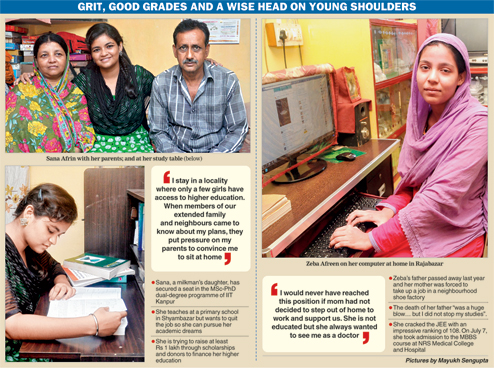
A milkman’s daughter made it to the IIT to pursue her dream of becoming a physicist. Sana Afrin funded her education and that of her brother’s by giving tuition and working as a primary school teacher.

Zeba Afreen, a fatherless girl whose mother works in a sweatshop to pay for her education, is set to become a doctor.

Metro meets the two inspiring girls.

SANA AFRIN

The test was tough but she secured an admirable countrywide rank of 23 to win a seat in the MSc-PhD dual-degree programme at IIT Kanpur.

The daughter of milkman Sheikh Rahi of Paikpara in north Calcutta had cracked tougher tests and hopefully overcome the one she is currently fighting: finance her education at an IIT.

Born in a financially weak and conservative family, 21-year-old Sana’s tryst with hurdles began at a young age when her father had to make a choice between daughter and son since he could afford to educate only one of the two children.

“My parents decided to support my education despite some unpleasant advice from relatives and friends. My younger brother had to wait a year to start his schooling,” said Sana at her home in Saudagar Patti, Paikpara.

Sana did not disappoint her parents, especially her hardworking father who delivers milk door to door to earn his living. She scored well in her Class X board exam and chose science for her Higher Secondary.

Just when she thought everything was on course, Sana faced her biggest hurdle. Her father didn’t have the money to pay her admission fee, leaving the daughter on the threshold of giving it all up.

To rub it in, some relatives advised her father that it was not wise to educate a girl so much. “They said I wouldn’t be able to cope with science. When I heard this, I was determined to prove that my parents’ decision to educate their daughter was right,” she said.

Loans from friends and scholarships from some NGOs helped her tide over the crisis and shut disapproving mouths.

Sana is now awaiting her BSc Part III results from Calcutta University.

She not only managed her education but also that of her younger brother, a Class XI student at an English-medium school in Dum Dum.

Sana remembers the hostile reaction when she announced her wish to go to college after Class XII. “I stay in a locality where only a few girls have access to higher education. When members of our extended family and neighbours came to know about my plans, they put pressure on my parents to convince me to sit at home.”

The gritty girl stuck to her plan: BSc with honours in physics. She filled in forms of various colleges and took admission in the first college where her name appeared on the merit list.

She knew all too well about her father’s financial situation and the people who wouldn’t let go any opportunity to scuttle her academic pursuit. Sana circumvented the situation by giving tuition, the earning taking care of her and her brother’s education to some extent.

Sana now teaches at a primary school in Shyambazar after clearing the Teacher Eligibility Test last year. Only one per cent of the several lakh candidates who appeared for the TET could get through.

In February this year, she appeared for the IIT Joint Admission Test for the MSc course. “I wasn’t well-prepared for the exam… I had just joined the school. I was also studying for my third-year final and doing private tuition,” she said.

Still she managed a ranking of 23.

She is aware that her current job will bring some financial stability to the family but her heart is with higher studies at IIT Kanpur. “I want to study and fulfil my dreams. I do not want to remain a primary school teacher.”

The new challenge is to arrange for her admission and semester fees. “I have been able to book my seat by paying a token amount of Rs 10,000. I need close to Rs 1 lakh,” she said.

When she visited a government department that apparently helps children from poor families with stipends and scholarships, she was told that she was not eligible. “They said they would have helped me had I been pursuing medical, engineering or civil services. They will not fund anybody’s education for research,” Sana said.

She never forgets to thank people who doubt her abilities. “They deserve credit. If they don’t question my ability, I will not be able to give my best,” she said.

Sana is eligible to apply for an IIT scholarship considering Sheikh Rahi’s financial situation, but she does not want to leave anything to chance.

If she manages to arrange the money, she would leave for Kanpur on July 16. The prospect of not spending Id with her parents does make her sad but she is determined to fulfil her dreams because her brother’s future is also at stake. “It will be tough but I need to do this and provide a better life to my parents and fund my brother’s higher education.”

ZEBA AFREEN

When Zeba Afreen’s father passed away last year and her mother was forced to take up a job in a neighbourhood sweatshop that manufactures footwear, she had several excuses to abandon her dreams.

But the 20-year-old did not lose sight of her goals, the immediate one being the Joint Entrance Exam. She studied 14 hours a day despite taking care of household chores and three younger siblings.

The Rajabazar girl cracked the JEE with an impressive ranking of 108. On July 7, she took admission in NRS Medical College and Hospital to its MBBS course.

Zeba did not let her father’s death influence her preparations, though “it was a huge blow… a bolt from the blue”. “But I did not stop my studies. I kept studying for the joint exam,” she said in her Rajabazar home opposite Tasvir Mahal cinema hall.

“I initially thought of quitting studies and taking up some odd job. Mother was dead against it. She wanted me to continue my studies,” she said.

Her father was a small-time envelope-seller and didn’t have any savings, forcing his wife Afsari Khatoon to work at the small shoe factory to support her children.

Zeba did not disappoint her mother.

She took help of senior teachers in her locality to prepare for the physics, chemistry and mathematics papers since she couldn’t afford classes at coaching institutions for competitive examinations.

“There was no way I could afford the expensive coaching centres. My only option was to study hard on my own,” said Zeba, who passed Higher Secondary from Shri Shikshayatan after Madhyamik in a neighbourhood school.

There was no dearth of distractions that cropped up every day to offset Zeba’s dream, the most annoying being the din on the road outside her house while she was preparing for her exams.

“I couldn’t concentrate even at night. Autorickshaws ply till late in the night… honking of vehicles. Ooph!”

This was Zeba’s second shot at the entrance exams. She came somewhere in the 2000s on the rankings last year and so decided to give appear again instead of taking up engineering in a lesser-known institution.

“I used the failure to identify areas I needed to work upon. From time management to improving my answers, I practised hard in the past one year,” she said.

“I would never have reached this position if mom had not decided to step out of home to work and support us. She is not educated but she always wanted to see me as a doctor,” Zeba said.

She now intends to focus on her two younger sisters and a brother. “I hope to guide my siblings the way my mother guided me.”

After completing her MBBS, Zeba wants to specialise in neurology and help the poor. “I owe my success to many people who came forward to help me when I was in need,” she said.

What message do you have for Sana and Zeba? Tell ttmetro@abpmail.com

source: http://www.telegraphindia.com / The Telegraph – Calcutta / Front Page> Calcutta> Story / by Zeeshan Jawed / Wednesday – July 09th, 2014