Category Archives: Uncategorized

BSF women patrol border for first time

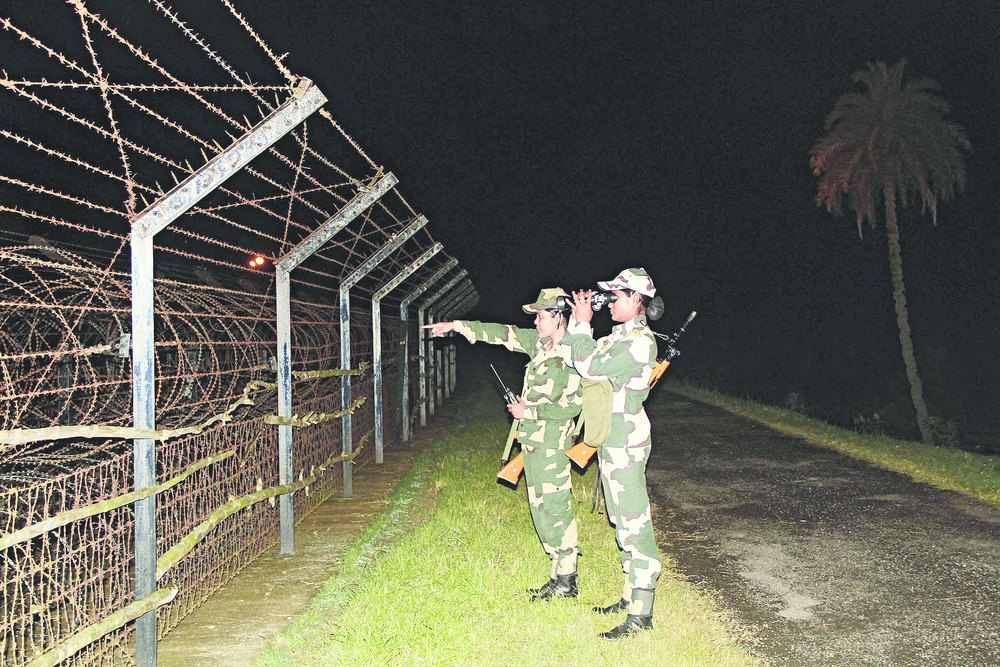
Women commandoes of the BSF at the India-Bangladesh border in Nadia. Picture by Pranab Debnath

Gede (Nadia) :

For the first time, women commandos of the Border Security Force (BSF) have been patrolling the south Bengal frontier on the India-Bangladesh border in Nadia’s Krishnagar sector.

The deployment of the women personnel in night patrolling comes in the wake of security alerts claiming terror outfits can use young women in possible attacks around Independence Day.

Women BSF personnel have done “camp duty” at night in Punjab, which meant guarding the gates. There have not been reports, however, of women personnel being used in anti-sabotage or active patrolling in the night.

It is certainly the first time women are patrolling the border in Bengal.

The BSF began to think differently following the blasts in Burdwan’s Khagragarh on October 2, 2014, in which women played a key role. Razia Biwi, a homemaker, had allegedly played a key role in the Burdwan blast and in weaving a terror network.

In addition, there were reports that Bangladeshi terror outfits were recruiting young homemakers and training them.

“Intelligence inputs indicate that women with terror links may try to sneak in in the guise of cattle smugglers. Bangladeshi terror outfits such as the Jamaat-ul-Mujahideen Bangladesh (JMB) are quite active in the border areas. They have recruited young homemakers and given them terror training. It is not easy for a male BSF officer to get into a combat with or frisk them. So women personnel were pressed into action,” said a BSF officer in Gede.

The BSF deployed the women in key stretches of the 235km sector in North 24-Parganas and Nadia.

For the past three days, women constables of the BSF’s 113th battalion posted in the Gede area of Nadia are on their toes round the clock along the India-Bangladesh border.

Three young women are in their camouflage uniform. They hold the sophisticated Insas and Beretta guns in their hands and night-vision cameras to their eyes. They are guarding the international rail tracks connecting Gede with Darshana in Bangladesh. The Indo-Bangla train, Maitree Express, uses these tracks.

“This is a challenging job. I have been enjoying it,” said a woman constable who was recruited in 2012.

A woman constable and a male constable share the same duties, BSF authorities said.

BSF South Bengal Frontier inspector-general Sandeep Salunke said: “A woman constable is supposed to perform all the duties of their male counterparts. Women have been trained to undertake any type of operation. So it is quite natural that they be engaged in night patrolling too.”

BSF started recruiting women constables in 2009 for the Punjab and Bengal borders. At present, it has over 2,000 women personnel, who have been given commando training. The force recently recruited 27 officers in the rank of assistant commandos through the UPSC.

Senior BSF officers said that even though there was no strict rule against engaging women commandos in night patrol, the force had nevertheless avoided deploying them frequently.

“In Bengal, they are being deployed the first time in patrolling and area dominance during night,” a senior BSF officer said.

The presence of women constables has already made a difference, officials here said.

“Many local villagers are involved in smuggling. They often try to smuggle small fertiliser bags, drugs, gold biscuits, silver and cattle. We were earlier unable to frisk the women involved. Villagers often raise allegations of molestation against our male jawans. But things have changed once women constables have been deployed along the border,” said the officer.

“Direct noticeable involvement of women involved in suspected criminal activities in border areas has also come down largely as women BSF personnel undertake random combing of villages along the border,” the officer added.

source: http://www.telegraphindia.com / The Telegraph, Calcutta, India / Front Page> Bengal> Story / by Subhasish Chaudhri / Sunday – August 16th, 2015

An evening to remember

Kolkata :

The Times of India organized Times Evening at The Residency, City Centre-I, Salt Lake on Valentine’s Day.

Presented by Airtel in association with Toyota – Quality Revolution, IFB, Bhagirathi Neotia Women & Child Care Centre, Adrija Gold and Diamond Jewellery Collections, Re-Feel, Kent – Mineral RO, The Braands – E mall, Lifespan Diabetes & Cardiometabolic Clinic, Lawrence & Mayo, SIP Abacus, Bubble Blue – Montessori School, Keventer Fresh, The State Bank of India, IFB Agro Ltd and Rikshiva Fashion, Times Evening began with a medical camp where Lifespan Diabetes & Cardio metabolic Clinic conducted free blood sugar test and doctors consultations. Lawrence & Mayo did free eye check-up.

Toyota-Quality Revolution organized a free test session for all residents throughout the day and also gave freebies to all the persons who took test drives. The special offer to residents included Rs 15,000 worth accessories free for spot bookings.

In the evening, a sit-and-draw competition was held for young ones up to the age of 12. In the event ‘Paint your Imaginations’, 18 kids participated in it. The first prize was won by Trisha Khilani, the second prize by Diya Gupta and the third prize by Pranit.

In the cooking competition titled ‘Master Chef Competition’ sponsored by IFB and IFB Agro Ltd, Ankita Mundra who made moong dal ka halwa won the first prize, an IFB microwave oven. Susmita Dash won the second prize, an IFB induction cook top, for her chilli chicken. Nisha Sharma’s veg pasta with mixed sauce was adjudged third.

The evening ended with a musical performance. The prizes were handed out by guests of honours Sumanta Bhaduri of Adrija Gold & Diamond Jewellery Collections, Shantanu Roy Chaodhury and Arnab Bhattacharya of Topsel Toyota, Anil and Nidhi Khandelwal of The Braand and Nabanita Bose Mukherjee of SIP Abacus

source: http://www.timesofindia.indiatimes.com / The Times of India / Home> City> Kolkata / TNN / February 20th, 2015

Web debut for historic society

The homepage of the British Indian Association website

The British Indian Association may have lost its old building, and the street named after it may have been renamed after Abdul Hamid, but now it can boast its brand new website launched recently.

The association occupies several rooms on the third floor of a new office building at the head of Barretto Lane constructed on the site of its old building. The website (http://biakolkata.co.in) displays the history of the association, lists of its important members past and present, of the invaluable books, newspapers, and journals in its 163-year-old library, and of its publications 1868 onwards.

Apart from a rich collection of books, the association possesses paintings and other artefacts, among which are the portraits of local Indian dignitaries who were association members, and two busts of Radhakanta Deb and Kristo Das Paul.

The association was originally a political organisation that had a role in the creation of the Indian National Congress, whose early meetings were held in the old building. From a political organisation it became a landholders’ organisation, although it also took up causes that affected Indians in general. After the abolition of the zamindari system in the early 1950s, its functions may have been curtailed but over the years it has become a repository of valuable research material.

About 20 years before the establishment of the British Indian Association in 1851, the Zamindari Association, later renamed Landholders’ Society, was formed in 1831. But after the death of Dwarkanath Tagore, it was as good as dead. Thereafter, in 1839, the Bengal British India Society was formed. It was meant to further the interests of all classes of Indians through its recommendations and measures which had to be “consistent with pure loyalty to the person and government of the reigning sovereign of the British dominions”.

Subsequently, the Landholders’ Society and the Bengal British India at a meeting held on October 29, 1851, at Kasaitola (subsequently Bentinck Street) decided to form the British Indian Association by merging the two bodies to highlight the grievances of Indians. The first committee of the association was composed of Radhakanta Deb, Kalikrishna Deb, Debendranath Tagore, Digambar Mitra, Prasanna Kumar Tagore, Peary Chand Mitra and Sambhunath Pandit. Besides rajas and maharajas and zamindars, Derozians and the intellectual aristocracy of the Bengal Presidency also held important positions on the committee. Traders and businessmen were also members. But membership was strictly confined to Indians. The objects of the association “were related partly to improvements in the local administration of the country and partly to the system of Indian government laid by Parliament”. Joteendra Mohan Tagore and Joykrishna Mukherji enabled the association to have a home at 18 Raneemoody Gully, whose name was later changed to British Indian Street.

The association had “an all-India outlook” and championed the causes of the Indian people at a time when there was no strong political body in the country.

After the Indigo Rebellion of 1859-60, it pleaded with the government to appoint a commission of inquiry to solve the problems of indigo cultivation. The association suggested measures on epidemics, floods, famines, taxation, the practice of Sati, burning ghats and property and inheritance. The association gave the people the first lesson in the art of fighting constitutionally for their rights and giving expression to their opinions. Now it will support research work and try to survive as an institution promoting excellence.

source: http://www.telegraphindia.com / The Telegraph, Calcutta / Front Page> Calcutta> Story / Sunday – December 28th, 2014

Muktijoddha poet’s creations go unnoticed

Kolkata :

Lyricist Gobinda Halder, whom Bangladesh President Abdul Hamid met at a hospital on Monday, didn’t just write ‘Joy Banglar Gaan’, patriotic songs that inspired the Muktijoddhas during the Bangladesh Liberation War in 1971. He had also penned nearly 3,500 semi-classical, folk, baul, kirtan, Shyamasangeet and modern Bengali songs before glaucoma claimed his sight and ended his writing spree.

Some of his patriotic songs like ‘Mora Ekti Phulke Bachabo Bole Juddho Kori’, ‘Ek Sagor Rokter Binimoye Banglar Swadhinata Anlo Jara’, ‘Purbo Digonte Surjo Uthechhe Rokto Lal’ and ‘Padma Meghna Jamuna Tomar Amar Thikana’ are still popular in Bangladesh. Artistes from All India Radio and Doordarshan did sing some of his songs from other genre but Halder was never acknowledged. Most of his works, both songs and poetry, remain unpublished and unknown.

Halder’s first book on poetry had been a success. The 500-odd copies that the writer had managed to print in 1989 after depleting his meagre resources got sold out. Unfortunately, Halder did not have the means to reprint ‘Door Digante’, a collection of powerful poems.

His childhood friend Debkumar Mitra, who was chief librarian of Calcutta University till 1994-95, did publish the second edition five years later. But a combination of factors that ranged from poor production quality to lack of sales and a quantum change in reading habits post-Liberalisation ruined its prospects.

“I still have about 70 copies unsold. During my trips to Bangladesh, I had approached officials and offered to hand them over so that they could be distributed either in the country where he is loved or from the Bangladesh pavilion at the Kolkata Book Fair,” said Debkumar’s daughter Sangeeta.

Mitra would drop by at Halder’s tiny Ramakrishna Samadhi Road apartment in Kankurgachhi regularly till four years ago when his own failing health confined him indoors. He passed away this March, his dream of publishing his friend’s works unfulfilled.

Halder, who is unaware of his friend’s demise, is recuperating at JN Roy Hospital. B Hazra, the doctor treating him, said his condition was stable. “He was in a critical condition when he came on December 13, suffering from cerebral atrophy that affected his speech. He had also contracted bed sore. His speech has since improved,” the physician said. Halder is on Ryles tube and catheter.

Halder’s daughter Gopa said they were happy with the treatment and glad her father was responding to it.

source: http://www.timesofindia.indiatimes.com / The Times of India / Home> City>Kolkata / by Subhro Niyogi & Debasish Konar, TNN / December 24th, 2014

Park Mansion raises ‘French toast’

Kolkata :

Tuesday marked the end of a 15-year wait for all those who have a part of Alliance Francaise du Bengale. So as bottles of St Emilion 2011 were being uncorked atop the grand-old Park Mansion, a lot was being toasted for. It was a homecoming that arrived late, but each moment of wait has bolstered Kolkata’s French connection that has been going strong for the last 75 years.

Alliance Francaise lost its home of 60 years in a devastating fire in 1999. “Park Mansion not only used to be the hub of the French delegates in Kolkata post Independence, but it was also one of our treasured structures that fell prey to the April 1999 fire. It’s as if the building and its treasures like the Alliance Francaise has risen from the ashes,” gushed G M Kapoor, founder of Intach.

The inauguration brought together several of the city’s elite for whom it was much more than a soiree. For Nitin Kothari, one of the oldest tenants of Park Mansion and owner of Peter Cat and Mocambo, it was a momentous occasion. “It’s Alliance Francaise arrival and also the first party on our terrace,” said Kothari, pointing at the majestic dome that’s unique to the Park Mansion, which was developed by Armenian jute merchant T M Thaddeus in 1910 in a style that’s a blend of the Victorian and the Indo-Saracenic.

For Alliance Francaise director Stephan Amalir, it was a proud moment: “Being the prime organizer of the event, I have so many things to worry about, but I can’t let go of the feeling of euphoria that comes along with the shifting,” he said.

The honours were done by Francois Richier, ambassador of France in India, who came to confer the title of “Chevalier de l’Ordre des Arts et des Lettres” (Knighthood of the Order of Arts and Letters) to three Kolkatans for contributions to arts.

Alliance Francaise doesn’t look the same though as Amalir has risen new-age needs while keeping alive the old-world charm. Fire-proofing gadgets and new cabling system have been installed. There is an e-library (Culturetheque) for GenY.

AFB had been operating out of Khaleel Munzil and Bimal Villa on West Range, a few buildings behind it. The institute is retaining Bimal Villa but the library and the administrative offices have shifted to Park Mansion in its much smaller space (3,500 sq ft as opposed to the earlier 10,000 sq ft covering two apartments on the first and the third floor). The apartment is on a 10-year lease.

“The 1999 fire was a catastrophe, but today we proved that it did not deter us from reclaiming our old home,” said Gargi Bannerjee, Alliance Francaise president.

source: http://www.timesofindia.indiatimes.com / The Times of India / Home> City> Kolkata / TNN / December 16th, 2014

World’s first mangrove zoo in Sunderbans: Mamata

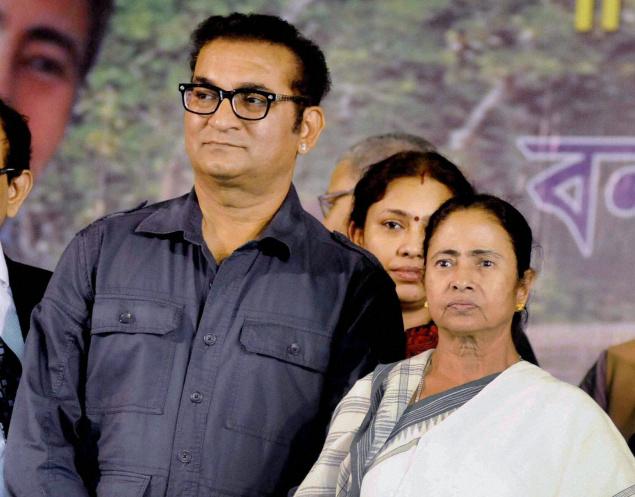
West Bengal Chief Minister Mamata Banerjee with singer Abhijit during the inuaguration of several government aided projects at Sunderbans in South 24 Parganas district on Monday. / PTI

Addressing a gathering at Jharkhali in Sunderbans, West Bengal Chief Minister Mamata Banerjee said on Monday that the industrialists accompanying her on the trip would invest in the tourism industry, which would result in employment generation for the local youths.

Describing proposed tourism projects in Sunderbans as pro-people and pro-environment, Ms. Banerjee announced that land had been identified for the world’s first mangrove zoo which will house rare and endangered animals of the Sunderbans.

“The project will be completed in five years,” she said. It will cost Rs. 25 crore.

Ms Banerjee also said that she would ‘do whatever it takes’ to make Sunderbans the primary destination for tourists.

Ms. Banerjee also inaugurated a Tiger Rescue Centre, which will have capacity to look after six injured tigers.

“We have given about Rs. 2 crore for the project,” she said. Ms. Banerjee laid the foundation stone of the Rs. 400 crore eco-tourism project that will come up under public-private partnership.

She also inaugurated a bridge that will connect Mathurapur and Patharpratima in South 24 Parganas.

source: http://www.thehindu.com / The Hindu / Home> News> Cities> Kolkata / by Staff Reporter / Kolkata – December 09th, 2014