The government plans to develop smart cities and townships across the state with high-density vertical buildings and adequate green area.
The New Town Kolkata Development Authority (NKDA) has already started following the model for Rajarhat New Town. An NKDA official said they are trying to showcase New Town as the Singapore of Kolkata and the authorities were putting stress on optimum utilization of space by going vertical when it comes to real estate development.
The state government has already come up with a new urban policy that relaxes floor area ratio (FAR) to make way for buildings with larger space. According to the policy, 15% additional FAR will be allowed for mass housing, IT complexes and mega commercial housing complexes.
The Mamata Banerjee government has already identified 10 areas to develop smart cities. These are Rajarhat New Town, Raghunathpur, Jaigaon, Sagar, Kalyani, Baruipur, Durgapur, Bolpur, Debanandapur and Fulbari.
The areas have been identified on the basis of the pace of urbanization and geographical location. Rajarhat New Town is leading the way with NKDA developing it as the first green smart city of the state.
“The model that the authorities have started to follow is to have high-density buildings that will go vertical for optimum utilization of space,” an urban development official said, adding that there were about 25% green areas throughout New Town.
There has been a 31% increase in urban population between 2001 and 2011. Urban development and planning officials will conduct surveys in the areas where the state plans to develop smart cities.
NKDA has already allowed non-residential plot owners to get additional FAR if their plots fall within 250 metres of the Metro route that is coming up near the central business district.
In New Town, residential plots are now being allowed for commercial use subject to certain terms and conditions. The authorities have listed 30 non-polluting commercial activities that a lessee could take up in the residential areas.
The state government is also working on plans to approve housing projects faster.
source: http://www.timesofindia.indiatimes.com / The Times of India / Home> City> Kolkata / by Suman Chakraborti, TNN / August 24th, 2014
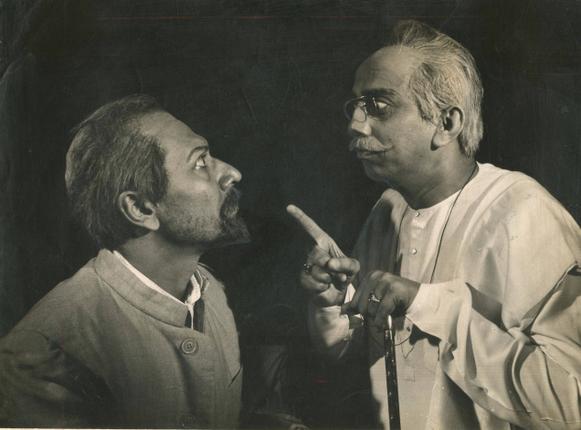
Sombhu Mitra and Amar Ganguly in Bohurupee’s “Dasachakra” / The Hindu Archives
As a festival commemorating Sombhu Mitra’s birth centenary gets underway in the Capital, former associates of the iconic theatre artist speak about his contribution.
Sombhu Mitra, in his acceptance speech for the Magsaysay Award, spoke of the artistic urge in human beings that separated them from other species: “…it is in the nature of man that he is compulsively driven to overcome the dictates of mere convenience. In the early days of civilization, as he needed to draw water, he invented the urn. The urn was filled, but not his heart. So he began now to decorate it with colour, geometric patterns, and his imagination. What an incomprehensible and strange craving!”
Perhaps it was this belief, and a recognition of his own “incomprehensible and strange craving” that led him to break away from the idealistic and message driven plays of the Indian People’s Theatre Association, and in 1948, to found Bohurupee along with Bijon Bhattacharya and other associates in Calcutta.
Bohurupee was a pioneering theatre group as it represented the individual artistic quest, perhaps what could be called the middle ground between commercial theatre and those productions whose underlying aim was to raise awareness among the masses.
“For him theatre was high art,” feels Raka Chakravarty, who from childhood had a chance to observe the philosophy and working style of the icon. “It was not to be used like street theatre or for propaganda. It was pure art, and for that of course he selected the best of plays.”
Raka’s father, eminent journalist Prithvis Chakravarti, is credited with bringing Bohurupee to Delhi for the first time. The occasion was the National Theatre Festival held at the All India Fine Arts and Crafts Society (AIFACS) in 1956, and Chakravarty was one of the event’s main movers. “In fact this was the inaugural event of AIFACS,” recalls Raka.
There was another significance to the occasion. Charles Fabri, the highly influential critic whose writings in newspapers including The Statesman moulded public opinion nationally and internationally, was convinced that contemporary Indian theatre had no identity of its own and the productions being done were either mythological or historical plays or merely adaptations of Western theatre. On the other hand, Bengali artists and thinkers were sure that the works of Rabindranath Tagore, imbued with the spirit of India, were not stageable. Mitra’s path-breaking production of Tagore’s “Rakta Karabi” demolished both these notions. Chakravarti and Fabri had laid a wager, says Raka, and Fabri had to accept the worth of Indian theatre when “Rakta Karabi” was presented by Bohurupee at the 1956 festival.
Bohurupee performed two productions, “Rakta Karabi” and “Chhenra Taar”, and both were so excellent it was difficult for the jury to decide which should be given the top prize, she notes.
Well known theatre director Kirti Jain, former Director of the National School of Drama, also looked to ‘Sombhu da’ as an avuncular figure. She too grew up in the benevolent ambience of friendship shared by her parents — Nemichandra Jain and Rekha Jain — with Sombhu da and his wife the celebrated actress Tripti Mitra.
Conversations between Kirti’s father and Mitra would range from philosophy to mathematics, language and semiotics to politics. “He could create in you a curiosity about so many things. That kind of range I saw in my father too,” she says. “I found that very fascinating. It was more than theatre; it was a whole way of life. And that entire generation had it, though of course Sambhu da was special.”
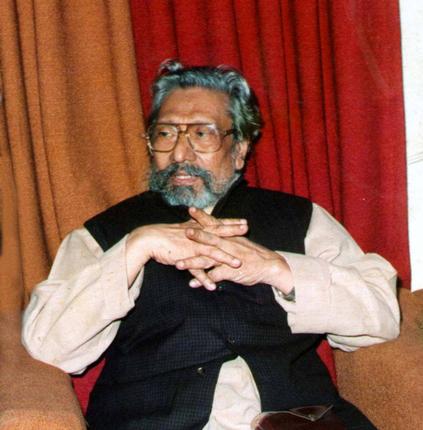
Sombhu Mitra (August 22, 1915 – May 19, 1997) / Special Arrangement / The Hindu
On her own interactions with Mitra, she says, “For me, it was like hero worship, someone you could look up to in theatre. It was nice to have that access to him through my parents.”
Her last interaction with him was a professional one, where she interviewed him for a film. “That interview wasn’t as warm as I had expected,” she recalls. Since at home, “it was always laughing and talking, and food, and making fun of the food, and all that happens in a home,” she had thought that her involvement in the interview would ensure a measure of informality, but this did not happen. “Maybe because he wanted it to be formal,” she muses.
But the reason could also have been his fierce conviction regarding his work. Raka too knew the difference between Mitra’s personal and directorial personas. The Chakravartys would spend summer vacations in Kolkata, and regular visits to Bohurupee to listen to play readings were a memorable feature of these holidays. “He (Mitra) was a family friend and one was not in awe of him,” notes Raka, “but there, he was like an emperor!”
Averee Chaurey, who acted under Mitra’s direction in significant roles as a youngster in Kolkata, while referring to him as “amazing,” admits that he was “aloof, not paternal”, and “never allowed anybody else to direct.” Mitra had “a great intellect and could recite a hundred poems at a time,” says Averee.
Punctuality was non-negotiable. Anyone who came even five minutes late would not be allowed into the rehearsal. Kumar Roy, who took over the reigns after Mitra left Bohurupee, was “paternal”, she adds. However, the group continued to follow Mitra’s philosophy. “We had body movement and voice training, we learnt the harmonium and singing and poetry recitation.”
If the discipline Mitra inculcated has remained to this day in the theatre artists he moulded, he also brought out unexpected talents. Rekha Jain was married as a child to Nemichandra Jain. Joining IPTA, Calcutta, with her husband, she found herself for the first time expected to sing and dance and act. Her first role was in the Hindi version of “Navanna”.
“My father had translated it (into Hindi) and Sombhu da was directing it. My mother was from a very conservative family. She had to play the role of a woman who because of poverty takes to prostitution. She used to tell us about how Sombhu da got her out of that embarrassment.”
Mitra was also a formidable actor. Kirti recalls seeing him as Chanakya in “Mudrarakshas”. There was excitement around the production as he was returning to the stage after a gap. The audience had yet to settle down when the play started. “Sombhu da was speaking. And suddenly he stopped, and looked from one end of the auditorium to the other, and there was pin drop silence!”
Such was the command of the man who was among the pioneers of group theatre in India, who believed in stories of the common people, for the common people.
Impresario India presents “Salute to you, O Creative Genius” . August 22, India Habitat Centre, 7 p.m.; August 23 & 24, Azad Bhawan, Indian Council for Cultural Relations, 6 p.m.; August 27, India International Centre, 6.30 p.m.
For enquires, call 9811763534, 98111209
source: http://www.thehindu.com / The Hindu / Home> Features> Friday Review / by Anjana Rajan / New Delhi – August 21st, 2014
It’s all right to brag about India evolving as the next super power, but what about its impact on wildlife. For once, why can’t we prioritise GEP (gross environment product) over GDP? Bahar Dutt, author of Green Wars, made the audience sit up and deliberate on the questions during her engaging conversation with British Council director Sujata Sen on Tuesday evening.
At the launch of Dutt’s maiden literary attempt in Kolkata, the Green Oscar recipient, whose environment investigations for a television channel stalled an illegal shopping mall project on the Yamuna river bed, an illegal mine coming up on the Goan forest land and an airport on wetlands that were home to Sarus cranes in Uttar Pradesh, pertinently wondered aloud: Whose development is it, anyway?
“When we say development, it’s this brutal development that we are going through where we need to find out if the development is reaching the people living close to those resources,” said Dutt, giving a presentation on her experience as wildlife conservationist to find out how this conflict between a modernizing economy and saving the planet can be resolved. “That is why I have called my book, ‘Green Wars’,” explained Dutt, after Nayantara Pal Chowdhury, president of the Indo-British Scholars’ Association introduced her to the august gathering at the British Council.
“It doesn’t read like a first book,” said Sen, initiating the dialogue with Dutt. “One just gets hooked on to reading this book. It’s very personal, but for every personal encounter, she takes you to the larger views. It’s so captivating …”
The British Council director made the most intriguing query. What made Dutt write the book? “For a television story, you spend 48 hours trekking through the forests, waiting for the animal that might never show up (supposing it’s a tiger). Then your story comes down to two minutes. So I thought, in the humdrum of television reporting, how to get to the depth of the problem. You could say, ‘Green Wars’ is a back-story to my stories,” Dutt said, recalling: “I can’t say I was involved in the prevention of illegal mining in Goa. But in one of the chapters I have written about the incident where we were physically assaulted by the mining mafia, they tried to snatch our camera.”
Dutt, who had told her television editor in no certain terms that: “I don’t want to do cute-cuddly stories on wildlife, but the politics of it”, would take down notes after every reportage – perhaps to relive those exhilarating moments of her confrontations with gharials and the grand old organg-utan and similar creatures facing an uneasy future in ‘Green Wars’ someday. Moving away from charismatic mega fauna, the book focuses on lesser known species, she has focussed on special like Hoolock gibbons (she helped one find his mate). One of the chapters deals extensively with the ‘Himalayan Tsunami’ in Uttarakhand and why it happened.
For the past one year, she has spent hours in rigorous research to come up with data analysis like India losing 333 acres of forest every day to large development projects like dams, roads and mining. Calling to save all that is precious in a ‘development without brakes’ model of economy, she said, “Indians get rich their lifestyles are getting more and more carbon intensive.”
source: http://www.timesofindia.indiatimes.com / The Times of India / Home> City> Kolkata / by Ajanta Chakraborty, TNN / August 21st, 2014
For lovers of the golden voice of Debabrata ‘George’ Biswas, this is akin to finding hidden treasure. Previously unreleased songs of the Rabindrasangeet legend was launched in two CDs — ‘Joto Suniyechilam Gaan’ and ‘Gaaner Tori Dilem Khule’. The songs in the first album are from author Pramathanath Bishi’s personal collection while those in the second were recorded from an Akashbani programme in 1961. Dey’s Publishing launched a book on Biswas to mark the occasion.
“Pramathanath Bishi was devoted to Biswas’s voice and regularly visited him at his home. In 1972, he requested the master to let him record his songs for his personal collection. Biswas then recorded 40-odd songs. Bishi’s daughter Chirasree and son Kanishka have allowed us to release the songs. These were in a very good condition. We simply transferred them from analog to digital and did some noise filtering,” said professor Sukanta Datta, who had seen Biswas from close quarters for years.
“In our search for unreleased songs, we found Pradip Deb, before migrating to the US, had developed a habit of recording Akashbani programmes. In 1961, he had taped one such programme by Biswas. It was an amazing collection, sung by the master in his prime. When we approached Deb, he agreed to let them be released,” added Datta. Debabrata Biswas Smaran Committee had organized the event.
At Sisir Mancha, the auditorium was overcrowded with admirers, mostly senior citizens, jostling for space to drink in every moment. The seats ran out in a blink and the jostling intensified. Temper flew as anyone trying to elbow his way ahead was rebuked sharply from others around. Among those seated, they were intent on catching every word being spoken from the dais and hissed at anyone who spoiled the moment by talking or taking calls. And the event saw admirers from all walks of life thronging to get hold of the CDs.
Tridib Chatterjee, general secretary of the Publishers and Booksellers Guild, was among the audience. “For my generation, George Biswas is the first and last word in music. I have extensively listened to all his songs, or so I thought till now. One of the songs — ‘Nach Shyama Tale Tale’ — I had earlier heard in the voice of Sagar Sen and later, Swagatalaxmi. Again, two songs — ‘Pothe Chole Jete Jete’ and ‘Pother Sesh Kothay’ — I had heard them in Hemanta Mukherjee’s voice but never did I dream that I’ll get to hear them Biswas’s golden voice as well,” he gushed.
Subal Saha, a retired caretaker of Rabindra Sadan, had seen many of Biswas’s concerts and had hosted him on all those occasions. “I saw him first in 1971, and several times more later on. When I heard a new CD will be launched, I had to come. For me, it’s like travelling back in time,” he said.
source: http://www.timesofindia.indiatimes.com / The Times of India / Home> City> Kolkata / TNN / August 23rd, 2014
It’s all right to brag about India evolving as the next super power, but what about its impact on wildlife? Why can’t we prioritize GEP (gross environment product) over GDP? Many such questions raised by Bahar Dutt, author of ‘Green Wars’, at an engaging conversation with British Council director Sujata Sen made the audience sit up and give them a serious thought.
At the launch of Dutt’s maiden literary attempt in Kolkata recently, the Green Oscar recipient, whose environment investigations for a television channel stalled an illegal shopping mall project on the Yamuna river bed or an airport on wetlands that were home to Sarus cranes in Uttar Pradesh, pertinently wondered aloud: Whose development is it, anyway?
“When we say development, it’s this brutal development that we are going through where we need to find out if the development is reaching the people living close to those resources,” said Dutt. “That is why I have named my book ‘Green Wars’,” she explained, after Nayantara Pal Chowdhury, president of the Indo-British Scholars’ Association, introduced her to the gathering at the British Council.
“It doesn’t read like a first book,” said Sen, initiating the dialogue with Dutt. “One just gets hooked on to reading this book. It’s very personal, but for every personal encounter, she takes you to the larger views. It’s so captivating.”
The British Council director made the most intriguing query. What made Dutt write the book? “For a television story, you spend 48 hours trekking through the forests, waiting for the animal that might never show up. Then your story comes down to two minutes. So I thought, in the humdrum of television reporting, how to get to the depth of the problem. You could say, ‘Green Wars’ is the back-story to my stories,” Dutt said, recalling: “I can’t say I was involved in the prevention of illegal mining in Goa. But in one of the chapters I have written about the incident where we were physically assaulted by the mining mafia, they tried to snatch our camera.”
Dutt, who had told her TV editor: “I don’t want to do cute-cuddly stories on wildlife, but the politics of it”, would take down notes after every reportage – perhaps to relive those exhilarating moments of her confrontations with wild animals in ‘Green Wars’ someday.
source: http://www.timesofindia.indiatimes.com / The Times of India / Home> City> Kolkata / TNN / August 22nd, 2014
Since early morning on Friday, there was an air of urgency in the proceedings at Sainik School, Purulia. It was Independence Day and the occasion is celebrated with much pomp and gaiety at the institution which turned 50 recently. This year was going to be different though. History was about to be created with the honour guard of senior cadets preparing to salute the first headmistress of the school. This was also the first time in the school’s history that the National flag would be unfurled by a lady Army officer. A second-generation Army officer, Lt Col Palli Swarna Lata is now the headmistress and officiating principal of the school. The Lt Col joined the Army as a short service commission officer but was granted permanent commission later on.
“Both Republic Day and Independence Day are celebrated with much patriotic fervour at this school,” said Lt Col Lata, after taking the salute and unfurling the flag. The school has a checkered history. Among its alumnus is Air Chief Marshal Arup Raha, the present Indian Air Force chief. Several others who have passed out from the Sainik School in Purulia have served the Army, Navy and Air Force as officers. Many of them have served in other fields including the central paramilitary forces and the private sector. Many alumni of the school have been decorated with gallantry awards. One of them is Col (retd) Subir Mookherjee who received the Shaurya Chakra for gallantry in 1980. On Friday, some former students of the school celebrated Independence Day with Mookherjee at his Salt Lake residence in Kolkata, with a view to draw inspiration from the brave soldier.
“Several former students from the batches between 1992 and 2012 went to Col (retd) Mookherjee’s residence on Independence Day. Alumni from all over India and abroad also called him up to thank him for his service to the nation,” said Shreyas Kumar, an alumnus based abroad who is also the vice-president, Sainik School Purulia Student Welfare and Inspiration Foundation Trust (SSP SWIFT). The organization has launched nine scholarships, one of which was recently won by a girl student Sagnika Chakraborty. One of the scholarships is dedicated to late Flying Officer Rafi Ahmad of the IAF. On Friday, these scholarships were distributed among deserving students by Lt Col Lata.
“This year, two cadets from Sainik School, Purulia, have joined the NDA and INA. Preparations are on to train more cadets for the next semester,” Lt Col Lata said.
source: http://www.timesofindia.indiatimes.com / The Times of India / Home> City> Kolkata / by Jayanta Gupta / August 17th, 2014
Deep within the suburbs of Unkal in the city lies a key relic of our rich architectural history — the Chandramouleshwar temple — forgotten by many and being usurped by the unscrupulous. The temple, which dates back to reign of the Badami Chalukyas in the 11-12th century, has been crying for attention for years now, but no concrete measures have been taken to protect the historical monument despite the Archeological Survey of India (ASI) designating it as a protected monument under the Ancient Monuments and Archaeological Sites and Remains Act,1958.
Over the years, the land on which it stands has also been allegedly encroached upon by villagers.
Unkal was a border area between the Hoysala and Chalukya empires. The Chandramouleshwar temple, therefore, bears resemblance to both Hoysala and Chalukya styles of architecture. Its unique plus-shaped plinth sets it apart from other temples in the state, claim experts.
A facade of promises
The temple has about 4-5 acres of land around it, but most of it has allegedly been encroached upon by villagers. ASI had woken up to such encroachments five to six decades ago, had conducted a survey and planned a renovation of the temple. But, it then placed all plans on the back burner.
C B Marigoudra, a retired teacher and historian, recalls that the temple was declared a historical monument by ASI around 50 years ago. “But, no steps for development have been completed to date.”
Around five years ago, ASI again took a shot at reining in encroachments by constructing a wall around the site. But work on redevelopment came to a grinding halt a few years ago, alleges Marigoudra.
P S Parvati, a retired officer of information and broadcasting department, says the district administration had sent a proposal to the state government around two years on developing the temple, improving road connectivity to it and providing other facilities to visitors. That file has been gathering dust. “Citizens are forgetting the importance of the temple. Many people don’t known that such a historical monument is located right in our city. There is a need to renovate the temple and create awareness about its importance among the people,” suggests Parvati.
M S Koravi, a former corporator, says ASI had served notices to residents who had encroached upon the land a few years ago. But that zest fizzled out soon. “No action was taken by the department against the encroachers. If ASI wants to clear the encroachments, it should provide alternative rehabilitation to the residents. Only then should it develop the city’s only historical temple,” recommends Koravi.
J Ranganath, assistant superintending archaeologist engineer, ASI, Dharwad division, points at half-hearted measures taken: construction of a compound wall and a watchman to keep an eye on the temple. “The ASI division will soon get funds, with which we will take up renovation in two to three months. There is a technical problem with removing encroachments and that will looked into as well,” he claims.
source: http://www.timesofindia.indiatimes.com / The Times of India / Home> City> Hubli / TNN / August 07th, 2014
All India Radio, Kolkata has been awarded as the most ‘effective’ regional news unit in India.
This decision was recently conveyed to the regional head of the Kolkata AIR unit by News Services Division, a unit of AIR in Delhi. AIR Guwahati has also been given the award along with its Kolkata counterpart. According to a AIR Kolkata spokesperson, the award was prestigious for the city regional unit as Kolkata unit of AIR has bagged such an award among 44 regional news unit in past five decades.
The award was given to the AIR Kolkata for broadcasting as many as 13 news bulletins everyday in regional language. Of these, 13 bulletins, 12 are in Bengali language and one in Santhali. This Santhali news has been popular not only with areas such as Bankura, Purulia, Mindapore or other Santhali dominated areas in West Bengal, but in large areas of Odisha, Bihar and Jharkhand. The spokesperson said that AIR Kolkata henceforth will be more careful to choose issues in airing news or news related programmes to cater the needs of the millions of listeners based in West Bengal and its neighbouring states. “The award has given us a sense of confidence and also a sense of responsibility to reach to more listeners,” the AIR (Kolkata) spokesperson said.
source: http://www.timesofindia.indiatimes.com / The Times of India / Home> City> Kolkata / Saikat Ray, TNN / August 16th, 2014
Three and a half years after legendary Rabindrasangeet exponent Suchitra Mitra passed away, her daughter Sudeshna Chatterjee has come forward to bring her legacy alive. Sudeshna has brought together the oldest students of Rabitirtha – the Rabindrasangeet institute started by Suchitra Mitra – to form Rabitirtha Praktoni. The fledgling organization promises to surprise the city with its mammoth Suchitra Smarane – a three-day celebration of Tagore songs and discussions at the ICCR in September on the occasion of Mitra’s 90th birth anniversary.
This is a breakaway from the mother institute that still exists off Lake Market. Towards the last couple of years of Mitra’s life, former minister Subhas Chakraborty and wife Romola took over the reins of Rabitirtha. After Mitra’s death, the media had been rife with reports of how its management changed overnight under Chakraborty’s aegis and how classes became irregular. Mitra’s students complained that teachers, whom she had handpicked, were thrown out of the institute. Interestingly, apart from Rabitirtha, Mitra’s house was also taken over by Romola Chakraborty’s NGO, Pather Panchali, and it was announced that a museum on Mitra would be developed. However, that is yet to come up.
Sudeshna, whom Mitra lovingly called Chiku, has relocated from the US to bring this project alive. Instead of the old world school where the original version is housed, Rabitirtha Praktani is holding its classes inside a state-of-the-art studio for performing arts owned by her. “The classes are being taken by some of my mother’s famous students like Purba Dam, Sumitra Roy and Agnibha Bandyopadhyay. We are bringing back that old tradition at Rabitirtha Praktani,” Sudheshna said.
You will find Sabitri Dutta in her late 70s, Tapati and Bharati Mukherjee, in their 60s, who had been trained by Mitra, happily coming to the class like old times. “We were heartbroken at the old school because training was intermittent and the likes of Kashinath Das, one of Suchitra-di’s handpicked teachers, were asked to leave,” said an old student.
The three-day festival at ICCR is being supported by JU’s School of Cultural Texts and Records that is providing rare photographs of Mitra for an exclusive exhibition and the Rabindra Bharati University.
source: http://www.timesofindia.indiatimes.com / The Times of India / Home> City> Kolkata / by Jhimli Mukherjee Pandey, TNN / August 14th, 2014
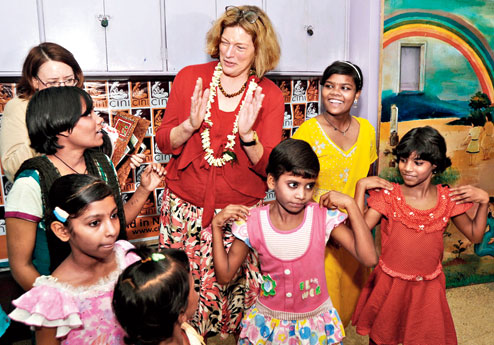
US charge d’affaires ambassador Kathleen Stephens (centre) spent an hour on Wednesday at CINI, the Child In Need Institute’s short-stay home on Rafi Ahmed Kidwai Road.
She discussed child and maternal health care with CINI officials before interacting with children at the home. The kids, aged between six and 14, greeted her with a garland and danced to the song Dhaaker taaley from the film Poran Jai Jolia Re. Stephens handed each child a little brooch with the Indian flag on it.
In the afternoon, Stephens visited Presidency University and met vice-chancellor Anuradha Lohia. Stephens interacted with teachers and students on a host of issues, including exchange of teachers and students and research collaboration between Presidency and US universities. She spent close to an hour browsing through the galleries and artefacts at Victoria Memorial. Picture by Pradip Sanyal
Calcutta :
US charge d’affaires ambassador Kathleen Stephens is scheduled to meet chief minister Mamata Banerjee at 4pm tomorrow at Nabanna, sources in the state secretariat said this evening.
A charge d’affaires is a diplomatic secretary or a counsellor or a minister who heads a mission in the absence of its titular head.
“I am here to take Indo-US relations to a new level,” said Stephens, who took charge in early July.
If the meeting is held according to schedule, it will be Mamata’s first such session with a visiting foreign diplomat since she met Nancy Powell, the then US ambassador, in May 2013.
Powell, who had tried to “change the chief minister’s mind on FDI in retail” during that meeting, did not get an audience with Mamata during her next visit to Calcutta in February this year.
Sources in the US consulate had described Powell’s failure to meet Mamata as a “disappointment”. The then US ambassador to India had met then Gujarat chief minister Narendra Modi before her Calcutta visit.
Asked about her chances of meeting the chief minister, Stephens, who interacted with a select group of journalists this evening, said: “I have a good schedule tomorrow.”
The fact that Stephens and other officials of the US consulate were guarded about the prospect of the meeting was an indication that they did not want to make any announcements before the session.
“One cannot rule out the possibility of the meeting being cancelled at the last minute,” a Nabanna source said.
Unlike her predecessor Buddhadeb Bhattacharjee, who used to meet visiting diplomats or delegate the responsibility to senior ministers, Mamata has not shown much eagerness in engaging with foreign envoys.
The Nabanna sources said they received requests from visiting diplomats, seeking appointments with Mamata. But on most occasions, they do not get an audience with the chief minister or any of her senior colleagues, the sources said.
The approach has, however, been different in case of engagements with the US. Then secretary of state Hillary Clinton had come to Calcutta in May 2012 to meet the chief minister.
Although the Hillary-Mamata meeting had gone off well, there was a controversy later over whether they had discussed FDI in retail.
“A statement released by the US consulate had said the issue had been touched upon. But the way the state government reacted, with finance minister Amit Mitra calling up the US consul-general, did not go down well with the American establishment,” said a source close to the consulate.
Although Mamata had met Powell after that, the vibes were “not as warm as before”, the source said.
If Mamata finally meets Stephens, it will send a positive message to the US establishment.
“The chances of a meeting seem brighter this time as the chief minister is unlikely to miss the opportunity to tell the visiting diplomat that she is leaving for Singapore later this week to scout for investment,” a source said.
source: http://www.telegraphindia.com / The Telegraph, Calcutta / Front Page> Bengal > Story / by Our Correspondent / Thursday – August 14th, 2014