All posts by wellnmed@gmail.com

INDIA ON WAX – Record discs that helped defeat the British empire: Tagore sings ‘Bande Mataram’

During the freedom struggle, recordings of patriotic speeches and songs helped rally support.
PhonographKOLKATA01sept2014
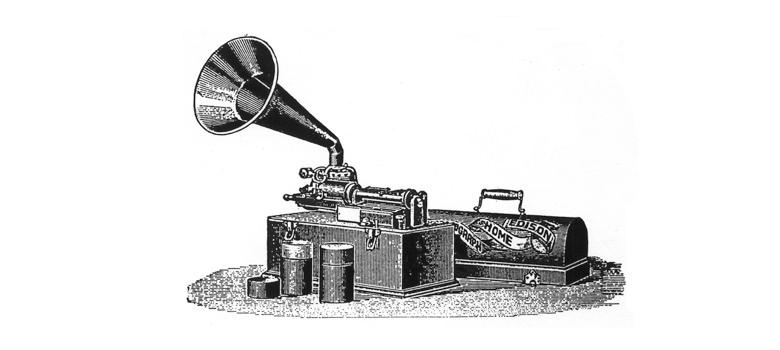
Between 1877 and 1878, Thomas Alva Edison submitted patent applications for the phonograph in many countries, including British India. It is not known when these patents were granted, but it is known that in December 1878, the first phonograph recording was demonstrated in Kolkata.

For the next 30 years, recordings on the phonograph cylinder became quite popular, remaining so even in the early years of disc records.

Many members of royal families and wealthy people bought cylinder phonograph machines and recorded musicians and religious personalities. The Maharajah of Khetri recorded Swami Vivekananad’s speeches and discourses much before he went to America and gave his famous talks on religion. The internet is full of versions of his celebrated speeches.

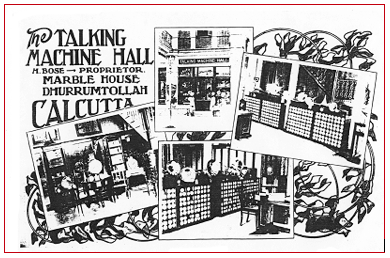
Hemendra Mohan Bose (1864-1916) opened the Talking Machine Hall in Kolkata, a shop where one could get one’s voice recorded. Bose was a sound recording expert and also had an agency to sell Edison and Pathe brand phonograph machines. Many great writers, poets and political leaders would visit him and he would record their recitations and speeches.

A 1906 catalogue lists several cylinder recordings of Rabindranath Tagore. Unlike disc records, cylinders could not be reproduced for sale. Most of these cylinders have been lost. Some museums have broken or damaged copies of cylinders as artefacts but no audible sound can be extracted from them.

TagoreAdsKOLKATA01sept2014
During agitations against the partition of Bengal in 1905, H Bose recorded many political speeches and songs, such as Bande Mataram, both on phonographs and disc records, and they became very popular. But his factory and shops were sealed, machines and discs destroyed ruthlessly by police. As a result, nothing has survived today except a very short piece from Bande Mataram, sung by Tagore.

Recording experts from Beka, a German company, were in Kolkata in November 1907. The British government went about destroying all nationalistic material, whereas the German company was the first to record a political speech right under the nose of the British.

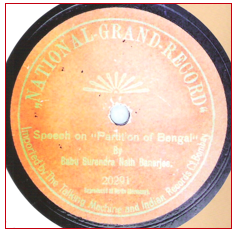
The National Grand Record label had a saffron disc with a rising sun as the logo. On it was recorded a speech by Babu Surendranath Banerjee, on the partition of Bengal. The flipside of this unusual 78-rpm disc has a speech on Bande Mataram.
DiskKOLKATA01sept2014

The man responsible for producing this disc was Sir Abdul Halim Guznavi, a political leader and agent for the Beka record company in Kolkata. Only few copies have survived. We have the image of the label only but no access to the audio file of this historically important recording.

We welcome your comments at letters@scroll.in.

source: http://www.scroll.in / Scroll.in / Home> All News / by Suresh Chandvankar / August 15th, 2014

DOWN MEMORY LANE – A legendary doc

Dr. Hem Chandra Sen
Dr. Hem Chandra Sen

From curing ailments common and uncommon to initiating Durga Puja in Delhi, Dr. Hem Chandra Sen left behind an unforgettable legacy

Doc Holliday may have been a favourite with youngsters watching Western cowboy films over five decades ago, but long before that Delhi had its own bearded Doc whom few remember now. There were no motorised vehicles in 1879 when Dr. Hem Chandra Sen came here in a bullock cart all the way from Agra. Rich people travelled in palanquins, buggies or four-wheeled landaus and the poor in ekkas and carts. Women hardly showed their faces in public, they either wore burqas or ghoonghats and there was no electricity and piped water supply. In this milieu Dr. Sen became the first Indian allopathic doctor of Delhi.

From dispensing medicines to those building the E.I. Railways’ Agra-Delhi line, he started treating the local populace; women did not mind uncovering their heads and faces before him. Dr Sen was credited with “miraculous healing powers”, his day beginning at 4 a.m. and ending late at night. Rich and poor alike were treated by him. Those who couldn’t come to his chambers were visited by him, for which he used two sets of horse carriages — one for the morning and the other for the evening. He charged Rs. 2 (for the full treatment) from those whom he visited at home and nothing from patients who came to his clinic. He set up a pharmacy also, as getting medicines from Calcutta took a lot of time. Later it became a separate unit known as H.C. Sen and Company.

In 1883 Dr. Sen, founder of the Imperial Medical Hall, set up the Imperial Medical Press and type-setting moulding unit adjacent to his clinic. It was afterwards run by his nephew A.T. Roy, and the latter’s sons and grandsons, as one of the leading presses of Delhi. Member of the first management committee of Hindu College, Dr. Sen played a leading role in youth education along with Lala Shri Krishna Dass Gurwala (one of the founders of the college), M. M. Malaviya and many others of note.

Lala Krishan Dass Gurwala was among the seths who persuaded Dr. Sen to settle down in Delhi. It is interesting to note that the name Gurwala was appended to the family as it used to provide gur and gram to pilgrims, says the centenary brochure on Dr. Sen brought out in 1980. Gurwala’s grandfather was hanged by the British for supporting Bahadur Shah Zafar. The family traces its history to 1560 and Lala Nodhamal of Akbar’s reign. After Gurwala helped establish the Delhi Cloth and General Mills, it meant an extended practice for Dr. Sen. However when the good doctor fell seriously ill due to his exertions (“grace under pressure”, to quote Hemingway), the British Chief Commissioner of Delhi ensured that there was complete silence in the Fountain area of Chandni Chowk so that he was not disturbed. It’s worth mentioning that when Unani medicines were ineffective even the famous Ballimaran hakims did not hesitate in referring patients to Dr. Sen for a speedier cure.

Europeans also came to Dr. Sen, a Freemason, for treatment and for advice even on personal matters. Born in Calcutta before the 1857 Revolt, he died in 1906 and the Delhi markets were closed for a week as a mark of respect. He was succeeded by his sons, Dr B. C. Sen and Dr R.B. Sen (Adu Babu). From 1880 till his death Dr. Sen had stayed on in Delhi and among his guests were Rabindranath Tagore, Swami Vivekananda, novelist Sarat Chandra, Sir Surendranath Banerjee, Subhas Chandra Bose, Madan Mohan Malaviya, Hakim Ajmal Khan and the Maharajas of Jaipur and Jodhpur.

Interestingly, Vivekananda used to walk to the Yamuna every day through Chandni Chowk so long as he stayed in Delhi. The road from the Fountain leading to Old Delhi station is named after Dr. Sen and on Ansari Road in Daryaganj his descendants continue to maintain their 100-year-old pharmacy. Now a book on the legendary doctor, an initiator of Durga Puja in Delhi, is being written (at the behest of Anees Enterprises) by Shipra Sen to commemorate her ancestor whose medicines for curing diseases like jaundice, other liver infections and malaria are still popular. May be Doc Holliday too would have got rid of his bottle-induced problems had he cared to saunter (shoulder-strapped gun and all) into Dr. Sen’s celebrated 19th Century “Maktab” at the Fuwarra!

source: http://www.thehindu.com / The Hindu / Home> Features> FridayReview> History & Culture / by R. V. Smith / August 31st, 2014

How Vicky Roy went from being a ragpicker to celebrity photographer

VickyRoyKOLKATA31aug2014

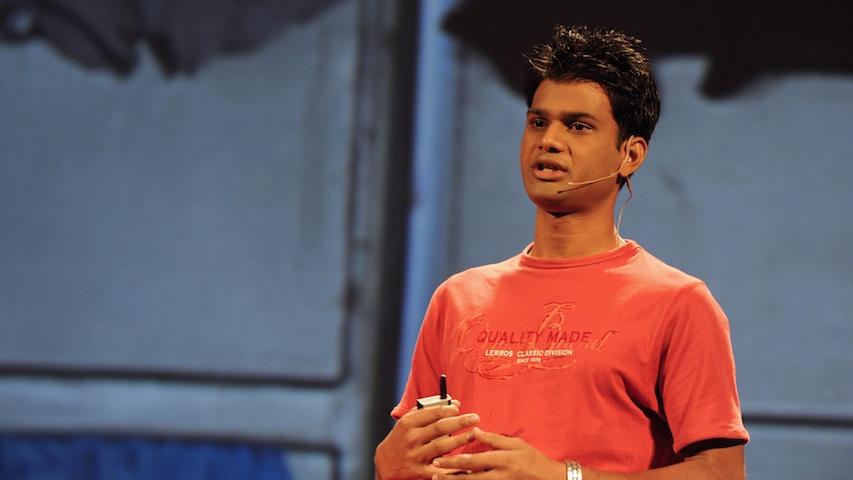
Vicky Roy came from a poor family, other than him, there were six other mouths of his three sisters and three brothers to feed. Getting beaten by his mother was normal, and he was not allowed to play with other children, and while his parents went in search of work, he was left with his grandparents.

Running away:

In 1999, when he was 11-years old, Roy decided to run away. With Rs. 900 in his pocket, which he had stolen from his uncle, he boarded a train at Purulia, West Bengal, and landed in Delhi. Some street children at the station spotted him crying, and took him to Salaam Balaak Trust (SBT), a home for young boys who have no place else to go that was formed from the proceeds of the Mira Nair movie ‘Salaam Bombay.’

But the place was always locked, this did not suit Roy’s free spirit, so one morning when the gates were opened for the milkman to come, he ran away for a second time. He met the same kids he had met at the railway station, and after narrating his tale, he joined them as a ragpicker. ” I collected water bottles and sold them for Rs. 5, the police beat us and the goons on the railway platform would steal all our money. I joined a restaurant near Ajmeri gate as a dishwasher, during winters the water was cold, and I had rashes that would bleed. This was when I met a volunteer from the same SBT who told me that I should be in school and that the trust had many centres and in some you could attend school and you are not locked up all the time,” says Roy. He rejoined one of the many centres the trust ran called Apna Ghar.

Back to SBT and meeting Dixie Benjamin:

Roy scored 48 per cent in his 10th standard board exams. Realizing that he was not bright academically he was told to join National Institute of Open Schooling where he could get training in computers or TV repair. His first brush with photography happened here, when he came across two kids who were undergoing a photography training, and had also gone to Indonesia and Sri Lanka.

Little did he know that his life was about to change forever.

He met Dixie Benjamin, a British filmmaker, who was making a documentary on SBT. Roy hit it off with Benjamin and became his assistant, and thus began his journey as a photographer. Benjamin couldn’t converse in Hindi, and Roy knew only a smattering of English, but he was still able to pick up most of what Benjamin taught him about concepts like aperture, lighting and so on. Before this Roy had used a plastic Kodak camera to take photos. Benjamin brought him upto speed with the use of an SLR.

A dream comes true:

Roy was soon to turn 18-years, and he was dreading it, this meant that he will have to leave SBT and set out on his own. SBT would provide with the basics like a gas cylinder, stove, matress and utensils: but he knew no other life other than what he had at SBT. However, becoming independent proved a blessing in disguise. Roy approached Anay Maan, the well-known portrait photographer to be his assistant. He agreed, but wanted Roy to stay with him for a minimum of three years, he did want him to leave after a few months having picked up some tricks of the trade.

Anay Maan turned out to be a good teacher and mentor. He used to teach Roy about photography by drawing a picture by hand and explaining concepts like lighting and depth of field. The assignments took Roy to many places, his life was now lived in luxurious hotels, and he was collecting flight boarding passes by the dozen. He also browsed a lot of books on photography, which told stories of different subjects. It occurred to him that he had a story to tell as well. He was already on possession of a Nikon F80 that he had bought taking a loan of Rs 28,000 from SBT, which he had repaid by giving back Rs 500 a month.

He shot street children who were 18 years or less, and had a goal to do something with their lives. “I had my first exhibition called ‘Street Dreams’ in 2007, this was sponsored by British Commission and DFID that was very successful. I also took the exhibition to London and South Africa and sold many copies of the book. I now started feeling like I had arrived as a photographer and started developing an attitude,” says Roy. Anay Maan called him and put things into perspective saying that before the exhibition he was simple, but now he was rude. This struck a chord in Roy, who promised to stay true to his roots and not forget his humble beginnings.

He continued working with his mentor on a part-time basis and mostly on the big assignments. There was a subtle change in their relationship, Ayaymaan treated him with a lot more respect, now as his equal, and friend.

Dreaming bigger:

Having a built a platform with ‘Street Dreams’ Roy was confident to take on more ambitious projects. In 2008, there was global competition organized by Maybach Foundation, the Ramchandra Nath Foundation nominated his work, and he was one among three photographers chosen for a six-month residency to be held in 2009 at the International Centre for Photography. This led him to be given access to the World Trade Centre (WTC) site, once a week, for two hours. “I finally felt I knew the reason why I had run away from home all those years back,” recalls Roy. His work was exhibited at WTC 7, and won the Duke of Edinburgh’s award, he was invited to lunch with Prince Edward at Buckingham Palace. This was the first time that he had heard of the palace. Roy’s work started to go places: like the Whitechapel Gallery and the Fotomusem Switzerland. He held his second solo exhibition – WTC: Now- at the American centre in Delhi, in 2009.

Going back to his Apna Ghar roots:

After tasting success globally, Roy decided to come back home to Apna Ghar and resumed work that he had started in 2007. The work was displayed at Vadera Art Gallery, and to coincide with 25 years of Apna Ghar’s existence, he teamed with editor Sanjiv Shaith to bring out a book that was debuted at the Delhi Photo Festival in 2011 called Home. Street. Home.


Giving back:

Even after all the success that Roy has under his belt in his relatively short career, he doesn’t feel like he has arrived as yet. But he’s giving back to his fraternity in small ways. Last year, along with photographer Chandan Gomes he started a photo library called Rang by donating over 500 books to Rang. Rang organizes photography workshops for children in schools and shelters and tries to infuse the spirit of photography in them. The high-quality books on photography can be accessed by anybody at Rang’s Open Library, which is currently located within the Ojas Art gallery in Mehrauli.

Realizing the invaluable role that mentors like Benjamin and Anaymaan played early on in his life he has taken on himself to mentor other upcoming new photographers. He has currently taken under his wing, a 20 year old called Anish to assist him with his shoots.

You can check out Roy’s work here.

Disclosure: The author was hosted by the organizers of the INK Conference, at Kochi, where he met Vicky Roy, an INK 2013 Fellow.

source: http://www.social.yourstory.com / Home> Social Story / by Nelson Vinod Moses / January 29th, 2014

Child Crusader’s Story to Inspire the World

Kolkata :

Her defiance against an age-old custom developed into a campaign that caught the imagination of the nation. And now anti-child marriage crusader Rekha Kalindi will rub shoulders with Malala Yousafzai and Anne Frank in a book that tells the tales of how they changed the world.

The story of this braveheart from West Bengal’s Purulia district, conferred the National Bravery Award for refusing to be a child bride and inspiring many of her ilk, features in the “Kinderen Die De Wereled Hebben Veranderd” (Children Who Changed the World), a Dutch book to be released Nov 20 to mark the 25th anniversary of the UN Declaration of the Rights of the Child.

Written by renowned Dutch journalists and historians, the book portrays the heroics of 20 children who stood up against injustice or became a symbol of injustice done to them and includes the likes of Pakistani education activist Malala Yousafzai and holocaust diarist Anne Frank.

Talking about Rekha’s story – the only one from India – Aletta Andre who has penned the chapter on her, elaborated about the 16-year-old’s efforts to inspire nearly 10,000 girls in the district to pursue their studies and not to concede to their families’ demand of an early marriage.

“It’s not only about her own defiance but also about how she counselled and inspired a lot of other girls to do the same. At least 10,000 in Purulia district have resisted child marriage and her story has been also mentioned in a Class V textbook,” Andre, a Delhi-based Dutch journalist, told IANS on the phone.

Considered a liability, her parents had planned to marry Rekha off at 11 to get rid of “their burden”. But having seen her elder sister suffer as she became a mother at 12, the idea of marriage terrified Rekha and eventually led her to revolt that created history.

Conferring the Bravery award in 2009, the then president Pratibha Patil had described Rekha as a “messenger of social change”.

At the age of four Rekha started working, rolling beedis along with her mother. Now a class 10 student of Jhalda Satyabhama Vidyapith, she actively campaigns against child labour and child marriage.

Ecstatic about being part of the book, Rekha at the same time is distraught for she can read only Bengali and not Dutch.

“I heard the book is in some other language which I cannot read. I am sad at that, but I am also very happy that my story will be read by foreigners,” Rekha told IANS.

Aspiring to be a teacher and preparing hard for her board exams, Rekha insists her job has just begun.

“There is so much poverty; many girls have to work because of which they don’t get time to study. I wish a day comes when all of us will go to school without having to worry about work,” added Rekha.

Unicef, which has been working to curb the menace of child marriage, expressed happiness at Rekha’s contribution getting international recognition and hoped this would inspire and create many a crusader like her.

“This is surely a proud moment for all of us and I hope it creates many a Rekhas to fight out the menace of child marriage and child labour,” Asadur Rahman, head of Unicef’s field office said.

Others featuring in the book include Pakistani child labour hero Iqbal Masih who helped over 3,000 minor bonded labourers to escape before he was murdered in 1995 and South African Nkosi Johnson, who made a powerful impact on public perceptions of HIV/AIDS and its effects before his eventual death at the age of 12 from the pandemic.

source: http://www.newindianexpress.com / The New Indian Express / Home> Nation / IANS / August 31st, 2014

Jadavpur University begins work on graphic anthology of Tagore stories

Kolkata :

Jadavpur University Press on Friday started the process of compiling a graphic anthology of 10 short stories by Rabindranath Tagore with Harper Collins as the co-publisher. It also launched a book of essays by Upendrakishore Raychowdhury on half-tone photography, published in a single volume for the first time. And professor Abhijit Gupta and Deeptanil Ray of JU unveiled a website that showcases the evergreen comic books generations have grown up devouring.

“Raychowdhury had written the essays in Penrose’s Pictorial Annual, a London-based magazine that reviewed graphic art. British Library had the only copies of the magazine and gave us permission to reproduce them in a facsimile edition. We have not edited a word and have printed images of those articles,” said Dr Devalina Mookerjee, development editor at JUP. When asked about the Tagore project, she added: “We want the artists to look at the stories in the context of contemporary world. The artists will be working independently.”

Illustrators Vishwajyoti Ghosh, Trinankur Banerjee, Sarbajit Sen and Nitesh Mohanty discussed their work and plans with Rimi B Chatterjee as the moderator.

Later, Mohanty told TOI: “It’s a one-of-its-kind project where all artists will bring in their essence to the eternal spirit of Tagore. We will stick to the original and there will be no deviation from the original story.” Banerjee agreed and added: “And to retain the spirit of the doodles, the book will mostly be in black and white. But there will be a colour section as well,”

Professor Emeritus Sukanta Chaudhuri regaled the audience with an address on Tagore’s doodles while Sekhar Mukherjee, former head of the animation department at National Institute of Design, spoke on the animated ‘Birpurush’ that has been in the works for a while now.

The day was rounded off with a discussion on ‘Upendrakishore’s versatile genius’ with Prasad Ranjan Roy, Subhendu Dasmunshi and Amlan Dasgupta. Samantak Das was the moderator.

Former home secretary Roy, who is also related to Upendrakishore, said: “Satyajit Ray had written about how he showed the same passion of violin and pakhowaj. At night he would study stars with a telescope while in day he would take to the canvas with oil and watercolour. Possibly, he took up half-tone photography after his drawings for ‘Chheleder Ramayan’ became unusable. But his daughter Purnalata has written that he took it up while in the UK.”

source: http://www.timesofindia.indiatimes.com / The Times of India / Home> City> Kolkata / TNN / August 30th, 2014

Spunk and sacrifice – Awarded for excellence, courage and more

SnehaKOLKATA29aug2014

Sneha Mukherjee has a plastic sphere where her right would have been and minus power in her left eye but the only “favour” the 12-year-old takes in class is to sit in the front row.

Sneha underwent an eye surgery for removal of tumour when she was just 11 months old and had since had no vision in her right eye.

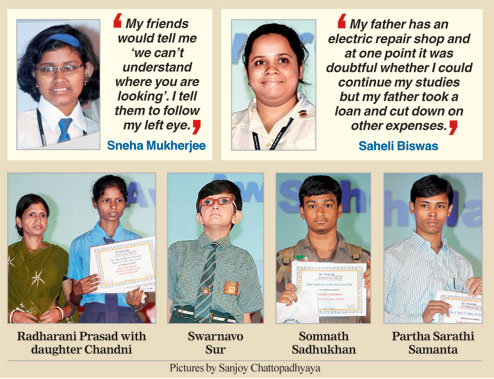
That has not impaired her spirit and Sneha, who has a ready response for any insensitive remark about her eye implant. “My friends would tell me ‘we can’t understand where you are looking’. I tell them to follow my left eye,” said the Class VII student of St. Joseph’s Convent in Chandernagore and winner of The Surrendra Paul Memorial Award for Courage at Peerless presents The Telegraph School Awards for Excellence 2014, in association with Parle-G and powered by Adamas University.

If Sneha has always been encouraged by mother Lopamudra not to take any favours, other parents have made sacrifices — big and small — for their children’s education.

Radharani Prasad has to work as a domestic help as her husband is confined to bed by paralysis but that didn’t stop her for admitting daughter Chandni to Gurukul Vidyamandir Higher Secondary School after she scored 75 per cent in ICSE. Chandni received The Telegraph Education Foundation Scholarship.

“The school did give us concession but despite that I had to pay about Rs 15,000 for her admission after taking loan. I haven’t been able to pay her monthly fee so far,” said Radharani, who shared The Abhirup Bhadra Memorial “Thank You Baba-Ma” Award with Balaka and Swarup Sur, parents of Swarnavo, a kindergarten student at Assembly of Angels Secondary School, Barrackpore.

Swarnavo had a hernia surgery when he was 10 months old and an eye surgery when he was three. “He is extremely regular in school and I do not have to give him any special attention,” said the proud mother.

It was for Subir and Swarnali Biswas (who received The Abhirup Bhadra Memorial “Thank You Baba-Ma” Award) that their daughter Saheli (who received The Telegraph Education Foundation Scholarship) could continue her studies.

“My father has an electric repair shop and at one point it was doubtful whether I could continue my studies but my father took a loan and cut down on other expenses,” said the student of Class XI.

The spunky Somnath Sadhukhan, who received The Faith in Astha Scholarship, studies geography honours at Surendranath College while his mother sells pens and stationery in and around Shyambazar.

Rudrangshu Mukherjee, the managing trustee of The Telegraph Education Foundation, had one thought on Saturday for the students. “When you become somebody eminent, somebody successful… just turn back and reflect on those who need to be educated, those who need your support… “Please grow with The Telegraph Education Foundation, the best is yet to be because the best is in your hands.”

Barry O’ Brien, the convener of The Telegraph School Awards for Excellence, shared how students and teachers have often told him how moved they are by the stories of courage and resilience.

“Don’t just be moved. Don’t just take a handkerchief out of your pocket and wipe your tears. Do something small, very small, it could be anything. Try to reach out to somebody,” was O’Brien’s advice,

Delhi Public School Megacity and Sunita Sen, the principal of Ballygunge Shiksha Sadan, did just that, responding on the spot to a request to fund a laptop for Partha Sarathi Samanta, the son of a guard who is studying MTech at the Indian Institute of Engineering Science and Technology. They chipped in with Rs 40,000 for the recipient of The Club Friday Scholarship.

source: http://www.telegraphindia.com / The Telegraph, Calcutta / Front Page> Calcutta> Story / by Jhinuk Mazumdar / Tuesday – August 26th, 2014

FORSAKEN BY HISTORY – Fazlul Huq’s actions directed history at many levels

First Person Singular – A.M.
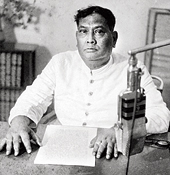
FazlulHuqMPOs29aug2014

The significance of the year 1937 as a major milestone in the colonial history of India is often either brushed aside or missed altogether. The British parliament had, a couple of years ago, passed the new Government of India Act promising Indians limited self-governance and suggesting a federal structure of administration for the Indian empire. Provincial elections were ordered in 1937 all over ‘British India’ so that people’s representatives, though elected on the basis of restricted franchise, could still wield some power. The Indian National Congress, despite its reservations over the provision of the act, participated in the polls and, as was only to be expected, had a cakewalk victory in most of the ‘general’ constituencies everywhere; it also succeeded in electing its candidates from an impressive number of constituencies reserved for the scheduled castes and tribes. The All India Muslim League, presided over by Mohammed Ali Jinnah, did much below its expectations. Even in the provinces where Muslims constituted a clear majority of the electorate, its performance was none too impressive. In Punjab, it was defeated by the Unionist Party put together by Sikander Hyat Khan, representing the landowning interests, who became the prime minister (this was the nomenclature used in the 1935 Act) of the province. In Bengal, A.K. Fazlul Huq’s Krishak Praja Party prevailed over the League in a majority of the constituencies reserved for the Muslim community. His party lacked an overall majority in the provincial assembly; it nonetheless emerged as the largest single party. The Indian National Congress claimed the second place, the Muslim League was a not too impressive third. In Sind, it was a rag-bag coalition of regional parties which formed the provincial government, the Muslim League was isolated. In the North-West Frontier Province, given the popularity of Khan Abdul Gaffar Khan and his brother, Khan Sahib, the Congress did tremendously well; it won seats which fell short of a majority by just one; the Muslim League failed in its mission to capture the province. It was only the Indian National Congress in the rest of the country, including the United Provinces, the Central Provinces, Bihar, Assam, Orissa, as well as the Madras and Bombay Presidencies.

Jawaharlal Nehru was the Congress’s president that year. At his direction, the Congress set down two conditions for joining a coalition with others for forming a government in a province where it would be unable to form a ministry on its own: (a) the Congress would not enter into alliance with any ‘communal party’ and (b) even where it chose to form a coalition with another party to form the government in any province, the prime minister must be only from the Congress; it would supposedly be demeaning for the great national party to take orders from a prime minister who belonged to a nondescript political formation.

What was ironical was that in its anxiety to keep the Muslim League out of power in the NWFP, the Congress did not hesitate to breach immediately the first of these conditions and agreed to accommodate the sole Hindu Mahasabha legislator in the state assembly, Mehr Chand Khanna, in the ministry it formed. When it came to Bengal, the party’s high command, so-called, was adamant in sticking to principles. Fazlul Huq, having successfully snubbed the Muslim League in the just-held polls, was most reluctant to have any truck with the League and was keen to have the Congress as his partner. He sent a formal proposal to the Congress authorities inviting the party to form a coalition with the KPP and join the ministry he would form as the province’s prime minister. Sarat Chandra Bose, elected leader of the Congress in the Bengal assembly, was eager to respond affirmatively to Fazlul Huq’s invitation. His request to do so was contemptuously turned down by the high command. Poor Fazlul Huq had no alternative but to approach his erstwhile sworn enemy, the League, to join his ministry. The League responded with great alacrity; the KPP-Muslim League coalition regime took charge of the provincial administration in Bengal. The course of history changed in Bengal from that point onwards.

Fazlul Huq’s KPP had a clear-cut programme to protect the interests of the rural masses. Once installed in office, Fazlul Huq wasted no time in implementing the pledged promises to relieve the peasantry of the burden of unbridled exploitation by big landlords and loan sharks. A legislation imposed ceilings on land cess charged by intermediaries. Of far greater relevance was the introduction of a separate legislation concerning rural indebtedness. It either considerably reduced or even squashed altogether the burden of land cess charged by intermediaries in the recovery of past loans. Fazlul Huq did not quite stop here. He decided to set up a commission — the Floud Commission — to introduce major land reform all over the province. A further measure, perhaps of equal, if not greater, significance, was an order which, taking into account the denominational distribution of the province’s population, reserved 54 per cent of job opportunities in the provincial government henceforth for members of the Muslim community.

This series of measures had a tremendous impact on all sections of the Muslims in Bengal whose support for Fazlul Huq soared. The reaction of Hindus and the Indian National Congress was, perhaps not totally surprisingly, to the contrary. The prospect of losing the opportunity of making easy money by increasing exploitation of the rural poor disturbed the thinking process of the Hindu gentry and middle-class Hindus; the additional, very real, possibility of shrinkage in opportunities to enter government service further alienated them from Fazlul Huq and his administration.

Ignoring advice for restraint, the Congress launched a virulent campaign depicting Huq as an arch communalist. It was conveniently forgotten that, barely a couple of years ago, the same Fazlul Huq had made the Congress happy by taming the League in the polls. The news media in Calcutta, both English and Bengali, owned by Hindu fat cats, were full of reports, often concocted, of how much sections of the Hindu community were suffering in different parts of the province under the tyranny unleashed by the coalition government. Fazlul Huq withstood the calamity for a while. He was a man of emotions though. At one point he decided that enough was enough, if he was dubbed communal for being a friend of the poor, he would rather turn into a full-fledged communalist. He liquidated his own party and joined the Muslim League, along with the bulk of the KPP legislators. He, so to say, handed on a platter the crucial province of Bengal, with its huge density of Muslim population, to Mohammed Ali Jinnah.

The rest of the story is well known. Huq was persuaded to move at the League’s annual session in 1940 the resolution demanding the creation of Pakistan. The League reaped what Huq’s KPP had sown in Bengal. Muslim masses all over the country were bowled over by reports of what the League had supposedly done for poverty-stricken Muslims in the eastern province. Their loyalties got swiftly transferred to the League. Jinnah begun to roar like a real lion. Pressure was unbearable on Muslim politicians who till then had kept their distance from the League. Sikander Hyat Khan could read the signs, and capitulated in Punjab and joined the League too. It was the same story in the rest of the country. Only Abdul Gaffar Khan’s NWFP refused to bend all the way.

Since at heart Fazlul Huq, besides abhorring Jinnah’s overwhelming ways, could not reconcile himself to the League’s exceedingly aggressive communal stances, he soon fell out with the League leadership. He tried to form an alternative government in Bengal by parting with the League. Most of his former supporters were, however, no longer with him. Even so, Huq succeeded in scraping together a majority in the provincial assembly with the help of Sarat Chandra Bose, who too had now broken with the Congress following Subhas Chandra Bose’s expulsion. What raised a furore was Huq’s seeking and receiving support from the Hindu Mahasabha leader, Shyama Prasad Mookherjee. This latest move by Fazlul Huq unnerved the British rulers. They had been happy when he merged his party with the Muslim League, which kept the Congress out of power in Bengal. The Congress was turning increasingly hostile. Mahatma Gandhi was threatening to launch the Quit India Movement, and the spreading influence of the League was considered a good antidote by the foreign masters. That apart, the Second World War was reaching a critical stage. Subhas Chandra Bose had disappeared from the country and had surfaced in Berlin. And now his elder brother, Sarat Bose, was Fazlul Huq’s choice for the post of home minister in the new ministry he was proposing to form. This could not be allowed to happen, for the home department handled many sensitive and confidential matters. Sarat Bose was arrested under the Defence of India Act before he could be sworn in. A shaky new ministry anyway took office with Huq as prime minister. It did not last long because of more desertions by his past followers who did not like his associating with Mookherjee. Huq’s self-styled Progressive Coalition government soon collapsed and the Muslim League got back to power. Huq was by now a totally isolated figure; his soliciting the support of the Hindu Mahasabha leader added grist to the anti-Huq propaganda by the League, which succeeded in establishing absolute control over the Muslims in Bengal. It was equally true elsewhere in the country. In the provincial elections held in 1946 after the war was over, barring the NWFP, it was the Muslim League, and only the Muslim League, triumphing in nearly all the constituencies reserved for Muslims. The country got partitioned barely a year later. The League was almost a non-entity in 1937; it could divide the country exactly a decade later.

The Congress could infringe its principles in the NWFP in 1937, but would not do so in Bengal; it instead, made a gift of Fazlul Huq to the Muslim League. This individual, Huq, in that sense played the most important role in settling the destiny of the sub-continent. He is nevertheless a forgotten person as much in India as in Pakistan. What is even more astonishing, his name is barely mentioned these days in Bangladesh too. What remains under layers of oblivion is the fact that the Bangladeshi national ethos was created by the emergence of a self-assured Muslim middle class in Bengal, which in turn was the direct consequence of the measures introduced by Fazlul Huq on assumption of office in 1937. The reforms initiated by Huq emancipated an impressive percentage of the rural as well as urban Muslim masses, offering them opportunities to get educated, provided them with jobs, and thereby created a substantive middle class full of pride and self-confidence. It is this class which, in spite of its mistrust of the Bengali Hindu exploiters, had a deep attachment for their mother tongue, Bengali, in spite of its Hindu roots. The constituents of this class had been shapers of mass opinion in East Pakistan, and have continued in that role in Bangladesh. The national consciousness built around pride for their own language would not accept their mother tongue to be treated with contempt in Pakistan, where they — Bangladeshis — made up the nation’s majority. Resistance grew and grew and was compounded by rising resentment against the oppressive domination of their land and people by West Pakistanis both in civil as well as military administration. The parentage of this Bangladeshi national ethos belongs to Fazlul Huq. History however is habituated to bypass those who create history.

source: http://www.telegraphindia.com / The Telegraph, Calcutta / Front Page> Opinion> Story / Tuesday – August 26th, 2014
Coconut Board of India starts residential training camp for farmers

Raiganj :

With an objective to make the farmers interested for the start of the coconut cultivation, the officials of Coconut Board of India started six days professional and residential training camp for the farmers in the office of Comprehensive Agricultural Development Corporation at Kaliyaganj of North Dinajpur district since today.

Forty farmers including some women from different blocks of the district are receiving this training here.

The Deputy Director of Coconut Board of India Mr Khakan Debnath reportedly inaugurated this training today.

The officials of district horticulture and officials of CADC organized this training.

Deputy Director of Coconut Board of India Mr Khakan Debnath said: Farmers had an idea that sea side was only ideal field for coconut cultivation.

But recently we prepared a high breed coconut plant which is ideal for cultivation in the soil of North Bengal districts.

So we invited the farmers to get training and start coconut cultivation on profession ways in North Dinajpur district.

Such coconut saplings will be available from the office of CADC in Kaliyaganj.

After five years the plant will bear fruit. If the farmers cultivate on the baisis of professional ways ,then government will provide them special subsidy.

The farmers will get atleast Rs 1000 from each tree in a year.

The Horticulture Officer of North Dinajpur Mr Samarendranath Khara said: We are helping the Coconut Board of India to conduct this training for the rise of coconut cultivation in our district.

Through a projector skin they are demonstrating the farmers about the way of nurturing coconut plants.

The farmers are being taught about the using of manure to the trees, its lookafter and the way of climbing the trees with a modern machine. We hope that such camp will create an interest among the farmers for cultivation of coconut in our district.

source: http://www.thestatesman.net / The Statesman / Home> Bengal / Statesman News Service / Raigang – August 25th, 2014

Kolkata Vocalist Gets Pandit Rajguru Award

Dharwad :

Classical singer Padmashri Pt Ajoy Chakraborty of Kolkata has been conferred the Pt Basavaraj Rajguru National Award-2014.

Pt Ajoy Chakraborty
Pt Ajoy Chakraborty

Dr Ravikiran Nakod (tabla) of Dharwad and Apoorva Gokhale of Mumbai (vocal) were honoured with annual youth award given by the Swarsamrat Pt Basavaraj Rajaguru National Memorial Trust here on Monday.
While the national award carries a cash prize of `1 lakh, youth awardees were given `25,000 each.

Deputy Commissioner P Rajendra Cholan presented the awards.

Chakraborty saluted the musicians and artistes of the region and said he was blessed by an award from the land which has produced many luminaries in the field of arts, music and culture.

Later, he enthralled the audience with his vocal rendition in Rag Bhairav. Pt Raghunath Nakod (Tabla) and Dr Panchakshari Hiremath (Harmonium) accompanied him. Apoorva Gokhale and Dr Ravikiran Nakod also performed.

The award ceremony scheduled on August 24, was postponed to Monday following the death of Jnanpith awardee U R Ananthmurthy.

source: http://www.newindianexpress.com / The New Indian Express / Home> States> Karnataka / by Express News Service / August 26th, 2014

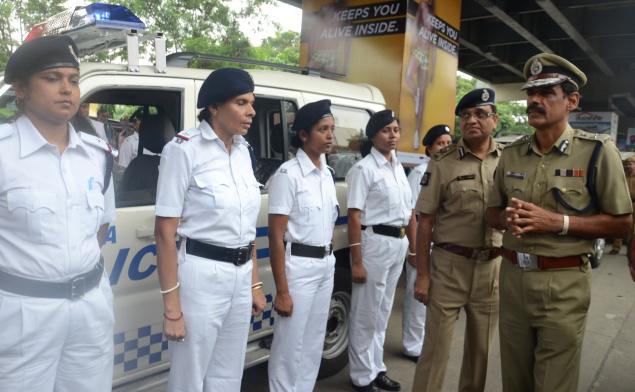
All women police team for making Kolkata safe

Kolkata Police Commissioner inaugurating a mobile police van that will have only women personnel, on Thursday. Photo: Sushanta Patronobish / The Hindu

In an effort to encourage women to approach the police, Kolkata Police Commissioner of Police Surajit Kar Purkayastha on Wednesday inaugurated Reinforce City Patrol, where patrolling vehicles will have only women cops. This comes at a time when a number of sexual assault and rape cases are being reported in the State and city. West Bengal ranked third in the 2013 Crime in India report by the National Crime records Bureau.

Headed by Deputy Commissioner of Police, Women Police, Headquarter, Debasree Roy, three vehicles were launched initially which will be manning three spots in the city — J.L. Nehru Road crossing, south Kolkata’s Rashbihari Road and Akashvani Bhawan in central Kolkata.

The women police personnel will be working in two shifts, from 6.30 a.m. to 12.30 p.m. and from 12.30 p.m. to 8.30 p.m., Ms. Roy said.

source: http://www.thehindu.com / The Hindu / Home> News> Cities> Kolkata / Staff Reporter / Kolkata – August 21st, 2014