All posts by wellnmed@gmail.com

City organization wins US ambassador grant to document folk music

Kolkata :

After seven years, a Kolkata-based organization—Banglanatak.com—has won a prestigious grant from the Ambassador’s Fund for Cultural Preservation (AFCP) 2014 for their project “Documentation of Bengal folk music genres Bhawaiya, Bhatiali, and Bangla Qawwali”. The city chapter of Indian National Trust for Art and Cultural Heritage (Intach) was the last to win the grant in 2007 for restoration of the Lalgola project in Murshidabad.

Announcing the grant award to Banglanatak.com at the American Centre on Friday, director Joanne Joria expressed hope that the documentation of three music genres would help preserve and popularise them again. Musicians of all three genres performed on the occasion.

According to Banglanatak.com founder director Amitabh Bhattacharya, the project will document and preserve folk music traditions—Bhawaiya songs of North Bengal, Bhatiali songs of Sunderbans in South Bengal and Bangla Qawwali of Kolkata, Nadia, and Murshidabad that are fast losing ground to other modern forms of entertainment and being pushed to the point of near extinction.

An initiative by the Bureau of Educational and Cultural Affairs of the US State Department, AFCP supports preservation of cultural sites, cultural objects, and forms of traditional cultural expression in more than 100 countries around the world. AFCP-supported projects include the restoration of ancient and historic buildings, assessment and conservation of rare manuscripts and museum collections, preservation and protection of important archaeological sites, and the documentation of vanishing traditional craft techniques and indigenous languages.

“By taking a leading role in efforts to preserve cultural heritage, the US shows its respect for other cultures,” Joria explained.

The last time a Kolkata organization won this grant was in 2007 when the Indian National Trust for Art and Cultural Heritage (INTACH) won the grant for restoration of the Lalgola project in Murshidabad.

source: http://www.timesofindia.indiatimes.com / The Times of India / Home> City> Kolkata / TNN / October 17th, 2014

For Malala, this West Bengal teenager is a true hero

Anoyara Khatun.— Photo: Sushanta Patronobish / The Hindu

As the world celebrates Pakistani teenager Malala Yousafzai winning the Nobel Peace Prize, Malala herself is celebrating the courage of a little known young girl from West Bengal’s Sandeshkhali area who has been quietly working against the trafficking of young girls from the region.

Anoyara Khatun, 18, from North 24 Parganas, has, with the support of other children and non-governmental organisations, built a strong network to resist trafficking of young girls and prevent child marriages in the region.

“Malala and the Malala Fund celebrate Anoyara’s exemplary courage and leadership. She has helped reunite more than 180 trafficked children with their families, prevented 35 child marriages, rescued 85 children from the clutches of child labour and registered 200 out-of-schools (drop-outs) into schools,” says a Facebook post by the Malalafund, an initiative by Malala.

The post made on October 13, International Day of the Girl, only a few days after Ms. Malala was awarded the Nobel Prize, has described Anoyara as “a true girl hero.”

When The Hindu met Anoyara at Sandeshkhali on Wednesday, she was aware of the Facebook post and could not stop talking about Malala. The first year student of a local college has also collected a number of vernacular newspapers that published news of Ms. Malala’s award and shared it with her friends.

“Though I have not met Malala, I did meet her father Ziauddin Yousafzai at Brussels in June 2012,” she said. She made the trip to Belgium when she was nominated for The International Children’s Peace Prize.

“Trafficking of young girls and child marriages were rampant in the villages here. Poverty and lack of awareness and education provided the ideal conditions for traffickers to operate here,” Ms. Anoyara said.

In 2008, Save the Children, an international non-governmental organisation working for child rights, helped establish a number of multi activity centres in the Sandeshkhali area. These centres help create awareness among the children of the region about the dangers of trafficking and similar crimes. Anoyara recalls stories of how she and others chased away traffickers who came offering jobs and marriage to young girls in the region.

Jatin Mondar, the State Programme Manager of Save the Children, West Bengal said that through these centres, the organisation had managed to put in place a “committee-based child protection model” in Sandeshkhali since 2004.

“Now, if someone approaches the villagers with the proposal to take a girl to Delhi or anywhere else for work, that person is sure to be handed over to the police by us,” Anoyara said.

source: http://www.thehindu.com / The Hindu / Home / by Shiv Sahay Singh / Sandeshkhali (North 24 Parganas) / October 16th, 2014

Kolkata dock system creates record in monthly container handling

Kolkata :

Bharat Kolkata Container Terminals Pvt Ltd, a wholly-owned unit of PSA International is due to commence container handling operation at the Kolkata Dock System (KDS) of Kolkata Port Trust (KoPT) Terminal from December, 2014 and has already started mobilizing equipment. This was announced by KoPT chairman RPS Kahlon.

Officials believe that this will boost KDS’ performance which has already created a record in September. According to Kahlon, KDS handled 50,092 Twenty Feet Equivalent Units (TEUs) containers in September, creating an all time record. The previous highest was monthly handling by this port facility was in August, 2014, when it handled 44,873 TEUs.

“During the first six months of the current financial year, KDS recorded a growth of 7.93% in container handling as compared to the same period of the last fiscal and continued to hold third position among the major ports. Between, April and September, 2014, KDS and Haldia Dock Complex (HDC) combined handled 3,14,440 TEUs as against 2,97,970 TEUs in the corresponding period in the last fiscal. This was a growth of 5.52%,” Kahlon said.

According to officials, this was possible due to the sustained encouragement, faith and support of customers.

source: http://www.timesofindia.indiatimes.com / The Times of India / Home> City> Kolkata / by Jayanta Gupta, TNN / October 14th, 2014

Surgical cure for ‘silent fracture’

Kolkata :

An alarming 45 to 50% Kolkatans in the age group of 55 to 70 suffer from osteoporosis or some form of bone disorder, mentions a survey done by orthopaedics.

For about half of them, the disorder results from loss of bone density and it cripples them within two years.

“Silent fracture” of the vertebral column induced by osteoporosis is a common manifestation of bone disorder that now affects thousands in the city and 25 million across the country.

However, there is some ray of hope as a new form of treatment has emerged over the last few years to treat bone compression fractures effectively, say experts.

Balloon kyphoplasty is a technique that involves repairing a fractured and compressed bone with a balloon that’s inserted into the vertebral fracture.

It helps to restore the bone in its original position, thereby curing the resultant stoop caused by a curved spine.

The effect, according to doctors, is a long-lasting one and has helped patients improve their quality of life.

“Bone degeneration starts from the age of 45 and it gets very acute in some people. Loss of bone density leads to osteoporosis, often resulting in fracture of the spine. Once that happens, the spine gets curved, leading to a stoop that restricts movement. Balloon kyphoplasty is the only way of repairing a fracture-induced curve. But, it is used only in those who are in intense pain and have a severe stoop,” said Abrar Ahmed, orthopaedic su-rgeon at Apollo Gleneagles Hospital.

The surgical procedure is a simple one and the recovery time is just about two hours.

A small hole is drilled on the skin near the position of the vertebral fracture. A needle with the balloon is inserted into the fracture to lift up the bone to its normal height, thereby restoring the curve.

The balloon is then taken out with the needle and the gap is filled up with a fluid. The patient can walk within two hours of the surgery. Balloon kyphoplasty is also effective in trauma-induced spinal fractures.

“It works well for trauma patients with spinal fractures,” said Sisir Mandal, another rorthopaedic surgeon.

Experts said a simple bone mass density (BMD) test could help prevent bone compression and spinal fractures. “Those above 50 years of age, people who have been taking steroids for a long time and those with a history of bone injury or illness should undergo the test. BMD helps assess bone health and works as an alert for making pharmacological and lifestyle interventions to restore it timely. It could help to curb at least half of the spinal disorders including fractures. But, very few undergo the test on time,” said Ahmed.

The surgery is expensive, though. It costs Rs 2 lakh and is recommended only when all other forms of treatment are ruled out.

A healthy diet and a regular, active lifestyle help to slow down bone degeneration, said experts.

“Over the last decade, we have seen a major shift in lifestyle and food habits that has affected bone health. Sadly, awareness about bone diseases is among the lowest. This is probably why we have seen a spurt in the number of osteoporosis patients,” said Debashish Basu, preventive medicine expert.

Ahmed said balloon kyphoplasty was among the “safest and most advanced surgeries” of modern times.

source: http://www.timesofindia.indiatimes.com / The Times of India / Home> City> Kolkata / TNN / October 13th, 2014

ISL Tour Diary: Kolkata, a city that offers something new every time

Kolkata is known for its love for the game of football. (Photo: Shubasish Dutta)

Being a Probashi Bengali (a non-resident Bengali), my affair with Kolkata is a long-standing one. Born to parents who were originally from Kolkata, I have been brought up in Delhi all my life. I always had a strange feeling whenever I visited the city, predominately because of the culture difference. While I was growing up, I have always seen Kolkata as an outsider, without having a chance to feel the soul, the spirit of the city.

But each time I had been there, the city gave me a sense of belonging, offered me something new to take back. The City of Joy, as it is affectionately called, does something to you which cannot be upturned. Every time I have travelled to this city, it left an everlasting impression on me as a person.

My latest trip to the city was an official one, for two days, to cover the inaugural game of the Indian Super League (ISL) – the new hope of Indian football. I have always heard of the city’s madness for football but it was only this time that I had the opportunity to witness it from close quarters.

The city is crazy about football

The people of Kolkata force you to rethink the definition of passion. The zeal with which they follow their game is probably something I haven’t seen before. Wherever you go, from a narrow lane in north Kolkata to swanky grounds of the south, you would see a bunch of kids playing football. A day before the match I planned to travel around the stadium and see the buzz generated by the ISL in the city. It was a rainy afternoon, drizzling to be precise, and I saw people unmoved from their queues, standing undeterred in front of the ticket counters at the iconic Salt Lake Stadium.

From school kids to senior citizens, everybody braved the rain to get their ticket. If this was not enough, then on the match day when I checked out of my hotel to reach the stadium, a journey of not more than 10 minutes took an hour to complete. Hoards of people were charging towards the stadium entrance giving the traffic police a nightmare. It wasn’t a Kolkata derby clash but people here just love the game. The stadium was jam-packed with sixty thousand plus attendance. The crowd made Mexican wave on every good move by the home team Atletico de Kolkata, which eventually won 3-0 against Mumbai City FC. If you want to watch football, Kolkata is the place for you. The city’s passion for the game is second to none.

An unplanned visit to Syed Rahim Nabi’s home

It happened to be that I went to attend a lunch invite to one of my relatives living in Howrah. In the middle of a lunch-table conversation, when I disclosed my purpose of visiting the city, my uncle quickly rose up and with an animated face, said: “Nabi lives near our house! Yes, footballer Nabi lives a few blocks away.” And suddenly all my focus shifted from the delicious lunch cooked by my aunt to Nabi’s house. So quickly after finishing the food (leaving the table without finishing the food is a sin in Kolkata), I went to check out Mumbai City FC captain’s house.

But the visit left us disappointed when we realised that nobody was at home. However, I was left flabbergasted with the modesty of Nabi’s home. It was a simple three-storey building located in one of the narrow lanes of Howrah. For a person unfamiliar with the locality, it was not until I saw the sign board that I realised that I am standing in front of Nabi’s home. It speaks a volume about Nabi’s character and the hardship behind his success.

The Maidan Area – home of the legends

If you are in Kolkata and the purpose of the visit is football, then a visit to the Maidan area is a must. The name of the area struck me at first when I heard it but when I reached there I realised why it is called the Maidan area, mostly because of the gigantic grounds. The place is home to three of the most legendary football clubs in the country – Mohun Bagan, East Bengal and Mohammedan Sporting.
These clubs have so far ruled over the city, creating a divide in the fan base. Not just these, many more city football clubs are located in the area, which is maintained by the Army. There’s also a statue of Gostha Pal, which grabbed my attention. Pal is considered one of the most celebrated and gifted defenders the country has ever produced. A Mohun Bagan legend, Pal was nicknamed “The Great Wall of China” for his great defensive skills. He was the first Indian footballer to be honoured with the Padma Shri award.

Incidentally, my fascination towards the Maidan area didn’t end here. It is also home to the Mecca of Indian Cricket – The Eden Gardens. And even on a tour to cover football, I couldn’t resist but to quickly grab a few clicks of the legendary stadium.

source: http://www.ibnlive.in.com / IBN Live / Home> Football Next> News / by Subhasish Dutta, IBN Live Sports / October 14th, 2014

UK minister’s city date with WW I, football & museum

Sajid Javid, Britain’s culture minister and one of the rising stars of British politics, is to set foot in Calcutta on Monday.

Javid, 44, whose formal title is Secretary of State for Culture, Media and Sport and who is a full member of David Cameron’s cabinet, was the subject of a very positive profile last month in the Daily Mail.

The paper’s right-wing columnists normally make a living by putting the boot into immigrants but for Javid, the long headline read: “Could Sajid Javid be Britain’s first Asian Prime Minister? His parents arrived here with just £1, yet he’s now a minister. That’s why this man believes immigrants are natural Tories?”

JavidKOLKATA13oct2014

So who is Sajid Javid and what’s he doing in Calcutta?

Javid will have a busy day in Calcutta where he will host a reception. The day will begin early with a First World War Centenary Commemoration at the Commonwealth War Graves Cemetery. More than a million Indian soldiers fought for Britain in the First World War.

This will be followed with the launch of the community football development programme for girls under the Premier Skills Kolkata Goalz Project at Alipore Bodyguard Lines on Diamond Harbour Road.

He will then introduce the UK-India joint report at the Museums Round Table at the National Library.

For many years now, the British have been training staff in Indian museums. Privately, they say that Indian Museum is a wonderful place but it badly needs sorting out.

For the second part of his visit, Javid will go to Delhi where he will deliver a keynote speech at a UK-funded Cyber Governance Security conference; meet a number of ministers; and also attend a session at the British Council with young Indian creative entrepreneurs and Indians who have studied in the UK.

As culture secretary, he is chairman of the special advisory group supervising the erection of a statue of Mahatma Gandhi in Parliament Square, ready for unveiling on January 30, 2015.

A first-time member of parliament, elected in May 2010, Javid’s political rise has been swift.

After stints in the treasury as economic secretary and financial secretary, David Cameron brought him into the cabinet in April 2014.

He had previously been a banker for 18 years, working in senior positions in New York for Chase Manhattan, and later in Singapore for Deutsche Bank.

Javid’s father, Abdul-Ghani Javid, and mother, Zubaida, came to Rochdale in the north of England in the early 1960s from a village background in Punjab in Pakistan. The couple had five sons — Sajid is the third.

Abdul-Ghani initially worked in a cotton mill, then moved to the buses, first as a conductor and then a driver. By the time the family moved to Bristol, he had started a business in women’s clothes, with Zubaida doing the cutting and stitching at home.

Unlike P.G. Wodehouse’s creation, the bully Roderick Spode, 7th Earl of Sidcup, whose guilty secret (rumbled by Jeeves) was his ownership of a firm dealing in ladies’ lingerie, the culture secretary is quite happy to poke fun at himself: “I think it’s fair to say that I know more about ladies’ clothing than any other male MP!”

Abdul-Ghani, who died of cancer two years ago, planted the seeds of his son’s political thinking.

In the “winter of discontent” in 1978, when rubbish was not being cleared and even bodies were piling up in mortuaries because of trade union unrest, his father saw hope in Margaret Thatcher.

“She will be good for the country,” Abdul-Ghani told his son, then nine. “She’s got steel. She’s the one who is going to sort out the country.”

“And, of course, she did,” asserted Javid, who keeps a portrait of the late Lady Thatcher behind his office desk.

As culture secretary, his mission is to make enjoyment of cultural activities accessible to everyone in society — “I believe that culture is for everyone.”

Not just the ethnic minorities but the poorer sections of society, too, may feel they have now got a champion in Javid who added with quiet determination: “And when I say everyone – I really do mean everyone.”

Javid himself has a quality not always obvious among folk from the Indian sub-continent — he does self-deprecation.

“Self-deprecation is a good thing,” he grinned, looking completely relaxed in his 6th floor office on Parliament Street. “Don’t take yourself too seriously.”

When he addressed the most powerful and somewhat precious men and women in television at the Royal Television Society in September, he disarmed everyone by recalling his school days: “If life had taken a different turn I could have been part of the TV industry myself. My careers adviser at school told me I had a bright future working in television.”

He got the timing right with a little pause.

Then came the punch line: “Delivering them at Radio Rentals for repair.”

source: http://www.telegraphindia.com / The Telegraph, Calcutta / Front Page> Calcutta> Story / by Amit Roy in London / Monday – October 13th, 2014
Kolkata’s ‘Hangwoman’ creates a buzz in the literary world

Kolkata :

The country’s first and only woman executioner lives in Kolkata — well, if not in reality, at least in K R Meera’s fictional novel ‘Hangwoman’. Meera was honoured with the prestigious Vayalar Award in Kerala for the novel.

The Vayalar Award, instituted in 1977 in the memory of poet Vayalar Ramavarma, recognizes the best literary work in Malayalam every year.

The idea of placing her protagonist Chetna Grddha Mullick in a Kolkata family came to the journalist-turned-author as the city, at the time of finishing her novel, was where the last hanging had taken place in India. The author, though, is emphatic in clarifying that her plot has nothing to do with any person living or dead.

“I wanted to write about women and their empowerment in our country. All my characters are fictional and have nothing to do with any person living or dead. In my story, Mullik is not only a common name, but Mallika means jasmine in both Bengali and Malayalam. I had written the story in a serialized fashion for my Malayali reader as I had no inkling then that this would be translated,” the author told TOI.

Chetna grew up in a poverty-stricken family near a crematorium, fed on stories of her lineage that predates even Christ.

In due course of time, she is appointed as the successor to her hangman father and later, finds herself under the glare of TV cameras and lights. She fights her inner turmoil till she breaks out and turns into a genuine role model. The story was published in a serialized form in a Malayali magazine before being published as the book, ‘Aarachar’. In July 2014, ‘Hangwoman’, translated by Malayali hisotiran and social critic J Devika, hit the stands.

When managing editor of Penguin Books, India, R Shivapriya spotted the story, she sniffed a potential bestseller.

“The first chapter of the book was translated and printed on a magazine. When I read it, I knew instantly that this had huge potential. So I approached Meera, who we have published earlier. She was delighted and immediately gave her nod to be translated,” said Shivapriya.

“Meera’s first visit to Kolkata was when she was on her way to Jamshedpur in 1999 to receive a journalism award. But after she decided on the plot, she again went to Kolkata and visited many locations unique but typical to the city.”

“Many readers from Bengal have congratulated me. With its immense history and cultural heritage, I’m glad I was able to capture the essence of the city, though it was originally meant for Malayali readers,” said the author.

Penguin’s senior sales manager (eastern region) Pinaki Sarkar said: “The book is selling well. There have been repeat orders as well.”

source: http://www.timesofindia.indiatimes.com / The Times of India / Home> City> Kolkata / TNN / October 13th, 2014

Darjeeling harbours a trove of springtails

A species of springtails, Isotomurus balbeatus, commonly found in the soil in Darjeeling. PHOTO: SPECIAL ARRANGEMENT

In the forested foothills of Sukna in the Kurseong subdivision alone, 21 species of springtails are found. The number falls with altitude.

Darjeeling is home to the highest number of species of springtails, a wingless insect that helps in soil formation, in the country.

A recent study by Zoological Survey of India scientists says 32 species of springtails (Collembola), more than 10 per cent of the total found in India, is present in the hill district of north West Bengal.

“Springtails play a very important role in soil fertility. Springtails are the only insects that are as important as bacteria and fungi in the breakdown of leaf litter and organic soil formation,” Gurupada Mandal, a scientist who took part in the three-year study, told The Hindu.

In the forested foothills of Sukna in the Kurseong subdivision alone, 21 species of springtails are found. The number falls with altitude.

“We have conducted surveys in different part of the country, including the Northeast, and have found springtails there as well, but never such a high concentration of so many species as in Darjeeling,” Mr. Mandal says.

The soil too becomes rich, providing enormous scope for cultivation of various crops. It is an indication of rich biodiversity, the scientists say.

ZSI Director K. Venkataraman said springtails were a unique kind of insect, which, by using binoculars, could be seen to jump on the soil surface.

They were tiny with sizes varying from 0.25 mm to 6 mm, barely seen with naked eyes.

“While we have considerable information on winged insects, not much is known about non-winged insects such as springtails,” he said.

Beneficial
Usually, people perceive insects as harmful; however, there are insects such as springtails which, are in fact, beneficial for human beings as they circulate nutrients in the soil, Mr. Venkatraman said adding that the country required more such studies.

source: http://www.thehindu.com / The Hindu / Home> News> National> Other States / by Shiv Sahay Singh / Kolkata – October 12th, 2014

British culture secretary Sajid Javid’s visit to focus on museum tie-up

Kolkata :

British culture secretary Sajid Javid will be in the city next week to discuss with representatives of three museums of Kolkata and several from the rest of the country on how to transform them from mere tourist spots to nerve centres of their respective cities.

Javid, who is coming to Kolkata on a two-day visit on Monday, is also likely to meet chief minister Mamata Banerjee and talk about possible areas of collaboration between Britain and Bengal in the sphere of museums and other cultural monuments and heritage structures. The British Deputy High Commission in Kolkata has reportedly sought an appointment with the chief minister on Tuesday for Javid’s visit, but they are yet to receive a confirmation from Nabanna.

The fact that Mamata has cancelled her Sandakphu trip, which had been scheduled around the same time, is significant. Javid is the first person of Asian origin to have entered the British cabinet. Hence, his visit is being considered to be of importance to this subcontinent.

For the past one year, representatives of the British Council have been visiting the best museums of the country to find out how they function. They have also written a report on what should be done to transform the museums to hang-out places of academic interest. The report will be placed at the round table discussion. The suggestions for change and assurance of help in bringing this transformation will also be discussed.

Officials of Indian Museum, Victoria Memorial, National Library and the National Council of Science Museums have been selected for this interaction as prime museums of the country based in Kolkata. The chosen others are Chhatrapati Shivaji Maharaj Vastu Sangrahalaya, Mumbai, Dr Bhau Daji Lad Museum, Mumbai, and Crafts Museum, Delhi.

The research is an opportunity to explore UK-India opportunities and partnerships looking at best practices in collections, policies, strategies, human resources, education programming and audience profiling in Indian and UK museums and galleries,” said a British Council press release.

source: http://www.timesofindia.indiatimes.com / The Times of India / Home> City> Kolkata / by Jhimli Mukherjee Pandey, TNN / Ocotber 11th, 2014

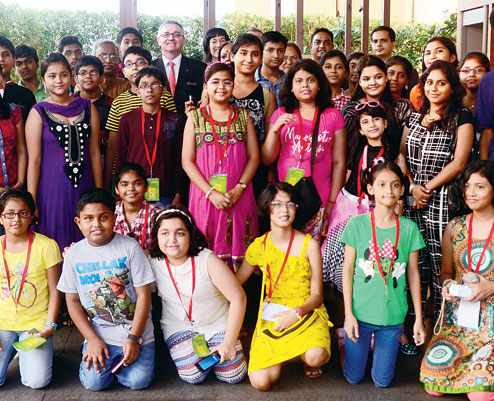
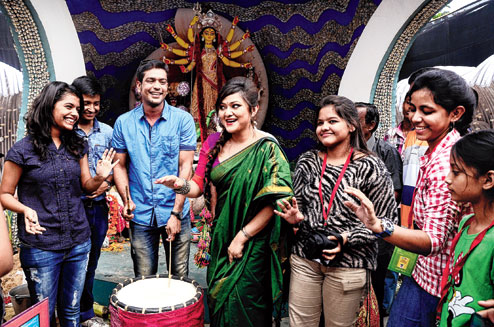
Two stars, forty kids and selfies galore

The young judges with Marco Saxer (centre), general manager of Swissotel. Pictures by B. Halder

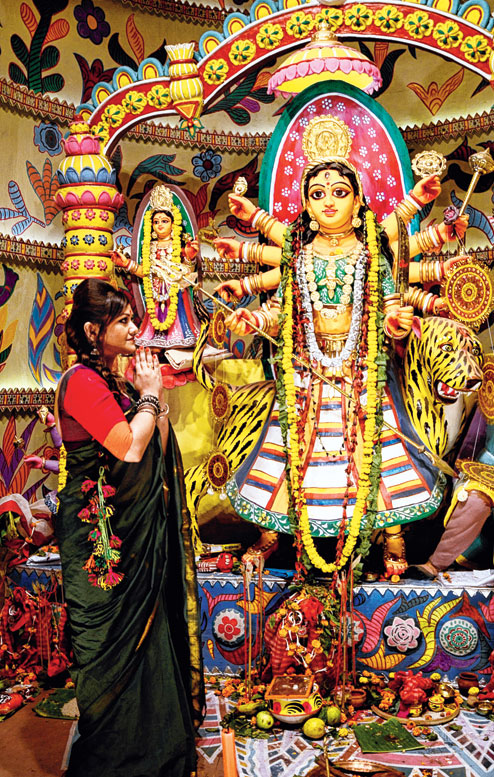
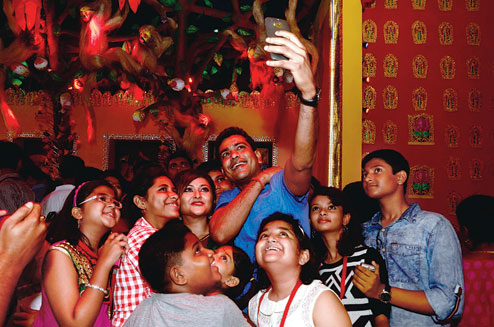
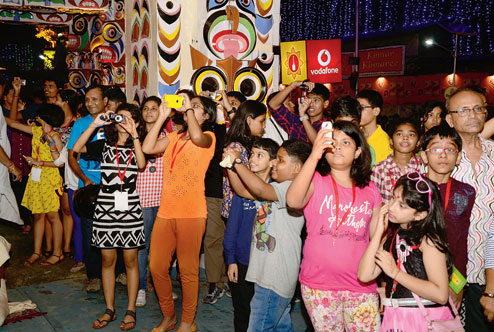
Colourful pandals, innovative idols and the infectious energy of 40 kids made it a special Saptami for Laxmi Ratan Shukla and Koneenica Banerjee. They clicked selfies, played the dhak, danced to its beat and obliged every request of the kids for autographs and pictures in between touring pandals for TTIS Choto Chokhe Boro Pujo, in association with Truly Nolen.

Manicktala Chaltabagan Lohapatty, Best Puja

Last year’s finalist won the hearts of the young judges this year as well. Kids loved the idea of an entire pandal made out of ghee tins. “We have used around 5,000 tins and the designs that you see in the mandap have been cut out from ghee tins as well,” said Ashok Jaiswal, vice-president, Manicktala Chaltabagan Lohapatty puja committee. The recycle effort scored with the children who thought it was an eco-friendly affair. “It’s very colourful and they have used lead-free colours. Their idea was very innovative,” said Riddhi Basu, a Class VII student of Shri Shikshayatan School.

Koneenica loved the play of colours. “It is so vibrant and attractive that everyone will be tempted to walk in. They have also tried to keep it green. That’s not an easy task,” said the actress.

Santoshpur Lake Pally, First runner-up

Koneenica was thrilled to see seashells everywhere as they reminded her of childhood holidays. Santoshpur Lake Pally brought alive the theme Teen Bhaag Jal, Ek Bhaag Lake Pally with sea waves made out of plastic cups and fishes made with seashells. The roar of the sea in the background created the perfect ambience. “We have imported shells from nine countries, as far as Australia and Indonesia,” said Rana Dasgupta, the general secretary of Santoshpur Lake Pally.

Laxmi Ratan felt the pandal had all the right elements to attract children. “The way they have created sea waves using plastic cups is incredible. I am amazed by the decorations and the sand art,” he said before trying his hand at the dhak. Koneenica was quick to keep step as some of the children too joined in.

Ultadanga Sangrami, Second runner-up

This Choto Chokhe Boro Pujo veteran turned lucky this year. The theme Ebhabeo Utsab Hoy was depicted with a fusion of flavours from south Indian festivals. “All south Indian festivals are very colourful and flowers are an integral part of them. So we decorated our pandal with flowers made of water bottles which became a hit with the schoolchildren,” said Joy Saha, media convener of the puja.

Sonket Mukherjee, a Class XII student of Aditya Academy (Senior Secondary), was happy with the use of bio-degradable products. “They used plants, bamboo and jute for decoration and no extra effort is needed to recycle the products used here,” he said.

Santoshpur Lake Pally
Dum Dum Park Tarun Sangha
Vivekananda Sporting Club, Lake Town
Manicktala Chaltabagan Lohapatty
Behala Buroshibtala Jana Kalyan Sangha

Behala Buroshibtala Jana Kalyan Sangha, Best Theme

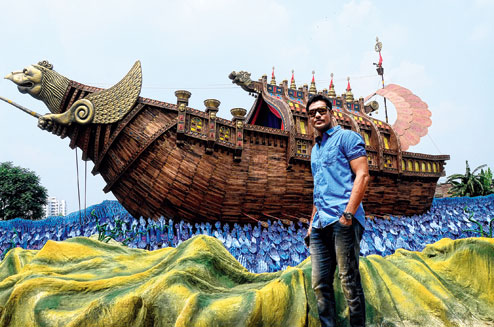
It’s not just Prime Minister Narendra Modi who’s trying to create awareness about the need to clean up Ganga. The message at this puja in Behala was similar. The wooden mandap resembled a massive boat surrounded by several raised hands. “The hands represent Ganga praying to Durga to save her. These hands are also of all those people who depend on Ganga for their livelihood,” said Robin Mondal, the secretary of the puja. The pandal that took five months to build had the children impressed. “I like the way they have worked on Ganga pollution as it is a serious concern. I also liked the idol, there seemed to be intensity in Maa Durga’s eyes,” said Sayantika Das, a Class IX student of Loreto Day School, Sealdah.

The theme, according to Laxmi Ratan, was touching. “We all want a cleaner Ganga and this puja sends out a strong message. I liked the sea of blue hands.”

This puja was also special because the entire team of little judges got to pose for a click with the former India cricketer.

Vivekananda Sporting Club, Lake Town, Best Idol

A lesson in mythology awaited the children and the stars at this Lake Town puja. The idol made out of clay and lead-free colours caught the eye. Yug Adhya, a Class III student of Frank Anthony Public School and the youngest of the judges, thought the goddess here had a gelled hairstyle! The entire story of akal bodhan was depicted here and the kids had Laxmi Ratan impressed with their trivia.

Laxmi Ratan, too, thought it was a good idea to borrow the theme from Indian mythology. “In this age of Chhota Bheem, this is very relevant. It will encourage children to know more about their tradition and mythology.”

For Koneenica, the puja offered a healthy dose of mythology and fun. “Kids are bound to love the monkeys and Ravana. Also, they are getting to know so much about the Ramayan and the beginning of Durga Puja at a time when they are mostly into Harry Potter and Xbox.”

Both Laxmi Ratan and Koneenica dropped in at a stall selling patachitra paintings and artefacts and picked up a fan each.

Dum Dum Park Tarun Sangha, Shrachi Green Earth Award for Greenest Puja in association with Earth Day Network

Haryana came alive at this pandal, where folk art from the state was used to depict Sajimata Utsav. “Just before Holi, women in Haryana make idols out of cow dung, place them on the walls and worship them. We have made these wall sculptures with paper pulp and multani mitti. Our idol is of Sherawali Mata dressed in Haryanvi style,” said Bipul Saha, the joint secretary of Dum Dum Park Tarun Sangha. Anika Chakravarty, a Class VI student of Modern High School for Girls, was so happy that she wanted to give the puja extra points. “I loved it as it was eco-friendly and colourful,” she said.

The colourful folk stories took Koneenica back to Puja holidays and reading pujobarshikis. “This pandal reminded me of that time. Stories always attract children.”

TEXT BY AYAN PAUL, SAMABRITA SEN AND SHWETA KESHRI

source: http://www.telegraphindia.com / The Telegraph, Calcutta / Front Page> Calcutta> Story / Wednesday – October 08th, 2014